
HeyGen vs Higgsfield for Ads: Talking-Avatar Video or a Multi-Model Studio
HeyGen builds an ad around a presenter who says your script and bills per minute of avatar. Higgsfield builds it around a shelf of generation models and bills per clip. Both now run Seedance 2.0. What each does for an ad team, what it costs as of September 17, 2026, and when to use which.

Mauricio Valdivia
·13 min
Start from the spoken line, or from the shot
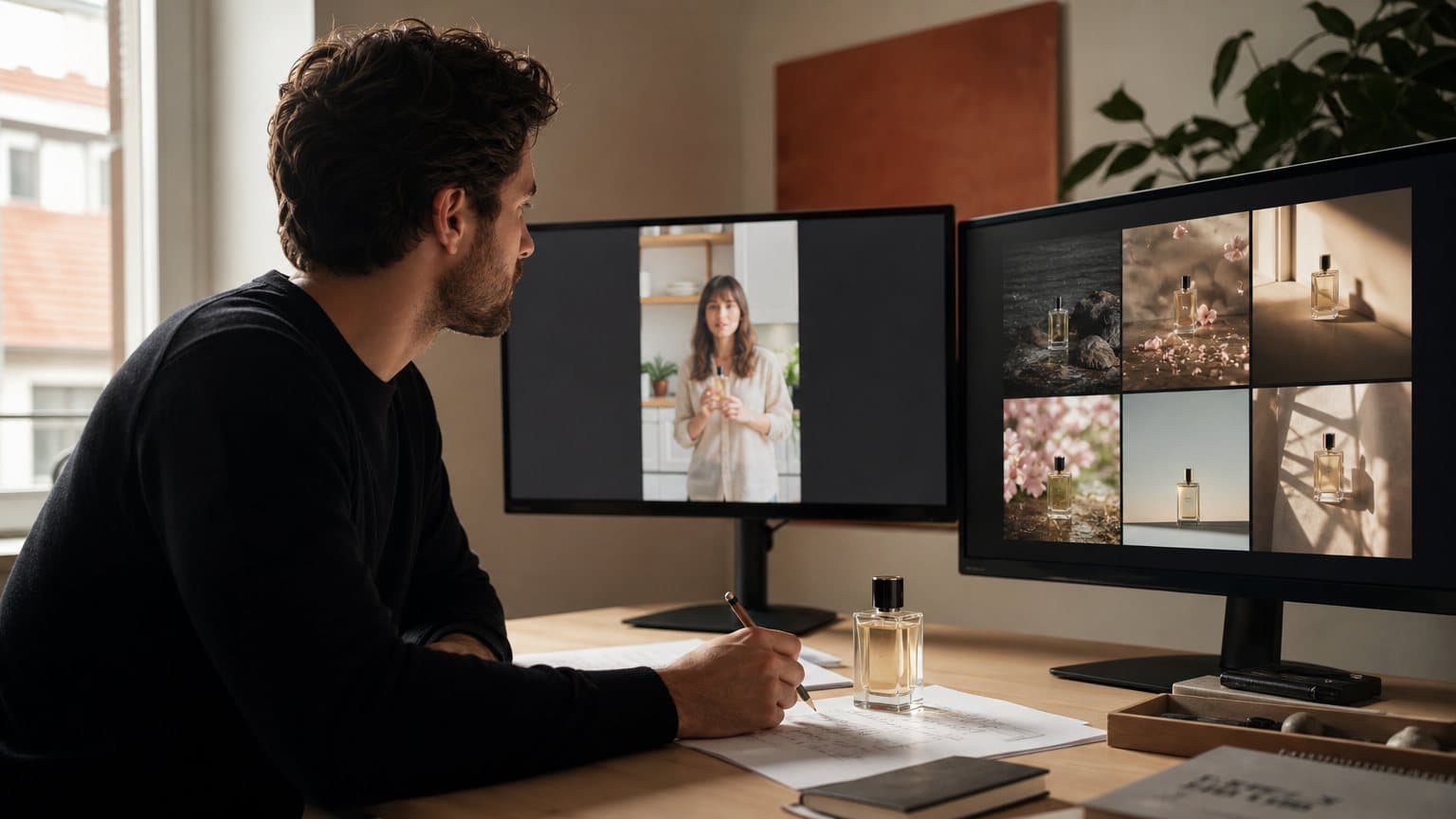
A creative lead at a skincare brand opens Monday with two briefs for one serum launch. The first is a 45-second founder-style explainer. Legal has signed off on every word, and it has to run in English, Spanish and German. The second is six 15-second product clips with nobody in them: a dropper catching light, the texture on skin, the bottle on wet stone. Same product. Two different jobs.
She could push both briefs through HeyGen, or both through Higgsfield, because each tool now reaches both jobs. But each was built from one end. HeyGen started as an avatar studio, where a presenter delivers a script you control, and its Pro plan starts at $49 a month for 1,000 credits. Higgsfield started as a generation studio, where you choose from a shelf of image and video models, and its ad tool, Marketing Studio, caps each generation at 15 seconds. Where a tool started still decides what it does cheaply, what it does well, and what it makes you redo.
A disclosure before going further. We make Novoads, an AI UGC ad generator that competes with both, and we have compared ourselves with each in Novoads vs HeyGen and Novoads vs Higgsfield. This post is about the choice between the two of them. Every price, credit rate and capability below comes from HeyGen's and Higgsfield's own pricing pages, help centers and product pages, read on September 17, 2026. Prices in this category move often, so check that date before a number goes into a budget.
The short answer
If you read one section, read this one.
- Use HeyGen when the ad is a person saying a script you control: testimonials, reviews, founder explainers, anything that must be said word for word and then localized. Presenter minutes are cheap on its own credit table, its paid plans list 175+ languages and dialects, and its videos run up to 30 minutes on Creator and Pro.
- Use Higgsfield when the ad is a shot you want to direct: product motion, CGI packshots, try-ons, cinematic scenes, or many visual directions from one product. It puts many generation models behind one account and one credit balance, and its mid and top plans include Unlimited access to selected models.
- Use both when your week has both kinds of brief. That is a real option rather than a hedge, and the worked example below shows why a split can beat forcing one tool to do everything.
- Treat realism as a tie you test yourself. Both tools run Seedance 2.0 for generated video, and HeyGen's homepage calls its avatars the most lifelike in AI video. A claim on a homepage is not a test. Render your own script on both.
Two products that met in the middle
This comparison exists because each product has grown toward the other. Read their own pages and the overlap is plain, but so is each one's center of gravity.
HeyGen: an avatar studio that added generation models
HeyGen's core is the presenter. Its UGC video generator sums up the workflow as write your script, pick a creator-style presenter, and generate, from a pool of 1,100+ presenters it says are designed to look like everyday creators, not corporate spokespeople. Its newest avatar model, Avatar V, builds a digital twin of a real person from a 15-second video, and HeyGen's homepage says every custom avatar requires on-camera identity verification from the person depicted. Around the presenter sits AI Studio, a text-based editor that HeyGen says works like writing a document.
The generation layer is newer. HeyGen's homepage dates its "Seedance 2.0 is now inside HeyGen" announcement to April 2, 2026. Its help center lists access to the Seedance 2.0 engine among Pro's additions, inside cinematic mode, avatar shots, Video Agent and B-roll creation, and says its asset generator runs on third-party models such as Nano Banana, Recraft, Seedream and Runway. So HeyGen does generate scenes. It generates them in service of a video with a presenter at the center.
Higgsfield: a generation studio that added presenters
Higgsfield runs the other way around. Its site navigation lists video models including Seedance 2.5, Seedance 2.0, Kling 3.0, Veo 3.1 and Wan 2.6, next to image models such as Flux 2 and GPT Image 2. Its help center splits the suite by job:
- Marketing Studio for product ads, UGC videos and campaign assets generated from a single product URL or image, with native lip sync.
- Cinema Studio for cinematic video in a filmmaking environment with camera and lighting control.
- Canvas for chaining multiple models into one visual workflow.
- AI Influencer for building a consistent AI character.
Presenters live inside that suite rather than above it. Marketing Studio offers 40+ ready-to-use avatars or a custom one generated from a text prompt, and its UGC videos come in Faceless, Talking Head and Silent formats. A presenter is one of many things Higgsfield can put in a shot.
The engine they share
One detail settles the realism argument before it starts. Higgsfield says Marketing Studio videos are powered by Seedance 2.0, and HeyGen brought Seedance 2.0 inside its product in April. Novoads runs Seedance 2.0 as well. When three tools rent the same ByteDance engine, generated footage is not what separates them. The product wrapped around the engine is: who controls the script, what a render costs, and what happens when a take comes back wrong.

Who is on camera, and how much of the line you own
For a performance marketer, the presenter question is really a control question. The words are the part legal approves, the part that gets tested, and the part that gets translated.
Presenter libraries and custom faces
Library size favors HeyGen by a wide margin on the vendors' own counts: 1,100+ UGC presenters against Marketing Studio's 40+ ready-to-use avatars. Custom faces are closer. HeyGen's Avatar V starts from a 15-second video of a real, verified person. Higgsfield's Soul ID is trained once on 20 or more photos of one person, up to 80, and after that every ad variation uses the same face automatically. Two practical differences follow:
- Input. A short recording for HeyGen, a photo set for Higgsfield.
- Portability. Higgsfield says a trained Soul ID is not exportable as a standalone file, so that face lives inside Higgsfield.
If you want an invented character rather than a real spokesperson, Higgsfield's text-prompt avatars and its AI Influencer builder are the more natural fit. For a character-first tool set against HeyGen, see our Hedra vs HeyGen comparison. Keeping one face steady across a long test series is a craft problem on either tool, and our notes on consistent AI actors across ad variations cover the parts no setting solves.
Script control and fixing a bad take
This is the sharpest difference between the two, and it comes straight from the vendors' own descriptions.
HeyGen is script-driven. You write or paste the script, and HeyGen says AI Studio lets you direct every word, gesture and emotion through its text-based editor. For Video Agent output, HeyGen says every motion element stays fully editable after generation, so text, color, timing or layout can change without rendering the video again from scratch.
Higgsfield's Marketing Studio is built to decide for you. Its AI Ad Generator page says Marketing Studio writes the script, directs the shots and delivers the final cut. Its help center is candid about the trade: voiceover and pacing in UGC videos can vary by generation, and outside the Posters category results are regenerated, not edited. For an ad whose line is fixed, one wrong word means a new render. Our Higgsfield review walks through those limits in depth.
How long one take can run
- HeyGen: videos up to 30 minutes on Creator and Pro, and up to 60 minutes on Business.
- Higgsfield Marketing Studio: 15 seconds maximum per generation.
- Higgsfield's video tool: Seedance 2.5 generates clips up to 30 seconds, on Pro and Plus plans and above, not on Starter or Basic.
Most hook-and-proof cuts for paid social fit inside that cap. A 45-second testimonial does not, and on a generation tool it becomes several takes stitched together, each with its own delivery. Our Arcads vs Higgsfield comparison works through the same cap for a batch of 30-second hooks.
What the shot itself can be
Now flip the brief. When nobody needs to speak, the multi-model studio has the edge, and HeyGen's answer is narrower but real.
Higgsfield's range across models and modes
Breadth is the reason to choose Higgsfield. Its AI Ad Generator page offers one product three creative directions, running from selfie-style UGC to Hyper Motion, a pure CGI product commercial it describes as having no people and no voiceover, just the product as the hero. Its help center puts the Marketing Studio template library at 1,500+ options organized by task. And because the model picker sits in the same account, a team can move a concept from one engine to another without a second subscription.
Higgsfield's plans article states the catch plainly. Entry-level plans include core generation models, and higher plans unlock every model on the platform, including the latest releases. Price the plan that carries the models you actually intend to use, not the entry plan. Our Runway vs Higgsfield comparison sets that meter against another multi-model studio.
HeyGen's scene tools
HeyGen's scene work centers on getting a product into a presenter video. Its AI Product Placement tool takes a packshot and a scene, can combine a product photo and a face photo into a presenter video, and lets you review the composite before the full render, which is the cheapest place to catch a bad pairing. For footage with no presenter, HeyGen's asset generator makes Seedance 2.0 and Veo 3 clips from the same credit balance. That is plenty for B-roll. It is not a model shelf anyone would choose HeyGen for.

What to check on your own product
Branded products hit rules that demos never do. Higgsfield's help center lists branded product names or logos used as generation subjects among the triggers for its IP block, and HeyGen's verification rule means a custom spokesperson has to verify their identity on camera. Before committing a budget, run the same three checks on each tool:
- Render your real packaging and read the label at phone size.
- Render your hardest line, the one with the brand name and the claim, twice, and compare the two deliveries.
- Time one fix: change a single word and measure what the corrected take costs in credits and minutes.
Localizing and automating a winner
Neither topic usually decides the first purchase. Both decide whether a winning ad can scale.
Translating the line or rendering it again
HeyGen treats translation as a product. Its UGC page says the video translator localizes any video into 175+ languages with lip sync and preserved voice tone, and its credit table prices lip-synced translation at 6 credits per minute in speed mode and 10 in precision mode. For a proven ad the workflow is short: keep the winner, translate it, ship it. Our HeyGen vs Synthesia comparison prices that translation meter against Synthesia's dubbing.
Higgsfield's route is to generate again. Its Seedance help article says the model produces native sound with lip sync in multiple languages, so a Spanish version is a new render with a Spanish line, and the same character carries across separate generations when you save it as an element. That gives each market its own creative freedom. It also makes each language a fresh take whose pacing can drift from the original.
Programmatic access
- HeyGen sells API credits pay-as-you-go, separate from its plans: its help center says you can buy them without a Creator, Pro or Business plan. Its API table lists an Avatar V digital twin at $7.20 per minute, charged by the actual seconds generated.
- Higgsfield connects to Claude, OpenClaw, Hermes Agent and NemoClaw through its MCP server and CLI, and says that surface gives an agent access to 30+ models. Every generation through MCP, CLI, Canvas or other automated tools deducts credits whatever the plan, and its help center says the template-based Marketing Studio is not available through agentic channels yet.
For the developer side of the second tool, our Higgsfield API guide goes endpoint by endpoint.
What each costs, as of September 17, 2026
HeyGen publishes its self-serve ladder on a public page. Higgsfield's help center points to a pricing page for current plan prices, and that page renders in the browser, so we describe Higgsfield's meter and do not print a dollar figure for it.
HeyGen's published ladder
- Free, $0 a month. 3 videos per month, each up to 1 minute.
- Creator, $29 a month. 600 credits, videos up to 30 minutes, 1080p export.
- Pro, starting at $49 a month billed monthly. 1,000 credits and 4K export on the entry tier. Pro scales in credit tiers up to 100,000 credits a month at $4,300, and annual billing lowers the effective monthly rate.
- Business, $149 a month, with extra seats at $20 each. 1,500 credits, videos up to 60 minutes, and extra credits at $0.05 each.
- Enterprise, contact sales.
Unused monthly plan credits roll over for one additional billing cycle. For how HeyGen's per-minute avatar meter compares with a per-ad meter, see HeyGen vs Creatify.
What HeyGen's credit table says about its priorities
The credit table in HeyGen's help center is the most revealing document in this comparison, because it prices HeyGen's own presenters and its hosted third-party models on one page:
| HeyGen feature | Credits |
|---|---|
| Avatar IV, Video Look | 31 per minute |
| Avatar V | 48 per minute |
| Lip-sync translation, speed | 6 per minute |
| Seedance 2.0 clip, 720p | 60 per video |
| Seedance 2.0 clip, 1080p | 150 per video |
| Veo 3 clip | 90 per video |
| Video Agent, Seedance mode | 120 per minute |
Read it as a price list for two businesses. A full minute of Avatar V costs 48 credits, and one 1080p Seedance 2.0 clip costs 150, whatever its length. On HeyGen, presenter minutes are the core product and priced like one. Generated scenes are available, and priced like an add-on.
Higgsfield's meter, without the sticker
Higgsfield documents mechanics instead of numbers:
- Per-generation cost. Credits depend on the model, resolution and duration, and the exact cost is shown on the Generate button before you confirm.
- No rollover. On individual plans, subscription credits reset each billing cycle.
- Model access by tier. Entry plans carry core models, higher plans every model, and Seedance 2.5 is not on Starter or Basic.
- Unlimited models. Mid and top plans include Unlimited access to selected models, on higgsfield.ai only, where those generations run in the standard queue while credit-based ones take the priority queue.
- One published data point. In a blog post dated August 14, 2026, Higgsfield reported that a 15-second UGC video with Seedance 2.5 at 1080p cost 270 credits in its own run, and a 30-second cinematic take cost 540.
Higgsfield has no trial period, and every generation on a free account carries a watermark. To compare credit meters across tools at all, our AI video credits explainer lays out the method.

A worked example: one launch week, two briefs
Back to the serum launch. Here is what each brief costs on the meters the two vendors publish, as of September 17, 2026.
Brief A: a 45-second presenter explainer in three languages.
- On HeyGen, 0.75 minutes of Avatar V at 48 credits a minute is 36 credits. Lip-synced translation into Spanish and German at 6 credits a minute adds about 4.5 credits per language, 9 in all. Total: about 45 credits.
- In dollars, the entry Pro tier sells 1,000 credits for $49, about 4.9 cents a credit, so the brief uses roughly $2.20 of credit value.
- On Higgsfield, Marketing Studio's per-generation cap means the English explainer is at least three generations stitched together, and each language is rendered again. The credit cost of each take shows on the Generate button, and the dollar value of a credit sits on the pricing page.
Brief B: six 15-second product clips at 1080p, nobody on camera.
- On HeyGen, six Seedance 2.0 clips at 150 credits each is 900 credits, about $44 of entry Pro credit value and 90% of that tier's month. At 720p the same six clips are 360 credits.
- On Higgsfield, at the rate in its own published run, six 15-second Seedance 2.5 clips at 1080p come to 1,620 credits. If your plan's Unlimited list covers the model you pick, those generations deduct no credits on the web, in the slower standard queue.
What the math does and does not say. The two vendors' credits are different currencies, and brief B sets Seedance 2.0 on HeyGen against Seedance 2.5 on Higgsfield, so no line above is a like-for-like price. What the numbers show is shape. On HeyGen's own table, brief B costs 20 times the credits of brief A. A team whose week is mostly brief A will find HeyGen's entry plans stretch a long way. A team whose week is mostly brief B pays HeyGen's add-on rates for the job Higgsfield was built around, and should price a Higgsfield plan whose model list and Unlimited access match the engines it actually uses.
Which one fits your ad program
Neither tool wins outright, and a comparison that crowned one would be selling something. The split follows the brief.
Choose HeyGen when:
- Your ads are people talking: testimonials, reviews, founder explainers, walkthroughs.
- Legal approves exact lines, and a one-word fix should be an edit rather than a re-roll.
- A winner has to run in other languages with lip sync.
- A single take has to run long, like a two-minute product walkthrough.
- You want a published price before signing up, and an API without a subscription.
Choose Higgsfield when:
- Your ads are shots: product motion, CGI packshots, try-ons, cinematic scenes.
- You want many models behind one balance and the freedom to switch engines per concept.
- You want the system to write and direct, and you will judge the variations it proposes.
- Your team generates heavily on the web and can live with Unlimited models in the standard queue.
- A consistent invented character matters more than a verified real spokesperson.
If your shortlist runs past two names, our roundup of the best HeyGen alternatives compares seven more tools by the kind of ad each one makes.
Where Novoads fits, with a disclosure
We compete with both tools, which is why there is no Novoads column above and nothing in the verdict depends on us. For completeness, Novoads sits between the two shapes. In Novoads you upload a product image or write a script, pick an AI actor or upload a photo of someone holding your product to make a custom one (a stock talking actor's hands are empty), and get an ad-ready video, and the same account generates video with Seedance 2.0, Seedance 2.0 Mini, Seedance 2.5, Kling v3 Pro, Google Veo 3.1 and Omni Flash. The concessions come first: HeyGen's presenter library and translation workflow are far larger than ours (we market 100+ AI actors), and Higgsfield offers more models and more ad modes. Novoads starts at $49/month (Starter, 50 credits per month), and all plans are published on /pricing. If your ad depends on a creator holding your real product in a short vertical take, Novoads is worth a test beside these two.

Buy the tool that owns the part you redo
Every ad team repeats one part of the work more than the rest. Some teams rewrite lines all week: a hook changes, a claim gets softened, a new market needs its own language. Those teams want a presenter studio, where the line is the thing you edit and the face stays put. Other teams reshoot scenes all week: a new setting, a new angle, a new engine that handles liquid better. Those teams want a generation studio, where the shot is the thing you direct and the engine is a dropdown. HeyGen and Higgsfield each reach the other side now, and they run the same engine underneath, so neither feature list will make the call for you. Price your next launch week brief by brief, the way the example above does, and let the part you redo most choose the tool.
Frequently Asked Questions
What is the main difference between HeyGen and Higgsfield?
Where each product starts. HeyGen is built around a presenter: you write a script, pick one of 1,100+ creator-style presenters or your own verified digital twin, and control the words in a text-based editor. Higgsfield is built around generation models: its site lists video models such as Seedance 2.5, Seedance 2.0, Kling 3.0, Veo 3.1 and Wan 2.6, and its ad tool, Marketing Studio, turns a product URL or image into ads in many styles. Each now reaches the other's job, but the starting point decides what is cheap and what is easy to fix.
Which is better for talking-head UGC ads, HeyGen or Higgsfield?
For ads where a person must say an approved script, HeyGen is the better-shaped tool, as of September 17, 2026. Its presenter library is far larger (1,100+ UGC presenters against Marketing Studio's 40+ ready-to-use avatars), its videos run up to 30 minutes on Creator and Pro, and it describes script-driven editing. Higgsfield's Marketing Studio does make Talking Head UGC videos with native lip sync, but it caps each generation at 15 seconds, says voiceover and pacing can vary by generation, and regenerates rather than edits results outside its Posters category.
Which is better for product shots and cinematic video ads?
Higgsfield. Its ad tool offers modes from selfie-style UGC to Hyper Motion, a pure CGI product commercial with no people and no voiceover, plus a template library it puts at 1,500+ options, and the same account reaches many video and image models. HeyGen can generate scenes too, through Seedance 2.0 and Veo 3 clips and its AI Product Placement tool, but its own credit table prices a 1080p Seedance 2.0 clip at 150 credits, about three minutes of its most expensive avatar model.
How much do HeyGen and Higgsfield cost?
HeyGen publishes its ladder: Free at $0 with 3 videos a month up to 1 minute, Creator at $29 a month for 600 credits, Pro starting at $49 a month billed monthly for 1,000 credits and scaling to 100,000 credits at $4,300, and Business at $149 a month plus $20 per extra seat, as of September 17, 2026. Higgsfield's help center points to its pricing page for current plan prices, and that page renders in the browser, so we do not quote a figure. Its documented meter: credits depend on model, resolution and duration, the cost shows on the Generate button, individual-plan credits reset each cycle, and mid and top plans include Unlimited access to selected models on the web.
Do HeyGen and Higgsfield use the same AI video model?
For generated scenes, partly. HeyGen's homepage dates the integration of Seedance 2.0 into HeyGen to April 2, 2026, and Higgsfield says its Marketing Studio videos are powered by Seedance 2.0, a ByteDance model. Higgsfield also offers Seedance 2.5 and other engines in its model picker. HeyGen's presenters, on the other hand, come from its own avatar models, Avatar IV and Avatar V.
Can I try HeyGen or Higgsfield before paying?
Both have a no-cost tier with tight limits. HeyGen's Free plan lists 3 videos per month, each up to 1 minute. Higgsfield's help center says there is no trial period, that its free tier is limited to a set of models, and that every generation on a free account carries a watermark. Higgsfield refunds an initial purchase within 7 days if no credits have been used, with a service fee of up to 6%.
Key Takeaways
- HeyGen is an avatar studio that added generation models: its center is a presenter delivering a script you control, with 1,100+ creator-style presenters, a text-based editor and lip-synced translation into 175+ languages and dialects. Higgsfield is a generation studio that added presenters: its center is a shelf of image and video models, with Marketing Studio for ads.
- Both run Seedance 2.0 for generated video (HeyGen dates its integration to April 2, 2026; Higgsfield says Marketing Studio videos are powered by it), so realism at the engine layer is a tie. The product around the engine is what differs.
- Control is the sharpest split. HeyGen describes a script-driven editor where a fix does not require rendering again from scratch. Higgsfield's Marketing Studio writes the script, caps each generation at 15 seconds, and regenerates rather than edits outside its Posters category.
- As of September 17, 2026, HeyGen Pro starts at $49 a month billed monthly for 1,000 credits and scales in tiers to 100,000 credits at $4,300. Higgsfield's help center sends buyers to a pricing page that renders in the browser, so we describe its meter rather than print a dollar figure.
- HeyGen's own credit table prices a minute of Avatar V at 48 credits and one 1080p Seedance 2.0 clip at 150, so presenter briefs are cheap there and generated-scene briefs are not. Split your launch week by brief before you pick a tool.