Luma AI vs Runway for Video Ads: What a 5-Second Clip Costs on Each
Luma's Ray3.2 and Runway's Gen-4.5 are both sold by the credit, next to a shelf of rented models. Here is what a 5-second clip costs on each by resolution and plan, what a month buys, and how HDR, agents and editing change the math, as of September 2026.

Mauricio Valdivia
·13 min

The 1080p button quadruples the bill
A growth marketer at an electrolyte drink brand has 30 five-second hooks to test before Friday. She opens Luma's Ray page and reads the Ray3.2 price row. A 5-second clip at 720p costs 100 credits. The same 5 seconds at 1080p costs 400.
Same prompt. Four times the credits.
Then she opens Runway, where Gen-4.5 is quoted per second: "Gen-4.5 uses 12 credits per second of generated video." Runway even does the conversion for her, printing "625 credits monthly = 52s of Gen-4.5" on its Standard plan.
Luma AI and Runway both sell a house video model, Luma's Ray3.2 and Runway's Gen-4.5, next to a shelf of models from other labs, and both bill in credits. So for an ad team, "Luma AI vs Runway" is mostly a question of meters: what a 5-second clip costs at the resolution you will actually run, what a month of credits buys, and what happens to the bill when you switch on HDR or pick a rented model like Seedance 2.0 or Veo 3.1. One disclosure first: Novoads competes in AI video ads and runs some of the same rented engines, so we have a stake. Every Luma and Runway figure below comes from the vendor's own pages, as of September 2026.
Luma or Runway, decided by the job
Neither one wins across the board. They are priced for different habits.
Pick Luma when
- You test cheap and finish only the winners. Ray3.2 prices each resolution separately, from a 20-credit draft to 400 credits for 5 seconds at 1080p, so a 720p test pass costs a quarter of a 1080p one.
- You direct motion inside the shot. Luma says multi-keyframe "lets you set up to 16 keyframes inside a single clip."
- You swap products in footage you already have. The Ray page lists product swap, to "adapt products across campaigns without reshoots or manual editing."
- You want the lower price per house-model clip. Plus is $30 a month, or $300 billed yearly, for 10,000 credits, which works out to $0.30 for a 5-second Ray3.2 clip at 720p.
Pick Runway when
- You want one flat rate per second. Gen-4.5 costs the same 12 credits for every second, so a 10-second clip is exactly twice a 5-second one.
- You edit longer footage. Runway says of Aleph 2.0: "You can now edit clips up to 30 seconds long at 1080p."
- Your cut ends in an Adobe timeline. Runway's changelog entry of September 8, 2026 says "Runway now runs in a panel inside Adobe Premiere Pro and After Effects."
- You rent other labs' models at volume. On Runway's Pro and Max plans, Seedance 2.0 at 1080p costs less per second than on Luma's Plus plan (the math is below).
Edge for low-cost tests on a house model: Luma. Edge for longer edits that end in an Adobe timeline: Runway.
Two house models built for the grading suite
Both companies pitch their own model at studios and post-production, not only at the feed. That shows in what they sell and in what they charge extra for.
Ray3.2 is sold on direction
Luma announced Ray3.2 on June 9, 2026, saying it "was designed in collaboration with creatives from the entertainment, advertising, and gaming industries." The Ray page organizes the pitch around control:
- Multi-keyframe: up to 16 keyframes in one clip, so you set what changes and what holds.
- Modify Video: reshapes footage you already have, "up to 20 seconds, all at 1080p."
- Reframe: "reframe handles every aspect ratio," the step that turns one shot into cuts for different placements.
- Global campaigns: "create market-specific campaign variations without reshoots."
Gen-4.5 is sold on motion
Runway introduced Gen-4.5 on December 1, 2025, and says it "achieves unprecedented physical accuracy and visual precision." The ad-relevant part is how things move: "Objects move with realistic weight, momentum and force. Liquids flow with proper dynamics." In a drinks ad, that is the pour and the splash. Runway also publishes the model's limits, including that "objects may disappear or appear unexpectedly across frames." Budget a retry for any shot where a hand crosses the label, one of the motion tests in our Runway vs Seedance comparison.
If you are weighing more than these two, our Runway alternatives for ad creators roundup compares Runway with six other tools, Luma included.
Both render HDR, and both charge for it
The two house models share one premium tier, and it is priced very differently:
- Luma: Ray3.2 offers HDR generation in "native 16-bit color, generated by the model," plus "16-bit exr frames for color grading, compositing, and vfx." Its price table sets SDR as the base, HDR at 2x the SDR credits, and HDR with EXR at 3x.
- Runway: its API docs say Gen-4.5 "hdr outputs are true hdr renders," and its API pricing adds 20 credits per second for 10-bit and HDR profiles (40 above roughly 4K) on top of the model's rate. Runway's Max plan card lists "Studio-grade quality generations: HDR, ProRes, image sequences."
For a Reels, TikTok or Shorts placement, pay the SDR rate. HDR and EXR earn their price when a colorist grades a TV spot or a brand film, not when a phone plays your hook in a feed.

What a 5-second clip costs at each resolution
Credits only mean something next to a resolution and a length. Here is each house model, row by row.
Luma prices every resolution on its own row
Ray3.2 text-to-video and image-to-video, SDR, from the table on Luma's Ray page:
- Draft (360p): 20 credits for 5 seconds, 60 for 10.
- 540p: 50 credits for 5 seconds, 150 for 10.
- 720p: 100 credits for 5 seconds, 300 for 10.
- 1080p: 400 credits for 5 seconds, 1,200 for 10.
Two patterns matter for ad budgets. Moving from 720p to 1080p multiplies the price by four. And at every resolution a 10-second clip costs three times a 5-second clip, so two 5-second takes cut together cost less than one 10-second take. Luma's pricing page also lists an upscale to 1080p at 10 credits a second, which puts a 720p winner at 1080p for 50 credits more than its 100-credit render, against 400 credits for a native 1080p render. An upscale is not a native render, so judge the result on a phone before you commit a batch to it.
Runway prices Gen-4.5 by the second
Runway's model table lists "Gen-4.5 60 credits/5s," which matches the 12-credits-a-second rate: 60 credits for 5 seconds, 120 for 10. On Runway's developer API, Gen-4.5 text-to-video takes a ratio of 1280:720 or 720:1280 and a duration from 2 to 10 seconds. So the fair Luma comparison is the Ray3.2 720p row, not the 1080p one. Runway's plan cards list 4K upscaling on Standard and "Unlimited 4K video upscaling" on Pro and Max.
Runway's lower-cost house model is Gen-4 Turbo: its Standard card equates 625 credits to "104s of Gen-4 Turbo," twice the seconds of Gen-4.5, and its API lists Gen-4 Turbo as an image-to-video model.
The API price lists put both in dollars
Both companies publish developer prices, which remove the plan math entirely:
- Luma Ray3.2 API, SDR: 5 seconds costs $0.15 at 540p, $0.30 at 720p and $1.20 at 1080p, and 10 seconds costs $0.45, $0.90 and $3.60.
- Runway Gen-4.5 API: "Credits can be purchased for $0.01 per credit," and Gen-4.5 is 12 credits per second, so $0.12 a second: $0.60 for 5 seconds and $1.20 for 10.
At the 720p class, a 5-second Ray3.2 clip lists at $0.30, half the $0.60 of a 5-second Gen-4.5 clip. A native 1080p Ray3.2 clip lists at $1.20, the price of a 10-second Gen-4.5 clip at 720p. At 10 seconds the gap narrows to $0.90 against $1.20, because of Luma's steeper 10-second row.
What a month of credits buys
Plans hide the per-clip price behind a credit allowance. Converting both back to clips shows how far each one goes.
Luma plans, counted in 5-second clips
Luma's plan cards list credits. Dividing them by the Ray3.2 rows, if every credit goes to 5-second SDR clips:
- Plus, $30 a month or $300 billed yearly, 10,000 credits: 100 clips at 720p, or 25 at 1080p.
- Pro, $90 a month or $900 yearly, 40,000 credits and "4x usage with the Luma Agents": 400 at 720p, or 100 at 1080p.
- Ultra, $300 a month or $3,000 yearly, 150,000 credits and "15x usage with the Luma Agents": 1,500 at 720p, or 375 at 1080p.
Runway plans, counted in seconds
Runway prints the seconds on each card:
- Standard, $15 a month or $12 billed annually, 625 credits: 52 seconds of Gen-4.5, about 10 five-second clips.
- Pro, $35 or $28, 2,250 credits: 187 seconds, about 37 five-second clips.
- Max, $95 or $76, 9,500 credits: 791 seconds, about 158 five-second clips.
Runway's FAQ says that "on the Standard and Pro plans, monthly credits don't roll over," while on Max up to one month of unused credits carries into the next. Extra credits come in a minimum purchase of 1,000 and never expire.
A Luma credit and a Runway credit are different units
Comparing 10,000 credits with 625 credits tells you nothing, because a Luma Plus credit costs an eighth of a Runway Standard credit. Divide each plan's price by its credits first.
The per-clip formula: plan price ÷ plan credits × credits per clip = dollars per clip, assuming every credit goes to that clip.
| Plan | Price per month | Price per credit | 5-second house-model clip |
|---|---|---|---|
| Luma Plus | $30 | $0.003 | $0.30 at 720p, $1.20 at 1080p |
| Luma Pro | $90 | about $0.0023 | about $0.23 at 720p |
| Luma Ultra | $300 | $0.002 | $0.20 at 720p |
| Runway Standard | $15 | $0.024 | $1.44 |
| Runway Pro | $35 | about $0.016 | about $0.93 |
| Runway Max | $95 | $0.01 | $0.60 |
Luma Plus lands on exactly its own API price for these clips, while Runway's plans only reach the API rate at Max. Our explainer on AI video credits shows how to turn any vendor's credit price into a cost per finished ad.

The same rented model on two meters
The house-model math is not the whole bill. Luma's pricing table lists Seedance 2.0, Seedance 2.5, Kling 3.0, Veo 3.1, Minimax H3 and Gemini Omni Flash among its video models, and Runway's plan cards list Kling 3.0 and, from Pro up, Seedance 2.5. When a job calls for one of those engines, the ranking can flip. Our Runway vs Higgsfield comparison sets Runway's meter against another multi-model studio's.
Seedance 2.0 at 1080p
- Luma: 240 credits a second at 1080p, with the table's audio column marked Yes. At Plus's credit price that is $0.72 a second, and at Ultra's it is $0.48.
- Runway: its model table lists Seedance 2.0 Pro 1080p at 160 credits per 4 seconds, or 40 credits a second. That is $0.96 a second on Standard, about $0.62 on Pro and $0.40 on Max. Runway's API lists seedance2 at 1080p at the same 40 credits a second, also $0.40.
So Luma Plus beats Runway Standard on this model, Runway Pro and Max beat Luma Plus, and Luma Ultra beats Runway Pro. A 5-second 1080p Seedance 2.0 clip is 1,200 Luma credits, 12% of a Plus month.
Veo 3.1 with sound
- Luma: Veo 3.1 is 140 credits a second without audio and 280 with it, at 720p or 1080p. With audio, a Plus month covers about 35 seconds.
- Runway: its API lists "veo3.1 (audio) 40 credits per second," or $0.40 a second. On the web plans, the comparison table opens on four video rows (Gen-4.5, Aleph 2.0 and two Seedance 2.0 tiers) and puts the rest behind "View more," so expand it and read the Veo 3.1 plan rate there before you budget a batch, and our Runway vs Veo comparison counts each Runway plan in Veo 3.1 clips.
Where the voice comes from
A UGC ad usually talks, so check where the voice comes from before you pick a model. Luma's Ray3.2 FAQ answers "Do generations have native audio?" with a no for text-to-video and image-to-video, and says voiceover, music and sound effects are added as a separate step. That step is inexpensive on both shelves:
- Luma lists ElevenLabs v3 text-to-speech at 21 credits per 1,000 characters.
- Runway lists "Music, voice & sound effects generation" on its Standard card, and its API prices eleven_v3 at 1 credit per 50 characters.
- The expensive path is a model that renders sound in the same pass: Veo 3.1 with audio costs double its silent rate on Luma.
For a cheaper model with sound in the same pass, Luma's table lists Minimax H3 at 28 credits a second at 768p with audio; our MiniMax H3 explainer covers what that model does for ad makers, and our Hailuo alternatives roundup sets it against its rivals on Luma's table. Our Runway vs Kling comparison covers Kling 3.0's native audio, which both shelves carry.
Agents and editing for ad variants
Both companies now sell an agent that plans and generates a batch for you, and an editing model for footage you already have. Both change the bill in ways a price table will not show.
Luma Agents run the brief
Luma's homepage says its agents "research, generate, and refine across video, image, audio, and text," and pitches "paid social variants" and "fifty variants by end of day." Its Luma Agents FAQ, published March 16, 2026, says "a single structured brief can generate coordinated deliverables such as hero images, short-form video ads with audio, and formatted assets for specific platforms." The same FAQ says Luma "handles model selection, parameter configuration, resolution, aspect ratio, and execution logic automatically." For editing, Luma's pricing page lists Ray3.2 video-to-video at 72 credits a second at 720p and 144 at 1080p.
Runway Agent and Aleph 2.0
Runway says its "Agent generates fresh hooks and variations to test on Meta, TikTok, YouTube and more," and that "it chooses the best model for the task automatically." Its changelog dates Agent 2.0, pitched as "Make marketing that drives revenue," to June 25, 2026. For edits, "Edit one frame and Aleph 2.0 modifies the rest of your video to match," with examples that read like an ad brief: "Make the sneakers red," "New background, no reshoot" and "Seasonal versions of your ad." Runway's model table lists Aleph 2.0 at 140 credits per 5 seconds.
An agent that picks the model also picks the price
Here is the trap in both products. On Luma, 5 seconds costs 100 credits on Ray3.2 at 720p and 1,400 credits on Veo 3.1 with audio, and an agent that "handles model selection" can land on either. Pin the model and the resolution yourself for a test batch, where volume multiplies every rate, and let an agent choose for the few finals. Our guide to ad creative testing covers how to read the test before you pay for the finals.
Worked example: 30 hook tests, then 3 finals
Rates only become a budget once you run a real brief through them.
The brief
An electrolyte drink brand wants 30 silent five-second product hooks for Reels: a pour, a stick pack tearing open, a glass fogging up. The three hooks that win get re-rendered as 10-second finals at 1080p or upscaled to it, because a 9:16 cut at 1080 x 1920 fits every network in our video ad specs by platform guide. The voiceover goes in during the edit on either tool. Whether 30 test cells is right for your budget depends on your conversion volume, which our breakdown of how many ad creatives you need shows how to size.
On Luma, with Ray3.2
- Tests at 720p: 30 × 100 credits = 3,000 credits.
- Finals at native 1080p: 3 × 1,200 credits = 3,600 credits.
- Total: 6,600 credits, inside Plus's 10,000, with 3,400 left for retries. On Luma's API the same batch is 30 × $0.30 + 3 × $3.60 = $19.80.
- Lower-cost finish: render the finals at 720p (3 × 300 credits) and upscale them at 10 credits a second (300 credits), for 4,200 credits in total.
On Runway, with Gen-4.5
- Tests: 30 × 60 credits = 1,800 credits.
- Finals: 3 × 120 credits = 360 credits, then upscaled with the plan's 4K upscaling.
- Total: 2,160 credits. That is more than Standard's 625, so the batch needs Pro's 2,250, with 90 credits spare. On Runway's API it is 2,160 × $0.01 = $21.60.
What the arithmetic leaves out
- Retries. Luma Plus still has room for 34 more 720p tests; Runway Pro has room for one more 5-second clip.
- The label check. Runway lists object permanence among Gen-4.5's known limitations, and no price table covers a take you cannot run. Render one shot where a hand crosses the pack on each tool before you commit all 30.
- The talking half. Neither batch includes a voice or captions, and neither puts a person on camera. Budget those steps separately.
On the developer price lists, the batch costs about the same on each: $19.80 against $21.60. On the monthly plans, Luma's $30 Plus covers it with native 1080p finals and room to spare, while Runway needs the $35 Pro and leaves almost none.
How Novoads solves the talking-ad half
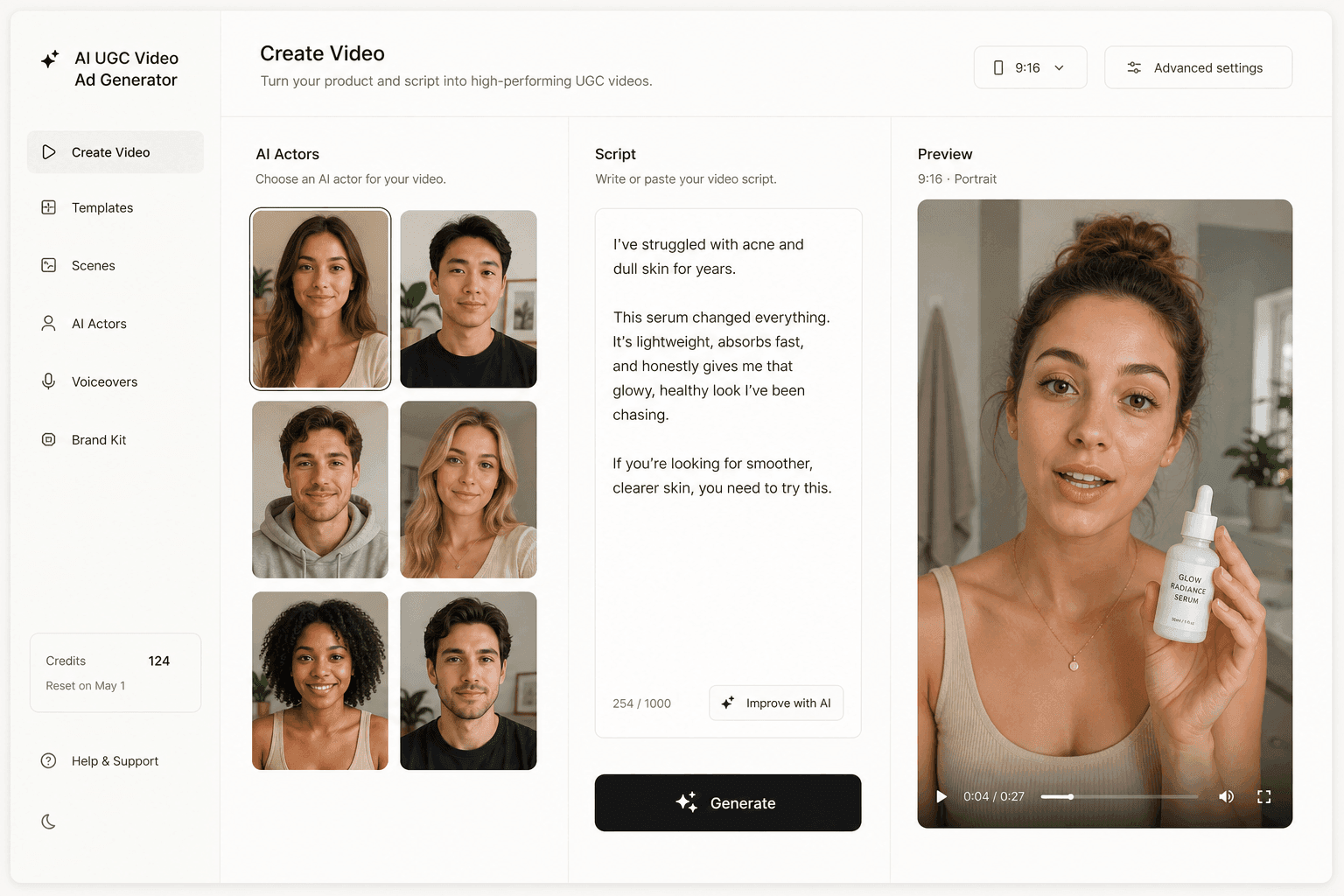
Novoads is a global AI UGC video-ad generator. You upload a product photo, write or auto-generate a script, pick an AI actor and export an ad with voice, lip-sync and captions in 9:16, 1:1 or 16:9. Novoads runs Seedance 2.0, Seedance 2.0 Mini, Seedance 2.5, Kling v3 Pro, Google Veo 3.1 and Omni Flash, the same frontier engines Luma and Runway rent beside their house models. So realism is a tie. The difference is the input and the published price.
What a clip costs in Novoads
- Seedance 2.0 Mini, 5 seconds: 1.5 credits.
- Seedance 2.0, 5 seconds: 3 credits.
- Google Veo 3.1: a flat 10 credits per video.
Novoads starts at $49/month (Starter, 50 credits per month), and all plans are published on /pricing. The worked example's 30 five-second tests, run on Seedance 2.0 Mini, come to 45 credits, which fits inside Starter's 50. A stock actor from the library has empty hands, so to show your product in hand, upload a photo of someone holding it to create a custom actor, or start from a Discover product template, which puts your uploaded product into a template creator's hand.
What Novoads does not do
Novoads does not offer Luma's Ray3.2 or Runway's Gen-4.5 and Aleph 2.0. If the job is 16 keyframes inside one shot, an HDR or EXR master for a grade, or edits to footage you already shot, Luma or Runway is the better tool. If the job is a steady stream of spoken, product-first vertical ads to test, you can start on Novoads and build them from a product photo and a script.
Price the resolution you will run, not the one you admire
Luma and Runway both sell a studio-grade house model and both rent the same frontier engines, so the useful comparison is the meter, not the demo reel. Luma charges steeply for 1080p, 10-second takes and HDR, and very little for a 720p test. Runway charges one rate per second, and on its Pro and Max plans less than Luma Plus for some rented models. Test at 720p, pay for 1080p only on the winners you will actually run, and read the rented-model rate before an agent spends your month for you.
Frequently Asked Questions
Is Luma AI or Runway better for video ads?
It depends on the job. Luma is the lower-cost place to test silent product shots on its own model at 720p, and Ray3.2 adds up to 16 keyframes inside one clip. Runway charges one flat per-second rate for Gen-4.5, edits clips of up to 30 seconds at 1080p with Aleph 2.0, and runs as a panel inside Adobe Premiere Pro and After Effects on paid plans. Both host models from other labs, and on some of those, Runway's higher plans cost less per second than Luma Plus.
How much does Luma AI cost compared with Runway?
As of September 2026, Luma's individual plans are Plus at $30 a month ($300 billed yearly) with 10,000 credits, Pro at $90 ($900 yearly) with 40,000 credits and Ultra at $300 ($3,000 yearly) with 150,000 credits. Runway's paid plans are Standard at $15 a month ($12 a month billed annually) with 625 credits, Pro at $35 ($28) with 2,250 credits and Max at $95 ($76) with 9,500 credits. A Luma credit and a Runway credit buy different amounts, so compare dollars per clip, not credit counts.
How many credits does a Luma Ray3.2 video cost?
Luma's Ray page prices Ray3.2 text-to-video and image-to-video in SDR at 20 credits for a 5-second draft, 50 at 540p, 100 at 720p and 400 at 1080p. The 10-second row is 60, 150, 300 and 1,200 credits. HDR output costs 2x the SDR credits, and HDR with EXR export costs 3x. On Luma's API, the 5-second SDR clip is $0.15 at 540p, $0.30 at 720p and $1.20 at 1080p.
How much does Runway Gen-4.5 cost per second?
Runway says Gen-4.5 uses 12 credits per second of generated video, and its plan table lists it at 60 credits per 5 seconds. On Runway's developer API, credits cost $0.01 each, so Gen-4.5 is $0.12 a second. Runway's Standard plan equates its 625 monthly credits to 52 seconds of Gen-4.5, Pro's 2,250 credits to 187 seconds and Max's 9,500 credits to 791 seconds. HDR and 10-bit output formats add 20 credits a second on the API.
Do Luma and Runway offer the same third-party video models?
Several overlap. Luma's pricing table lists Seedance 2.0, Seedance 2.5, Kling 3.0, Veo 3.1, Minimax H3 and Gemini Omni Flash among its video models. Runway's plan cards list Kling 3.0 and, from Pro up, Seedance 2.5, and its model table lists Seedance 2.0 Pro at 1080p. The same model carries a different price on each shelf: Seedance 2.0 at 1080p is 240 credits a second on Luma and 40 credits a second on Runway.
Can I use Seedance or Veo in Novoads?
Yes. Novoads runs Seedance 2.0, Seedance 2.0 Mini, Seedance 2.5, Kling v3 Pro, Google Veo 3.1 and Omni Flash. A 5-second Seedance 2.0 Mini clip is 1.5 credits, a 5-second Seedance 2.0 clip is 3 credits, and Google Veo 3.1 is a flat 10 credits per video. Novoads starts at $49/month (Starter, 50 credits per month), and all plans are published on /pricing. It does not offer Luma's Ray3.2 or Runway's Gen-4.5.
Key Takeaways
- Luma and Runway both sell a house video model next to models from other labs, billed in credits. Luma's is Ray3.2, released June 9, 2026. Runway's is Gen-4.5, introduced December 1, 2025.
- Luma prices every Ray3.2 resolution on its own row: 20 credits for a 5-second draft, 100 at 720p and 400 at 1080p, and a 10-second clip costs three times a 5-second one. Runway charges Gen-4.5 a flat 12 credits per second, and its API renders Gen-4.5 at 1280:720 or 720:1280.
- On the two developer price lists, a 5-second Ray3.2 clip at 720p is $0.30 and a native 1080p one is $1.20, while Gen-4.5 is $0.12 a second, or $0.60 for 5 seconds. HDR costs 2x the SDR rate on Luma, 3x with EXR, and adds 20 credits a second on Runway's API.
- Credits are not the same unit on the two shelves. Luma Plus is $30 for 10,000 credits, about $0.003 each, while Runway Standard is $15 for 625, about $0.024 each. On rented models such as Seedance 2.0 at 1080p, Runway's Pro and Max plans come out cheaper per second than Luma Plus.
- Novoads competes in AI video ads and does not offer Ray3.2, Gen-4.5 or Aleph 2.0. It runs Seedance 2.0, Seedance 2.0 Mini, Seedance 2.5, Kling v3 Pro, Google Veo 3.1 and Omni Flash for script-led UGC ads, and starts at $49/month (Starter, 50 credits per month).