Best Runway Alternatives for Ad Creators: 6 Tools, Priced Per Second
Runway's entry plan buys 52 seconds of Gen-4.5 a month, by Runway's own arithmetic. Here are six Runway alternatives for ad creators, each with its entry price, the billing basis behind that price, and what one 15-second take draws from the month.

Mauricio Valdivia
·Updated ·16 min

The engine is the same. The meter is not.
The best Runway alternatives for ad creators are the tools that get you to a runnable UGC ad on a meter that suits your testing volume, with less to fix before you spend behind it. Read live on September 19, 2026, Runway's entry paid plan is Standard at $15 a month, or $12 a month billed annually, for 625 credits, and Runway's own pricing page does the arithmetic for you: "625 credits monthly = 52s of Gen-4.5, 104s of Gen-4 Turbo, or 78 Gen-4 Images (1080p)." Its FAQ explains why, in one line: "Gen-4.5 uses 12 credits per second of generated video." A $15 plan is therefore 52 seconds a month of the model you came for.
That is the number this page is built around, because the rest of the field publishes the same kind of number in a different currency, and almost nobody lines them up. Below are six alternatives, each with its entry price, the billing basis behind that price, the meter cell its own site publishes, and what one 15-second take draws from the month. One warning before the list. Leaving Runway often changes the counter rather than the engine, because Runway rents many of the same third-party models everyone else does. Runway's own Standard card lists "Gen-4.5 Kling 3.0 Nano Banana Pro and more", and its Pro and Max cards add Seedance 2.5.
The 6 best Runway alternatives, at a glance
Runway sits at the high-craft end of AI video, with its own Gen-4.5 model, an ad Agent, and third-party engines on its paid plans. The alternatives below win, where they win, on a different meter, a different input, or a narrower job.
- Higgsfield is best for a wide model catalogue with flat passes layered on top of credits.
- Luma is best for keyframed B-roll and agent-made variants.
- Pika is best for the lowest paid entry across many engines.
- invideo is best for a full timeline editor with the models inside it.
- LTX is best for per-second API pricing and weights you can run yourself.
- Novoads is best for script-led UGC ads with an AI actor, on a monthly credit plan.
Every price below carries its billing basis, because a monthly rate and an annual-equivalent rate are not the same number and the field prints them in the same typeface. Runway's Standard card, for instance, shows $15 struck through to $12, and the $12 is a monthly-equivalent rate on an annual commitment, not a cheaper month.
| Tool | Entry plan and basis | Credits included | The meter cell it publishes | One 15-second take | Takes in the entry month |
|---|---|---|---|---|---|
| Runway | Standard, $15/mo monthly or $12/mo billed annually | 625/mo | Gen-4.5, 12 credits per second | 180 credits | 3 |
| Higgsfield | Starter, $15/mo monthly (Seedance 2.5 sits on the $49 plan) | 200/mo, or 1,000 at $49 | Seedance 2.5, 52 credits per 8s at 720p | about 98 credits | about 10 on the $49 plan |
| Luma | Plus, $30/mo monthly or $300 billed yearly | 10,000/mo | Ray3.2 SDR, 100 credits per 5s at 720p | 300 credits | 33 |
| Pika | Starter, $10/mo monthly or $8/mo billed annually | 900/mo | Seedance 2.5, 122 credits per 5s at 720p | 366 credits | 2 |
| invideo | Starter, $20 per seat/mo billed annually | 400 per seat/mo | Seedance 2.0 Fast, about 30 credits per 5s at 720p | about 90 credits | about 4 |
| LTX | No subscription. Billed per second of output | n/a | ltx-2-5-fast at 720p, $0.09 per second | $1.35 | n/a |
| Novoads | Starter, $15/mo monthly | 200/mo | Kling v3 Pro, 30 credits for a 15s clip | 30 credits | 6 |
Credits are not comparable across vendors, and nothing above says a Luma credit is worth a Runway credit. The comparable column is the last one: what share of the entry month one finished take eats. On that column the spread is wide, and it does not track the sticker price at all.

Why an alternative changes the meter, not the model
This is the part most roundups skip, and it is the reason a $15 plan is not a $15 plan. Before you compare tools, notice how much of the field is renting from the same few labs.
The same engines, rented from four different counters
Each of these is the vendor's own published rate, read on September 19, 2026, in the vendor's own currency.
- Runway prices its own models on its pricing page at "Gen-4.5 60 credits/5s", "Aleph 2.0 140 credits/5s", "Seedance 2.0 Pro 1080p 160 credits/4s" and "Seedance 2.0 Fast 116 credits/4s". Its Standard card lists Kling 3.0 among the included models, and Pro and Max add Seedance 2.5.
- Luma prices third-party engines per second in its cost table: Veo 3.1 at 720p with audio at "280 credits/sec", Kling 3.0 at 1080p with audio at "49 credits/sec", Seedance 2.5 at 720p at "78 credits/sec" and Minimax H3 at 768p at "28 credits/sec".
- Pika prices Seedance 2.5 at 720p for 5 seconds at 122 credits and Wan 3.0 at the same length at 33, in the table it labels "What your monthly credits make".
- invideo meters "Seedance 2.0 Fast 720p ~30 credits/5s" and "Seedance 2.5 1080p ~50 credits/5s" in its compare table, and its own site indexes model pages for Google Veo 3.1, Kling AI, Hailuo AI, Wan AI and Seedance.
Four vendors, four currencies, and a large overlap in what is actually generating the pixels. Our Runway versus Kling comparison and Runway versus Seedance go deeper on two of those overlaps, and AI video credits explained shows how to convert any of these meters into dollars per second.
Credits reset, they do not bank
Three of these vendors say so in their own words, which matters more than the allowance itself when your testing is lumpy. Runway's FAQ: "On the Standard and Pro plans, monthly credits don't roll over". Pika's FAQ: "Plan credits refresh each billing period and do not roll over." invideo's FAQ: "Unused credits don't roll over to the next month."
Runway's Max plan is the stated exception, with "Roll over unused credits for 1 month" printed on the card. If your month is one heavy week and three quiet ones, that single line can be worth more than a lower sticker.
One engine you cannot plan a quarter around
Worth knowing before you shop, because Runway, Pika and invideo all sit next to it in the same search results: fal's Sora 2 text-to-video endpoint page, read on September 19, 2026, carries a banner reading "This endpoint will be shut down on September 24, 2026." and, below it, "This model is no longer supported." Whatever you build on a model, check that the door you reach it through is still open. We wrote up the wider picture in Sora 2 shutdown alternatives.
What Runway costs once you price a take
Runway is credit-metered, the plans are public, and annual billing is 20% below the monthly rate. Note that runwayml.com/pricing 308-redirects to runway.com/pricing, so both addresses land on the same card set. These figures were read live on September 19, 2026.
| Plan | Monthly | Billed annually | Credits |
|---|---|---|---|
| Free | $0 | $0 | 125, one-time |
| Standard | $15/mo | $12/mo | 625/mo |
| Pro | $35/mo | $28/mo | 2,250/mo |
| Max | $95/mo | $76/mo | 9,500/mo |
One 15-second take, with the arithmetic showing
Runway's Gen-4.5 rate is 12 credits per second, so a 15-second take is 12 x 15 = 180 credits. Standard's 625 credits therefore cover 625 / 180 = 3 takes a month, with 85 credits stranded, and Runway's minimum top-up is 1,000 credits. Its Pro card carries the same equation at a bigger scale: "2250 credits monthly = 187s of Gen-4.5".
There is a second way to read the same number that is harder to argue with. The compare table prices Gen-4.5 at 60 credits per 5-second generation, so Standard's 625 credits buy exactly ten 5-second clips, 600 credits spent and 25 stranded. Fifty usable seconds, in ten pieces, for $15. That is the honest shape of the entry tier, and it is not a criticism of the model, which is excellent. It is a statement about testing volume.
A third-party engine on Runway costs more per second than Gen-4.5 does. Seedance 2.0 Pro at 1080p is 160 credits per 4 seconds, which is 40 credits a second, so 15 seconds is 600 credits, and five such takes are 3,000 credits, more than a whole Pro month.
The developer meter is a different meter
Runway's API is priced separately from the app, and mixing the two is the easiest mistake to make in this category. On the developer platform, at Runway's API price of $0.01 per credit, a Gen-4.5 second at 12 credits works out to $0.12, and the Product UGC recipe at 720p costs "192 credits for a 4 second video, plus 36 credits per additional second", so a 15-second clip is 192 + (11 x 36) = 588 credits, or $5.88. Those developer rates were verified on September 17, 2026 and not re-fetched today. Do not carry them across to a subscription: a credit inside a plan is bought at the plan's blended rate, not at a dollar a hundred.
The six tools, priced per second
Here is where each one fits, what its own site says it costs, and what to watch for.
1. Higgsfield, best for a wide catalogue with passes on top
Higgsfield sells credits and then sells flat access on top of them, which is an unusual shape in this field and a useful one if your work concentrates on one model. Its own September 15, 2026 guide sets the ladder out: "Starter, $15/mo: 200 credits and the model catalog, without the unlimited set.", "Plus, $49/mo or $39 annual: 1,000 credits", and "Ultra, $129/mo or $99 annual: 3,000 credits". On top of the plans it sells per-model passes, "from $7 for a 1-day pass to $1,035 for a 7-day all-models pass".
One thing the entry price hides. Higgsfield's own Seedance pricing post says "Seedance 2.5 starts on Higgsfield's $49 plan, which carries 1,000 credits.", that "A 720p 8 second clip draws 52 credits, which comes to $2.55 and about 19 clips a month.", and that "Cheaper plans below it do not include the model." So the $15 Starter is a real price, and it is not a price for the model most of this comparison is about. On the $49 plan the arithmetic runs 52 / 8 = 6.5 credits a second, so a 15-second take is about 98 credits and the month holds about ten of them.
A note on how we sourced that. We fetched higgsfield.ai/pricing on September 19, 2026 and it returned HTTP 200 with roughly 380 characters of readable text, navigation chrome only, with no plan cards in the server-rendered HTML. The numbers above therefore come from Higgsfield's own dated blog posts, not from a third party, and we say so rather than presenting a scraped pricing table we could not actually read. Our Runway versus Higgsfield comparison sits alongside this.
- Stands out for: catalogue breadth, flat passes on heavy single-model months.
- Watch for: the entry plan does not carry Seedance 2.5, on Higgsfield's own account.
- Best-fit ad job: a month spent hammering one engine.
2. Luma, best for keyframed B-roll and agent-made variants
Luma's Ray3.2 supports up to 16 keyframes inside a single clip and 1080p across every mode, and Luma Agents research, generate and refine across video, image, audio and text, which it pitches at paid social variants.
The pricing, read live on September 19, 2026: Plus is "$30 /month" or "$300 billed yearly" with "10,000 credits", "Luma and third-party image and video models" and "Commercial use". Above it, Pro is "$90 /month" or "$900 billed yearly". Luma publishes a per-model cost table rather than a single rate, so the meter you actually spend on depends entirely on the model you pick: Ray3.2 SDR at 720p is "100 credits/5 sec", which puts a 15-second take at 3 x 100 = 300 credits and 33 takes inside a Plus month. Switch to Veo 3.1 at 720p with audio, at "280 credits/sec", and the same 15 seconds is 4,200 credits, so a Plus month holds two. That is a 16x swing inside one plan, and the plan card cannot warn you about it.
- Stands out for: 16 keyframes per clip, agent variants, a transparent per-model table.
- Watch for: audio-capable engines drain the month 16x faster than the house model.
- Best-fit ad job: stylish B-roll and variant batches. Luma versus Runway compares the two directly.
3. Pika, best for the lowest paid entry across many engines
Pika is a multi-model creative platform with a Product Ad app among its video apps, and it names ad creatives and marketers among the professionals it serves. Read live on September 19, 2026, its ladder starts at a Free plan with "0 credits / month · packs only" and "Not included: Commercial license", then "Starter 900 credits / month" at "$10" or "$8" a month billed annually, then Creator at "3,150 credits / month" for "$35" or "$28", which is where "Included: Commercial license" first appears.
The meter is published in Pika's own table: Seedance 2.5 at 720p for 5 seconds costs 122 credits, and Pika's own column says Starter buys 7 of those. A 15-second take is 3 x 122 = 366 credits, so Starter's 900 credits hold two of them and Creator's 3,150 hold eight. The line that matters for ads is the license, not the credit: compare engines cheaply on Starter if you like, but anything you intend to run behind spend belongs on Creator. Our Runway versus Pika comparison covers the rest.
- Stands out for: the lowest paid entry in this list, many engines behind it.
- Watch for: the commercial license starts at Creator, not at Starter.
- Best-fit ad job: comparing engines on a small budget before committing.
4. invideo, best for a timeline editor with the models inside
invideo is the one entry here that is an editor first and a generator second, which changes what the credits are for. Read live on September 19, 2026, its Starter plan is "400 credits per seat/mo" at "$20 per seat/mo, billed annually", and the card adds "No difference compared to monthly", which is a straight answer you rarely get on a pricing page. Above it, Plus is "$60" struck to "$50 per seat/mo, billed annually" with 2,000 credits, and Max is "$150" struck to "$101 per seat/mo, billed annually" with 5,000.
invideo's plan finder makes the editor point itself: "the full timeline, multiplayer editing, colour, audio and 3D are on every plan, including starter at $20 a seat. 40 hours of editing costs nothing." The generation meter is separate and published in the compare table, where "Seedance 2.0 Fast 720p ~30 credits/5s" gives Starter 13 videos a month, so a 15-second take is about 3 x 30 = 90 credits and Starter's 400 holds about four. Note the ceiling on the entry seat: the same table marks Seedance 2.5 at 1080p, metered at about 50 credits per 5 seconds, with a cross in the Starter column. For the wider field, see our roundup of invideo alternatives.
- Stands out for: a real timeline, multiplayer editing, per-seat pricing.
- Watch for: the per-seat basis, which multiplies quietly on a team of three.
- Best-fit ad job: assembling generated shots into a finished cut in one place.
5. LTX, best for per-second pricing and weights you can run
LTX is the odd one out and the most honest meter in the list, because there is no plan to reason about. Its documentation states the model plainly: "Video generation is billed per second of output video." The published rates, read live on September 19, 2026, run "ltx-2-5-fast 1280x720 / 720x1280 $0.09 1920x1080 / 1080x1920 $0.13 2560x1440 / 1440x2560 $0.19 3840x2160 / 2160x3840 $0.30", with ltx-2-5-pro at $0.12 and $0.17 for the same first two resolutions.
The arithmetic has no plan in it. A 15-second take at 720p on ltx-2-5-fast is 15 x $0.09 = $1.35, and a 15-second take at 1080p is 15 x $0.13 = $1.95. Nothing expires at the end of the month and nothing is stranded. The second half of the story is the weights: LTX's August 11, 2026 launch post says LTX-2.5 ships "as open weights on Hugging Face", that it "runs on hardware you already own", and that it is "free to use for organizations under $10M in annual recurring revenue". That last clause is the vendor's own summary of its licence on its launch page rather than the licence text, so read the licence before you lean on it. Our LTX-2.5 release write-up has the model detail.
- Stands out for: no subscription, no expiry, published per-second rates, open weights.
- Watch for: it is an API and a model, not an ad workflow. You supply everything around it.
- Best-fit ad job: high-volume B-roll generation inside your own pipeline.
6. Novoads, best for script-led UGC ads on a monthly credit plan
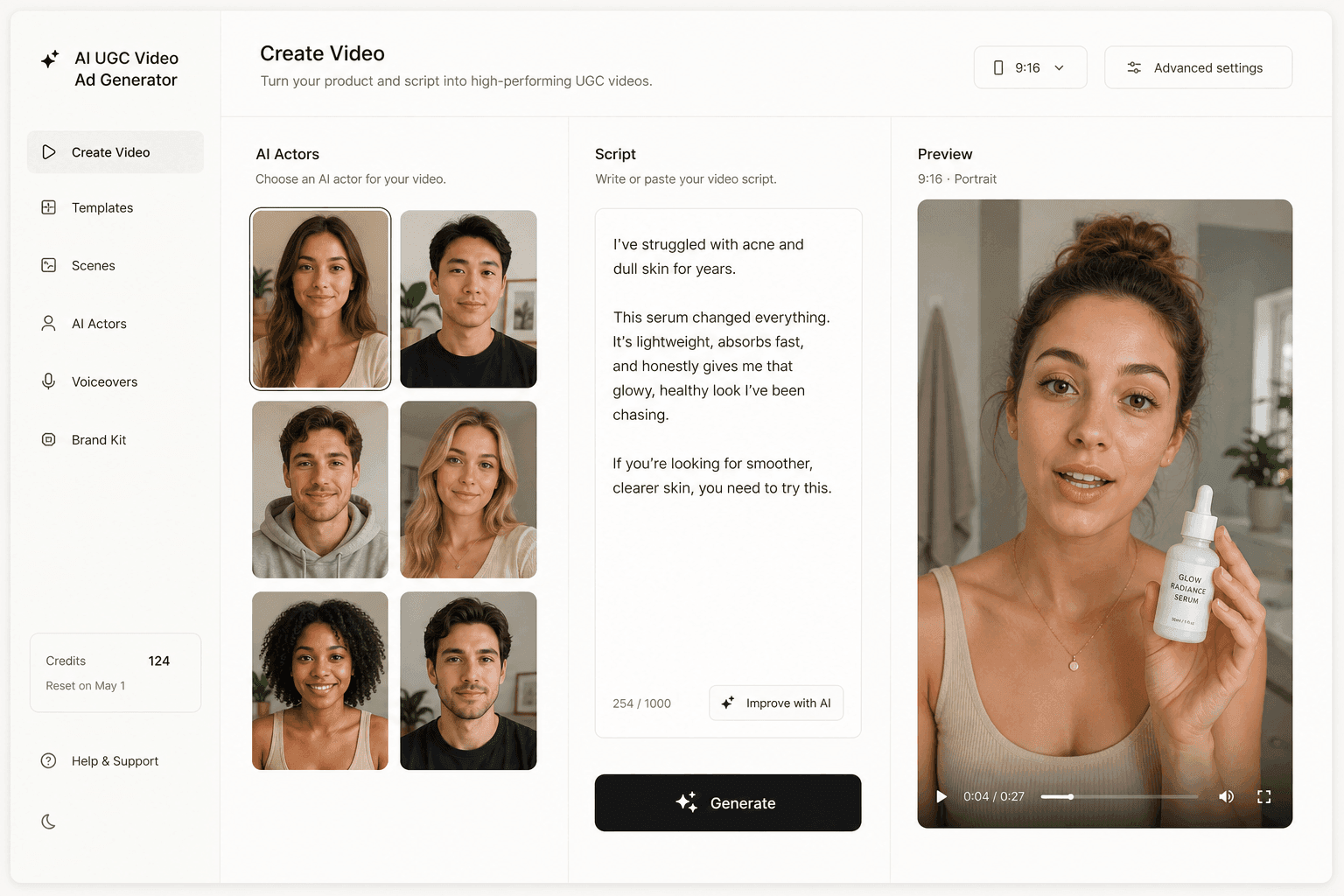
Novoads is built around a script and an AI actor rather than a shot brief. You write or auto-generate a script, pick an AI actor from a library of 100+, and get a vertical UGC ad with voice, lip-sync and captions in about four minutes, sized for TikTok, Reels and Meta. A stock actor's hands are empty. To show the product in hand, you upload a photo of someone holding it to create a custom actor (Create Actor, then Upload: "Transform a picture into a talking actor"), or you use a Discover product template, which swaps your product into a template creator's hand before animating the clip. The engines are the same frontier ones the tools above rent, so realism is a tie; what differs is the input and the meter.
The meter is per clip and published: a 15-second Kling v3 Pro scene is 30 credits, so Starter's 200 credits a month hold six of them, and talking-actor video bills 200 credits per started minute.
- Stands out for: script plus actor, per-clip credit prices published before you render.
- Watch for: no Gen-4.5; product in hand needs a custom actor or a Discover template.
- Best-fit ad job: script-led UGC ads at test volume.
A worked example: one sleep-supplement ad
Say you sell a magnesium sleep supplement and you want a 15-second vertical UGC ad: a tired-at-11pm hook, then a testimonial to camera with the bottle in hand. Here is the same brief on Runway and on a script-led tool.
The brief
- Hook: a person scrolling in bed, unable to sleep.
- Turn: they take the supplement, and the room settles.
- Payoff: a short, believable line to camera holding the bottle.
- Delivery: 9:16, captions, a warm and natural voice, ready for Meta.
The winner among five hooks like this is unpredictable, which is why you want to make several cheaply and test. Five hooks is the unit of work, so price five, never one.
Running it on Runway
On Runway you upload photos of the bottle as references, describe the presenter, the bedroom and the action, and ask Agent for five hook variations in 9:16. The workflow generates the speech in the language you prompt in, and the render quality is among the best available. What stays on you:
- Check that the bottle and its label hold in every frame, especially after a hand covers it. Runway's own Gen-4.5 research lists object permanence as a limitation, with objects that "may disappear or appear unexpectedly across frames (e.g., a cup vanishing after being occluded)."
- Listen to each take's line, and confirm which model Agent used, because the rate changes with it.
- Budget the seconds. Five 15-second Gen-4.5 takes are 5 x 180 = 900 credits, more than a Standard month and a good chunk of Pro's 2,250. On Seedance 2.0 Pro at 1080p the same five takes are 5 x 600 = 3,000 credits, past a whole Pro month.
You end with strong footage, a meter that counts every second, and the review work any generated ad needs.
Running it on a script-led tool
On Novoads the same brief starts from the script: upload the bottle photo, paste the script or auto-generate it, pick an actor whose age, accent and vibe match your audience, and generate a 9:16 ad with a synced voice, lip-sync and captions in about four minutes. For the payoff shot, a stock actor will not do, because its hands are empty: upload a photo of someone holding the bottle to create a custom actor, and that actor delivers the line. To test five hooks, you change five lines of script, not five shot briefs.
The meter is published per clip. Five 15-second Kling v3 Pro hook scenes are 5 x 30 = 150 credits, and talking-actor video bills 200 credits per started minute, so five hooks plus one shared payoff line come to 350 credits, more than Starter's 200 and about a third of Plus's 1,000. The same checks still apply: read the label in every take and listen to every line.

What no meter fixes
None of this is a knock on quality. Every tool here can make the ad. The reasons teams still compare are about what the workflow asks of you, and about what it costs to be wrong.
The presenter and the brief are yours to supply
Runway's UGC page tells you to "describe the presenter, the setting and the action, and generate the video directly." That is a shot brief: you direct a scene rather than cast from a roster. On the API, the Product UGC recipe needs an image of the on-camera creator, and Runway's docs add: "Make sure you have the rights and consent to use any person's likeness as a reference."
For a brand that wants one recognizable face across fifty variations, that likeness has to be cleared once and reused, or generated and held consistent across takes. Our guide to creating ads with AI walks through the rest of the layers, and the roundups of Arcads alternatives and Creatify alternatives cover the AI-actor field specifically.
Every take still needs a product and a language check
Runway tells sellers to "upload photos of your product as references so it stays exactly right (packaging, colors and logo) in every generation." Treat that as the goal of the workflow, not a waiver on review. Before a take runs, check three things:
- The product in every frame. Watch the moment the product passes behind a hand, which is exactly the occlusion case Runway's own research names.
- The spoken line. Speech follows the language of your prompt, so listen to every take for pronunciation and brand names.
- Which model produced it. Runway says Agent "chooses the best model for the task automatically", and rates differ by a factor of three across its own table, so the model choice is also a budget choice.
These checks apply to every tool on this list, Novoads included. What changes from tool to tool is only what a retake costs.
How Novoads solves the script-to-ad job
Novoads is built for the team that wants many spoken UGC variations from a script, in the language its audience speaks, at a price it can read before it renders.
From script and product photo to UGC ad
You write or auto-generate a script, pick an AI actor, and get a vertical ad that arrives finished:
- Voice, lip-sync and captions, ready for sound-off feeds.
- 9:16, 1:1 and 16:9 output in HD, downloadable for any ad platform.
- Voices in 31 languages, so a Spanish or Portuguese ad is spoken, not captioned over an English read.
- Product in hand through a custom actor made from a photo of someone holding your product, or through a Discover product template.
Product-to-Ad also turns an uploaded product image into an ad image, for the static placements that run next to the video.
The same engines on a published meter
The tools above and Novoads rent many of the same frontier engines, so realism is a tie. What differs is the plan around them. Novoads keeps these on one plan:
- Google Veo 3.1 for premium, sound-on cuts.
- Kling v3 Pro for cinematic clips, plus Kling Motion Control to drive a specific performance.
- Seedance 2.0, Seedance 2.0 Mini and Seedance 2.5, from cheap high-volume tests to 30-second takes.
A clip costs from about 25 cents for a five-second Seedance 2.0 Mini clip to about $4 for an eight-second Google Veo 3.1 clip, and about $10 for a full 30-second Seedance 2.5 take. That is the practical answer to model churn: keep the script, swap the engine, and read the cost before you render.
Every tool makes the ad now. Pick the meter.
The best Runway alternative is no longer the one that can make an ad, because Runway can, and so can the five below it. It is the one whose input matches how your team works, a shot brief or a script, and whose meter lets you run enough takes to find the winner. Runway is the visual benchmark and a capable ad workflow for teams that direct scenes and budget by the second, and its entry tier is fifty usable seconds a month of that benchmark. For teams that write scripts, cast AI actors and test hooks by the dozen, a script-led tool is the closer fit. Either way, an ad is finished only when someone has checked the label and heard the line. Novoads starts at $15/month (Starter, 200 credits per month). All plans are published on /pricing.
Compare Runway and Novoads side by side
Frequently Asked Questions
What is the best Runway alternative for ad creators?
It depends on the input you have and the meter you want. If you want the widest model catalogue with flat passes on top of credits, Higgsfield. If you want keyframed B-roll and agent-made variants, Luma. If you want the lowest paid entry across many engines, Pika, with a commercial license from its Creator plan. If you want a full timeline editor with the models inside it, invideo. If you would rather pay per second of output with no subscription, LTX. If you would rather write a script, pick an AI actor and pay per clip from a monthly credit plan, Novoads fits that workflow, and it runs Kling v3 Pro, Google Veo 3.1, Seedance 2.0 and Seedance 2.5.
How much does Runway cost?
Read live on September 19, 2026, Runway's pricing page lists a Free plan with 125 one-time credits, Standard at $15 a month or $12 a month billed annually with 625 credits, Pro at $35 or $28 billed annually with 2,250 credits, and Max at $95 or $76 billed annually with 9,500 credits. Gen-4.5 uses 12 credits per second, and Runway's own Standard card says 625 credits monthly equals 52 seconds of Gen-4.5. Monthly credits don't roll over on Standard and Pro; on Max, up to one month of unused credits rolls over. Note that runwayml.com/pricing redirects to runway.com/pricing, so the two addresses are the same page.
What does one 15-second take cost on each tool?
In each platform's own credits, on the meter cell that platform publishes. Runway: Gen-4.5 at 12 credits per second, so 12 x 15 = 180 credits, about three takes inside Standard's 625. Luma: Ray3.2 SDR at 720p at 100 credits per 5 seconds, so 3 x 100 = 300 credits, about 33 takes inside Plus's 10,000. Pika: Seedance 2.5 at 720p at 122 credits per 5-second generation, so 3 x 122 = 366 credits, two takes inside Starter's 900. Higgsfield: a 720p 8-second Seedance 2.5 clip draws 52 credits, which is 6.5 a second, so 15 seconds is about 98 credits, about ten takes inside the 1,000 credits on its $49 plan. invideo: Seedance 2.0 Fast at 720p at about 30 credits per 5 seconds, so about 90 credits, about four takes inside Starter's 400. Novoads: Kling v3 Pro at 15 seconds is 30 credits, so six takes inside Starter's 200.
Can Runway make UGC ads?
Yes. Runway's UGC ads page says it generates phone-shot-style UGC video for TikTok Shop, Reels and Shorts from a product photo and a description, and that the model will generate speech in the language you prompt in. Its Agent generates hooks and variations to test on Meta, TikTok and YouTube, and its developer API has a Product UGC recipe that takes a creator image and a product image. What you still check is each take: the product and label across frames, the spoken line, and the rights to any real person's likeness you use as a reference.
Can I use Kling, Veo, Seedance or Minimax without Runway?
Yes. They are separate models that several platforms rent, each on its own meter. Runway includes Kling 3.0 on its paid plans and adds Seedance 2.5 on Pro and Max, Luma's cost table prices Veo 3.1, Kling 3.0, Seedance 2.5 and Minimax H3 per second of output, Pika's credit table prices Seedance 2.5 and Wan 3.0, and invideo's compare table meters Seedance 2.0 Fast and Seedance 2.5. Novoads runs Kling v3 Pro, Google Veo 3.1, Seedance 2.0 and Seedance 2.5, so you can render the same script across engines on one plan and keep the take that performs.
Key Takeaways
- Read live on September 19, 2026, Runway's entry paid plan is Standard at $15 a month, or $12 a month billed annually, for 625 credits. Runway's own pricing page equates that to 52 seconds of Gen-4.5, at 12 credits per second, so the entry tier buys under a minute a month of its flagship model.
- Credits reset, they do not bank. Runway says monthly credits don't roll over on Standard and Pro, Pika says plan credits refresh each billing period and do not roll over, and invideo says unused credits don't roll over to the next month. Runway's Max plan is the exception, rolling over one month.
- Leaving Runway usually changes the counter, not the engine. Runway's Standard card lists Kling 3.0 and its Pro and Max cards add Seedance 2.5, Luma's cost table prices Veo 3.1, Kling 3.0, Seedance 2.5 and Minimax H3, Pika prices Seedance 2.5 and Wan 3.0, and invideo meters Seedance 2.0 Fast and Seedance 2.5.
- An entry price only means something with its billing basis attached: Runway Standard and Higgsfield Starter are $15 monthly, Pika Starter is $10 monthly or $8 billed annually, Luma Plus is $30 monthly or $300 billed yearly, invideo Starter is $20 per seat per month billed annually, and LTX sells no subscription at all, billing per second of output.
- Novoads is the script-led pick: write or auto-generate a script, choose an AI actor, and get a UGC ad with voice, lip-sync and captions. Novoads starts at $15/month (Starter, 200 credits per month). All plans are published on /pricing.