Runway vs Kling for Video Ads: Runway Resells Kling, So Compare Price and Workflow
Runway's paid plans already include Kling 3.0 next to its own Gen-4.5, so the real choice is Runway's editing workflow against Kling's one-pass sound and 15-second takes. Here are both, priced per second as of September 2026.

Mauricio Valdivia
·12 min

The Kling button is already inside Runway
A performance marketer opens Runway on a Tuesday to cut a vertical ad for a magnesium sleep supplement. She clicks the model picker, expecting Runway's own Gen-4.5. Kling 3.0 is sitting in the same menu.
So the "Runway or Kling" question she searched an hour earlier has half-answered itself. Runway's pricing page shows Kling 3.0 beside Gen-4.5 on its Standard, Pro and Max plans, and Runway says "Kling 3.0 is available on all paid and Enterprise plans." Part of this comparison is Runway the platform against a model Runway itself resells.
That leaves two real differences. One is Runway's own models, Gen-4.5 for generation and Aleph 2.0 for editing, plus the workflow wrapped around them. The other is Kling 3.0 as a model you can run on Runway, in Kling's own app, or through an API host such as fal. One disclosure before the details: Novoads competes in AI video ads and sells Kling too, as Kling v3 Pro, so we have a stake in the Kling half. Every rival price below is the vendor's own, as of September 2026.
The quick answer for ad work
Neither one wins across the board, because they are built for different halves of making an ad. Runway is strongest after the render. Kling is strongest inside it.
Use Runway when
- You need to change footage you already have: a new product color, a new background or a winter version, without generating the shot again.
- The shot is visual and silent, like a pour, a fabric drop or a product spin, where Runway sells Gen-4.5 on physics and prompt adherence.
- You want generation, editing, a timeline and ProRes delivery in one workspace, with Kling 3.0 on the same plan when a scene needs to talk.
Use Kling when
- The ad talks. Kling 3.0 generates speech and sound in the same pass, in five languages by Kling's own guide; on fal, only Chinese and English are native.
- The script runs past 10 seconds. Kling 3.0 renders single takes of 3 to 15 seconds.
- You would rather pay per second of video through an API host than size a monthly credit plan.
Edge for editing and silent product shots: Runway. Edge for spoken takes of up to 15 seconds: Kling 3.0.
What you are actually comparing
The name "Runway vs Kling" suggests two rival models. It is closer to a store against one of the products on its shelf.
Runway is a platform that stocks other labs' models
Runway describes its lineup as "Runway models like Gen-4.5 and Aleph 2.0, plus third-party models like Nano Banana Pro 2, GPT Image 2, Kling 3.0, Kling O3, Veo 3.1, Seedance 2.5 and more." Kling reached that shelf early in the year. Runway's changelog entry dated February 20, 2026 lists Kling 3.0 among the third-party models it added.
Its own models are what set it apart. Gen-4.5 is Runway's text-to-video and image-to-video model, announced on December 1, 2025. Aleph 2.0 is its video editing model, which launched with Edit Studio on May 21, 2026.
Kling is a model family with several front doors
Kling 3.0 comes from Kling AI, which published its VIDEO 3.0 user guide on February 6, 2026. You can reach it three main ways:
- Kling's own app, where the guide's element features live, including recording a character video.
- An API host such as fal, which bills per second of generated video.
- A reseller, which is what Runway is here, and what Novoads is too.
Same model, different wrapper, different price. Our Higgsfield vs Kling comparison prices another of those wrappers. If you want to see how Kling 3.0 compares with Seedance for ads, our Kling vs Seedance breakdown covers that head-to-head.
So the matchup is Gen-4.5 plus a workflow, against Kling 3.0
If you pay for Runway, you can already generate with Kling. "Runway vs Kling" really asks two narrower questions. Is Gen-4.5 a better shot-maker than Kling 3.0 for your ad? And is Runway's editing workflow worth a subscription, compared with reaching Kling somewhere else? The rest of this post takes them in order: shot quality, sound and length, price per second, then workflow. For the wider field around Runway, our Runway alternatives for ad creators roundup compares six other tools, and our Runway vs Higgsfield comparison sets it against a second multi-model studio.

Shot quality: what each maker claims, and what that leaves open
Both companies publish long capability pitches. Read side by side, they are pitching different strengths.
Gen-4.5 is sold on physics and prompt adherence
Runway's announcement says Gen-4.5 "achieves unprecedented physical accuracy and visual precision," and spells out what that means: "Objects move with realistic weight, momentum and force. Liquids flow with proper dynamics." For an ad, that is the pour of a serum, the fall of a dress or the spin of a sneaker on a turntable. Runway also reports that Gen-4.5 ranked first on the Artificial Analysis text-to-video leaderboard with 1,247 Elo points, as of November 30, 2025.
Runway is unusually candid about weak spots. It lists three known limitations, including object permanence: "objects may disappear or appear unexpectedly across frames (e.g., a cup vanishing after being occluded)." In a product ad, that is the failure that costs you money, the bottle that vanishes when a hand passes in front of it.
Kling 3.0 is sold on direction, sound and lettering
Kling's guide leads somewhere else. Three claims matter for ad work:
- Multi-shot: the model can "automatically plan scene transitions, shot framing, and camera angle changes based on the prompts."
- Element references: 2 to 4 reference images keep a character or product consistent through camera moves.
- Lettering: clean on-screen text aimed at "high-fidelity use cases such as e-commerce advertising," which matters when the label on your jar is part of the pitch.
Kling hedges its own multi-shot mode, too. With it switched on, "the model will generally follow the prompts," but it adjusts when a scene suits a single shot better. Plan a test render before you trust a shot list.
The leaderboard number predates this matchup
Runway's chart put Gen-4.5 at 1,247 Elo against 1,225 for Kling 2.5, more than two months before Kling published its 3.0 guide. So Runway's own comparison says nothing about Kling 3.0. No spec sheet settles realism between these two either, since both are frontier engines that many ad tools rent, a point we unpack in where AI UGC realism actually comes from. The honest move is to render the same brief on both and judge the takes.
Sound and length: where a spoken ad lives or dies
A UGC-style ad is built around a person talking to camera. That makes audio and duration the two specs that decide the workflow.
Kling returns dialogue in the same render
Kling's guide describes native audio in "Chinese, English, Japanese, Korean, and Spanish," along with "authentic dialects and accents." Runway's own Kling page makes the same pitch: you "generate dialogue, ambient sound and effects together with your visuals." On Runway, Kling 3.0 comes in three tiers, and Runway's advice is to "Pick Kling 3.0 Standard for budget-friendly generations, Pro for the most advanced output with audio and speech, or Turbo when speed matters most."
For a talking ad, that is most of the job. The voice, the lip movement and the room tone come out of one pass, so there is no dubbing step to drift out of sync. How that native audio compares with Veo 3.1's is part of our Kling vs Veo comparison.
Gen-4.5 is Runway's visual lane
Runway's Gen-4.5 announcement talks about motion, physics and prompt fidelity. Its Kling page is where Runway talks about speech. Runway's plans also list "Music, voice & sound effects generation" as a feature of their own. In practice, a spoken ad built on Runway goes one of two ways:
- Through Kling 3.0's Pro tier, or another audio-native model on the shelf, in a single pass.
- As Gen-4.5 visuals, with the voice produced as a separate step and laid in during the edit.
Fifteen seconds against ten
Length decides how many joins a script needs. Kling 3.0 offers "a flexible duration ranging from 3 to 15 seconds." On Runway's developer API, a Gen-4.5 clip is set between 2 and 10 seconds, and the reference says the duration "Must be an integer from 2 to 10." So a 15-second testimonial is one Kling take, or two Gen-4.5 clips joined in the edit. Neither is wrong, but the second one leaves a cut you have to hide. If a script needs one take longer than either, our Kling alternatives guide matches engines to jobs, take length included.
If holding one face steady across many takes is the real problem, our Kling motion control pricing guide covers motion transfer from a reference video.

Price per second, surface by surface
Runway meters credits, fal meters seconds, and ad tools meter credits per clip. To compare them, convert everything to dollars per second of video. Our explainer on AI video credits walks through why that conversion is the only one that holds.
What Runway charges for its own models
Runway says "Gen-4.5 uses 12 credits per second of generated video." On the web plans:
- Standard: $15 a month, or $12 a month billed annually, for 625 credits, which Runway equates to 52 seconds of Gen-4.5.
- Pro: $35 a month ($28 annually) for 2,250 credits, or 187 seconds of Gen-4.5.
- Max: $95 a month ($76 annually) for 9,500 credits, or 791 seconds of Gen-4.5.
On Standard and Pro, monthly credits do not roll over; Max rolls up to one month of unused credits forward.
The Standard-plan formula: $15 ÷ 52 seconds ≈ $0.29 per second of Gen-4.5, if every credit goes to Gen-4.5. On Runway's developer API, credits cost $0.01 each, so Gen-4.5 at 12 credits a second is $0.12 per second there, and an Aleph 2.0 edit at 28 credits a second is $0.28.
What fal charges for Kling 3.0
fal publishes Kling 3.0 per second of generated video:
- Kling 3.0 Pro text-to-video: $0.112 per second with audio off, $0.168 with audio on, and $0.196 when voice control is used.
- Kling 3.0 Standard text-to-video: $0.084 per second with audio off and $0.126 with audio on.
Kling's price inside Runway sits behind "View more"
Here is the gap to plan around. Runway's "Compare models across plans" table gives credit rates for Gen-4.5, Aleph 2.0, Seedance 2.0 Pro 1080p and Seedance 2.0 Fast. Those are only the rows it opens on. The rest of the list, Kling 3.0 included, sits behind its "View more" control, so expand it and read the Kling rate in Runway credits before you commit a month of credits to a Kling batch.
| Surface | Model | List price per second |
|---|---|---|
| Runway API | Gen-4.5 | $0.12 |
| Runway Standard plan | Gen-4.5 | about $0.29 |
| Runway API | Aleph 2.0 edit | $0.28 |
| fal | Kling 3.0 Pro, audio on | $0.168 |
| fal | Kling 3.0 Pro, audio off | $0.112 |
| fal | Kling 3.0 Standard, audio on | $0.126 |
| Runway plans | Kling 3.0 | in Runway credits (expand the pricing table) |
Worked example: 20 ten-second hooks
Say you want 20 ten-second hook variants for one product. That is 200 seconds of video before a single retry.
- Gen-4.5 on Runway's API: 200 × 12 = 2,400 credits, or $24, with no voice.
- Gen-4.5 on a Runway plan: 2,400 credits is more than Pro's 2,250 a month, so the batch needs Max or extra credits, which Runway sells in a minimum purchase of 1,000.
- Kling 3.0 Pro on fal, audio on: 200 × $0.168 = $33.60, with the voice track included.
- Kling 3.0 Pro on fal, audio off: 200 × $0.112 = $22.40.
- Kling 3.0 on Runway: billed in Runway credits at the rate in the pricing table's expanded rows; read it there before sizing the batch.
The sticker gap is small. The larger cost is the step the cheaper silent rows skip, because a silent hook still needs a voice before it can run.
Workflow: where the ad actually gets finished
Price per second is the easy part to compare. The bigger difference is where each tool expects you to do the work.
Runway fixes and finishes footage after the render
Runway's edge is everything after generation. With Aleph 2.0 you "Edit one frame and Aleph 2.0 modifies the rest of your video to match," and Runway's own examples read like an ad brief: "Make the sneakers red," a new background with no reshoot, seasonal versions of an ad. It edits "clips up to 30 seconds long at 1080p." The rest of the finishing stack is dated in Runway's changelog:
- Studio, added June 18, 2026, to "Trim, stitch, reorder and export a final video."
- ProRes and PNG sequence export of Gen-4.5 and Aleph 2 generations, on Pro plans and above since August 10, 2026.
- A panel inside Adobe Premiere Pro and After Effects, on paid plans since September 8, 2026.
Runway is also aiming straight at marketers. Its Agent page promises everything "From a TikTok-ready UGC ad to an Instagram carousel," says Agent "generates fresh hooks and variations to test on Meta, TikTok, YouTube and more," and names Kling 3.0 Pro among the models it can call. Developers get a Product UGC recipe that turns a creator image and a product image into a vertical UGC-style clip, priced at 192 credits for a four-second 720p video plus 36 credits for each additional second.
Kling puts the control inside one generation
Kling moves the control before the render. Its guide describes four levers you set up front:
- Multi-shot: one generation can carry several camera setups.
- Custom Multi-Shot: lets you "precisely control the content and duration of each shot."
- Element references: lock a character or product from reference images, and in Kling's own tools a character element can carry a voice tone as well.
- Start and end frames: pin where the motion begins and ends.
That puts the consistency work at generation time, which suits a batch of variants that must share one face. Our guide to keeping one AI actor consistent across ad variations explains why that matters once you start testing.
Two philosophies, and the jobs to test on both
Runway assumes you will fix the ad after you see it. Kling assumes you will describe it well enough to get it in one take. That splits the common jobs cleanly:
- Colorway and seasonal variants of one approved ad: Runway, with Aleph 2.0.
- Agency delivery into a Premiere timeline: Runway, with ProRes export and the Adobe panel.
- Spoken UGC testimonials and multi-shot mini stories: Kling 3.0, in one pass with sound.
Two jobs deserve a test on both: packaging text on screen, and hands handling a product. Kling claims clean lettering for e-commerce, and Runway names object permanence as a known limitation, so render the same five-second brief on each and keep the take that holds the label and the product. Our guide to ad creative testing covers how to read a result like that without fooling yourself.

How Novoads solves the spoken-ad half of this comparison
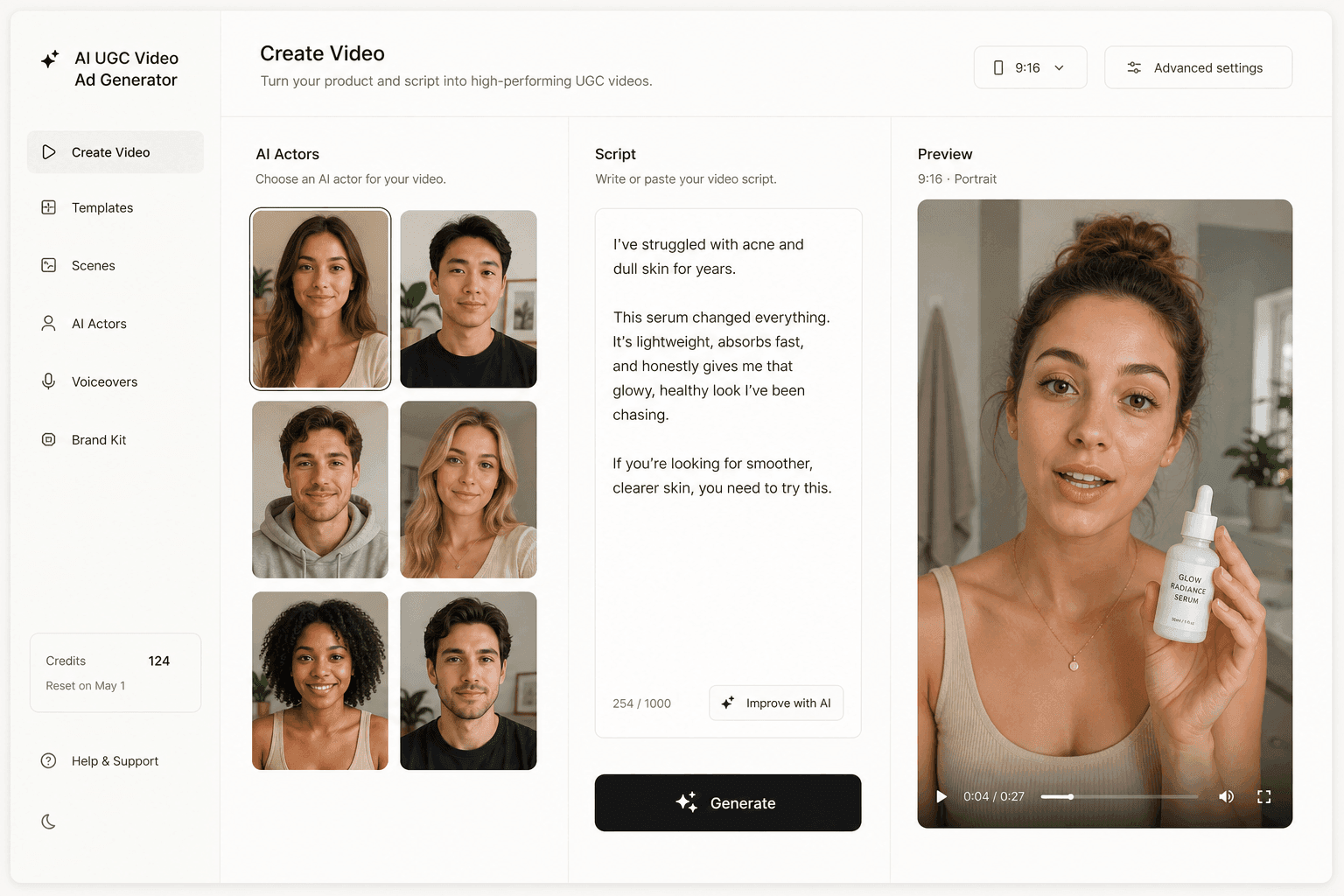
Novoads is a global AI UGC video-ad generator. You upload a product photo, write or auto-generate a script, pick an AI actor and export a vertical ad. Kling v3 Pro runs inside Novoads next to Seedance 2.0 and Google Veo 3.1, so the Kling side of this comparison works without an API account or a Runway plan, and our Seedance vs Kling comparison shows when to switch engines inside the same project.
Kling v3 Pro, priced in credits
Kling v3 Pro in Novoads renders 3 to 15 seconds in 9:16, 16:9 or 1:1, at these credit costs:
- 5 seconds: 3 credits.
- 10 seconds: 5 credits.
- 15 seconds: 7 credits.
Novoads starts at $49/month (Starter, 50 credits per month), and all plans are published on /pricing. The 20 ten-second hooks from the worked example come to 100 credits, which is the monthly allowance of the $79 Pro plan, before retries. That is more than fal's raw per-second list price. What sits around the clip is the rest of the ad in one project: scripts, AI actors, voices in 31 languages and captions.
What Novoads does not do
Novoads does not offer Runway's Gen-4.5 or Aleph 2.0. If the job is editing footage you already shot, or delivering ProRes into an edit suite, Runway is the better tool. If the job is a steady stream of spoken, product-first vertical ads to test, you can start on Novoads and run Kling there.
The model is shared. The workflow is the choice.
Runway already sells Kling, so this is not really a fight between two models. It is a choice between fixing an ad after the render and getting it right inside the render, and between a subscription that bundles an editing suite and paying per second for the take alone. Put edits and silent product shots on Runway, and spoken takes on Kling, wherever you choose to run it.
Frequently Asked Questions
Is Runway or Kling better for video ads?
It depends on the job. Runway is stronger when the work happens after the render: Aleph 2.0 changes a product color, a background or a season across footage you already have, and Studio and ProRes export finish the cut. Kling 3.0 is stronger when the ad talks, because it generates speech and sound in the same pass and runs single takes of up to 15 seconds. Because Runway includes Kling 3.0 on its paid plans, many teams can use both from one account.
Does Runway include Kling?
Yes. As of September 2026, Runway's pricing page shows Kling 3.0 on its Standard, Pro and Max plans, and Runway's Kling 3.0 page says it is available on all paid and Enterprise plans. Runway added Kling 3.0 to its third-party model lineup in a changelog entry dated February 20, 2026. Runway offers Kling 3.0 in Standard, Pro and Turbo tiers.
How much does Kling 3.0 cost per second?
On fal, as of September 2026, Kling 3.0 Pro text-to-video costs $0.112 per second with audio off, $0.168 with audio on and $0.196 when voice control is used. Kling 3.0 Standard costs $0.084 with audio off and $0.126 with audio on. On a Runway plan, Kling 3.0 is billed in Runway credits: expand the model table on Runway's pricing page with its 'View more' control to read the current rate before budgeting a batch there.
How much does Runway Gen-4.5 cost?
Runway says Gen-4.5 uses 12 credits per second of generated video. The Standard plan is $15 a month, or $12 a month billed annually, for 625 credits, which Runway equates to 52 seconds of Gen-4.5. Pro is $35 a month ($28 annually) for 2,250 credits and Max is $95 ($76 annually) for 9,500 credits. On Runway's developer API, credits cost $0.01 each, so Gen-4.5 works out to $0.12 per second there.
Can Runway and Kling make a talking ad with sound?
Kling 3.0 generates native audio with the video, including dialogue in Chinese, English, Japanese, Korean and Spanish by Kling's own guide (fal's page lists Chinese and English natively, with other languages auto-translated to English), and Runway describes its Kling 3.0 Pro tier as the one with audio and speech. Runway's plans also list music, voice and sound effects generation as a separate feature. For a spoken UGC-style ad, a one-pass audio model avoids a separate dubbing step.
Can I use Kling in Novoads?
Yes. Novoads runs Kling v3 Pro alongside Seedance 2.0 and Google Veo 3.1. A Kling v3 Pro clip costs 3 credits for 5 seconds, 5 credits for 10 seconds and 7 credits for 15 seconds. Novoads starts at $49/month (Starter, 50 credits per month), and all plans are published on /pricing. Novoads does not offer Runway's Gen-4.5 or Aleph 2.0.
Key Takeaways
- Runway already sells Kling. Its pricing page shows Kling 3.0 next to Gen-4.5 on the Standard, Pro and Max plans, and Runway says Kling 3.0 is available on all paid and Enterprise plans. The real matchup is Runway's own models and workflow against Kling 3.0 wherever you run it.
- Runway's edge is after the render: Aleph 2.0 edits one frame and carries the change through clips of up to 30 seconds at 1080p, and Studio, ProRes export and an Adobe panel finish the ad.
- Kling 3.0's edge is inside the render: native audio in five languages by Kling's own guide (fal lists Chinese and English natively), multi-shot generation and single takes of 3 to 15 seconds. Runway's API sets Gen-4.5 clips at 2 to 10 seconds.
- Per second, as of September 2026: Gen-4.5 is 12 credits a second, which is $0.12 on Runway's API, while Kling 3.0 Pro on fal is $0.112 with audio off and $0.168 with audio on. On a Runway plan, Kling 3.0 is billed in Runway credits, and the pricing page's model table lists its rate behind a 'View more' control, so read it there before you budget Kling-on-Runway.
- Novoads runs Kling v3 Pro at 3 credits for 5 seconds and 7 credits for 15 seconds, and starts at $49/month (Starter, 50 credits per month). It does not offer Gen-4.5 or Aleph 2.0, so Runway stays the better pick for editing footage you already have.