Pinterest Visual Search Ads: What 80 Billion Monthly Searches Mean for Your Product Creative
Pinterest announced Visual Search Ads on 17 September 2026, a slot advertisers bid for in search results and Pin closeups, arriving in beta in the coming weeks. Here is what changed, what Pinterest has not said yet, and the image creative to prepare now.

Mauricio Valdivia
·12 min
When the search is a picture, so is the ad
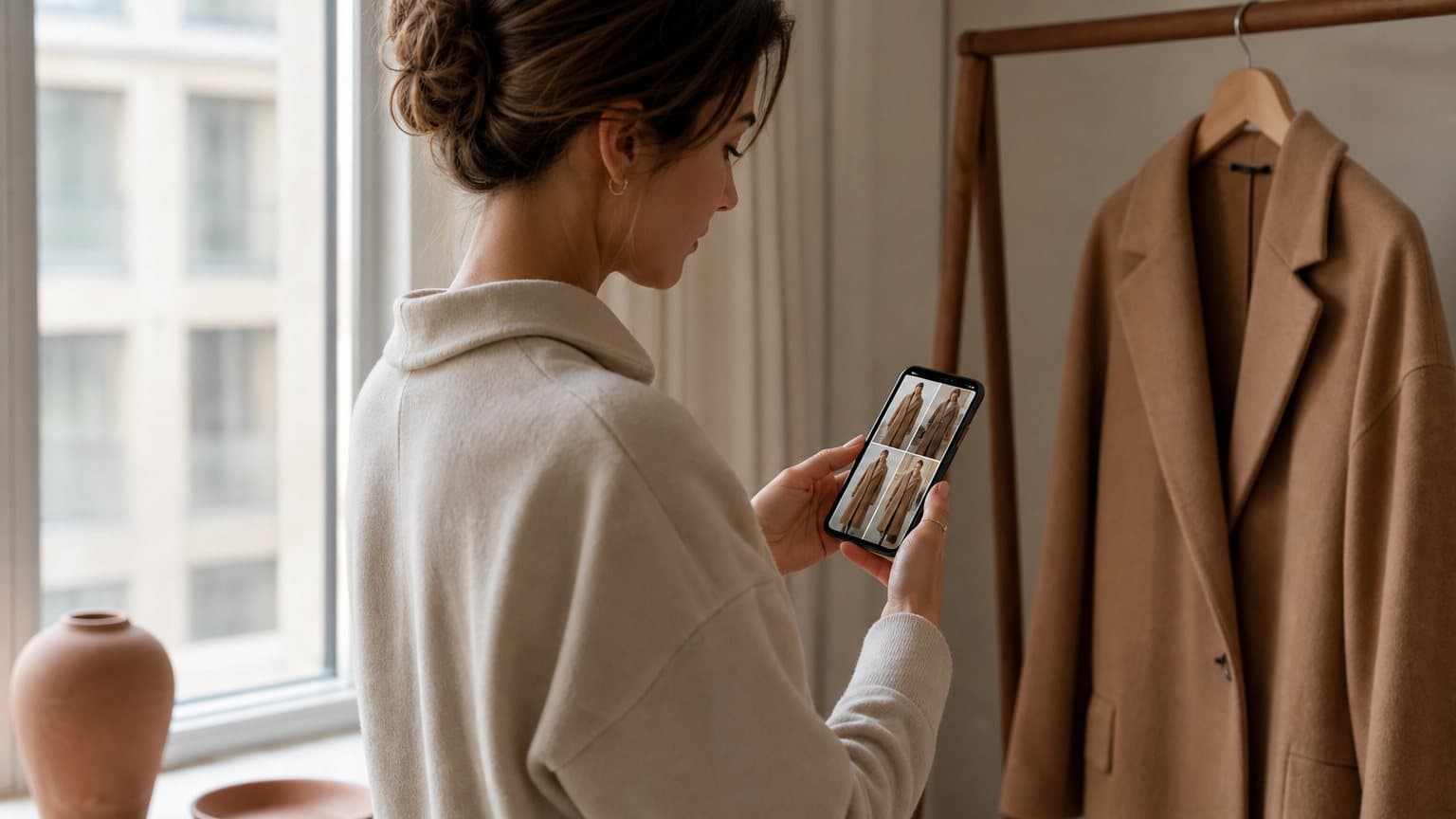
A shopper scrolling Pinterest stops on a camel wool coat in a street-style photo. She long-presses the Pin and gets back a grid of similar coats. No typed query. No brand name. A picture, answered with pictures. Pinterest says its users run more than 80 billion searches a month, that the vast majority of them are visual, and that more than half are commercial.
In the coming weeks, one of those answers can be an ad that an advertiser bid for. At Pinterest Presents, its annual advertiser summit, Pinterest announced Visual Search Ads on 17 September 2026. The format places advertisers in Pinterest Search Results and in Pin closeups, and Pinterest says advertisers can bid for a top response that sends people directly to their site. It is not live yet: Pinterest says it "will be available in beta for eligible advertisers in all Pinterest ad markets in the coming weeks."
For anyone who makes the ads, the interesting part is the part the announcement leaves out. Pinterest published no creative specs, prices or bid mechanics for the format. This post covers what Pinterest did announce, how it differs from the Top of Search ads Pinterest already sells, why a visual query changes what your image has to do, and the creative to prepare before the beta reaches your account. Where a spec appears below, it comes from Pinterest's existing documentation for the formats that exist today, and it is labeled that way.
What Pinterest announced at Pinterest Presents 2026
The newsroom post is short, and most of its sentences carry weight. Read it as three separate facts: where the ads show, how you buy the slot, and when you can use it.
Two placements: search results and Pin closeups
Pinterest's wording is precise: "The format prominently places advertisers in Pinterest Search Results and Pin closeups, pairing keyword relevance with a distinctive new ad format to reach people as they search, compare and move closer to a decision."
Those are two different surfaces with two different jobs:
- Search Results is the grid of images that comes back from a query. Your image competes with a dozen look-alike images for a tap.
- A Pin closeup is the enlarged view a Pin opens into when someone taps it; Pinterest's own help center describes it as what you see "in close-up" after you click on the Pin. Your image is the one thing on screen, and the person is studying it.
A bid for the top response, sent straight to your site
The commercial terms fit in three lines:
- Buying: "Advertisers can bid for a top response and connect people directly to an advertiser's site."
- Objectives: Visual Search Ads support lower-funnel objectives.
- Automation: they are compatible with Pinterest Performance+, which Pinterest calls its AI-powered performance advertising suite.
Pinterest's CEO, Bill Ready, framed the pitch against text search: "Traditional search advertising has long relied on keywords, but in an AI-driven world, people are expressing themselves in much richer ways." He described the placement as sitting at "the critical decision points where people see, save and decide."
What Pinterest has not said yet
Plenty of what an ad buyer would normally plan around is missing from the announcement. As of 18 September 2026:
- No creative specs for the format: no sizes, no supported Pin types, no text limits of its own.
- No pricing or auction detail beyond the phrase "bid for a top response".
- No firm date and no eligibility rules. The beta arrives "in the coming weeks" for "eligible advertisers".
- No performance figures for Visual Search Ads. The one percentage in the announcement belongs to App Promotion, a different product covered below.
That gap is the practical reason to prepare creative now. When the beta opens, the bidding will take an afternoon to set up. A library of search-ready product images takes longer.
Not Pinterest's first search ad: what Top of Search already sold
It would be easy to read this as Pinterest's debut in search advertising. It is not. Advertisers already reach people in Pinterest search through keyword targeting, and a year ago Pinterest launched a product built for the top of those results. That earlier product is the best guide to what the new one changes.
Top of Search, September 2025
On 25 September 2025, at the previous Pinterest Presents, Pinterest announced Top of Search ads, then in beta across all of its monetized markets. In Pinterest's words, "These ads appear directly within the top ten search results and in Related Pins." Its reasoning then was about where attention sits:
- 45% of clicks occur in the top ten search results, Pinterest said.
- 96% of top searches are unbranded, which Pinterest's footnote sources to its own US internal data from June 2023.
That second number is the one to remember. A search with no brand in it is a search any advertiser can win, and on a visual platform the thing that wins it is the image.
The numbers Pinterest reported, and how to read them
Pinterest said its testing showed "an average click-through rate 29% higher for Top of Search ads compared to standard campaigns, and a 32% higher likelihood of attracting new clickers." It added that "Wayfair, one of the first testers, saw a 237% increase in click-through rate over a two-week period compared to their usual campaigns." Its footnote adds that Wayfair's Top of Search ad spend was under 1% of its business-as-usual campaign spend during that test.
Three things to hold onto before you quote them:
- They are vendor-reported. Pinterest's own figures from Pinterest's own tests, with one named advertiser behind the largest number.
- They describe Top of Search, not Visual Search Ads.
- They are click-through figures, the metric a search placement flatters most easily. A higher click rate is not the same thing as a better ad, a point we make at length in why a high CTR does not mean a good ad.
What changed between the two announcements
Set side by side, the two newsroom posts describe different products.
| Top of Search ads | Visual Search Ads | |
|---|---|---|
| Announced | 25 September 2025 | 17 September 2026 |
| Placements named | Top ten results, Related Pins | Search Results, Pin closeups |
| Status at announcement | Beta, all monetized markets | Beta "in the coming weeks" |
| Buying mechanic named | Not described | Bid for a top response |
| Objectives named | Not stated | Lower funnel, Performance+ |
The Pin closeup is a placement the 2025 post did not name, and the bid for a top response is new language. Pinterest's 2026 post does not say whether Visual Search Ads replace Top of Search or sit beside it. If you already run Top of Search, treat the new format as a separate line item until Pinterest says otherwise.
Why a visual query rewrites the creative brief
On Google, an ad answers words with words, and even there the words around the ad are shifting, as we covered when Google started testing AI summaries under search ads. On Meta there is no query at all: the system picks the audience from behavior, which is why targeting there is now controls plus suggestions. On Pinterest, most searches are visual by Pinterest's own count, and the answer is a grid of pictures. That changes which part of the ad does the matching.
The image is the query, and the answer
Pinterest has been turning the image itself into the search box. In May 2025 it announced visual search features that generate words describing what a person likes about an image, and it expanded access to the "Search image" button so users could simply long-press any Pin in their home feed. Those features launched first for women's fashion in the US, UK and Canada.
Bill Ready's quote on 17 September names the engine behind the new ads: Pinterest Intelligence, "our AI-enabled visual understanding of images, products, taste and intent". Our read of that sentence is simple. If a model is deciding which product images are a good answer to a picture, then an ad image that shares the query's shape, color, material and setting has the strongest case to be shown. A clever headline cannot rescue an image that does not look like what the person was searching for.
Keywords did not go away; they moved into your text fields
Pinterest says the format pairs "keyword relevance" with the new unit, so keyword work still matters. Keyword targeting, per Pinterest's help center, "lets you reach people as they search for a specific idea on Pinterest", and Pinterest allows up to 20,000 keywords per ad group while recommending at least 25.
The text on the ad itself works differently from a search ad's text. Pinterest's ad specs say an ad's description can run up to 800 characters, does not appear in the feed, and "descriptions do not appear for ads when viewed up close." It is still worth writing, because Pinterest says "Descriptions are used by our algorithm to determine relevance for delivery." Write it for the machine:
- Materials and finish: solid oak, brushed brass, boucle, recycled wool.
- Style words: mid-century, Japandi, coastal, minimalist.
- Room or occasion: reading nook, entryway, wedding guest, office.
- Typed synonyms: the terms a person would use if they typed instead of tapped.
More than half of searches are commercial
The 80 billion figure comes with a qualifier Pinterest chose to publish: more than half of those searches are commercial. That is why the format is pitched at lower-funnel objectives. The person in the closeup is comparing options, not daydreaming, so the image has to answer comparison questions: what exactly is this, what is it made of, how big is it, what does it look like in use.
The creative to supply for search results and Pin closeups
Pinterest has not published specs for Visual Search Ads. The closest published brief is its "Review ad specs" page for the formats that run today, and until Pinterest publishes something specific, build to it. If you want every Pinterest format and the job each one does, our guide to the types of social media ads covers them network by network.
An image that wins the grid at thumbnail size
For standard image ads, Pinterest says: "We recommend using a 2:3 aspect ratio, or 1000 x 1500 pixels. Pins with an aspect ratio greater than 2:3 might get cut off in people's feeds." Files can be PNG or JPEG, up to 20 MB on desktop and 32 MB in the app.
In a grid of similar answers, the job is recognition at a glance:
- One product per image, filling most of the frame, so it reads at thumbnail size.
- Clear contrast between the product and its background.
- The attribute the searcher is matching on (the cut of a coat, the grain of a table, the shade of a lipstick) visible without zooming.
One quiet detail matters for product shots on white. Pinterest says it adds "a faint color layer to image Pins in the home feed with white or black backgrounds." A pure-white packshot will look very slightly grey in the light-mode home feed. That is expected, and not a reason to re-export.
A closeup that makes the pitch without the description
Because the description is hidden when an ad is viewed up close, everything a comparing shopper needs has to be in the image or the title. The title rules, from Pinterest's specs:
- Length: up to 100 characters, but "Depending on the device, the first 40 characters may show in people's feeds."
- Double-byte languages: for Chinese, Japanese, Korean, Arabic and similar scripts, only the first 30 characters show.
- Placement: when entered, titles appear in the home feed or search feed.
So front-load the product type and the one attribute that sells it, inside 40 characters. "Brass arc floor lamp, dimmable" is 30 characters and says what the thing is. "Our favorite new arrival for cozy evenings" says nothing a shopper can compare.
Color and file hygiene
Pinterest says: "All uploaded images are converted to standard 8-bit RGB JPEGs before being turned into Pins and ads. Advertisers should upload images in PNG with sRGB formats to avoid any reduction in image quality." It also warns that custom color profiles are not supported and may produce slightly different colors.
For a product where color is the purchase decision (paint, fabric, cosmetics, furniture finishes), a shifted color is a wrong answer to a visual query. Three habits prevent it:
- Export PNG in sRGB, not a wide-gamut or custom profile.
- Keep the master file so you can re-export instead of re-editing a compressed copy.
- Check the published Pin on a phone before you scale spend behind it.
Video, if the format takes it
Pinterest has not said whether Visual Search Ads accept video. If they do, its standard width video specs are the likely brief:
- Length: 6 to 15 seconds recommended, with a 4 second minimum.
- Shape: square (1:1) or vertical (2:3, 4:5 or 9:16) recommended.
- File: .MP4, .MOV or .M4V, up to 2GB.
Our video ad specs by platform guide puts Pinterest's numbers next to five other networks.
If you plan to run the format inside Performance+, one more fact matters. Pinterest's Performance+ creative tools can "Automatically crop and resize eligible Pins" and use generative AI "to apply backgrounds for your product images" in Sales campaigns. Supply a clean product with space around it, so an automated crop or background still reads as your product.
AI-made product images and Pinterest's AI label
Much of the image volume this format rewards will be generated or edited with AI. Pinterest has a published rule for how that shows up on an ad, and it is worth knowing before you upload.
How Pinterest discloses AI in ads
As of September 2026, Pinterest's help center says it detects AI use from a Pin's metadata, following the IPTC standard, and from its own classifiers, which catch "Gen AI content, even if the content doesn't have obvious markers." For ads, the placement of the label differs from organic Pins: "For ads, the Gen AI label won't appear when you click on the Pin." People see it with the other ad details behind the ellipsis icon.
The wording of that disclosure depends on how the image got there. Pinterest says it "will say the Pin was modified with AI or if it contains an AI-generated person based on what the content owner has indicated, or that the Pin may be modified with AI if Pinterest's systems flagged the content." In practice that gives three outcomes:
- You declared AI editing: the disclosure says the Pin was modified with AI.
- You declared an AI-generated person: the disclosure says so.
- You declared nothing, but Pinterest's systems flagged it: the disclosure says the Pin may be modified with AI.
Advertisers who believe a label is wrong can appeal through Pinterest support.
What that means for a generated product scene
The label sits one tap away from the closeup, not on the image. The larger risk in a visual search placement is a generated image that misrepresents the product, because the closeup is exactly where people inspect it. Our stance: keep the product itself real, generate or edit the setting around it, and disclose honestly. For the wider picture across networks, see whether you have to label AI-generated ads.
The rest of the Pinterest Presents slate
Visual Search Ads led the announcement, but three other items change how you will test and measure the creative you make for it.
Performance+ adds Priority Products and self-serve A/B testing
Pinterest says Performance+ is adding Priority Products, which give advertisers more control over the products they want to prioritize "in key moments, like a seasonal launch, promotion or category push, while maintaining the scale and efficiency of automation." That last clause is the shape of the feature: the control sits inside the automation rather than replacing it. It still fills a real gap: as of September 2026, Pinterest's help center says Performance+ Sales campaigns use the All Products product group and do not include a Product Group picker.
The bigger news for creative teams is testing. Pinterest is "introducing self-serve A/B testing making it easier for advertisers to test campaign strategies", with tests "across creative, targeting, and within Pinterest Performance+." That is the tool to answer the question this post keeps raising: which version of a product image wins in a visual search. The method is the same one we lay out in how to test ad variations and read a real winner.
App Promotion, and one advertiser's number
App Promotion is a purpose-built objective for app installs, "Now in global beta with qualified advertisers". Pinterest says one advertiser saw "up to an 85% improvement in cost per install compared to previous workarounds", and the footnote under that sentence describes that advertiser as a single US enterprise advertiser in an alpha test that ran from August 2025 to August 2026. Before that number travels, note what it is:
- One account, one alpha test. Pinterest's footnote reads "US enterprise advertiser (n=1), Aug 2025 - Aug 2026. Alpha test".
- Vendor-reported, with "up to" in front of it.
- About app installs. It says nothing about Visual Search Ads.
Restyle and the CTV series are for shoppers, not buyers
Restyle, "launching in beta in the US and Canada", lets people use a photo to reimagine a space, test ideas and compare options in their own home. Pinterest also said its CTV series Bring My Pinterest to Life is returning for a second season. Neither is an ad product. Both push the same habit as the new ad format: starting a search from a photo instead of a sentence.
A worked example: a home-decor brand gets ready for the beta
Take a small home-decor brand with 12 hero products across three categories: lamps, rugs and side tables. Here is what preparing for Visual Search Ads looks like in numbers, using only Pinterest's published guidance plus our own production math.
The keyword and image plan
One ad group per category gives three ad groups. At Pinterest's recommended minimum of 25 keywords each, that is at least 75 keywords, written as the phrases a person would type for the same idea ("arc floor lamp", "brass reading lamp", "mid-century lamp").
For images, plan three versions per product, all at 2:3:
- Plain background, the product alone, to win the grid.
- Styled room, the product in a setting that matches how people search for it.
- Detail crop, the material or finish a comparing shopper wants to inspect in the closeup.
That is 12 products times 3 versions, or 36 images.
What the image set costs to produce
If you generate those variants from product photos in Novoads, the image-to-ad flow costs 0.3 credits per image and offers a 2:3 output. So 36 images use 10.8 credits. On the Starter plan ($49 a month for 50 credits, so about $0.98 per credit), that is roughly $10.60 of one month's credits, with 39.2 credits left for video. A photo shoot styled three ways for 12 products would cost far more than that before anyone knew which setting wins.
How to read the result
When the beta and self-serve A/B testing reach your account, run it in this order:
- Test one variable: plain background against styled room, same products, same keywords, same budget.
- Pick the lower-funnel metric first: conversions or add-to-cart, the conversion events Performance+ supports, not click-through rate.
- Read it over the same period: the test worked when one version delivers a lower cost per conversion. A version that only wins on clicks has not won.
- Roll the winner forward: make the next round of variants in the winning style, then test detail crops against it.
How Novoads solves the visual-search creative problem
Novoads turns an uploaded product photo into ad-ready images and UGC-style video ads, which is the raw material a visual search placement consumes: many honest, on-product variants, fast. You can do it in Novoads without booking a shoot for every setting.
What it covers, and what it does not
- Images: the image-to-ad flow takes a JPEG, PNG or WebP product photo and returns an ad image for 0.3 credits, with 2:3, 4:5, 1:1 and 9:16 among its aspect ratios.
- Video: clips export in 9:16, 1:1 and 16:9 and cost from about a dollar for a five-second Seedance 2.0 Mini clip to about $8 for an eight-second Seedance 2.5 clip, and about $26 for a full 30-second Seedance 2.5 take.
- Price: Novoads starts at $49/month (Starter, 50 credits per month). All plans are published on /pricing.
What it does not do is buy the placement. Bidding, keywords and the A/B test all stay in Pinterest Ads Manager; Novoads gives you downloadable files to upload there.
The picture is the keyword now
Pinterest is selling the top answer to a picture. The advertiser who wins that slot will not be the one with the longest keyword list. It will be the one whose image looks most like what the searcher had in mind, and who has made enough versions to find out which one that is.
Get the 2:3 library ready before the beta arrives, and let the test pick the winner.
Frequently Asked Questions
What are Pinterest Visual Search Ads?
Visual Search Ads are an ad format Pinterest announced on 17 September 2026 at Pinterest Presents, its annual advertiser summit. Pinterest says the format places advertisers in Pinterest Search Results and Pin closeups, pairing keyword relevance with a new ad format, and that advertisers can bid for a top response that connects people directly to their site. It supports lower-funnel objectives and is compatible with Pinterest Performance+, the company's AI-powered performance advertising suite.
Can I run Pinterest Visual Search Ads today?
Not as of 18 September 2026. Pinterest's announcement says the format will be available in beta for eligible advertisers in all Pinterest ad markets in the coming weeks. The announcement gives no firm date and no eligibility criteria, so check your Ads Manager account and Pinterest's business channels rather than planning a launch around a date.
How are Visual Search Ads different from Pinterest Top of Search ads?
Top of Search ads were announced on 25 September 2025, in beta across all of Pinterest's monetized markets, and appear within the top ten search results and in Related Pins. Visual Search Ads, announced a year later, name Search Results and Pin closeups as their placements and let advertisers bid for a top response. Pinterest's 2026 announcement does not say whether the new format replaces Top of Search or runs alongside it.
What image size should I use for Pinterest Visual Search Ads?
Pinterest has not published specs for this format yet. Its current ad specs for standard image ads recommend a 2:3 aspect ratio, or 1000 x 1500 pixels, accept PNG or JPEG files up to 20 MB on desktop and 32 MB in the app, and warn that Pins with an aspect ratio greater than 2:3 might get cut off in feeds. Pinterest also recommends uploading PNG in sRGB to avoid a loss of image quality. Build to that until Pinterest says otherwise.
Does Pinterest label AI-generated ad images?
Yes, in its own way. As of September 2026, Pinterest's help center says that for ads the Gen AI label does not appear when you click on the Pin; people see it with the other ad details behind the ellipsis icon. The disclosure says the Pin was modified with AI or contains an AI-generated person, based on what the content owner indicated, or that it may be modified with AI if Pinterest's systems flagged it. Pinterest detects this from IPTC metadata and from its own classifiers.
Does the 85% cost-per-install improvement apply to Visual Search Ads?
No. That figure belongs to App Promotion, a separate objective for app installs announced the same day. Pinterest says one advertiser saw up to an 85% improvement in cost per install compared to previous workarounds, and its footnote describes that advertiser as a single US enterprise advertiser in an alpha test that ran from August 2025 to August 2026. Pinterest published no performance figure for Visual Search Ads.
Key Takeaways
- Pinterest announced Visual Search Ads at Pinterest Presents on 17 September 2026. The format places advertisers in Pinterest Search Results and Pin closeups, and advertisers can bid for a top response that sends people straight to their site.
- It is not live yet. Pinterest says it will be available in beta for eligible advertisers in all Pinterest ad markets in the coming weeks, that it supports lower-funnel objectives, and that it is compatible with Performance+.
- It builds on Top of Search ads, which Pinterest put into beta in September 2025 for the top ten search results and Related Pins. What the 2026 announcement adds by name is the Pin closeup placement and the bid for a top response.
- Pinterest has published no creative specs, prices or bid mechanics for the new format. Its existing ad specs are the working brief: a 2:3 image at 1000 x 1500 pixels, a title whose first 40 characters may be all that shows, and no description in the closeup view of an ad.
- In a visual search the picture does the job a keyword does in text search, so the product image has to look like a match in the grid and make the whole pitch in the closeup. Prepare several versions per product and let Pinterest's new self-serve A/B testing pick the winner on conversions, not clicks.