
Google Is Testing AI Summaries Under Search Ads: 5 Moves Advertisers Should Make
Google Ads is testing AI-generated summaries beneath sponsored results, and it changes what your copy and creative have to do. Here is what is happening and the five moves to make now.

Mauricio Valdivia
·11 min

An AI Summary Now Sits Right Under Your Search Ad
Someone searches for a handyman. The top result is a paid ad, exactly as it has been for twenty years. But this time, tucked right under the description, there is a short machine-written paragraph explaining the offer, followed by a small line of text warning that the answer was generated by AI and might be wrong.
That is the change. On July 1, 2026, Search Engine Roundtable reported that "Google is testing the placement of AI-generated summaries in Google Ads sponsored results, right below the description." The tested unit even carries a disclaimer telling people the AI response is generated independently and can make mistakes, so they should double-check it. Google has done this on organic listings before. Now it is doing it on ads.
It is a small visual tweak with a large strategic tail. For the first time, a paragraph your competitors did not write, and that you did not write either, can sit inside the most valuable rectangle on the internet and reframe what your ad means. This post is about what that does to your copy, why it makes strong creative more important rather than less, and the five concrete moves to make now. None of it is cause for panic. It is a reason to get deliberate.
What Google Is Actually Testing
Before drawing conclusions, it helps to separate the specific test that surfaced from the broader direction Google has already announced. The two together tell you where this is going.
The summary that sits under your ad
The observed behavior is narrow and concrete. In sponsored results, below the normal description, Google is slotting an AI-generated summary of the offer, plus a disclaimer. It reads like the AI Overviews people already see on unpaid results, only now attached to a paid listing. The disclaimer language matters: it signals Google knows the summary is a separate, fallible voice, and it is telling searchers to treat it as such.
For advertisers, the immediate takeaway is that your ad slot is no longer a monologue. There is a second speaker in the box, and it paraphrases. If your description is a bundle of vague superlatives, the summary will likely restate it as a bundle of vague superlatives, indistinguishable from the next advertiser's.
Part of a bigger shift to AI-era ads
This test does not stand alone. In its Google Marketing Live announcement, Google said, "Built with Gemini, we're testing new ad formats in Search and expanding our Direct Offers pilot to help brands connect with consumers." It is explicit that "both of these new formats will feature an independent AI explainer as part of the ad," and in Google's own words, "Our Gemini model evaluates and synthesizes information about a product or service, and displays that context alongside the advertiser's creative." The two named formats make the direction concrete:
- Conversational Discovery ads, where "your ad answers a person's specific question" with creative tailored to the search.
- Highlighted Answers, where relevant "ads are eligible to appear on that list as a Highlighted Answer" inside an AI Mode recommendation.
Read that last line twice. Google is not replacing your creative. It is placing a synthesized, independent explanation next to it. The AI handles the neutral context. Your creative still has to do the persuading. That distinction is the whole game, and it is why this is a creative story more than a copy story. It is the same platform-level bet you can see in how Meta is building an end-to-end AI advertising suite: the machine takes the plumbing, and the differentiator moves to the asset.
Why Google wants that real estate
The motive is not mysterious. As search becomes conversational, people read answers instead of clicking ten blue links, and Google needs to monetize the space where attention now lands. Google reports that "75% of people report making faster, more confident decisions using AI Mode in Search." If that is where decisions happen, that is where the ads have to be. The summary under your listing is Google following its own users into the AI layer, and pulling the ad unit along with them.
For advertisers, that reframes the whole conversation. This is not a feature you opt into or out of. It is the direction of the surface you already buy, and it will keep moving whether or not you adjust. The choice in front of you is not whether to accept AI summaries around your ads. It is whether your copy and creative are ready for a result page where a machine gets a say in how your offer is described.

What It Changes for Your Ad Copy
If a model is going to paraphrase the words in and around your ad, the value of those words shifts. Some copy survives summarization intact. Most does not.
Your headline shares the frame now
Your headline and description are not going away. They still run, they still get read, they still feed Google's ranking. What changed is that they are no longer the only text in the slot. A Gemini summary can sit beneath them and restate the offer in neutral language. If your headline was carrying the persuasion through tone and swagger, a flat paraphrase underneath can quietly deflate it. The fix is not louder copy. It is copy built on facts a summary has to keep.
Write claims a summary cannot blur
A machine summary keeps concrete, checkable claims and discards mush. "Great service, amazing prices" compresses to nothing. "Licensed, insured, same-day booking, 4.9 stars from 2,000 reviews" survives, because each token is a fact the model has a reason to retain. This is the same discipline that separates a real AI ad from generic filler: specificity is what carries. Run the test on every phrase in your description:
- A summary keeps numbers, guarantees, named features, ratings, and proof points.
- A summary drops superlatives, mood words, and adjectives with nothing behind them.
Delete the deletable yourself and replace it with something load-bearing, before the model does the deleting for you.
The disclaimer sets a new trust bar
The AI disclaimer on the ad is doing something subtle: it is teaching searchers to double-check. A person primed to distrust the machine paragraph will look harder at the human parts of the result, your brand, your creative, your proof. That raises the bar on honesty. Overstated claims read worse next to a "this might be wrong" warning, not better. It also connects to a broader move toward disclosure, which we cover in labeling AI-generated ads. Clean, verifiable claims are becoming a competitive asset, not just a compliance chore.
Why Creative Matters More, Not Less
Here is the counterintuitive part, and it is the thesis of this piece. When the words around your ad get standardized by a model, the non-word elements are what set you apart. The summary can rewrite a sentence. It cannot rewrite a face, a demonstration, or a hook.
The AI reframes the result, not your asset
Google's own framing is that the AI explainer appears alongside the advertiser's creative. The creative is outside the model's summarizing reach. That makes it the last reliably differentiated surface in the ad. Two competitors selling the same thing can end up with near-identical AI summaries, because the model is synthesizing the same underlying facts. What they cannot share is a distinct creator, a distinct hook, and a distinct demonstration. The asset is the moat.
Distinctive creative resists paraphrase
This is why UGC-style ads keep outperforming polished studio spots as the surface gets noisier. A real-seeming person holding your product, speaking to a specific pain, is not reducible to a neutral paragraph. It carries trust the summary cannot manufacture and cannot flatten. The role of the UGC content creator, human or AI, is to produce exactly that kind of unsummarizable signal: a face and a voice a searcher believes. As the text around the ad converges, the visual and the human are what diverge.
A worked example: the cost of one winner
Say you decide to test ten creative angles to find the one that wins in this new layout. Producing UGC-style video variants with AI runs from about a dollar for a five-second Seedance 2.0 Mini clip to about $8 for an eight-second Seedance 2.5 clip, and about $26 for a full 30-second Seedance 2.5 take. Ten variants cost you somewhere between about $10 and $80 to find a winner. Compare that with the older path of hiring for each angle, where a single deliverable can run far more before you even know if it works, a range we break down in how much UGC creators charge. The point is not that one clip is cheap. It is that finding the winner is cheap, and finding winners is the job.
Now run the same math the other way. If your process only lets you test one or two angles a month, because each one needs a brief, a shoot, and a round of edits, then a single layout change can wipe out the one creative you were leaning on and leave you with nothing queued behind it. The advertiser who can render a fresh batch this afternoon is never in that position. Their cost per winner is low because their cost per attempt is low, and the surface can shift as often as it likes without stranding them. That gap, the ability to attempt cheaply, is the real edge the AI-era result page rewards.
Testing Volume Becomes the Real Moat
If the surface around your ad keeps shifting, no single creative stays optimal for long. The advantage moves from having the perfect ad to being able to find the next one fast.
One perfect ad is a fragile bet
Pouring a month into one hero creative was always risky. It is riskier now, because the frame it lives in can change under it. An AI summary that reads well next to your ad today can be rephrased tomorrow, and your one asset does not adapt. A portfolio of variants does. When you have twenty live angles, a shift in the layout demotes a few and promotes others, and you keep moving. When you have one, a shift just costs you.
What to optimize when the SERP shifts
As the result page changes shape, the smart response is to change what you optimize. Here is the shift in plain terms:
| Ad element | Old priority | Priority with AI summaries |
|---|---|---|
| Headline tone | Carry the persuasion | Carry facts a summary keeps |
| Description | One polished pitch | Specific, extractable claims |
| Creative | Nice to have | The main differentiator |
| Volume | A few strong ads | Many variants, fast turnover |
| Success metric | Clicks and CTR | Cost per acquisition and ROAS |
Each row is the same message from a different angle: standardize less, differentiate more, and measure the outcome that pays you.
High CTR is not the finish line
One warning as the layout changes: do not chase surface clicks. A summary that intrigues can lift clicks that never convert, and a strong click-through rate can hide a weak funnel. We wrote a whole piece on why a high CTR does not always mean a good ad, and it matters more here. Optimize to the business result underneath the click, not the click itself, or the AI layer will happily inflate the vanity number.

Lean Into Google's Automation, Own the Inputs
The instinct to fight the machine is the wrong one. Google's automation is genuinely good at the parts it owns. The move is to let it run those parts and concentrate your effort where you still have leverage.
Smart Bidding already runs delivery
Bidding is not where your edge is anymore. In Google's description of Smart Bidding, "machine learning algorithms train on data at a vast scale to help you make more accurate predictions across your account about how different bidding amounts might impact conversions or conversion value." You are not going to out-compute that by hand. Hand it the delivery decision, feed it a clean conversion signal, and spend the hours you save on creative instead.
AI Max and Performance Max widen the surface
Google is also pushing broader automated campaign types into this AI-era layout. On AI Max, the company announced it is "expanding the power of AI Max to more advertisers, helping you capture new opportunities in an expanding Search universe." These systems decide where and how your ad shows across an increasingly varied set of placements, including the newer video and reach surfaces we cover in Google video reach campaigns. The more Google automates placement, the more your job narrows to one thing: giving it excellent inputs.
Your lever is the creative feed
Automation is a multiplier, and it multiplies whatever you feed it. Point Performance Max at a thin set of mediocre assets and it will efficiently deliver mediocre ads. Point it at a deep, fresh library of distinct creative and it has real material to optimize against. In an automated system, the creative feed is not a side task. It is the main input, and it is the one competitors cannot copy by turning the same dials.
What To Do Now: 5 Moves for Advertisers
Enough theory. Here is the practical checklist, in order of what pays back fastest.
- Look at your own ads under a summary. Run your top queries, watch how a machine paragraph reframes your listing, and note where your copy dissolves into sameness. You cannot fix what you have not seen.
- Rewrite copy into extractable facts. Replace superlatives with specifics a summary has to keep: numbers, guarantees, proof, named features. Delete anything a paraphrase would drop.
- Build a creative volume pipeline. Commit to producing many UGC-style variants per angle instead of one hero spot, so you always have fresh, distinct assets to test and rotate.
- Let automation own delivery, judge on outcomes. Keep Smart Bidding and Performance Max in charge of bidding and placement, but measure them on cost per acquisition and ROAS, never on clicks alone.
- Keep it labeled and honest. Lean into disclosure rather than around it. Clean, verifiable creative reads better next to an AI disclaimer and builds the trust the summary cannot.
None of these require a new budget line. They require pointing the effort you already spend at the inputs that still move, and letting Google's machine handle the rest.
Creative Is the One Input No Summary Can Rewrite
Strip the news down and the lesson is simple. As Google fills the search result with synthesized, standardized language, the words become commodities and the creative becomes the differentiator. The summary can restate your pitch. It cannot restate a believable person delivering it. That is where the fight moves, and that is where you should invest.
How Novoads fits
This is the problem Novoads is built for. It is a global AI UGC video-ad generator that makes native-local video ads in 30-plus languages with real regional accents. You write or auto-generate a script, pick an AI actor, or upload a product image and turn it into an ad, and get a UGC-style video ready to run. Because each clip costs from about a dollar for a five-second Seedance 2.0 Mini clip to about $8 for an eight-second Seedance 2.5 clip, and about $26 for a full 30-second Seedance 2.5 take, producing the twenty distinct variants this new layout rewards is finally practical instead of a budget event. You can start from $49 per month, and cancel whenever you want.
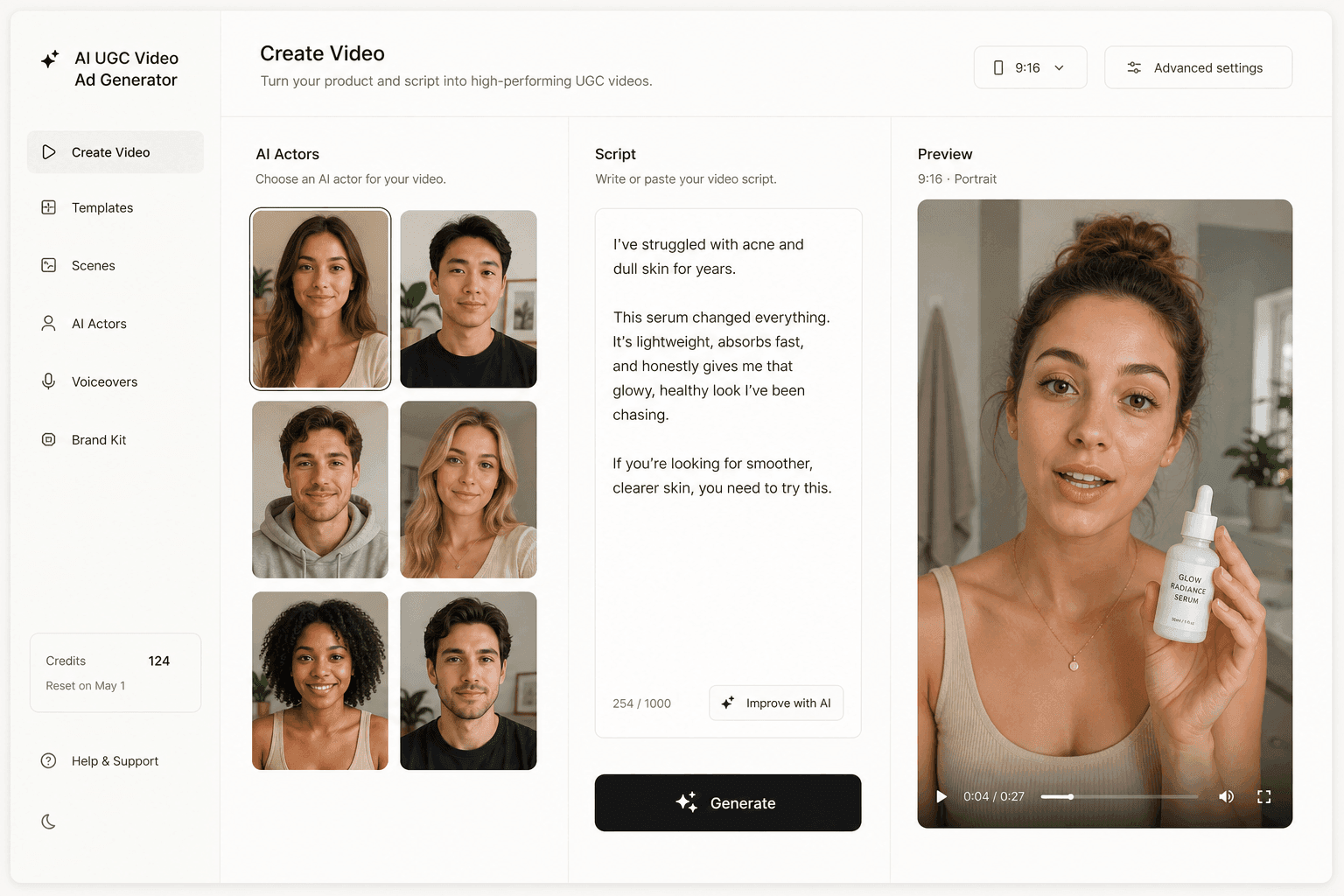
The platforms will keep rearranging the result page around your ad. Let them. Own the one thing no model can summarize away, a distinct creative that a real person believes, and produce enough of it to always have the next winner ready.
Frequently Asked Questions
What is Google testing with AI summaries in Search ads?
Google is testing the placement of AI-generated summaries inside sponsored results, appearing right below the ad description. The tested unit carries a disclaimer telling searchers the AI response is generated independently and can make mistakes, so they should double-check it. It was spotted publicly on July 1, 2026 and reported by Search Engine Roundtable. Google has run AI summaries on organic listings before, so extending the pattern to paid results is a logical next step, not a total surprise.
Will AI summaries replace my ad copy?
No. Your headline and description still run. What changes is the context around them: a Gemini-generated paragraph can now sit beside or below your ad and reframe the result in the searcher's eyes. Your copy is no longer the only voice in the ad slot, so it has to say something specific enough that a paraphrase cannot flatten it into the same sentence as every competitor.
Does this mean ad creative matters less now?
The opposite. When a model synthesizes and summarizes the words around your ad, the words become more interchangeable and the distinctive asset, the face, the demonstration, the hook, becomes the part that stands out. Google itself says the AI explainer is displayed alongside the advertiser's creative, not instead of it. The creative is the input the summary cannot rewrite.
How should I change my Google Ads strategy?
Keep letting Google's automated bidding optimize delivery, because that is what it is good at, and move your energy to the inputs you still control: sharper claims, more distinct creative, and enough variants to find winners. Judge performance on business outcomes like cost per acquisition and return on ad spend, not on surface clicks, because the AI layer changes how people move through the result.
Are AI-generated ad summaries labeled?
In the test spotted so far, yes. The summary appears with a disclaimer noting the AI response is generated independently and can make mistakes, and Google says its new AI ad formats stay clearly labeled as Sponsored. Disclosure is becoming standard across platforms, which is one more reason to keep your own creative honest and clearly attributable.
How do I produce enough creative to test at volume?
This is where AI UGC tools help. Instead of booking a shoot for every angle, you write or auto-generate a script, pick an AI actor, and render UGC-style video ads for about a dollar to $8 per clip of up to eight seconds, from a five-second Seedance 2.0 Mini clip to an eight-second Seedance 2.5 clip, or about $26 for a full 30-second Seedance 2.5 take. That cost curve is what makes testing ten or twenty variants realistic, which is the behavior that wins when the surface around your ad keeps changing.
Key Takeaways
- Google Ads is testing AI-generated summaries directly beneath sponsored search results, right below the description, with a disclaimer that the AI response is generated independently and can make mistakes.
- Google frames this as part of a wider shift: new Gemini-built ad formats where an independent AI explainer sits alongside the advertiser's own creative.
- When a machine paraphrases the result, generic copy blends in. Specific, extractable claims and distinctive creative are what survive summarization.
- The durable advantage is testing volume: finding one winner out of many cheap variants beats betting on a single hero asset the AI can reframe.
- Let Google's automated bidding handle delivery and own the one input it cannot rewrite, your creative feed, which AI UGC tools let you produce at about a dollar to $8 per clip of up to eight seconds, from a five-second Seedance 2.0 Mini clip to an eight-second Seedance 2.5 clip, or about $26 for a full 30-second Seedance 2.5 take.