Synthesia Review for Ads: The New Syren Beta and Who It Fits
Synthesia turns a script into a polished presenter video, and on October 9, 2026 it launched Syren in beta to build whole videos from a prompt or a document. Built from Synthesia's own dated pages and public ratings rather than hands-on use, this review covers what it does well for ads, where it falls short, and who should pick it.

Mauricio Valdivia
·15 min
Synthesia makes presenters. Feed ads often want creators.
Synthesia's own pages define its AI actor as "a digital presenter that delivers your script on video", and that line is still the right lens for judging it as an ad tool. Two launches this year changed how a Synthesia video gets made. Its October 9, 2026 blog post launched Syren in beta, a tool that builds a video from a description or a shared document. The July 15 post introduced Express-3, an avatar model that follows the sentiment of your script. Neither change makes the presenter look like a customer filming on a phone, which is the look a UGC-style ad borrows.
The verdict, up front: pick Synthesia when your ad is a polished presenter explaining a product, an offer or a launch, especially across several languages, or when the same subscription also has to carry training and internal video. Look elsewhere when the ad must look phone-filmed, with a creator holding your product, or when you want to buy one video at a time, which Synthesia does not sell.
How we built this review: we have not used Synthesia hands-on, and we made no account. Every Synthesia fact below comes from Synthesia's own dated pages (its blog, updates feed, help center and pricing page, read on October 21 and 22, 2026) or from public ratings, each with its date and review count. The Novoads side is a real render of the same ad type, one creator-style talking actor saying a short line, made on October 21, 2026.
What Synthesia is in October 2026
Synthesia sells AI video to business teams. You choose a presenter, paste or generate a script, and get a finished video of that presenter speaking it, with scenes and b-roll around them. Most of what Synthesia shipped in 2026 builds around that presenter.
Presenters from a script, in 140+ languages
The library is the product. Synthesia's AI-actors page offers 240+ ready-made AI actors and says their performances "can then speak any script in 140+ languages." It also says "All Synthesia AI actors are created using real actors who provide consent and are paid per video generated using their likeness." Past the stock library, there are three ways to put a face of your own on screen:
- Personal avatars. Synthesia's avatars page says you can "turn yourself into an AI avatar from a single photo" or record a brief video, before "recording a live consent statement". Its pricing FAQ says personal avatars are included with paid plans.
- Studio Express-1 avatars. A paid add-on at $1,000 a year for annual plans only, and the pricing page warns they "can take up to 10 days to process."
- Style avatars. Stylized and cartoon characters from the Avatar Builder, which the help center prices at 14 credits each.
The help center sorts the stock library into five types, from synthetic avatars that are "fully AI-generated and not based on any real person" to filmed ones. The one it rates highest, Express-1, is "built from professionally filmed footage of real actors" and, in Synthesia's words, delivers "the most realistic and consistent output of any stock Avatar type". Keep that sentence in mind for the ad question later: the most realistic Synthesia presenter is a studio presenter.
What changed between July and October 2026
Synthesia dates its changes on its blog, its updates feed and its help center. Read together, they show a busy quarter:
- July 15: a new Assistant, where you "drop in a prompt, files, or URLs" and it structures and scripts the video, plus Express-3, which Synthesia calls "our most advanced avatar model for lip sync, natural body movement and gestures."
- September 9: credits sold on their own, with automatic top-ups "so long-running jobs don’t fail when your balance runs low."
- September 15 and 16: curated b-roll featuring your avatar, "free on all plans", then Flux 3 b-roll of up to 20 seconds with synced audio.
- September 23: Synthesia MCP, to "create an on-brand Synthesia video without leaving ChatGPT or Claude."
- October 1: new plans. "Creator is renamed Pro," every plan includes 10 minutes of video a month, and video creation then uses about 100 credits per minute.
- October 9: Syren, launched in beta.
For an advertiser, three of these matter more than the rest: Express-3 for the presenter, the b-roll for everything around the presenter, and Syren for how fast a first cut appears.
Syren, the beta that builds the whole video
Synthesia's October 9, 2026 post, signed by its CTO Peter Hill, calls Syren "Synthesia’s new AI video creation tool." You describe a video or share material you already have (documents, images, videos, PowerPoints or YouTube links), "and it builds motion graphics, avatars and voiceover." Starting from a prompt or a document is not new at Synthesia, since the July Assistant already did it. What changes is the editor around the request:
- An agent that writes the video. "Syren’s agent writes the whole video as code and the rendering engine plays it back live," so the cut takes shape on screen while you watch.
- Edits by chat. A new editor with "playback, a transcript view and chat-based editing", so you ask for a change instead of starting over.
- Length and shape. Videos "can run up to three minutes, horizontal or vertical", and the help center names the sizes Wide 16:9 and Tall 9:16.
- Credits. "Syren is credit-based." At launch Synthesia gave everyone 2,000 Syren credits that "expire after one month". The pricing page we read on October 22 lists them by plan instead: 1,000 on Basic, 1,500 on Starter and on Pro, and 2,000 per user on Enterprise, each "limited time only". After they run out or expire, says the help center, Syren uses the standard credits in your account.
- Plans. The help center says "Syren is a beta feature" and lists it on the Basic, Starter, Pro and Enterprise plans, with a watermark on Basic.
Two details keep the launch in proportion. The engine is not new: the post says it "has been quietly powering motion graphics inside Synthesia since June", and Syren is the tool built on top of it. And brand learning is still a promise. Under "What’s coming", the post says Syren "will soon learn a company’s brand from its existing videos." Synthesia aims the result at "fast, creative enterprise video: launch videos, explainers and marketing content." Creator-style UGC ads are not on that list.
What Synthesia does well for ads
The strengths are real, and most of them arrived since mid-July.
Presenters that act on the script
Express-3 is Synthesia's answer to the stiff avatar presenter. The July 15 post says it "introduces more script-aligned gestures and movement, helping avatars feel less static and more human", that the new avatars "follow the sentiment of your script, so they can be happy, serious, neutral or friendly depending on what you've written," and that "Videos using Express-3 can generate up to 2x faster." Synthesia's updates page says Express-3 "is replacing Express-2 across the platform."
In an ad, delivery is the hook. A line read with the wrong energy loses the scroll in the first second, and a presenter whose face matches the words gives the script a chance. These are Synthesia's own claims, from what its post calls "internal head-to-head testing", and we did not test the output ourselves.
B-roll and action shots without a second tool
The bigger change for ad makers is everything around the presenter. Since November 2025, Synthesia's customizable avatars can "prompt for a short action clip to illustrate the point right after it’s spoken", with Synthesia's own examples including "place the device on the table". The pricing page charges 230 credits for each b-roll asset with action. September added three more layers:
- Curated b-roll. AI video clips featuring your avatar, matched to the scene and, per the updates feed of September 15, "free on all plans".
- Flux 3 clips. "Up to 20 seconds of B-roll with natively synced audio" from Black Forest Labs' model since September 16, with 720p, 1080p or 4K options since September 25.
- Other engines, priced per asset. The credits article, modified October 21, 2026, lists "1 Veo 3.1 video asset (with audio) = 460 credits" beside Gemini Omni and FLUX 3 clips.
Our reading: a product explainer cut as presenter, then action, then presenter again is now a one-tool job in Synthesia. That is a real strength for software, app and service ads, where showing the device or the screen does more work than showing a face.
One script, many markets and screens
Localization is where Synthesia's scale shows. Its AI actors speak "any script in 140+ languages," the help center lists a Portrait 9:16 size of 1080 by 1920 for "IG reels, TikTok, Stories", and its MP4 downloads come "in Full HD, 1920 x 1080." The avatars page names the ad job directly: "Generate and test multiple ad variations with AI avatar characters, without reshooting every time something changes." For a brand that runs one offer in eight markets, that is a short route from one approved script to eight localized versions with the same face.
When the winning ad already exists, dubbing carries it instead. The credits article prices one minute of AI dubbing at 80 credits with lip sync and 40 without, and the updates feed of September 30, 2026 adds that you can "add burned-in captions to dubbed videos in one click, so your localized content stays accessible and easy to follow, even with sound off." For an ad that may play muted in a feed, the captions step matters as much as the voice.
Where Synthesia falls short for ads
The limits come from two places: Synthesia's own help center, and the distance between a presenter and a creator.
The rough edges its own help center lists
Synthesia is candid in its help center, and the candor is useful. Its stock-avatar article, last modified September 2, 2026, says three things an ad buyer should plan around:
- "Express-3 is currently in staged rollout. Not all avatars or workspaces have access yet, and some rough edges are expected during this period".
- Lip sync problems "can occur across all Avatar types but are most common with Legacy and Expressive-labelled Avatars."
- "Some Express-2 and Express-1 stock Avatars may occasionally appear to look slightly away from the camera."
The July 15 post says both that Express-3 "is rolling out in stages" and that the full range is "available now for all users on all plans," so check which avatars your workspace has before you plan a campaign around Express-3. Syren adds a beta caveat of its own: "Review your video, including avatars and audio, before you share it." And while Syren "uses credits as you create and refine a video," neither the Syren post nor its help article, as we read them on October 22, 2026, gives a credit figure per video. Budget from the meter, not from a sticker price.
A presenter library, not a creator casting call
This gap decides most ad briefs, and it is a matter of design, not quality. Synthesia's AI-actors page says teams use its actors "for training, marketing, and explainer videos to produce professional content without cameras, actors, or studios," and the help center's top-rated stock type is filmed by professionals. The library is built to look produced. A UGC-style ad is built to look unproduced: a UGC creator talking to a phone at home, often with the product in hand.
Synthesia's route to the product is the action clip, a separate shot cut between lines and charged per asset. A personal avatar made from your own photo or recording can look more casual, but it carries one face: yours. A plan built on ten different creators holding the same serum in ten bathrooms is a different brief from the one Synthesia's pages pitch.
Two buying limits add to it:
- No single videos. The pricing FAQ answers "Can I pay per video?" with "No. Synthesia is based on monthly and yearly subscriptions."
- Basic is for trying, not for running ads. On the $0 Basic plan, "Videos carry a Synthesia watermark", and downloading your content is listed among what Starter adds. Syren videos made on Basic can be downloaded and shared only for the first two weeks.
Ad use depends on which avatar you pick
Synthesia's content rules have limited what its stock avatars may promote, and its November 13, 2025 post says so plainly. Videos made with its customizable, action-capable avatars "will be reviewed under the same rules that govern Custom Avatars, rather than the more stringent policy historically applied to Stock Avatars." The same post adds: "you couldn’t previously make videos for branding or business promotion purposes; with the new Avatars, that will now be possible."
That loosening covers the customizable avatars the post introduced. Before you build a paid campaign on any other stock presenter, read the content policy that applies to it today. Policy-based rejections also come up in the review summary below, so treat moderation as part of the production timeline, not an afterthought.
What reviewers say, with dates and counts
Ratings depend on where you look, and each one below is a reading on a date, not a fact about the product:
| Platform | Score | Reviews | Read |
|---|---|---|---|
| Trustpilot | 3.8, "Great" | 1,829 | October 21, 2026 |
| G2 | 4.6 out of 5 | 2,841 | Archived copy of October 9, 2026 |
| Product Hunt | 3.9 | 24 | October 21, 2026 |
On Trustpilot, 71% of those reviews were five-star and 14% one-star, and the profile showed "Hasn't replied to negative reviews." G2's live page refused our fetchers on October 21, 2026, so its figure comes from the Internet Archive's copy of October 9, which split the 2,841 reviews 80% five-star and 16% four-star. Product Hunt's sample is small, but its AI summary, read October 22, is specific. It says reviewers "mostly praise Synthesia for making polished videos quickly, with easy editing, realistic avatars and voices," and that "users report long waits for avatar creation and manual review, failed renders, account bans or policy-based rejections, weak refund handling, and slow support."
Our reading: the praise is about the output, and the complaints are about access and support. If a campaign date depends on a custom avatar, build in time for review and approval.
What Synthesia costs, in short
On October 21, 2026, Synthesia's pricing page showed US visitors Starter at $19 a month on monthly billing ($14 a month billed yearly), while dollar visitors outside its top price tier see $29; Pro was $89 a month on monthly billing for 6,000 credits, Basic is $0 with watermarked videos, and Enterprise is custom. Every plan includes 10 minutes of video a month, after which video draws about 100 credits a minute. Our Synthesia pricing guide works through every regional card and what one 30-second avatar ad costs on each plan.
Who Synthesia fits, and who should look elsewhere
The fit comes down to the ad's format, so here it is as two lists.
Pick Synthesia when
- Your ad is a presenter explaining something: a software feature, a B2B offer, an app walkthrough or a launch.
- You need the same ad in many languages from one script, with one consistent face.
- Your team also makes training, onboarding or internal video, so one subscription covers both jobs.
- You want a founder or spokesperson on screen without filming them each time, through a personal avatar.
- Your drafts start as documents or decks, and a beta tool (Syren) is acceptable in your workflow.
Look elsewhere when
- The ad has to look phone-filmed, like a customer's own video, rather than produced.
- Your angles need different people, ages and settings, each holding the product while they talk.
- You need a custom studio face this week: Studio Express-1 avatars "can take up to 10 days to process."
For presenter-style rivals, our HeyGen vs Synthesia comparison and Colossyan vs Synthesia breakdown price both sides from each vendor's own pages. For creator-style ad tools, start with the Synthesia alternatives we ranked by fit and cost.
How Novoads makes the same talking ad
Novoads makes UGC-style talking-actor ads: you pick a creator-style AI actor, write or generate the script, and get a video of that person saying it. We ran the same ad type through it to show the job, and the bill, plainly.
Our run: one Spanish line, one started minute
On October 21, 2026 we asked Novoads, through its MCP connector, for a 6-second Spanish line at 720p: library actor Nadia, library voice Ana Sofía, reading "Dos semanas con este sérum y por fin mi piel se ve despierta. Tres gotas en la noche, y listo." (Two weeks with this serum and my skin finally looks awake. Three drops at night, and done.)
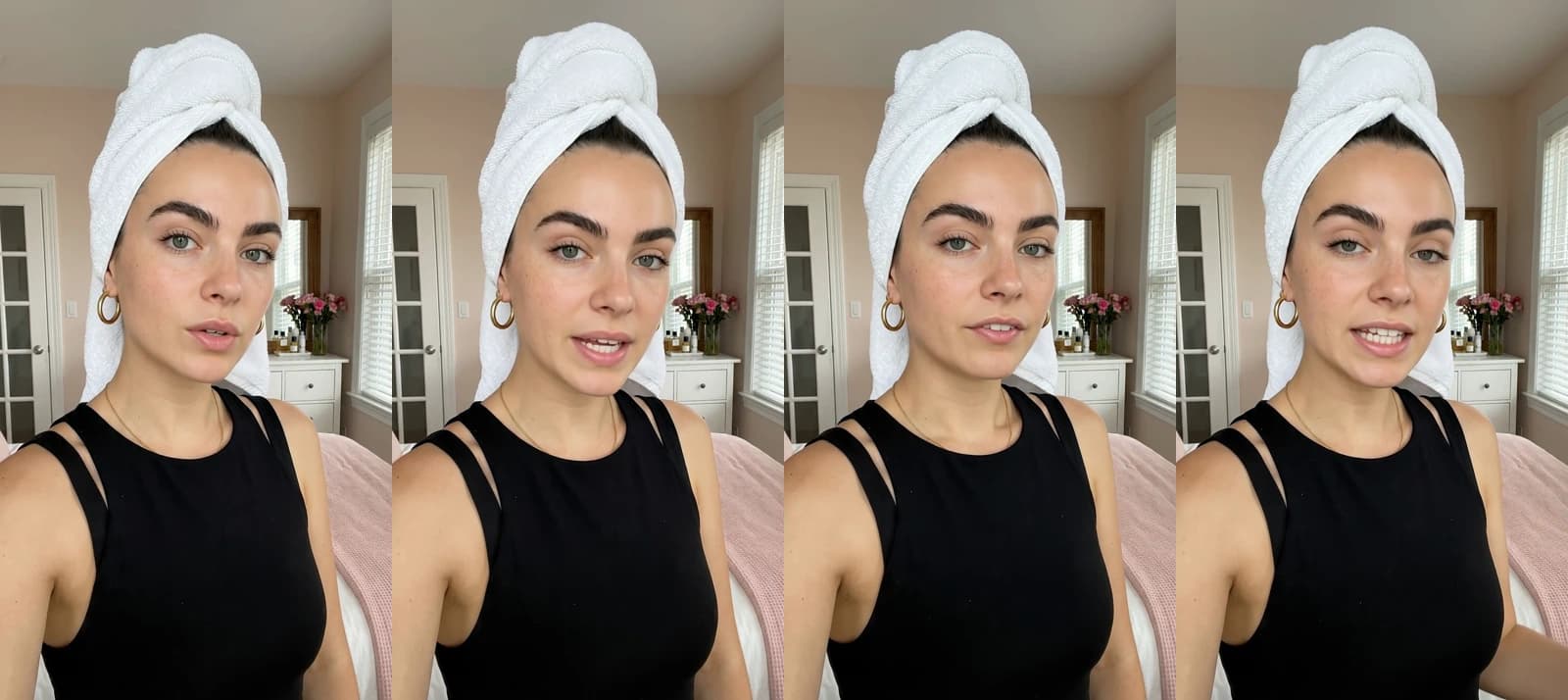 Talking actor · library actor Nadia says a 6-second Spanish line about a serum in the library voice Ana Sofía, made through the Novoads connector · 200 credits at 720p · rendered 2026-10-21
The clip came back in 72 seconds. A Whisper transcript with automatic language detection heard Spanish on its own and returned the line word for word. It cost 200 credits, and that number is the point of the test: a Novoads talking actor bills per started minute, so this 6-second clip cost what a 30-second or a 60-second ad would.
What the same 30 seconds costs on each side
Synthesia meters avatar video at about 100 credits a minute, so a 30-second presenter draws about 50 credits. On the US Starter card read on October 21, 2026 ($19 a month on monthly billing for 1,250 credits), that is well under a dollar of credits, and the first 10 minutes each month come before any credits at all. A Novoads talking actor costs 200 credits per started minute at 720p: $9.80 of a Plus month (Plus is $49 for 1,000 credits), or the whole 200-credit month on Starter ($15).
| One talking ad | Synthesia | Novoads |
|---|---|---|
| How it is metered | About 100 credits a minute | 200 credits per started minute |
| 30 seconds | About 50 credits | 200 credits |
| 60 seconds | About 100 credits | 200 credits |
| 30 seconds, in dollars | Under a dollar, US Starter | $9.80 on Plus |
The gap grows with volume. Synthesia's 10 included minutes alone cover about twenty 30-second presenter videos a month before a single credit is spent, while twenty Novoads talking-actor ads at 720p draw 4,000 credits.
Synthesia costs far less per talking minute, and we will not pretend otherwise. What is true on the Novoads side: a 60-second ad costs the same 200 credits as a 30-second one, the 480p option halves the price to 100 credits ($4.90 of Plus), and the Starter plan is $15 a month. Clips from the other video engines are priced by the second, from about 25 cents for a five-second Seedance 2.0 Mini clip to about $4 for an eight-second Google Veo 3.1 clip, and about $10 for a full 30-second Seedance 2.5 take. Every plan is on the Novoads pricing page.
Where Novoads fits instead
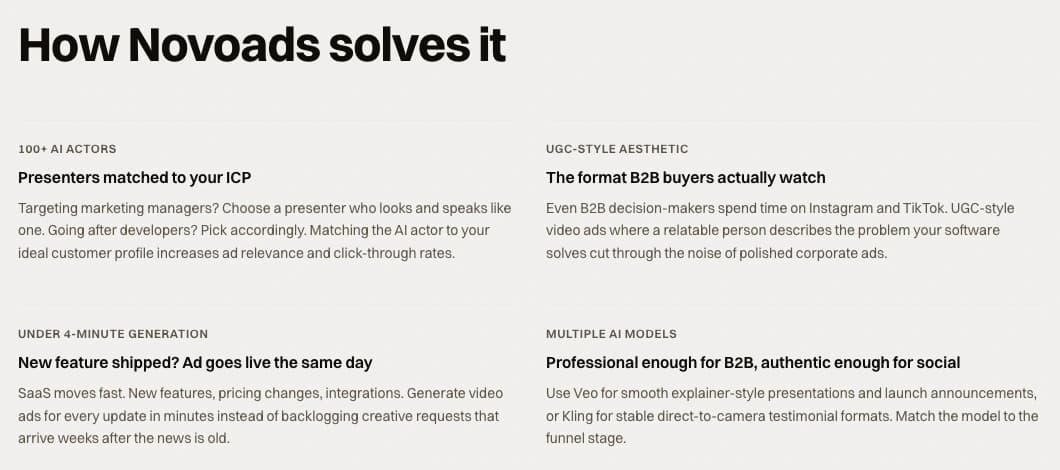 Screenshot: novoads.ai/use-cases/anuncios-video-ia-para-saas, the "How Novoads solves it" cards for SaaS video ads, including presenters matched to your buyer, taken 2026-10-22
That screenshot is our own SaaS ads page, the corner of the market where the two tools overlap most: a person explaining software to a buyer. Even there, Novoads leans toward the creator look over the studio look. Its 100+ AI actors are UGC-style, its voices cover 31 languages, and the same account runs Seedance 2.0, Seedance 2.0 Mini, Seedance 2.5, Kling v3 Pro, Google Veo 3.1 and Omni Flash.
A stock talking actor's hands are empty, so a product in hand takes one extra step. Upload a photo of someone holding your product to create a custom actor ("Transform a picture into a talking actor", in the app's words), or start from a Discover product template, which swaps your product into a template creator's hand and renders a 15-second Seedance 2.0 clip.
On realism we call it a tie at the engine level. Synthesia rents Veo 3.1 for its b-roll and Novoads sells Google Veo 3.1 among its engines, so realism comes from the engines more than from the brand. The talking-head pipelines are each vendor's own, which is why this review judges them by format rather than naming a winner. Synthesia also wins three rows outright: 140+ languages against voices in 31, 240+ ready-made AI actors against 100+, and a public review record in the thousands. For the full side-by-side on a creator ad, read our Novoads vs Synthesia comparison.
Polish is a format, not a verdict
Since July, Synthesia has given its presenter more expression and its editor more ways to start a video, and for a presenter ad it is a strong, well-reviewed choice at a low price per minute. What no tool can decide for you is whether your buyer trusts a presenter or a customer. Answer that first and the shortlist writes itself; if the answer is a customer, the Novoads and Synthesia comparison page is the next stop.
Frequently Asked Questions
Who are Synthesia's main competitors?
It depends on the ad. For presenter-style avatar video, the closest rivals are HeyGen and Colossyan, and we compared each with Synthesia from the vendors' own pages in September 2026. For UGC-style product ads, where a creator talks about the product as if filmed on a phone, the shortlist moves to creator-ad tools such as Novoads, Arcads and Creatify.
How expensive is Synthesia?
On October 21, 2026, Synthesia's pricing page showed US visitors Starter at $19 a month on monthly billing, or $14 a month billed yearly, with 1,250 credits a month; dollar visitors outside its top price tier see $29. Pro was $89 a month on monthly billing for 6,000 credits, Basic is $0 with watermarked videos, and Enterprise is custom. Every plan includes 10 minutes of video a month, and video then uses about 100 credits a minute.
Is Synthesia.io safe?
We can only report what is published, with dates. Synthesia's AI-actors page says its AI actors are created from real actors who consent and are paid per video made with their likeness (its help center also lists synthetic stock avatars that are fully AI-generated), and creating a personal avatar includes recording a live consent statement. On October 21, 2026, Trustpilot showed 3.8 from 1,829 reviews, 14% of them one-star, and an archived G2 page from October 9, 2026 showed 4.6 out of 5 from 2,841 reviews. Product Hunt's AI summary of its 24 reviews names account bans, weak refund handling and slow support among the complaints, so read recent reviews before you commit.
Is Synthesia good for UGC-style video ads?
It is strongest when the ad is a polished presenter talking to camera, in many languages. Synthesia's own pages describe its AI actors as digital presenters and aim its October 9, 2026 Syren beta at launch videos, explainers and marketing content. For an ad that has to look phone-filmed, with a creator holding the product, a UGC-focused tool is the closer fit. We have not used Synthesia hands-on; this is a reading of its own dated pages.
Key Takeaways
- Synthesia's October 9, 2026 post launched Syren in beta: describe a video or share a document and an agent builds it, up to three minutes long, billed in credits, with launch credits that expire after a month: 2,000 for everyone at launch, and 1,000 to 2,000 by plan on the pricing page we read on October 22.
- Prompt-to-video is not new at Synthesia, since its July 15, 2026 Assistant already took a prompt, files or URLs. What Syren adds is an agent that writes the video as code, plays it back live and takes edits in chat.
- For ads, Synthesia is strongest at polished presenters in 140+ languages, with Express-3 avatars that follow the script's sentiment and b-roll made inside the editor; its help center still called Express-3 a staged rollout with rough edges on September 2, 2026.
- Ratings are dated readings: Trustpilot 3.8 from 1,829 reviews and Product Hunt 3.9 from 24 on October 21, 2026, and G2 4.6 out of 5 from 2,841 in an archived copy of October 9.
- We have not used Synthesia hands-on. Per talking minute it costs far less than a Novoads talking actor, which bills 200 credits per started minute at 720p; it fits presenter ads, while phone-filmed creator ads fit a UGC tool better.