What Is GPT Image 2: OpenAI's Model Behind ChatGPT Images 2.0, Tested on Ads
GPT Image 2 is the image model OpenAI released on its API on April 21, 2026. Two newer versions have come out since, but it's still for sale. We made three ads with it and show the prompt, size and credits for each.

Mauricio Valdivia
·Updated ·13 min
Two versions later, OpenAI still sells GPT Image 2
GPT Image 2 is the image model OpenAI released on its API on April 21, 2026. Its changelog entry that day called it "a state-of-the-art image generation model for image generation and editing." But it isn't OpenAI's newest. GPT Image 2.5 followed on September 8 and GPT-Image-2.6 on November 4, and OpenAI's image guide now files GPT Image 2 under earlier models. You can still buy it, though, and no page we read gives it a shutdown date.
The two explainers that ranked first and second for this search didn't mention 2.5 or 2.6 when we checked. And none of the five results we could open showed a GPT Image 2 ad with its prompt, the size it came back at and what it cost. So we made three ads of our own and kept all of that for each, including the take where the model garbled a label.
We checked those results and read OpenAI's pages on November 5, 2026, using dated Internet Archive copies of the ones that turned us away (its launch posts, its help article, its usage policies and its terms). The ads are our own, made in Novoads on November 3 and 4.
What GPT Image 2 is, and where you can use it
One model with several names
GPT Image 2 makes and edits images. You give it a text prompt, add pictures as references if you want, and it gives you back an image. OpenAI's changelog adds that it "supports flexible image sizes, high-fidelity image inputs, token-based image pricing, and Batch API support with a 50% discount."
You'll see it written a few ways. OpenAI writes GPT Image 2 or GPT-Image-2, developers call it gpt-image-2 in their code, and ChatGPT Images 2.0 (or just Images 2.0) is what OpenAI called its April launch in ChatGPT. GPT-2 is a different thing altogether, despite the similar name.
What "ChatGPT Images 2.0" means
OpenAI's launch post, dated April 21, introduces ChatGPT Images 2.0. Its API section says "Developers and businesses can bring these same capabilities into the products they're developing to the API through gpt-image-2". That line is why our title says "behind", and the word is our own reading of it.
OpenAI's later posts put ChatGPT on newer versions, Images 2.5 from September 8 and Images 2.6 from November 4. So read "ChatGPT Images 2.0" as the name of the April launch. It doesn't tell you what ChatGPT runs now. OpenAI's ChatGPT Learn page on image generation does still say "Built-in image generation uses gpt-image-2 and counts toward your general Codex usage limits." But that sentence comes from a passage about Codex limits, so we don't stretch it to cover ChatGPT.
Where you can run it
| Where | What you get | How you pay |
|---|---|---|
| OpenAI's API | Generation, edits and Batch | By the token |
| Codex | Built-in image generation | Your Codex usage limits |
| Microsoft Foundry | The April 21 version, generally available | Through Azure |
| Novoads | Low, medium and high | Credits |
We left ChatGPT off that table for the reason above. In Novoads, you pick GPT Image 2 from the image model list in the dashboard. It's also the model behind our Product-to-Ad flow, which turns an uploaded product image into an ad at medium quality.
Is it free? OpenAI's pages don't agree
For ChatGPT, OpenAI's own pages give different answers, and we can't settle the question from them.
- The April 21 launch post (archived October 11) says Images 2.0 is "available starting today to all ChatGPT and Codex users."
- The help article (archived October 23) says "ChatGPT Images is available on all tiers."
- The Images 2.6 post, dated November 4, says it's available in ChatGPT and Codex "across all subscription tiers".
- The Codex pricing page, which we read on November 5, says "Image generation isn't available on the Free plan."
That last line comes from an answer about Codex usage, so it may only apply to Codex. OpenAI's ChatGPT Learn pages also say "Image availability and usage limits in ChatGPT web depend on your plan and workspace settings." So your own account is the place to check.
The API is simpler. OpenAI charges by the token, and the rate-limit table on its model page marks the Free tier as "Not supported". That's an API tier, and it tells you nothing about ChatGPT's plans. In Novoads, billing starts with the first month.
Two details for anyone building on the API
- Transparent backgrounds are still in preview. OpenAI's changelog entry of August 20 says they're "now available in preview", and its prompting guide still says so. That's why we wouldn't plan a cutout workflow around them yet.
- The model page marks the Responses endpoint "Not supported", while the same August entry names "the Responses API image generation tool". We read those as two different routes, a direct call to the model and a tool, and we haven't tried either one.
What OpenAI says it can do with words
OpenAI's launch post says Images 2.0 can "render the fine-grained elements that often break image models: small text, iconography, UI elements, dense compositions, and subtle stylistic constraints".
Words are the part of an ad we'd worry about most, so we tested them first. We asked for five exact strings at medium, and this take got all five right. You'll find its prompt with the other two ads, in the section on our runs.
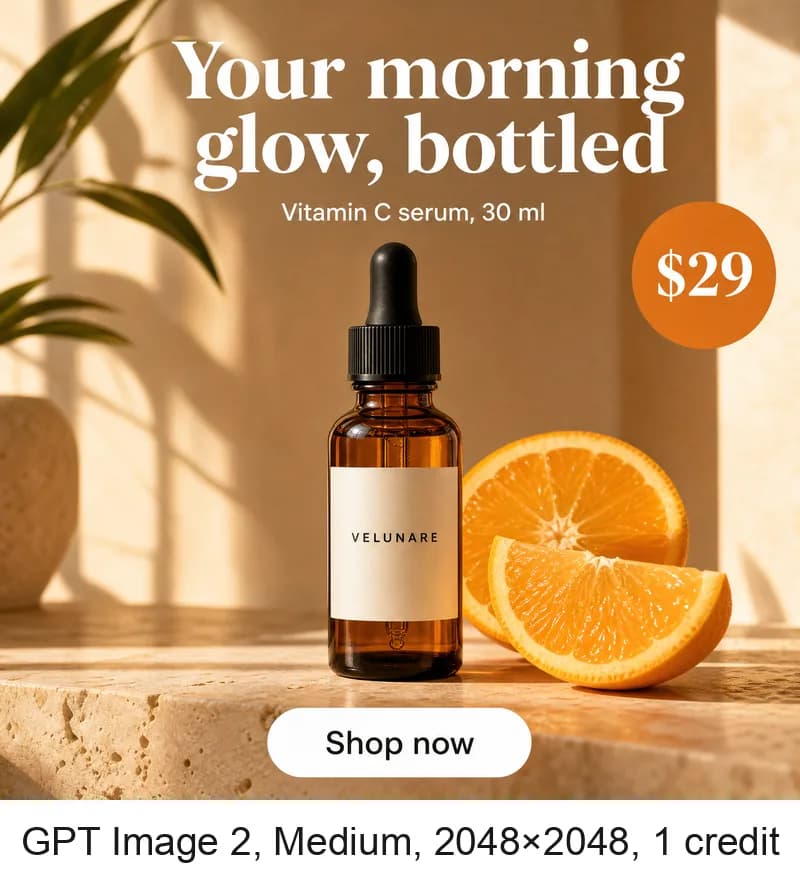
GPT Image 2 at medium · square serum ad with five text strings · 2048 x 2048 · 1 credit · 103 seconds · made in Novoads 2026-11-04
Where OpenAI files GPT Image 2 now
Under earlier models, for work that already exists
OpenAI's image guide puts GPT Image 2 in a section on earlier models and says "For new integrations, use one of the GPT Image 2.5 models described above." Its prompting guide says of GPT Image 2, "Use this reference to maintain existing integrations."
The two guides point to different versions, though. The image guide says 2.5. The prompting guide starts you on 2.6, and it sends a workflow that "meets your quality requirements" to 2.6 Flare and one that "falls short on a complex task" to 2.6 Sunburst.
April's phrase is still up, too. The model page says "GPT Image 2 is our state-of-the-art image generation model". Given where the guides now send new work, we read that as a label left in place, and we don't repeat it as our own.
No shutdown date on any page we read
OpenAI's deprecations page has no row that removes gpt-image-2. Older GPT Image models do have one, and OpenAI removes gpt-image-1.5, gpt-image-1-mini and chatgpt-image-latest from the API on December 1, 2026. And when DALL-E 2 and DALL-E 3 were removed on May 12, OpenAI's changelog recommended gpt-image-2 as one of the replacements, as we covered in our post on DALL-E 3 leaving the API.
We'd call it an older model you can still buy. Nothing we read says it's being retired.
What GPT Image 2.5 added
GPT Image 2.5 came out on September 8 as two models, Sunburst and Flare, and our post on GPT Image 2.5 for ad creative goes through the pair.
- OpenAI's changelog says both add new "xhigh" and "max" quality settings and "use GPT Image 2 token rates".
- OpenAI's pages disagree about Flare. The launch post (archived October 21) says it delivers "higher-quality images" than GPT Image 2 at "50% lower latency". The prompting guide describes it as having "image quality comparable to GPT Image 2".
- In Novoads, Sunburst and Flare each cost 1 credit for low or medium and 2 for high. GPT Image 2 costs 4 at high, but OpenAI warns that "The same quality label does not imply the same image quality or response time across models."
What GPT Image 2.6 added
OpenAI's changelog says GPT-Image-2.6 Sunburst and Flare came out on November 4, "with adjustable complexity, SVG generation, and animated GIF generation." You can pick both in Novoads for still images, at the same credits as 2.5, but their GIF and SVG output and the complexity setting aren't offered there. Our post on GPT Image 2.6 for ads covers the release and what it costs next to 2.5.
Three ads we made with it, prompts included
We ran these through the Novoads connector on November 3 and 4. Each is a single take, so it shows what happened that time and can't give you a success rate. The sizes are what those runs returned, and they aren't a promise for every shape or for the dashboard. The times are rough, since other jobs were running on our side, and there are none on file for the November 3 takes.
| Ad | Quality and shape | Came back at | Credits | Time |
|---|---|---|---|---|
| Serum | Medium, 1:1 | 2048 x 2048 | 1 | 103 seconds |
| Serum | High, 1:1 | 2880 x 2880 | 4 | 100 seconds |
| Cold brew can | Low, 2:3 | 1024 x 1536 | 1 | Not on file |
| Cold brew can | Medium, 2:3 | 1536 x 2304 | 1 | Not on file |
| Cold brew can | Low, 1:1 | 1024 x 1024 | 1 | Not on file |
| Cold brew can | Medium, 1:1 | 2048 x 2048 | 1 | Not on file |
| Selfie | High, 9:16 | 2160 x 3840 | 4 | 84 seconds |
Our guide to GPT Image 2 prompts covers how to write briefs like these.
Five exact strings on a square serum ad
This is the ad from the first section. Our prompt asked for one headline, one product line, one price badge and one button, plus a brand name on the label.
Create a square social media ad for a skincare brand called Velunare (spelled V-E-L-U-N-A-R-E). A 30 ml amber glass dropper bottle of vitamin C serum stands on a warm beige stone surface in soft morning window light, with two orange slices beside it. The bottle's label reads "VELUNARE" in small black capital letters. Put this text in the image, each line exactly once and spelled exactly as written: the headline "Your morning glow, bottled" in a bold white serif font across the top; the line "Vitamin C serum, 30 ml" in a small clean sans-serif font under the headline; a round orange price badge reading "$29" at the upper right; a rounded white button reading "Shop now" at the bottom center. No other text, no watermarks, no extra logos. Clean premium beauty ad design, warm orange and cream color scheme.
At medium, for 1 credit, all five strings came back spelled right, once each. We also ran it once at high, for 4 credits. That take got all five right too. One take apiece can't prove that medium is as good as high, but on this ad the words gave us no reason to pay for high.
Low against medium on a cold brew can
Both tiles in this strip came from one prompt of ours, run at 2:3. Each cost 1 credit.
Create a premium product ad for a brand called Tidewell, a small-batch cold brew coffee sold in a matte black can. The audience is busy commuters aged 25 to 40 who want good coffee without waiting. Show one can standing on a wet granite counter by a sunny kitchen window, with condensation on the can and a few coffee beans beside it. Photorealistic, soft morning light from the left, warm color direction, the can in the lower two thirds with clear space above it. The can label reads "TIDEWELL" (T-I-D-E-W-E-L-L). Render the headline "Cold brew, zero wait." exactly once at the top in bold white sans-serif letters, clearly and legibly. No other text, no watermarks, no unrelated logos.
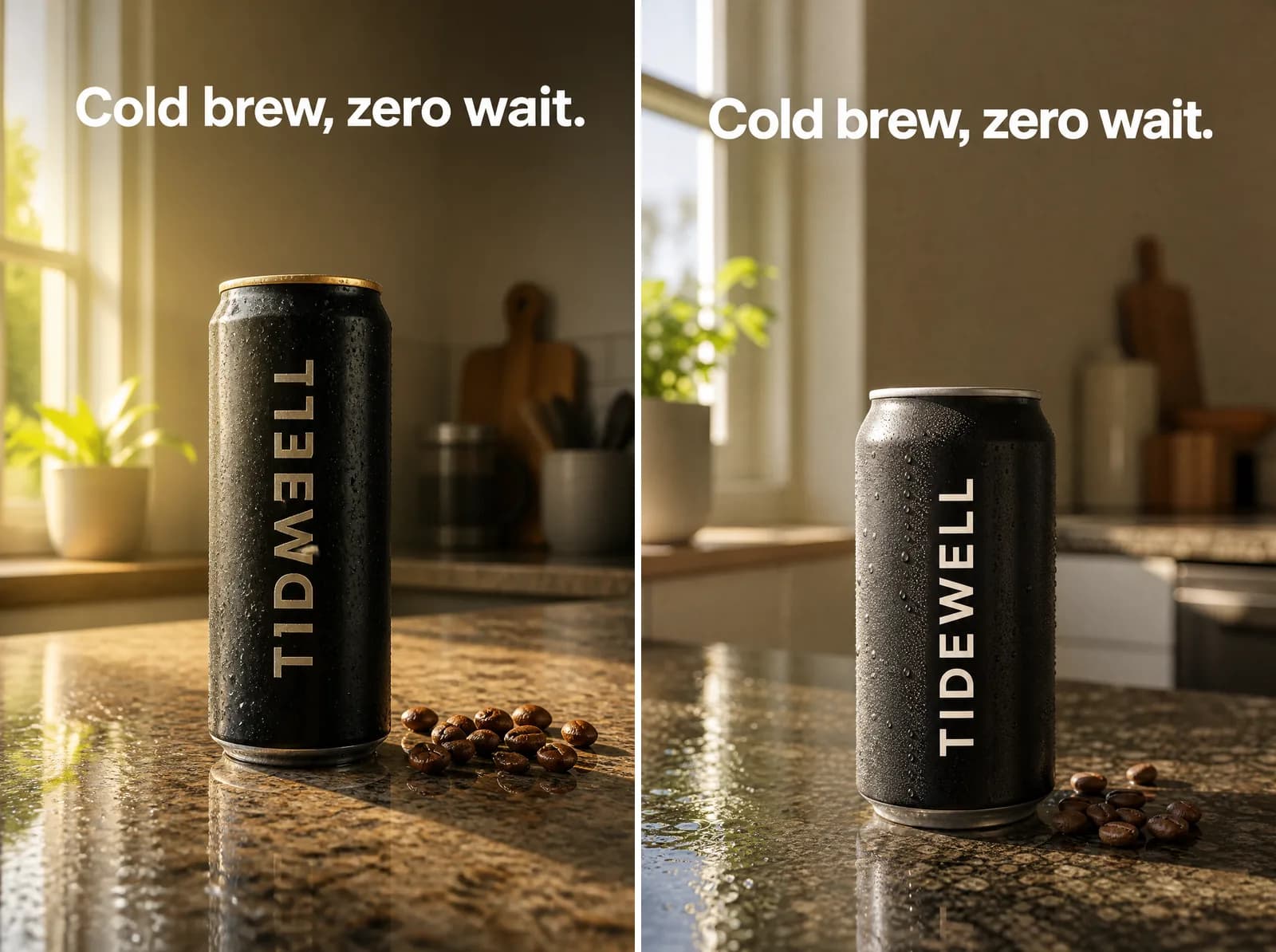
GPT Image 2 · one cold brew can prompt at 2:3 · low on the left (1024 x 1536), medium on the right (1536 x 2304) · 1 credit each · made in Novoads 2026-11-03
All four takes got the headline right. At low, the model garbled the can's label in the 2:3 take (the one on the left) and spelled it right in the 1:1 take. At medium, it spelled the label right in both. Two takes per quality are too few for a rate, but we know which of the two we'd run.
We'd planned a high take of this ad too. But runs at high failed five times on November 3 (each failure was refunded), so we have no high image of it. On November 4, runs at high went through with no failures.
A phone selfie beside Nano Banana Pro
Only the left-hand tile here is GPT Image 2. On the right is Nano Banana Pro, another model we sell, given the same prompt, and the full run is in GPT Image 2 vs Nano Banana Pro.
A candid front-camera selfie taken on a smartphone by a woman in her late twenties in a small bright bathroom in the morning. She smiles slightly and holds a white tube of hand cream next to her cheek with the label toward the camera; the label reads "SOFTLY" (spelled S-O-F-T-L-Y) in simple black capital letters. Natural window light, real skin texture, a slightly messy counter with a toothbrush cup behind her, casual grey t-shirt. It should look like an unedited phone photo a real customer posted, not a studio shot. The only text in the image is "SOFTLY" on the tube, exactly once. No other text, no watermarks, no logos.
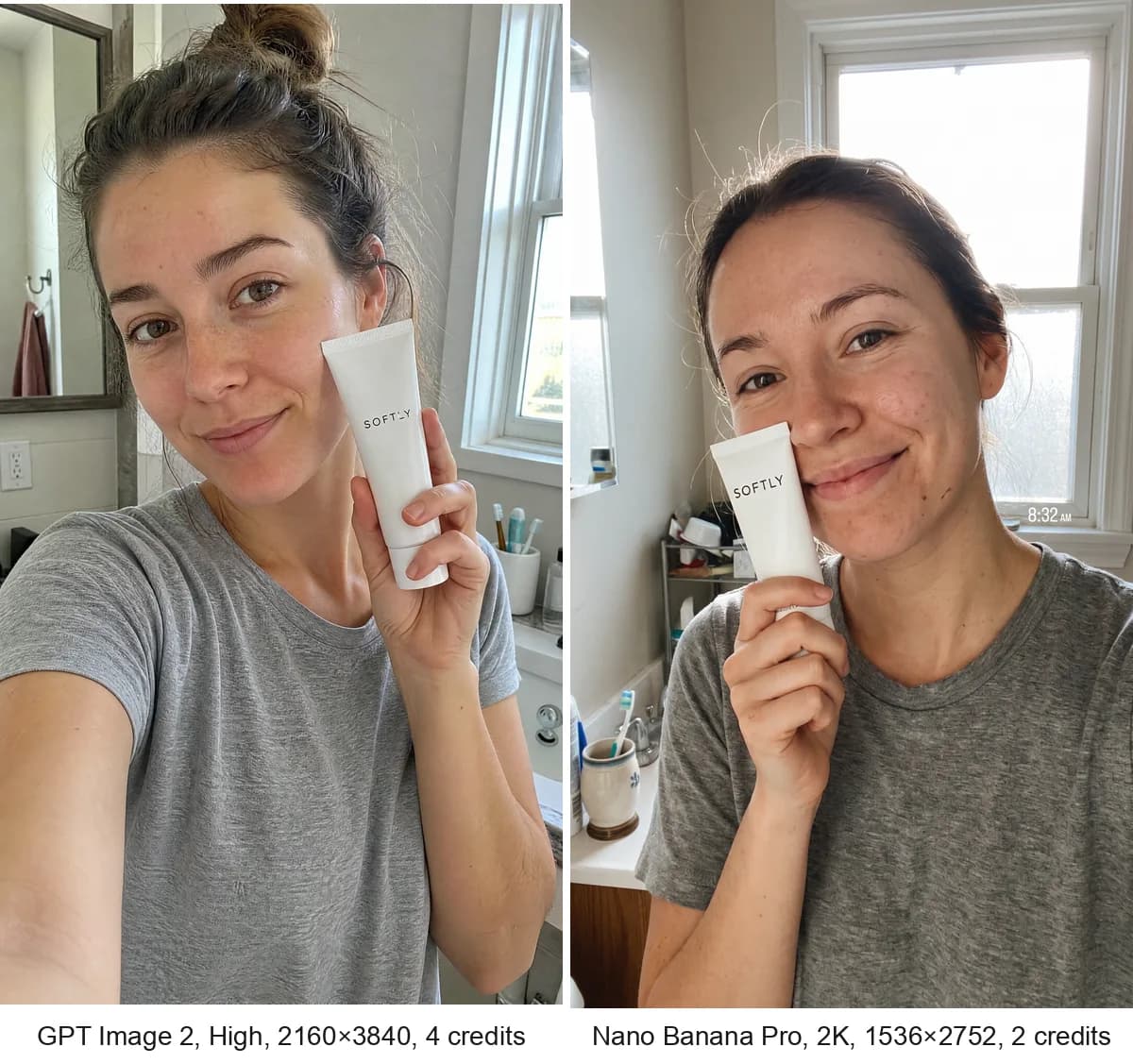
Left, GPT Image 2 at high · 2160 x 3840 · 4 credits · 84 seconds. Right, Nano Banana Pro at 2K, which isn't GPT Image 2 · 1536 x 2752 · 2 credits · 56 seconds. One prompt, the person invented from it, made in Novoads 2026-11-04
We didn't give either model a reference photo, so the person in each tile was invented from the prompt. GPT Image 2 kept the text to the one label, though the L came out smudged. Nano Banana Pro spelled the label clean but added a time stamp and a row of tiny garbled characters that nobody asked for. We'd clean up both before running either one.
What OpenAI warns about, and what it means for an ad
OpenAI's image guide lists limits for its GPT Image models.
- It says the model "can still struggle with precise text placement and clarity". For dense copy or production-critical typography, ChatGPT Learn tells you to "review every word and finish the asset in a design tool when needed." Our garbled label and our smudged L fit that warning.
- It warns about keeping "recurring characters or brand elements" consistent "across multiple generations". You'd want to test that before you build a campaign on one face or one logo.
- It says the model "may have difficulty placing elements precisely in structured or layout-sensitive compositions."
- It says "Complex prompts may take up to 2 minutes to process." Our timed takes ran 84 to 103 seconds.
- On size, the April launch post says "at up to 2K resolution in the API". The guide now lists 3840 x 2160 and 2160 x 3840 among popular sizes for GPT Image 2. It labels both 4K, and our selfie came back at the second one. For the 2.5 models, the guide adds "Resolutions above 2560x1440 are experimental." Its GPT Image 2 table has no such sentence, so we don't know if the caution carries over.
- On reference pictures, the guide's example uses 4 input images, but that's an example and doesn't set a limit. In Novoads, you can give GPT Image 2 up to 4. OpenAI also says "edit requests that include reference images can use more input tokens", because the model always processes those pictures at high fidelity.
Can you run its images as ads?
OpenAI's Terms of Use cover ChatGPT and its other services for individuals. The version effective January 1, 2026, in a copy from November 5, says "As between you and OpenAI, and to the extent permitted by applicable law, you (a) retain your ownership rights in Input and (b) own the Output." It also warns that "output may not be unique and other users may receive similar output", so another brand could end up with an image close to yours.
OpenAI's usage policies set the limits. The version effective November 20, 2026 (we read a copy from November 3) rules out a long list of uses. An advertiser is likeliest to run into these.
- "use of someone's likeness, including their photorealistic image or voice, without their consent in ways that could confuse authenticity"
- "attempts to infringe on intellectual property rights of others"
- "deceit, fraud, scams, spam, or impersonation"
- "political campaigning"
ChatGPT Learn adds three practical notes.
- When you depict a real person, "confirm that you have permission to use their likeness."
- "Request a generic or original design instead of imitating a specific brand, product, artist, or artwork."
- "You do not need to credit OpenAI for generated images".
Novoads makes the ad, and you run it on your own accounts, so those calls are yours to make. Our pricing FAQ's line on commercial use is about videos ("All videos generated with Novoads are fully licensed for commercial use."), so we don't cite it for these images.
What you pay for an image, at OpenAI or with us
Prices as of November 5, 2026. OpenAI's image guide prices image output for a 1024 x 1024 GPT Image 2 image by quality. Low is $0.006 and medium is $0.053. High is $0.211. Input tokens come on top, since "You should still account for text and image input tokens when estimating the total cost of a request." The other sizes, Batch and the plan math are in our GPT Image 2 pricing post.
In Novoads, a low or medium image costs 1 credit and a high image costs 4 credits, whatever the shape. The dollar amounts per image in the table are our own arithmetic from each plan's price.
| Plan | A month | Credits | A credit | Low or medium | High |
|---|---|---|---|---|---|
| Starter, monthly only | $15 | 200 | $0.075 | About 8 cents | 30 cents |
| Plus | $49 | 1,000 | $0.049 | About 5 cents | About 20 cents |
So which one should you pay for?
- If you're a developer who wants a lot of low-quality images, OpenAI's API is the better buy. It's far cheaper at low, and that's where we'd send you.
- At medium and high, a 1024 x 1024 image on the API comes in close to the Plus rate before you add input tokens.
- If you want the ad without the integration, Novoads is the better fit. You don't need an API key or any code, you choose the quality and shape in the dashboard, and your credits pay for video ads, talking actors and voiceovers as well.
Novoads is paid from the first month. You can cancel anytime from the customer portal, and our pricing page lists every plan.
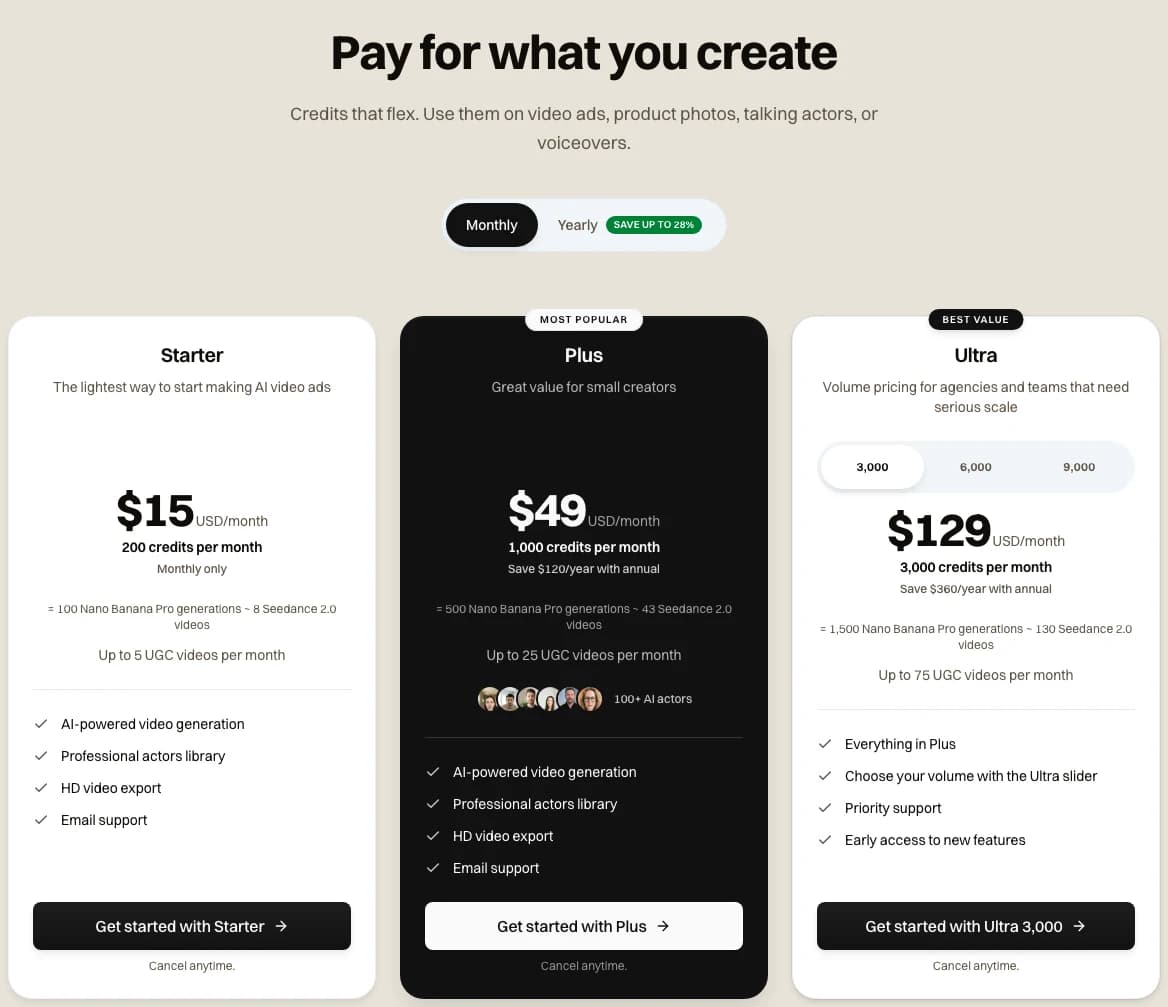
Screenshot: the Novoads pricing page with Monthly selected, taken 2026-11-05
Put GPT Image 2 on your next static ad
Choose low, medium or high in Novoads and pay in credits, with no API key and no code.
See the plansWhere we'd start with this model
We'd start an ad on medium. Low costs the same 1 credit in Novoads. But it's the quality that garbled a label on one of its two takes, so we wouldn't pick it for an ad with words on it. We'd only move up to high when a medium take misses something you can point to. High costs four times the credits, and on our one high serum take the words came out no more accurate than at medium.
We wouldn't start a new API integration on GPT Image 2, because OpenAI's own guides send new work to 2.5 or 2.6. If you already have one that works, the prompting guide's word for it is "maintain", and nothing we read gives you a date to leave by.
Whichever you pick, read every word at full size before the ad runs. We caught the garbled label and the smudged L by looking, and OpenAI's own pages tell you to do the same.
Frequently Asked Questions
Is GPT Image 2 free to use?
Not on OpenAI's API. You pay by the token there, and the rate-limit table on OpenAI's model page marks the Free tier as not supported. ChatGPT is less clear, because OpenAI's own pages disagree. Its help article, as archived on October 23, 2026, says ChatGPT Images is open to every tier, but its Codex pricing page says image generation isn't available on the Free plan. Novoads is paid from the first month.
How much does GPT Image 2 cost?
As of November 5, 2026, OpenAI's image guide lists the image output price of one 1024 x 1024 image at each quality. Low is $0.006 and medium is $0.053. High is $0.211, and input tokens come on top. Our GPT Image 2 pricing post has the other sizes. In Novoads, a low or medium image costs 1 credit and a high-quality image costs 4.
Is GPT Image 2 good?
For words on a static ad, it did well in our runs. At medium and at high, it spelled five text strings right, once each, on one take apiece. It isn't perfect, though. At low, it garbled a can's label on one of two takes, and one letter came back smudged on a selfie made at high. OpenAI's image guide also warns that the model can still struggle with precise text placement and clarity, and for new integrations it now says to use GPT Image 2.5.
How do I get GPT Image 2?
On OpenAI's API it's the model called gpt-image-2, and OpenAI's ChatGPT Learn pages say Codex's built-in image generation uses it. Microsoft Foundry's catalog lists it too. To use it without code, you can pick it in Novoads on a paid plan. OpenAI's later posts put ChatGPT on Images 2.5 and then 2.6, so don't count on getting this exact model in ChatGPT.
Key Takeaways
- GPT Image 2 is the image model OpenAI released on its API on April 21, 2026. Its changelog entry that day called it a state-of-the-art image generation model.
- It isn't OpenAI's newest. GPT Image 2.5 came out on September 8 and GPT-Image-2.6 on November 4, and OpenAI's image guide now lists GPT Image 2 under earlier models. No page we read gives it a shutdown date.
- ChatGPT Images 2.0 is what OpenAI called its April launch, and its later posts put ChatGPT on Images 2.5 and then Images 2.6. So the name doesn't tell you what ChatGPT runs now.
- In our single takes, the model spelled five text strings right at medium, for 1 credit. At low, it garbled a can's label on one of its two takes. Runs at high failed five times on November 3, and each failure was refunded. On November 4, runs at high went through with no failures.
- OpenAI's API is far cheaper at low, at $0.006 of image output for a 1024 x 1024 image. In Novoads, low and medium images cost 1 credit each and high images cost 4, on plans paid from the first month.
Sources
- •OpenAI: API changelog
- •OpenAI: GPT Image 2 model page
- •OpenAI: image generation guide
- •OpenAI: image prompting guide
- •OpenAI: deprecations
- •OpenAI: Introducing ChatGPT Images 2.0 (archive copy of October 11, 2026)
- •OpenAI: Introducing ChatGPT Images 2.5 (archive copy of October 21, 2026)
- •OpenAI: Introducing Images 2.6 (archive copy of November 5, 2026)
- •OpenAI: Images in ChatGPT help article (archive copy of October 23, 2026)
- •OpenAI: usage policies (archive copy of November 3, 2026)
- •OpenAI: Terms of Use (archive copy of November 5, 2026)
- •ChatGPT Learn: image generation
- •ChatGPT Learn: Codex pricing
- •Microsoft Foundry: gpt-image-2