GPT Image 2 Pricing: $0.211 a High-Quality Square, and Ad Costs
OpenAI lists $0.211 for one high-quality GPT Image 2 square, image output only. We price a square, a portrait and a 9:16 ad, then put Novoads' credits next to them.

Mauricio Valdivia
·12 min
Two settings can make one ad image cost about 40 times as much
OpenAI's image generation guide lists $0.211 for one high-quality 1024 x 1024 GPT Image 2 image. Change the quality to low and the size to 1024 x 1536, and the same table lists $0.005. Both figures count image output only. And OpenAI keeps them among its older-model pricing examples while it points new work to GPT Image 2.5.
None of the top results we could open for this search puts OpenAI's figures for a square, a portrait and a 9:16 ad image next to an ad tool's price per image, and none says OpenAI now lists GPT Image 2 under earlier models. So we did both. OpenAI's figures, in US dollars, come from its guide and pricing page, which we read from Spain on November 3, 2026. We didn't test OpenAI's API for this post. The Novoads side comes from our own price list and four runs of one ad prompt.
So what does one ad cost? By our arithmetic, a creative in three shapes at medium quality comes to about 13 cents of image output on OpenAI's API, before input tokens. In Novoads, the same three images cost 3 credits. That's 14.7 cents on our Plus plan or 22.5 cents on Starter.
What OpenAI's guide lists for GPT Image 2
These are list prices as of November 3, 2026, per image, in US dollars, at OpenAI's Standard rate. They count image output only.
| Quality | 1024 x 1024 | 1024 x 1536 | 1536 x 1024 |
|---|---|---|---|
| Low | $0.006 | $0.005 | $0.005 |
| Medium | $0.053 | $0.041 | $0.041 |
| High | $0.211 | $0.165 | $0.165 |
Why you have to open a section to see them
The table doesn't show when the page loads. OpenAI keeps it in a closed section called "Older-model pricing examples", under the heading "Earlier GPT Image models". That part of the guide opens with "The details below apply to earlier models, not Sunburst or Flare. For new integrations, use one of the GPT Image 2.5 models described above."
We read that as OpenAI filing GPT Image 2 as an older model it still sells. So $0.211 is a real list figure, but we wouldn't call it OpenAI's headline image price, and GPT Image 2 isn't the model OpenAI recommends today.
The figure isn't new, either. The Internet Archive's copy of the guide from April 26, 2026, already shows it, and OpenAI's changelog dates GPT Image 2 to April 21, 2026, with token-based pricing from the start. We found no price change for the model in the changelog since then.
Where $0.211 comes from
OpenAI bills GPT Image 2 by the token. Its pricing page lists these Standard rates per million tokens, and you may need to open "All models" on that page to see the row.
| Tokens | Input | Cached input | Output |
|---|---|---|---|
| Image | $8.00 | $2.00 | $30.00 |
| Text | $5.00 | $1.25 | None listed |
OpenAI's calculator gives 7,024 output tokens for a high-quality 1024 x 1024 image. At $30 per million, that's $0.21072. The table rounds it to $0.211.
Size doesn't behave the way you'd guess. The 1024 x 1536 portrait has more pixels than the square but costs less at every quality level. OpenAI's guide says "A larger non-square resolution can sometimes produce fewer output tokens than a smaller or square resolution at the same quality setting."
OpenAI's pages spell the model GPT Image 2, gpt-image-2 and GPT-Image-2, and its April launch post called the ChatGPT side ChatGPT Images 2.0. GPT-2 and GPT-3 come up in the same search, but they're older language models and aren't on this price list.
What one ad image costs on OpenAI's API
OpenAI says GPT Image 2 "supports thousands of valid resolutions" and that its table lists "the same sizes used for previous GPT Image models for comparison". So there's no figure for 4:5 or 9:16. We worked those two out with the formula in OpenAI's calculator, at $30 per million output tokens. OpenAI wants both edges in multiples of 16 pixels. That rules out 1080 x 1920, so our 9:16 row uses 1088 x 1920.
| Ad shape | Size | Low | Medium | High |
|---|---|---|---|---|
| Square, 1:1 | 1024 x 1024 | $0.006 | $0.053 | $0.211 |
| Portrait, 2:3 | 1024 x 1536 | $0.005 | $0.041 | $0.165 |
| Feed, 4:5 (our arithmetic) | 1024 x 1280 | about $0.005 | about $0.045 | about $0.184 |
| Story or Reel, 9:16 (our arithmetic) | 1088 x 1920 | about $0.004 | about $0.040 | about $0.159 |
Our guide to static ads covers which shape goes where. The ad example in OpenAI's prompting guide uses 1024 x 1536 at medium, which this table lists at $0.041 (OpenAI's sample pictures there come from GPT Image 2.5). For how to write a prompt like that, see our GPT Image 2 prompt guide.
One ad in three shapes
We counted one creative as a square, a 2:3 portrait and a 9:16, with one take of each, at the Standard rate. All of this is our arithmetic, and it counts image output only.
- Low comes to about $0.015.
- Medium comes to about $0.134.
- High comes to about $0.53.
You'll probably run more than one take of each, so multiply by the takes you expect to pay for.
What those figures leave out
Right above its table, OpenAI says "You should still account for text and image input tokens when estimating the total cost of a request." Four charges can land on top of those figures.
- Text input is $5.00 per million tokens. A 200-token prompt adds about $0.001, by our arithmetic.
- Image input, for a product photo or any other reference, is $8.00 per million tokens. OpenAI says "image input tokens can be higher for edit requests that include reference images", because GPT Image 2 always processes those images at high fidelity.
- Streamed partial images add 100 image output tokens each, about $0.003 by our arithmetic.
- If you send a request through the Responses API, you also pay for the mainline model's tokens.
We found no published rule for counting reference-image tokens on GPT Image 2, so you'd have to measure that charge from the usage figures each API response returns. It's the one we'd watch on a product ad, since those usually start from a product photo.
Batch, regional processing and cached input
Three more settings change the bill, and the table shows none of them.
- Batch cuts it in half. The Batch rate is $15.00 per million output tokens, which makes the high square about $0.105 by our arithmetic.
- Regional processing adds to it. OpenAI charges "a 10% uplift" on data residency endpoints for eligible models released on or after March 5, 2026, and it lists GPT Image 2 for processing in the United States and Europe. By our reading, that covers this model and takes the high square to about $0.232. The uplift follows the endpoint you choose, so where you live doesn't trigger it.
- Cached input only helps in one place. OpenAI says cached pricing "applies only to the image generation tool in the Responses API" and "doesn't apply to direct Images API requests".
GPT Image 2 or GPT Image 2.5?
OpenAI's advice for new work is direct. Its prompting guide says "For a new workflow, start with GPT Image 2.5 Flare when speed is the priority, or GPT Image 2.5 Sunburst when demanding quality requirements are the priority." Its GPT Image 2 reference says "Use this reference to maintain existing integrations."
That advice doesn't come with a shutdown date. When we read OpenAI's deprecations page, it had no shutdown row for GPT Image 2. The older GPT Image models it does name, including GPT Image 1.5 and GPT Image 1 Mini, leave the API on December 1, 2026.
Same token rates, different image prices
OpenAI's changelog says Sunburst and Flare "use GPT Image 2 token rates", and its guide warns that "Equal token rates don't mean equal cost per image". OpenAI doesn't publish a per-image table for GPT Image 2.5, so that column below is our arithmetic, from the guide's calculator, at 1024 x 1024 and for image output only.
| Quality | GPT Image 2 | GPT Image 2.5 (our arithmetic) |
|---|---|---|
| Low | $0.006 | about $0.006 |
| Medium | $0.053 | about $0.013 |
| High | $0.211 | about $0.053 |
| Xhigh | Not offered | about $0.094 |
| Max | Not offered | about $0.211 |
The labels don't compare straight across. As OpenAI puts it, "The same quality label does not imply the same image quality or response time across models." It describes Flare as having "image quality comparable to GPT Image 2" and Sunburst as having "higher image quality than GPT Image 2".
On a new ad, we'd test GPT Image 2.5 first, and we'd keep GPT Image 2 wherever a prompt you've already proven still does the job. GPT Image 2.5 for ad creative goes further into both models.
ChatGPT and the API are two separate bills
Which model you get depends on where you ask, so we keep the two apart.
- In the ChatGPT app, OpenAI's help article describes ChatGPT Images 2.5 and says "ChatGPT Images is available on all tiers". We read it in an Internet Archive copy from October 23, 2026.
- In ChatGPT Work and Codex, OpenAI's ChatGPT Learn docs say "Built-in image generation uses gpt-image-2 and counts toward your general Codex usage limits", and that image generation "isn't available on the Free plan".
How much image generation comes with ChatGPT Plus
ChatGPT Plus is $20 a month, and we can't give you an image count for it, because none of the OpenAI pages we could read gives one. ChatGPT Learn says "Image availability and usage limits in ChatGPT web depend on your plan and workspace settings". For Codex, it says image generations use included limits "3-5x faster on average than similar turns without image generation, depending on image quality and size."
Is the API cheaper than Plus for images?
With no published count, nobody can give you an exact break-even, but we can price the other side of it. At the guide's figures, $20 of API spend covers roughly 490 medium portraits before input tokens. At high, the same money covers roughly 95 squares. If you make fewer images than that and don't need Plus for anything else, the API is the smaller bill. OpenAI also tells Codex users to move larger batches to the API so API pricing applies.
Pro and Business subscribers get something Plus doesn't. If you have an eligible Pro or Business subscription, OpenAI lets you claim monthly API credits that cover the Images API, once you link the subscription to an API organization you own.
| Subscription | Monthly API credits |
|---|---|
| Pro at $100 | $100 |
| Pro at $200 | $200 |
| Pro at $500 | $500 |
| Business Standard | $20 per paid seat |
| Business Premium | $100 per paid seat |
Unused credits expire at the end of the billing cycle, Business credits are capped at $500 per workspace a month, and OpenAI names Plus as an ineligible plan. These credits don't cover Codex usage through API keys. At the guide's figures, $100 of credit covers roughly 470 high squares of image output.
What the API asks of you
You need an API key, and OpenAI says "you may need to complete the API Organization Verification from your developer console before using GPT Image models." Its model page lists the API's Free tier as not supported for GPT Image 2, and its Build tier allows 20 images a minute. That's routine if you have a developer on the team. A marketer working alone is who we built Novoads for.
How Novoads prices GPT Image 2
Novoads charges credits per image. GPT Image 2 costs 1 credit at low or medium and 4 credits at high. The app's image settings offer 1:1, 2:3, 9:16 and 16:9 at that price, and the Novoads API also takes 4:5. The credit count depends on the number of images, the quality and the model, so a long prompt or a product photo doesn't add to it.
| Plan | Monthly price | Monthly credits | Low or medium image | High image |
|---|---|---|---|---|
| Starter | $15 | 200 | $0.075 | $0.30 |
| Plus | $49 | 1,000 | $0.049 | $0.196 |
The per-image prices are our arithmetic, and they assume you use up the month's credits, because plan credits reset at each renewal and don't carry over. Starter's credits make 200 low or medium images, or 50 high ones. On our Plus plan, they make 1,000 or 250.
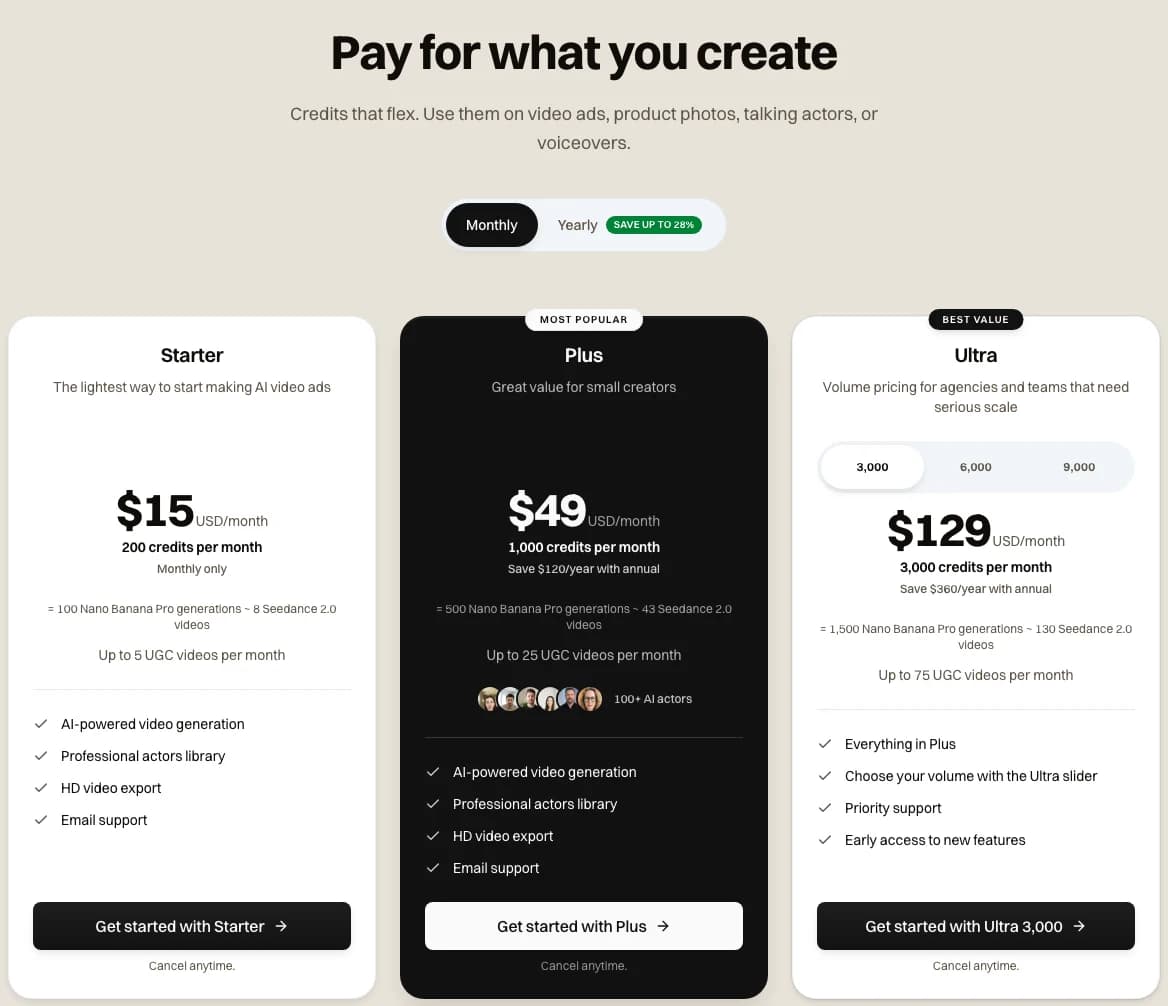 The Novoads pricing page with Monthly selected, on 2026-11-03.
GPT Image 2.5 Sunburst and Flare have their own prices in Novoads, at 1 credit for low or medium and 2 for high.
Novoads next to OpenAI, by plan, quality and size
OpenAI's column counts image output only, so input tokens come on top of it, and its 9:16 rows are our arithmetic. Bold marks the lower figure in each row, and a 4:5 image follows the 2:3 rows.
| Size and quality | OpenAI | Starter | Plus |
|---|---|---|---|
| Square, low | $0.006 | $0.075 | $0.049 |
| Square, medium | $0.053 | $0.075 | $0.049 |
| Square, high | $0.211 | $0.30 | $0.196 |
| 2:3, low | $0.005 | $0.075 | $0.049 |
| 2:3, medium | $0.041 | $0.075 | $0.049 |
| 2:3, high | $0.165 | $0.30 | $0.196 |
| 9:16, low | about $0.004 | $0.075 | $0.049 |
| 9:16, medium | about $0.040 | $0.075 | $0.049 |
| 9:16, high | about $0.159 | $0.30 | $0.196 |
The answer flips with size, so we won't call either side cheaper in general. OpenAI's figure is lower at low quality at every size, and it's lower at medium and high for a portrait or a 9:16 on these two monthly plans. Our Plus plan comes in lower only for the square at medium or high. Our Starter plan is above OpenAI's figure in every row.
Annual billing changes that. On our Plus plan billed annually, at $39 a month, a credit works out to $0.039. That puts medium and high under OpenAI's output-only figure at all three sizes, while low stays lower on OpenAI.
One ad prompt at low and at medium
To see what low and medium buy, we ran one cold brew ad prompt four times through GPT Image 2 in Novoads on November 3, 2026. We ran both qualities at 2:3 and at 1:1, for 1 credit each. The prompt asked for a matte black can on a wet granite counter by a sunny kitchen window, spelled the label out as T-I-D-E-W-E-L-L, and asked for the headline "Cold brew, zero wait." exactly once.
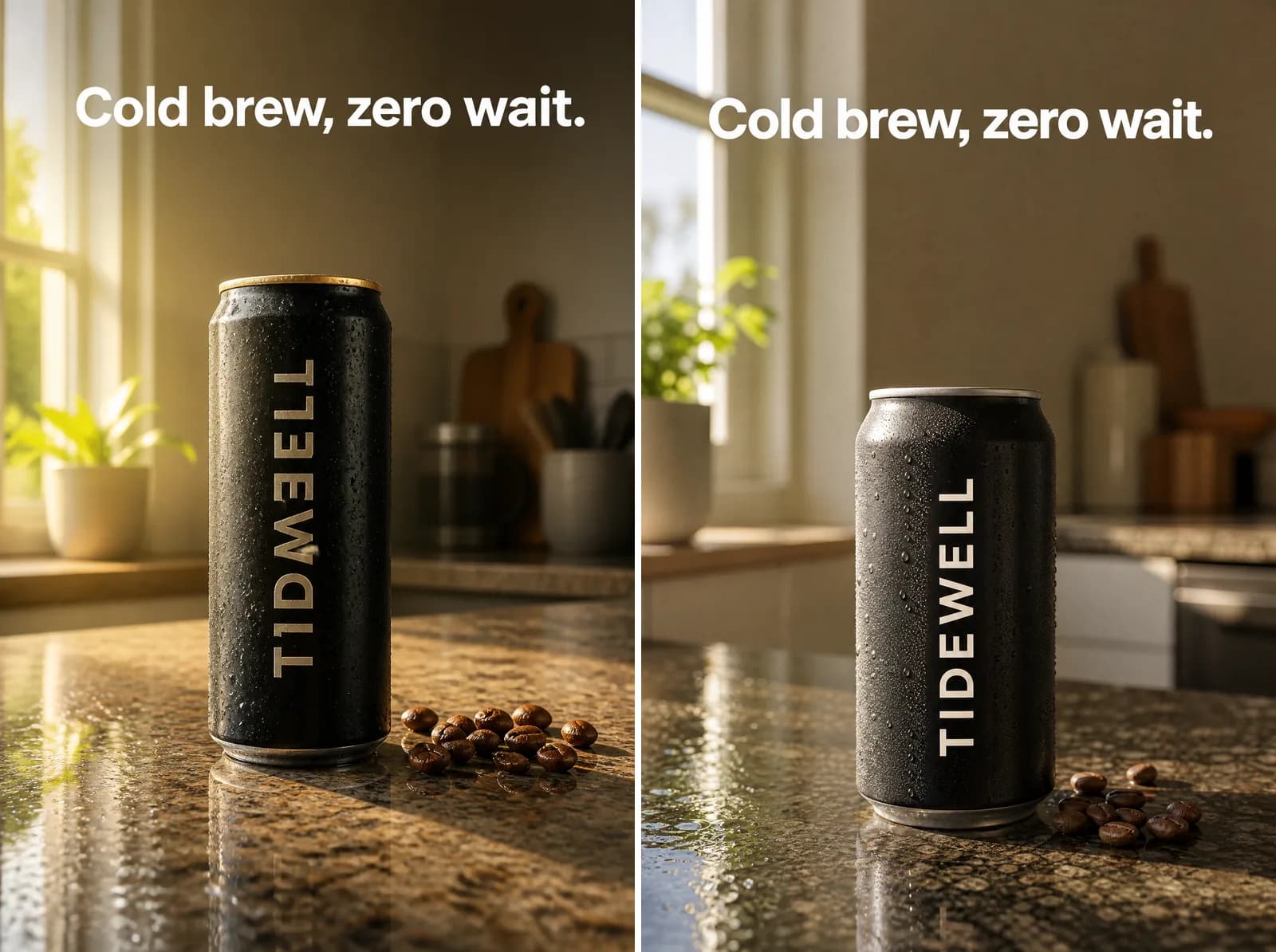 Made in Novoads with GPT Image 2 · low on the left, medium on the right · 2:3 · 1 credit each · 2026-11-03
In OpenAI's table, going from low to medium at 1024 x 1536 takes you from $0.005 to $0.041. In Novoads, both qualities cost 1 credit.
| Take | Size returned | Can label | Headline |
|---|---|---|---|
| 2:3, low | 1024 x 1536 | Garbled | Clean, once |
| 2:3, medium | 1536 x 2304 | Reads TIDEWELL | Clean, once |
| 1:1, low | 1024 x 1024 | Reads TIDEWELL | Clean, once |
| 1:1, medium | 2048 x 2048 | Reads TIDEWELL | Clean, once |
The can, the wet counter, the window, the condensation and the beans showed up in all four. In the 2:3 low take, the label goes wrong after the T, with a 1 where the I should be, a mirrored E and an extra letter at the end. The other low take spelled it right, so low garbled the label in one take of two and medium in neither of two. That's two takes each, which is too few to call a rate. OpenAI's prompting guide also says "Compare medium or high quality for small text, dense information, or multiple fonts." Exact brand colors are a separate check, which we cover in our piece on hex codes in AI image generators.
At the same 1 credit, medium returned more pixels than low at both shapes. That's what these four runs returned, and we wouldn't promise it for every shape. This post has no high image, and the strip shows low and medium.
Which setting we'd start an ad on
On OpenAI's API, we'd draft at low and finish higher. OpenAI's own advice is to use low "for quick drafts" and, for final assets, to "compare higher quality settings to find the right balance of detail, latency, and cost." At $0.005 against $0.041 for a portrait, drafting at low saves real money at volume, and Batch cuts the cost further if the run can wait. If your team already calls APIs and you make images by the thousand, OpenAI's API at those settings should be the lower bill, and we'd use it.
In Novoads, low and medium cost the same credit, so we'd start at medium. The settings show high when you pick GPT Image 2, so change the quality before you generate if you're drafting. Before you pay 4 credits for high, compare it against medium on your own prompt.
We built Novoads for the marketer who wants the ad without an API key, a verification step or any token math. Upload a product photo to Product-to-Ad and you get an ad image from GPT Image 2 at medium for 1 credit. The same credits pay for the other image models, like Nano Banana Pro, and for video ads. If you're pricing more than one image tool, we did the same math for Midjourney's plans and for Midjourney against Nano Banana. Novoads is paid from the first month, and our pricing page shows what each plan's credits make.
Put a price on your next ad image
GPT Image 2 is 1 credit at medium in Novoads, and Starter is $15 a month for 200 credits.
Compare the plansOpenAI's figures here are from November 3, 2026, so check the guide's older-model section again before you budget a large run.
Frequently Asked Questions
How much does one GPT Image 2 image cost?
As of November 3, 2026, OpenAI's image generation guide lists $0.211 for one high-quality 1024 x 1024 image and $0.165 at 1024 x 1536. Medium is $0.053 and $0.041 at those sizes. Low is $0.006 and $0.005. Those figures count image output only, so you'd pay for text and image input tokens on top.
How much image generation do you get with ChatGPT Plus?
We can't give you a number. ChatGPT Plus is $20 a month, and OpenAI says image availability and usage limits in ChatGPT web depend on your plan and workspace settings. None of the OpenAI pages we could read on November 3, 2026, gives an image count for Plus.
Is the ChatGPT API cheaper than ChatGPT Plus for images?
There's no exact break-even, because OpenAI doesn't publish an image count for Plus. At the guide's figures, $20 of API spend covers roughly 490 medium portraits of image output. At high, it covers roughly 95 squares. If you make fewer images than that and don't need Plus for anything else, the API is the smaller bill.
Is GPT Image 2 cheaper in Novoads than on OpenAI's API?
It depends on the plan, the quality and the size. On our monthly Plus plan, a square at medium or high comes in under OpenAI's output-only figure, and OpenAI's figure is lower at every other size and quality. Our Starter plan is above it in every case we priced. OpenAI's figure also leaves out input tokens, and those don't add anything to a Novoads credit price.
Key Takeaways
- As of November 3, 2026, OpenAI's image generation guide lists $0.211 for one high-quality 1024 x 1024 GPT Image 2 image and $0.165 at 1024 x 1536. Those figures count image output only, so you'd pay for text and image input tokens on top.
- OpenAI lists those prices among its older-model pricing examples and tells anyone building a new integration to use GPT Image 2.5. That model has the same token rates and, by our arithmetic, costs less at high quality.
- By our arithmetic, one creative as a square, a 2:3 portrait and a 9:16, with one take of each at medium, comes to about $0.134 of image output on OpenAI's API.
- In Novoads, GPT Image 2 costs 1 credit at low or medium and 4 at high. On our monthly Plus plan, that's under OpenAI's output-only figure only for a square at medium or high.
- We ran one ad prompt four times in Novoads. Low garbled the can's label in one of two takes and medium in neither of two, and that's too few takes to call a rate.
Sources
- •OpenAI API docs, Image generation guide
- •OpenAI API docs, Pricing
- •OpenAI API docs, Changelog
- •OpenAI API docs, Deprecations
- •OpenAI API docs, API credits for ChatGPT subscribers
- •ChatGPT Learn, Image generation
- •ChatGPT Learn, Pricing
- •OpenAI Help Center, Images in ChatGPT (Internet Archive copy, October 23, 2026)