Midjourney vs Nano Banana: What One Ad Image Costs on Each
Midjourney is cheaper per ad image at listed rates. By our math, an HD set of four on Basic is $0.065, and Google lists Nano Banana Pro at $0.134 an image.

Mauricio Valdivia
·12 min
The two price lists don't share a unit
Midjourney sells minutes of GPU time and Google bills Nano Banana by the token, so neither price list tells you what one usable ad image costs. Of the top five results for this search, we could read three, and none of them puts a dollar figure on one ad image from Midjourney next to one from Nano Banana Pro. So we did the math ourselves.
We didn't test Midjourney for this post. We read Google's pages on November 3, 2026. Midjourney's help site wouldn't open for us that day, so its figures come from Internet Archive copies, each with its own date. The Nano Banana Pro run further down is our own.
At listed rates, Midjourney is cheaper by a wide margin. An HD prompt on its Basic plan works out to $0.065 for a set of four images, and Google lists one Nano Banana Pro image at $0.134. We still wouldn't decide on that alone, because what you make on Midjourney is public by default below its Pro plan and, rare exceptions aside, the company says it doesn't provide an API.
Which Nano Banana people mean
"Nano Banana" covers five models at different prices, so a price doesn't tell you much until you know which model it's for. Google's image guide opens with "Nano Banana refers to the following models available in the Gemini API:" and then lists them.
Google's five models and their prices
Prices as of November 3, 2026, for one output image on Google's paid Standard tier.
| Google's name | 1K | 2K | 4K |
|---|---|---|---|
| Nano Banana 2.1 | $0.0336 | $0.0504 | $0.113 |
| Nano Banana 2 Lite | $0.0336 | no price listed | no price listed |
| Nano Banana 2 | $0.067 | $0.101 | $0.151 |
| Nano Banana Pro | $0.134 | $0.134 | $0.24 |
| Nano Banana, the original | $0.039, up to 1024x1024 | no price listed | no price listed |
Google rewrote some of these descriptions in the past few days, so we're quoting them as they read on November 3.
- Nano Banana 2.1 is "the primary high-efficiency workhorse model for image generation and conversational editing." Google's guide also says "Recommended for all new projects to use Nano Banana 2.1."
- Nano Banana 2 Lite is "The fastest and cheapest Gemini image model."
- Nano Banana 2 is "The previous-generation high-efficiency workhorse model." Google deprecated it on October 6, 2026, with no shutdown date announced, and still lists the price above.
- Nano Banana Pro is "The premium choice for complex visual tasks, utilizing advanced reasoning ("Thinking") to follow complex instructions, maintain brand consistency, and render high-fidelity text."
- The original Nano Banana is "The legacy model of the Nano Banana series." Google's pricing page says it "will be shut down on March 15, 2027."
What search results and the Gemini app call it
We read the titles of the top 10 results for "midjourney vs nano banana", and none names 2.1. Four name Nano Banana Pro, one names Nano Banana 2 and the other five use the plain name. Two of the four People Also Ask questions name Pro. In the Gemini app, Google's help page says Nano Banana 2 "is selected when you make an image request with the Gemini model set to Flash or Pro," and that "Paid subscribers can use Nano Banana Pro to regenerate an image."
We think most people typing this search mean Pro or Nano Banana 2 rather than the original. We price Pro here for two reasons. Google's guide points to it for text and brand consistency, and a static ad leans on both. And it's the only Nano Banana we sell, so read our math with that in mind. Our Nano Banana 2 vs Nano Banana Pro comparison covers the choice between those two, and our Nano Banana Pro explainer covers the model on its own.
What one ad image costs on each
Nano Banana Pro at Google's listed price
Prices as of November 3, 2026. Google's pricing page for the Gemini API lists Nano Banana Pro (Gemini 3 Pro Image) at the equivalent of $0.134 per output image at 1K or 2K on its paid Standard tier. Google gets there from 1,120 tokens at $120 per million. By our math, that's $0.1344. A 4K image on the same tier is the equivalent of $0.24.
That's the price of the output image and nothing else. The same table lists each input image at the equivalent of $0.0011 and thinking at $12 per million tokens. Google's image guide says the thinking step "cannot be disabled in the API" and that "thinking tokens are billed by default," and the pricing page gives no per-image figure for them. So by our math, one 2K image made from one product photo comes to $0.134 + $0.0011 = $0.1351, before thinking tokens. If you turn on Google Search grounding, Google charges for each search query on top.
Google shows that same dollar table to every visitor, and the price isn't new. An Internet Archive copy of the page from November 29, 2025, already has $0.134 and $0.24 for the model's preview. Today the pricing page lists only a Standard price for Pro, while Pro's model page still marks the Batch API as supported, so we don't quote a Batch figure for it.
Midjourney by the prompt, then by the image
Midjourney charges for time. You buy a month of Fast GPU minutes, and each prompt spends some of them. Its getting-started guide (Internet Archive copy of October 26, 2026) says "Midjourney creates a set of four images." So the natural unit is the prompt, and a per-image figure only holds if you use all four.
Its plans page, in a copy from October 20, 2026, lists four plans. Extra GPU time is $4 an hour on all of them, and our Midjourney pricing breakdown goes through the rest of each plan.
| Plan | Monthly | Billed yearly, per month | Fast time a month |
|---|---|---|---|
| Basic | $10 | $8 | 200 minutes |
| Standard | $30 | $24 | 15 hours |
| Pro | $60 | $48 | 30 hours |
| Mega | $120 | $96 | 60 hours |
Its GPU page (copy of October 15, 2026) lists an SD prompt at 0.8 minutes and an HD prompt at 1.3 minutes, under the heading "Approximate GPU Cost." At the default square, SD is the smaller size, starting at 1024 x 1024, and HD is 2048 x 2048. We got the rows below by dividing each plan's price by its minutes, and all of this arithmetic is ours.
| Fast time bought on | Per minute | SD prompt, four images | HD prompt, four images | HD, each image if you use all four |
|---|---|---|---|---|
| Basic, monthly ($10 / 200) | $0.05 | $0.04 | $0.065 | about $0.016 |
| Basic, billed yearly ($8 / 200) | $0.04 | $0.032 | $0.052 | $0.013 |
| Standard, Pro or Mega, monthly ($60 / 1,800 on Pro) | about $0.033 | about $0.027 | about $0.043 | about $0.011 |
| Standard, Pro or Mega, billed yearly ($48 / 1,800 on Pro) | about $0.027 | about $0.021 | about $0.035 | about $0.009 |
| Extra time ($4 / 60) | about $0.067 | about $0.053 | about $0.087 | about $0.022 |
Two things push those figures up. They assume you use up the month's Fast time, and Midjourney says "any unused time doesn't carry over to the next month," so using half of your minutes doubles every figure. Midjourney also says that "using nonstandard aspect ratios" might take more time. That page doesn't say which ratios it means, so we can't tell you whether they include 4:5 and 9:16, the sizes ads run in.
Relax mode and the company-size rule
Two plan rules change that math.
- Midjourney says Relax mode for images is "only available to those with Standard, Pro, and Mega Plans," and that with it "you can create as many images as you want each month without using your Fast time." You give up speed, since its GPU page warns of "wait times ranging from 0 to 30 minutes." So on Standard at $30 a month, if you have time to wait, more images add nothing to the bill. Basic doesn't have that option.
- Midjourney's plans page says "You must purchase the Pro or Mega plan if you are a company making more than $1,000,000 USD in gross revenue per year." Its terms (copy of October 25, 2026) apply that to "any employee of a company" above that line too, and say they "must be subscribed to a “Pro” or “Mega” plan to own Your Assets." So for many ad buyers, the entry price is $60 a month, or $48 billed yearly.
The same math, per image you keep
You rarely ship every image in a batch, so we also divide by the ones you keep. This table prices four images at about 2K on each route, with Midjourney's HD prompt standing in for that size. It's all our arithmetic.
| Route | Four images | Each, if you keep all four | Each, if you keep one |
|---|---|---|---|
| Midjourney Basic, monthly | $0.065 | about $0.016 | $0.065 |
| Midjourney Pro, monthly | about $0.043 | about $0.011 | about $0.043 |
| Nano Banana Pro, Google's output price | $0.536 | $0.134 | $0.536 |
| Nano Banana Pro in Novoads, Starter | $0.60 | $0.15 | $0.60 |
| Nano Banana Pro in Novoads, Plus | $0.392 | $0.098 | $0.392 |
At these listed rates, Midjourney is cheaper per image on every row, even when you keep one image out of four. None of these figures is the cost of an ad, because they leave out retries, edits and your own time. Google's row also leaves out input and thinking tokens. We don't have a keep rate for either model, so you'll have to finish this table with your own count.
Differences that matter once it's an ad
Who can see your drafts
Midjourney's images start out public, and three of its pages say how far that goes.
- Its terms (copy of October 25, 2026) say "By default, Your Content is publicly viewable and remixable."
- Its plans page (copy of October 20, 2026) says Stealth Mode, "which keeps your images and videos private, is only available on the Pro and Mega Plans."
- Its changelog of October 8, 2026, says "Non-stealth images can still appear on Explore and on profiles, even if you made them inside a private folder."
So on Basic or Standard, other people can see concepts for a launch you haven't announced. For an ad team, we think that's a stronger reason to pay for Pro than the rate per minute. On Google's side, the pricing page answers "No" on the "Used to improve our products" row for Pro's paid tier.
Scripts and APIs
Midjourney's own pages rule out scripts for nearly everyone.
- Its community guidelines (copy of October 5, 2026) say "With a few rare exceptions that are explicitly granted, Midjourney does not provide an API."
- Its terms add "You may not use automated tools to access, interact with, or generate Assets through the Services."
- The only post about an API we found among its updates is a survey from July 2025, which says "We're starting to investigate opening up an Enterprise API for people to start integrating Midjourney into their companies and services."
Google's price list is an API price list, so you can call Pro from your own script. If you're running a catalog of products through one template, we think that settles it before you get to price.
Sizes and ratios
Midjourney's upscaler page (copy of October 1, 2026) says "HD images generate at 2048 x 2048px automatically, and currently cannot be upscaled further." Its chart gives pixel sizes for "some common aspect ratios," namely 1:1, 4:3, 2:3 and 16:9. That leaves out 4:5 and 9:16, so we can't give you a Midjourney pixel size for either. Google's size table for Gemini 3 Pro Image covers both of those ad shapes and goes to 4K.
- At 4:5, it lists 1856x2304 at 2K and 3712x4608 at 4K.
- At 9:16, it lists 1536x2752 at 2K and 3072x5504 at 4K.
Ask for the ratio every time. Midjourney says "The default aspect ratio is 1:1," and Google's model "matches the output image size to that of your input image, or otherwise generates 1:1 squares."
Your product as a reference
Google's guide counts Pro's references two ways. Its table says "Up to 6 images of objects with high-fidelity to include in the final image," while a note under it says Pro "supports 5 images with high fidelity, and up to 14 images in total." We'd plan on five until Google settles it. Each input image bills at the equivalent of $0.0011, so by our math six product shots add $0.0066.
Midjourney's Edit Model page (copy of October 10, 2026) offers "up to 4 reference images." An Edit Model HD prompt is 2.3 minutes on the GPU page, which by our math is $0.115 for a set of four on Basic. Its Image Prompts page (copy of October 16, 2026) says "Midjourney uses Image Prompts and references as inspiration to guide new creations, not to copy them exactly," and sends you to its Editor for precise changes. We didn't test how close either model gets to a real product, so try yours before you rely on either.
Words in the image and edits by region
Each company is making its own claims here, and we didn't run a side-by-side test.
- Google's guide says "Gemini excels at rendering text," tells you to "Use Gemini 3 Pro Image for professional asset production," and adds that "Gemini works best if you first generate the text and then ask for an image with the text."
- Midjourney's Text Generation page (copy of September 3, 2025, the newest we could read) says to put the words "inside double quotation marks," and that "Text generation works best with the standard Latin alphabet, like English letters." Its V8 post of March 17, 2026, says "Text rendering works better than ever (when specified in “quotes”)."
- For edits, Midjourney's post of September 24, 2026, says "Making targeted edits to the image will change only the pixels that you've selected."
- Google's guide says you can "Conversationally define a "mask" to edit a specific part of an image while leaving the rest untouched."
Our Nano Banana prompt guide has more on writing prompts for it.
Watermarks on the image
- Google says "All generated images include a SynthID watermark" for images from its API.
- In the Gemini app, the visible mark is a setting, though "If you are in India, South Korea, or Vietnam, you'll only see this setting if you have an AI Ultra subscription." That setting "only controls the visible watermark," so SynthID stays.
- None of the Midjourney help-page copies and update posts we read mention a watermark, which doesn't tell you either way whether Midjourney adds one.
Google's own cheaper routes for small volumes
For a few images a week, we think you should try Google's own apps first.
Google Flow
Google's help pages for Flow, read November 3, 2026, disagree about who can use it.
- Its images page says "Generating and upscaling images in Google Flow does not currently use your monthly Google Flow credits or AI credits," and its table gives Nano Banana Pro "Up to 20 / day" without a Google AI plan. That rises to 100 a day on Google AI Plus and Pro, and to 500 a day on Ultra.
- Its getting-started page says you must "Be subscribed to Google AI Plus, Google AI Pro, or Google AI Ultra."
- Google's US plans page lists a level at "$0 / month with a Google Account," with "limited access to Nano Banana Pro."
So test it before you plan around it. If the no-plan allowance works for you, it costs less than any per-image price here, ours included. Our breakdown of what's free in Nano Banana has more on those limits.
The Gemini app
Google's help pages give no per-image price for the Gemini app. You start on Nano Banana 2, paid subscribers can redo an image with Pro, and you can download "at 2K resolution with a Google AI plan or at 1K without an AI plan."
Google's US plans page lists Google AI Plus at $4.99 a month and Google AI Pro at $19.99 a month.
Four statics from one Nano Banana Pro call
On October 20, 2026, we sent one Nano Banana Pro call through Novoads, asking for four 4:5 statics of an amber candle jar at 2K. The prompt spelled out a headline ("Light it. Slow down.") and a small line of product facts, and the model drew both into each picture. Both came back legible on all four.
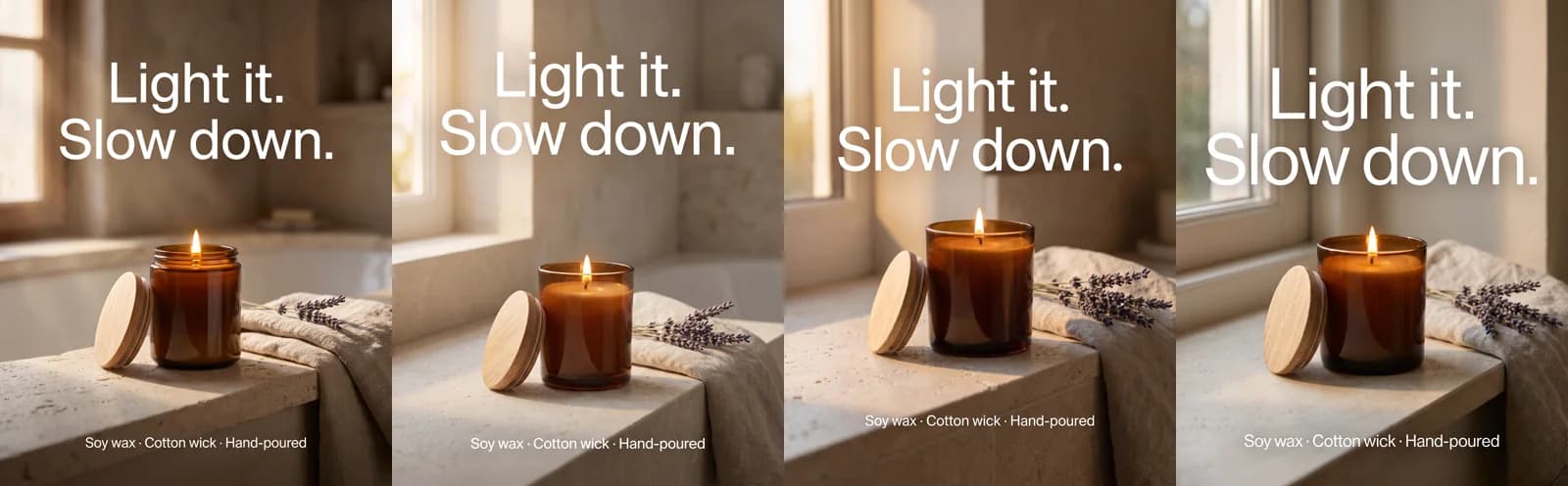
Made in Novoads with Nano Banana Pro · four 4:5 candle-jar statics at 2K from a single call, both lines of copy legible on each · 8 credits · rendered 2026-10-20
That's the same kind of job as a Midjourney prompt (one request and four images to choose from), which is why we count both by the set. These four came from Nano Banana Pro. We didn't run the brief on Midjourney, so they can't tell you how Midjourney would have handled it.
The math on those four images is ours.
- At Google's listed output price, four 2K images are 4 x $0.134 = $0.536, before input and thinking tokens.
- In Novoads, they were 8 credits, which is 8 x $0.075 = $0.60 on Starter.
- On Plus, the same 8 credits are 8 x $0.049 = $0.392.
To get to an ad, someone still has to pick one and test it, and our guide to static ads covers the rest of that job. We sell Nano Banana Pro and none of Google's other Nano Banana models, and we don't sell Midjourney.
What Nano Banana Pro costs in Novoads
You pay for Novoads from the first month, and we charge for Nano Banana Pro in credits per image, by size. An image at 1K or 2K is 2 credits, and one at 4K is 4 credits. There's no token line, and reference images don't change the count.
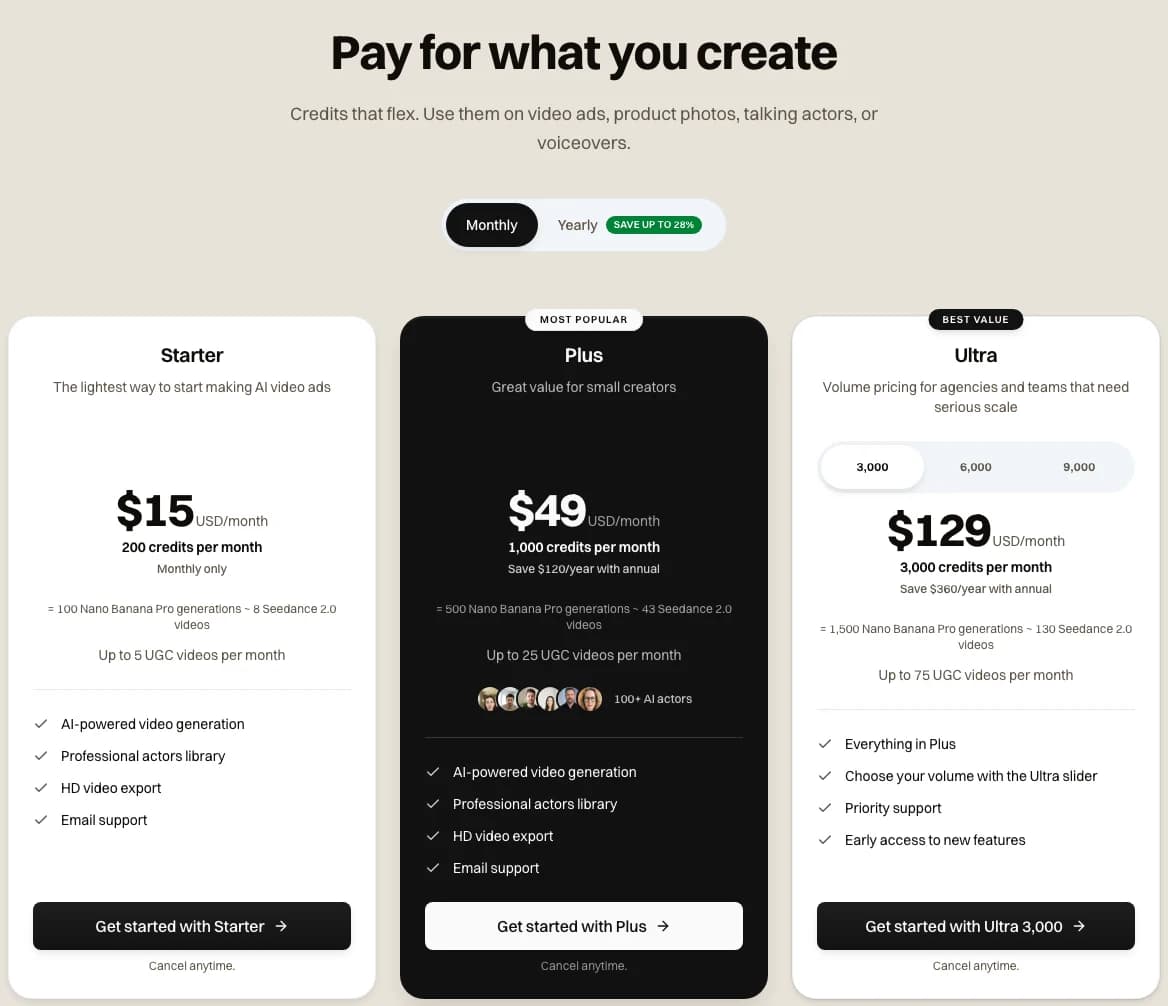
Our pricing page with Monthly selected, where the Starter card reads 100 Nano Banana Pro generations and the Plus card reads 500 · screenshot taken 2026-11-03
Prices as of November 3, 2026. The dollar figures below are our arithmetic on each plan's price per credit.
| Nano Banana Pro image | Google's listed output price | Novoads on Starter | Novoads on Plus |
|---|---|---|---|
| 1K or 2K | $0.134 | 2 x $0.075 = $0.15 | 2 x $0.049 = $0.098 |
| 4K | $0.24 | 4 x $0.075 = $0.30 | 4 x $0.049 = $0.196 |
- Starter is $15 a month for 200 credits. That's $0.075 a credit, or 100 images at 2K.
- Plus is $49 a month for 1,000 credits. That's $0.049 a credit, or 500 images at 2K.
- Plus billed yearly is $39 a month, which brings a 2K image to 2 x $0.039 = $0.078.
Google's listed output price is lower than Starter at both sizes, though Google bills thinking and input tokens on top of it and we don't. Plus comes in under Google's listed price. Nano Banana 2.1 is cheaper still. At $0.0504 for a 2K image on Google's page, it's about half the price of a Pro image on Plus, though it's a different model and we don't sell it. And Flow's no-plan allowance, where it works for you, costs less than any of these.
Those per-credit figures assume you spend all of the month's credits, the same assumption we made for Midjourney's Fast time, because plan credits reset at each renewal and don't carry over. For the extra you pay on Starter, you get one flat price per image with no token math, plus credits that also pay for video ads, product photos, talking actors and voiceovers. Our pricing page lists what each plan includes.
Price your next four statics
Nano Banana Pro is 2 credits an image at 1K or 2K in Novoads, and you pay from the first month. Compare the plans before you run a batch.
Compare the plansWhich one we'd start with
We'd start with Midjourney for the lowest price per image while you explore looks by hand. We'd start with Nano Banana Pro if you need published ad sizes up to 4K, several product references or a script. We sell Nano Banana Pro, so factor that in.
Use Midjourney when:
- You're exploring looks by hand and you'll use most of your Fast time each month.
- The lowest listed price per image matters most.
- Your drafts can be public, or you're paying for Pro or Mega and can use Stealth Mode.
Use Nano Banana Pro when:
- You need 4:5 or 9:16 at a published pixel size, up to 4K.
- You want to call the model from your own script, or run a catalog through it.
- You're working from several product photos as references.
- You'd rather pay per image than buy a month of time.
If you only need a few images, try Flow or the Gemini app before you pay anyone per image. If neither model fits, our list of Midjourney alternatives for ads has others, we priced GPT Image 2 separately, and our V8.2 explainer covers what Midjourney's current default version changes for ads.
Before you compare prices again, count how many images you keep out of every four on a real brief, because keeping one instead of four multiplies each per-image figure above by four.
Frequently Asked Questions
Is Midjourney or Nano Banana cheaper for one ad image?
Midjourney, at listed rates. By our math, an HD prompt on Basic is $0.065 for a set of four images if you use up the month's Fast time, or about $0.016 an image if you keep all four. Google lists Nano Banana Pro at the equivalent of $0.134 per output image at 1K or 2K, with thinking and input tokens on top. Midjourney's figures come from Internet Archive copies from October 2026, and Google's come from its pricing page, read November 3, 2026.
Are Nano Banana Pro and Nano Banana 2 the same thing?
No. Google lists them as separate models. Its guide calls Pro "The premium choice for complex visual tasks" and Nano Banana 2 "The previous-generation high-efficiency workhorse model." As of November 3, 2026, its pricing page lists a 2K image at $0.134 on Pro and $0.101 on Nano Banana 2. Google deprecated Nano Banana 2 on October 6, 2026, and recommends Nano Banana 2.1 for new projects.
Is Nano Banana Pro that good for ad images?
Google's model page says it's best for "complex graphic design, high-fidelity product mockups, and factual data visualizations that require accurate text rendering and real-world grounding via Google Search." Those are Google's words. In our own run on October 20, 2026, one call returned four 4:5 statics at 2K with the headline legible on all four. That's one run of one brief, and we didn't try it on Midjourney, so it can't tell you which model is better.
Does Midjourney have an API?
Its community guidelines (Internet Archive copy of October 5, 2026) say "With a few rare exceptions that are explicitly granted, Midjourney does not provide an API," and its terms bar automated tools. The only API post we found among its updates is a July 2025 survey about opening an Enterprise API. Google sells Nano Banana through an API, priced per token.
Key Takeaways
- By our math on listed rates, if you use up the month's Fast time, an HD prompt on Midjourney's Basic plan is $0.065 for a set of four images, or about $0.016 an image if you keep all four.
- Google lists Nano Banana Pro at the equivalent of $0.134 per output image at 1K or 2K on its paid Standard tier, with thinking and input tokens billed on top.
- Google's guide lists five models under the name Nano Banana, each with its own price, so name the model whenever you quote a price.
- What you make on Midjourney is public by default below the Pro plan, and, rare exceptions aside, the company says it doesn't provide an API. Either one can settle the choice for an ad team before price does.
- For a few images, Google's Flow and Gemini app can cost less than any per-image price here. In Novoads, Nano Banana Pro is 2 credits an image at 1K or 2K, and you pay from the first month.