GPT Image 2 vs Nano Banana Pro: Same Ad Prompts, Pro at $0.134
We ran three ad prompts on GPT Image 2 and Nano Banana Pro in Novoads. See what each spelled, what it missed, and its list price and credit cost.

Mauricio Valdivia
·13 min
Both models spelled our ad right, then they split
We gave GPT Image 2 and Nano Banana Pro the same three ad prompts in Novoads, one run each. On a serum ad with five text strings, both got every string right. GPT Image 2 came closer to the angle and light that Google's own mug prompt asks for. And on a customer-style selfie, Nano Banana Pro looked more like a real phone photo, but it also added text we'd told it to leave out.
The prices split too. Google lists Pro at the equivalent of $0.134 per output image at 1K or 2K. In Novoads, that image is 2 credits. OpenAI lists a high-quality 1024 x 1024 image from GPT Image 2 at $0.211. In Novoads, high is 4 credits and medium is 1.
Of the top five results for this search on November 4, three test Nano Banana 2 instead of Pro, and a Reddit thread wouldn't open for us. The fifth, a reseller's comparison dated April 29, runs three prompts on Pro and GPT Image 2 without stating its settings or what any image cost. It's the only page we could read that prices both, but its GPT Image 2 figures match what OpenAI's table lists today for GPT Image 1 ($0.167 for a high square).
OpenAI's and Google's figures below come from their own pages, read November 4, 2026. The renders are ours, made in Novoads that day. We didn't run either model on its maker's API for this post, so the makers' prices are what their lists say.
The same three prompts on both models
How we ran the seven images
We made all seven images through our MCP connector (the way into Novoads from an AI assistant), using the text prompt alone and one image a run. We kept the first result each time, and on November 4 all seven runs succeeded on the first try. GPT Image 2 ran at high and Nano Banana Pro at 2K on all three prompts, and the serum prompt ran once more on GPT Image 2 at medium. That's 19 credits in all.
The connector delivered these sizes that day.
| Model and setting | Shape | Delivered size | Credits |
|---|---|---|---|
| GPT Image 2, high | Square | 2880 x 2880 | 4 |
| GPT Image 2, high | Vertical | 2160 x 3840 | 4 |
| GPT Image 2, medium | Square | 2048 x 2048 | 1 |
| Nano Banana Pro, 2K | Square | 2048 x 2048 | 2 |
| Nano Banana Pro, 2K | Vertical | 1536 x 2752 | 2 |
So at high, GPT Image 2 came back with about twice Pro's pixels for twice the credits, and at medium with Pro's size for half the credits. Because the comparison strips show every image at one display size, you can't see that gap. And nothing here shows how much the extra pixels matter once a platform re-encodes an ad. The labels under the images are ours, and we only resized the renders.
The times below run from the job's creation to the file landing in our storage, with other jobs running, so we wouldn't call either model faster. One run per prompt is a sample, and it can't give you a success rate.
A serum ad with five text strings
We wrote this one for a brand we made up, following OpenAI's exact-text advice and Google's accurate-text template. Our GPT Image 2 prompt guide has more on writing prompts like this.
Create a square social media ad for a skincare brand called Velunare (spelled V-E-L-U-N-A-R-E). A 30 ml amber glass dropper bottle of vitamin C serum stands on a warm beige stone surface in soft morning window light, with two orange slices beside it. The bottle's label reads "VELUNARE" in small black capital letters. Put this text in the image, each line exactly once and spelled exactly as written: the headline "Your morning glow, bottled" in a bold white serif font across the top; the line "Vitamin C serum, 30 ml" in a small clean sans-serif font under the headline; a round orange price badge reading "$29" at the upper right; a rounded white button reading "Shop now" at the bottom center. No other text, no watermarks, no extra logos. Clean premium beauty ad design, warm orange and cream color scheme.
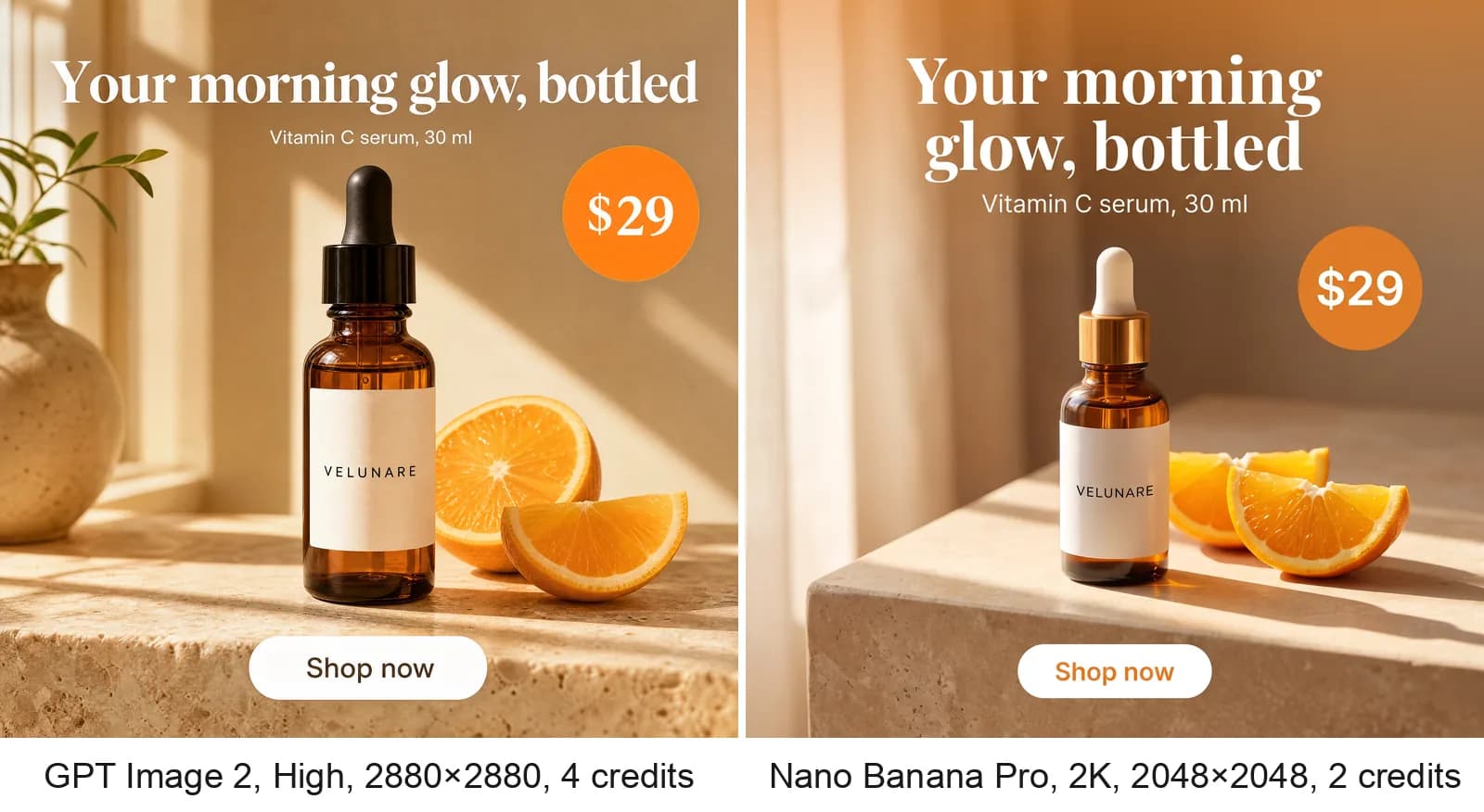 Made in Novoads with GPT Image 2 (left) and Nano Banana Pro (right) · the serum prompt · 4 credits at high, 2 credits at 2K · 2026-11-04
- GPT Image 2 at high (4 credits, 100 seconds) got all five strings exact, once each, with no other text. Its headline runs on one line, its $29 badge is at the upper right, and its white button is at bottom center. It also added a stone vase and a plant nobody asked for.
- Nano Banana Pro at 2K (2 credits, 91 seconds) also got all five exact, once each, with no other text. Its headline runs on two lines, its badge is lower on the right, and its button's letters are orange. It added no props, and its dropper has a white bulb and a gold collar.
We'd call that a tie on spelling, but the prompt did a lot of the work. It named a font and a place for each string and spelled the brand letter by letter, the kind of direction both makers' guides ask for. A looser prompt could go another way. Both makers warn about text too. OpenAI says "the model can still struggle with precise text placement and clarity", and DeepMind's page for Pro says Gemini "can still struggle with small faces, accurate spelling, and fine details in images". So we wouldn't say either model wins on text from this one ad.
We ran the same prompt once more on GPT Image 2 at medium, a quarter of high's credits in Novoads. It came back in 103 seconds with all five strings exact, once each, and no other text. The headline breaks onto two lines, the badge is level with the dropper, and it added a plant and a vase here too.
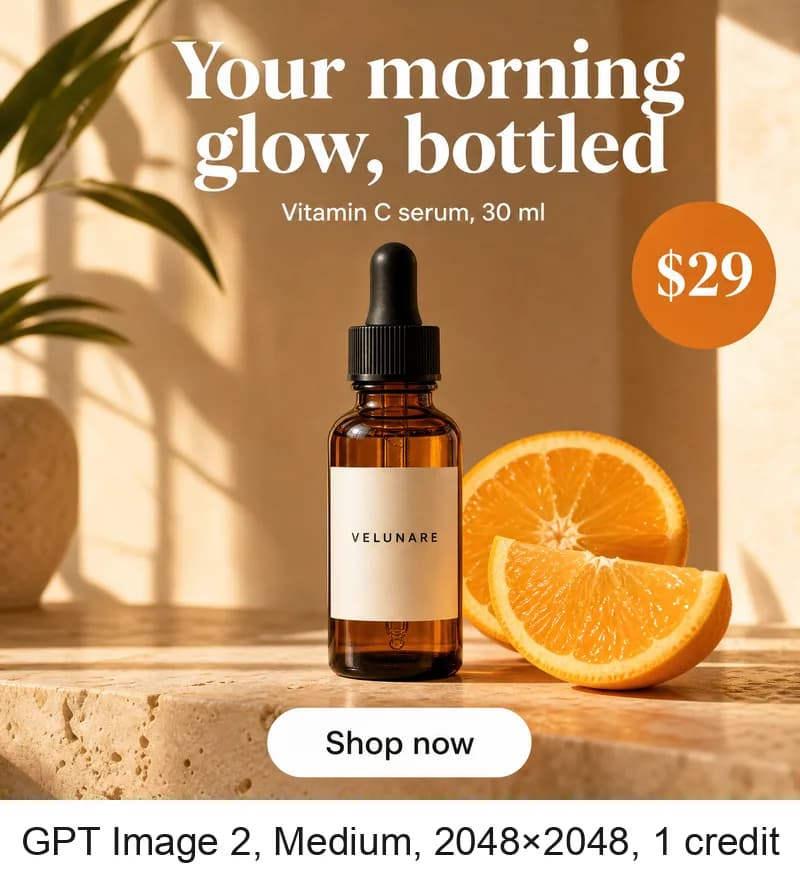 Made in Novoads with GPT Image 2 at medium · the serum prompt · 1 credit · 2048 x 2048 · 2026-11-04
On this one ad, then, 1 credit was enough for clean text. OpenAI's prompting guide says to "Compare medium or high quality for small text, dense information, or multiple fonts", and we'd do that before trusting medium with your own small print.
Google's own mug prompt
This prompt is Google's, word for word, from its image generation guide, so it may favor Nano Banana Pro. Neither image has any text.
A high-resolution, studio-lit product photograph of a minimalist ceramic coffee mug in matte black, presented on a polished concrete surface. The lighting is a three-point softbox setup designed to create soft, diffused highlights and eliminate harsh shadows. The camera angle is a slightly elevated 45-degree shot to showcase its clean lines. Ultra-realistic, with sharp focus on the steam rising from the coffee. Square image.
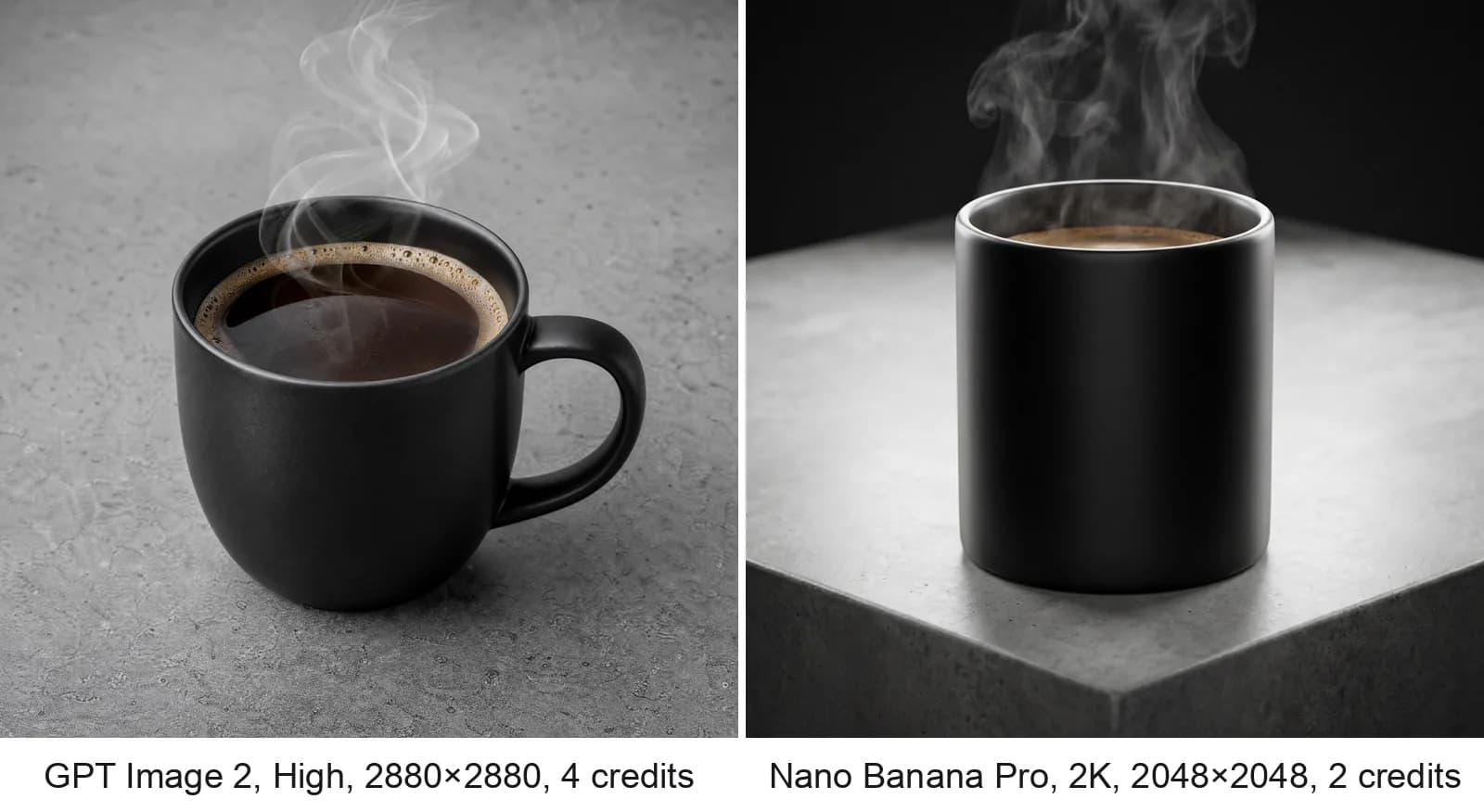 Made in Novoads with GPT Image 2 (left) and Nano Banana Pro (right) · Google's mug prompt · 4 credits at high, 2 credits at 2K · 2026-11-04
- GPT Image 2 at high (4 credits, 88 seconds) made a round matte black mug with a handle, seen from about 45 degrees, so you look down onto the coffee and its ring of foam. The light is soft and even, and the steam is sharp. The concrete looks more rough than polished.
- Nano Banana Pro at 2K (2 credits, 37 seconds) made a straight-sided cup with no handle in view, on the corner of a concrete block against a near-black background. The view is lower than 45 degrees, so you only get a sliver of coffee, and the light is moodier, with deep blacks, than the "soft, diffused highlights" the prompt asks for. The surface is smoother and closer to polished, and the steam is thick.
We think GPT Image 2 follows the prompt more closely on the angle and the light, and it has the handle. Pro comes closer on the surface and makes the more dramatic picture. Some ad makers may like that one better, so judge the look yourself.
A phone selfie with one word of text
This one's ours again, a vertical ad for a hand cream we made up, with SOFTLY on the tube as the only text we allowed.
A candid front-camera selfie taken on a smartphone by a woman in her late twenties in a small bright bathroom in the morning. She smiles slightly and holds a white tube of hand cream next to her cheek with the label toward the camera; the label reads "SOFTLY" (spelled S-O-F-T-L-Y) in simple black capital letters. Natural window light, real skin texture, a slightly messy counter with a toothbrush cup behind her, casual grey t-shirt. It should look like an unedited phone photo a real customer posted, not a studio shot. The only text in the image is "SOFTLY" on the tube, exactly once. No other text, no watermarks, no logos.
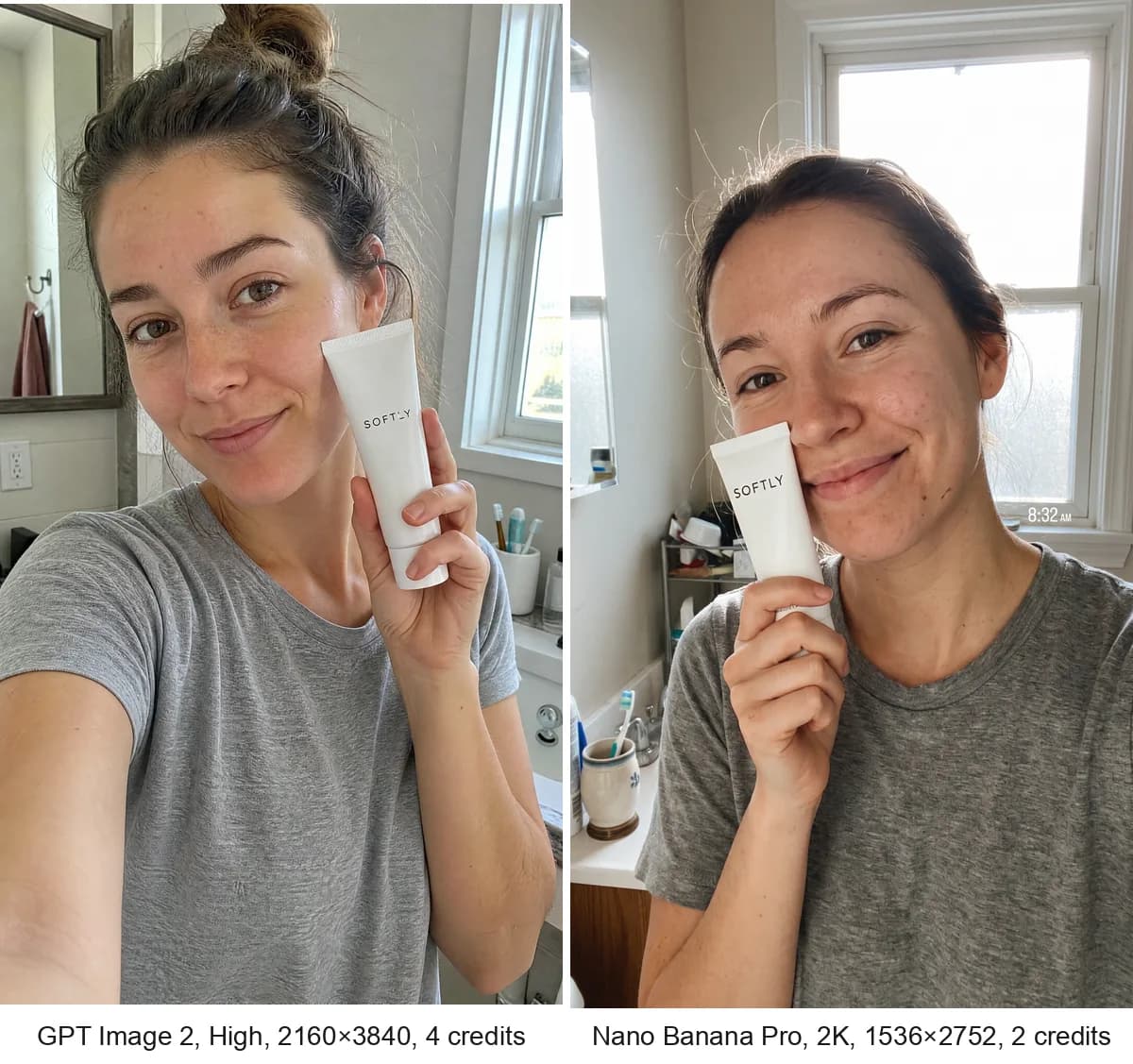 Made in Novoads with GPT Image 2 (left) and Nano Banana Pro (right) · the selfie prompt · 4 credits at high, 2 credits at 2K · 2026-11-04
- GPT Image 2 at high (4 credits, 84 seconds) printed SOFTLY once and spelled it right. At full size, though, the L has a pale smudge through its stroke, which at phone size can read like an apostrophe before the L, and the letters carry a faint white halo. We found no other readable text (the toothpaste and the bottle behind her have blurred marks). The hand and fingers hold up. The room is tidier than the "slightly messy" counter we asked for, and the skin is freckled but clean, so it's the more polished of the two.
- Nano Banana Pro at 2K (2 credits, 56 seconds) printed SOFTLY clean and spelled right, then added text the prompt forbade. There's a white "8:32 AM" stamp over the window, like a phone story overlay, and a line of tiny garbled characters on the tube's lower edge. A spray can at far left also shows blurred marks and a barcode. The fingers hold up, and the picture reads more like a real phone photo, with skin marks, flyaway hair, a cluttered shelf and a patterned toothbrush cup.
So GPT Image 2 kept our text rule with a flaw in one letter, and Pro got the word clean but broke the rule twice. We think Pro's selfie looks more like an unedited phone photo. We wouldn't use either one as it came out, and if you'd crop or retouch first, you may weigh those flaws differently than we do.
What OpenAI and Google list per image
Prices as of November 4, 2026, in US dollars, for image output only.
| Model | Size and quality | Listed at |
|---|---|---|
| Nano Banana Pro | 1K or 2K | Equivalent to $0.134 |
| Nano Banana Pro | 4K | Equivalent to $0.24 |
| GPT Image 2 | 1024 x 1024, high | $0.211 |
| GPT Image 2 | 1024 x 1024, medium | $0.053 |
| GPT Image 2 | 1024 x 1024, low | $0.006 |
What Google's figure leaves out
Google's figures come from the Paid Tier column under the Standard tab of the Gemini API pricing page, and prices elsewhere at Google may differ. They're output prices, worked out from $120.00 per 1M image tokens, and they aren't the full cost of a request. That column lists input at $2.00 per 1M tokens, which Google says comes to $0.0011 per input image. It lists text and thinking output at $12.00 per 1M tokens, and Google's guide adds that "thinking tokens are billed by default for thinking models". Pro's interim thought images are "visible in the backend but not charged", and we found no per-image figure for the thinking itself.
We can't give you a Batch price for Pro. Google's model page marks the Batch API as supported, but the Pro section of the pricing page has only the Standard tab.
What OpenAI's figure leaves out
OpenAI's table covers image output too ("Per image at 30 USD per million image output tokens"), and its guide says to "account for text and image input tokens when estimating the total cost of a request". Its pricing page lists text input at $5.00 per 1M tokens and image input at $8.00. Our GPT Image 2 pricing post goes through the rest of OpenAI's rates.
That table also stops at 1536 px, with a row note saying "Additional sizes available", and OpenAI points you to a calculator for the rest. So OpenAI doesn't print a per-image price for the larger files our high runs came back with.
We ran the calculator's own formula at $30 per 1M tokens and got the figures below. They're our arithmetic, and OpenAI doesn't print them, though the same formula does return its printed $0.211 for a high 1024 x 1024.
- 2880 x 2880 at high comes to 23,719 tokens, about $0.71.
- 2160 x 3840 at high comes to 13,342 tokens, about $0.40.
- 2048 x 2048 at medium comes to 3,568 tokens, about $0.107.
The vertical file comes out lower because the formula gives non-square shapes fewer tokens at the same pixel count.
How Novoads prices the two
In Novoads, both models draw on one credit balance. GPT Image 2 is 1 credit at low or medium and 4 at high, at any size we offer. Nano Banana Pro is 2 credits at 1K or 2K and 4 at 4K. Starter is $15 a month for 200 credits, monthly only. That works out to $0.075 a credit. Plus is $49 a month for 1,000 credits, which works out to $0.049.
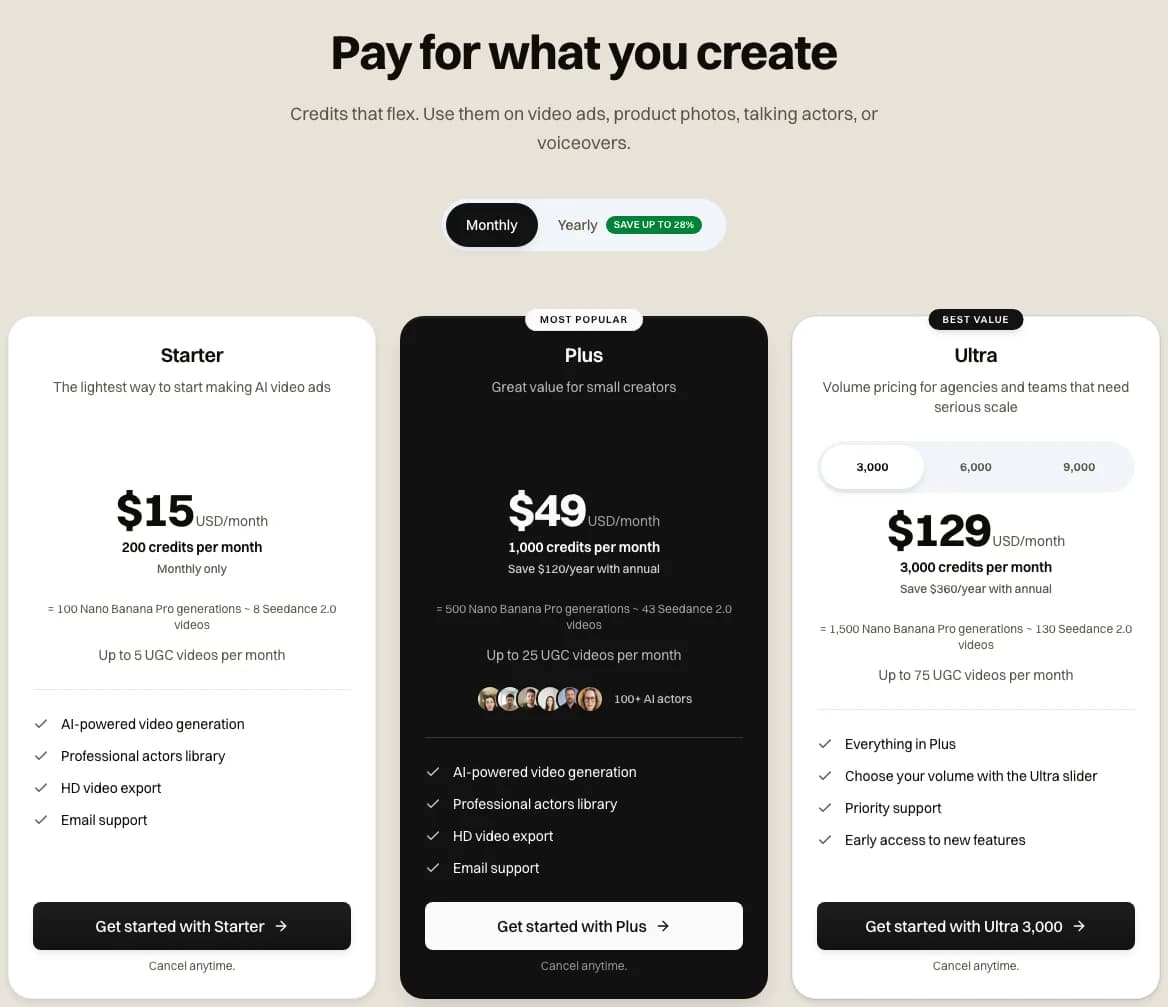 The Novoads pricing page with Monthly selected · Starter's 200 credits come to 100 Nano Banana Pro generations · 2026-11-04
What our test images cost
The Starter and Plus columns are our arithmetic at those rates. The last column is the maker's figure for image output only.
| Image from our test | Credits | Starter | Plus | Maker's figure |
|---|---|---|---|---|
| GPT Image 2 high, 2880 x 2880 | 4 | $0.30 | $0.196 | About $0.71, calculator arithmetic |
| GPT Image 2 high, 2160 x 3840 | 4 | $0.30 | $0.196 | About $0.40, calculator arithmetic |
| GPT Image 2 medium, 2048 x 2048 | 1 | $0.075 | $0.049 | About $0.107, calculator arithmetic |
| Nano Banana Pro 2K, 2048 x 2048 | 2 | $0.15 | $0.098 | Listed at the equivalent of $0.134 |
| Nano Banana Pro 2K, 1536 x 2752 | 2 | $0.15 | $0.098 | Listed at the equivalent of $0.134 |
You should know where a maker's list comes in lower. A Pro image is $0.15 on Starter, above the $0.134 Google lists. On Plus it's $0.098, below that list. OpenAI lists a low 1024 x 1024 image at $0.006, well under our 1 credit on either plan. It lists medium at $0.053, under Starter's rate and just over Plus's. And a plan has a floor, since you'd pay us $15 a month for one image or a hundred.
We think the gap runs our way on large, high-quality files, because OpenAI's formula climbs with pixels and our GPT Image 2 credits don't. Whether those pixels help your ad is the part we can't show you. The whole test came to 19 credits. That's about $1.43 on Starter or about 93 cents on Plus.
What a month of credits buys
| Plan | Pro at 2K | GPT Image 2 at high | GPT Image 2 at medium |
|---|---|---|---|
| Starter, 200 credits | 100 | 50 | 200 |
| Plus, 1,000 credits | 500 | 250 | 1,000 |
Where each model stands with its maker
Both makers still sell these models, and neither lists a shutdown date for them on its deprecations page as of November 4, 2026.
OpenAI's image guide files GPT Image 2's settings under "Earlier GPT Image models", and that section says "For new integrations, use one of the GPT Image 2.5 models described above." Older models are going away, though. OpenAI says GPT Image 1 was shut down on October 23, 2026, and that it told developers other older GPT Image models would be removed from the API on December 1, 2026. If you're moving off an older OpenAI model, our DALL-E 3 post goes through what ad makers use now.
Google's deprecations page lists Pro's stable version, released May 28, 2026, with "No shutdown date announced". Novoads sells Pro and none of Google's other Nano Banana models. Our Nano Banana Pro explainer and our Nano Banana 2 vs Pro post cover Google's lineup.
What each model takes as input
Reference images
OpenAI's edit reference says "For GPT image models, you can provide up to 16 images", and its guide says GPT Image 2 "processes every image input at high fidelity automatically". Google's guide says "Nano Banana models allow you to mix up to 14 reference images." Google's own pages don't agree on how to count Pro's references.
| Google page | What it says about Pro's references |
|---|---|
| Image guide, table | Up to 6 objects, 5 characters, 3 style |
| Image guide, best practices | 5 with high fidelity, up to 14 in total |
| DeepMind model page | Up to five characters, fourteen objects |
| Launch post | Up to 14 images, 5 people |
So we'd plan on up to 14 and test your own mix. None of our three prompts used a reference picture.
Sizes and shapes
OpenAI's guide sets these limits for GPT Image 2's custom sizes, and our high files hit the very top of the last one.
- Both edges must be multiples of 16 px.
- The longest edge can't go past 3840 px.
- The long edge can't be more than 3 times the short edge.
- Total pixels must be between 655,360 and 8,294,400.
Google's guide lists ten shapes for Pro at 1K, 2K and 4K. We didn't run 4K, so we're taking Google's word on that size.
Watermarks and provenance signals
Google's guide says "All generated images include a SynthID watermark". OpenAI's provenance guide describes two signals its checking tool looks for, C2PA Content Credentials and SynthID, and it says "Editing, converting, or sharing a file can remove its metadata." We didn't check either signal on our files, so we can't tell you what a file from these runs carries.
The dashboard and the connector in Novoads
You can reach both models from the dashboard or through the connector, for the same credits. What you can set differs a little.
| In Novoads | GPT Image 2 | Nano Banana Pro |
|---|---|---|
| Settings | Low, medium, high | 1K, 2K, 4K |
| Dashboard references | Up to 4 | Up to 4 |
| Connector references | Up to 4 | Up to 14 |
| Dashboard shapes | 1:1, 2:3, 9:16, 16:9 | Ten shapes |
| Connector shapes | Those, plus 4:5 and 21:9 | Ten shapes |
Which one we'd start with for which ad
This is our reading of three prompts, one run each, so treat it as a place to start.
Start with GPT Image 2 when
- Your prompt spells out framing you need to hit. On the mug it came closer on angle and light, and it drew the handle.
- You can't have stray text on the picture. On the selfie it kept to the one word we allowed, with a smudge you'd need to fix.
- You're drafting statics with a lot of text and watching credits. At medium it spelled all five strings for 1 credit in the one run we tried.
- You want the larger file and don't mind twice Pro's credits.
Start with Nano Banana Pro when
- You want the look of an unedited phone photo. Its selfie was the more convincing, though you'd need to check it for added text.
- You'd rather have a darker, more dramatic product shot than an exact match to the brief.
- You want a square ad with spelled-out text at half the credits of GPT Image 2 at high. All five strings came back right for 2 credits.
- You need more than 4 reference pictures. Through the connector it takes up to 14, though none of our runs used any.
Where GPT Image 2.5 fits
We didn't run GPT Image 2.5 for this post. OpenAI's prompting guide says its Flare model has "image quality comparable to GPT Image 2" and its Sunburst model "higher image quality than GPT Image 2". Novoads sells both at 1 credit at low or medium and 2 at high, half GPT Image 2's credits at high. Our post on the pair has more.
Trying your own ad on both
Novoads sells both from one balance, at the credits above, so you can pick ad by ad. We'd take a prompt you'd really use, with its real words on it, and run it once on each. That comes to 6 credits at high and 2K, or 3 if you start GPT Image 2 at medium. You pay from the first month, and the plans and what a credit buys are on our pricing page.
Put one prompt through both models
GPT Image 2 and Nano Banana Pro share one credit balance, so you can compare them on your own ad and keep the better image.
See plans and creditsWhichever one you keep, check its text letter by letter before you use it. That's where both of our selfie images went wrong.
Frequently Asked Questions
Which is better for ads, GPT Image 2 or Nano Banana Pro?
Neither won outright on our three prompts. Both spelled a five-string ad right. GPT Image 2 came closer to the angle and light on Google's mug prompt, and Nano Banana Pro's selfie looked more like a real phone photo but added text we'd told it to leave out. That's one run per prompt, so we'd test your own ad on both before you choose.
What is more powerful, Nano Banana 2 or Nano Banana Pro?
Google's image guide calls Nano Banana Pro 'The premium choice for complex visual tasks' and Nano Banana 2 'The previous-generation high-efficiency workhorse model'. We didn't test Nano Banana 2 for this post, and Novoads sells Pro and none of Google's other Nano Banana models. Our post on Nano Banana 2 vs Nano Banana Pro covers the two side by side.
When did GPT Image 2 come out?
OpenAI's changelog lists GPT Image 2 as released on April 21, 2026. Nano Banana Pro came first. Google's deprecations page dates its preview to November 20, 2025, and its stable version to May 28, 2026.
Can you use GPT Image 2 or Nano Banana Pro for free?
Not on their makers' APIs, going by the pages we read on November 4, 2026. OpenAI's model page marks GPT Image 2's Free tier 'Not supported', and Google's pricing page shows 'Not available' in Pro's Free Tier column. We didn't read ChatGPT's or the Gemini app's plan pages for this post, so we can't speak to those. You pay for Novoads from the first month.
Key Takeaways
- We ran the same three prompts on GPT Image 2 and Nano Banana Pro in Novoads on November 4, 2026, one run each, plus an extra run at medium. That's seven images, so we won't call a winner beyond those prompts.
- On a serum ad with five text strings, every run spelled all five right, including GPT Image 2 at medium for 1 credit. But the prompt named each string's font and place, so a looser prompt could go another way.
- On Google's own mug prompt, GPT Image 2 came closer on angle and light. On a customer-style selfie, Nano Banana Pro looked more like a real phone photo but added text we'd ruled out, and GPT Image 2 left a smudge in one letter.
- Google lists Pro at the equivalent of $0.134 per 1K or 2K output image. OpenAI lists a high-quality 1024 x 1024 image from GPT Image 2 at $0.211. Both figures cover image output only.
- In Novoads, Pro is 2 credits at 1K or 2K, and GPT Image 2 is 1 credit at low or medium and 4 at high, all from one balance. You pay for Novoads from the first month.