Midjourney vs Stable Diffusion: Cost per Image and the $1M Rule
A Midjourney HD prompt on Basic and one SD 3.5 Large image on Stability's API both cost about 6.5 cents. We also spell out who each $1M rule applies to.

Mauricio Valdivia
·13 min
About 6.5 cents each, and a $1M line on both sides
On price, Midjourney and Stable Diffusion land in almost the same place. An HD prompt on Midjourney's Basic plan works out to about 6.5 cents if you use up the month's allowance, and it makes four images. One SD 3.5 Large image on Stability's API costs $0.065, and that's one image.
Both companies also draw a line at $1M in revenue, but the two lines do different jobs. Above it, Midjourney requires your company to be on Pro or Mega. Below it, Stability's Community License lets you run its Core Models commercially, and above it you'd need an Enterprise License.
We could read three of the top five search results. None of them puts a dollar figure on one image, so we did the math ourselves. We read Stability's pages and both Trustpilot pages on November 4, 2026. Midjourney's help center wouldn't load for us, so its numbers come from dated Internet Archive copies, and we give each number its copy's date. The Novoads side is a run of ours on a model we sell. We didn't test Midjourney or Stable Diffusion for this post.
Pricing one image on each, in the same units
The two companies bill for different things. Midjourney charges for a month of GPU time, and each prompt draws on it. Stability charges per image, in credits you buy up front.
What a Midjourney prompt costs on Basic
The price comes from three lines in Midjourney's help pages.
- Basic is $10 a month for 200 minutes of Fast time (plans page, copy of October 20, 2026).
- An SD prompt takes 0.8 minutes and an HD prompt takes 1.3 (GPU page, copy of October 15).
- A prompt makes "a set of four images" (getting-started guide, copy of October 26).
That's 5 cents a minute if you use them all. So an SD prompt costs 4 cents and an HD prompt costs 6.5 cents, by our arithmetic. SD images start at 1024 x 1024 at the default ratio, and HD images come out at 2048 x 2048, according to the upscalers page (copy of October 1).
What one image costs depends on how many of the four you keep. Keep all four from an HD set and each one costs about 1.6 cents. Keep one and it carries the whole 6.5 cents. We'd budget around the first number for variations you'll actually run and the second for a single hero shot.
The real number can run higher.
- The math assumes you use all 200 minutes, and the GPU page says "any unused time doesn't carry over to the next month," so a light month costs more per prompt.
- Basic has no cheaper fallback. That page says Relax mode for images is "only available to those with Standard, Pro, and Mega Plans."
- Once the minutes run out, the plans page lists extra time at $4 an hour, which puts an HD prompt near 8.7 cents.
Stability's credits, billed per image
Stability's pricing page says "1 credit = $0.01." Its API page sets SD 3.5 Large at a "Flat rate of 6.5 credits per successful generation," so one image costs $0.065. That page gives the size as 1 megapixel, 1024 x 1024 by default, and says you won't be charged for failed generations. Every Stability price here is as of November 4, 2026.
The same page sets SD 3.5 Large Turbo at 4 credits and SD 3.5 Medium at 3.5. It also prices SD 3.5 Flash at 2.5 credits, but its list of available models leaves Flash out, so check before you plan around that price.
Midjourney's HD images are larger than a default SD 3.5 image, so getting closer to their size takes the Fast Upscaler, at a flat 2 credits. That brings one image to 8.5 credits, or $0.085. Stability's pricing page says the upscaler goes "up to 4 megapixels" and its API page gives "a maximum size of 16 megapixels," so look at the output before you rely on either.
When we read it, Stability's pricing page offered 25 free credits to get started, enough for three SD 3.5 Large images. Its terms say unused credits expire a year after purchase, unless otherwise specified. Midjourney's getting-started guide says you'll need to subscribe to a plan before your first image.
The four runs side by side
| Run | One run costs | Images | Size | If you keep one | If you keep all |
|---|---|---|---|---|---|
| Midjourney Basic, SD prompt | $0.04 | 4 | 1024 x 1024 | $0.04 | $0.01 each |
| Midjourney Basic, HD prompt | $0.065 | 4 | 2048 x 2048 | $0.065 | about $0.016 each |
| SD 3.5 Large on the API | $0.065 | 1 | 1024 x 1024 | $0.065 | $0.065 |
| SD 3.5 Large plus Fast Upscaler | $0.085 | 1 | See above | $0.085 | $0.085 |
By these numbers, Midjourney is cheaper at both sizes, and you get four images each time. At 1024 x 1024 it's 4 cents against 6.5. At the larger size it's 6.5 cents against 8.5.
Those Midjourney numbers only hold if you use all 200 minutes, though, and Stability's hold at any volume. Ten dollars buys about 153 HD prompts on Basic and about the same number of SD 3.5 Large images on the API. Fifty images in a month use $3.25 of Stability credits, and the Basic bill is still $10. So we'd say Midjourney wins on price for a steady user who keeps several images from each set, and Stability wins for light or uneven use.
The math for a company over $1M
A company with over $1M in revenue has to be on Pro or Mega, so Basic's 6.5 cents isn't its number. The plans page (copy of October 20) lists Pro at $60 a month for 30 hours of Fast time. Billed yearly, it's $48 a month.
Spread over all 1,800 minutes, the monthly price comes to about 4.3 cents an HD prompt. But it takes about 1,384 HD prompts a month to get there. At 100 prompts a month, each one costs 60 cents. For a larger company with light volume, we think Stability's API is the cheaper route by a wide margin.
Both companies warn that their numbers can change. Stability's pricing page says "Pricing is subject to change as we improve our models and infrastructure," and its release notes record an increase on select API services on August 1, 2025. Midjourney's archived plans page says "Plan availability and features are subject to change." Our Midjourney pricing post covers every plan, and Midjourney vs Nano Banana does the same kind of math against Google's model.
Who each $1M rule applies to
Stability's Community License
Stability's license page offers the Community License "For researchers, developers, small businesses, and creators with less than $1M in annual revenue." It's marked "Free." The page has no date, so take the wording as what we read on November 4, 2026. The terms behind it aren't new. The Stability AI Community License Agreement was last updated on July 5, 2024.
A few details matter for an ad team.
- The test is total revenue. The page's FAQ says "regardless of the source of that revenue," and the agreement counts "You or Your Affiliate(s), either individually or in aggregate."
- Commercial use means registering. The agreement says "If You are using or distributing the Stability AI Materials for a Commercial Purpose, You must register with Stability AI."
- It only covers the listed models. The Core Models page (updated May 20, 2026) lists SD 3.5 Medium, Large and Large Turbo, and says other models aren't included. SDXL 1.0 base isn't listed there, and its Hugging Face card names a different license, so don't apply the $1M line to it.
- Research-only use is treated differently. The license page's FAQ says it falls within the license "regardless of the amount of revenue generated by your organization." The agreement's revenue clause doesn't mention that exception.
If you cross the line, the agreement says your license ends as of that date and you must request one, "which Stability AI may grant to You in its sole discretion." The license page's FAQ tells you to contact Stability to buy an Enterprise License, and the page lists that license at "Custom Pricing."
All of that is about running the Core Models yourself. Stability's API is a separate matter. Its FAQ answers "Can I use the API outputs for commercial purposes?" with "Yes, as long as the output doesn't violate anyone's copyright." We found no revenue line in the API FAQ or in Stability's terms of service (effective September 30, 2026), so we don't apply the $1M line to buying credits.
Midjourney's Pro or Mega rule
Midjourney's terms took effect on May 27, 2026, and we read the copy of October 25. They say "If you are a company or any employee of a company with more than $1,000,000 USD a year in revenue, you must be subscribed to a “Pro” or “Mega” plan to own Your Assets." Midjourney's commercial-use page (copy of July 31) says a business grossing more than that needs Pro or Mega "to use your images commercially for your company."
We read "any employee" as closing the obvious workaround, so a marketer at a larger company doesn't get out of the rule by buying Basic on a personal card. Below the line, the plans page (copy of October 20) says that once you've subscribed, you're free to use your images "in just about any way you want."
So the two rules ask for different things. On Midjourney, crossing the line means buying a bigger plan at a list price. If you self-host Stability's models, crossing it means asking for a license with no public price.
What each side asks of you
| Your annual revenue | Midjourney | SD 3.5, self-hosted | Stability's API |
|---|---|---|---|
| Under $1M | Any paid plan | Community License, register for commercial use | Buy credits |
| Over $1M | Pro or Mega | Enterprise License, custom pricing | Buy credits, no revenue line found |
These are our readings of the companies' pages, and the agreements themselves are what bind you. Our Stable Diffusion explainer goes further into the license and Stability's price list.
Control and privacy for an ad team
Who can see what you make
On Midjourney, your images start out public, and keeping them private costs more.
- The terms say "By default, Your Content is publicly viewable and remixable."
- The archived plans page says Stealth Mode, which keeps images private, "is only available on the Pro and Mega Plans."
- The Stealth page (copy of June 12) warns that with it on, "any creations made in public channels on Discord are still visible to others."
- The October 8 alpha changelog says non-stealth images "can still appear on Explore and on profiles, even if you made them inside a private folder."
So on Basic or Standard, we'd treat everything you make as public, unreleased campaigns included.
If you run Stable Diffusion's weights yourself, the images are made on your own machines, so nothing reaches a public feed unless you put it there. For the API, Stability's terms say "you can opt-out to prevent us from using your Inputs and Outputs to train our models." Its help center says it adds no visible or invisible watermarks, and that outputs from its APIs and its own products are signed with a C2PA manifest. The Midjourney copies we read don't mention watermarks.
Scripts, batches and running the model yourself
Midjourney's community guidelines (copy of October 5) say "With a few rare exceptions that are explicitly granted, Midjourney does not provide an API," and that automating its service is prohibited. Its terms say "You may not use automated tools to access, interact with, or generate Assets through the Services." So Midjourney is a tool for a person at a screen, and you can't wire it to a product feed.
Stability's API suits that job better. Its FAQ gives a rate of 150 requests every 10 seconds, and its terms bar bots and scripts except through an API it makes available, used the way its documentation says. For a team that makes variants in batches, we think that one difference settles it.
Stability's launch post from October 22, 2024, says the SD 3.5 weights are on Hugging Face for self-hosting, and it lists Replicate, Fireworks AI, DeepInfra and ComfyUI as other routes. The same post says SD 3.5 Medium "only requires 9.9 GB of VRAM (excluding text encoders)." We didn't read those hosts' prices, and we don't have a number for what a GPU costs you, so every Stable Diffusion price here is for Stability's own API. If nobody on your team runs GPUs, we'd start on the API.
References, edits and prompt language
Midjourney's Edit Model page (copy of October 10) says it can "Generate new images using up to 4 reference images." An HD edit prompt takes 2.3 minutes, about 11.5 cents on Basic. Stability's pricing page lists Structure and Style Guide at 5 credits each, or $0.05. Its ControlNets for self-hosters are "compatible only with Stable Diffusion 3.5 Large (8b)," according to their card. We didn't test how well either side holds a product's shape or label, so try yours before you commit a campaign to one.
The SD 3.5 API page says "English is the only supported language for this service," so a team working in Spanish or Portuguese has to write its prompts in English there. Midjourney's text page (copy of September 3, 2025) is about the words inside an image, and it says "Text generation works best with the standard Latin alphabet, like English letters." Our Stable Diffusion prompts post covers how to write for Stability's API.
What's changed on each side, with dates
Stability's apps changed, and SD 3.5 stayed on sale
- Stability's help center says "Stable Assistant is being sunset on October 1, 2026." If a comparison sends you there, it's out of date.
- DreamStudio's address, dreamstudio.stability.ai, now sends you to brandstudio.com.
- Brand Studio's price isn't a Stable Diffusion price. Its undated help page lists a Creator plan at $19 a month and a Core plan at $50, and says the app "automatically selects the optimal AI model from leading providers." We couldn't find a per-image cost for it on the pages we could reach.
Those are apps, though, and Stable Diffusion isn't over. SD 3.5 is still on Stability's API price list and its weights are still on Hugging Face, both as of November 4, 2026.
Stability's release notes still call the SD 3.5 family its "latest base models," in an entry dated July 24, 2025, and the newest image-model entries there are from October 2024. Midjourney's default dates from July 2026. We didn't test which one makes a better ad.
Midjourney's V8.2, its Edit Model and its alpha tests
- On July 24, 2026, V8.2 became the default, according to Midjourney's Version page (copy of October 6). Our V8.2 post covers the model for ads.
- On August 27, 2026, Midjourney opened its Edit Model to everyone for testing.
- On October 8, 2026, it announced Thinking Mode as a test on its alpha site, saying "We're finding in tests that this helps make the model better at prompt accuracy, typography, and coherence." That's its own report of a test, and we wouldn't plan an ad job around it.
The October 2 alpha changelog says edits now keep the base image's aspect ratio, "so a stray --ar in your prompt won't stretch the result." The Edit Model page (copy of October 10) says to change the ratio with --ar in the prompt. We can't tell which one holds on the main site today, so try one edit before you resize a campaign that way.
What we can't see from here
When we read Midjourney's updates blog on November 4, it showed nothing after October 9. The newest help-center copy we read is from October 26, so any change since then won't show in this post.
What customers say on Trustpilot
We read both pages on November 4, 2026, and both companies score low.
| Trustpilot page | Score | Reviews | One-star share |
|---|---|---|---|
| midjourney.com | 1.7 (Bad) | 373 | 76% |
| stability.ai | 1.8 (Poor) | 16 | 88% |
We didn't go through the reviews one by one, so we won't say what the complaints are about. Sixteen reviews is a small sample. And both pages rate each company's services, so they can't tell you how SD 3.5 weights behave on your own machine.
Which one we'd pick for ad images
When we'd use Midjourney
We'd pick Midjourney when a person on your team chooses images by eye and uses most of the month's minutes. Its price works best when you use several images from each set.
- You'll use more than one image from each prompt.
- You're happy working at a screen, with no script involved.
- Your revenue is under $1M, or you've budgeted for Pro.
- Public images are fine, or you're paying for Stealth.
When we'd use Stable Diffusion
We'd pick Stable Diffusion on Stability's API when a script makes the images or your monthly volume is low. You pay for each image you get, and failed generations aren't charged.
- You make batches from a sheet or a feed, so you need an API.
- You make a few dozen images a month and don't want an allowance that resets.
- You want to keep images off a public feed without paying for Pro.
- Someone on your team runs GPUs and you'd rather host SD 3.5 yourself, after the license steps above.
If neither fits, our list of Midjourney alternatives matches other image generators to the job.
Where Novoads fits, at a higher price per image
On Nano Banana Pro, the model in the run below, Novoads costs more per image than either of these, so we'll start there. We don't sell Midjourney or Stable Diffusion, and you pay for Novoads from the first month.
What one image costs with us
One Nano Banana Pro image at 1K or 2K is 2 credits. On Starter, at $0.075 a credit, that's $0.15 by our arithmetic. On Plus, at $0.049 a credit, it's $0.098.
Stability's API charges $0.065 for one SD 3.5 Large image. We charge about 2.3 times that on Starter and about 1.5 times on Plus. Against a Midjourney HD set you keep whole, the gap is wider. Our lowest image price is 1 credit (GPT Image 2 at low or medium quality, for example), which is $0.049 on Plus. That's under Stability's price per image, at a quality setting we haven't compared with SD 3.5 Large.
If stills at the lowest price are all you need, one of the two above will serve you better. Novoads makes sense when you also need video ads. You start from a product photo or a script, choose an AI actor and get a finished video, and the same credits pay for images, video and voiceovers. A 5-second Seedance 2.0 clip at 720p costs 23 credits. That's about $1.13 on Plus.
A run of ours, on a model we sell
We made these four statics on September 1, 2026, for our own merch cap, all in Novoads with Nano Banana Pro. At today's price, the same four images cost 8 credits. That's $0.60 on Starter or about $0.39 on Plus. Neither Midjourney nor Stable Diffusion made them, so they don't tell you how either would handle the same brief.

Made in Novoads with Nano Banana Pro · one tan merch cap, four 4:5 statics at 2K with Spanish headlines (studio plinth, street portrait, desk flat-lay, billboard), one generation apiece, 8 credits at today's 2-per-image rate, rendered 2026-09-01.
What those credits cost each month
Starter costs $15 a month for 200 credits, and it's monthly only. That's 100 Nano Banana Pro images. Plus costs $49 a month for 1,000 credits. That's 500 images, and billed annually it's $39 a month. The pricing page has Ultra and the rest.
Our pricing FAQ says "All videos generated with Novoads are fully licensed for commercial use," and it names no revenue line.
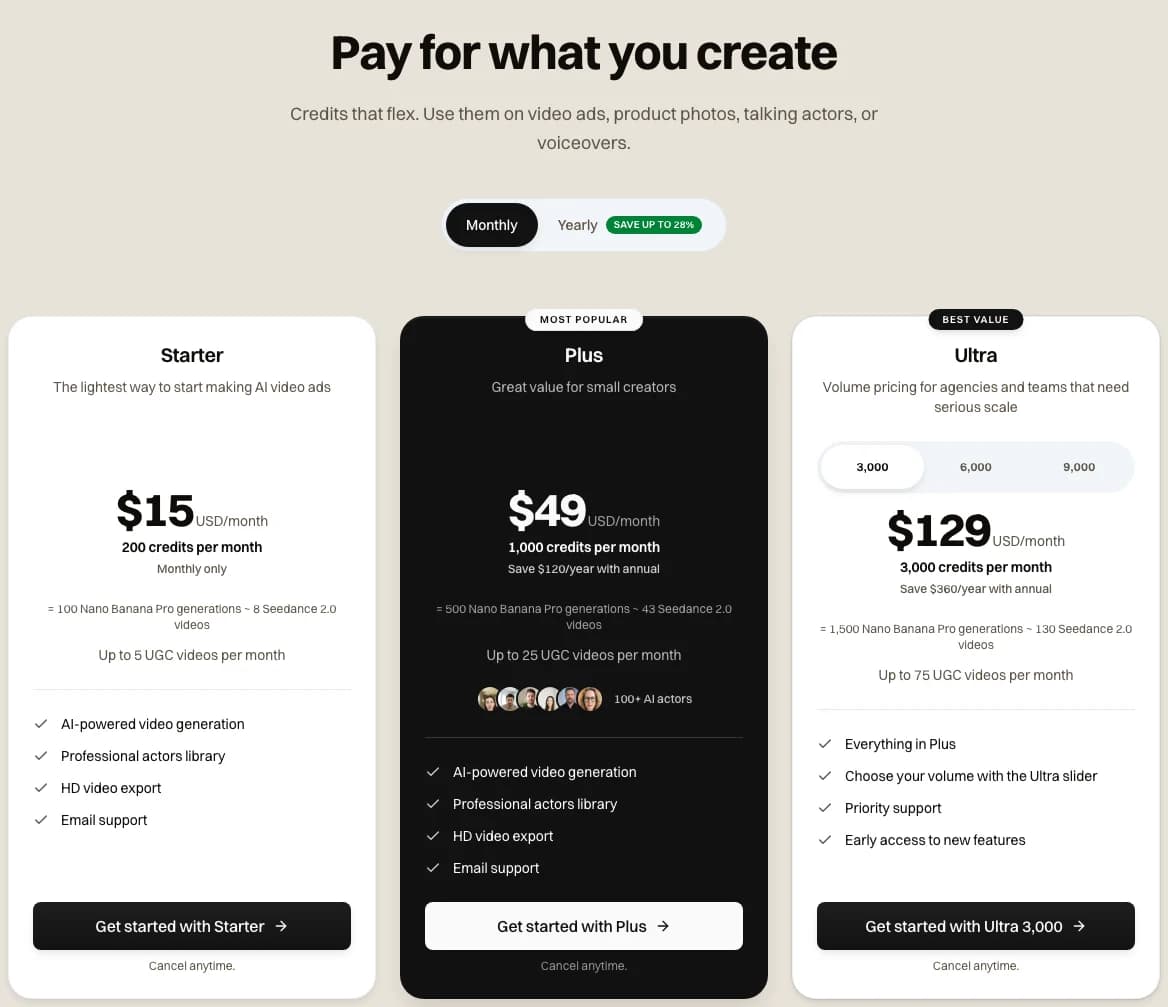
Our pricing page at novoads.ai/pricing with Monthly selected, captured 2026-11-04.
Put a price on your next ad batch
See what a month of credits covers across stills, video ads and talking actors.
Compare the plansBefore you choose any of the three, count the images you actually kept last month and check your company's revenue against the $1M rules above.
Frequently Asked Questions
What are the Stable Diffusion models?
Stable Diffusion is Stability AI's family of image models. Its release notes call the SD 3.5 family its latest base models, and they date Large and Large Turbo to October 22, 2024, and Medium to October 29, 2024. You can call them through Stability's API at a price per image, or download the weights from Hugging Face and run them yourself.
Does Stable Diffusion have censorship?
On Stability's API, yes. Its API reference describes requests that a content moderation system denies at no charge, outputs that come back blurred because they violated its moderation policy, and a refusal when an uploaded image shows a public figure's likeness. Stability's Acceptable Use Policy (effective September 30, 2026) also covers self-hosting under its licenses, and among other things it bars sexually explicit content and impersonating people without consent or legal right. We didn't test what gets flagged.
What's the difference between Stable Diffusion and ComfyUI?
Stable Diffusion is the model, and ComfyUI is a tool for running it. Stability's Hugging Face card for SD 3.5 Large recommends ComfyUI "for node-based UI inference" when you run the model locally or self-host it, and Stability's launch post lists ComfyUI among the ways to reach SD 3.5.
Can I use Midjourney and Stable Diffusion images in ads?
Yes, but the conditions differ. On Midjourney, a company with over $1,000,000 a year in revenue must be on Pro or Mega, according to its terms effective May 27, 2026. On Stability's API, the FAQ allows commercial use as long as the output doesn't violate anyone's copyright. If you self-host SD 3.5 under the Community License, you have to register for commercial use, and that license ends above USD $1,000,000 in annual revenue, counted with affiliates.
Key Takeaways
- By our arithmetic, an HD prompt on Midjourney's Basic plan costs about 6.5 cents for four images if you use up the month's allowance (plans page, copy of October 20, 2026). One SD 3.5 Large image on Stability's API costs $0.065.
- Keep all four from that Midjourney set and each image costs about 1.6 cents. Keep one and it carries the whole 6.5 cents.
- A company with over $1,000,000 a year in revenue must be on Midjourney's Pro or Mega plan. That puts its entry price at $60 a month, or $48 billed yearly.
- Stability's Community License covers listed Core Models such as SD 3.5 if your annual revenue, counted with affiliates, is below $1M, and commercial use requires registering. We found no revenue line in its API FAQ or terms.
- On Nano Banana Pro, Novoads costs more per image than either, at $0.15 on Starter or $0.098 on Plus by our arithmetic.
Sources
- •Stability AI: license page
- •Stability AI Community License Agreement
- •Stability AI: Core Models
- •Stability AI: API pricing
- •Stability AI: Stable Diffusion 3.5 API reference
- •Stability AI: API FAQ
- •Stability AI: Acceptable Use Policy
- •Stability AI: Introducing Stable Diffusion 3.5
- •Hugging Face: Stable Diffusion 3.5 Large model card
- •Midjourney: Comparing Midjourney Plans (Internet Archive copy of October 20, 2026)
- •Midjourney: GPU Speed (Internet Archive copy of October 15, 2026)
- •Midjourney: Terms of Service (Internet Archive copy of October 25, 2026)