What Is Stable Diffusion? Ad Images at 6.5 Cents on Its API
Stable Diffusion is Stability AI's family of open image models. What one ad image costs on its API, what the $1M license line means for ads, and what changed at Stability this fall.

Mauricio Valdivia
·12 min
Download the weights, or pay 6.5 cents an image
Stable Diffusion is Stability AI's family of text-to-image models, and the company offers it two ways. You can download the weights and run them on your own graphics card, or you can pay Stability to run them for you on its API. On that API, one picture from Stable Diffusion 3.5 Large costs 6.5 credits. Credits sell for a cent each, so the picture lists at 6.5 cents before tax.
Everything we say about Stability below comes from its own docs, price list and license pages, which we read on November 1, 2026, over a connection in Madrid. When a reseller hosts the same model, we name the reseller and give its own price. We didn't run Stable Diffusion for this post. We made one image for it with Nano Banana Pro, a model we sell in Novoads, and the caption under it names that model.
Who makes Stable Diffusion, and which version people mean
A research model that Stability took public
Stable Diffusion started in a university lab. The original code, which the CompVis group published on GitHub, calls it "a latent text-to-image diffusion model" and says it was "made possible thanks to a collaboration with Stability AI and Runway." The model builds on the group's earlier paper, High-Resolution Image Synthesis with Latent Diffusion Models, which went up on arXiv in December 2021.
Stability's launch post says Patrick Esser of Runway and Robin Rombach of the Machine Vision & Learning group at LMU Munich led the work. The same post says the core dataset was LAION-Aesthetics, a subset of LAION 5B. Stability released the model to the public on August 22, 2022, after a first release for researchers.
Diffusion is also the name of the general method behind many image models, but this post sticks to Stability's.
The versions you'll see named
Guides name specific versions, so it helps to know the order they came in.
- The 1.x weights came first, and v1.4 was the version Stability recommended at the public release.
- Stable Diffusion 2 came out as an open-source release, and 2.1 followed it.
- SDXL arrived as version 0.9 and then as SDXL 1.0, and Stability introduced SDXL Turbo as a real-time model.
- Stable Diffusion 3 started as an early preview. Stability then put it on the API alongside a Turbo version and released an open SD3 Medium.
- Stability brought the 3.5 family to its API on October 22, 2024, starting with Large and Large Turbo. Its launch post says the company added Medium to the open release on October 29.
The price list puts Large at 8 billion parameters. Large Turbo is a distilled version that runs in four steps, and Flash is a distilled version of Medium. Stability's release notes still call the 3.5 family "Stability AI's latest base models."
Stability also runs two API services on top of those models. Stable Image Ultra is the flagship, built on SD 3.5 Large, and Stable Image Core is tuned for speed and cost.
Where to get the weights
Stability publishes the open weights on Hugging Face. The SD 3.5 Large page asks you to agree to share your Hugging Face information before you can download the files, and its model card describes Large as a Multimodal Diffusion Transformer, or MMDiT. Stability also keeps an SD 3.5 repository on GitHub, which it calls "a reference library meant to assist partner organizations in implementing SD3.5/SD3."
What one image costs on Stability's API
6.5 credits, and what a credit is worth
Stability's API reference gives SD 3.5 Large a "flat rate of 6.5 credits per successful generation." Its pricing page sets one credit at $0.01. The getting-started guide puts it as $1 USD per 100 credits. So one SD 3.5 Large image lists at 6.5 cents, or $0.065.
The rate is flat because the size is fixed. The endpoint returns a 1-megapixel image. By default, that's 1024 by 1024 pixels. You can pick another aspect ratio, and the image still comes back at 1 megapixel. The ratios run from a wide 21:9 to a tall 9:21.
That price isn't new. SD 3.5 Large has been on the API since October 22, 2024. It isn't on the list of price increases Stability made on August 1, 2025. When Stability rerouted calls for its older SD3 models to their 3.5 equivalents on April 17, 2025, it kept them "at the same price."
Tax, refunds and credits that expire
Treat the 6.5 cents as a list price. Stability's terms of service, in force since September 30, 2026, and its price list both have lines that affect what you end up paying.
- The terms let Stability charge "any applicable fees and taxes" on top of the price.
- They say "All payments are non-refundable, except where required by law."
- Unused credits expire a year after you buy them, unless Stability specifies otherwise.
- The price list says pricing "is subject to change," and the terms let Stability raise fees "with advance notice."
The pricing page offers 25 credits to get started, enough for three SD 3.5 Large images. We couldn't see Stability's smallest credit pack, because billing is behind a sign-in.
The rest of Stability's price list
Stability's other image models work out the same way, at a cent a credit.
| Image model on Stability's API | Credits per image | List price per image |
|---|---|---|
| Stable Image Ultra | 8 | $0.08 |
| Stable Diffusion 3.5 Large | 6.5 | $0.065 |
| Stable Diffusion 3.5 Large Turbo | 4 | $0.04 |
| Stable Diffusion 3.5 Medium | 3.5 | $0.035 |
| Stable Image Core | 3 | $0.03 |
| Stable Diffusion 3.5 Flash | 2.5 | $0.025 |
| SDXL 1.0, at 30 steps or fewer | 0.9 | $0.009 |
Ultra costs the most, at 8 cents, and Stability says it "excels in typography, complex compositions, dynamic lighting." Core is cheaper at 3 cents and returns a bigger image, at 1.5 megapixels. SDXL 1.0 is the cheapest line in the table, and the price list calls it a "legacy base model for straightforward image generation."
If you need more pixels than the endpoint gives you, Stability's Fast Upscaler adds 2 credits. Two of Stability's pages disagree on how big the result gets.
- The upscaler's API page says the result is four times the input, up to "a maximum size of 16 megapixels."
- The price list says the same tool goes "up to 4 megapixels."
We didn't run the upscaler to see which page is right. Add an upscale, and an SD 3.5 Large image comes to 8.5 credits, or 8.5 cents.
Which images get billed
Stability's pages cover four cases.
- The SD 3.5 API page says a failed generation isn't charged.
- A request the moderation system refuses outright comes back with a 403 error that says "You were not charged for this request."
- A blurred image can be billed. The API spec defines a CONTENT_FILTERED result as a "successful generation, however the output violated our content moderation" policy, and the price is per successful generation.
- An undated help-center article says that when the filter flags an image the user didn't mean to trigger (a false positive), "the end-user is not charged for the blurred image." It doesn't say whether that covers API calls.
We wouldn't count on that last case when budgeting.
Three ways to use Stable Diffusion
Through Stability's API
Stability's getting-started guide boils the API down to three steps.
- Create a Stability AI account on its developer platform.
- Get an API key from that account.
- Buy credits, since every call uses them.
Image calls go to api.stability.ai/v2beta/stable-image/generate/sd3, with the key in the header and the prompt in the body. The prompt is the only required field, and four other details shape how you call it.
- If you don't pick a model, you get sd3.5-large.
- A negative prompt lists "what you do not wish to see in the output image."
- Add an image and a strength value, and the same call becomes image-to-image.
- The API allows 150 requests every 10 seconds.
Through a reseller
Stability's launch post for 3.5 lists Replicate, Fireworks AI, DeepInfra and ComfyUI as other places to use the model. SD 3.5 Large is on fal too, where the model page prices a request at $0.065 per megapixel (fal's own price on November 1, 2026). For a 1-megapixel image, that's the same 6.5 cents Stability lists. Resellers set their own prices and terms, so read the reseller's page before you budget.
On your own graphics card
Run the weights yourself and you spend no credits. You pay for the hardware and the electricity instead. For SD 3.5 Large, the Hugging Face card recommends "ComfyUI for node-based UI inference, or diffusers or GitHub for programmatic use," and you can download the files once you agree to share your Hugging Face information.
Your graphics card's memory decides what you can run, and Stability gives these numbers.
- SD 3.5 Medium needs 9.9 GB of VRAM, not counting the text encoders.
- SDXL 1.0 should work on consumer GPUs with 8GB.
- Stability's TensorRT build of SD 3.5 Large for NVIDIA RTX cards cuts memory use from 19GB to 11GB.
Even at home, you're still under the Community License and its $1M line. Our image-to-video guide weighs the same hardware-for-credits trade for video models.
The license, if your images go into ads
The $1M line is about the weights
The Community License covers what Stability calls its Core Models. That list, last updated on May 20, 2026, includes SD 3.5 Large, Medium and Large Turbo, SD3 Medium and SDXL Turbo. Stability's license page says anyone may use them at no charge unless the use is commercial and "you or your organization generate over USD $1M (or local currency equivalent) of annual revenue, regardless of the source of that revenue."
That last clause matters for a brand. The $1M counts all of your company's revenue, including revenue that has nothing to do with the images.
Above that line, the page sends you to its Enterprise tier, which it describes as "for enterprise, API providers, and businesses with annual revenue exceeding $1M." Below the line, three more Community License terms apply.
- You must register with Stability.
- You own your outputs "to the extent permitted by applicable law."
- Stability says there's no limit on how many images you make.
SDXL 1.0 has its own license
Stability released SDXL 1.0 under the CreativeML OpenRAIL++-M License, a text dated July 26, 2023. The Core Models list names SDXL Turbo but not SDXL 1.0, and it says any model it doesn't name isn't one of the Core Models. Read the OpenRAIL++-M terms before you build ads on SDXL 1.0.
Using API images in ads
Pictures you make through the API fall under Stability's API pages rather than the license tiers. Its API FAQ answers "Can I use the API outputs for commercial purposes?" with "Yes, as long as the output doesn't violate anyone's copyright." Its terms assign you "all of our right, title, and interest (if any) in the Outputs," and we didn't find a revenue limit in the terms.
The terms also forbid passing an output off as human-made or stripping out the content credentials Stability adds. Its APIs sign images with C2PA. If your ads run on Google, our post on Google Ads rules for AI-generated images covers what gets AI images disapproved there.
What changed at Stability this fall
Stable Assistant's sunset
Stability's help center set October 1, 2026, as the date it would sunset Stable Assistant, its subscription app. Guides that send you to Stable Assistant to try the model are out of date on that point. We'd use the API or the weights instead.
Brand Studio, gone from the footer's Applications list
The other change involves Brand Studio. Stability's home page still calls it "our fully managed creative production platform for enterprise teams," but the Applications list in the site's footer now shows only Stable Audio. An archived copy of a Stability page from August 10 showed Brand Studio in that list too. We found no notice from Stability about the change.
What one ad image costs on Stability and on Novoads
A product shot from a model we sell
To put a real picture next to Stability's prices, we used a model we sell rather than Stable Diffusion. We took the product-shot template from Google's Gemini image docs and filled it in with our own details. Our version asked for an amber serum bottle with its label left blank, standing on pale stone under three soft lights, shot from a low angle with water beads on the glass. We made a single 2K image at 4:5 with Nano Banana Pro, through the Novoads MCP connector.
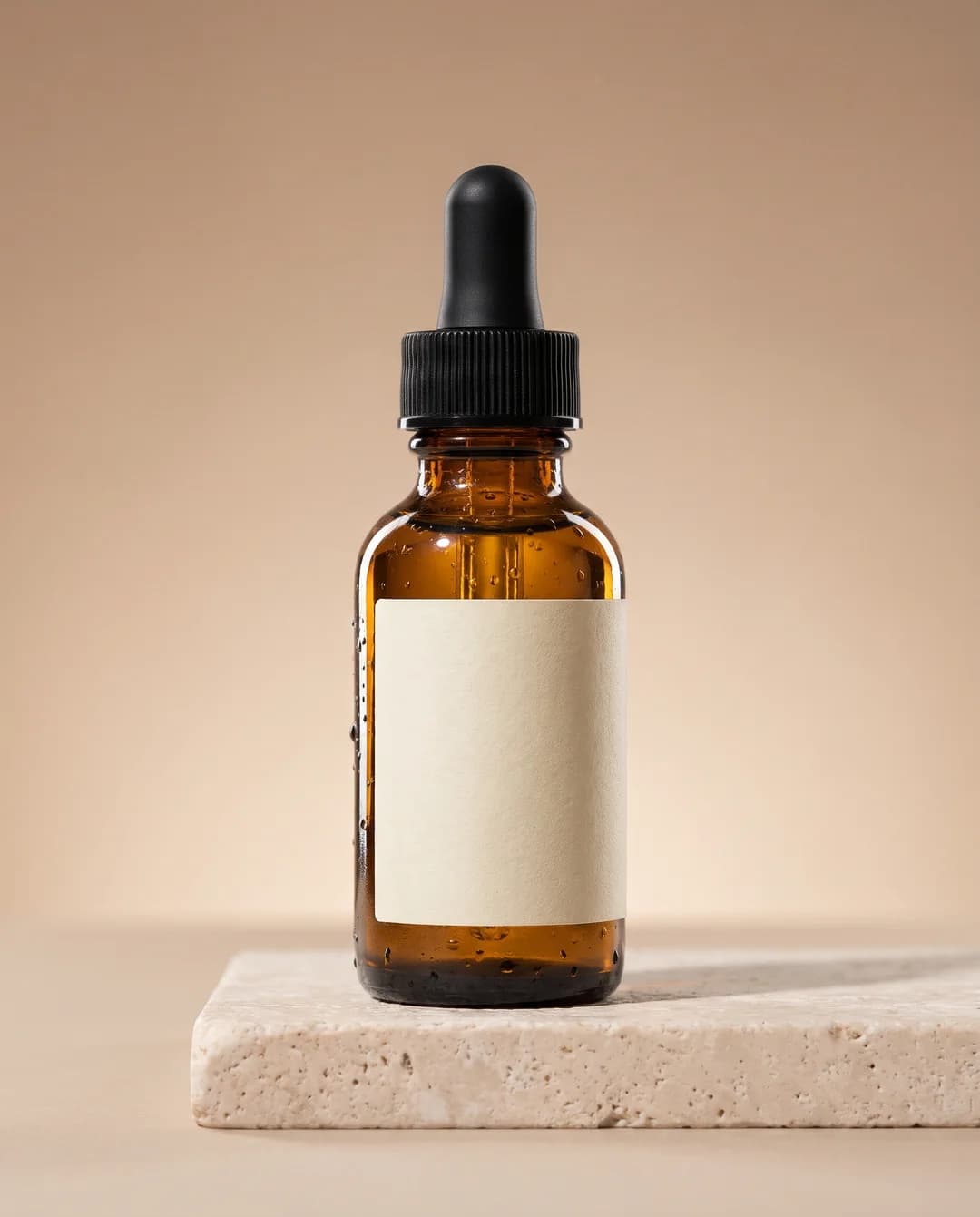
Made in Novoads with Nano Banana Pro · one 2K image at 4:5 from Google's product-shot template, with our own serum details · 2 credits · 2026-11-01
The file measured 1856 by 2304 pixels. It cost 2 credits, and the bottle, the dropper cap, the stone and the water beads ended up where the prompt put them. One image shows the template can work. It doesn't show how reliably it works, and because the blank label was our request, it tells you nothing about how the model handles text.
This isn't a Stable Diffusion image, and we didn't compare the two models' output. It's also bigger, at about 4.3 megapixels, while Stability's rate buys 1 megapixel. You'll find Google's template, and the others in its image guide, in our Nano Banana prompts guide.
The price per image, side by side
Stability's API costs less per image than Nano Banana Pro in Novoads, on either of our plans.
| Where, and which model | One image costs | What the price covers |
|---|---|---|
| Stability API, SD 3.5 Large | 6.5 cents | 1 megapixel, list price before tax |
| Stability API, Stable Image Core | 3 cents | 1.5 megapixels |
| fal, SD 3.5 Large | $0.065 per megapixel | fal's own price |
| Novoads Starter, Nano Banana Pro at 1K or 2K | $0.15 | 2 credits at 7.5 cents each |
| Novoads Plus, Nano Banana Pro at 1K or 2K | about 10 cents | 2 credits at about 4.9 cents each |
| Novoads Starter, a 1-credit image | 7.5 cents | GPT Image 2 or 2.5 at low or medium quality, or Seedream 5 Lite |
| Novoads Plus, a 1-credit image | about 4.9 cents | the same models |
On Starter, our 1-credit images cost more than SD 3.5 Large, at 7.5 cents. On Plus they cost less, at about 4.9 cents. Stable Image Core, at 3 cents, undercuts our cheapest image on both plans.
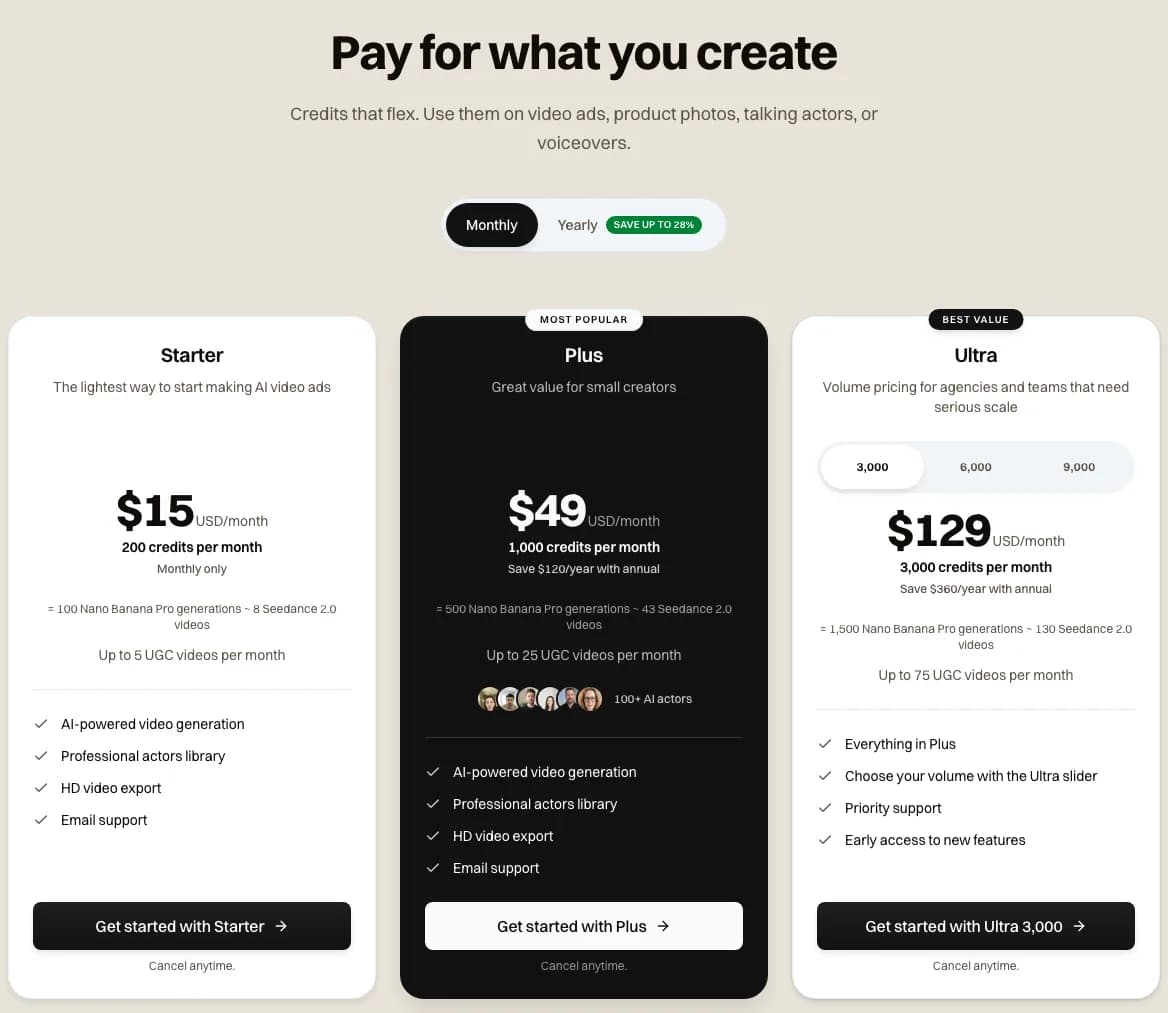
The Novoads pricing page on Monthly, captured 2026-11-01. Starter is $15 for 200 credits. Plus is $49 for 1,000 credits, and Ultra starts at $129 for 3,000.
What a month's budget buys
At list price, the same monthly spend buys this many images.
| Spend a month | SD 3.5 Large on Stability's API | Nano Banana Pro on our plans | Our 1-credit models |
|---|---|---|---|
| $15, our Starter price | about 230 images | 100 images | 200 images |
| $49, our Plus price | about 750 images | 500 images | 1,000 images |
The two budgets don't buy the same things. Stability's credits buy Stability's models. Ours buy images from Google, OpenAI and ByteDance models, plus video ads, all from one balance. Our pricing page puts Starter's 200 credits at about 8 Seedance 2.0 videos.
If you write code and want the lowest price per 1-megapixel picture, Stability's API is the better deal. If you'd rather make the product shot and the video ad in one place, without an API key, see what each plan includes. Starter costs $15 a month for 200 credits.
Make the shot, then the ad
Nano Banana Pro images and video ads draw on one credit balance in Novoads. See what each plan's credits buy.
Compare the plansRatings, limits and our verdict
Reviews, from a small sample
When we read Trustpilot's page for stability.ai on November 1, 2026, it showed a TrustScore of 1.8, which Trustpilot labels Poor. That score came from 16 reviews, and 88% of them were one-star. Sixteen reviews is a small sample, and the page rates the company as a whole rather than the model.
What the model cards admit
Stability's own card for SDXL base 1.0 is blunt about its limits. It says the model "does not achieve perfect photorealism" and "cannot render legible text," and that "faces and people in general may not be generated properly." Those are SDXL's limits. The SD 3.5 Large card claims "improved performance in image quality, typography, complex prompt understanding, and resource-efficiency," and we haven't tested that.
If readable words inside the picture matter for your ads, Seedream 5.0 Pro and Nano Banana Pro are the models we've written up for that.
Our verdict
We think Stable Diffusion earns its place in two cases.
- A developer who wants a low, predictable price per picture. SD 3.5 Large lists at 6.5 cents and Core at 3 cents, each for a fixed size.
- A team with a strong graphics card and less than $1M in revenue, which can run the open weights without paying per image.
For a marketer who wants finished ads without code, the lower price per image comes with setup work, and the image is only the first piece of the ad. That's where we think a tool that puts images and video on one credit balance earns its higher price per picture. If you're making still ads either way, our static ads guide covers the formats and sizes platforms ask for. For other image tools, see our Midjourney alternatives and our Adobe Firefly explainer.
Frequently Asked Questions
Is Stable Diffusion secure?
Stability answers that for its own API. It says its APIs filter inputs and outputs and sign images with C2PA, and that it has completed SOC 2 Type II and SOC 3 certifications. Its terms also let you opt out of having your inputs and outputs used to train its models. If you run the weights on your own machine, keeping that setup secure is up to you.
What is an AI image?
An AI image is a picture a model generates from a text prompt, or from a starting image plus a prompt, rather than one taken with a camera or drawn by an illustrator. Stability's terms call these Outputs. They forbid passing one off as human-made, and they describe the content credentials Stability applies as marks that identify an output as AI-generated.
How to use Stable Diffusion?
You can use it three ways. On Stability's API, you create an account, get an API key, buy credits and send a prompt to its image endpoint, where SD 3.5 Large costs 6.5 credits a picture. To run it yourself, download the weights from Hugging Face (you'll have to agree to share your details first), then use ComfyUI or the diffusers library, as Stability's model card suggests. Resellers such as fal host it too, at their own prices.
Which is the best diffusion model?
We don't think one model wins every job. Within Stability's own lineup, the price list calls SD 3.5 its most powerful base model, and the release notes call Stable Image Ultra its highest-quality model. For ads, test your own product and copy on the models you're weighing, at the size you'll publish, and compare the price per image at that size.
Key Takeaways
- Stable Diffusion is Stability AI's family of text-to-image models. You can download the weights and run them yourself, or pay Stability to run them on its API.
- On Stability's API, SD 3.5 Large lists at 6.5 cents a picture before tax, and that price is for a 1-megapixel image.
- The Community License's $1M revenue line is about running the weights yourself. Images you make through the API fall under Stability's FAQ and terms instead.
- Stability's help center set October 1, 2026, as Stable Assistant's sunset date, and Brand Studio no longer appears in the Applications list in the site's footer.
- Per image, Stability's API costs less than Nano Banana Pro in Novoads on either plan, at 6.5 cents against $0.15 on Starter.