
AI Music in Ads: What Sony's 30,117-Recording Suit Against Udio Means for Advertisers
Sony filed a second copyright suit against Udio on July 20, 2026 covering 30,117 recordings. Here is what the case does and does not settle for anyone dropping a generated track under a paid ad.

Mauricio Valdivia
·11 min
A fair-use win still would not clear your soundtrack
It is late, the campaign goes live Thursday, and the twenty-second product cut needs something under the voiceover. Nobody licenses a track for a test creative. So you open a generative music tool, type "warm upbeat indie pop, no vocals," drag the render into the timeline, and ship. Ninety seconds, problem solved.
On Monday, July 20, 2026, Sony Music Entertainment filed a second copyright infringement lawsuit against Udio in the US District Court for the Southern District of New York, asserting 30,117 sound recordings it says the AI music company copied without permission to train its models. The filing landed after the same court refused to let Sony expand its original case, which remains at 333 works.
Most coverage of that filing is written for the music industry. This one is written for the person about to put a generated track under a paid ad. The useful part of the case is not the headline number. It is a quieter claim buried in the complaint that turns on how the training audio was obtained rather than whether training on it was fair, and that claim does not go away if the AI side wins the fair-use argument everyone is watching. What follows is a read of what was filed, what it settles, what it does not, and where the boring low-risk paths are. It is a description of live litigation, not legal advice.
What Sony actually filed on Monday
A second suit, not a bigger one
Sony first sued Udio in June 2024, in litigation coordinated by the RIAA on behalf of the major labels. That case is still running before Judge Alvin K. Hellerstein in the Southern District of New York, and it still covers 333 recordings.
Discovery is what changed the scale. Once Sony could inspect Udio's training data, it identified far more of its own catalog than the original complaint listed, and in May it moved to add more than 30,000 recordings to the existing case. In late June the court said no, holding that adding that many works so close to the end of document discovery would materially alter the scope of the case. The same order left the door open, noting that "plaintiffs have the right to seek to stop infringement of, and recover damages for, all copyrighted works." Sony took the second half of that sentence and filed a new action.
Two numbers are easy to blur here and worth keeping apart. The motion the court denied sought to add 30,442 recordings. The new suit asserts 30,117. Related sets, not the same set.
Three claims, and the odd one out
The complaint brings three counts: infringement of post-1972 sound recordings, infringement of pre-1972 recordings protected under the Music Modernization Act, and circumvention of technological measures under the Digital Millennium Copyright Act.
The first two are the familiar fight. Did training a generative model on copyrighted recordings infringe, or was it fair use? That question is live in dozens of cases and nobody knows the answer yet.
The third one is different in kind, and it is the reason this story matters to someone buying media rather than someone running a label. It does not ask what the model did with the audio. It asks how the audio was taken in the first place.
| Count | What it turns on | If training is fair use |
|---|---|---|
| Post-1972 recordings | Was the training infringement | Count fails |
| Pre-1972 recordings (MMA) | Same question, older catalog | Count fails |
| DMCA circumvention | How the audio was obtained | Count survives |
What Sony is asking for
Sony is seeking statutory damages of up to $150,000 per work infringed, plus up to $2,500 for each act of circumvention, along with an injunction, and it has demanded a jury. Those ceilings are not invented for this case. Section 504(c) of the Copyright Act lets a court raise a statutory award to "not more than $150,000" where infringement is proven willful, and section 1203(c)(3)(A) sets circumvention damages at "not less than $200 or more than $2,500 per act of circumvention."
Run the arithmetic and the scale becomes obvious. Billboard, working from the complaint, estimated that going from 333 recordings to more than 30,000 moves Udio's potential damages exposure from around $50 million to roughly $4.5 billion. That is a reporter's multiplication, not a court's finding, and no court has awarded a cent. But it explains why the industry treats this as the pivotal AI music case and why the licensing conversations around it moved so fast.
Why the DMCA count is the part ad buyers should read
Access controls, copy controls, and a rolling cipher
The circumvention claim rests on a technical distinction most marketers have never had a reason to learn. The DMCA prohibits bypassing technologies that control access to a work. It does not, on its own terms, prohibit bypassing technologies that merely prevent copying once you already have access.
Sony's allegation is that YouTube employs certain technological measures, including a "rolling cipher," to control access to its content and stop protected media files from being downloaded, and that Udio got around them to pull recordings in bulk. Udio's motion to dismiss argued the rolling cipher is a copy control, not an access control, and therefore falls outside the statute.
On April 15, 2026, Judge Hellerstein denied that motion, holding the allegations sufficient at the pleading stage. He also flagged that whether YouTube's measures ultimately count as access controls "requires a greater factual record than the pleadings contain," and allowed Udio to raise the argument again later. So the claim is alive, not won.
Udio's own filing supplies the predicate
This is the part that makes the count unusually sturdy. In its answer to Sony's amended complaint, Udio stated plainly that it "obtained audio data from YouTube for use as training data," adding that "it acquired some of its training data by utilizing YT-DLP," a widely used download tool. Udio's position is that downloading publicly available videos is not unlawful and that its use of the material is fair use.
Set the legal argument aside for a second and notice the factual posture. The acquisition method is not in dispute. What is in dispute is whether the method was legal. That is a very different litigation from one where a plaintiff has to prove what happened.
It survives a fair-use ruling
Two federal rulings in June 2025 are the ones AI companies cite most: courts in the Northern District of California found in Bartz v. Anthropic and Kadrey v. Meta that using copyrighted works to train AI models constituted fair use, while noting limits.
Here is why that does not close the question for a commercial user. As the Sher Tremonte client alert on the April ruling put it, even if AI training on copyrighted material is ultimately deemed fair use, the method by which training data is acquired may independently violate the DMCA. Fair use is a defense to infringement. It is not a defense to circumvention.
So the mental model many advertisers carry, "the courts will bless AI training and this all goes away," is only half right at best. One fight could resolve in the platforms' favor while a second, narrower fight about acquisition keeps running.
What fair use would and would not settle
The question the court left open
The access-control versus copy-control line at the center of the April ruling is also before the Second Circuit in Yout LLC v. Recording Industry Association of America, which could produce binding guidance on the same statutory question Hellerstein declined to resolve on the pleadings. Appellate courts move slowly. Plan on this being unsettled through the next several campaign cycles.
Where that leaves a commercial user
Nothing here creates a new obligation for advertisers. There is no rule that says you must document the training provenance of your background music. What has changed is the probability that someone asks. Read the case as three separate clocks:
- Fair use on training. Unresolved, and likely to stay that way for years.
- How the data was acquired. Already past a motion to dismiss, and factually conceded in part.
- Industry practice. Moving fastest of the three, because six rightsholder groups already signed.
That pattern should feel familiar if you have been tracking the disclosure side of AI advertising. Platform rules moved before any court did: Meta, TikTok and Google each built their own AI labeling regime, and we mapped how the three rulebooks differ and when a label is actually required. Music provenance is on the same track, one layer down in the stack.
Sony's other argument: the licensed market already exists
The roster
Udio is not an outlaw platform. It has signed with most of the industry. Per Billboard's read of the complaint, "Udio has inked training licenses with UMG and WMG, as well as with Kobalt, Merlin, Believe and the National Music Publishers' Association (NMPA)."
The sequence, all of it predating this week's filing:
- Universal Music Group settled with Udio in October 2025.
- Warner Music Group followed in November 2025.
- Merlin, representing independent labels, reached a deal in January 2026.
- Kobalt signed in April 2026.
- The NMPA announced its industry-wide pact on June 10, 2026.
Believe signed too. Sony is the only major music company yet to reach a licensing agreement with Udio, which is the whole shape of the story: six rightsholder groups took the deal, one is still litigating.
Why a signed deal becomes evidence
Sony uses those deals against Udio directly, aimed at the market-harm factor in the fair-use test. If a licensing market for training data exists, the argument goes, then taking the inputs for free harmed it. The complaint puts it in one line: "A company that pays to license the very inputs at issue cannot credibly maintain that no market exists for those inputs."
You do not have to think that argument wins to see what it means downstream. As licensed training deals become normal, "there was no way to license this" stops being an available answer, for platforms and for the people using their output.
What the licensed deals actually cover
Worth reading the fine print, because "Udio has a deal with Universal" is not the same as "any track you generate today is cleared." The Universal and Warner settlements, per Billboard, require the company to build a new model out of pre-cleared training data and to keep AI-generated music inside a walled garden on the platform.
That is a forward-looking architecture, a different model with different training data and constraints on where the output can travel. A deal announced in the fall of 2025 does not retroactively clean a file you exported before it, and a walled-garden output was not designed with your Meta ad account in mind.
Why a brand ad is a bigger surface than a personal upload
Commercial use is the aggravating fact pattern
Fair use analysis weighs commerciality. So does damages exposure, and so does the willfulness multiplier in section 504(c). None of that decides an outcome, but the direction of travel is consistent: the same twenty seconds of audio carries more weight under a paid ad for a supplement brand than under a bedroom demo.
Your ad is findable in a way a personal post is not
A personal upload is one file on one account. A paid creative is a different object:
- It is distributed by a platform and subject to that platform's own content rules.
- It is frequently retained in a public ad library, long after you paused it.
- It carries a brand name attached to a company with a registered address.
- It runs against inventory where automated audio identification is routine.
If a track ever becomes a problem, an ad is the easiest possible artifact to locate and the most expensive to unwind, because pulling it also pulls the spend, the learnings and the creative that was working.
Provenance is the question you cannot answer later
Six months from now, "where did this track come from" has exactly two answers: a file path plus a license, or a shrug. The second answer is not a legal loss. It is just a position with no floor under it, taken to save the ten minutes it would have cost to use a cleared source. Ad teams already run this discipline for images, where Google's rules on AI-generated imagery and TikTok's disclosure requirements made sloppy sourcing expensive. Audio is the layer nobody got around to.
The low-risk paths for a soundtrack
Three options, in rough order of how often they fit an ad team:
- A licensed production-music library, with the license file stored beside the creative.
- The ad platform's own commercial sound library, scoped to advertising use by design.
- No music bed at all, which is how most creator-style ads already sound.
Licensed libraries and the platform's own sound tools
The unglamorous answer is still the right one. A production-music subscription with a commercial-use license, or the ad platform's own commercial sound library, both give you a chain of title you can point at. They cost less than one hour of the argument you would otherwise be having.
The one habit to add: save the license alongside the creative, not in someone's inbox. If your creative operations system already tracks which variant is live and which is retired, the license file belongs in the same row.
Voice-forward ads that do not need a bed
Here is the part most advertisers underuse. Plenty of the best UGC-style ads run on nothing but a person talking to camera with room tone, no music bed anywhere. Music is a polish signal, and polish is exactly what this format is trying to avoid. When a creator-style ad sounds produced, it stops reading as a recommendation and starts reading as a commercial.
So the compliance-safe option and the performance option often point the same way: cut the bed, tighten the script, let the voice carry it. If you are building this kind of creative from scratch, our step-by-step guide to AI UGC ads walks the whole flow.
Keep the paper trail
Three fields per creative, and this whole category of problem becomes administrative:
- Source. Which library, tool or platform the audio came from.
- Right. The license file, the subscription seat, or the in-platform tool used.
- Date. When it was pulled, because terms change and you want the version you agreed to.
That is the entire practice. It costs nothing until it saves everything.
How Novoads handles the layer that is actually risky
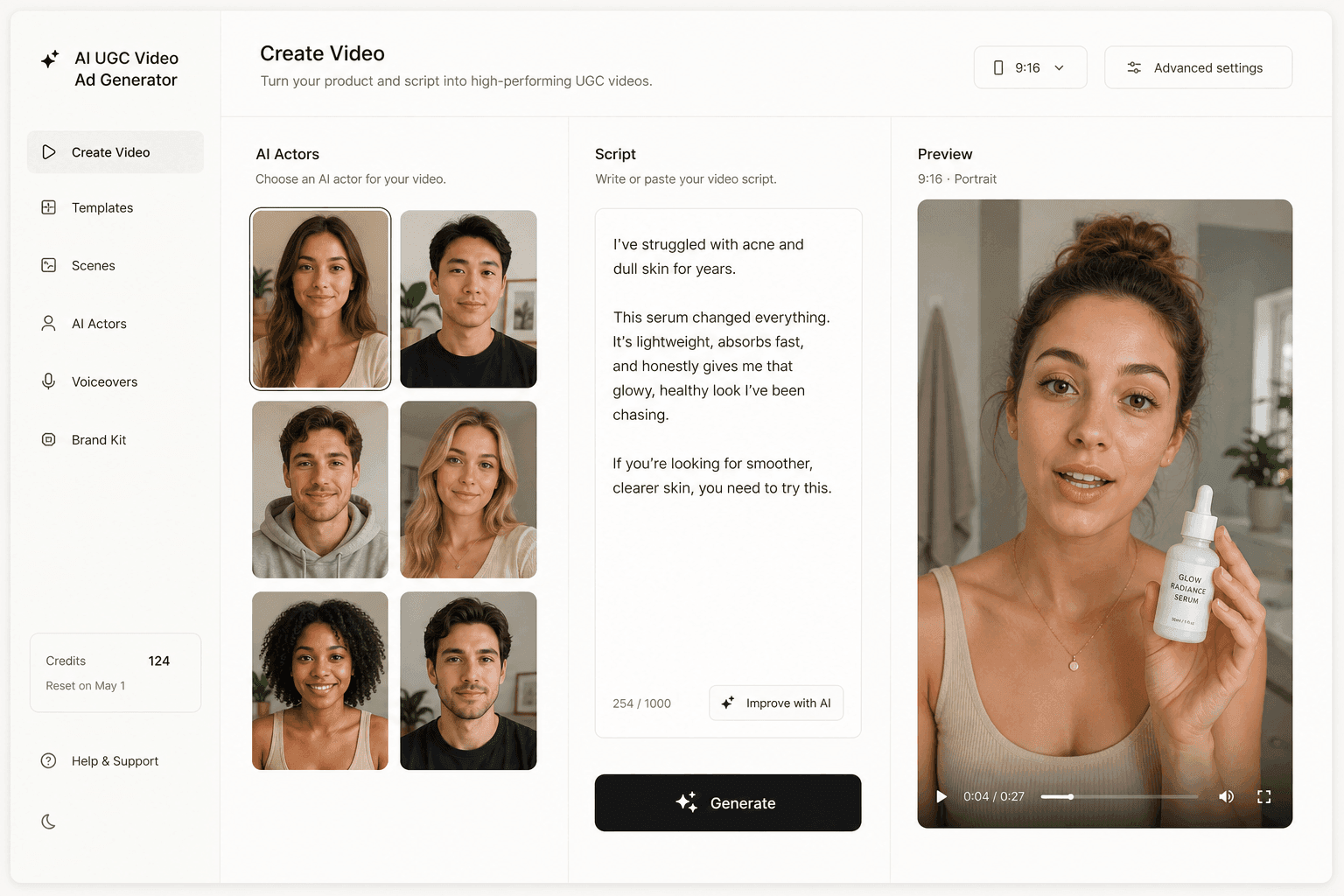
Novoads generates the two layers a UGC ad genuinely needs, the actor and the voice. You write or auto-generate a script, pick an AI actor, and get a vertical video ad with an AI voiceover, with voices available in 31 languages. It does not generate music, which is deliberate: the music bed is the layer with the murkiest provenance right now, and it is also the layer a creator-style ad least needs.
If you do want a bed, add it in the edit from a licensed library or the ad platform's own cleared sound tools, and keep that receipt with the asset. Provenance is turning into a standing cost of running paid media, in the same way that being cited as a source inside Google's AI Mode turned out to be a separate contest from buying the placement. And if voice quality is the reason you were reaching for music in the first place, our rundown of open-source alternatives for ad voiceovers covers the honest tradeoffs. You can try the actor-and-script flow yourself and see how many of your cuts never needed music.
Provenance is becoming a creative-ops problem, not a legal one
The Sony filing will take years to resolve and the fair-use question may not resolve at all this decade. Waiting for the verdict is not a strategy, and neither is panic. What the case actually tells an advertiser is narrower and more useful: the industry is building a paper trail for where machine-generated audio comes from, one licensing deal and one court order at a time, and the DMCA count means that trail matters even in the world where training turns out to be fair use.
You do not need a legal opinion to act on that. You need a source you can name for every second of audio you ship. Teams that already treat sourcing as part of the creative workflow will not notice when the question arrives. Everyone else will answer it under deadline.
Frequently Asked Questions
What did Sony file against Udio on July 20, 2026?
Sony Music Entertainment, alongside nine affiliated labels, filed a second copyright infringement lawsuit against Udio in the US District Court for the Southern District of New York, asserting 30,117 sound recordings it says the AI music company copied without permission to train its models. It is a separate action from the original 2024 case, which the same court kept at 333 works after refusing in late June to let Sony expand it.
Does this lawsuit make AI-generated music illegal to use in ads?
No. Nothing has been decided. This is a complaint, not a ruling, and the underlying fair-use question is still open. What the case does is raise the odds that provenance, meaning where a model's training audio came from, becomes a documented issue rather than an abstract one. For an advertiser the exposure is not the lawsuit itself, it is using a track whose origin you cannot describe if a rightsholder or a platform asks.
What is the DMCA anti-circumvention claim and why does it matter more?
It is a claim under 17 U.S.C. 1201 that Udio bypassed YouTube's technological protections to download audio in bulk, a practice known as stream ripping. On April 15, 2026, Judge Alvin K. Hellerstein denied Udio's motion to dismiss that claim. It matters because it targets how the data was obtained rather than how it was used, so it survives independently of any fair-use ruling on training. A fair-use win for AI music platforms would not clear it.
Which music companies have licensed Udio, and which have not?
According to the new complaint, Udio has struck deals with Universal Music Group, Warner Music Group, Merlin, Kobalt, Believe and the National Music Publishers' Association. Universal settled in October 2025, Warner in November 2025, Merlin in January 2026, Kobalt in April 2026, and the NMPA announced its industry-wide pact on June 10, 2026. Sony is the only major music company yet to reach a licensing agreement with Udio.
Is a brand ad riskier than posting a generated track on my personal account?
The exposure surface is bigger, yes. A paid ad is a commercial use, it is distributed by a platform under that platform's own content rules, it is often archived in a public ad library, and it usually carries a brand name that a rightsholder can identify and contact. None of that decides a legal question, but it does mean a track with unclear provenance is easier to find and more expensive to unwind than the same track in a personal upload.
What is the lowest-risk way to put music under an AI-generated ad right now?
Three practical paths. Use a licensed production-music library and keep the license file with the creative. Use the ad platform's own cleared commercial sound library, which is scoped to advertising use by design. Or build a voice-forward cut that does not need a music bed at all, which is how most high-performing UGC-style ads are already structured. Whichever you pick, save the receipt next to the asset, because provenance questions arrive months after the campaign.
Key Takeaways
- On Monday, July 20, 2026, Sony Music filed a second copyright infringement lawsuit against Udio in the Southern District of New York, asserting 30,117 sound recordings, after the same court refused to let it expand the original case.
- The suit brings three claims: infringement of post-1972 recordings, infringement of pre-1972 recordings under the Music Modernization Act, and circumvention of technological measures under the DMCA. Sony seeks up to $150,000 per work infringed plus up to $2,500 per act of circumvention, plus an injunction and a jury trial.
- The DMCA anti-circumvention count is the durable one for commercial users. Judge Alvin K. Hellerstein let it proceed on April 15, 2026, and it turns on how the training audio was acquired, not on whether training is fair use. A fair-use win would not extinguish it.
- Sony's own complaint argues a licensed training market already exists, pointing at Udio's deals with Universal, Warner, Merlin, Kobalt, Believe and the NMPA. Sony is the only major without one, which is what makes provenance a real question for anyone using generated music commercially.
- The practical move for an advertiser is not to guess at legal outcomes. It is to make the soundtrack layer boring: licensed libraries, the ad platform's own cleared sound tools, or a voice-forward cut with no music bed, with the receipts saved next to the creative.
Sources
- •Music Business Worldwide: Sony Music sues Udio again, asserting over 30,000 recordings
- •Billboard: Why Sony Just Filed a New AI Music Copyright Lawsuit Against Udio
- •Sher Tremonte client alert: SDNY Allows DMCA Claim to Proceed Against Udio
- •Music Business Worldwide: Judge denies Sony Music bid to add over 30,000 recordings
- •17 U.S.C. 504, Remedies for infringement: Damages and profits