
ChatGPT Ad Load by Category: Sponsored Ads Hit 47% of Tracked Gaming Chats
Search Engine Journal's reading of Comscore's gated Q2 2026 AI Intelligence Report puts sponsored ads in 47% of the US desktop ChatGPT conversations about video games and consoles that Comscore tracked in June 2026, up from 3% in March. Here is what the three category series measure, what they leave out, and how to use them when you decide where to test.

Mauricio Valdivia
·12 min

Nearly half the gaming chats Comscore tracked carried an ad
Picture a small studio that sells a strategy game online and a companion board game from its own store. In March, its ChatGPT ads would have run in a category where sponsored placements were still rare. By June, they were not.
According to Search Engine Journal's reading of Comscore's gated Q2 2026 AI Intelligence Report, sponsored ads appeared in 47% of the US PC ChatGPT conversations about video games and consoles that Comscore tracked in June 2026, up from 3% in March. The same slide, as SEJ describes it, shows ad presence rising from 5% to 24% in toys and hobbies and from 9% to 22% in books, music and video. Comscore released the report on September 22, 2026.
Those are big moves in four months. They are also three series from one slide, read by one publication, out of a report that sits behind a download form. SEJ's own verdict is that until Comscore publishes detailed conversation counts, "the June increase should be considered a preliminary observation."
So this post does two jobs. It lays out exactly what the category figures say and what they leave out, with every caveat in the open. Then it separates the one thing ad load can tell an advertiser, which is where the other advertisers already are, from the thing it cannot, which is where your customers will click. If you need the mechanics of the channel first, start with how to run ChatGPT Ads.
The three category series, month by month
SEJ reports the slide as three monthly series, March through June 2026. Here they are as SEJ gives them. Each cell is the share of tracked ChatGPT conversations in that category that included a sponsored ad, in US PC activity.
| Category | March | April | May | June |
|---|---|---|---|---|
| Video games and consoles | 3% | 3% to 4% | 18% | 47% |
| Toys and hobbies | 5% | 12% | 14% | 24% |
| Books, music and video | 9% | 12% | 8% | 22% |
SEJ gives April for gaming as a range rather than a single value, so the table does too.
Video games and consoles: flat, then a jump
Gaming barely moved for two months. In SEJ's words, ad presence in ChatGPT gaming conversations "stayed between 3% and 4% through April, then increased to 18% in May and reached 47% in June."
Do the arithmetic and the shape is stark:
- May to June: up by a factor of about 2.6.
- March to June: up roughly fifteenfold.
- Timing: almost all of the move happened in the last two months of the window.
Neither of the other two series comes close to that curve.
Toys and hobbies: the only steady climb
Toys and hobbies is the one category that rose every month. SEJ: "Toys and hobbies grew each month, from 5% in March to 12% in April, 14% in May, and 24% in June."
It ends June at about half the gaming figure. It is also the smoothest line on the chart, and a steady climb is harder to explain away as a one-month blip than a single spike is. That is our reading of the shape, not something Comscore says.
Books, music and video: a dip before the rise
The third series wobbles. SEJ describes it moving "from 9% in March to 12% in April, a dip to 8% in May, and a rise to 22% in June."
A dip between two rises can come from any of three things:
- a small monthly sample
- a change in how conversations were classified
- a real pause in buying
Comscore has published neither the counts nor the classification rules, so there is no way to tell which from the outside. Hold every point value in this table loosely for that reason.
What Comscore counted, and what it did not publish
The figures are only as useful as the definition underneath them, and most of that definition is not public.
A share of conversations, not of impressions or people
SEJ is precise about the unit: "Comscore's retail chart focuses on conversations rather than tracking individual users or ad impressions." Each number is the share of ChatGPT conversations that Comscore classified into a retail category and that included a sponsored ad. SEJ also reports the slide's source note, which says "the data reflects U.S. PC activity only and is based on an opt-in panel."
The panel is Comscore's own. Its September 3 release describes the sponsored-chat product as "built on real user activity from its opt-in panel," and Digiday reports a respondent base for the Q2 report "running between 500,000 and 1 million users." That is a large panel. It does not tell you how many of those people talked to ChatGPT about video games in a given month.
Read the scope as three exclusions:
- Mobile is out. The slide covers US PC activity only.
- Other countries are out. It is a US read, and nothing in it describes Europe or anywhere else.
- Frequency is out. As far as the chart shows, a conversation with one ad and a conversation with several are the same data point.
No conversation counts, and no counting rules
Three gaps sit under every figure, and SEJ names all of them:
- Sample size. In SEJ's words, "the report doesn't specify the number of conversations behind each monthly figure".
- Classification. Nor, SEJ adds, does it detail how conversations are sorted into categories.
- The trigger. "It also isn't clear whether just one sponsored ad in any part of a conversation is enough for it to be counted."
Comscore did publish a total. Its release says ChatGPT "reached 168 million desktop conversations in June 2026." It did not say how many of those were about video games and consoles. A category share without its count cannot be turned into a volume, so nobody outside Comscore can yet say whether 47% of gaming conversations is a large slice of ChatGPT's desktop inventory or a thin one.
The ad-free plans problem, in numbers
The biggest open question is the denominator. SEJ: "It's also unclear whether Comscore's base includes conversations from ad-free plans."
OpenAI's own pages are clear about who can see ads. Its European expansion post says "ads will be shown only to users on the Free and Go plans," and its help center says it does not show ads "to users on Plus, Pro, or any Business plan." SEJ, citing the help center, lists Plus, Pro, Business, Enterprise and Edu as ad-free. If those conversations sit in the base, SEJ puts the consequence plainly: "the chart doesn't reveal the ad rate among conversations eligible to show ads."
The denominator check: ad rate among eligible conversations = reported share ÷ (1 − the share of conversations on ad-free plans).
Comscore has published no ad-free share, so the inputs below illustrate the range. They are not estimates.
- If ad-free conversations are already excluded, 47% is the eligible rate as printed.
- If one in five tracked gaming conversations came from an ad-free plan, 47% becomes about 59% of eligible conversations (47 ÷ 0.8).
- If one in three did, it becomes about 70% (47 ÷ 0.67).
The same arithmetic lifts toys and hobbies from 24% to 30% in the one-in-five case. The outputs are not the point. The point is that the headline number is exact under one reading of the method and a floor under the other, and nothing published so far says which reading is right.
Where the jump sits in OpenAI's ad rollout
The timing of the June spike lines up with a change on OpenAI's side. That is worth knowing, and worth not over-reading.
The series starts a few weeks into the US test
OpenAI's own summary of the pilot: "In February, we began testing ads in ChatGPT with a pilot in the United States." SEJ places Comscore's window against that: "Comscore's retail series starts in March, a few weeks into that test."
So March is not a zero point. It is an early-pilot month. OpenAI's May 5 post describes that phase directly: "In the first phase of the pilot, advertisers could buy ChatGPT ads on a CPM (cost-per-mille impressions) basis," and access ran through a small group of advertisers and partners.
June was the first full month of self-serve buying
On May 5, 2026, OpenAI wrote: "Today, we're beginning to roll out a beta self-serve Ads Manager that allows advertisers to sign up and purchase ads directly to appear in ChatGPT." The same post introduced cost-per-click bidding.
SEJ makes the connection explicit and then declines to draw a conclusion from it: "June, the highest month in all three categories, was the first full month after OpenAI began rolling out the beta self-serve Ads Manager. Comscore doesn't link the two, and the chart can't show whether new advertisers, more inventory, or something else drove the jump."
Our reading, and only that: a self-serve door plus a click-based price is the kind of change that lets smaller game, toy and media sellers in without a sales call, and if these three categories are heavy with small online sellers, they are a plausible place for that to show first. It is a hypothesis, not a finding. The next monthly reads are the test of it.
What changed after the measured window
More months are coming. Comscore's September 3 release says the sponsored-chat capability "is now integrated into Comscore's production pipeline for monthly ingestion and reporting."
Those months will cover a changed platform: OpenAI's September 16 launches, Sponsored Agents and a ChatGPT Ads app for Shopify merchants, arrived after the March to June window, and SEJ notes that "Comscore's published methodology does not specify how these separate sponsored chats will be handled in future reports."
How the category figures compare with other ChatGPT ad data
The retail slide is not the only ad-presence number in circulation, and the others are measured differently. None of them can simply be added as another row in the table.
The hotel series Comscore put in its own releases
Comscore's September 3 release published a travel series directly: "Comscore's analysis of hotel-related ChatGPT prompts with identified source links found sponsored-ad presence increasing from 6% in March 2026 to 14% in April and 24% in May."
The September 22 release repeats the endpoints in broader terms. It says sponsored ads "began appearing inside AI travel search results", and gives the series as "rising from 6% of hotel-related prompts with source links in March 2026 to 24% by May 2026." That travel figure is the one ad-presence number the September 22 release carries. The retail-category figures in this post come from the report slide as SEJ read it, not from either release.
Three differences keep the hotel series apart from the retail chart:
- It counts prompts, not conversations.
- It counts only prompts with source links. SEJ: "Since this series only counts prompts with source links, it doesn't directly match retail percentages."
- It stops in May, before the June peak in all three retail series.
A vendor's one-day snapshot
In August, SEJ covered SE Ranking's ChatGPT ads report, which in SEJ's summary "examined 50,006 commercial prompts collected on July 23 and found that 25.94% of them included ads."
That is a different instrument. SE Ranking ran prompts a vendor wrote, on one day. Comscore's chart follows conversations real panelists started, across four months. Both are useful. Neither can be subtracted from the other, and a buyer who averages them is averaging two different questions.
ChatGPT's share of AI prompts fell while its audience grew
The headline of Comscore's release was not ads at all. It was share. Between January and June 2026, per the release:
- ChatGPT "remains the clear category leader but has seen its share of AI prompt volume fall from 70% to 50%."
- Gemini's share rose from 17% to 30%.
- Claude's share "grew from 2% in January 2026 to 11% in June 2026."
- ChatGPT's reach still grew: it "grew its multiplatform visitation to 99 million from 59 million a year earlier."
Our reading of those numbers, for an advertiser:
- The audience is growing. ChatGPT's multiplatform visitors rose from 59 million to 99 million in a year, even as its share of AI prompt volume shrank. Comscore gives no earlier ChatGPT conversation count to set beside June's 168 million, so the release cannot say whether its conversation inventory grew.
- It is still the obvious first test. ChatGPT is the biggest single surface by Comscore's count.
- It is not the whole map. A plan that treats ChatGPT as all of AI discovery is planning against half the prompt volume Comscore measured in June, at most.
The same release tracks search too, where Google desktop searches with an AI overview rose from 25.8% in July 2025 to 39.4% in June 2026; for what advertising inside Google's AI answers actually buys, see our Google AI Mode ads study.
What ad load can and cannot tell you about where to test
This is the part the chart invites people to get wrong.
Ad load is a supply signal, not a performance signal
A category with ads in 47% of its tracked conversations is a category where advertisers are buying, or where more of the available slots are being filled, or both. That is information about competition and inventory. Comscore's slide, as SEJ describes it, measures presence and nothing else. It says nothing about cost per click, click-through rate or conversion.
So do not read 47% as "gaming converts." Read it as "gaming is where the other advertisers went first." Those two statements can both be true, but the same jump could also come from:
- One large advertiser buying heavily across the category.
- The new self-serve door, letting many small sellers in at once.
- A change in classification, moving conversations into or out of the category.
The chart alone cannot separate them.
Three ways to use a category read
Test sooner, with a real budget, when:
- You sell into one of the three measured categories, since the numbers suggest competitors are already bidding there and the quiet early months are over.
- You can measure past the click, through conversion bidding and the OpenAI Pixel, so a crowded auction shows up in your data as a cost rather than a mystery.
- You have several honestly different images ready, because a busy category is where a single image stops standing out.
Test small, or wait, when:
- Your category is not on the chart. No data is not the same as no ads. Only three retail categories and one hotel series have been reported publicly; if the gated report holds more, nobody has published them.
- You can only measure clicks. A crowded category raises the price of learning, and clicks alone will not tell you whether it was worth paying.
- You have one image and one headline. That tells you whether one ad worked, not whether the channel works.
Your own account is the better sensor
Comscore gives you the category. Your account gives you the price of being in it. OpenAI's help center lists what Ads Manager Beta reports: "impressions, clicks, spend, click-through rate (CTR), average CPC, average CPM, and conversions."
Those numbers describe your own ads, not the category. But OpenAI says it uses "a relevance-weighted, second-price auction to select among eligible ads," and in a second-price auction the price you pay depends on who else is bidding. So if average CPC or CPM climbs month over month on a stable bid and a stable creative set, that climb is your own ad-load reading, measured on the only people who matter: the ones your ads reached.
A worked example: a hobby-kit seller's first month. OpenAI's help center recommends starting CPC campaigns at a maximum bid of $3 to $5 per click. Take a seller of model kits and paint sets, which plausibly falls under toys and hobbies, with a $1,500 test budget and a $4 maximum bid.
- Clicks. If the budget delivers in full and every click cleared at the $4 maximum, $1,500 buys 375 clicks. In a second-price auction a click can clear lower, which only raises that number.
- Variants. Split across six images, that is about 60 clicks each: enough, in our view, to spot an image nobody clicks, not enough to crown a winner.
- The comparison. Write down the month's average CPC and CPM, then set them beside Comscore's next read for the category. If the category's ad presence rises and your costs rise with it, the chart was describing your auction. If your costs hold flat, it was describing someone else's.
Creative is the part of the test you control
Bids and budgets are shared inputs, and everyone in the auction sets them. The creative is the one input that is only yours.
The unit is an image and two short lines
OpenAI's help center says "Ads appear below ChatGPT responses," and lists what every ad is made of:
- Advertiser name and favicon, the logo line.
- A title, which the Ads API caps at 3 to 50 characters.
- Copy, which the same API caps at 100 characters.
- A landing page.
- An image asset, which the help center labels the creative.
Our reading: in a category where sponsored ads show up in a large share of the tracked conversations, a 50-character title and a one-line body are too short to carry a differentiated argument, which leaves most of the work to the image. We made the long version of this case for Europe, where contextual-only targeting pushes even more of the job onto the creative, in what an EEA campaign can actually buy.
Context hints describe a conversation; they do not buy it
Matching inside a category runs partly through context hints set at the ad group level. OpenAI's wording is careful: "These hints help guide ad matching, but they are not exact-match keywords and do not guarantee delivery in specific conversations."
So there is no keyword to bid your way out of a crowded gaming auction. What you can change is which image and which promise sit in front of the conversations you do win, and how many different versions of them the system gets to compare.
More variants, fewer bets
The practical answer to a crowded category is volume of honest variation. For one model kit, that might be:
- a macro close-up of the parts on the sprue
- the finished model in a hand, for scale
- a painting session in progress
- the box flat against a plain surface
- a shelf of finished models a hobbyist would recognize as theirs
Structured creative testing is the discipline for reading the results, and how many ad creatives a test needs is the arithmetic behind the count.
The constraint is almost never the idea. It is producing six or eight usable images before the flight starts, which is the job we built Novoads to shorten.
How Novoads solves the variant problem a crowded category creates
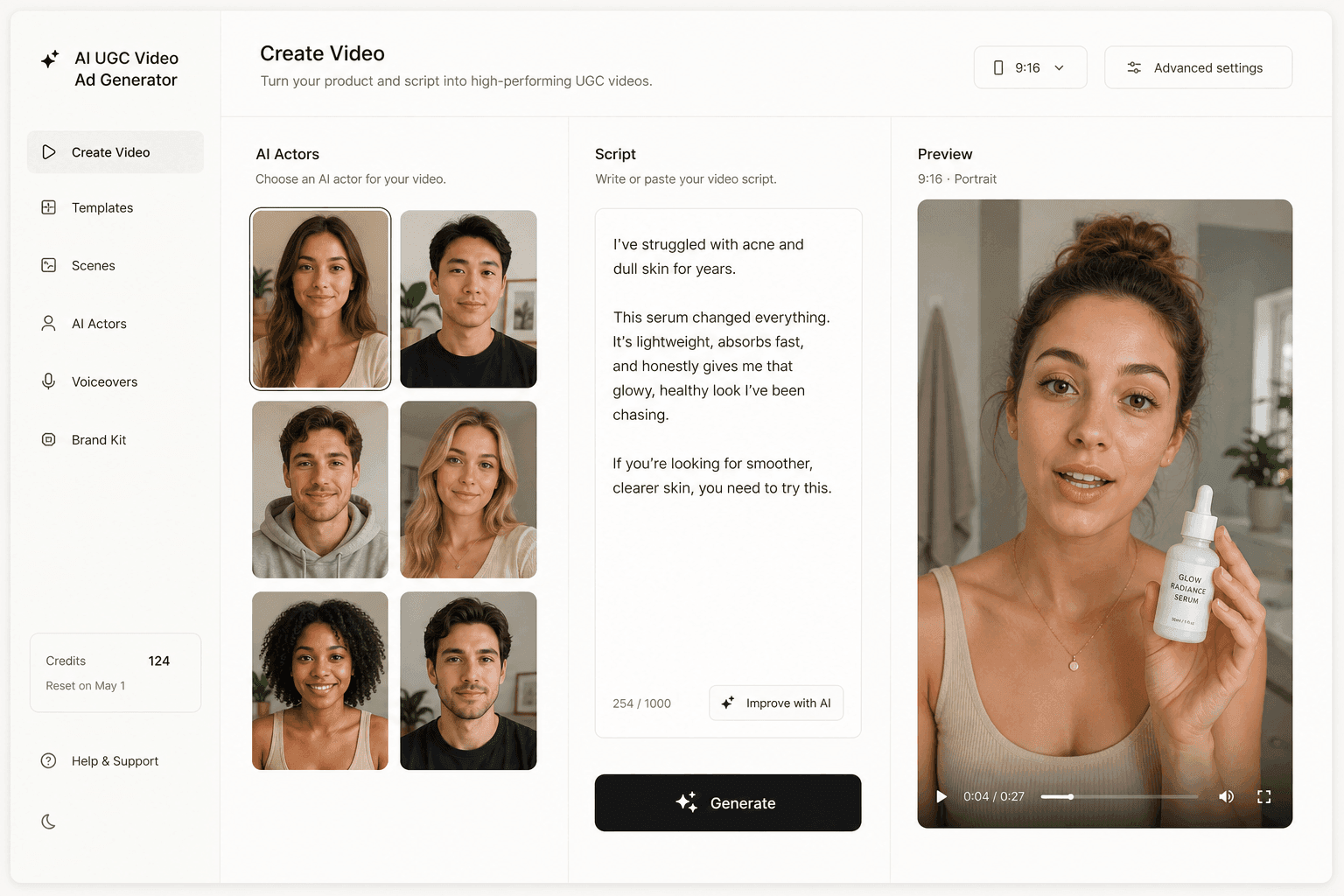
Novoads turns one product photo into ad-ready creative. Upload the photo and Product-to-Ad generates ad images from it, which is the kind of asset the ChatGPT ad unit asks for. The same product photo can also seed video generation for the placements where video is the unit, such as Meta and TikTok, so one product library serves every channel in the test plan instead of one shoot serving one campaign. Plans and what each generation costs are on the pricing page.
Ad load maps the competition, not the customer
Three retail categories went from single digits to between 22% and 47% in four months, and the fastest of them, video games and consoles, ended June with sponsored ads in almost half the gaming conversations Comscore tracked. That is a real signal with real holes in it: one panel, desktop only, no counts, an unknown denominator, one publication's reading of a gated slide. Use it for what it is.
A number like 47% tells you where the other advertisers are. It cannot tell you where your customers will click. Only your own test can, and in a category that crowded, the part of the test you fully control is the image.
Frequently Asked Questions
How often do ChatGPT conversations include sponsored ads?
It depends on the category, and the only published breakdown is narrow. According to Search Engine Journal's reading of Comscore's gated Q2 2026 AI Intelligence Report, sponsored ads appeared in 47% of the US PC ChatGPT conversations about video games and consoles that Comscore tracked in June 2026, in 24% of those about toys and hobbies, and in 22% of those about books, music and video. The data covers US desktop activity from an opt-in panel, and Comscore has not published the conversation counts behind the figures.
Which product categories have the most ChatGPT ads?
Of the three retail categories in Comscore's chart as Search Engine Journal reported it, video games and consoles had the highest ad presence in June 2026, at 47%, up from 3% in March. Toys and hobbies reached 24% and books, music and video 22%. Comscore's own September 3 release also published a hotel series: sponsored ads in 6% of hotel-related ChatGPT prompts with source links in March 2026, rising to 24% in May. No other category figures have been reported publicly, which is a gap in the public data, not evidence that other categories carry no ads.
Does Comscore's ChatGPT ad data include Plus subscribers?
That is not clear. Search Engine Journal notes it is unclear whether Comscore's base includes conversations from ad-free plans. OpenAI says ads are shown only to users on the Free and Go plans, and its help center says it does not show ads to users on Plus, Pro or any Business plan. If ad-free conversations are in the base, the published shares understate the ad rate among conversations that can show ads.
Why did ChatGPT ad presence jump in June 2026?
Comscore does not say. June was the first full month after OpenAI began rolling out a beta self-serve Ads Manager and added cost-per-click bidding on May 5, 2026, and Search Engine Journal points out that timing. It also notes that Comscore does not link the two, and that the chart cannot show whether new advertisers, more inventory or something else drove the jump.
Does a category with more ChatGPT ads perform better?
Nothing in the data says so. Ad presence measures how many conversations carried an ad, which is a signal about competition and inventory. It says nothing about click-through rate, cost per click or conversions. The way to learn how a category performs for you is a measured test in your own account, where Ads Manager Beta reports impressions, clicks, spend, CTR, average CPC, average CPM and conversions.
What share of AI prompts does ChatGPT have?
According to Comscore's September 22, 2026 release of its Q2 2026 AI Intelligence Report, ChatGPT's share of total AI prompt volume fell from 70% to 50% between January and June 2026. Gemini's share rose from 17% to 30% and Claude's from 2% to 11% over the same period. Comscore still calls ChatGPT the clear category leader, with 168 million desktop conversations in June 2026.
Key Takeaways
- According to Search Engine Journal's reading of Comscore's gated Q2 2026 AI Intelligence Report, released September 22, 2026, sponsored ads appeared in 47% of the US PC ChatGPT conversations about video games and consoles that Comscore tracked in June, up from 3% in March.
- Over the same months, toys and hobbies rose from 5% to 24% and books, music and video from 9% to 22%. Gaming stayed between 3% and 4% through April, then jumped to 18% in May and 47% in June.
- The figures cover US PC activity from an opt-in panel. Comscore published no conversation counts behind the category figures and no categorization rules, and it is unclear whether ad-free plans are in the base. If they are, the headline shares understate the ad rate where ads can actually run.
- June was the first full month after OpenAI began rolling out its beta self-serve Ads Manager and cost-per-click bidding on May 5. Comscore does not link the two, and the chart cannot say what drove the jump.
- Ad load measures competition and inventory, not performance. Use it to decide where to test sooner, read your own average CPC and CPM as the real sensor, and bring enough image variants to stand out in a crowded category.
Sources
- •Search Engine Journal: ChatGPT Ads Appeared In 47% Of Video Gaming Chats, Data Shows
- •Comscore: Q2 2026 AI Intelligence Report press release, GlobeNewswire (archived September 22, 2026)
- •Comscore: Q2 AI Intelligence Report 2026
- •Comscore: Comscore Expands Its AI Intelligence to Measure Sponsored Chat Advertising and Its Business Impact
- •OpenAI Help Center: Ads in ChatGPT, The Basics (archived September 3, 2026)
- •Digiday: Comscore data shows how AI discovery is splintering beyond ChatGPT