How to Create Ad Variations: A 5-Layer System for Iterating One Winning Ad
To create ad variations from a winning ad, change one layer per round (hook, presenter, format, text, then offer framing), package the versions inside one ad where Meta allows it, name each file by the variable it tests, and stop when the changes add up to a new concept.

Mauricio Valdivia
·12 min

Forty variations later, nobody knew which change worked
A sleep-supplement brand has one ad that works. A woman stands in her kitchen at night, holds up a small bottle and says she stopped waking at 3 a.m. It is 22 seconds long and it has carried the account for a month. On Monday the team makes forty versions of it: new openings, two new presenters, a square cut, new captions and a bundle offer, mixed together. Three weeks later a handful beat the original. Nobody can say why.
The ads were fine. The system was missing.
Meta's help article on managing ad volume says one ad can contain multiple (up to 10) creative assets, and that if you are testing multiple text variants you should use multiple text optimization. Our reading: the platform wants variations packed into fewer ads. Packing helps delivery, but it can also hide which version won, so how you build the set decides whether you learn anything from it.
An ad variation is a copy of a proven ad with one deliberate change. This guide is a system for making them from a single winner: which layer to change in what order, how many versions to run per round, how to package them so Meta can use them, how to name them so the results read per variable, and how to tell when the set has turned into a new concept.
What an ad variation is, and what it is not
One proven ad, one deliberate change
Start from a winner, meaning an ad that has beaten your account's usual cost per result over enough events to trust the read. If you are not sure you have one, reading a real winner comes first, because iterating a lucky ad multiplies the luck.
The winner becomes the control. It keeps running while its variations compete against it. Meta makes a related point in its creative fatigue article: when it recommends a new ad, it notes that keeping your original ad active instead of pausing it may maximize results.
Every variation then changes exactly one thing about the control. Everything else stays frame-for-frame identical. That constraint is the whole method: it is what lets a result mean something.
Three jobs that get confused
Iteration sits next to two other jobs, and most messy variation sets are really a mix of all three:
- Iteration refines one proven ad, one element at a time. The output is a better version of the same idea. That is this guide.
- Testing is the controlled comparison that tells you which version won. The protocol is in our guide to ad creative testing.
- Diversification builds distinct concepts for different people and motivations. Why Meta rewards it is covered in creative diversity in Meta ads.
Meta's own December 2025 note gives the plainest example of the first job. It says creative iteration might produce two ads with identical visuals but different text CTAs.
Why changing everything at once teaches nothing
Take five things you could change about the kitchen ad and three alternatives for each. With the control's own value, that is four options per layer, and 4 × 4 × 4 × 4 × 4 = 1,024 possible ads.
Forty versions pulled from that space cover about 4% of it, and each one differs from the control in two or three places. When one of them wins, you know a combination beat the control. You do not know which part did the work, so you cannot carry it into the next ad. Forty ads bought a result and no finding.
The five-layer variable ladder
The ladder below is our method, not Meta guidance. It orders the layers of a video ad from the one that decides who keeps watching to the one that changes what the ad argues.
| Layer | What changes | What stays frozen |
|---|---|---|
| 1. Hook | The first three seconds | Body, presenter, offer |
| 2. Presenter | Who speaks on screen | Script, winning hook |
| 3. Format | Aspect ratio, length, pace | Script, presenter |
| 4. Text | Captions, primary text, headline | The video itself |
| 5. Offer framing | How the offer is stated | Product, price, terms |
Layer 1: the hook
The opening goes first because it decides who watches the rest. A better hook changes the audience that reaches layers two to five, so testing anything below it while the hook is still weak means reading a result on the wrong people.
Keep the body fixed and swap only the opening: the first line, the first frame, or the on-screen opener, with new first lines drawn from sources such as the searches that already surface your social videos. Writing and reading the openings is its own craft, and ad hook variations covers it in full: how many to write, how long each should run, and how to read attention before cost.

Layers 2 and 3: presenter and format
For the presenter layer, keep the script word for word and change only the person delivering it. A new presenter changes age, voice, energy and who feels addressed, all at once, which is why it gets its own round. Holding one face stable across later rounds is its own problem, covered in keeping one AI actor consistent across ad variations.
For format, the candidates are aspect ratio (9:16, 1:1, 16:9), length (a 15-second cut against the full take) and pace (fewer, longer shots against faster cuts). If your account can use Meta's Flexible ad format, part of this layer can be handed to the delivery system, which is covered in the packaging section below. Spend the round on length and pace instead.
Layers 4 and 5: text and offer framing
Text is the cheapest layer to vary and the one Meta has a dedicated tool for. It covers the on-screen captions, the primary text above the ad and the headline below it. The primary text and headline never touch the video file, and new captions are an edit, not a reshoot.
Offer framing comes last because it changes the argument. "Save 20% when you subscribe" and "your first month costs less than a coffee a week" can describe identical economics and still pull different buyers. If the price or the terms themselves change, that is a new offer, not a variation.
Each round's winner becomes the next control
The ladder is a ratchet. When a challenger beats the control, it becomes the control for the next layer, and the old control retires. When no challenger wins, keep the control's value for that layer and move on. Do not rerun the layer with ten more options: a layer that three honest challengers could not move is rarely where the ad's ceiling is.
How many variations to make per round
A control and three challengers
Meta's A/B testing tool lets you test up to five ad variants. Our default is one control plus three challengers, which leaves room under that ceiling and keeps each round readable. Three challengers is enough to try three genuinely different values of one layer (a question hook, a result-first hook, a confession hook) without slicing the budget so thin that none of them gets a fair share of delivery.
The event math behind a round
Meta says you will start seeing A/B results once at least 100 events are observed for the cost per result you are testing, and that you should wait until the test has ended to evaluate the final results. It recommends running a test for at least two weeks.
Meta's page does not say whether the 100 events are counted per variant or across the whole test; we assume per cell, the cautious reading. Here is what that assumption means for the kitchen ad, as our own arithmetic, assuming a $28 cost per purchase. On that assumption, four cells at 100 purchases each is 400 purchases before a preliminary read. At $28 each, that is about $11,200 of spend for one round, and about $56,000 across all five layers, both figures resting on the per-cell assumption. Most accounts that need this guide cannot fund that.
Two adjustments keep the ladder affordable:
- Read the early layers on an earlier signal. Hook, presenter and format act in the first seconds, so screen them on an attention metric (3-second plays over impressions, for example) and confirm only the finalist on cost per result.
- Keep the cell count low. On that per-cell reading, every challenger you add is another 100 events before a preview, so pick challengers by hypothesis and treat any pre-launch creative score as a way to order the queue. The limits Meta places on ad volume, and what they mean for how many creatives you need, are laid out in how many ad creatives you need.
The ladder against the forty
Five rounds of three challengers is 15 new ads, and every one of them differs from its control in exactly one place. That is fewer ads than the team's forty, and every result becomes a finding you can reuse: a hook type, a presenter profile, a length, a line of copy, a way to state the offer.
Package variations inside one ad, not as more ads
What Meta's ad-volume article asks for
Meta's article on managing ad volume says that when an advertiser runs too many ads at once, each ad delivers less often. Its advice is to decrease ads per ad set while keeping diverse creative assets per ad set, and it says one ad can contain multiple (up to 10) creative assets.
For text, the article is specific. It says to use multiple text optimization when testing multiple text variants, and that one ad with multiple text optimization is usually more effective than multiple ads without it. Our reading: layer 4 of the ladder belongs inside one ad, not spread across four.
The Flexible ad format, and its fine print
Meta's help article on the Flexible ad format says that when you select Flexible as your ad format, you can select up to 10 images and videos in a single ad campaign, and the delivery system decides which media or combination (single image, video or carousel) to show people. The same article says you don't need to create more ads per ad set to test different formats, and that you can group media with different combinations of texts.
Four things to know before relying on it, all from Meta's own pages:
- Each page words the limit its own way. The Flexible article says up to 10 images and videos "in a single ad campaign". The ad-volume article says "One ad can contain multiple (up to 10) creative assets." The Flexible article also says the format is selected at the ad level.
- Four objectives only. Meta says Flexible can only be selected for campaigns created with the traffic, engagement, sales and app promotion objectives.
- Not every account has it. The article opens with a banner that says the feature may not be available to you, and points advertisers without access to multi-media ads.
- It is Meta's suggested substitute for dynamic creative on some objectives. The ad-volume article says that starting in June 2024 you may no longer be able to use dynamic creative when creating sales or app promotion ad sets in Ads Manager, and recommends the flexible ad format for a similar result.
What packaging costs you: the clean read
Packaging hands the choice to the delivery system. That is good for delivery and bad for learning which variation won, and Meta's system already makes variations of its own: its creative fatigue article says Advantage+ creative automatically creates variations of your ad using a single image or video.
So split the ladder by what you need from each layer. Package the layers you want delivery to optimize, usually text and format. Run the layers you want to learn from, usually hook, presenter and offer framing, as separate cells in a controlled test. Before you package a round, check what your own Ads Manager reporting shows for the assets inside one ad. We have not verified that it breaks results out per asset, so do not plan a read that depends on it.
Name every variation by the variable it tests
A naming template that reads per variable
A variation's name should say what changed, not what the ad is. This template is ours, and it works in Ads Manager, in exported reports and in a shared drive:
CONCEPT_L#-LAYER_value_v##_YYYY-MM-DD
For the kitchen ad's first round, that gives names like SLEEP-3AM_L1-HOOK_ceiling-stare_v03_2026-09-21. The rules that keep it useful:
- The concept code never changes across the whole ladder, so every descendant of one winner sorts together.
- One layer per name. If a name needs two layer codes, the variation changed two things.
- The value is one to three words in plain language:
ceiling-stare,older-man,15s-cut. - The date is the launch date, so two rounds of the same layer never collide.
The variation log
Keep one row per variation beside the names: the name, the layer, the control's value, the challenger's value, the signal you read it on, the result, and which value became the next control. Seven columns are enough. The last one matters most, because it turns a pile of results into a chain of decisions someone else can follow.
Why the name beats the note
Notes get lost; names travel with the data. Export a month of results, split the ad name on its underscores, and you can pivot by layer and value in a minute. A name like kitchen-ad-new-final-v2 carries none of that, and the finding dies with whoever made it.
When iteration stops and a new concept starts
Meta's line between the two
Meta's December 16, 2025 note, "Demystifying Creative Diversification", says creative iteration can inform new ad concepts for a diversification strategy, but should not replace true creative diversification. The same note says its system groups ads that share key visual and thematic attributes, which is the argument laid out in creative diversity in Meta ads.
For the ladder, the practical meaning is a stopping rule. Iteration improves one idea. It cannot find you a second one.
Three signals the ladder has run out
- Two rounds in a row produce no winner. The idea is close to its ceiling, and more rounds will mostly spend money confirming it.
- The control shows fatigue. Meta says an ad set or ad shows a Creative fatigue status when its cost per result is twice or more that of ads you ran in the past. Its recommendation is a new ad with a new image or video that is materially different from the original. Meta also says those recommendations are only available for ad sets with one creative, with some exceptions, so do not wait for the label as your only signal.
- The next change you want alters who the ad is for or what it argues. A new persona, a new problem or a new product benefit is a new concept, whatever the file is called.
What carries over to the new concept
The footage retires; the findings do not. Write a short brief from the variation log: the hook type that won, the presenter profile that won, the length, the line of copy, the offer framing. That brief is the starting point for the next concept, and repurposing winning ads covers how to rebuild a proven idea around a new angle without losing what worked.
Five ways a variation system breaks
- Two layers change in one version. It happens when a new presenter is recorded with "a slightly better script". The fix is to freeze the script before the presenter round starts.
- A winner is crowned on a preview. Early leads flip. Meta's own guidance is to wait until the test has ended, and a round promoted early poisons every round built on it.
- The control dies. Someone pauses the original to "give the new ones room". Now there is nothing to beat, and every later result floats.
- A layer you wanted to learn from gets packaged. Hooks bundled into one ad with the delivery system choosing leave no clean read. Package text and format; test the rest.
- Names describe the ad instead of the change. Three months later nobody can reconstruct why the current control looks the way it does, so the next person starts the ladder from zero.
How Novoads solves the variation supply problem
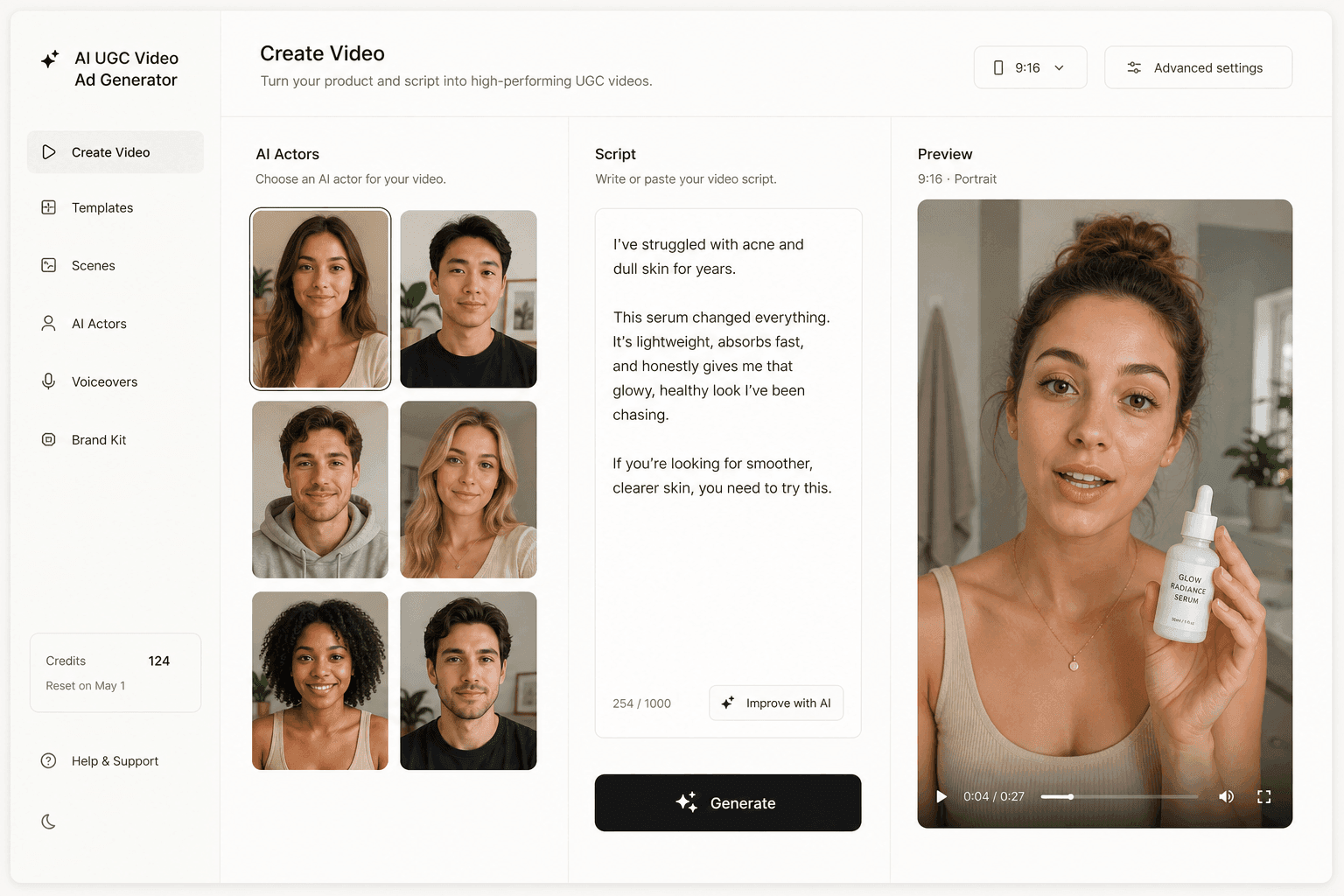
Novoads generates UGC-style video ads from a script and an AI actor, or from an uploaded product image. For a variation ladder, that turns most layers into a script edit instead of a reshoot.
A layer is a script edit, not a reshoot
- Hooks: put the new opening lines in one script, render them with the same actor and the same voice, and cut each one onto the existing body in your editor, so the body stays identical.
- Presenter: keep the script frozen and pick a different AI actor. A stock actor from the library has empty hands, so if the ad needs the product in someone's hand, use a custom actor made from a photo of a person holding it, or one of Discover's product templates, which place your uploaded product in a template creator's hand.
- Format: output comes in vertical and horizontal sizes (9:16, 1:1 and 16:9), so the format round does not need a new shoot.
What a round costs to make
A generated clip costs from about 25 cents for a five-second Seedance 2.0 Mini clip to about $4 for an eight-second Google Veo 3.1 clip, and about $10 for a full 30-second Seedance 2.5 take. Against the event math above, the variations are the small line in a round's budget; the media spend that reads them is the large one. A first round of challengers can come out of Novoads the same afternoon you write them. Plans and what each includes are on novoads.ai/pricing.
One change per round is how a winner keeps paying
A winning ad is not a finished asset. It is the control for the next five rounds, and every round either improves it or proves where its ceiling is. Change one layer at a time, package only what you do not need to learn from, name every file by the change it tests, and stop when the next change is really a new idea.
The team with forty versions got a few better ads. A team with fifteen, built one layer at a time, gets better ads and knows why they are better.
Frequently Asked Questions
How do you create ad variations from a winning ad?
Keep the winning ad running as the control and change one layer of it per round. A practical order is the hook first, then the presenter, then the format and length, then the on-screen and primary text, and finally how the offer is framed. Make three challengers per round, read them against the control, and promote the winner to be the next round's control.
How many ad variations should I make per round?
A control plus three challengers is a workable default. Meta's A/B testing tool tests up to five ad variants, and Meta says preliminary results appear once at least 100 events are observed for the cost per result you are testing. Meta does not say whether that count is per variant or for the whole test. If it applies to each cell, four cells need about 400 events before even a preview, so adding more challengers makes each round slower and more expensive to read.
Should ad variations be separate ads or one ad?
It depends on whether you need to learn from the round. Meta's ad-volume article says one ad can contain multiple (up to 10) creative assets and recommends multiple text optimization for text variants, and its Flexible ad format article says Flexible takes up to 10 images and videos. Packaging suits layers you want delivery to optimize, such as text and format. Layers you want a clear read on, such as the hook or the presenter, are better run as separate cells in a test.
Is the Flexible ad format available for every campaign?
No. Meta's article says Flexible can only be selected at the ad level for campaigns created with the traffic, engagement, sales and app promotion objectives. The same article opens with a banner that says the feature may not be available to you, and points advertisers without access to multi-media ads.
What is the difference between ad iteration and creative diversification?
Iteration refines one proven ad by changing one element at a time. Diversification builds distinct concepts for different people and motivations. Meta's December 16, 2025 note says creative iteration can inform new ad concepts for a diversification strategy, but should not replace true creative diversification.
How should I name ad variations?
Put the variable in the name. A template such as CONCEPT_L1-HOOK_value_v03_date keeps the concept code fixed for the whole ladder, names the layer and the value being tested, and adds a version and a launch date. Exported to a spreadsheet and split on the underscores, every result sorts by layer and value without anyone reading notes.
Key Takeaways
- An ad variation is a copy of a proven ad with one deliberate change. Change one layer per round, in order: hook, presenter, format, text, then offer framing. Each round's winner becomes the next round's control.
- Run a control and three challengers per round. Meta's A/B testing tool takes up to five variants, and Meta says you start seeing results once at least 100 events are observed for the cost per result you are testing. Our reading: if that threshold applies to each cell, every extra cell raises the spend a round needs.
- Package the layers you want delivery to optimize. Meta's ad-volume article says one ad can contain multiple (up to 10) creative assets and to use multiple text optimization for text variants. Its Flexible ad format article says Flexible takes up to 10 images and videos, but only for four objectives and not for every advertiser.
- Name every variation by the variable it tests (concept, layer, value, version, date) so results can be read per layer instead of per ad.
- Stop iterating when two rounds in a row produce no winner, when the control shows fatigue, or when the next change alters who the ad is for. Meta says iteration should not replace true creative diversification.
Sources
- •Meta Business Help Center: About the Flexible Ad Format
- •Meta Business Help Center: About managing ad volume
- •Meta for Business: Demystifying Creative Diversification (December 16, 2025)
- •Meta Business Help Center: About creative fatigue recommendations in Meta Ads Manager
- •Meta for Business: A/B testing
- •Meta for Business: A/B Testing Ads on Facebook & Instagram