
AI vs UGC Creators: What Each Is Best For in 2026
AI UGC and human UGC creators do different jobs. AI owns volume, speed, and testing; a human creator owns a specific face and lived experience. Here is the cost, quality, and how to choose.

Mauricio Valdivia
·11 min

AI didn't replace UGC creators. It split the job.
Two years ago, swapping a human UGC creator for AI sounded like a downgrade. Today the question is quieter and more useful: which job are you actually hiring for?
A human UGC creator and an AI UGC tool are not two grades of the same thing. They are two tools for two different jobs. One is built around a real person and their lived experience. The other is built around speed, cost, and the sheer number of variations you can test before you find a winner.
This guide compares AI-generated video ads and human UGC creators on the dimensions that decide a campaign: cost, speed, quality, authenticity, and when to use each. No false binary, no hype. Just what each is best for, and one simple rule for choosing between them. If you run paid social, the answer changes how you budget every single month.
What "AI vs UGC creators" actually means
A human UGC creator: the person and the asset
A human UGC creator is someone a brand pays to film authentic-style content (a testimonial, an unboxing, a demo) that the brand then posts as its own. You are buying two things at once: a real person's credibility and a finished video asset you own and can run as an ad. If the role is new to you, our explainer on what a UGC creator is covers what they do and charge. The content itself is user-generated content: footage that looks like a customer made it, not a marketing department.
AI UGC: a script, an actor, a render
AI UGC reproduces that same look without a shoot. The workflow is short:
- Write or auto-generate a script for your product.
- Pick an AI actor whose age, gender, and accent match your audience.
- Render a UGC-style vertical video with voice, lip-sync, and captions.
- Download it and run it as an ad.
The feel is the same handheld, talking-to-camera style; the input is a text box, not a film crew. Our walkthrough on how to create UGC ads with AI covers the full flow.
Why the comparison is really about jobs, not quality
Most "AI vs creators" debates get stuck arguing whose video looks better. That is the wrong axis. A talented creator and a good AI render can both clear the believability bar. What actually differs is the job each is built to do: a creator gives you one credible, specific human; AI gives you many cheap, fast variations. Once you see it that way, the better question is not which is more authentic but which job is in front of you this week. Side by side, the trade-off is clear:
| Dimension | AI UGC | Human UGC creator |
|---|---|---|
| Cost per video | A few dollars | A few hundred dollars |
| Turnaround | Minutes | Days to weeks |
| Variations | Many, on demand | Limited by schedule |
| Consistency | Identical every render | Varies by shoot |
| A specific real face | A synthetic actor | A real person |
| Physical product demo | Actor presents on camera | Hands-on, real use |
| Languages and accents | Many, swappable | The creator's own |

The Volume Line: the one rule that settles the debate
Naming the framework
Here is the idea worth naming, because it replaces the false binary. Every creative pipeline has a Volume Line: the point where the job stops being about a specific person and starts being about throughput. Below the line, you need many believable versions of a message and you do not care who delivers it. Above the line, the person is part of the message and cannot be swapped out. Match the tool to the side of the line you are on, and the "AI vs creator" argument mostly disappears. For most direct-to-consumer brands the line sits surprisingly low: the bulk of monthly creative is testing and refresh work that lives below it, with only a handful of true flagship pieces above.
Below the line: testing, iteration, localization
Below the Volume Line lives most of what paid social actually rewards:
- Hook testing: ten openings for one product to find the one that stops the scroll.
- Angle testing: problem-solution, testimonial, and demo versions of one offer.
- Localization: the same script across several languages and accents.
- Seasonal refreshes before a winning ad fatigues and the cost per result climbs.
- Audience splits: a different actor for a Gen Z feed than for a parent's feed.
- Always-on variations to keep a top-performing campaign from going stale.
None of these need a specific human. They need volume, and volume is where AI is unbeatable on cost and speed.
Above the line: a specific face, a flagship, a physical demo
Above the line, a real person is the point:
- A founder telling the origin story in their own voice.
- A long-term brand ambassador whose face customers learn to trust.
- A flagship hero video where production and personality are the message.
- A genuine hands-on demo of a product that must be worn, tasted, or physically used.
For these, a human UGC creator is the right call, and no amount of cost savings changes that.
Cost: what each approach really charges
The human creator's price, plus the hidden costs
A human UGC creator typically charges a few hundred dollars per video, and the sticker price is the smaller half. What it actually costs you is everything around it:
- The brief, and the time to write it well.
- Sourcing and vetting the right creator for your product.
- Usage rights, often priced per platform and per month.
- Revisions, which restart the clock with every round.
- A turnaround measured in days to weeks, not minutes.
- Reshoots whenever the product, the packaging, or the offer changes.
The real cost is not the invoice; it is what that invoice does to testing. At a few hundred dollars per clip, testing ten angles is a four-figure commitment most brands quietly skip. Our breakdown of video ad production cost runs the full math.
The AI price per variation
AI flips the unit economics. In Novoads, a finished UGC video costs from about a dollar for a five-second Seedance 2.0 Mini clip to about $8 for an eight-second Seedance 2.5 clip, and about $26 for a full 30-second Seedance 2.5 take and renders in roughly four minutes. The price per variation drops far enough that the question changes from "which one ad can we afford" to "how many should we test." Cheap iteration is not a nice-to-have; it is the entire reason the format rewards testing.
A worked example: testing ten hooks
Say you want to test ten hooks for one skincare serum. With human creators at a few hundred dollars each, that is several thousand dollars and one to two weeks of briefs and revisions before a single ad goes live. With AI at about a dollar to $8 per clip of up to eight seconds, from a five-second Seedance 2.0 Mini clip to an eight-second Seedance 2.5 clip, or about $26 for a full 30-second Seedance 2.5 take, the same ten variations is roughly $10 to $80 in a single afternoon. Same ten hooks, same product. The difference is whether testing is a budget line you protect or one you skip.

Speed and scale
Turnaround: weeks versus minutes
Speed is not a luxury in paid social; it is the whole game. A creator shoot runs on a calendar: brief, film, review, revise. AI runs on a render queue: type, generate, download. When a trend breaks or a competitor moves, minutes instead of days is the difference between riding the moment and missing it.
Scale: a calendar versus a queue
Scale compounds the same gap. A creator can make only so many videos a week; a generator can make as many as you can write scripts for. That is why AI owns the testing phase. The format was built to be tested at volume, and only one of the two approaches can supply that volume on demand. Volume is not the goal in itself; it is how you buy enough lottery tickets to land a winner you would never have predicted.
What speed buys you in paid social
More shots on goal, and three things follow from that:
- The winning ad is rarely the one you would have guessed, so more entries means a better chance of finding it.
- You can react to a trend or a competitor in hours, while the moment is still live.
- You can replace a fatiguing creative the day performance dips, not the week after.
- You can localize a proven winner into new markets the same day it pays out.
Speed and scale are not about doing the same work faster; they are about getting more chances to be right. Our guide to writing ad hooks pairs well here, since the hook is usually what you are testing.
Quality and authenticity: where the real trade-off lives
What a human creator brings that AI cannot fake
Be honest about this: a real person has lived experience an AI does not. A creator who actually used the product, in their real kitchen, with an unscripted reaction, carries a texture that is hard to manufacture. For content where the human is the message (a personal story, a real transformation, a face customers bond with over months), a human UGC creator wins, and it is not close. That texture is not nostalgia; it is a signal a viewer reads in a glance, and it is the one thing a generated clip cannot borrow.
Where AI now holds up
For high-volume, script-led formats, AI renders are convincing enough that the believability gap is small and shrinking. The formats it handles well are exactly the ones you test most:
- A clean testimonial read to camera.
- A problem-solution skit with a sharp first line.
- A straightforward feature or benefit demo.
- A localized version of any of the above.
- An unboxing or first-impression read for a new SKU.
The point is not that AI makes a better video than a great creator. It is that for the jobs below the Volume Line, AI is good enough and a fraction of the cost. If your goal is a higher return across a tested batch, our guide to improving ROAS with UGC goes deeper.
Accent and language: the localization edge
Localization is where AI quietly pulls ahead for global brands. A human creator delivers one voice in one accent. AI can deliver the same script across many languages, and tools like Novoads ship 30+ languages with real regional accents, so a Mexican audience hears a Mexican voice and an Argentine audience hears an Argentine one. For brands selling across markets, that is reach a single creator cannot match.
When a human creator is the right call
Signs you are above the Volume Line
You are above the line, and should hire a person, when:
- The video's value depends on who is in it, not just what is said.
- The product has to be physically used to be believed.
- You need one recurring face customers will recognize over time.
- The piece is a one-time flagship, not a variation in a test.
The flagship and the founder face
If you are producing one hero piece for a launch, or the founder is telling the story, hire the human. The person is the value, not a swappable delivery mechanism, and that is worth paying for.
Physical demos and lived experience
When the product has to be physically handled, worn, tasted, or shown working in a real environment, a real creator in a real setting is more convincing than any render. AI excels at talking to camera; a genuine hands-on demo is a human's home turf.
How to run both without picking sides
Use AI for the testing phase
The highest-performing brands do not choose; they use AI to explore and a human to commit. The loop is simple:
- Generate a batch of AI variations across hooks, angles, and accents.
- Launch them as a test and let spend find the winner.
- Kill the losers fast and keep the one that beats your benchmark.
- Feed what you learned into the next batch, then repeat.
Promote winners to a human flagship
Once the data names a winning concept, that is the moment a human creator earns their fee. You are no longer guessing which idea is worth a few hundred dollars; you are scaling one you already proved. AI does the exploration, the human does the exploitation, and the spend follows the evidence rather than a hunch. It is the cheapest insurance there is: you commission a real face only after the idea has already won in market.
Read cost per winner, not cost per video
The metric that settles every "is AI cheaper" argument is cost per winning ad, not cost per video. A few-hundred-dollar creator clip that loses costs more than fifty AI clips that surface one winner. Budget by how many winners a dollar finds, and the workflow designs itself. That single reframe is what turns AI from a cheaper video into a faster way to find the ad that actually pays.
How Novoads fits the AI side of the split
Product image plus a script
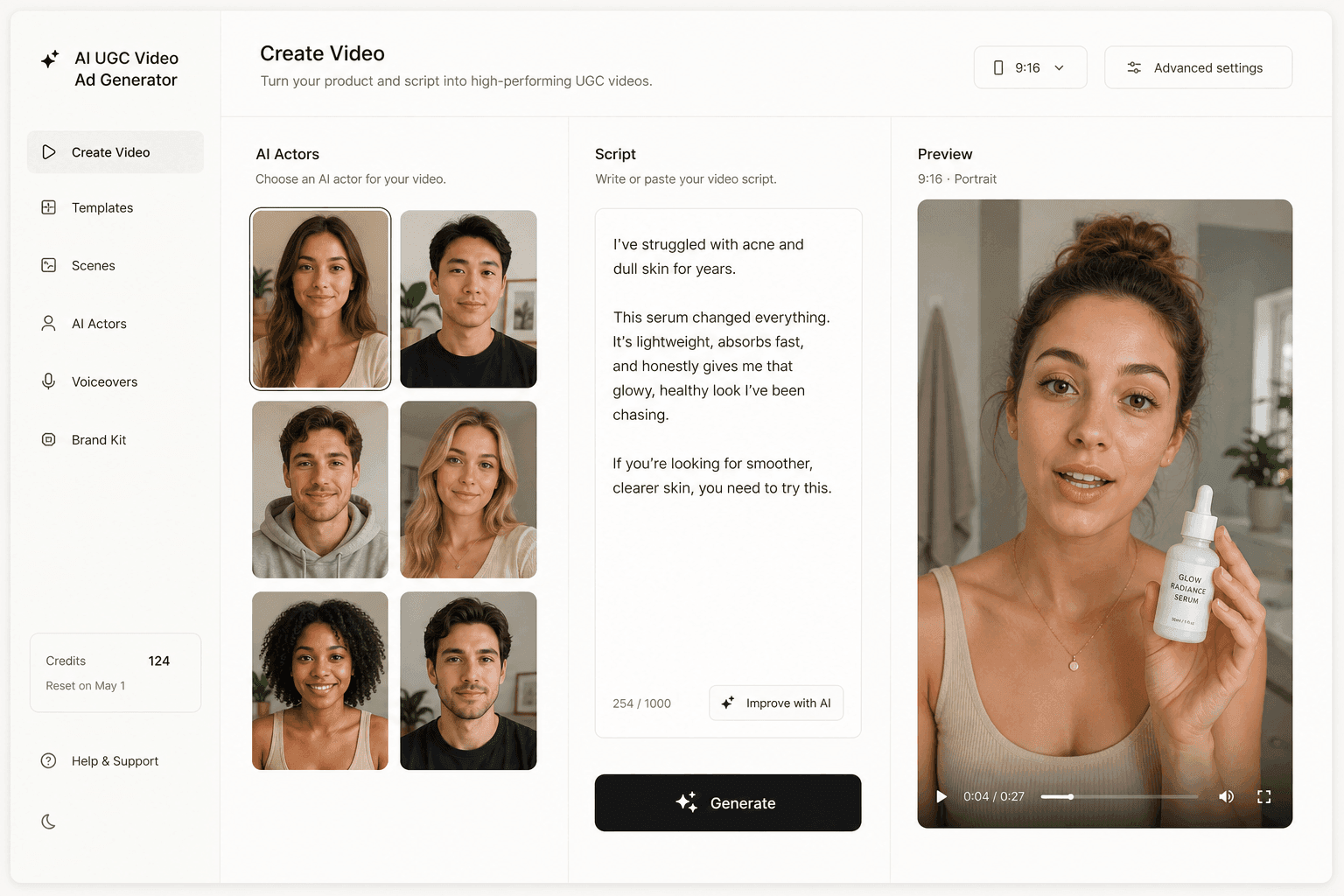
Novoads is built for the volume side of the line. You upload a photo of someone holding your product to create a custom actor, write or auto-generate a script, and that actor holds and presents your product on camera (the 100+ stock actors in the library have empty hands). Every render ships ad-ready:
- Vertical, square, or landscape (9:16, 1:1, 16:9).
- HD, with voice, lip-sync, and on-screen captions.
- Downloadable for TikTok, Reels, Meta, or any ad platform.
- Consistent framing and pacing across an entire batch of variations.
Custom actors who hold your product, in 30+ accents
Because each video costs from about a dollar for a five-second Seedance 2.0 Mini clip to about $8 for an eight-second Seedance 2.5 clip, and about $26 for a full 30-second Seedance 2.5 take and renders in roughly four minutes, you can produce a batch of variations in one sitting instead of one precious clip a week. Across 30+ languages with real regional accents, the same product becomes ten localized tests rather than one. That is the AI side of UGC ads doing what it is best at: volume, speed, and cheap iteration.
Where it sits next to Arcads and Creatify
The AI UGC field has real range. Arcads offers a library of 1,000+ Captivating AI Actors, lets you create your own AI Avatar, has its actors hold your product, and localizes into more than 30 languages, which makes it a strong pick when polished talking-head realism is the priority. Creatify leans into ecommerce volume with a paste-a-product url to ad workflow and a watermarked free plan to try it. For a wider field, see our comparison of the best AI video ad platforms and our Arcads alternatives roundup. Novoads' own edge is native multilingual depth: ad-ready UGC in 30+ accents from a product photo and a script.
Draw your Volume Line first
The AI versus creators debate is a false binary because the two were never competing for the same job. AI owns volume, speed, and cost; a human creator owns a specific face, a real demo, and the flagship moment. Draw your Volume Line, put each job on the right side of it, and the choice makes itself. Most brands discover they live below the line far more than they admit: one hero video does not make a testing program, and thirty cheap variations do.
You can generate your first AI UGC ad with Novoads from $49/month at novoads.ai. Cancel anytime.
Frequently Asked Questions
Is AI UGC as good as a human UGC creator?
They are good at different jobs. For high-volume, script-led formats (testimonials, demos, problem-solution skits), AI renders now hold up well. For a specific real face, a genuine hands-on demo, or flagship content where the person is the message, a human UGC creator still wins. The honest answer is that quality is not the right axis; fit for the job is.
Is AI UGC cheaper than hiring a UGC creator?
Yes, by a wide margin for volume work. A human UGC creator typically charges a few hundred dollars per video and turns it around in days. An AI clip in Novoads runs from about a dollar for a five-second Seedance 2.0 Mini clip to about $8 for an eight-second Seedance 2.5 clip, and about $26 for a full 30-second Seedance 2.5 take and renders in roughly four minutes. That gap is what makes testing many angles affordable instead of a luxury.
Will AI replace UGC creators?
Unlikely in the near term. AI absorbs the high-volume, repeatable end of the work (hook testing, iteration, localization), while human creators move toward premium, personality-led content where a specific person is part of the value. Most brands end up using both rather than choosing one.
Which converts better, AI or human UGC?
It depends on the job. The single best creative often comes from a talented human. The better average across a tested batch usually comes from AI, because you can run far more variations and let the data pick the winner. Volume tends to beat the one perfect ad.
Can viewers tell a video is AI?
For short, script-led UGC formats, increasingly less. The realism gap has narrowed quickly. A long, emotional, personality-driven piece still tends to read more naturally from a real person, which is one reason flagship content stays a human job.
How do I move from creators to an AI-first workflow?
Run AI variations alongside your current creator content for a few weeks, compare cost per winning ad rather than cost per video, then shift budget toward whatever produces more winners per dollar. Keep a human creator for the flagship pieces that sit above your Volume Line.
Key Takeaways
- AI did not replace UGC creators; it split the job. AI owns volume, speed, and testing; a human creator owns a specific face, real demos, and flagship content.
- The decision rule is the Volume Line: below it (testing, iteration, localization) AI wins on cost and speed; above it (a named face, a real demo, a brand ambassador) a human wins.
- Cost is the real divide. A human creator runs a few hundred dollars per video over days; an AI clip in Novoads runs from about a dollar for a five-second Seedance 2.0 Mini clip to about $8 for an eight-second Seedance 2.5 clip, and about $26 for a full 30-second Seedance 2.5 take in roughly four minutes.
- The best single ad often comes from a talented human; the best average across a tested batch usually comes from AI, because volume lets the data pick the winner.
- Smart brands use both: AI to explore dozens of angles cheaply, a human creator to produce the flagship version of whatever wins.