PixVerse V6 for Ad Creative: What 15 Seconds at 1080p Actually Costs to Run
PixVerse V6 is PixVerse's flagship video model, announced March 30, 2026: clips of 1 to 15 seconds, up to 1080p, with audio generated in the same pass. Here is the spec sheet, the per-second math on a real ad clip, and how it lands against the engines you can run today.

Mauricio Valdivia
·Updated ·10 min
PixVerse's Flagship Is Not Its Newest Model
You are pricing a fifteen-second vertical spot. Not a film. Fifteen seconds of a bottle turning in good light, with sound, at a resolution that still holds up after a platform re-encodes it. You open the model page, and the number waiting for you is quoted in a unit almost no ad team budgets in: $0.115 per second.
That page belongs to PixVerse V6, and the per-second meter turns out to be the most useful thing on it. PixVerse is a Singapore-based AI video company, and V6 is its flagship video model. PixVerse announced it on March 30, 2026, describing it in its own release as "the latest version of its flagship model." That was roughly four months ago, which is a long time in this category, so the first question is whether the label still means anything.
It does, with a wrinkle that a lot of secondary coverage gets wrong. V6 is the flagship. It is not the most recent model PixVerse shipped. Novoads does not run PixVerse, so what follows is a spec-and-economics read on an engine we watch rather than sell: what the model does, what fifteen seconds really costs, and how the numbers land next to the engines you can already point at a product photo today.
What PixVerse V6 Actually Is
Strip the version number and V6 is one model that returns a clip with its own soundtrack from a single prompt, in a set of frames that includes the vertical one ads live in. Three things are worth understanding before you price it.
One prompt, several shots, sound attached
PixVerse's launch note puts the headline capability plainly: a key advancement in V6 is "its ability to generate multi-shot short films with native audio from a single prompt," and the example it reaches for is a product advertisement. The sound is not a dub pass bolted on afterwards. "Audio and video are generated simultaneously," which is the mechanism behind the multi-shot claim above.
Multi-shot from one prompt is the half that matters for advertising. A fifteen-second spot is almost never one continuous take. It is a hook, a demo, and a payoff, and stitching three separate generations together is exactly where character and lighting continuity usually falls apart.
Five ways to start a clip
The platform docs list five generation modes, all running on the same model, and prompts run to 5,000 characters. Read them as entry points rather than as a feature count, because each one answers a different production problem:
- Text-to-video is the blank page, for a concept nobody has shot yet.
- Image-to-video is the one an e-commerce team reaches for, because the entry point is the product shot you already own.
- First and last frame is a storyboard tool: you supply both ends and the model fills the middle, which is the closest thing here to art direction.
- Video extension buys length on a take that was already working, instead of re-rolling the whole shot.
- Reference-to-video, which PixVerse calls fusion, is the consistency lever: you feed image references so the same subject survives across shots.
The useful read is that only one of those five starts from nothing. The other four start from an asset you already have, which is the difference between a toy and a tool once there is a real product in the frame.
The version story, in the vendor's own words
Here is the correction worth carrying into any comparison. On April 7, 2026, eight days after V6, PixVerse announced C1, "its first AI video model purpose-built for film production," generating "video at up to 1080p and 15 seconds, with native audio-visual output." C1 is newer. C1 is not the flagship.
You do not have to take that on inference, because PixVerse says it on the C1 page itself: "Its flagship V6 model delivers fluid motion, stylistic versatility, and precise prompt adherence." A vendor describing an older model as the flagship on the announcement page of a newer one is about as clear as product positioning gets. The company runs parallel lines rather than a single upgrade path, with a V-Series for consumer and API work, a C-Series for film and commercial production, and an R-Series of world models that began with R1 in January 2026. So "newest PixVerse model" and "flagship PixVerse model" are two different answers, and only one of them is V6.

The Spec Sheet an Ad Buyer Should Read
Model pages are written for developers, which means the three specs an ad team actually needs sit scattered across a parameter table. Here they are, pulled together.
Length: 1 to 15 seconds, with no resolution penalty
The docs give the duration range as "1-15 seconds (1080p supports up to 15s)" and the quality options as "360/540/720/1080." The parenthetical is the load-bearing part. Plenty of video models cap their top resolution to short durations, so you pick sharpness or length and lose the other. V6 does not make you choose, which is why a full fifteen-second cut at the highest resolution is a single generation rather than an assembly job.
Fifteen seconds is also a working ad length rather than a demo length, which is the difference between a spec that reads well on a model page and one you can write a brief around. That is a different bar from the one a text-to-video model usually gets benchmarked on.
Frame: 9:16 is a parameter, not a crop
The supported aspect ratios are "16:9,4:3,1:1,3:4,9:16,2:3,3:2,21:9," so the vertical frame is a first-class option rather than something you crop into afterwards. That saves the quality loss and the reframing guesswork you get from cropping a landscape render.
One caveat the parameter table gives up and the marketing does not: aspect ratio is only a parameter on text-to-video and reference-to-video. On image-to-video, transitions and extensions it is not exposed, so the source frame decides the output shape. If you are feeding a square catalogue photo and expecting a 9:16 ad, that is the line that will bite you.
Audio: a boolean, not a mode
Sound is exposed as a generate_audio_switch boolean on every one of the five modes. There is no separate audio endpoint and no second job to queue. There is, however, a price attached, which is the subject of the next section: every published tier charges more per second with the switch on.
What Fifteen Seconds Actually Costs
Per-second billing is unusual enough in this category to be worth slowing down on. It is not a per-clip price with a length allowance. It is a meter.
The published per-second card
On fal, which hosts V6, "billing is calculated per second of video generated," and every resolution tier carries two prices, one with sound and one without:
- 1080p: "$0.090 per second without audio and $0.115 per second with audio."
- 720p: "$0.045 per second without audio and $0.060 per second with audio."
fal even publishes the consumer-facing version of this math: $1 buys "approximately 40 seconds at 360p (no audio) or about 11 seconds at 1080p (no audio)."
PixVerse's own platform runs the same shape in its own currency. Its credit table is explicitly "calculated per second," charging 18 credits per second at 1080p without audio and 23 with it, against 9 and 12 at 720p. Audio is a surcharge at every tier on both surfaces, which tells you it is a priced capability rather than a bundled extra.
What a meter does to your instincts
Per-clip pricing quietly trains a bad habit. When a 5-second and a 15-second render cost the same, you always take the 15 and trim later, because length is included and trimming is easy. A meter removes that option. At 1080p with sound, a 15-second take costs three times a 5-second one, so duration stops being a default and turns into a line item you justify shot by shot.
For advertising that is mostly healthy discipline, because the cut that wins is usually shorter than the one you generated. It does move work earlier, though. The shot list has to exist before the render rather than emerging in the edit: decide the hook length, the demo length and the payoff length first, then buy exactly those seconds. Teams that skip that step tend to find their model bill is mostly footage that never made the cut, which is the same failure pattern that shows up in creative operations long before anyone blames the model.
The number that matters is renders per usable ad
Now the worked example, because per-second pricing makes the headline number look smaller than the real one.
One fifteen-second 1080p clip with sound bills at 15 × $0.115, or about $1.73. For fifteen finished-looking seconds with sound, that is genuinely cheap. But nobody ships the first render. Price the actual job instead: three script angles, three takes each to get one usable cut per angle, and you are at nine renders, or about $15.53. You now have three raw clips and no voice you chose, no captions, and no guarantee the same actor persona survived from angle one to angle three.
That gap between the per-render price and the per-winner price is why a model's pricing page rarely predicts what an AI video ad platform actually costs you in a month. The seconds are cheap. The discard pile is the budget.
Where It Sits Next to the Engines We Run
Novoads runs Seedance 2.0, Seedance 2.0 Mini, Kling v3 Pro and Google Veo 3.1. PixVerse is not among them, and the comparison below is honest about where each side is stronger, because they are not competing on the same axis.
| Dimension | PixVerse V6, rented on fal | The engines inside Novoads |
|---|---|---|
| Clip length | 1 to 15 seconds | Up to 15 seconds |
| Top resolution | 1080p | 720p on Seedance 2.0 |
| Native audio | Optional, priced per second | Included at no surcharge |
| Billing unit | Per second | Per clip, in credits |
| What arrives | A raw clip | A finished ad |
| Setup | API key, your pipeline | None |
V6 wins the resolution row outright. Seedance 2.0 tops out at 720p, and for a 1080p master out of a single generation, a model that renders 1080p natively is the shorter path. Anyone chasing sharper deliverables should also read our note on native 4K in ad creative before assuming resolution is the constraint that is costing them performance.
Use each when
- Reach for PixVerse V6 when you want 1080p out of one generation, you are comfortable driving an API or its own web app, you need first-and-last-frame or extension control over a specific shot, and you are assembling the finished ad yourself somewhere else.
- Reach for motion transfer when the problem is not resolution but sameness: one character who has to look like the same person across a dozen variations. That is a different control surface, and Kling v3 Motion Control covers what it costs and where its duration caps land.
- Reach for a managed engine when the deliverable is an ad rather than a clip: an actor holding your product (in Novoads, a custom actor made from a photo of someone holding it), a voice, lip-sync and captions, produced without a pipeline. The relevant per-clip anchor is that a 15-second Seedance 2.0 or Kling v3 Pro clip is 7 credits in Novoads, and Seedance 2.0 Mini is half of that at 3.5. If you are weighing those two engines specifically, Seedance against Kling is the direct comparison.
Two Caveats Worth Pricing In
The first comes from PixVerse itself. The second comes from the size of the company now shipping it.
The vendor's own list of what still breaks
Buried near the end of the launch announcement is a sentence most write-ups skip: "there are areas that continue to evolve, including precise directional control in complex scenes and consistency across significant spatial changes." Translated into ad terms, that is the model warning you about the two shots that go wrong most often, a camera move you specified precisely and a cut that relocates the subject. Budget extra takes for both, or design the spot to avoid them.
Also worth knowing: V6 supports multilingual text rendered inside the frame, which is genuinely useful if you localize one spot across markets. On-screen text is one of the last places where AI video still visibly breaks, so treat it as a capability to verify on your own copy rather than a solved problem. The same caution applies to any AI video generator you are testing for TikTok.
"Flagship" carries an expiry date
State the version, not the ranking. PixVerse closed a Series C extension "with a total of $439 million raised in the round," and TechCrunch reported that "its valuation has crossed over $2 billion," with the company expanding into interactive entertainment. A company at that funding level does not leave a flagship model in place indefinitely. As of late July 2026 V6 is current, and the honest way to write that in a brief is with the date attached, the same discipline that keeps a model comparison useful three months after you publish it.
How Novoads Solves the Same Job Without a Second Vendor
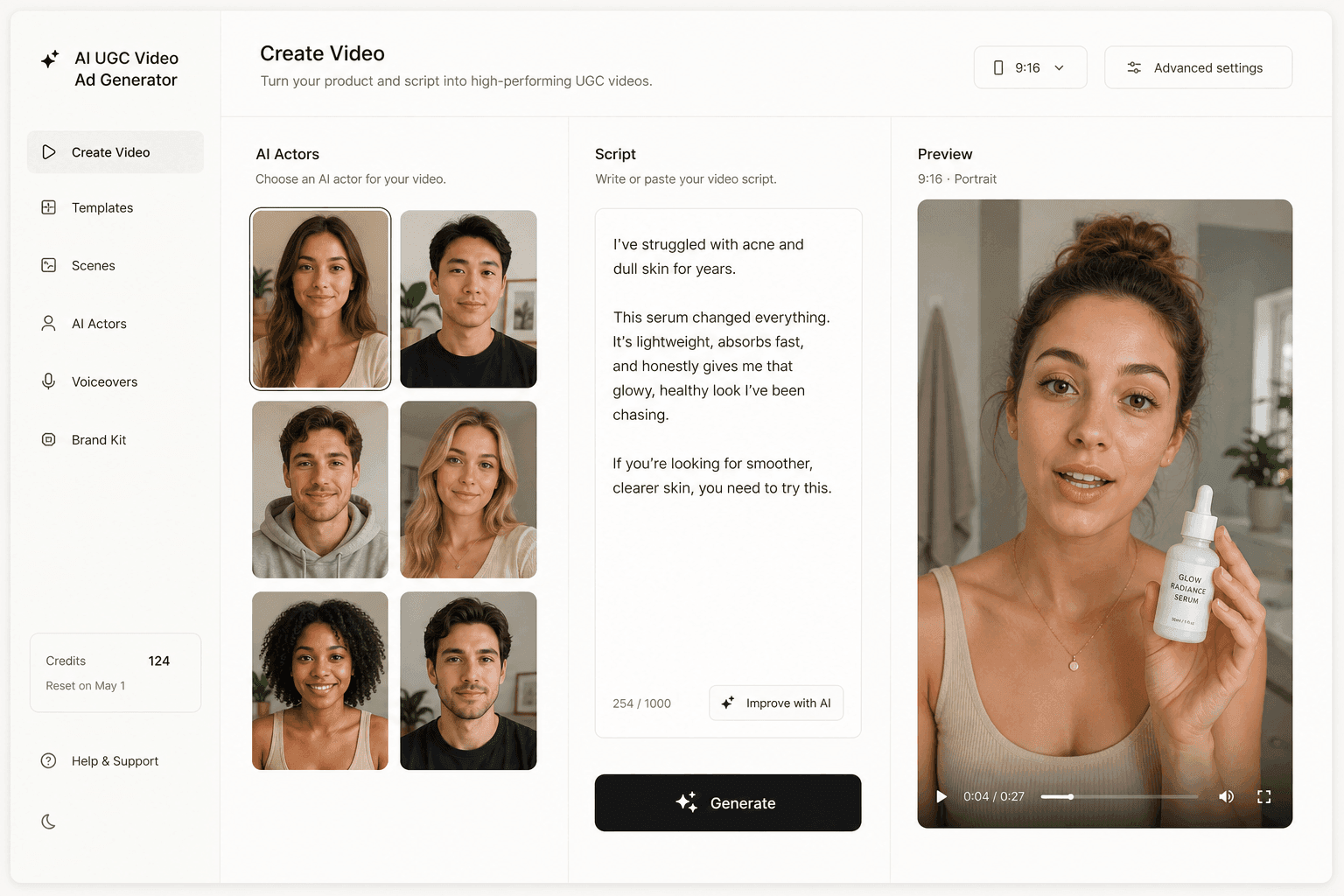
To be straight about it: PixVerse V6 is not available in Novoads, and we are not going to imply otherwise. What Novoads does is remove the step V6 leaves you holding, which is turning a good clip into a running ad. In Novoads the flow starts from the asset you already have:
- Upload a product photo and write or auto-generate the script, with no timeline to edit.
- Pick an AI actor from more than 100 to present the product, or upload a photo of someone holding it to create a custom actor that holds it on camera (a stock actor's hands are empty).
- Generate a vertical ad with voice, lip-sync and captions, in about four minutes.
- Localize the same spot using a voice catalogue that spans 31 languages with regional accents.
- Swap the engine per placement, from Seedance 2.0 Mini for volume testing up to Google Veo 3.1 when the shot has to carry.
The pricing is per clip rather than per second, which makes a variation budget something you can actually forecast. A 15-second Seedance 2.0 clip is 7 credits, Seedance 2.0 Mini is 3.5, and across the catalogue a video lands anywhere from about a dollar for a five-second Seedance 2.0 Mini clip to about $8 for an eight-second Seedance 2.5 clip, and about $26 for a full 30-second Seedance 2.5 take. That is still a fraction of what a human creator charges per deliverable, which is the comparison that matters if you are deciding what a UGC creator is worth on your own product.
One honest note by the button: the entry plan is $49/month, cancel anytime. It is a paid plan, not a free tier, and it grants 50 credits a month, which is enough to see your own product in several finished ads rather than in a demo reel.
You Are Not Buying a Model. You Are Buying Seconds.
Per-second billing is the most honest thing about PixVerse V6, and it is also the trap. It makes the model feel almost too cheap to think about, right up to the moment you multiply it by the number of renders a real campaign consumes. The spec sheet is not the constraint here. Fifteen seconds at 1080p with sound is solved, by V6 and by several models beside it, and it will be solved by something cheaper next quarter. What is not solved is knowing which fifteen seconds to buy: which hook, which angle, which face, tested against a real audience rather than a prompt. Pick the engine on the row it wins and stop treating the model as the decision. The engine is a metered commodity. The creative judgment about what to point it at is the only part nobody sells by the second.
Frequently Asked Questions
What is PixVerse V6?
PixVerse V6 is the flagship video generation model from PixVerse, a Singapore-based AI video company. PixVerse announced it on March 30, 2026 as the latest version of its flagship model. It generates clips of 1 to 15 seconds at up to 1080p, with optional audio produced in the same pass as the picture, and it covers text-to-video, image-to-video, first and last frame transitions, video extension, and reference-to-video.
Is PixVerse V6 the newest PixVerse model?
No, and this is the detail most coverage gets wrong. V6 is the flagship, but C1 is the more recent release: PixVerse announced C1 on April 7, 2026 as its first AI video model purpose-built for film production. On that same C1 page, dated after V6, PixVerse still describes V6 as its flagship model. The two are positioned as complementary, not as a replacement.
How long can a PixVerse V6 clip be, and at what resolution?
PixVerse's platform docs list a duration range of 1 to 15 seconds and note that 1080p supports up to 15 seconds, with quality options of 360p, 540p, 720p and 1080p. That matters because earlier PixVerse versions traded length against resolution. In V6 the top resolution no longer caps your clip length.
How much does a PixVerse V6 clip cost?
Billing is per second, so the answer scales with length, resolution and whether you want sound. On fal, 1080p costs $0.090 per second without audio and $0.115 with audio, and 720p costs $0.045 and $0.060. A 15-second 1080p clip with sound is therefore about $1.73 per render. On PixVerse's own platform the meter is in credits: 18 credits per second at 1080p without audio and 23 with.
Does PixVerse V6 generate audio?
Yes, and it is a parameter rather than a mode. The docs expose a generate_audio_switch boolean on all five generation modes, and the launch announcement states that audio and video are generated simultaneously. Every fal pricing tier charges more per second with audio on, so sound is a priced capability rather than a bundled extra.
Can I use PixVerse V6 inside Novoads?
No. Novoads does not run PixVerse. The video engines available in Novoads are Seedance 2.0, Seedance 2.0 Mini, Kling v3 Pro and Google Veo 3.1, wrapped in a workflow that returns a finished ad with an actor, a voice, lip-sync and captions rather than a raw clip. If you want V6 specifically, you run it on PixVerse or on a host such as fal and bring the file to wherever you assemble the ad.
Key Takeaways
- PixVerse V6 is PixVerse's flagship video model, announced on March 30, 2026. It renders clips of 1 to 15 seconds at 360p, 540p, 720p or 1080p, and 1080p supports the full 15 seconds.
- It is the flagship, not the most recent release. C1, announced April 7, 2026, is a separate model purpose-built for film production, and PixVerse's own C1 page still calls V6 the flagship.
- Audio is a boolean parameter rather than a separate step, available on all five generation modes, and PixVerse states that audio and video are generated simultaneously.
- Billing is per second at every layer. On fal a 1080p second costs $0.090 without audio and $0.115 with it, so a 15-second spot with sound is about $1.73 per render, before the renders you throw away.
- Novoads does not run PixVerse. It runs Seedance 2.0, Seedance 2.0 Mini, Kling v3 Pro and Google Veo 3.1 behind a finished-ad workflow, where a 15-second Seedance 2.0 clip is 7 credits.