Runway vs Higgsfield for Ad Creators: Models, Credits and Plans Compared
Runway and Higgsfield rent many of the same video engines, so for ad makers the choice comes down to workflow and the credit meter. Plans, per-model credit rates, Unlimited models and rollover rules, compared as of September 2026.

Mauricio Valdivia
·12 min
Same engines underneath, different meters on top
A creative strategist at a skincare brand has twenty hook ideas for one serum and a Friday deadline. Two tabs are open: Runway and Higgsfield. Both can render a vertical clip of a creator lifting the bottle to camera. Both list Seedance and Kling among their models. The question that decides her month is duller than realism: how many usable seconds does each subscription buy?
Runway prints part of that answer. As of September 2026, its pricing page lists the Standard plan at $15 a month billed monthly, or $12 a month billed annually, with 625 credits a month, which Runway equates to 52 seconds of its own Gen-4.5 model. Higgsfield keeps its plan prices on a pricing page that renders in the browser, and explains how its credits behave in help center articles dated August 2026.
The two products are closer than their branding suggests. Runway describes one workspace with access to image, video, audio, editing and language models, its own and other labs'. Higgsfield calls itself an AI-native creative suite and sells an ad generator, Marketing Studio, beside its general video tools. Both rent frontier engines from other companies, so the useful comparison is the workflow wrapped around those engines and the meter attached to it.
One disclosure first. Novoads competes with both for ad budgets: we sell AI-generated UGC video ads, and Runway and Higgsfield each market an ad workflow of their own. Every Runway and Higgsfield figure below comes from the company's own pages as we read them on September 17, 2026, and we say plainly where a page would not give us a number.
The short answer for ad makers
If you read one section, read this one. The deep dives that follow show the evidence behind each line.
Pick Runway when
- You want to write the shot yourself, as a brief, and keep control of references, camera and edits.
- You want the credit rate for each model printed on the pricing page before you subscribe.
- You want Runway's own video model, Gen-4.5, alongside the third-party engines.
- You want an editing model that changes one element across a clip, such as a product color, without a reshoot.
Pick Higgsfield when
- You want a product link to come back as a finished ad, with the script, shots and cut decided for you.
- You test many formats from one product: selfie UGC, unboxing, try-on, pure CGI, a TV spot.
- You iterate mostly in the web app, and your plan's Unlimited list covers the model you test on.
- You need one trained spokesperson face reused across every ad variation.
Runway and Higgsfield side by side
| Runway | Higgsfield | |
|---|---|---|
| In-house models | Gen-4.5, Aleph 2.0 | Soul, DOP camera presets |
| Shared engines | Seedance, Kling 3.0, Veo 3.1 | Seedance, Kling 3.0, Veo 3.1 |
| Ad workflow | Shot brief, Runway Agent | Marketing Studio, nine modes |
| Entry paid plan | $15/mo, or $12 yearly | On its pricing page |
| Where cost shows | Per-model rates, pricing page | Generate button |
| Unused plan credits | Reset; Max rolls 1 month | Expire at renewal |
| Unlimited perk | 4K upscaling, Pro and Max | Unlimited models, mid/top plans |
| Free tier | 125 one-time credits | Limited models, watermarked |
| Commercial use | Full commercial rights | Not restricted |
All rows as of September 2026.

Both are model resellers, and that is the honest starting point
Most of the video models in each picker come from other labs. That is not a knock on either company. It is the frame that makes the rest of this comparison useful, because it moves the argument away from "which one looks more real" and toward what you pay to get a clip you can run.
What Runway puts in the picker
Runway builds its own models. Gen-4.5, which Runway introduced on December 1, 2025, is its flagship video generator. Aleph 2.0 is what Runway calls an upgrade to its flagship in-context video editing model: you edit one frame and it carries the change through the rest of the clip, on clips up to 30 seconds at 1080p. For an ad maker that is a practical tool. One of Runway's own examples is "make the sneakers red", a product color swap without a reshoot.
Around those, Runway rents. Its product page lists Seedance 2.0, Seedance 2.5, Kling 3.0, Seedream 5.0 and Nano Banana Pro, and its MCP page adds Veo 3.1 and GPT Image 2. The Standard plan card names Gen-4.5, Kling 3.0 and Nano Banana Pro, and the Pro card adds Seedance 2.5 to that row. Our Runway vs Kling comparison weighs that Kling access against buying the model elsewhere.
What Higgsfield puts in the picker
Higgsfield organizes its models into image, video and audio families, and its help center says it uses the latest version in a family automatically. Its native pieces are Soul, an image model family whose biggest strength, by Higgsfield's account, is character consistency, and Higgsfield DOP, which it describes as a cinematography layer of VFX and directed camera moves applied through presets.
Its video roster is rented too. The site lists Seedance 2.5, Seedance 2.0, Kling 3.0, Veo 3.1, Wan 2.6, Grok Imagine 1.5 and Gemini Omni Flash, and on the image side Nano Banana, Flux 2, Seedream 5 and GPT Image 2. Marketing Studio, its ad tool, says every ad is powered by Seedance 2.0. What Kling costs through Higgsfield, against fal and Kling's own studio, is priced in our Higgsfield vs Kling comparison.
Where the rosters really differ for ads
The overlap is large, so the differences sit at the edges:
- Runway's own layer is video. Gen-4.5 generates and Aleph 2.0 edits, both built by Runway.
- Higgsfield's own layer is people and camera. Soul handles characters and DOP handles camera presets.
- Plan gates move the same engine around. Higgsfield says Seedance 2.5 is available on its Pro and Plus plans and above and isn't included in Starter and Basic. Runway lists Seedance 2.5 on its Pro card, and its Max card shows 26% off 1080p generations on it.
The same logic applies to us. Novoads runs Seedance 2.0, Seedance 2.0 Mini, Seedance 2.5, Kling v3 Pro, Google Veo 3.1 and Omni Flash, several of the same engines, so no tool in this comparison can claim a realism the others cannot rent. For what the newest Seedance actually changed, see our Seedance 2.5 explainer. This post is about the meters.
How each one turns a product into an ad
Higgsfield: paste a link, pick a mode
Marketing Studio compresses the brief into three moves, in Higgsfield's words: "Paste a URL. Pick a format. Get a finished ad." It pulls the product name, description and images from the link, or you build the product profile by uploading up to 5 images. You then choose an avatar, one of 40+ ready-made presenters or a custom one generated from a text prompt through Soul 2.0, and a mode. Higgsfield says Marketing Studio writes the script, directs the shots and delivers the final cut. If a presenter reading your own script is the whole ad, our HeyGen vs Higgsfield comparison sets Marketing Studio against an avatar studio.
Its AI Ad Generator page groups the modes into three creative directions, from raw UGC to cinematic ads. The nine modes are:
- UGC, tutorial, product review and unboxing, for creator-style social ads
- UGC virtual try-on and pro virtual try-on, for products people wear
- Hyper Motion, a pure CGI product commercial with no people and no voiceover
- TV Spot, with story arcs, and Wild Card, where you describe a scenario and the AI directs the rest
An app URL, rather than a product URL, returns a UGC video of someone demoing your screen. Higgsfield's help center is candid about the limits: the maximum clip length is 15 seconds per generation, results outside the Posters category are regenerated rather than edited, and the template-based Marketing Studio isn't available through Supercomputer, MCP or other agentic channels yet. Our Higgsfield review walks through each mode and limit, and our list of Higgsfield alternatives covers ad-first tools without the suite around them. For Marketing Studio against an AI-actor library, see our Arcads vs Higgsfield comparison.
Runway: write the shot brief yourself
Runway's UGC ads page describes a different contract. You upload photos of your product as references "so it stays exactly right (packaging, colors and logo) in every generation," then describe the scene, which Runway says to write "like a shot brief in plain language": a handheld unboxing in a home kitchen, a 15-second vertical clip, a real-phone look with natural lighting. You create takes with different hooks, pick the winners and download vertical video.
A few details on that page matter for paid social:
- Runway says you can generate in 9:16 from the start, instead of cropping a widescreen shot.
- If you prompt in your own language, Runway says the model will generate speech in that language.
- For product-only spots, its product video ads page covers spins, reveals and lifestyle scenes, and says you can ask its agent for a full commercial.
The trade is plain. Higgsfield hands you a finished format and asks you to approve it. Runway hands you a controllable shot and expects you to direct it. A team with a strong creative strategist will get more out of Runway; a team that needs volume without one will lean on Higgsfield. If Runway's control appeals but its shot-by-shot workflow does not, our Runway alternatives guide maps which tools close that gap.
Agents, teams and the campaign layer
Both companies are building past the single clip. Runway Agent is pitched at marketing work. Runway says you can share campaign data and the agent finds what's driving results, generates fresh hooks and variations to test on Meta, TikTok and YouTube, and translates a top-performing ad for every market you sell in. It chooses the model automatically, from a set Runway says includes Gen-4.5, Aleph 2.0, Seedance 2.5, Nano Banana Pro and Kling 3.0 Pro. Runway also plugs into ChatGPT, Claude and Cursor through its MCP integration. On September 4, 2026, it added a Team plan in which every seat adds 6,900 credits a month to one shared pool, for up to nine people.
Higgsfield sells Team, Scale and Enterprise business plans, where credits are shared across all seats. It also runs its own MCP server and CLI, covered in our Higgsfield MCP guide. The catch for agent work sits in its credits article: any generation made outside higgsfield.ai, including through MCP, CLI, Canvas and Supercomputer, always deducts credits, regardless of plan.

How the credits really work
Runway prints a rate for every model
Runway's pricing page lists a credit rate per model. As of September 2026:
- Gen-4.5: 60 credits per 5 seconds, which Runway's FAQ states as 12 credits per second
- Aleph 2.0: 140 credits per 5 seconds
- Seedance 2.0 Pro at 1080p: 160 credits per 4 seconds
- Seedance 2.0 Fast: 116 credits per 4 seconds
- Nano Banana Pro at 2K: 20 credits per image
Because plan prices sit on the same page, you can turn credits into dollars before you pay. The per-credit math: divide the monthly price by the monthly credits. On monthly billing that is 2.4 cents a credit on Standard ($15 for 625), about 1.6 cents on Pro ($35 for 2,250) and 1 cent on Max ($95 for 9,500). A five-second Gen-4.5 clip at 60 credits works out to about $1.44 on Standard, about 93 cents on Pro and 60 cents on Max, if you spend every credit you buy. Treat that as a snapshot. Per-model credit rates are the part of any pricing page most likely to move, which is why every figure here carries a date.
Higgsfield shows the price on the Generate button
Higgsfield's meter is harder to read from outside and easy to read at the moment of spend. Every generation costs credits depending on the model, resolution and duration, and the exact cost appears on the Generate button before you confirm. If you set the batch size to 2, 3 or 4, each output is charged separately. When a generation fails, Higgsfield says the credit refund is usually automatic, with specific models as exceptions.
Higgsfield has published at least one per-clip figure itself. In a guide dated August 14, 2026, it reported that a 15-second UGC video made with Seedance 2.5 at 1080p cost 270 credits in its own run, or 18 credits a second. We cannot turn that into dollars here, because the price of a Higgsfield credit sits on the pricing page we could not capture in a form a reader could check. Our guide to AI video credits explains why a credit on one platform says nothing about a credit on another.
Unlimited models change the math, but only on the web
Here the two plans work differently. Higgsfield's mid and top plans include Unlimited access to selected models, on which generations don't deduct credits. Four rules decide whether that helps an ad maker:
- Length of access. Most included models come with 365-day Unlimited access; the newest flagship models may get shorter windows, such as 7 days.
- Speed. Unlimited generations run in the standard queue, while credit-based generations run in the priority queue.
- Surface. Unlimited applies only on higgsfield.ai. MCP, CLI, Canvas and Supercomputer always deduct credits.
- Use. Higgsfield says Unlimited is designed for personal, human use only, and it stops working if your subscription ends.
If the model you test hooks on is on your plan's Unlimited list, a month of web-app iteration becomes a flat cost paid in queue time. If it is not, or if your team works through an agent, you are back on credits. Runway, which calls credits the unit you spend to generate images, video and audio, puts its unlimited perk elsewhere: its Pro and Max cards include unlimited 4K video upscaling.
What happens to credits you don't spend
Runway resets monthly credits, except on Max
On Standard and Pro, Runway says monthly credits don't roll over; they reset within 24 hours of your billing date each cycle. On Max, up to one month of unused credits rolls over to the following month. Credits you buy on top never expire, with a minimum purchase of 1,000 credits, and the Free plan's one-time deposit of 125 credits doesn't expire either.
Higgsfield expires plan credits at renewal and packs at 90 days
Higgsfield's subscription credits don't roll over. They reset with each paid renewal on monthly plans and every 30 days on annual plans. Credit Pack and Auto-Refill credits expire 90 days from purchase. Subscription credits are always spent first, and credits can't be used without an active subscription.
Trying before you pay, upgrading and refunds
The first week works differently on each:
- Runway has a Free plan with 125 one-time credits and a selection of models to test concepts. Upgrades take effect immediately and are prorated, and a downgrade applies your unused balance as a credit toward the next billing cycle.
- Higgsfield says there is no trial period. Its free tier covers a small set of models and doesn't include credits, and every generation on a free account carries a Higgsfield watermark. Upgrades take effect immediately with a prorated charge.
- Higgsfield refunds are available within 7 days of an initial purchase, or as local law allows, only if no credits have been used, with a service fee of up to 6%. Renewals are non-refundable, and a promo price applies to the first payment before the plan renews at the standard price.
One detail in Higgsfield's refund article changes how to test it. Higgsfield says using free generations or Unlimited model generations doesn't count as credit usage and doesn't affect eligibility. So a first week spent on your plan's Unlimited models keeps the refund option open, while the first credit-based render closes it. Plan the order of your tests around that.

A worked example: twenty hook tests in one month
The brief
Back to the serum. The strategist wants twenty five-second hook openers, vertical, and expects to keep about half of her first takes. So she budgets two takes per hook: 20 hooks, times 2 takes, times 5 seconds, is 200 seconds of generated video. The retake rate is her assumption, not a benchmark, and yours may be better or worse. If twenty is the wrong number for your account in the first place, our guide to how many ad creatives you need sets a baseline.
On Runway
- On Gen-4.5: 200 seconds at 12 credits a second is 2,400 credits. Standard's 625 credits cover 52 seconds, so it is out. Pro's 2,250 credits cover 187 seconds, which leaves the last 13 seconds on a top-up with a 1,000-credit minimum. Max's 9,500 credits cover the whole test with room to spare.
- On Seedance 2.0 Pro at 1080p: 160 credits per 4 seconds is 40 credits a second, so 200 seconds is 8,000 credits. Only Max holds that inside one month's allowance.
In dollars, the Gen-4.5 run fits Max at $95 billed monthly, or Pro at $35 plus a credit top-up bought from the Plans and Billing page in your dashboard.
On Higgsfield
- On credits: at the 18 credits a second implied by Higgsfield's own August run, 200 seconds of Seedance 2.5 at 1080p is 3,600 credits, if cost scales evenly with duration. Check that on the Generate button, then compare the total with the monthly allowance on the plan card you are considering. Seedance 2.5 needs Pro or Plus and above.
- On Unlimited: if your plan's card lists the model you test on as Unlimited, the same 200 seconds made in the web app deduct no credits and run in the standard queue.
- Through Marketing Studio: each generation caps at 15 seconds, which is plenty for a five-second hook, and on the template path the script and shots come from its modes rather than from your brief.
What the arithmetic leaves out
- Credits are not a shared currency. 2,400 Runway credits and 3,600 Higgsfield credits are different units. Only dollars per usable second compare.
- The models differ. The Runway lines use Gen-4.5 and Seedance 2.0 Pro; the Higgsfield line uses Seedance 2.5, because that is the figure Higgsfield published.
- The edit is not in either total. Twenty hooks still need cutting into twenty ads, with captions and an offer.
How Novoads solves the cost of a runnable UGC ad
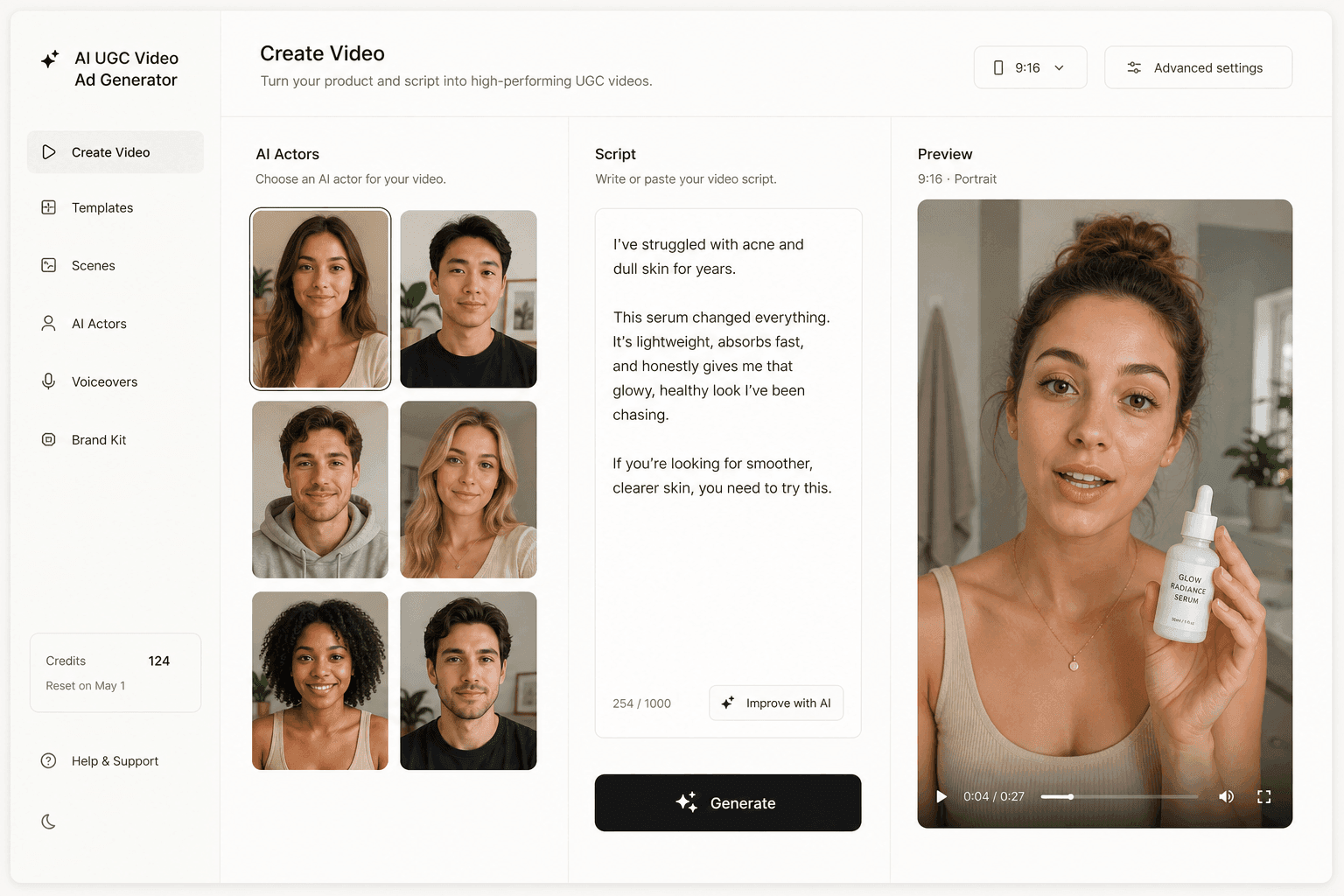
Novoads is an AI UGC video-ad generator: you upload a product image or write a script, pick an AI actor and get an ad-ready video. It runs the same class of engines this post has been pricing, so realism is a tie, and what we compete on is the cost of getting to an ad you can run.
What you put in and what comes out
In Novoads you upload a product image, write or auto-generate the script, choose one of 100+ AI actors, and export vertical, square or horizontal video for any ad platform. The input is a product image and a script, not a product link. We concede two rows to the tools above: Runway gives you finer shot control and an editing model, and Higgsfield offers more ad formats and, on its higher plans, time-limited Unlimited access to selected models in its web app. If a finished talking-actor UGC ad is the whole job, those are features you may be paying for without using. Our Novoads vs Higgsfield comparison goes row by row.
What a clip costs
Novoads starts at $49/month (Starter, 50 credits per month). All plans are published on /pricing. A clip runs from about a dollar for a five-second Seedance 2.0 Mini clip to about $8 for an eight-second Seedance 2.5 clip, and about $26 for a full 30-second Seedance 2.5 take. You can start with Novoads and price your own hook test in the same seconds this post used.
Count the seconds you keep, not the credits you buy
Runway and Higgsfield rent many of the same engines and meter them in credits that do not convert into each other. Runway prints its rates before you pay and leaves the directing to you. Higgsfield directs for you and softens the meter with Unlimited models, as long as you stay in its web app. Pick the one whose meter matches how your team actually works. Then judge it the only way that holds across every tool: dollars per second of footage you would put ad spend behind.
Frequently Asked Questions
Is Runway or Higgsfield better for making ads?
It depends on who directs the ad. Higgsfield's Marketing Studio takes a product link, and Higgsfield says it writes the script, directs the shots and delivers the final cut, across nine modes from selfie-style UGC to a pure CGI commercial. Runway asks you to upload product photos as references and describe the scene like a shot brief, then generate takes with different hooks. Teams with a creative strategist who wants control tend to fit Runway; teams that want finished formats at volume tend to fit Higgsfield. Both rent many of the same engines, so realism alone does not separate them.
Do Runway and Higgsfield use the same AI models?
Many of them, yes. As of September 2026, Runway's pages list Seedance 2.0, Seedance 2.5, Kling 3.0, Veo 3.1, Seedream 5.0 and Nano Banana Pro next to its own Gen-4.5 and Aleph 2.0. Higgsfield's site lists Seedance 2.5, Seedance 2.0, Kling 3.0, Veo 3.1, Wan 2.6, Grok Imagine 1.5 and Gemini Omni Flash, plus its own Soul image models and DOP camera presets. Higgsfield's Marketing Studio runs its video ads on Seedance 2.0.
How much does Runway cost?
As of September 2026, Runway's pricing page lists a Free plan with 125 one-time credits, Standard at $15 a month billed monthly or $12 a month billed annually with 625 credits, Pro at $35 or $28 with 2,250 credits, and Max at $95 or $76 with 9,500 credits. Runway equates Standard's 625 credits to 52 seconds of Gen-4.5, which it rates at 12 credits per second. Extra credits have a 1,000-credit minimum purchase and never expire.
How much does Higgsfield cost?
Higgsfield lists its current plans and prices on its pricing page, which renders in the browser, so we do not quote a figure here. Its help center explains the structure: individual plans plus Team, Scale and Enterprise business plans, a monthly credit allowance that resets at renewal, Unlimited models on mid and top plans, and no trial period. Each generation's credit cost is shown on the Generate button before you confirm. In its own August 14, 2026 guide, a 15-second Seedance 2.5 UGC video at 1080p cost 270 credits.
Do unused credits roll over on Runway or Higgsfield?
On Runway's Standard and Pro plans, monthly credits don't roll over and reset within 24 hours of the billing date; on Max, up to one month of unused credits rolls over, and credits you buy separately never expire. On Higgsfield's individual plans, subscription credits don't roll over: they reset with each paid renewal on monthly plans and every 30 days on annual plans, while Credit Pack credits expire 90 days from purchase.
Can I use Runway or Higgsfield videos in paid ads?
Both say yes. Runway's UGC ads page says you own full commercial rights to the video you create and can run it as paid media on TikTok, Meta, YouTube and elsewhere. Higgsfield's help center says it does not claim ownership of your outputs and does not restrict their commercial use, and that legal indemnification against third-party IP claims is available on its Enterprise plan only.
Key Takeaways
- Runway and Higgsfield both resell third-party video engines, including Seedance, Kling 3.0 and Veo 3.1. Runway adds its own Gen-4.5 and Aleph 2.0 models; Higgsfield adds its Soul image models and DOP camera presets.
- As of September 2026, Runway lists Standard at $15 a month billed monthly or $12 billed annually with 625 credits (52 seconds of Gen-4.5 at 12 credits a second), Pro at $35 or $28 with 2,250 credits, and Max at $95 or $76 with 9,500 credits.
- Higgsfield shows each generation's credit cost on the Generate button and keeps plan prices on its pricing page. Its mid and top plans include time-limited Unlimited access to selected models that deducts no credits, only while the subscription is active, only in its web app and in the standard queue.
- Unused plan credits reset on Runway Standard and Pro and roll over for one month on Max. Higgsfield's subscription credits expire at renewal, and its Credit Pack credits expire 90 days after purchase.
- For ad work, Higgsfield's Marketing Studio turns a product link into a finished ad across nine modes with a 15-second cap per generation, while Runway expects you to write a shot brief around your own product reference photos.