YouTube Image Ads During Horizontal Mobile Playback: One Sighting, No Confirmation, No Buy Path
One practitioner reported a static image ad overlaying part of the screen during landscape mobile YouTube playback, roughly every three minutes. Google has confirmed nothing, and there is no campaign type, buying path, or opt-in attached to it.

Mauricio Valdivia
·10 min
One person saw it. Nobody can buy it.
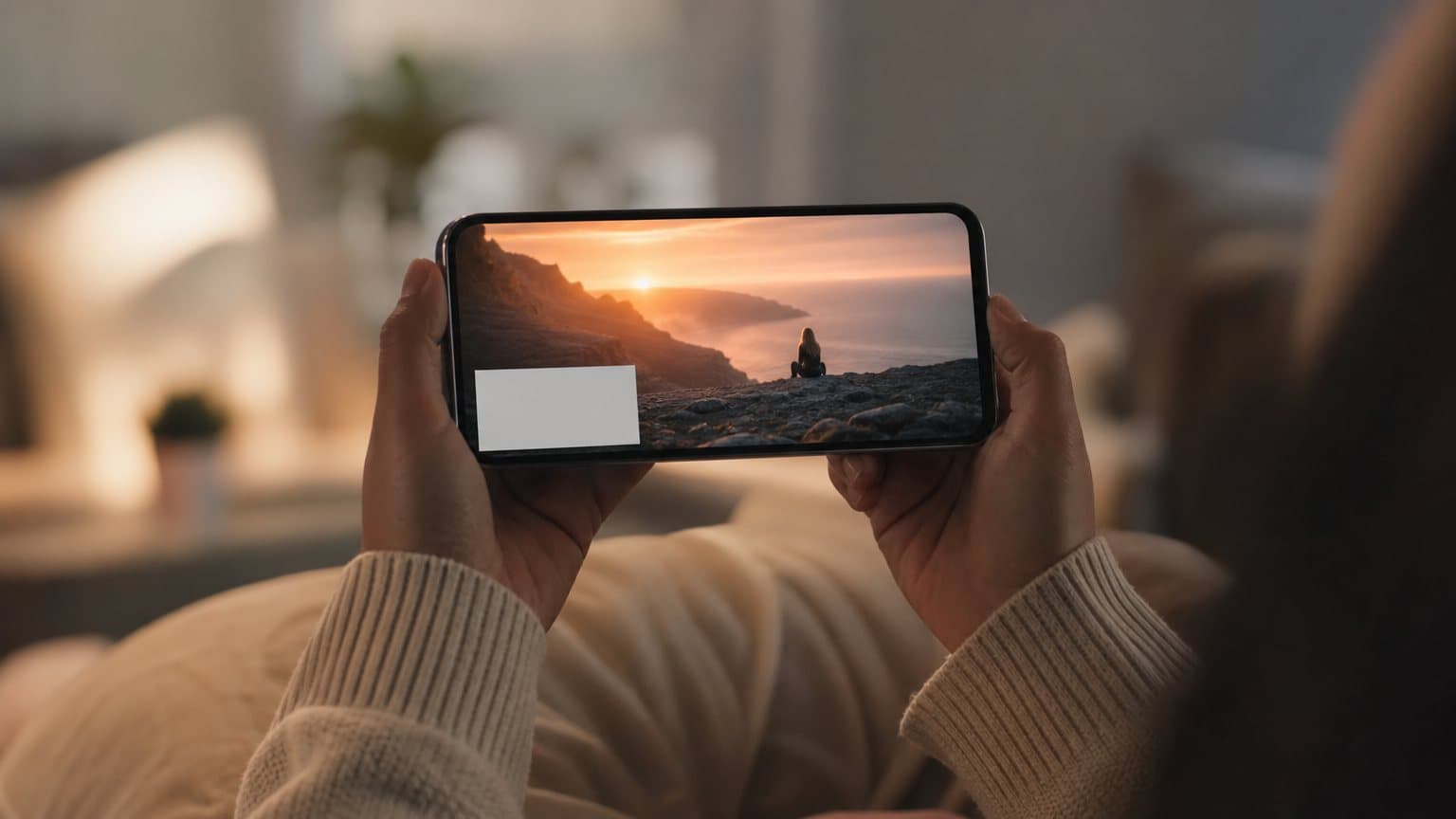
Turn a phone sideways, tap fullscreen, and watch the way most people watch YouTube on mobile. According to one report published on August 6, 2026, a static image ad slides over part of that frame while the video keeps playing, and it comes back roughly every three minutes.
That is the whole story. One sighting, relayed by a trade outlet the next day, with no statement from Google attached to it and no campaign type, buying path, or opt-in described anywhere in it. It is still worth reading, because the shape of the thing (a static image inside video inventory) says something real about where ad creative demand is going. But the gap between "someone saw this" and "you can plan around this" is the entire post, so let us keep the two apart on purpose. It is worth holding next to a change Google did confirm the following day, when Limited Ad Serving expanded to cover all Google Ads: one of these is a sighting you can safely ignore, and the other decides how much reach your account gets at all.
What was actually reported
The sighting, in plain language
PPC News Feed, a curation site that publishes short items on paid-media changes, ran the story on August 6, 2026 under the headline "YouTube Tests Image Ads During Horizontal Mobile Playback". Its opening line is careful: "YouTube appears to be testing image ads on mobile during horizontal video playback." The mechanic, in the item's own words, is a static panel that shares the screen rather than taking it over: "Instead of just traditional video ad breaks, the platform displays a static image ad that overlays part of the screen. It doesn't interrupt or cover the video."
Search Engine Land picked it up the next day, August 7, under the byline of Anu Adegbola, describing an experiment that overlays a sponsored image ad on part of the screen while a video continues playing in landscape mode, and crediting the sighting to PPC News Feed founder Hana Kobzova. Two write-ups, one observation: a still image, over part of a landscape phone screen, while playback continues.
The three-minute number, and who is behind it
The most quotable detail is the frequency, and it is also the softest. Both write-ups say the ads appear roughly every three minutes during playback, which would make them more frequent than standard video ad breaks. The origin item attributes that figure to nobody in particular: "Observers have indicated that these image ads appear roughly every three minutes during playback, creating a more frequent interruption than with previous ads YouTube was using."
Observers, plural and unnamed. No sample size, no device or operating system, no country, no time window, no note on whether the same account saw it twice. A number that arrives in a sentence beginning with "Observers have indicated" is an anecdote with a decimal point on it. Quote it if you must, but quote the attribution with it.
What the reports do not contain
Read both pieces looking for the things an advertiser would need, and the list comes back empty. Nothing here could be switched on, switched off, or briefed to a designer:
- No campaign type, and no placement name to search for in an account.
- No asset spec: no dimensions, aspect ratio, file weight, safe area, or text limit.
- No buying description: no auction, no pricing model, no reservation, no minimum.
- No reporting dimension, so even an advertiser already receiving these impressions could not isolate them.
- No opt-in, opt-out, or exclusion control, in either direction.
The origin item is honest about the ceiling on its own claim, twice. First on the advertiser side: "This update could introduce a new inventory option for advertisers while significantly changing the viewing experience for mobile users." Could. Then on the platform side: "It remains unclear whether this is a limited experiment or the beginning of a broader rollout." Search Engine Land draws the same line at the source, stating that Google has not confirmed whether the feature is part of a limited test or planned for a wider rollout.
Everything traces back to one origin
A next-day relay is not a second source
Two articles is not two sources. Search Engine Land credits the sighting to PPC News Feed's founder, and the PPC News Feed item ran a day earlier carrying the same mechanic, the same cadence, and the same uncertainty. The second article is a relay of the first, which is normal and useful trade-press behavior and is not corroboration. When a story looks like it has been widely reported, the useful question is how many independent observations sit under the coverage. Here the answer is one.
The chain has a single link at the bottom
Follow it down and it gets thinner rather than thicker. The relay credits a named practitioner. The origin item credits a named practitioner for the spot, then hands the load-bearing detail (the three-minute cadence) to unnamed "observers". There is no linked screenshot thread, no reproduction steps, and no second practitioner saying they saw it too on a different phone in a different country. Nothing here is dishonest. It is simply a report of an observation, and the reporting is more careful than the discussion around it will be.
What a single-origin sighting is worth
It is worth attention and zero budget. Sightings like this are how most platform changes surface, weeks or months before documentation exists, so ignoring them is its own mistake. The failure mode is upgrading them: a sighting becomes "a test", a test becomes "a rollout", and by the third retelling somebody is asking their agency to prepare assets for a placement that has never been described. Here is the honest state of each claim:
| Claim | Status | Where it comes from |
|---|---|---|
| Static image over landscape playback | Reported once | PPC News Feed, Aug 6 |
| Roughly every three minutes | Reported, unnamed observers | Same item, relayed Aug 7 |
| Limited test or wider rollout | Unknown | Google has not confirmed |
| Campaign type or buying path | Does not exist in either report | Named nowhere |
What Google has actually published
The page where it would appear
YouTube maintains a public list of the ad formats that run against monetized videos, and it is specific about the units that sit outside the player: "There are three types of ads that appear outside the video player." Those three are watch feed ads, subscriptions feed ads, and Watch While ads. There is no entry for a sponsored still that reappears on a three-minute cycle over landscape playback, and no advertiser-facing control for one.
Omission is not proof of absence, and platform documentation always trails what is live in an experiment. What it does tell you is that as of August 7, 2026 the reported unit has no published home, no name, and no serving rules you can read.
Watch While, the image ad that already runs during mobile playback
The interesting part of that same page is how close one documented format already sits. YouTube describes Watch While ads as "Image ads that display alongside a video on mobile devices without pausing the video." That is a still image sharing the screen with a playing mobile video, published, with serving rules attached:
- They are not selected, they are triggered. Watch While ads "automatically serve on monetizing videos that are ineligible for mid-roll ads (videos between 2 and 8 minutes, or videos over 8 minutes with mid-rolls turned off)."
- The viewer holds the exit. Viewers "can close the ad anytime or let it auto-dismiss after 30 seconds."
- The creator holds nothing. In YouTube's words, "these types of ads can't be controlled from within YouTube Studio."
Nobody has established that the August sighting is Watch While. Google has not commented, and neither report mentions it. What the documentation does establish is that a still image sharing the screen with a playing mobile video is an already-shipped idea at YouTube, which is a reason to be less excited about novelty and more interested in the creative implication.
Where image ads stand on the Google side
The buy side is blunter than the sell side. Google's own Display ads documentation states that "Display image ads don't serve on YouTube." So the placement people imagine when they hear "image ad on YouTube" (a display buy leaking into video inventory) is documented as not being a thing, and the reported unit, whatever it is, is not something you reach through a Display campaign. Between an unnamed sighting and a documented negative, the safe planning assumption is that there is nothing to buy here today.
The same shape of ad was reported in March, as a bug
What users described five months earlier
In March 2026, two consumer outlets reported overlay ads on mobile YouTube playback and framed them as a defect. 9to5Google wrote on March 3 that "the bug places ads over YouTube videos that can't be dismissed", with the ads sitting in a corner during fullscreen playback on Android and iOS, and noted that "the ads disappear after around 30 seconds, according to user reports". Android Authority followed on March 4 describing persistent overlay banners in the bottom-left corner and said: "We've reached out to Google to learn more about these undismissible overlay ads in the YouTube app, whether it's a bug or an intentional change."
9to5Google also noted the complaints were not new that week: "Some date back to January 2026, while others come from late 2025."
The option the test-or-rollout framing leaves out
The August coverage offers a binary, limited test or wider rollout, and Google has confirmed neither. The March reporting supplies a third option the binary skips. 9to5Google reasoned in the opposite direction from the trade coverage, writing that "if there were no option, we'd be inclined to think YouTube is testing a new ad format that displays persistent blocks in view throughout the video." Their conclusion was the reverse: because a dismissal control existed and failed, it looked like breakage.
Nobody has connected the two
Be careful here, because it would be easy to over-read. Line the two up and they differ on almost every detail that was actually recorded:
| Detail | March 2026 reports | August 2026 sighting |
|---|---|---|
| Framing | A bug | A possible test |
| Advertiser | Third-party apps, websites | Unspecified sponsor |
| Behavior | Dismiss control fails | Recurs on a cycle |
| Timing | Clears after ~30 seconds | Returns every ~3 minutes |
| Google response | Asked, no answer | Not confirmed |
Those are not obviously the same unit, no outlet has claimed they are, and Google has not addressed either one. What the March reports do settle is the novelty question: image-shaped ads over mobile playback are not new in 2026, so "YouTube is testing a brand new format" is a stronger claim than anyone has evidence for.

What advertisers should not plan around
There is no campaign type to select
If you go looking in Google Ads for the thing in the screenshots, you will not find it, because no report names it. That is not a gap in your account access or a staged rollout you have not been enabled for. Neither article names a campaign type, and Google has published nothing, so the correct expectation is that there is nothing to enable. Anyone who tells you they are already running it is describing a different format.
There is no opt-in, and no exclusion
The mirror image matters just as much for brand-safety-sensitive advertisers. There is no documented way to opt in, and there is equally no documented way to opt out, exclude, or cap the reported unit. If the sighting is real and it scales, controls would arrive with documentation, and that documentation is the moment the story becomes actionable. Until then, an exclusion list cannot be written against a placement with no name.
Do not brief creative for a slot that may not exist
The expensive mistake is a designer spending a week producing assets to an imagined spec. No dimensions, safe areas, file weights, or text limits have been published for the reported unit, and producing "just in case" assets to guessed dimensions is how teams end up with a folder of files that fit nothing. The split is simple enough to keep on a sticky note:
- Brief it when the slot has a published spec, a named campaign type, and a place in reporting.
- Watch it when the slot has an observation and nothing else, which is where this one sits.
Build creative for the first list, and let this one earn a brief when it earns documentation.
What is worth doing instead
Image creative on YouTube surfaces is already buyable
Here is the part with real money attached. The image half of YouTube inventory is not hypothetical: Demand Gen already carries image assets onto YouTube surfaces, and Google's own documentation says the split is yours to choose. Asked directly whether image-only campaigns are possible, Google answers that "you can choose to run a campaign that is strictly video-based or strictly image-based." Google also frames Demand Gen as the campaign type that "gives you more control over creative testing, audience targeting, and specific placements on YouTube and Discover."
Image ads inside video inventory are also documented elsewhere on the same YouTube page, which describes Shorts ads as "immediately swipeable video or image ads that appear between Shorts in the Shorts Feed." So the trend the sighting hints at is a trend that already has invoices behind it.
The sizes are already published
Where a sighting has no spec, Demand Gen has a list. Google documents its image asset shapes as "Image (Landscape 1.91:1, Logo 1:1, 4:1, Portrait 4:5, Square 1:1)", which is enough to brief a designer this afternoon:
| Asset | Ratio | Crop |
|---|---|---|
| Landscape image | 1.91:1 | Widest of the set |
| Portrait image | 4:5 | Tall crop for phone screens |
| Square image | 1:1 | Neutral, no orientation bias |
| Logo | 1:1 and 4:1 | Brand mark, not a creative slot |
If you want to be ready for a world where more video inventory carries still creative, produce against those published shapes, not against a guess. The work is reusable across Google's video campaign structures and reach-focused YouTube buys, and it stacks with the platform-by-platform specs you already maintain.
A standing rule for platform sightings
Give every unconfirmed sighting the same three-question triage, and this one answers itself in under a minute:
- Who observed it, and how many independent people? Here, one practitioner, relayed once.
- What did the platform say? Here, nothing, on any surface, in either direction.
- What could I change in an account today because of it? Here, nothing at all.
Three answers of that shape put a story in the read-and-note pile, not the plan pile. The triage matters more than any single verdict, because the next sighting will arrive with the same confident screenshots and a different subject line. Sort each one into a pile and act accordingly:
- One origin, no confirmation, no control: read it, note it, spend zero.
- Documented format, published specs: brief creative and test it.
- Announced with a date and an opt-out: put it on the calendar and prepare.
That triage is the same discipline behind good creative standards work and behind structured creative testing: decide what is real, then spend against it. The volume question (how many variants a live format actually needs) is a separate one we cover in how many ad creatives you need.
How Novoads solves the image half of a video brief
If this sighting has one durable lesson, it is that video-first teams keep getting asked for stills, and stills are usually the thing nobody planned for. Novoads takes an uploaded product photo and returns an ad-ready image at 0.3 credits per image, in six shapes including portrait 4:5 and square 1:1, which are two of the three image shapes Google documents for Demand Gen. The same project holds the video ads and the actor scripts, so the still and the spot come out of one brief rather than two vendors. You can try it for $49/month and produce a set of stills next to the video ads you are already running.
A sighting is not a placement
The discipline that protects a media budget is the same one that protects a newsroom: separate what was observed from what was confirmed, and never let the second inherit the confidence of the first. One practitioner saw a static image over a landscape video. Google has said nothing. There is no campaign type, no opt-in, and no spec. The honest instruction to an advertiser today is to keep image creative ready for the placements that already exist, and to let this one prove it exists before it gets a line in anyone's plan.
Frequently Asked Questions
Is YouTube launching image ads during horizontal mobile playback?
No. Nothing has been launched or announced. On August 6, 2026, PPC News Feed reported that YouTube appears to be testing image ads on mobile during horizontal video playback, and Search Engine Land relayed the report the next day. Search Engine Land states that Google has not confirmed whether the feature is part of a limited test or planned for a wider rollout. Treat it as a sighting, not a product event.
Can advertisers buy this placement?
There is no way to buy it. Neither report names a campaign type, a placement setting, a buying path, or an opt-in, and Google has published nothing about it. If you want image creative running on YouTube surfaces today, the documented route is Demand Gen, where Google says you can run a campaign that is strictly image-based.
How often do the reported image ads appear?
Both write-ups say roughly every three minutes during playback. The origin item attributes that frequency to unnamed observers, wording it as 'Observers have indicated that these image ads appear roughly every three minutes during playback'. There is no stated sample size, device, region, or measurement window, so treat the number as an anecdote rather than a spec.
Does YouTube already show image ads during mobile playback?
Yes, in a documented form. YouTube's own ad formats page describes Watch While ads as image ads that display alongside a video on mobile devices without pausing the video. They serve automatically on monetizing videos that are ineligible for mid-roll ads, and viewers can close them or let them auto-dismiss after 30 seconds. Nobody has established whether the August sighting is that format, something new, or something else.
Was this reported before August 2026?
Overlay ads during mobile playback were reported in March 2026 by 9to5Google and Android Authority, framed as a possible bug: ads in a corner of a fullscreen video that users could not dismiss, disappearing after about 30 seconds. Those reports are about a dismissal failure, not a three-minute cadence, and nobody has connected them to the August sighting. It does mean the shape of the ad is not new to mobile playback.
What should advertisers do about it this week?
Nothing that costs money. There is no setting to change and no placement to brief for. The useful reading is directional: a static image inside video inventory would be an image deliverable, and image creative already has a real buying path on YouTube surfaces through Demand Gen. Keeping a few on-brand still frames alongside your video ads is cheap insurance, and it pays off in placements that exist today whether or not this sighting ever becomes a product.
Key Takeaways
- The story is one sighting, not a launch: PPC News Feed published it on August 6, 2026, and Search Engine Land relayed it on August 7, crediting PPC News Feed founder Hana Kobzova. There is no second outlet with independent reporting.
- Google has confirmed nothing. Search Engine Land states plainly that Google has not confirmed whether the feature is part of a limited test or planned for a wider rollout.
- There is no campaign type, no buying path, and no opt-in. Nothing in either report tells an advertiser what to select in an account, so there is nothing to act on today.
- The three-minute cadence traces to unnamed observers. The origin item words it as 'Observers have indicated', with no sample, device, or region attached.
- Image creative on YouTube surfaces is already buyable through Demand Gen, where Google documents image-only campaigns and published asset shapes. That is where image creative pays off, not in a sighted placement.