
AI Testimonial Video Generator: Turn One Real Review Into a Video Testimonial in Minutes
An AI testimonial video generator turns a real customer review into a video testimonial delivered by an AI avatar or actor, in minutes and without filming, as long as you keep the words honest.

Mauricio Valdivia
·Updated ·11 min

Your best testimonial is trapped in text
An AI testimonial video generator turns a real customer review into a video testimonial: an AI avatar or actor reads the words to camera, with natural voice, lip-sync, and captions, in minutes instead of the weeks a shoot would take. If you have a folder of five-star reviews doing nothing, this is the tool that lets them talk.
The catch sits in one word: real. An AI testimonial video is a production method laid over genuine feedback, not a way to invent praise. Get that line right and you have the most persuasive social proof in marketing, produced on demand. Get it wrong and you have a legal problem. This guide covers how these generators work, the honest way to use them, the tools worth comparing, and when a filmed human still wins.
What an AI testimonial video generator actually does
At its core, the tool converts words into a talking video. You give it a testimonial script and pick who says it; it returns a finished clip. The interesting part is where the words come from and what "who says it" means.
From written review to talking video
The pipeline is short. You start with a real piece of feedback, a review, an NPS comment, a support thread, or a case-study quote. You rewrite that feedback into natural spoken language, because people do not talk the way they type. You choose an AI presenter, generate, and the system adds voice, lip-sync, and captions. What took a brief, a creator, and two weeks of revisions becomes a clip you can watch and re-render the same afternoon.
The feedback is the raw material and the AI is the factory. That order matters, and it is the difference between a testimonial and a fabrication. If you want the plain-language primer first, our explainer on what AI video testimonials are covers the format before you build one.
Avatar-led versus UGC-actor-led testimonials
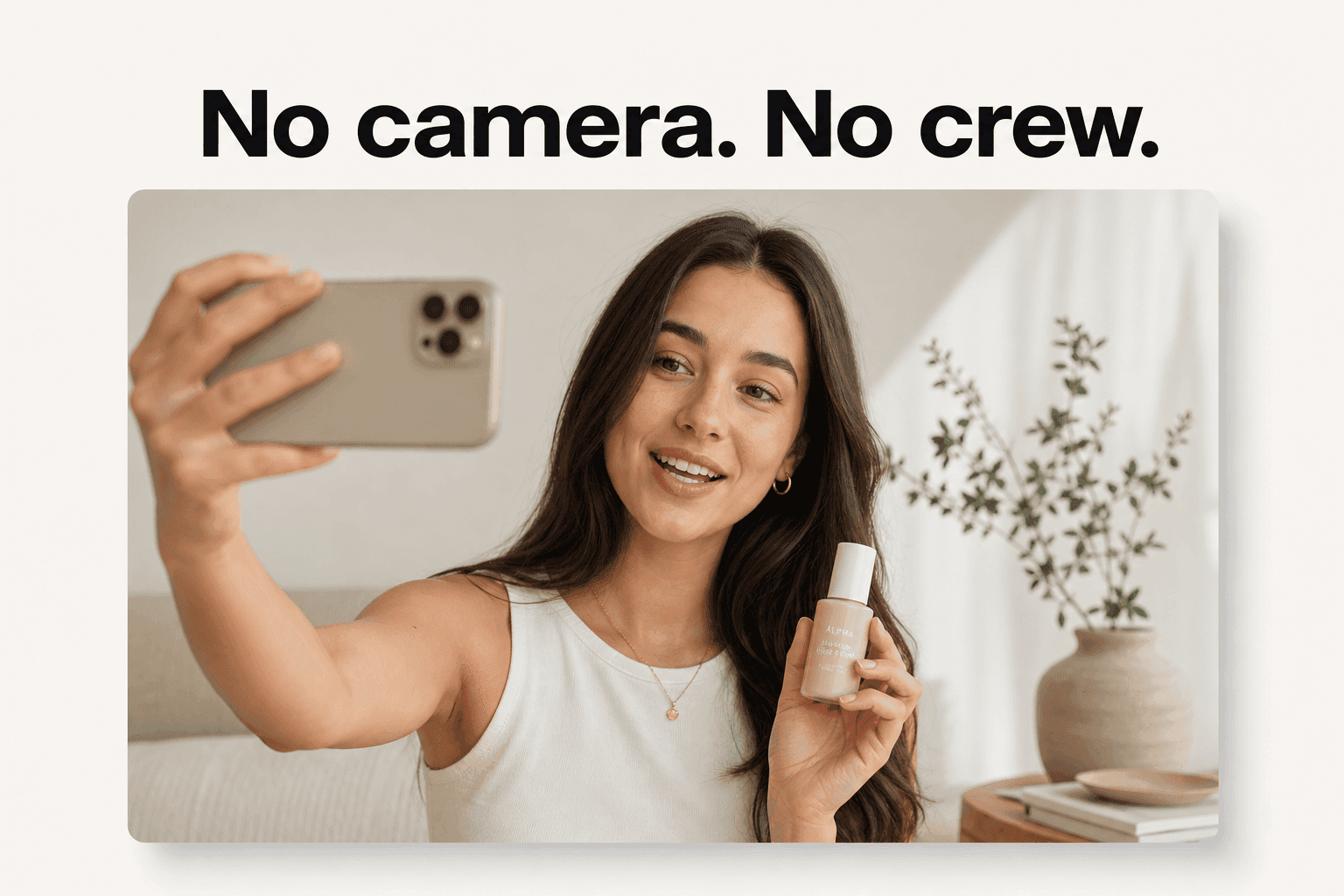
There are two visual styles, and picking the wrong one quietly kills credibility. An avatar-led testimonial is a clean, well-lit presenter talking to camera, closer to a corporate spokesperson or an explainer host. A UGC-actor-led testimonial is handheld and casual, the phone-in-the-kitchen look of a real customer who filmed themselves. Both are legitimate. They just signal different things: polish reads as brand, roughness reads as peer.
For a landing page or a sales deck, the studio look often fits. For paid social, where the whole game is not looking like an ad, the UGC style usually wins. A UGC creator sells exactly that handmade credibility, and the better generators can imitate the register on purpose. The testimonial is one of a handful of repeatable UGC ad patterns, and the same handheld register carries all of them.
What it is not: a review-invention machine
Here is the boundary to internalize before you generate anything. An AI testimonial generator is a camera and an editor, not a copywriter for opinions you wish customers held. The person on screen may be synthetic; the experience they describe may not be. You are moving a real endorsement into video, not manufacturing an endorsement that never happened. Everything in the honesty section below follows from this one distinction.
Why video testimonials outperform text, and why brands still skip them
Marketers agree that testimonials work, then leave their best ones as gray text under a product. The reason is not doubt about the format. It is that video testimonials have been expensive and slow to collect, so most never get made.
The trust math of a face on camera
Social proof is the strongest lever a store has, and video concentrates it. Reviews already drive behavior: in BrightLocal's 2026 survey, 85% of consumers say positive reviews make them more likely to use a business, and the vast majority read reviews before buying at all. A written review earns that trust in a thin way. A face on camera, a voice, a pause, a specific detail about a Tuesday night, clears the credibility bar a paragraph cannot. The mechanism is old: people believe people. Video just delivers more of the person.
The collection bottleneck
So why is the internet not flooded with customer videos? Because asking real customers to film themselves fails most of the time. They are busy, camera-shy, unsure what to say, or they agree and never follow through. Even when they deliver, the audio is rough and the framing is off. The happy customer exists; the footage does not. That gap between goodwill and usable video is exactly the space an AI testimonial generator fills, because it removes the ask entirely and works from feedback the customer already gave you in writing.
Where testimonials actually convert
A testimonial is not one asset; it is a format you place across the funnel. The high-value slots:
- Landing pages. A testimonial above the fold answers the "is this real" question before the visitor scrolls.
- Retargeting ads. Warm audiences who bounced get reminded why others stayed.
- Product pages. One testimonial per product, aimed at the specific objection that product raises.
- Email sequences. Onboarding and win-back flows carry a video proof point better than a quote block.
- Sales decks. Reps arm every common objection with a customer saying the answer for them.
Each slot rewards a slightly different angle and length, which is the entire argument for generating many versions cheaply instead of shooting one. If you want the revenue side of this, see our guide to improving ROAS with UGC.
How to make an AI testimonial video: a worked example
Abstract steps are easy to nod at and hard to reproduce, so here is a concrete run. Say you sell a magnesium sleep supplement and a customer, Daniela, a nurse who works night shifts, left this review: "I was skeptical but after two weeks I actually fall asleep on my nights off. First supplement that did anything."
Steps 1 to 3: start from the real review, script it, cast the presenter
- Start from a real review. Copy Daniela's exact words. Do not improve the claim, do not add a benefit she did not mention. The realness is the asset.
- Adapt it into a spoken script. Rewrite for the ear, keep the meaning. "Honestly, I was skeptical. I work night shifts, so my sleep is a mess. Two weeks in, on my nights off, I actually fall asleep. This is the first supplement that did anything for me." Add one line of context so a stranger can place her.
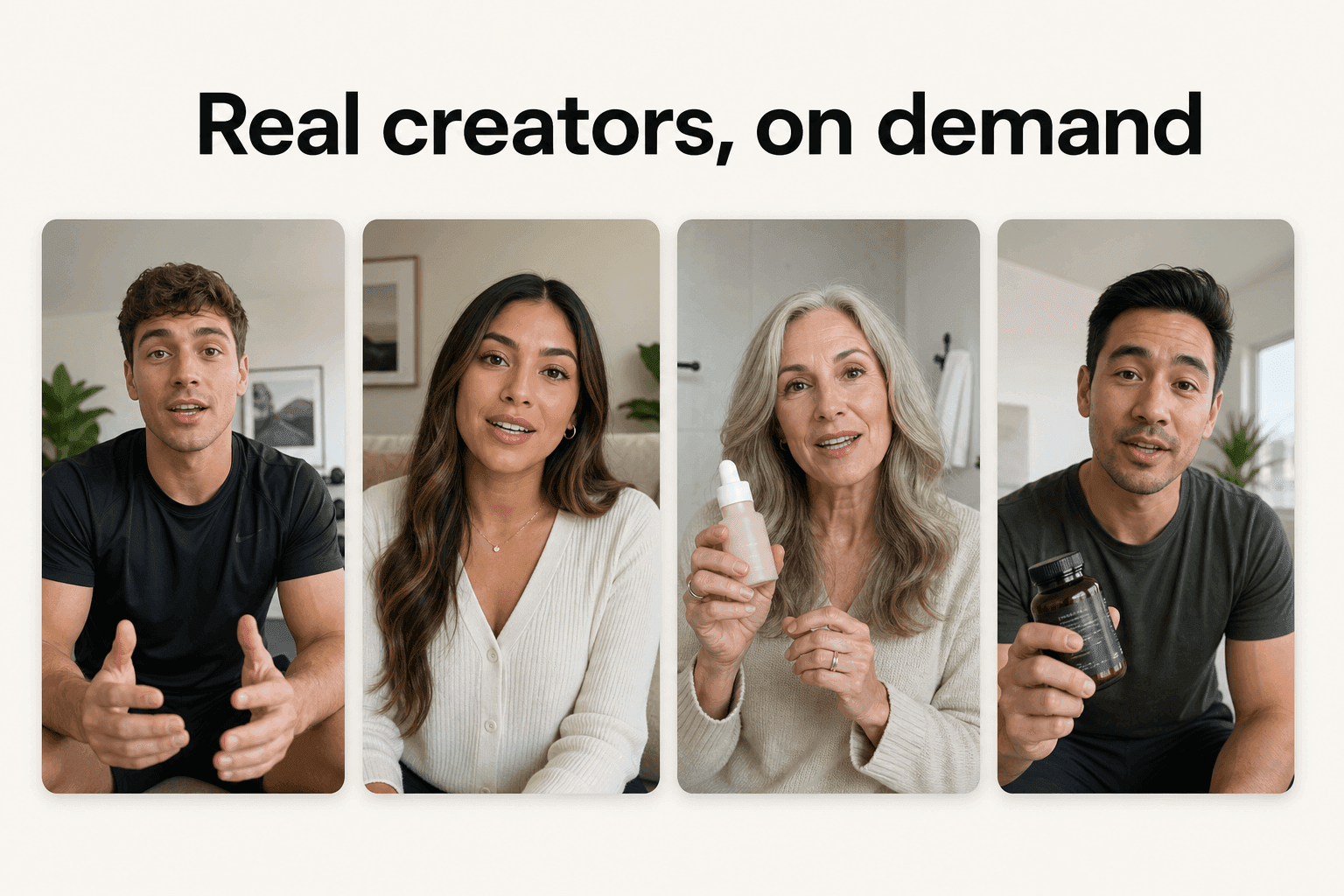
- Cast a presenter who matches the customer. Pick an actor whose age, look, and accent fit a night-shift nurse, not a glossy model. A mismatch between the words and the face is the fastest way to look fake. In Novoads you write or paste the script, pick a Talking actor whose profile fits, and it becomes a UGC-style vertical clip.
Steps 4 to 5: generate, add context, and localize
- Generate, then add context overlays. Produce the clip and layer on the trust cues: first name, "verified customer," a short results line. With permission, real specifics beat vague ones every time.
- Localize it. The same testimonial can be delivered in Spanish and Portuguese with native-sounding accents, so one review becomes proof for three markets instead of one. This is where AI pulls decisively ahead of a single filmed human who speaks one language.
How to know it worked
Do not trust your own taste; test it. Put the AI testimonial against your current above-the-fold on a landing page, or run it as a variation against your best current ad. A good testimonial lifts add-to-cart or hold rate against the control within a normal test window. If it does not beat the control, change the reviewer, the angle, or the first three seconds, and run it again. The point of cheap production is cheap iteration.
The honesty problem: FTC rules and platform disclosure
This is the section most tool marketing skips, and it is the one that keeps you out of trouble. AI makes fake testimonials trivially cheap to produce, which is precisely why regulators moved. You can use these tools well. You just have to know where the line is.
What the FTC actually bans
The FTC's Rule on the Use of Consumer Reviews and Testimonials took effect in October 2024. It targets testimonials that misrepresent that they are by someone who does not exist, such as AI-generated fake reviews, or by someone who never had actual experience with the product. In plain terms: you may not conjure a customer and a story out of nothing and present it as real. This is not a gentle guideline. Knowing violations can draw civil penalties of up to $53,088 per violation (2026), and those add up fast across a campaign.
AI avatars are allowed; fabricated experiences are not
Read that carefully, because the common panic gets it backwards. The rule does not outlaw synthetic presenters. The FTC has stated plainly that its rule has no blanket prohibition on the use of AI-generated avatars in marketing. What it prohibits is the lie underneath, a testimonial from a person who does not exist or who never used the product. So an AI actor reading Daniela's real review, with her consent, is fine. An AI actor reading a review Daniela never wrote, about a result she never had, is the violation. The tool is neutral; your inputs are not.
Platform labels: TikTok, Meta, and Google
On top of federal law, the platforms have their own disclosure rules, and they are expanding. The short version:
- TikTok has, in its own words, required creators to label realistic AIGC for over a year, and auto-labels AI content it detects.
- Meta says it began labeling ads that were created or significantly edited using its generative AI creative features.
- Google Ads requires that advertisers disclose all election ads that contain synthetic or digitally altered content, and the disclosure must be clear and conspicuous.
The safe posture is to disclose the AI presenter and keep the testimonial faithful. For the platform-by-platform detail, our guide to TikTok's AI ad disclosure rules walks through the specifics. Disclosure done right does not tank performance; TikTok even notes that turning on its AI label does not, by itself, affect distribution.
AI testimonial video generators compared
The market divides cleanly once you know the two styles. Match the tool to the testimonial you actually want, not to whichever brand you have heard of.
Avatar studios versus UGC ad tools
Avatar studios build a polished presenter reading your script, ideal for spokesperson testimonials, training, and explainer-style proof. UGC ad tools build the handheld, real-creator look designed to run as paid social. Some products lean hard one way; a few do both. The table below is a spec snapshot, so keep the cells honest and short.
The comparison table
| Tool | Testimonial style | Free tier | Starting paid | Best for |
|---|---|---|---|---|
| HeyGen | Studio avatar | 3 videos/mo | $29/mo | Corporate spokesperson clips |
| Synthesia | Studio avatar | 10 min/mo | $29/mo | Training and 160+ languages |
| Vidnoz | Avatar and talking photo | Daily credits | Paid tiers | High-volume avatar output |
| Creatify | UGC ad from URL | 2 videos/mo | 39 a month | URL-to-video product ads |
| Novoads | UGC actors and avatars | None | $49/mo | Native-accent UGC testimonials |
HeyGen and Synthesia both start their paid tiers at $29 per month and shine at clean, presenter-led video (Synthesia advertises 160+ languages and voices). Vidnoz leans on scale, marketing 1900+ realistic AI avatars plus an AI Talking Photo tool that animates a still image into a speaking clip. Creatify's signature move is URL to Video, generating an ad from a product link. For deeper head-to-heads, see our roundups of HeyGen alternatives and Synthesia alternatives, or the wider field in the best AI video ad generators.
How to choose
A quick decision read rather than a scorecard:
- Choose an avatar studio when the testimonial lives on a landing page, a sales deck, or in training, and a clean, corporate presenter fits.
- Choose a UGC tool when the testimonial runs as a paid social ad and must not look produced, and when native-accent localization is the point.
When AI testimonials help, and when to use a real customer
The honest stance is not "AI replaces testimonials." It is that AI removes the production tax on the testimonials you were never going to film anyway, and leaves the rare flagship case to a real human.
Use AI when you need volume and speed
Most testimonial value is in coverage, not in one perfect video. You want a proof point for each product, each objection, each language, each ad angle, and you want to test which lands. That is a volume problem, and volume is exactly what filming cannot afford. When a clip costs a few dollars and takes minutes, you can turn a quarter of accumulated reviews into a testing library. Our comparison of AI versus UGC creators runs the full trade-off.
Use a real filmed customer when the person is the proof
There is a case AI should not touch: the flagship story where a specific, recognizable customer, a named founder, a public case study, a face your audience already trusts, is itself the evidence. When the identity is the argument, film the human. Synthetic delivery of a story that leans on "this exact real person" undercuts the very thing that made it persuasive. Know which asset you are making, and do not automate the one that depends on a real face being real.

Real proof, produced at the speed of marketing
The oldest truth in advertising is that people believe people. What changed is the cost of showing one. A testimonial video used to sit behind a customer's calendar, a shoot, and a $200 invoice, so brands rationed a format built for volume. An AI testimonial video generator removes the production tax and leaves the one thing that was always the point: a real customer's real words, said out loud, by a face that fits.
That is the job Novoads is built for. You write or paste a real review, pick a Talking actor whose look and accent match the customer, and generate a UGC-style testimonial with voice, lip-sync, and captions in minutes, then localize it across 30+ languages with native accents. The canvas Animate Actor node can drive a presenter from a reference performance, and you can turn a product photo into an ad image in the same flow. The models available in Novoads (Google Veo 3.1, Kling v3 Pro, and Seedance 2.0) handle the heavier video work when you need it, and the same stack powers a polished AI commercial for the moments that call for brand over peer. Keep the words honest, disclose the AI presenter, and you have social proof at the speed your testing actually demands. You can make your first AI testimonial video in Novoads for $49/month. Cancel anytime.
Frequently Asked Questions
What is an AI testimonial video generator?
It is a tool that takes a testimonial script, usually adapted from a real customer review, and produces a video of an AI avatar or actor speaking it to camera, with natural voice, lip-sync, and captions. The point is to convert feedback you already have (reviews, survey answers, case-study quotes) into the video format people trust most, without scheduling a shoot. The AI supplies the production, not the opinion.
Are AI video testimonials legal?
Yes, when the content is grounded in genuine feedback and disclosed where required. The FTC's Consumer Reviews and Testimonials Rule bans testimonials that misrepresent that they are by someone who does not exist or who never had actual experience with the product. It does not ban AI avatars: the FTC has said the rule has no blanket prohibition on AI-generated avatars in marketing. Fabricating a person and a story is illegal; producing a real customer's real words with an avatar is not.
Do I have to disclose that a testimonial video is AI-generated?
Often, yes, and increasingly so. TikTok requires creators to label realistic AI-generated content, Meta labels ads made or significantly edited with its generative AI features, and Google Ads requires disclosure of synthetic content in election ads. Rules differ by platform and are expanding, so the safe default is to disclose that the video uses an AI presenter and to keep the testimonial itself faithful to real feedback.
Do AI testimonials convert as well as real filmed ones?
For volume testing and localization, they are close enough to be worth it, and they beat text-only reviews handily because a face on camera carries more credibility than a paragraph. They will not replace a flagship story where a specific, recognizable customer is the whole proof. Treat AI testimonials as the way to test many angles cheaply and to reach many languages, and reserve filmed customers for the hero asset.
How much does an AI testimonial video generator cost?
Avatar studios start around $29 per month (HeyGen Creator and Synthesia Starter both list $29), and most have a limited watermarked free tier. UGC-style tools price by credit or subscription, with individual clips costing a few dollars rather than the hundreds a filmed testimonial runs. In Novoads you can start on the $49 per month plan.
Can I use a real customer's name and words in an AI testimonial?
Only with permission. Get explicit consent before using anyone's name, likeness, or exact words, and keep the message true to what they actually said. Many brands use first name and company only, or anonymize the reviewer while preserving the substance. The words should come from a real customer even when the face and voice are synthetic.
Key Takeaways
- An AI testimonial video generator turns a real customer review into a video testimonial: an AI avatar or actor reads the words to camera with voice, lip-sync, and captions, in minutes instead of weeks.
- It is a production layer on top of genuine feedback, not a review-invention machine. The FTC's fake-review rule bans testimonials from people who do not exist or never used the product, with civil penalties up to $53,088 per violation.
- AI avatars themselves are legal. The FTC states its rule has no blanket prohibition on AI-generated avatars in marketing, so the line is honesty and disclosure, not the tool.
- The tools split in two: avatar studios (HeyGen, Synthesia, Vidnoz) for clean spokesperson testimonials, and UGC ad tools (Novoads, Creatify) for handheld, real-creator-style testimonials you run as ads.
- Use AI when you need volume, speed, and localization from reviews you already have; keep a real filmed customer for the flagship story where the specific person is the proof.