
AI-Powered Video Testimonials Explained: Four Formats and Where the FTC Draws the Line
An AI-powered video testimonial puts a real customer's words on camera through a generated face and voice. Here are the four formats, what the FTC's testimonials rule prohibits, and what makes one believable.

Mauricio Valdivia
·11 min

The person on screen can be synthetic. The experience cannot
A customer writes you four sentences at eleven at night. They are better than anything the agency produced this quarter. You ask her to say them on camera, and the thread goes quiet for three weeks.
AI-powered video testimonials exist for that silence. One is a testimonial video in which the experience comes from a real customer and the face, the voice, or both on screen are generated: a written review becomes a spoken script, an AI presenter delivers it to camera with lip-sync and captions, and the clip runs as an ad or sits on the product page. The production is synthetic. The experience being described is meant to be real, and in the United States that distinction stopped being a matter of taste in October 2024.
This post is an explainer, not legal advice. It covers what these videos actually are, the four formats hiding under one label, where the Federal Trade Commission's rule on consumer reviews and testimonials draws its line, what makes a generated testimonial credible to the person watching, and when a filmed human still wins. If you want the tooling side instead, our guide to the AI testimonial video generator covers how one is produced and what it costs.
What AI-powered video testimonials are, and what the FTC counts as a testimonial
Most people use "AI testimonial" to mean one thing and argue about a different one. The category is wider than it looks, and the rules attach to the format, not to the phrase.
The four formats hiding under one label
Four distinct things get sold under the same words. The first three are production decisions. The fourth is a different act entirely.
- Recast. A real review, delivered by an AI actor who is not the customer. The words are genuine, the person on screen is a stand-in, and nothing about the customer's identity is claimed.
- Relocalized. The real customer's own testimonial, re-voiced or dubbed so one clip reaches several markets. The speaker and the story stay the same; the language changes.
- Licensed likeness. An avatar built from the actual customer's photo or footage, used with their written permission, so the person you see is the person who wrote it. This is the route our guide to an AI avatar from a photo describes.
- Fabricated. A person who does not exist describing an experience nobody had. There is no permission to get and no customer to credit.
That last row is not a harsher version of the first three. It is the thing the rule below was written to stop, and it is worth noticing that it is also the only one of the four that needs no customer at all.
Review, testimonial, endorsement: three words the rule keeps apart
The vocabulary matters because the obligations differ. In its own questions and answers on the rule, the FTC defines a testimonial as "an advertising message that consumers are likely to believe reflects the opinions, beliefs, or experiences of a consumer or celebrity who has purchased, used, or otherwise had experience with a product, service, or business." A consumer review, by contrast, is an evaluation submitted to and published on a platform built to display them.
They are not the same population. The FTC puts it flatly: "Most consumer reviews are not consumer testimonials, and most consumer testimonials are not consumer reviews." The practical consequence for a marketer is small and sharp. The moment you lift a five-star review out of a listing and put it in an ad, you have made a testimonial, and testimonial obligations apply to it even though the words never changed. The same shift governs how paid creators are treated, which our comparison of UGC versus influencer marketing works through in detail.

Where the FTC line actually sits
This is the section most explainers replace with the word "ethical." Ethics are a preference. The rule is a text with a date, a citation, and civil penalties behind it, and reading it is faster than guessing.
The rule in one line: 16 CFR Part 465, effective October 21, 2024
The FTC's legal library publishes it as "16 CFR Part 465: Trade Regulation Rule on the Use of Consumer Reviews and Testimonials (Final Rule)," and the agency's guidance page states that the rule "went into effect on October 21, 2024."
Announcing the final rule, the FTC described its first prohibition as covering reviews and testimonials that "misrepresent that they are by someone who does not exist, such as AI-generated fake reviews, or who did not have actual experience with the business or its products or services, or that misrepresent the experience of the person giving it." Read that slowly, because it names three separate failures:
- A person who is not real. The reviewer was generated, not found. This is the branch that names AI directly.
- A real person with no experience. The face exists and the purchase never happened.
- A real experience, described falsely. The customer is real, the words are not what she meant.
Generated video makes the first one cheap, which is precisely why it is named in the text. It does nothing at all to the other two, which were already illegal with a camera and a paid actor.
Mapped onto the four formats above, the rule lands unevenly:
| Format | Person on screen | Whose experience | What the rule asks |
|---|---|---|---|
| Recast | AI actor | The customer's | Keep the claim hers |
| Relocalized | The customer | The customer's | Keep the meaning in translation |
| Licensed likeness | The customer | The customer's | Written permission |
| Fabricated | Nobody | Nobody's | Do not ship it |
The prohibited act is the invented person, not the synthetic face
Here the common panic runs backwards. Asked directly how the rule applies to marketing that uses AI stock avatars, the FTC answered that "the rule has no blanket prohibition on the use of AI-generated avatars in marketing," and added that a company's use of such an avatar might count as a testimonial, in which case it "would be prohibited under the rule only if the underlying testimonials were fake or false."
So the tool is not the violation. An AI presenter reading a genuine, substantiated review is a production choice. A generated person presented as a customer who never existed is the act the rule names. One boundary does sit on the avatar itself: the FTC says it "would also violate the rule for someone to use a celebrity avatar without the celebrity's permission to speak favorably about a product, if reasonable consumers would think that the celebrity actually gave a testimonial for the product." Likeness is not raw material.
What the Endorsement Guides add: honest opinion, and proof for the result
The rule is not the only text in play. The FTC's Endorsement Guides sit on top of it and are older, broader, and easier to trip over. Their core sentence: "An endorsement must reflect the honest opinion of the endorser and can't be used to make a claim the marketer of the product couldn't legally make."
That second clause is the one that catches AI testimonials, because a script is easy to nudge. If your customer wrote that she slept better and your script says the product fixes insomnia, no presenter makes that legal. The Guides also handle the standout result. Where an ad features an outcome consumers cannot generally expect, the advertiser's two options are to "have adequate proof to back up the claim that the results shown in the ad are typical" or to disclose clearly what people do generally achieve. A generated clip does not lower that bar. It lowers the cost of producing fifty variants that each clear it, or fifty that each miss.
What none of this settles
Three honest limits sit around everything above:
- The guidance is not a shield. The FTC's own answers carry the caveat: "Our staff guidance isn't definitive or comprehensive, and it doesn't provide a safe harbor from potential liability."
- The exposure is yours, not the reviewer's. The agency notes that "Ordinary consumers can't be liable under the rule for what they say or don't say in reviews or testimonials," which puts the risk on the business and its agency.
- This is one layer of one country. It is United States federal law, and the platform label rules are a separate set with their own timelines, covered in our breakdown of labeling AI-generated ads.
Nothing above is a legal opinion about your campaign. It is the text, dated and quoted, so you can bring a specific question to a lawyer instead of a vague worry.

One review, three videos you can run and one you cannot
Abstractions are agreeable and useless, so here is a single piece of feedback carried through four versions. A brand sells orthopedic dog beds. A customer, Rosa, writes: "Bought it for our eleven-year-old lab. By the second week he stopped pacing the hallway at night."
That is a good review precisely because nobody would invent it. "Stopped pacing the hallway at night" is the kind of detail a copywriter smooths away.
The version you can run
Adapt the words for the ear without changing what they claim. "We bought it for our lab. He is eleven. By the second week he stopped pacing the hallway at night, which is the part I did not expect." Cast a presenter who reads as a person with an old dog and a hallway, generate, and add a first name and a city as an overlay with Rosa's written permission. The claim is hers, the delivery is synthetic, nothing represents the presenter as Rosa.
The version that needs a line of context
Now marketing wants the headline "stops night pacing in two weeks." That is the same sentence promoted from one dog's experience to a general result, which is exactly the move the Endorsement Guides address. Two ways through:
- Evidence. Data showing two weeks is what owners generally see, held before the ad runs, not assembled after a complaint.
- A disclosure. A visible line stating the result owners do typically get, on screen long enough to read.
Cutting that line because it weakens the hook is the most common way a legal testimonial becomes an illegal one, and it happens in the edit, not in the brief.
The version that crosses the line
The fourth version invents "Dr. Marta, veterinarian," a generated person with a clinic backdrop, saying the bed relieves hip dysplasia. No Marta exists. No clinician made that claim. This is a testimonial from someone who does not exist, plus an unsubstantiated health claim, plus a fake expert endorsement, all in twenty-two seconds. The rendering is identical in effort to version one. Only the inputs changed, which is the whole argument for governing inputs.
What makes an AI testimonial credible to the person watching
Legality is the floor. Believability is a separate craft problem, and the failure modes are boringly consistent.
Cast someone the words could have come from
Viewers catch mismatches before they catch pixels. A twenty-four-year-old model delivering a sentence about an eleven-year-old dog and a hallway reads as false even though every word is true, and the credibility you lose is attributed to the claim rather than the casting. Match age, register, and accent to the story first, and worry about render quality second. Our teardown of where AI UGC realism actually comes from goes through why the model is rarely the constraint.
Keep the detail a copywriter would have cut
Real speech is lumpy. It names Tuesday, the wrong size, the thing that nearly went back. Generated scripts drift toward smooth, and smooth is what audiences have learned to distrust. When you adapt a review for the ear:
- Keep the number, the timeframe, and the one detail that sounds slightly off.
- Keep the hesitation, including the part where she doubted it would work.
- Cut the adjectives, the product name repetitions, and anything that reads as a benefit list.
- Never add a result, a bodily outcome, or a comparison she did not write.
The beat-by-beat version of this is in our piece on testimonial video examples, which takes finished clips apart to show which second is carrying the proof.
Say what the video is
Disclosure is treated as a tax on performance and it usually is not. A short line identifying the presenter as AI costs less trust than a viewer discovering it in the comments, and it pairs naturally with the technical work of making the clip not look plastic, which our guide on how to make AI video look real covers. The credibility argument and the compliance argument point the same way here, which is rarer than it sounds.

When a real filmed customer still wins
The honest position is not that generation replaces filming. It is that generation removes the production tax on the testimonials nobody was ever going to film, and leaves a narrow set where the human is the point.
Generate when:
- You have a backlog of written reviews and no footage.
- You need one story in several languages and accents.
- You are testing which objection, angle, or opening actually moves a metric.
- The proof is the experience, and the customer is happy to be quoted but not filmed.
Film when:
- The specific person is recognizable and their name is the argument.
- The claim sits in a regulated category where a real, identifiable speaker matters.
- The asset is a flagship case study a buyer will look up and verify.
- A customer has already offered, in which case take the footage.
When the identity is the evidence
Some testimonials are persuasive because of who is speaking: a named founder, a public case study, a customer your buyer already follows. Synthesizing that removes the exact thing that made it work, and it invites the audience to ask what else was synthesized. Know which asset you are making. Our comparison of AI versus UGC creators sets out the wider trade-off between the two production routes.
When the category regulates the claim
Health, finance, and anything touching outcomes people can be hurt by deserve a heavier hand. The Endorsement Guides already require proof for a typical result. Adding a synthetic speaker to a claim you cannot substantiate does not distribute the risk, it concentrates it, because the generated face becomes evidence of intent rather than a neutral production choice.
How Novoads solves the testimonial you already earned
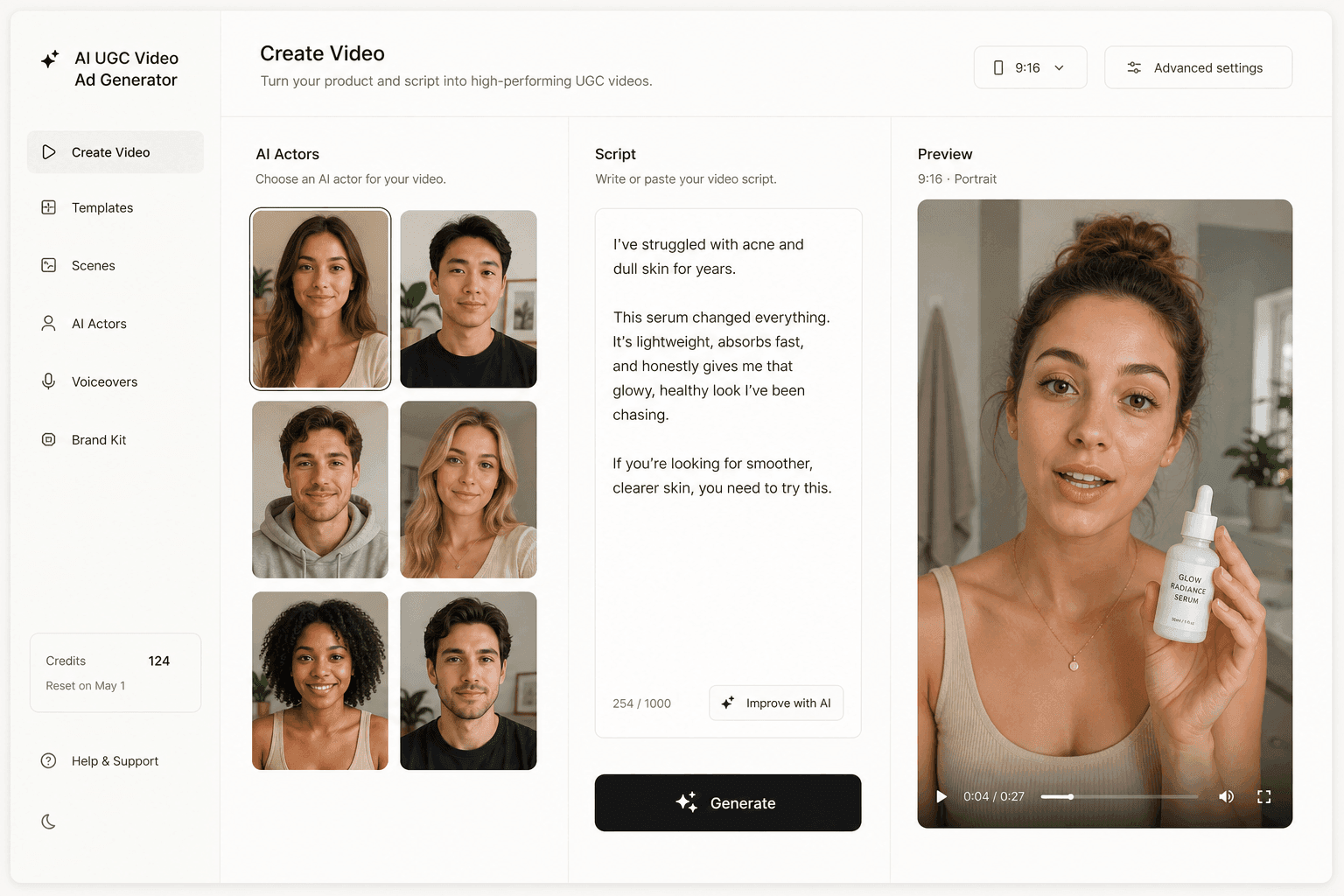
The problem worth solving is not "make a video." It is that the proof already exists in your inbox and has no route to a screen. In Novoads you paste a real review as the script, pick a talking actor whose look and register fit the customer who wrote it, and get a UGC-style vertical clip with voice, lip-sync and captions in minutes, with voices available in 31 languages so one review can serve several markets.
Two routes matter if the product itself has to be visible, because a stock talking actor from the library has empty hands:
- Custom actor. Upload a photo of someone holding your product (Create Actor, then Upload) and that becomes the presenter.
- Discover product template. Upload the product and a template creator holds it for you, no custom actor needed.
Plans start at $49 per month (Starter, 50 credits per month), published on the pricing page.
Consent is the asset. Production is the commodity.
Rendering a believable human talking to camera used to be the hard part of a testimonial. It is now the cheap part, and everything the rules care about sits upstream of it: a customer who exists, an experience they actually had, a claim you can back, and permission in writing. Those four things are the asset. The face is the format.
Which is a better position to be in than it sounds, because the scarce input is one you can collect deliberately. Ask for the review, ask for the permission in the same message, and the production question answers itself. You can turn your first real review into a video testimonial in Novoads for $49 per month. Cancel anytime.
Frequently Asked Questions
What is an AI-powered video testimonial?
It is a testimonial video in which the experience described belongs to a real customer and the face, voice, or both on screen are generated. A written review, an NPS comment, or a case-study quote becomes a spoken script, an AI presenter delivers it to camera with lip-sync and captions, and the clip runs as an ad or sits on a product page. The production is synthetic. The experience is supposed to be real, and that split is what every rule below turns on.
What does the FTC's Rule on the Use of Consumer Reviews and Testimonials prohibit?
The rule, published as 16 CFR Part 465, went into effect on October 21, 2024. Announcing it, the FTC said the rule addresses reviews and testimonials that misrepresent that they are by someone who does not exist, such as AI-generated fake reviews, or who did not have actual experience with the business, or that misrepresent the experience of the person giving it. The invented customer is the target, not the camera you used.
Can an AI actor deliver a real customer's review?
The FTC's own questions and answers on the rule say it has no blanket prohibition on the use of AI-generated avatars in marketing, and that a company's use of such an avatar would be prohibited under the rule only if the underlying testimonials were fake or false. So an AI presenter reading a genuine, substantiated review is a different act from a generated person presented as a customer who never existed. This is an explainer and not legal advice, and the FTC notes its staff guidance is not definitive and gives no safe harbor, so run your specific case past counsel.
Do I need the customer's permission to turn their review into a video?
Treat it as required. Get written consent before you use anyone's name, employer, likeness, or exact words, and keep the meaning of what they said intact. Many brands run first name and city only, or anonymize the reviewer entirely while preserving the substance. The FTC also says it would violate the rule to use a celebrity avatar without the celebrity's permission to speak favorably about a product, if reasonable consumers would think that the celebrity actually gave a testimonial.
What makes an AI testimonial believable instead of uncanny?
Three things, in this order. Cast a presenter the words could plausibly have come from, because a mismatch between the face and the story is what viewers catch first. Keep the one odd, specific detail the customer actually wrote, since invented copy is always smoother than real speech. And say what the video is, because a visible AI label costs less trust than being caught.
When should I film a real customer instead of generating one?
When the identity is the evidence. A named founder, a recognizable public case study, a clinician, a customer your audience already knows: in those clips the specific person being real is the whole argument, and a synthetic delivery removes the thing that made it persuasive. Generated testimonials are for coverage, volume, and languages, not for the one flagship story your buyer will look up.
Key Takeaways
- An AI-powered video testimonial is a production method, not a source of opinion: the words belong to a real customer and the face or voice on screen is generated.
- Four formats sit under the label. Recast, relocalized, and licensed-likeness are production choices. The fourth, a fabricated person describing an experience nobody had, is the act the FTC's rule targets.
- 16 CFR Part 465 went into effect on October 21, 2024, and reaches testimonials that misrepresent that they are by someone who does not exist or who never had experience with the product.
- The FTC says its rule has no blanket prohibition on AI-generated avatars in marketing, and that an avatar testimonial is prohibited only if the underlying testimonials were fake or false.
- The Endorsement Guides still apply on top: an endorsement must reflect the endorser's honest opinion, and a result shown in an ad needs proof that it is typical or a clear disclosure of what is.