Testimonial Ads: Examples by Format and the 4 Beats That Persuade
A testimonial ad is a paid ad in which a real customer vouches for the product: documented examples in four formats, and the four beats that make one persuade.

Mauricio Valdivia
·Updated ·10 min

The customer says it, so the brand doesn't have to
On June 10, 2002, Apple put eight people who had switched from PCs to Macs on television, each telling the story in their own words. That is a testimonial ad: a paid ad in which a real customer, not the brand, vouches for the product and usually names what it did for them. None of them was an actor.
Testimonial ads keep coming back because borrowed credibility does not wear out. Wistia's 2026 State of Video report says 47% of companies planned to make customer testimonial videos in 2026, up from 17% in 2023.
Below are testimonial ad examples in four formats, each traced to the page that documents it, then the four beats that make any of them persuade, what Google says star ratings do on Search ads, where AI actors fit, and how to get testimonials from customers.
Testimonial ad examples by format
Four formats cover most testimonial ads you will see, and each one carries proof differently. Nielsen reported in November 2021 that 88% of global respondents trust recommendations from people they know more than any other channel. A testimonial ad borrows a stranger's version of that trust, and the format decides how much of it survives.
Testimonials overlap with UGC ads, but a UGC ad can be any creator demoing a product, while a testimonial claims an experience. Each format also has a natural home: customer video in feeds and on landing pages, quote cards in retargeting and on product pages, stars in search results. For other formats in the feed, see eleven Facebook ad examples Meta documented, with their results.
| Format | What carries the proof | Example in this guide |
|---|---|---|
| Customer video | A buyer on camera | Apple 2002, Microsoft 2009 |
| Quote card | One line, a name, a face | Proactiv ruling, 2012 |
| Before and after | Two states, one product | FTC illustration, 2023 |
| Star rating | An average of many reviews | Google store ratings |
Customer video: Apple's switchers and Microsoft's testers
Apple's press release of June 10, 2002 says its "Real People" campaign debuted on television with eight different ads, each one a different "switcher" telling their story. The cast included a Windows network administrator, a writer, an illustrator, a small business owner, a programmer, an interactive producer and a DJ, and the ads were directed by Errol Morris, the documentary filmmaker. Print ads ran the same week in Time and Newsweek. Steve Jobs put the premise in one line: these were "real people who have switched from PCs to Macs, telling their story in their own words."
Seven years later, Microsoft cast its customers as co-authors. Its German newsroom release of October 22, 2009 describes the Windows 7 campaign like this (our translation):
- The cast: not actors but real Windows users from New York, Seattle, Paris, London, Sydney and Berlin, standing in for everyone who had shaped the product through user tests and online interviews.
- The line: "Ich bin ein PC. Und Windows 7 war meine Idee." In English: I'm a PC, and Windows 7 was my idea.
- The number behind it: eight million people took part in the worldwide Windows 7 beta program.
- The reach: 26 TV spots, airing from October 22 in the US, the UK, France, Canada, Australia and Germany.
Neither campaign asks the viewer to trust the brand. Each asks the viewer to believe someone like them: a switcher who made the move, a user who says the product was their idea. A customer video is also the only format with room for all four beats described below. For creator-led variations on it, see these UGC ad examples.
Quote card: one line, read literally
A quote card is the written version: one line from a customer, their name and often a photo, set on a static image for a feed or a landing page. It is the cheapest format to produce and the easiest to get wrong, because a written line is read literally, tense included.
The clearest dated case is a regulator's ruling, not a campaign. On July 18, 2012, the UK's Advertising Standards Authority ruled on two Proactiv ads, and the ruling reads like a checklist of how a written testimonial goes wrong:
- The ads: a teleshopping spot in which an American singer said "I really love the refining mask, I use that at night", and the brand's website, with written testimonials from several other American celebrities such as "even though my skin's clear now I still use Proactiv every day."
- The evidence: signed statements the advertiser supplied, covering five of the seven testimonials, said the celebrities had each used the UK formulation for only several weeks, one to three years before the ads appeared.
- The impression: the ASA judged that the ads presented the celebrities as "continued and regular users".
- The verdict: the claims of continued use were unsubstantiated, the ads were misleading, and they must not appear again in their current form.
The rule for any quote card follows: a present-tense line is a claim about today. Either it is still true, or the card says when it was said.
Before and after: the result is read as typical
A before-and-after testimonial shows two states with the product between them: skin in March and skin now, a cluttered inbox and an empty one. It is the most visual format and the most exposed one, because it states a result.
The FTC's guidance on its Endorsement Guides, a question-and-answer page dated June 2023, says endorsements claiming specific results "usually will be interpreted to mean that the endorser's experience reflects what others can also expect", and that statements like "Results not typical" or "Individual results may vary" won't change that interpretation. That leaves the advertiser two choices: proof that the results shown are typical, or a clear and conspicuous disclosure of the generally expected performance. The FTC's own illustration uses a hypothetical brand, pairing the endorsement "I lost 50 pounds in 6 months with QRS Weight-Loss" with a disclosure such as "Women who use QRS Weight-Loss for six months typically lose 15 pounds."
Two craft rules follow from that:
- Make the "after" checkable: same light, same angle and a date on both frames.
- Put the typical result in the ad itself, said by the customer or shown on screen, rather than in small print under the player.
Star rating: many customers, one number
The fourth format drops the story altogether. It is an average of many reviews, shown as stars and a count beside the ad, and it trades every beat for volume. It is also the format with a performance figure from Google itself, for Search text ads; that figure and its limits get their own section below.
The four beats that make a testimonial ad persuade
Behind every format above sit the same four beats, in the same order: Recognition, Friction, the Specific and Residue. Formats differ in how many they can carry. A customer video has room for all four. A quote card usually carries two, the Specific and the Residue. A star rating carries none, and substitutes volume for story.
Order matters on video because attention runs out. Wistia's data puts the average engagement rate for videos under a minute at 52%, and at 46% for customer testimonial videos of that length, so roughly half of a short testimonial goes unwatched. Whatever proves the claim belongs in the first half.
Recognition: the viewer's own problem, first
The opening seconds name the viewer's situation, not the product. "I'd tried four different retinols and my skin got worse every time" is Recognition; "I love this serum" is not. The job is to make one specific person stop and think the ad is about them, the same instinct behind strong ad hooks. If viewers drop in the first three seconds, this beat failed, and your hook rate will show it before your sales do.
Friction: the cost of the old way
The before state, stated as a cost rather than a feeling. Not "it was frustrating" but "I was rebooking the appointment every three weeks and still not sleeping." Customers naturally summarize old problems in adjectives. Adjectives do not transfer to a stranger. Costs do.
The Specific: one detail a stranger can check
One number, one date or one detail that proves the change happened. This is the load-bearing beat and the one to protect in the edit. Compare the same outcomes told two ways:
| Vague version | Specific version |
|---|---|
| "It saved us so much time" | "Monday reporting went from four hours to forty minutes" |
| "My skin looks amazing" | "This is March, this is now" |
| "Great customer service" | "They replied at 11pm on a Sunday" |
| "Worth every penny" | "I've reordered four times" |
Every specific version is the same length or shorter. Specificity costs nothing, and it is the only part of a testimonial a viewer can mentally verify.
Residue: what stayed different
What stayed different after the novelty wore off. "I stopped thinking about it" is Residue, and so is "I've bought it four times now." It is the beat editors most often cut for time, and the line a viewer is most likely to repeat to someone else.
How to tell the beats landed
Before you judge a testimonial ad on conversions, check that the structure held:
- Someone outside your team can restate the customer's problem after one viewing.
- The Specific appears before the halfway mark of the runtime.
- Nobody in the ad says amazing, incredible or game-changer.
- Removing your brand name would still leave a coherent story.
Star rating ads: what Google says the stars do
Star ratings are the testimonial format that runs inside the search results themselves, so it matters exactly what Google does and does not claim for them.
The 2% figure, with every limit it carries
Google's Ads Help page on store ratings says: "Store ratings on Text Ads on average drive a 2% improvement in click through rate on the Search network." The figure is footnoted "Google Internal Data", and the page gives no method or baseline. Read it with every limit it carries:
- It is an average from Google's own data, not a promise for any one account.
- It covers store ratings on Search text ads only, not Shopping ads, YouTube or video ads.
- Google does not say whether 2% is a relative lift or percentage points, so it stays "a 2% improvement".
It is also not a number about testimonial creative. A store rating is a store-level average of many reviews that Google shows beside a text ad; a customer video or a quote card does not inherit that 2%. The page carries no last-updated date, and we read it on October 19, 2026.
When Google shows the stars
A store rating can show a rating out of five stars and the number of ratings the business has received. The same page sets the conditions for text ads:
- A rating of 3.5 or above is required to show a store rating on a text ad.
- The ad's visible URL domain must match the domain the ratings belong to.
- Most merchants get a rating after collecting 100 or more eligible reviews, counted over the last 24 months.
- Even with a rating, whether the stars appear on an ad depends on auction dynamics and other factors.
Why a perfect 5.0 is not the target
Northwestern's Medill Spiegel Research Center, in findings first published in 2017, reports that purchase likelihood typically peaks at ratings between 4.0 and 4.7, then begins to decrease as ratings approach 5.0. Our reading: a wall of perfect scores looks curated, while a 4.6 with a few honest complaints looks like a store people actually buy from. The FTC's FAQ makes a related point about display: its example of deceptively organizing reviews is a page that shows every 5-star review first, regardless of date, because "A consumer could get a misleading picture of what users think."
Testimonial ads made with AI actors
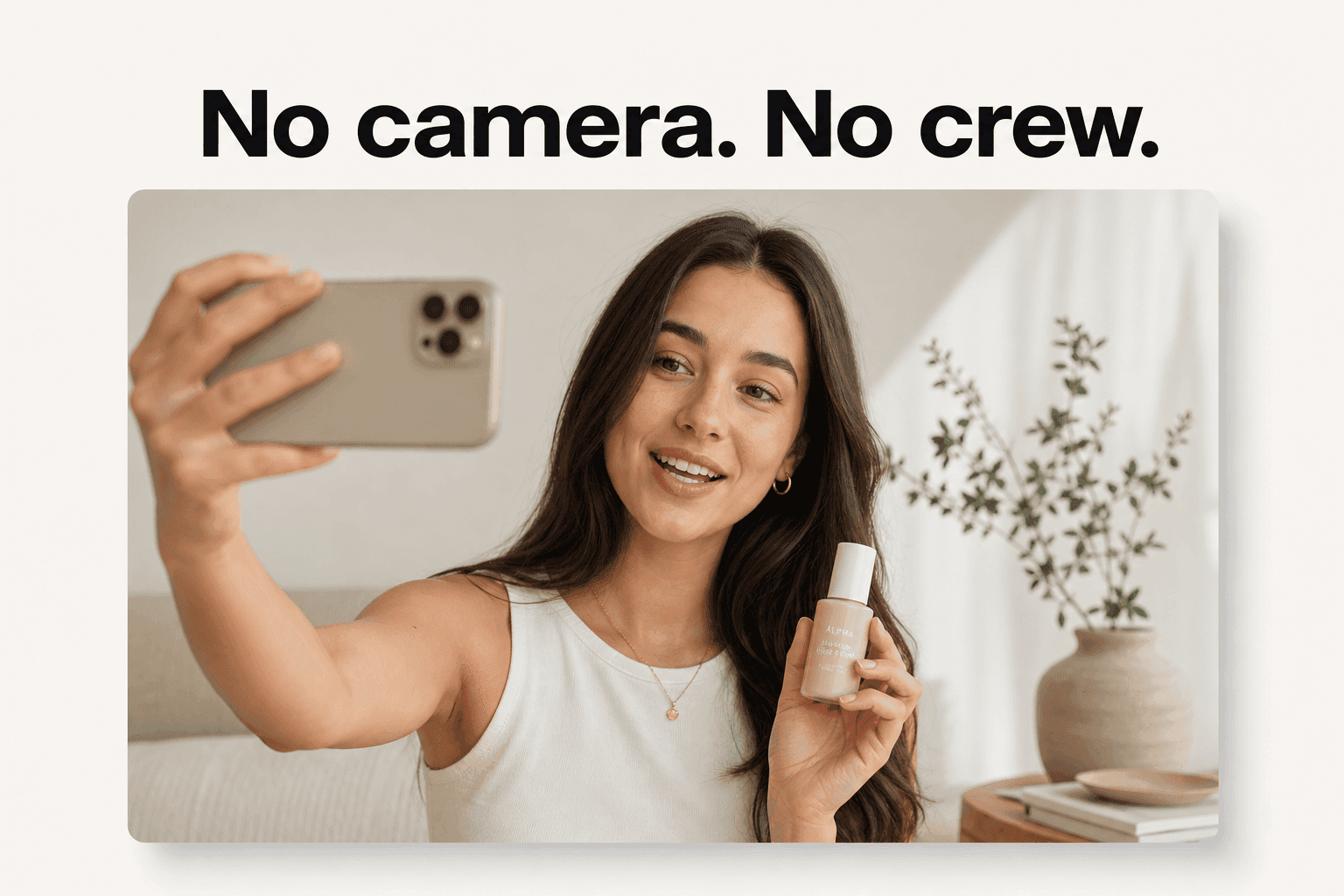
Sometimes the testimonial exists only in writing, in a review, an email or a support ticket, and the customer will not film. An AI actor can deliver those words on camera. What keeps it a testimonial is the rule in the next section: every line has to trace back to something a real customer said. The presenter is what you automate. The claim is not.
In Novoads, you paste the customer's words as the script, pick an AI actor and get a vertical video, with voices in 31 languages when the same story has to run in more than one market. Our guide to the AI testimonial video generator walks through that workflow, and where the FTC draws the line on AI testimonials covers disclosure. When a recognizable customer is the proof, film the real person. Plans are on the pricing page.
How to get testimonials from customers that work in an ad
Customers do not arrive specific. They arrive grateful, which sounds like praise and converts like nothing, so the beats have to come out of the questions you ask.
Ask four questions before you record
- "What were you doing before, step by step?" This produces Friction in the customer's own vocabulary.
- "What made you finally look for something else?" This produces the trigger, often a better opening line than anything you would write.
- "What changed that you could point at?" Not how they feel. What moved.
- "What would you tell someone who thinks this won't work for them?" This produces the objection and, often, the Residue line.
The fourth is the highest-yield question in the set and the one almost nobody asks. Record each answer as a standalone sentence, and the same interview can become a 15-second cut, a quote card and a longer version for a landing page, with enough openings to test several against each other.
Ask openly, and disclose what they were told
The FTC's FAQ on its Endorsement Guides answers this directly:
- You can ask customers about their experiences and feature their comments in your ads.
- If customers had a reason to expect a benefit for their comments, the ad should disclose it, and the FAQ counts even the chance to be featured in advertising as a possible benefit.
- Its sample wording is "Customers were told in advance they might be featured in an ad."
On top of that, get written permission for the name, the likeness and the words before anything runs, and keep the raw recording.
Edit for length, never for meaning
Trim, reorder and tighten, but never manufacture a claim the customer did not make. The working test: would this person, watching the finished cut, still recognize it as an accurate account of what happened to them? If a reordering creates a cause they never described, or a trim removes the qualifier that made a number honest, the edit has become authorship. When the clip has to lose ten seconds, cut from the setup, never from the Specific: the pause while a customer remembers the number reads as credibility.
Proof is a format, not a feeling
The brands that win with testimonial ads are not the ones with happier customers. They treat a testimonial as a structure: a real person, one checkable specific, placed where the viewer is still watching, in the format that fits the placement. Warmth without a specific is decoration.
If you have a folder of customer feedback and no ad, start with the most specific sentence anyone ever wrote you, and build the first ad around that one line.
Frequently Asked Questions
What is a testimonial in advertising?
A testimonial in advertising is a paid ad in which a real customer, rather than the brand, says what the product did for them: on camera, in a quoted line, in before-and-after images or as a star rating. Apple's 'Real People' campaign of June 2002 is the classic case: eight TV ads, each a person who had switched from a PC to a Mac telling the story in their own words. The persuasion comes from the speaker, because the viewer is asked to believe someone like them, not the brand.
What does a testimonial ad look like?
Most testimonial ads take one of four formats. A customer video shows a buyer telling the story on camera. A quote card sets one line, a name and often a photo on a static image. A before-and-after shows two states with the product between them. A star rating shows the average of many reviews beside the ad, the way Google's store ratings appear next to Search text ads. In every format, the strongest version carries one specific, checkable detail instead of praise.
How do you get testimonials from customers?
Ask, and ask for specifics. Four questions do most of the work: what were you doing before, step by step; what made you look for something else; what changed that you could point at; and what would you tell someone who doubts it would work for them. The FTC's guidance says you can ask customers about their experiences and feature their comments in your ads, but if they had a reason to expect a benefit, including the chance to be featured, the ad should disclose it. Get written permission for the name, likeness and words, and keep the raw recording.
Do testimonial ads need a 'results not typical' disclaimer?
That disclaimer does not solve the problem. The FTC's guidance says endorsements claiming specific results are usually read as what others can also expect, and that statements like 'Results not typical' or 'Individual results may vary' won't change that interpretation. The advertiser needs proof that the result shown is typical, or a clear and conspicuous disclosure of the generally expected result, as in the FTC's own illustration: 'Women who use QRS Weight-Loss for six months typically lose 15 pounds.' That is US guidance; in the UK, the Advertising Standards Authority applies its own codes.
Key Takeaways
- A testimonial ad is a paid ad in which a real customer, not the brand, vouches for the product. Most take one of four formats: customer video, quote card, before and after, or star rating.
- The documented classics cast real people instead of actors: Apple's PC-to-Mac switchers in June 2002 and Microsoft's Windows users in October 2009.
- Behind every format sit four beats: Recognition, Friction, the Specific and Residue. The Specific is the one a stranger can check, so in a short video it belongs in the first half.
- A result in a testimonial reads as typical. The FTC says 'results not typical' does not change that, and in July 2012 the UK's ASA ruled Proactiv ads misleading because their celebrity testimonials implied a continued use the evidence did not support.
- Google says store ratings on text ads drive, on average, a 2% improvement in click-through rate on the Search Network, from its internal data. It is a figure about store-level stars on Search text ads, not about testimonial videos or quote cards.
Sources
- •Apple Newsroom: Apple Launches Real People Ad Campaign (June 10, 2002)
- •Microsoft News Center Germany: Microsoft launcht Marketingkampagne für Windows 7 (October 22, 2009), archived copy
- •Advertising Standards Authority: ASA Adjudication on Guthy-Renker UK Ltd (July 18, 2012), archived copy
- •FTC: The FTC's Endorsement Guides, What People Are Asking (June 2023), archived copy
- •Google Ads Help: About store ratings
- •Medill Spiegel Research Center: How Online Reviews Influence Sales, archived copy
- •Wistia: How to Choose the Right Marketing Video Length for Any Goal
- •Wistia: 2026 State of Video Report
- •Nielsen: Building trust with consumers and engaging where sentiment is high