UGC Ad Examples That Convert: 5 Patterns and How to Recreate Each With AI
The best UGC ad examples share five repeatable patterns: problem/solution, unboxing, testimonial, before/after, and POV. Here is why each UGC video example converts, plus the exact way to recreate it with AI in minutes.

Mauricio Valdivia
·Updated ·11 min
The best UGC ads are patterns, not luck
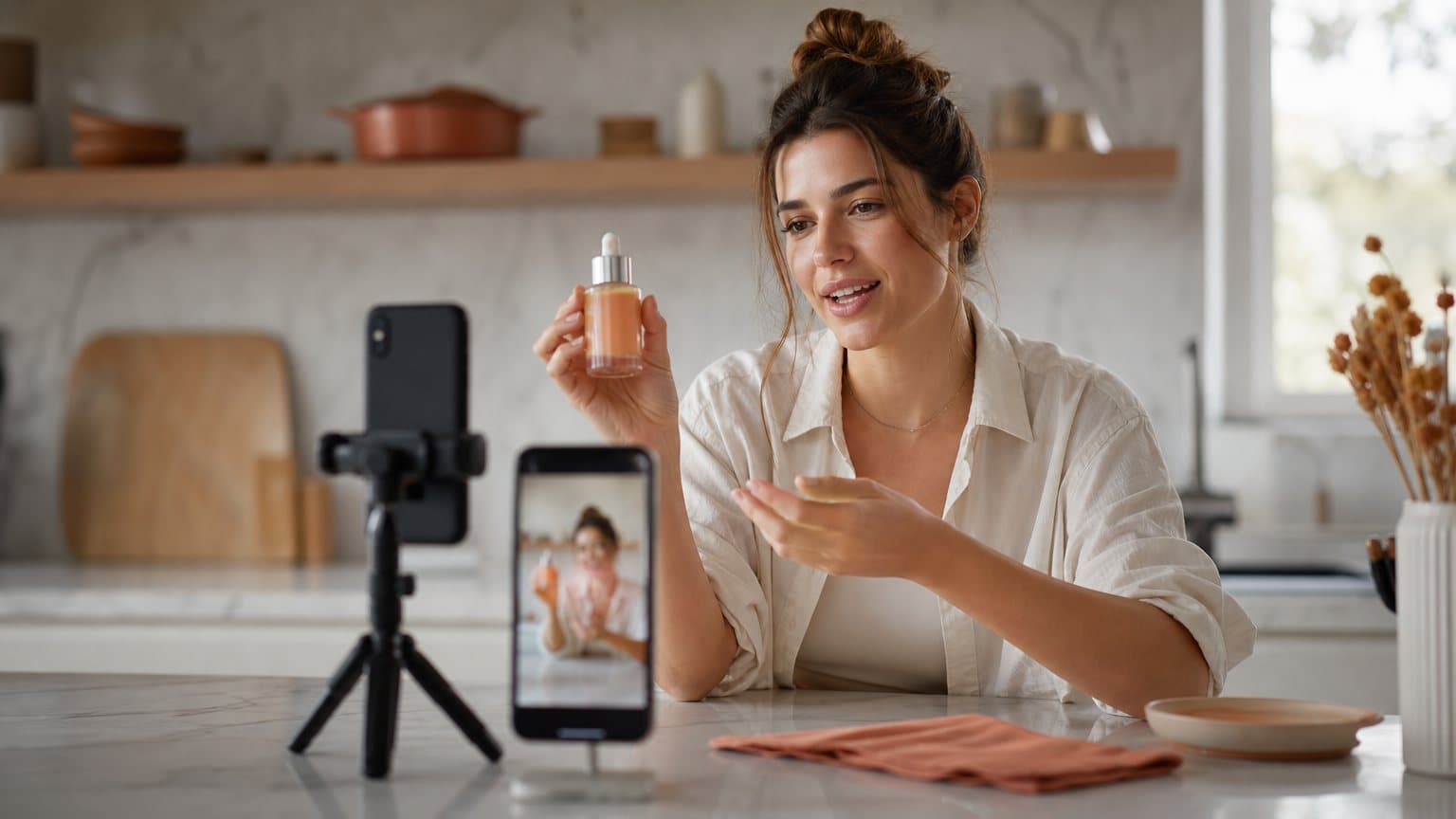
Scroll your feed and the ads that stop your thumb are rarely the polished ones. They are the phone-shot clips. A person talking in a messy kitchen, a hand tearing open a box, a face caught mid-reaction. Those are UGC ads, and the best UGC ad examples are not lucky accidents. They repeat. Watch enough winning UGC video examples and the same handful of shapes appear again and again: problem/solution, unboxing, testimonial, before/after, and POV. This guide breaks down each pattern, why it converts, and how to recreate it with AI in minutes instead of booking a creator and waiting a week.
The reason to think in patterns is simple. The winning ad is almost never the one you would have guessed, so the job is to run many and let the data pick the survivor. Patterns give you a menu to run against, and AI makes running the whole menu cheap. What is UGC covers the format itself; here we care about the specific ad shapes that move buyers, and the fastest way to produce each one.
What actually makes a UGC ad convert
The look versus the mechanism
The look is the easy part: vertical, handheld, unscripted-feeling, shot on a phone in a real room. But the look is not why UGC works. The mechanism is trust. A brand talking about itself is discounted on arrival, because everyone knows it is selling. A person who reads as a peer is not. The UGC ad borrows that peer credibility and aims it at your product, which is a very different job from making something that looks expensive.
Trust transfers where brand claims get discounted
The numbers back the mechanism. 65% of US consumers rely on user-generated content when making buying decisions, and 86% of shoppers engage with creator content before buying. It shows up on the product page too: shoppers are far readier to buy when they can see real people using the thing, with 91% saying they are more likely to purchase when reviews include photos and videos alongside text. That is the whole game. A UGC ad manufactures that peer signal on a schedule, instead of waiting for organic reviews to trickle in. Our primer on UGC and AI goes deeper on why the signal is reproducible rather than tied to one specific human.
Why volume, not polish, wins in paid
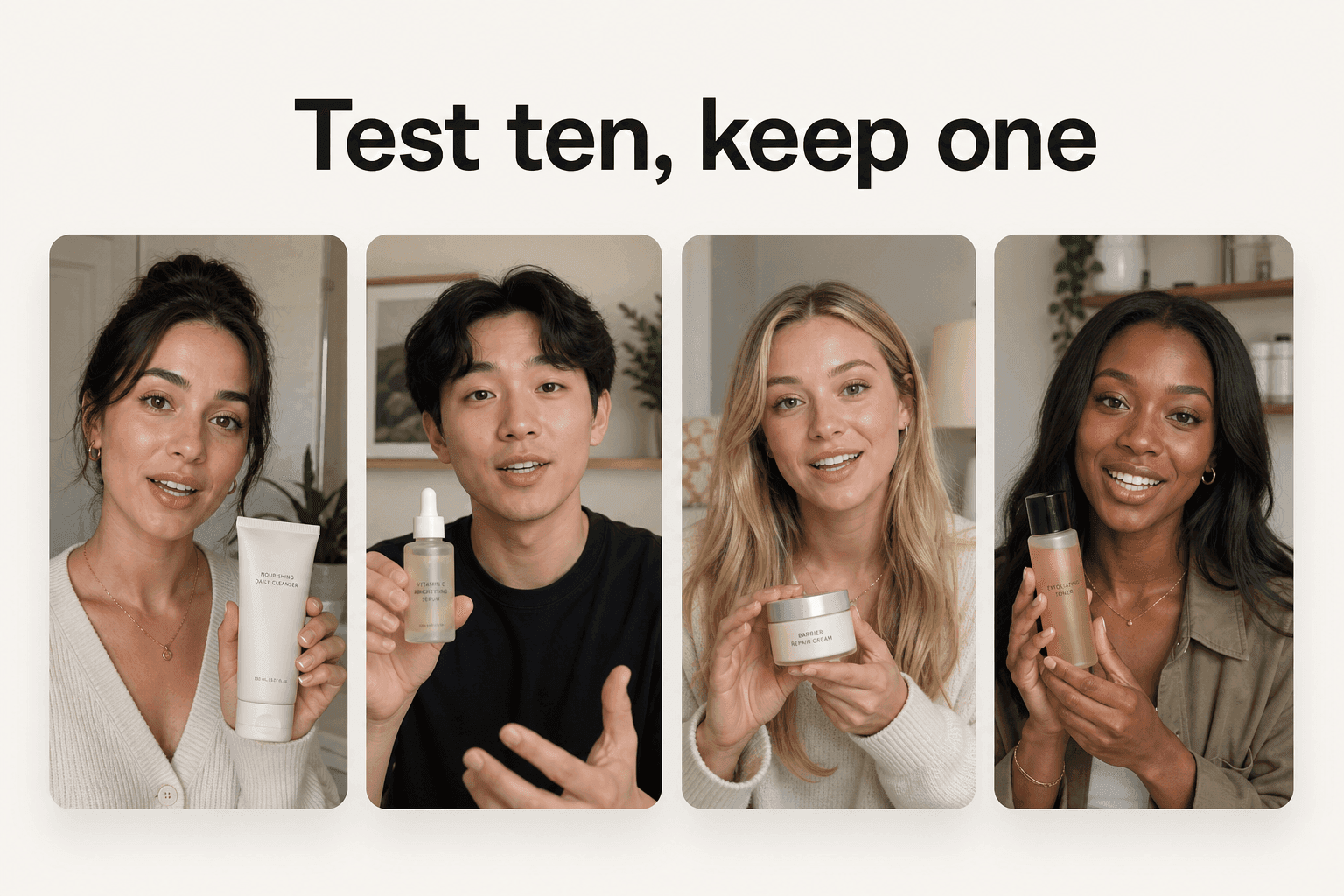
Here is the stance most brands get backwards: in paid social, volume beats polish. One beautiful hero video is a bet on a single guess. Thirty cheap variations is a search. Because the winner is genuinely unpredictable, the brand that can test ten hooks against three audiences finds a champion the brand shooting one perfect ad never will. That is why the patterns below matter. They are not art direction to agonize over, the way a polished AI commercial demands. They are a testing menu to run against.
The math is what makes patterns practical. Five patterns times two actors each is ten variations from a single product. At a few dollars per clip, that whole batch costs roughly what one hired UGC video would, and it goes live the same afternoon instead of two weeks later. So the goal is not to pick the one right pattern up front. It is to run the menu, let ROAS name the survivor, and pour budget into the shape that wins.
Five UGC ad patterns at a glance
Every high-performing UGC ad you have scrolled past is usually one of these five shapes. Here is the quick map: what each pattern is, the reason it converts, and the fastest way to recreate it with AI. The deep dives follow.
| Pattern | Why it converts | Recreate with AI |
|---|---|---|
| Problem/solution | Names the pain fast | Script + AI actor |
| Unboxing | Curiosity plus real proof | Product photo + actor |
| Testimonial | Borrowed peer credibility | Script + matched actor |
| Before/after | Shows the transformation | Two product shots + VO |
| POV | Feels like your own eyes | First-person script + actor |
If you only run two, run problem/solution and testimonial: they are the workhorses of paid UGC. The other three widen your angles once you have a baseline that converts. For a broader look at what is out there, see the best UGC creator tools and the wider field of AI video ad generators.
The five patterns, broken down
Problem/solution: name the pain in three seconds
The most reliable UGC ad opens on a frustration the viewer recognizes inside the first three seconds, then turns the product into the fix. "My skin was so dry it hurt to smile." Cut to the product. Cut to the relief. It converts because it mirrors how people actually shop: they feel a problem before they want a solution, so leading with the pain earns the attention the pitch needs. The craft is almost entirely in the hook; the first line decides whether the rest is ever watched. To recreate it with AI, you write or auto-generate a three-beat script (pain, turn, proof) and hand it to an actor whose face fits the audience.
Unboxing and first impressions: the reveal
The box, the pause, the reveal, the reaction. Unboxing works on curiosity and proof at once: the viewer wants to see what is inside, and the tactile reality of a real product in real hands reads as evidence the thing exists and actually arrives. That instinct is measurable, which is why 60% of US consumers always search for customer images and videos before committing to a purchase. To recreate it with AI, you pair a product photo with an actor who presents and reacts to it on camera, so the reveal lands without waiting on a physical shipment or a lightbox.
Testimonial: a real face vouching
A testimonial is one person, to camera, saying what changed for them. It is the purest form of the trust transfer, and it is why reviews move revenue so hard: the likelihood of someone buying a product with five reviews is 270% greater than buying one with none. A testimonial ad is that same effect set in motion, a single credible voice standing in for the wall of reviews a new product has not earned yet. To recreate it with AI, you write the testimonial in believable spoken language, strip out the ad-speak, and cast an actor whose age, gender, and accent match the customer you are actually targeting; our guide to the AI testimonial video generator walks this pattern end to end.
Before/after: the visible transformation
Before/after sells the delta, not the product. The messy desk and the tidy one. The dull skin and the glow. The cluttered pantry and the labeled jars. It converts because it shows the outcome the buyer wants rather than the features they have to decode, and the contrast does the persuading without a line of copy. The trap is honesty: an exaggerated before reads as a scam and burns the trust the format runs on, so the change has to be plausible. To recreate it with AI, you supply or generate the two states as product shots and lay an actor voiceover over the reveal, so the transformation is narrated by a believable person instead of a brand announcing its own results.
POV: the camera as the customer's eyes
POV puts the viewer inside the moment: "get ready with me, and this is the serum I swear by," filmed as if the phone is their own. It converts because it collapses the distance between an ad and a life, and short-form feeds reward that intimacy heavily. Gen Z spends 54% more time than the average consumer per day watching user-generated content on social platforms, and POV is the native grammar of that feed. To recreate it with AI, you write a first-person script and render it with an actor delivering it straight down the lens. For more format ideas to test against, see our roundup of UGC ads.
Stack two patterns for a stronger ad
The best-performing UGC ads rarely run one pattern clean; they braid two. A problem/solution hook that lands on a testimonial line borrows attention and then cashes it in with proof. The combinations that repeat:
- Problem/solution into testimonial. Open on the pain, then close on "and here is what actually changed for me."
- Unboxing into before/after. The reveal earns the watch; the transformation earns the click.
- POV into problem/solution. Film it as the viewer's own morning, then name the frustration they are already feeling.
Pick a base pattern for the hook and a second for the payoff, and you get a fresh variation to test without inventing a new idea from scratch.
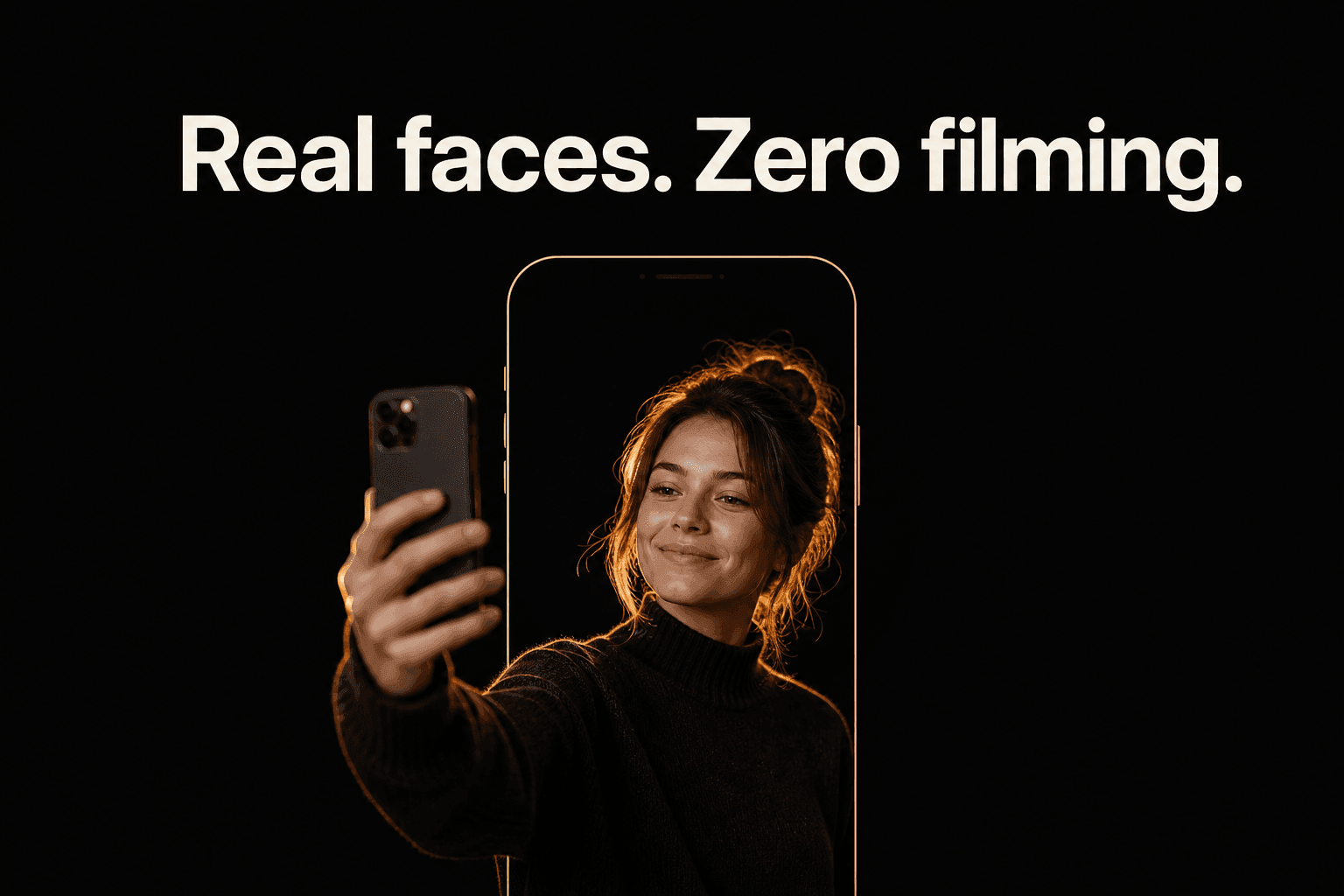
A worked example: a problem/solution ad, start to finish
Take one product, a $29 vitamin C serum, and run the most reliable pattern end to end.
Write the three-beat script
Problem/solution lives or dies on the first line, so write three beats and obsess over the first:
- Hook (0 to 3 seconds). "I spent two years and probably $400 on serums that did nothing."
- Turn (3 to 10 seconds). "Then I tried this one, and in a week the dark spots actually started to fade."
- Proof and CTA (10 to 20 seconds). "Here is my skin now, no filter. Link is in my bio."
Keep every line in spoken language, not ad copy: contractions, a small admission, a specific number. If you are staring at a blank page, you can auto-generate a first draft from the product and then rewrite the hook by hand, since the hook is the only line that truly has to sing. Our full walkthrough on how to create UGC ads covers scripting in more depth.
Cast the actor and pick the model
Pick an AI actor whose age, gender, and accent match your buyer, a mid-30s woman with a natural US accent for this serum. In Novoads the Talking actor engine delivers the script with voice, lip-sync, and captions, and when a pattern needs product b-roll or a generated scene you reach for video models available in the app like Seedance 2.0, Google Veo 3.1, or Kling v3 Pro. Cast two more actors while you are here, because variation is the entire point of the exercise, not a nice-to-have.
Render, caption, and ship it as a test
Render the clip as a 9:16 vertical file with burned-in captions, ready to download for TikTok, Reels, or Meta. The whole thing takes about four minutes and costs a few dollars, not a few hundred. Then do the part that actually decides the outcome: launch three to five variations as a test, not one precious ad. Read the numbers, kill the losers fast, and put budget behind the hook that beats your benchmark. The mechanics of reading that signal live in our guide to improving ROAS with UGC.
How do you know it worked? Read the funnel in order. First the hold rate through the first three seconds, because a hook that does not retain never gets a fair shot at converting. Then the click-through rate, which tells you the offer landed. Then ROAS against your control ad, which is the only number that pays rent. If the hold rate is strong but ROAS is weak, the hook is doing its job and the offer or landing page is not, so you keep the pattern and change what comes after the click.
Where these patterns break (and how to fix them)
The patterns are reliable, but they fail in predictable ways. The common breaks, and the fix for each:
- The hook buries the pain. If the first line is context or a logo, viewers are already gone. Fix: open on the sharpest version of the frustration and cut everything before it.
- The actor reads like an ad. Over-polished delivery kills the trust transfer on contact. Fix: write in plain spoken language and pick an actor who looks like the buyer, not a model.
- The claim outruns the proof. "Changed my life" with nothing shown reads as a lie. Fix: show the product doing the one specific thing, or drop the claim entirely.
- One ad, no test. Shipping a single variation wastes the format's only real advantage. Fix: run the pattern as a batch of angles and let ROAS choose the winner.
- Wrong accent, wrong market. A generic voice flattens a local audience instantly. Fix: match the language and the regional accent to where the ad will run.
Most of these are trust failures, not production failures, which is exactly why a believable person reading a tight script beats a glossy spot no one believes. The broader mechanics of testing at volume are in our guide to creating ads with AI.
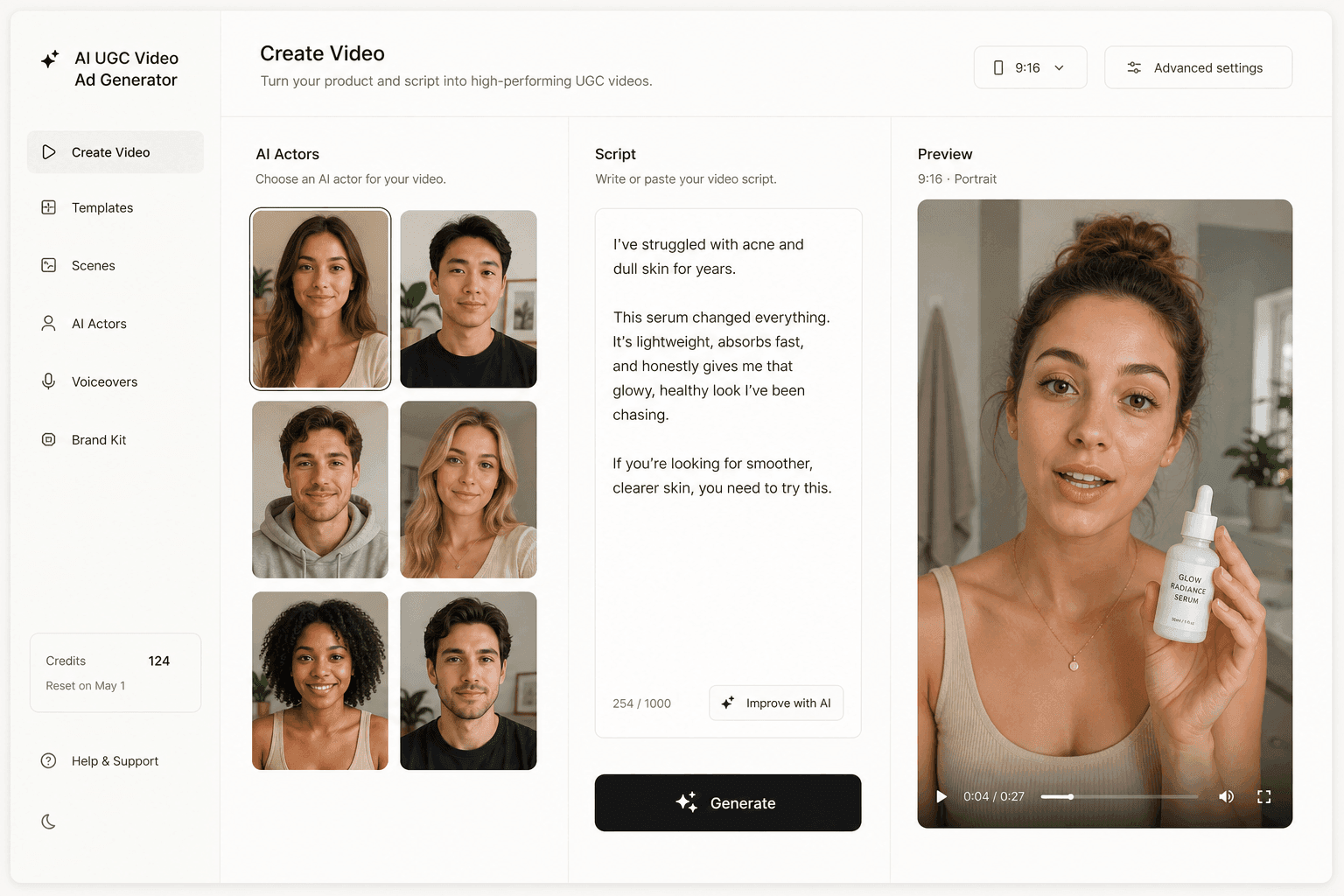
How Novoads recreates any of these patterns
From a script or a product photo
Every pattern above reduces to two inputs. For the talking patterns (problem/solution, testimonial, POV) you write or auto-generate a script and pick an AI actor, and Novoads renders a UGC-style vertical video with voice, lip-sync, and captions in about four minutes. For the product-led patterns (unboxing, before/after) you upload a product photo and turn it into an ad creative, or hand it to an actor who presents it on camera. Two inputs, five patterns.
The models behind each pattern
The clips render through models available in Novoads: Seedance 2.0, Kling v3 Pro, and Google Veo 3.1 for video, GPT Image 2 for product imagery, and the Talking actor engine for the face that delivers your script. You choose the pattern and the angle; the models handle the production so the cost of one more variation is a few dollars, not another shoot.
Native-local in 30+ languages
The trust transfer only holds if the person sounds like your audience. Novoads makes native-local ads in 30+ languages with real regional accents, so a POV ad for Mexico City and one for Madrid are not the same dubbed voice with a flag swapped. That gap is the difference between an ad that reads as local and one that reads as translated, and in UGC that difference is the whole conversion.
Creative you can run on repeat
A UGC ad was never a single lucky video. It is a pattern you can run on repeat: a peer voice pointed at your product, in a shape people already trust. The five here are your menu, and the winners are the ones you find by testing, not the ones you guess in a kickoff meeting.
What changed is the price of running the whole menu. When each variation costs a few dollars and takes minutes, you can finally test UGC the way the format always demanded. You can make your first one with Novoads on the $49/month plan. Cancel anytime.
Frequently Asked Questions
What are the most common UGC ad examples?
Almost every high-performing UGC ad is one of five patterns: problem/solution (name a pain, then show the fix), unboxing (the reveal and reaction), testimonial (one person to camera saying what changed), before/after (the visible transformation), and POV (filmed as if the phone is the viewer's own). Most winning ads combine two, for example a problem/solution hook that ends on a testimonial line.
What makes a UGC ad convert?
Trust, not production value. A brand talking about itself is discounted because everyone knows it is selling, while a person who reads as a peer is not. That is why 65% of US consumers rely on user-generated content when making buying decisions and 86% engage with creator content before buying. A UGC ad borrows that peer credibility and points it at your product.
What is a UGC video example I can copy?
A classic problem/solution clip: seconds 0 to 3 open on a frustration (my skin was so dry it hurt to smile), seconds 3 to 10 turn to the product (then I tried this), and seconds 10 to 20 show proof and a call to action (here is my skin now, link in bio). Keep it in plain spoken language, not ad copy, and let the hook carry the first line.
How do you recreate UGC ads with AI?
Every pattern reduces to two inputs. For talking patterns (problem/solution, testimonial, POV) you write or auto-generate a script and pick an AI actor matched to your audience, and the tool renders a vertical video with voice, lip-sync, and captions. For product-led patterns (unboxing, before/after) you upload a product photo and turn it into an ad creative, or have an actor present it on camera. In Novoads this takes about four minutes per clip.
Which UGC ad pattern works best for paid social?
Problem/solution and testimonial are the workhorses because they map to how people actually shop: they feel a problem before they want a solution, and they trust a peer over a brand. Start there, get a baseline, then widen your angles with unboxing, before/after, and POV. The real winner is unpredictable, so run several and let ROAS decide.
Are AI UGC ads as effective as real creator ads?
For volume testing, increasingly yes. The trust signal comes from a real-seeming person reading a believable script, and AI reproduces that from a script in minutes for a few dollars. Human creators still matter for a specific face or a flagship piece, but for running the many variations paid social rewards, AI removes the cost and time that used to cap how much you could test.
Key Takeaways
- The best UGC ad examples fall into five repeatable patterns: problem/solution, unboxing, testimonial, before/after, and POV. Think in patterns, not lucky clips.
- UGC converts on trust, not polish. 65% of consumers rely on UGC when buying, and 86% engage with creator content before they purchase.
- In paid social, volume beats one perfect ad. The patterns are a testing menu you run against, not art direction you agonize over.
- Every pattern reduces to two AI inputs: a script plus an AI actor, or a product photo turned into an ad creative.
- AI makes the whole menu cheap. A UGC-style clip renders in about four minutes for a few dollars, so you can finally test the way the format demands.

![What Is UGC? A Complete Guide to User-Generated Content [2026]](/_next/image?url=%2Fblog%2Fque-es-ugc.jpg&w=3840&q=75)