
Social Media Video Production: The 7-Step Workflow and Where AI Collapses Four Steps
Social media video production runs on seven steps and six handoffs. Here is what each step costs in days, which four AI removes outright, and what a two-person team can ship once they are gone.

Mauricio Valdivia
·11 min
Nobody's bottleneck is the camera
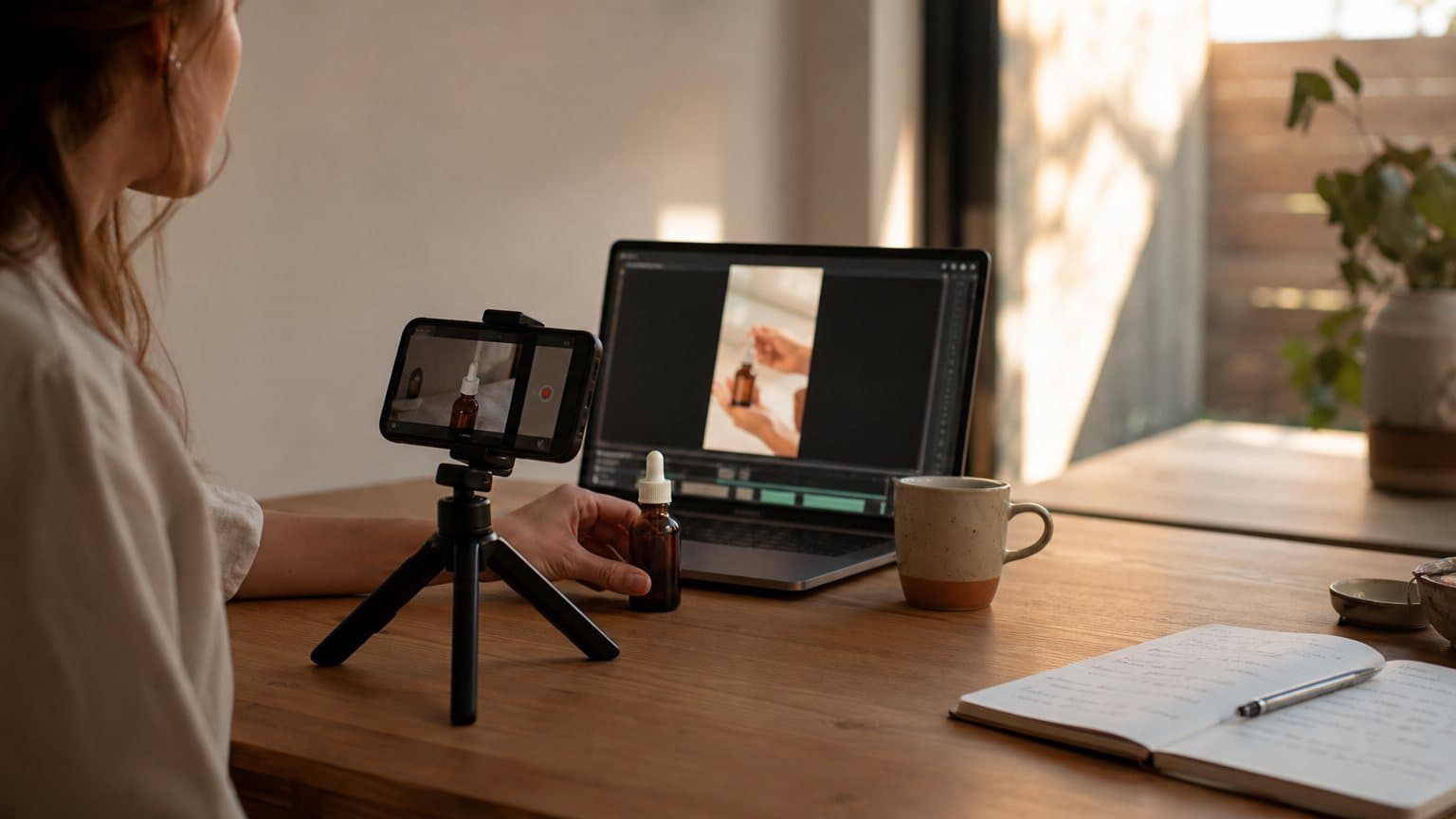
A two-person marketing team at a skincare brand books a shoot for a Thursday. The brief went out nine days earlier. The creator was confirmed on day four, the location on day six, and the script was frozen on day seven because the shoot could not start with an open question in it. Thursday goes well. The edit comes back the following Wednesday. Revisions land on Friday. The finished fifteen-second clip goes live seventeen days after someone first said "we should test this angle." Meanwhile 76% of companies are now making at least one video a month, according to Wistia's 2026 State of Video survey, which means that seventeen-day loop is not an occasional project anymore. It is the machine.
Social media video production is the seven-step process that turns an idea into a platform-ready file: concept, script, casting, setup, shoot, edit, and versioning. Most guides describe those steps as work. They are mostly waiting. The work inside a fifteen-second ad is maybe a day. The other twelve days are the gaps between the people who touch it, and that is the part AI actually changes.
This is a piece about the pipeline itself: what each step really costs, which steps survive contact with generated video, which four disappear, and what the loop looks like once they do.
The seven steps a social video actually passes through
Every social video, from a phone-shot testimonial to a produced spot, moves through the same skeleton. Naming the steps precisely is what makes the waste visible, because the waste never lives inside a step. It lives at the seams.
| Step | What it waits on | After AI |
|---|---|---|
| Concept | Nobody, it is the work | Unchanged, now decisive |
| Script | The angle settling | Unchanged, drafted faster |
| Casting | A person replying | Gone, pick an actor |
| Setup | A room and a light | Gone, described not built |
| The shoot | Everyone in one hour | Gone, a render you trigger |
| The edit | An editor's queue | Becomes a rerun |
| Versioning | The cut locking | Automatic per placement |
Pre-production: concept, script, casting, booking
Concept is the angle: what claim this video is making and who it is making it to. Script is that angle written as spoken words with a hook in front. Casting is finding a face, and booking is getting that face, a location, and a camera into the same hour. On paper this is four tasks. On a calendar it is one long dependency chain, because casting cannot start until the angle is settled and booking cannot start until casting resolves.
Production: setup and the shoot day
Setup is lighting, framing, sound, wardrobe, and the product itself looking the way the brand needs it to look. The shoot is the only step most people picture when they hear "video production," and it is usually the shortest one. A fifteen-second ad rarely needs more than an hour of usable footage. The reason it consumes a whole day is that everything around it has to be assembled and then taken apart.
Post: the edit, the revisions, the versioning
The edit is assembly, pacing, and the cut points that decide whether the hook survives. Revisions are the round trip where someone who was not on set says the second line is wrong. Versioning is the tax nobody budgets: the same cut re-exported at 9:16, 1:1, and 16:9, with captions burned in, sometimes with a different opening frame per placement. It is invisible in a brief and reliably eats a day.

The Handoff Tax: what a social video really costs
Here is the frame I use for all of this, and the one this post is built on. The Handoff Tax is the total time a video spends in transit between the people who touch it, as opposed to the time anyone spends working on it. Seven steps means six handoffs, and each handoff is a queue.
The waiting is the line item
Count the seventeen-day example again, but count only the labor. The brief is an hour. The script is an hour, maybe two. The shoot is an hour of usable footage. The edit is three or four hours. Versioning is one. That is roughly a single working day of actual production inside a seventeen-day calendar. The other sixteen days are a creator checking her messages, a studio's next opening, an editor's queue, and a stakeholder who reviews on Fridays. You are not paying for video. You are paying for a calendar.
Why the tax scales with variants, not with minutes
This is the part that breaks paid social specifically. A thirty-second video costs barely more to shoot than a fifteen-second one, because the handoffs are identical. But a second, genuinely different angle is a second trip through the entire chain: new script, possibly new casting, another booking, another edit, another review round. The tax does not scale with duration. It scales with the number of distinct ideas you want to test, which is exactly the axis social advertising demands you scale on.
Meta's own guidance draws that line explicitly. It separates iterating on a single concept from what it calls true creative diversification, the creation of distinct assets tailored to different personas and use cases, and says that genuine creative diversification is what "unlocks broader reach." A pipeline whose cost scales per idea is structurally the wrong pipeline for a channel that pays you per idea.
A worked number: six angles, thirteen working days
Say you want six angles for one product: a problem-first hook, a before and after, an unboxing, an objection handler, a comparison, and a founder note. Filmed, in the most optimistic honest version:
- Briefs and scripts: 2 days
- Casting and booking: 4 days
- Shoot day, all six captured back to back: 1 day
- Edits plus one revision round: 5 days
- Versioning and export: 1 day
Thirteen working days, and the six angles are frozen on day six because the shoot cannot absorb a seventh idea that arrives on day nine.
Now the same six through a generated pipeline. Scripts in an hour. Each clip returns in about four minutes, so six is roughly twenty-four minutes of generation. Review the same afternoon, rerun the two that missed, export by evening. At about a dollar to $8 per clip of up to eight seconds, from a five-second Seedance 2.0 Mini clip to an eight-second Seedance 2.5 clip, or about $26 for a full 30-second Seedance 2.5 take, six angles is somewhere between $6 and $48. For context, almost 40% of companies spent under $5,000 on video production for an entire year. The interesting number is not the cost. It is that angle seven is now allowed to exist.
Where AI collapses steps instead of speeding them up
The common framing is that AI makes each step faster. That is not what happens and it undersells the change. Four steps do not get faster. They stop existing as scheduled events, which is a different kind of saving, because you cannot compress a queue by working harder inside it.
The four steps that disappear
Four of the seven stop being events on a calendar:
- Casting. You pick an AI actor from a library instead of finding, negotiating with, and confirming a person.
- Booking. Nothing to coordinate, because there is no shared hour that has to exist.
- Setup. Lighting, framing, and location become description rather than logistics.
- The shoot day. A render you trigger whenever the script is ready, not a date everyone protects.
Together those four are the bulk of the Handoff Tax, and they vanish not because a machine does them quickly but because nothing has to be scheduled at all. This is the mechanic behind making video ads without a camera, and it is worth being precise about it: the camera was never the expensive part, the appointment was.
The three that survive, and get harder
Concept, script, and the review judgment survive intact. They also get more consequential, because they are now the only places a video can be good or bad. When production is scarce you can hide a mediocre angle behind excellent lighting. When production costs a few dollars a clip, the angle is all there is, and mediocre angles simply get generated faster. Teams that move to a generated pipeline and see flat results have almost always ported their old creative thinking into it unchanged.
What changes shape: the edit becomes a rerun
Editing does not disappear, it changes category. In a filmed pipeline the edit is where you make the best of what you got. In a generated one, a bad take is not something you cut around, it is something you regenerate with a different line, a different actor, or a different opening beat. The skill shifts from salvage to specification. The practical version of that shift is covered in the step-by-step guide to making UGC ads with AI.
Which pipeline a given video belongs in is usually obvious once you ask what it has to prove:
Still worth filming when
- A real customer's face is the claim
- The product needs an unrepeatable physical moment
- The piece has to feel authored
Better generated when
- You need six versions of one idea
- The hook is the variable under test
- The same angle has to ship in another language
Batch gravity and the revision cliff
Two forces explain why traditional production produces one hero video a quarter, and both of them are structural rather than financial. They are worth naming because they persist in teams that adopt AI tools but keep the old rhythm.
Batch gravity
Because you shoot once, everything has to be decided before the shoot. Hook, wardrobe, claims, product angle, call to action. That pressure to front-load decisions is batch gravity, and it quietly converts a creative process into a planning process. The most expensive consequence is not the cost of the shoot, it is that nothing gets tested before everything gets committed. You find out on day seventeen that the hook was wrong, and the only remedy is another thirteen-day cycle.
The revision cliff
Feedback in a filmed pipeline arrives after the point where it can be acted on cheaply. Change a word in the script after the shoot and you are not revising, you are reshooting. That asymmetry is the revision cliff: small notes and structural notes cost the same, so structural notes stop getting made. Reviewers learn to only mention things that can be fixed in the edit, and the honest feedback goes unsaid.
Streaming beats batching
A generated pipeline removes both. Decisions do not need to be locked because a rerun is minutes, so you can ship three angles, read the data, and ship the fourth informed by it. Production stops being a batch you plan and becomes a stream you steer. That is the same shift that makes scaling ad campaigns tractable for a small team: the constraint moves from what you can make to what you can learn.
The new production loop, end to end
Here is the loop as it actually runs, with the roles as they actually shrink. More than a third of companies already use AI somewhere in their video workflow, so this is a description of current practice, not a forecast.
Brief to script
Start from the angle, not the format. One claim, one audience, one objection it answers. Then write the script as spoken language with the hook carrying the first two seconds. TikTok's own creative documentation puts the stakes plainly: 90% of ad recall impact is captured within the first six seconds. That makes the hook, not the finished cut, the real unit of production. Six scripts sharing one body and differing only in their opening line is a legitimate and very cheap test design.
Script to shot
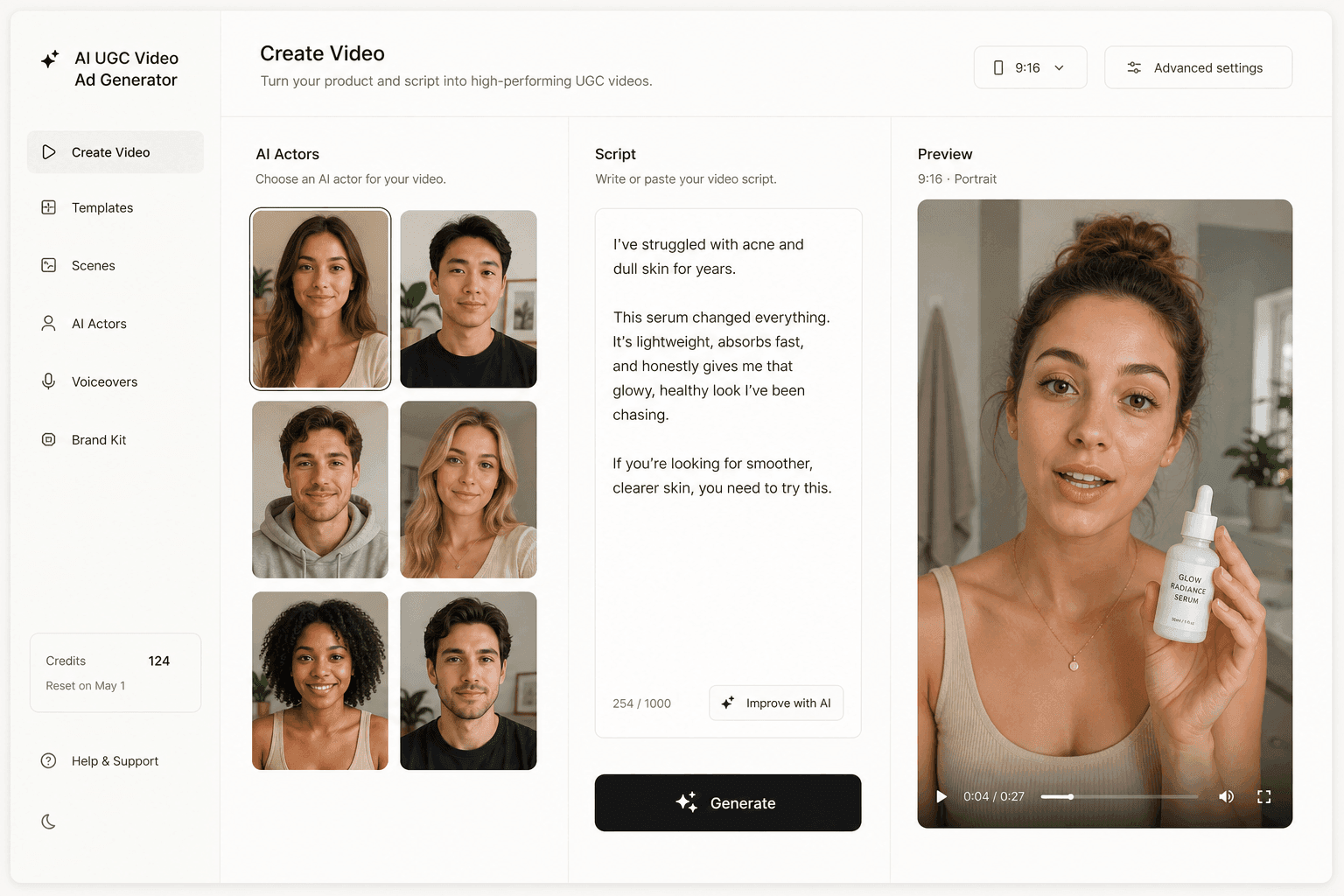
The input is an uploaded product image plus the script. You pick an AI actor, choose a model to match the motion the product needs, and generate. This is where the four deleted steps used to live, and it is why the same brief can produce six variants without six chains of coordination. For product-led shots specifically, the mechanics of getting the item to look right on camera are covered in making product videos with AI.
Shot to cut, and back around
Review in a batch, not one at a time. Kill the misses, note why they missed, regenerate with one variable changed. Add voice, burn captions, export each aspect ratio. Then the loop closes: what ran, what held attention, what earns another version next week. The whole cycle fits inside an afternoon, which is the actual headline. Not that a video is cheaper, but that the loop is short enough to run more than once before a decision has to be made.

Roles, turnaround, and what a small team can ship
Collapsing four steps does not just save money. It changes who is required in the room, and that is the part most teams underestimate when they plan the transition.
The roles that survive
The producer role, meaning the person who coordinated humans and calendars, largely disappears along with the handoffs it existed to manage. The strategist and the writer survive and become the constraint. The editor survives in a narrower, sharper form: less assembly, more judgment about which generated take is actually usable. A team of two can now cover what previously needed a chain of five, not because the two work faster but because four of the seven steps no longer need an owner.
Turnaround, stated honestly
- First usable clip: same day, often the same hour, since each render comes back in about four minutes.
- Six tested angles: one afternoon, including the reruns for the ones that missed.
- A full placement set: same day, captions burned in and every aspect ratio exported.
What does not compress is the review cycle, because it is still humans deciding. If your approvals take three days, your turnaround is three days regardless of how fast anything renders, and that is worth being blunt about before anyone promises a faster calendar to a stakeholder.
The skill that gets more valuable
Taste, specifically the ability to look at six variants and say why the third one works. When making a video was expensive, the scarce skill was execution. Now the scarce skill is discrimination, and it is not evenly distributed. This is the least automatable part of the pipeline and the one most worth staffing for, which is a strange sentence to write about a process where machines now do most of the labor.
How Novoads solves the Handoff Tax
Novoads is built as the collapsed pipeline rather than a faster version of the old one. You upload a product image and write or auto-generate a script, pick an AI actor, and get an ad-ready vertical video, with a headline time to result of about four minutes. There is no casting to arrange, no booking, no shoot day, which is precisely the four steps that carried the tax. Voices cover 31 languages, so a winning angle travels to another market as a rerun rather than as a new production. Clips run from about a dollar for a five-second Seedance 2.0 Mini clip to about $8 for an eight-second Seedance 2.5 clip, and about $26 for a full 30-second Seedance 2.5 take, so testing six angles is a line item rather than a decision. If you want the full cost comparison against a filmed pipeline, the video ad production cost breakdown runs the math, and the UGC ads guide covers what the format itself demands.
You can run the whole loop on Novoads for $49 per month, cancellable anytime.
Production was never the point
The seven-step workflow was never a description of how video gets made. It was a description of how many people had to agree before anything could get made. Removing four of those steps does not give you a cheaper video, it gives you permission to be wrong on a Tuesday and right by Thursday, which is the only version of creative work that ever actually compounds. Pick one angle you have been meaning to test and run it twice this week instead of once next month.
Frequently Asked Questions
What are the steps in social media video production?
Seven: concept and script, casting, location and setup, the shoot, the edit, revisions, and versioning for each placement. Traditionally each step ends in a handoff to a different person, and the waiting between them is what makes a fifteen-second clip take two weeks. In a generated workflow the middle four collapse, leaving concept, script, and the judgment about which cut to run again.
How long does it take to produce a social media video?
A filmed fifteen-second product ad realistically takes ten to fifteen working days from brief to exported file, because casting, booking, the shoot day, and the revision round each wait on a calendar rather than on the work itself. A generated clip returns in about four minutes, so the loop is bounded by how fast you review, not by how fast anyone shoots.
Do you still need a videographer for social media video?
For brand films, launches, and anything that has to feel authored, yes. For the volume layer of paid social, where you need six versions of the same idea to find out which hook lands, the constraint was never craft, it was throughput. Most teams should treat the two as separate pipelines rather than asking one crew to serve both.
How many social media videos should a brand produce per month?
Enough to keep new creative entering the auction rather than to hit a number. Meta's own guidance distinguishes iterating on one concept from genuine creative diversification, and rewards the latter with reach. Practically, that means a handful of genuinely different angles per month rather than one polished video, which is why production cost per variant matters more than production cost per video.
Can AI handle the whole social video production process?
Not the whole thing, and the parts it does not handle are the important ones. AI covers the mechanical middle: turning a script and a product image into a shot, generating the voice, cutting the captions, exporting each aspect ratio. The angle, the script, the first two seconds, and the decision about what to run again stay human, and they get more valuable as everything around them gets cheaper.
What does social media video production cost?
It depends almost entirely on which pipeline you are in. Wistia's 2026 survey found almost 40% of companies spent under $5,000 on video production for the whole year, which buys a small number of filmed pieces. A generated clip runs from about a dollar for a five-second Seedance 2.0 Mini clip to about $8 for an eight-second Seedance 2.5 clip, and about $26 for a full 30-second Seedance 2.5 take, so the same budget stops rationing videos and starts rationing attention.
Key Takeaways
- A social video passes through seven steps and six handoffs. The handoffs, not the filming, are where the calendar goes.
- AI does not accelerate all seven steps evenly. It removes four of them outright: casting, booking, the shoot day, and the reshoot.
- Batch gravity is the hidden cost of a shoot: because you film once, every decision has to be locked before any of it can be tested.
- The steps that survive are the ones that were always the real work: the angle, the script, the first two seconds, and the judgment about what to run again.
- Turnaround stops being measured in weeks and starts being measured in loops, which is what makes testing six angles a normal Tuesday instead of a quarterly event.