How to Make Ads That Convert: 6 Steps, a Checklist for Each
A six-step method for making ads that convert, from the offer to the test, with a checklist for each step and one candle ad carried through all six.

Mauricio Valdivia
·Updated ·12 min
Same Candle, Same Face, Three Different First Seconds
We gave one candle three different first seconds. The creator, the lamp-lit living room and the amber jar stayed the same in every take; only the opening changed. In one, she holds the jar up to the lens and says your workday never really ends. In another, she strikes a match. In the third, she lines the jar up with her empties and says she has bought it four times.
Choosing between those openings is the last step of making an ad, not the first. To make ads that convert, you decide six things in order: the offer, the buyer, the hook, the script, the visual and the test. Each step below ends with a short checklist, and the candle, which we rendered in Novoads on 2026-10-20, runs through all six.
Step 1: Write the Offer in One Sentence
An offer is what the viewer gets, what it costs them and why they should act now. Write it before anything else, in one sentence a customer could repeat to a friend. If it takes a paragraph to explain, the ad will take a paragraph too, and nobody watches a paragraph.
This step comes first for a blunt reason: no opening can rescue a weak offer. A better hook only shows a bad deal to more people. The planning around it (the angle, the format, the proof you can show) is laid out in the four decisions of an ad creative strategy.
What the one sentence has to carry
- The product, in plain words. "A scented candle", not "a sensory wellness ritual".
- The outcome the buyer wants. What changes for them, not what the product contains.
- A reason to believe it. A review, a number or a demonstration you can film.
- The terms, if you have any. A price, a bundle, a guarantee or a deadline. Leave out any you cannot honor.
The offer checklist
- The offer fits in one sentence a customer would repeat.
- It names an outcome the buyer wants, not a feature.
- It carries one reason to believe that you can show on screen.
- Every term in it (price, discount, deadline) is real, and you can honor it.
- It is the only offer in the ad.
The candle's offer
The candle we rendered has no label and no price tag, which makes it a clean case: the offer has to live entirely in a promise. Two of the three hooks spell that promise out (the workday at home never really ends, and the candle is how you clock out at six), and the third backs it with a repeat purchase. The woman in the takes is AI-generated from one still image, so nothing in the test borrows a real brand's or a real customer's reputation.
Step 2: Name One Buyer and Borrow Their Words
Write the ad for one person you can describe in a sentence: who they are, the problem they would type into a search bar, and where they will see the ad. "Women aged 25 to 45" is a targeting setting, not a buyer. Targeting is its own job, covered in how to target audiences in Meta ads; this step decides who the ad talks to.
Settle the placement here too, because it decides the format. An ad for a vertical feed (Reels, TikTok, Shorts) is a vertical video, built for a phone held in one hand.
Where the buyer's words come from
- Your reviews. The five-star ones show the outcome people bought; the three-star ones show the doubt you have to answer.
- Support tickets and direct messages. People describe the problem before they know your name for it.
- Comments under rivals' ads. Objections in public, in the buyer's own phrasing.
- Search terms. The exact words people type while the problem is fresh.
Copy their phrasing, not just the sentiment. "My workday never ends" beats "work-life balance", because a person would actually say it.
The buyer checklist
- One buyer, described in a sentence, not an age band.
- Their problem, written in words a customer used.
- The placement chosen, and the format that follows from it.
- At least one line of the script that this buyer would recognize as their own.
The candle's buyer
Our test named its buyer in the first five words. Hook A opens on "If you work from home, your workday never really ends." That is a callout: it tells the right viewer the ad is about them and lets everyone else scroll on. The jar is in her hand from the first frame, which step 5 comes back to.
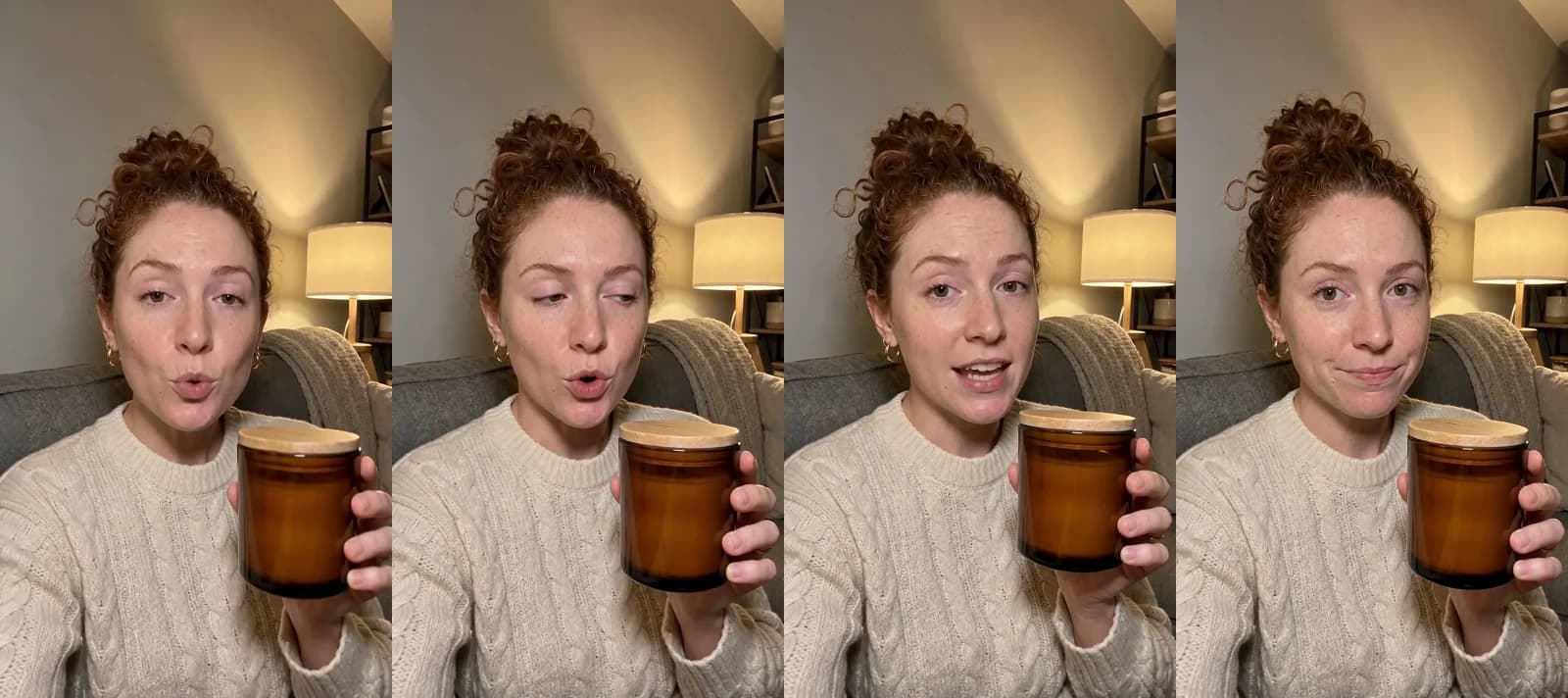 Seedance 2.0 Mini · hook A, the callout: she holds the candle to the lens and says your workday never really ends · 6 credits · rendered 2026-10-20
Step 3: Write Three Hooks Before You Pick One
The hook is the first few seconds, and the platforms are blunt about how few. TikTok's creative guidance says to "prioritize your hook in the first 6 seconds" and to "introduce your content proposition in the first 3 seconds for better recall and awareness." Write at least three openings for the same ad, different in kind, and let the test pick.
What Google's ABCDs add
Google's version of this advice is the ABCDs, its four principles for effective YouTube video ads: Attention, Branding, Connection and Direction. Under Attention, Google tells advertisers to "get to the heart of the story faster." Its Ads Help page says applying the ABCDs can "deliver as much as a 30% lift in short-term sales likelihood," and its footnote credits a Google/Kantar study from April 2021, The Short & the Long of ABCDs Effectiveness.
That figure needs its limits stated. Google commissioned the study about its own framework. Kantar, which ran it, says it used its Link AI tool to analyse over 11,000 ads, looking at 180 creative features, and found "a strong correlation between the ABCDs and predicted short term sales lift." So the 30% is a modelled prediction, not measured sales or a controlled test.
Our reading: use the ABCDs as a checklist for the video steps of this method (the hook, the script and the visual), since Google wrote them for YouTube video ads, and treat the 30% as a ceiling from a model, not a number to promise anyone.
Three kinds of hook worth writing every time
- The callout. Name the buyer or their problem in the first line, so the right person stops.
- Action first. Put the product doing its job in the first frame, before a word is said.
- Proof first. Open on a result or a repeat purchase, said by someone who can stand behind it.
Write more if you can: 12 hook formulas for the first three seconds covers the wider set.
The hook checklist
- At least three openings, each a different kind, not three rewordings of one idea.
- The product or the problem is on screen within the first 3 seconds.
- Each opening still makes sense with the sound off.
- Every opening leads into the same body, so the test compares hooks and nothing else.
The candle's three hooks
- Hook A, the callout: she holds the jar up to the lens and says "If you work from home, your workday never really ends."
- Hook B, action first: she strikes a match, lights the candle, then says "This is how I clock out at six."
- Hook C, proof first: she sets the jar beside her empties and says "I've bought this exact candle four times."
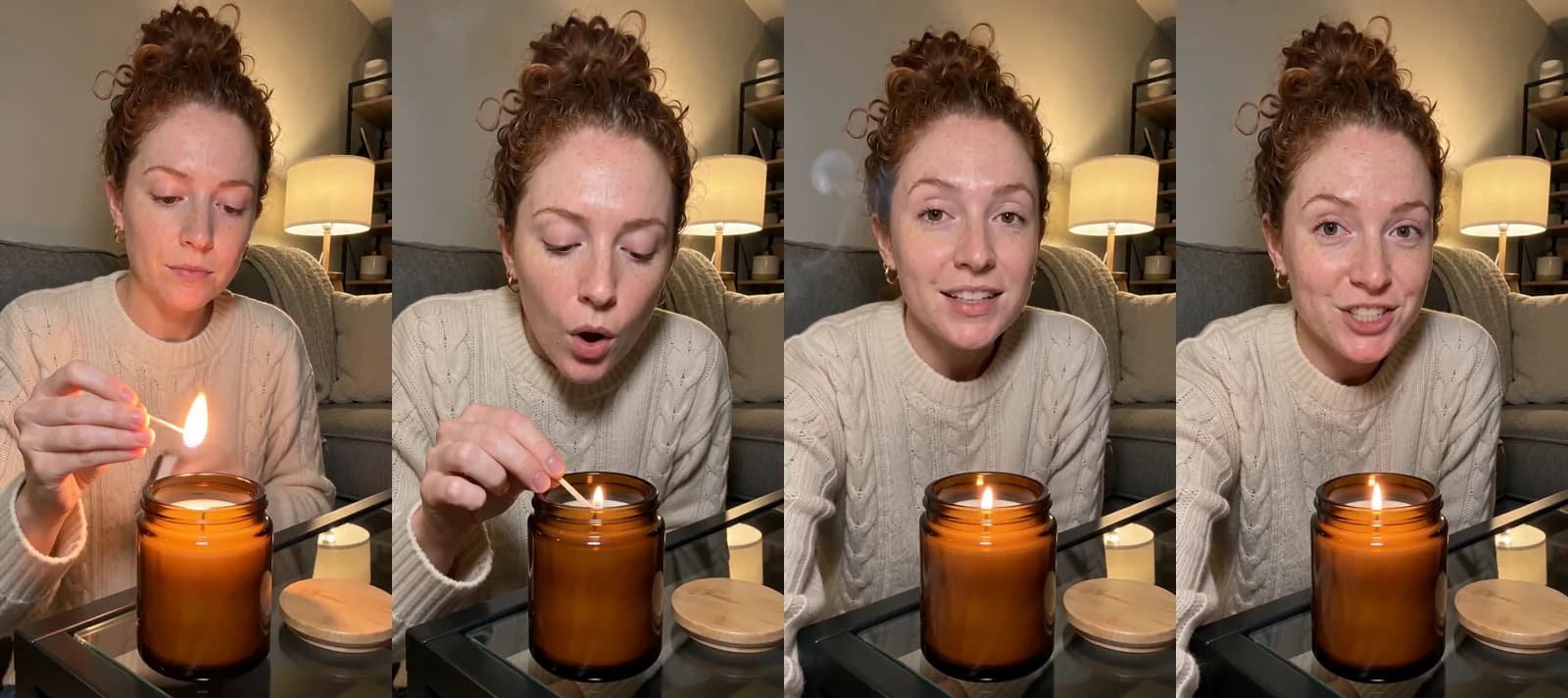 Seedance 2.0 Mini · hook B, action first: she strikes a match and lights the candle, then says this is how she clocks out at six · 6 credits · rendered 2026-10-20
Hook B says nothing until the flame catches. The match does the work, which is Google's "jump in" guideline taken literally.
Step 4: Script the Middle Around One Proof
Once the hook has the viewer, the rest of the ad has one job: make the promise believable, then ask for one thing. TikTok's guidance gives the shape: "have a hook, highlight your unique selling points, and end with a clear call-to-action." Google's Connection principle adds the discipline: "Avoid doing too much in your ad. Keep messaging and language focused and simple."
What goes in the body
- The problem, in the buyer's words. One line, taken from step 2.
- The product moment. The product in hand or in use, not a logo on a table.
- One proof. A review line, a number or a demonstration. One is believable; four sounds like a pitch.
- The close. One action, said out loud and shown on screen. Google's Direction principle asks you to "be intentional and add a CTA to drive a specific objective."
Proof has to be true
A proof line is only proof if a real person can stand behind it. Hook C has an AI-generated creator say she bought the candle four times; in a live ad, that line would have to come from a real customer's review or order history, kept as they said it. How to gather those words and use them in an ad is in testimonial ad examples by format.
The script checklist
- The body serves one promise, the one in the offer sentence.
- It carries one proof you could defend if a customer asked.
- Every proof line traces to a real customer, a real number or a real demonstration.
- It ends on one action, spoken and shown.
- Read aloud, each line fits the seconds you gave it.
The candle's script
Our test stopped at the openings, six seconds each, on purpose (step 6 explains why). Each line was written to be said well inside six seconds, and each came back word for word in its render, which we checked against a transcript of every take. A line that comes back mumbled, or with one word swapped, is not finished, however good the picture looks.
Step 5: Make the Visual Agree With the Words
Pick the format before the first frame. TikTok's basics include sound or music, a vertical 9:16 frame and at least 720p resolution. Then put people and the product on screen early: TikTok recommends "featuring people such as creators, employees, or customers to capture attention and increase engagement," and Google's Branding principle says to "introduce your brand or product from the start and maintain that presence."
Show the product doing its job
A product on a table is a still life. A product in someone's hands, being used, is a demonstration, and a demonstration is proof the viewer collects for themselves. For YouTube Shorts, Google's guidance says it in five words: "show talent using the product."
The visual checklist
- A vertical 9:16 frame at 720p or better, the basics TikTok lists.
- The product is in frame within the first 3 seconds and stays recognizable.
- A person handles or uses the product instead of pointing at it.
- Every claim in the script has a picture that agrees with it.
- You have watched every frame before the take goes into a test.
What the candle renders got right, and the one miss
One reference still, generated with Nano Banana Pro, kept the same face, hair, sweater, room and jar across three separate renders. Our first still came back with phone-app buttons drawn into the frame (a close icon, a menu icon, a navigation bar), which a video model would have copied into every take, so we discarded it and generated a clean one.
The miss is in hook C. Its line claims four purchases, and the prompt asked for three empty jars plus hers, but the shelf shows three jars in all. Most viewers will never count. The ones who do get a reason to doubt the line.
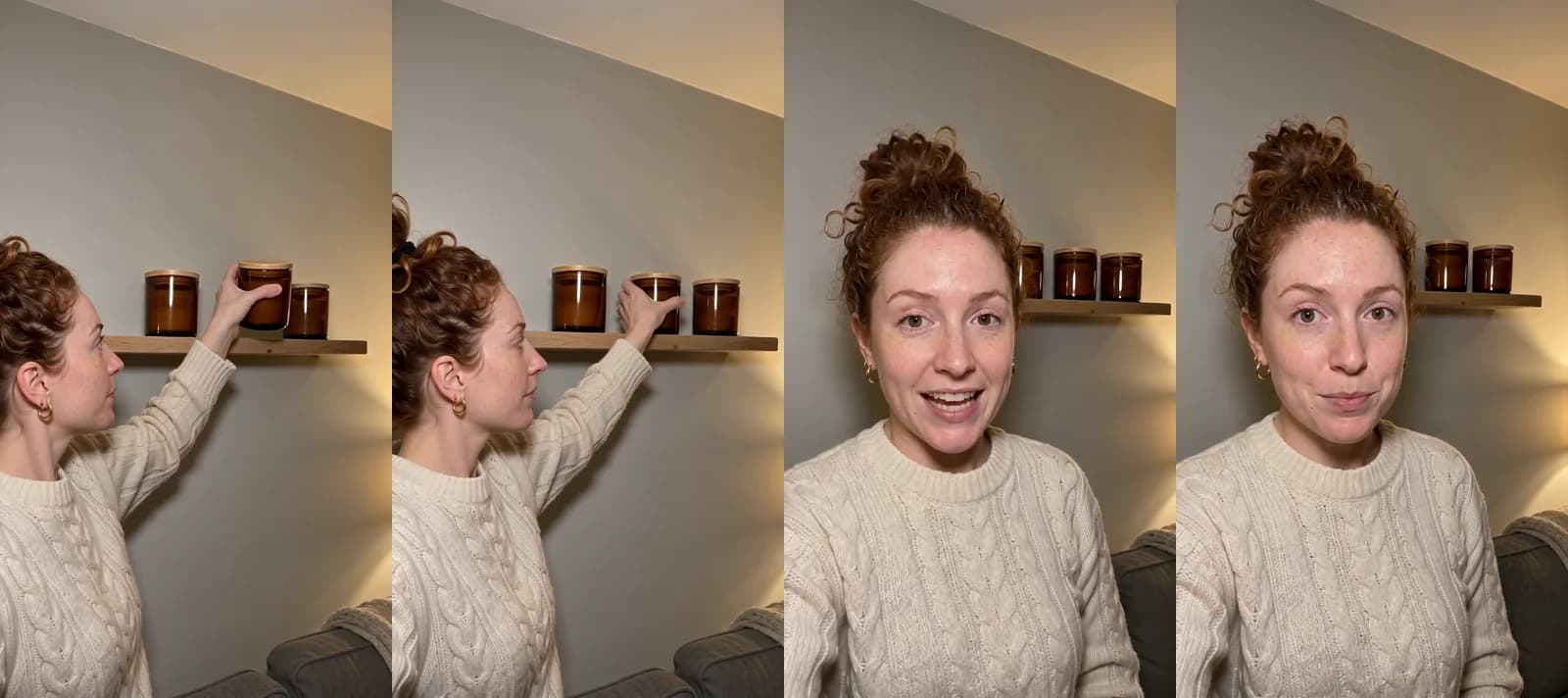 Seedance 2.0 Mini · hook C, the proof: she lines the jar up with her empties and says she has bought it four times · 6 credits · rendered 2026-10-20
A picture that contradicts the words costs more than the render did, so catch it here, before money goes behind it.
Step 6: Test the Openings Before You Pay for the Long Cut
Test one thing at a time, and make it the opening first. Meta's A/B testing tool is built this way: it divides the audience into random, non-overlapping groups that see ad sets "identical on all aspects except for a distinct variable," and it lets you "test up to five ad variants" at once. Meta also says that, "for the most reliable results," a test should run "for at least two weeks or up to 30 days."
Why the opening goes first
The opening is the cheapest part to vary and the part that decides whether anyone sees the rest. Our three candle takes cost 18 credits together: about half the 35 credits one five-second Seedance 2.5 clip costs at 720p, and less than a tenth of the 210 credits a 30-second Seedance 2.5 take costs. Find the opening that holds people, then spend on the long cut behind it.
What the candle test cost
All three takes ran on Seedance 2.0 Mini in Novoads on 2026-10-20, at 6 seconds, 720p and 9:16, from the same reference still:
| Hook | Credits | Render time | Spoken line in the take |
|---|---|---|---|
| A, callout | 6 | 3 min 14 s | Word for word |
| B, action first | 6 | 2 min 9 s | Word for word |
| C, proof first | 6 | 2 min 5 s | Word for word |
The two reference stills added 4 credits, 2 for the one we kept and 2 for the one we discarded. We have not run these three as paid ads, so the table shows what the variants cost to make, not which hook wins. That answer needs real spend, one variable at a time.
The test checklist
- One variable per test, starting with the hook; the body, the offer and the audience stay fixed.
- Three to five variants (Meta's A/B tool takes up to five).
- The same budget and schedule for every variant.
- No winner called until the test has ended; Meta advises at least two weeks.
- The decision rests on cost per result, not on clicks or views alone.
- The winning hook becomes the control for the next round.
To run ten openings against one body, see how to test ad hook variations; for Meta's limits on how many ads to run at once, see how many ad creatives you need.
Where AI Fits: Making the Variants, Not Choosing Them
Nothing in the six steps needs a particular tool. What AI changes is the price of steps 3, 5 and 6: an opening that used to need a creator, a shoot and an edit can be generated, so writing three hooks and testing them stops being a luxury. Our candle takes came from one still and three short renders, and each render finished in two to three minutes.
AI does not decide the offer, the buyer or whether a proof line is true. Those stay with you, and they are most of the work.
For the full walk-through of making the ad itself with AI, from the script to the export and what a finished ad costs, see AI ads, step by step. A TV-style spot follows the same six steps with more shots, and how to make a commercial with AI covers that format. To start from the format in this guide, a creator talking to the camera about one product, see AI UGC video ads in Novoads.
Decide the Ad in Order, Then Let the Test Choose
Most of an ad is decided before anyone films. The offer and the buyer cost an afternoon of reading reviews; the hook, the script and the visual cost a few credits or a few hours; only the test asks for budget, and by then it should be choosing between openings you would be glad to run. When an ad underperforms, walk back up the steps before you blame the creative, because a weak offer or a vague buyer shows up as a weak hook.
Spend the thinking on the offer and the money on the openings.
Frequently Asked Questions
How do you make a commercial ad?
Work through the same six steps as any ad: write the offer in one sentence, name one buyer, write several openings, script the middle around one proof, make visuals that show the product early, and test the openings before you pay for a long cut. TikTok's creative guidance boils the structure down to three parts: have a hook, highlight your unique selling points, and end with a clear call-to-action. A TV-style commercial adds shot planning and polish, not different steps.
How much do 1,000 clicks cost on Facebook?
There is no fixed price. Meta's pricing page says there isn't a one-size-fits-all answer to what its ads cost: every time there is a chance to show an ad, it enters an auction, and Meta says the auction looks at the ad's objective, budget, duration, audience and creative. What Meta does give is a starting point: its English-language pricing page, read on 2026-10-20, says the recommended practice is to start with at least $5 and to choose a duration over six days.
How many versions of an ad should you test?
Start with three to five openings on the same body. Meta's A/B testing tool takes up to five ad variants in one test and splits the audience into random, non-overlapping groups that see ad sets identical except for one variable. Meta recommends running a test for at least two weeks, up to 30 days, and waiting for the final result before calling a winner. Change only the hook in the first round; once one wins, test the next variable against it.
What makes a video ad effective?
Google's answer is the ABCDs, its four principles for effective YouTube video ads: Attention, Branding, Connection and Direction. Its Ads Help page says applying them can deliver as much as a 30% lift in short-term sales likelihood, citing a Google/Kantar study from April 2021, The Short & the Long of ABCDs Effectiveness. Google commissioned that research about its own framework, and Kantar, which ran it, reports a strong correlation with predicted short-term sales lift after scoring over 11,000 ads with its Link AI tool. Treat the 30% as a modelled prediction, not measured sales or a controlled test.
Key Takeaways
- Make an ad in six steps, in order: write the offer in one sentence, name one buyer in their own words, write three hooks, script the middle around one proof, make the visual agree with the words, and test the openings before any long cut.
- The offer and the buyer come first because no opening can rescue a weak offer: a better hook only shows a bad deal to more people.
- Write at least three openings of different kinds (a callout, action first, proof first). TikTok's guidance says to prioritize the hook in the first 6 seconds.
- We rendered three 6-second openings for one unbranded candle in Novoads with Seedance 2.0 Mini for 18 credits in all. Every line came back word for word, and the one miss was visual: hook C's shelf shows three jars where its line claims four purchases.
- Test one variable at a time, starting with the hook, keep the body, offer and audience fixed, and call no winner until the test has ended.
Sources
- •Google Ads Help: About the ABCDs of effective video ads
- •Kantar: Validating Google's ABCD framework with the power of artificial intelligence
- •TikTok Ads Help Center: Creative best practices for performance ads
- •Meta for Business: Ad measurement, A/B testing ads on Facebook and Instagram
- •Meta for Business: A/B testing ads on Facebook and Instagram
- •Meta for Business: Facebook and Instagram Ads Pricing & Cost, An Overview
- •Meta for Business: Facebook Ad Auctions Explained