UGC vs Influencer Marketing: 6 Differences in Cost, Rights, Disclosure and Control
UGC buys a video file you run from your own ad account; influencer marketing buys a post in front of someone else's followers. Here is how the two differ on audience, usage rights, FTC disclosure, control and cost, and which one to run as ads.

Mauricio Valdivia
·13 min
Same creator, same phone, two different invoices
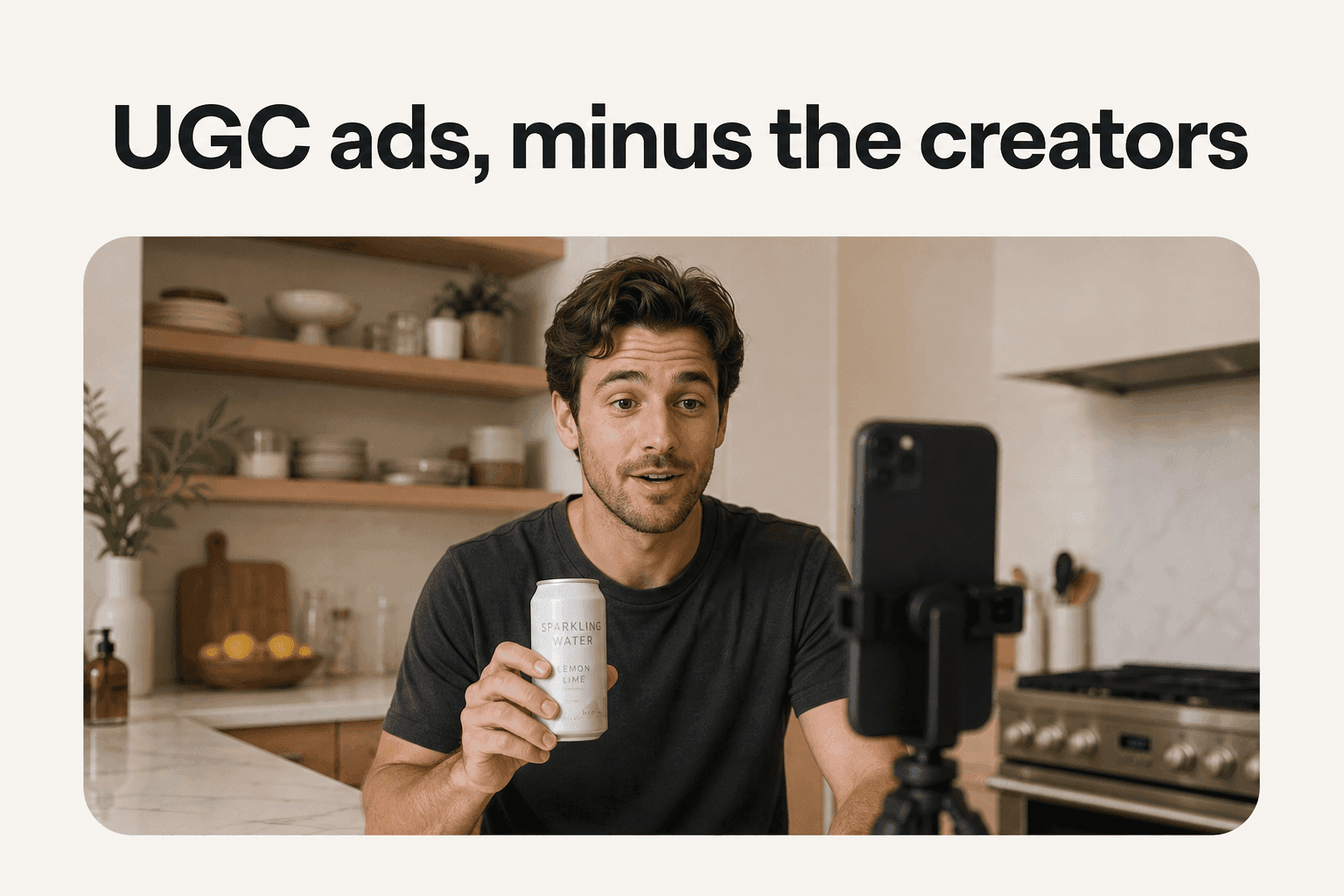
A skincare founder messages a creator whose videos she likes and asks for a price. The reply has two lines. One prices a 30-second video delivered as a file. The other prices the same video posted on the creator's own account.
Same face. Same phone. Different product.
That is UGC vs influencer marketing in a single quote. With UGC, you pay a creator to make a video and hand you the file, then you run it from your own accounts and pay the platform for reach. With influencer marketing, you pay a creator to publish to her own followers, and her audience is most of what you are buying. The first is a production job with a license attached. The second is closer to a media buy.
This post compares the two the way a buyer has to: whose audience sees the video, what the fee buys, usage rights, who carries the disclosure, who controls the edit, and how the costs are built. Then it covers which one to run as ads and where AI actors fit. The disclosure rules quoted here are US rules from the Federal Trade Commission, and they reach further than most brands assume.
The short answer: six differences side by side
If you read one section, read this one. The sections below take the rows in order.
| UGC | Influencer marketing | |
|---|---|---|
| Whose audience | Yours, bought as ad reach | Hers, built over years |
| What the fee buys | A video file | A post on her account |
| Usage rights | What your contract grants | The post; ads need permission |
| Disclosure | Your name is on the ad | She discloses in the video |
| Control | You hold the edit | You approve, then monitor |
| Cost driver | Per video, plus media | Audience size, per post |
Use UGC when
- You need footage for your own ad account, in volume.
- You are still testing which angle, hook or offer converts.
- You want to cut, re-edit and re-run the same clip for months.
- Your buyer is reachable through paid targeting.
Use influencer marketing when
- The creator's followers are your target market.
- You need credibility inside a specific community.
- You are launching and word of mouth is the point.
- Someone on your team has time to brief, approve and monitor every post.
Audience and deliverable: a feed or a file
The first two differences are really one question: when the money leaves your account, what arrives?
UGC reaches the people you pay the platform to reach
A UGC video has no audience of its own. It sits in your ad account until you put budget behind it, and then it reaches whoever your targeting and the platform's delivery system choose. The creator's follower count barely matters to the result. A creator with a few hundred followers and one with a large following hand you the same kind of file.
That is the strength and the cost of the model at once. You decide who sees the video. You also pay for every impression.
An influencer post reaches people who chose her
An influencer post lands in the feeds of people who decided to follow that person. The FTC's staff FAQ on its Endorsement Guides explains why that matters in its own words: "posts are more likely to be seen by followers, and followers are more likely to trust and rely upon people they follow".
That trust is what you rent. No ad platform sells it at any CPM, and it belongs to her, not to you. When the campaign ends, the followers stay with the account they chose.
One creator can sell you both, under two contracts
Many creators do both jobs, which is why buyers mix them up. The way to tell them apart is to ask what the quote is pricing:
- A UGC quote prices work. Hours, revisions, raw footage, and a license to use the result.
- An influencer quote prices attention. Followers, engagement, a publishing date, and a caption on her account.
If you are new to the first side, start with what a UGC creator actually does, then read how to hire and brief a UGC content creator before you send a brief.
Usage rights: how long, and where, you can run the video
Rights are where the two models split hardest, and where most disputes start.
A UGC fee buys a license, and the contract draws its edges
Neither the platform nor the FTC decides how long you can run a UGC video. Your contract does. A usable UGC agreement names four things:
- Where the video may run: organic posts, paid ads, your site, email.
- How long the paid-ads permission lasts.
- Whether you can edit, cut down and recombine the footage.
- Whether raw footage is part of the delivery.
Leave one out and the file on your drive may not be a file you can run for long. Usage terms are also the biggest lever on price, which our breakdown of what UGC creators charge walks through tier by tier.
An influencer post is not an ad license
Paying for a post buys the post. It does not, on its own, let you put that video into your ad account. Google says so in its Ads Help for creator partnerships: "you're responsible for securing sufficient rights to use the video as an ad. This may require you to have a separate agreement with the creator or other rights holders." Budget for that second agreement when you budget the post.
Partnership ads run on permission the creator can take back
Agencies still call it whitelisting. Meta's term is partnership ads, and its help centre is direct: "Branded content ads are now called partnership ads." It adds that "advertisers need permission from the partner whose handle the ad will include" and that "Creators and other partners can revoke these permissions at any time." (Meta Business Help Centre, read September 2026.)
That last sentence is the practical difference. A UGC file you licensed runs until the license ends. A partnership ad runs as long as the creator keeps the permission on. TikTok's version of the format is Spark Ads, and it rests on the same consent: its ads help centre lists, among the things the format lets an advertiser do, "Publish ads using organic posts made by other creators (with their authorization)" (read September 2026). Our guide to whitelisting a creator's handle covers what each platform's permission grants, what it costs by the month, and how a creator switches it off.
Disclosure: what the FTC asks of each side
This is the section most comparison posts skip, and the one with legal weight.
The influencer discloses, inside the video
The FTC staff brochure Disclosures 101 for Social Media Influencers, dated November 2019, is short and specific. Its core rules for an influencer:
- Make the relationship obvious. "If you endorse a product through social media, your endorsement message should make it obvious when you have a relationship" with the brand.
- Gifts count. The relationship includes the brand "giving you free or discounted products or services", so a gifted box counts.
- Put it in the video. "the disclosure should be in the video and not just in the description uploaded with the video."
- It is her job. "As an influencer, it's your responsibility to make these disclosures".
- The toggle is not enough. "Don't assume that a platform's disclosure tool is good enough".
The FTC's longer staff FAQ, the companion document that sends readers to the Endorsement Guides "revised in 2023", is blunter when the question is put to it directly. Asked whether a TikTok video's disclosure can live in the text description, it answers that "A disclosure in the text description is thus very unlikely to be clear and conspicuous."
Two cautions for reading all of this. The wording is "should", because this is staff guidance, and the FAQ says "The Guides themselves don't have the force of law." But it also says "practices inconsistent with the Guides may result in law enforcement actions alleging Section 5 violations". And the brochure says "U.S. law applies if it's reasonably foreseeable that the post will affect U.S. consumers", even when the creator posts from abroad.
The brand is on the hook either way
Here is the part brand owners miss. The same FAQ spreads the risk to you in three lines:
- Enforcement starts with you. "our focus usually will be on advertisers or their ad agencies and public relations firms".
- The platform is not the backstop. "the ultimate responsibility for clearly and conspicuously disclosing a material connection rests with the influencer and the brand".
- Gifting without a fee does not help. "you're still on the hook for their deceptive claims".
So the influencer carries the disclosure. You carry the risk of her getting it wrong.
A UGC ad under your own name still has endorsement rules
When a UGC video runs only from your ad account, the relationship is visible by design: the ad carries your brand's name. The FTC's general test is the audience's understanding: "If the audience understands the relationship, a disclosure isn't needed."
What does not go away is the truth of what the creator says. The FAQ defines an endorsement as "an advertising message that consumers are likely to believe reflects the opinions or beliefs of someone other than the sponsoring advertiser". A creator talking about your product in your ad fits that definition. Three rules follow:
- She has to have used it. Disclosures 101: "You can't talk about your experience with a product you haven't tried." Ship product before the shoot.
- Results need proof. If the script claims a result, the FAQ says advertisers must "Have adequate proof to back up the claim that the results shown in the ad are typical" or disclose what people generally get.
- If she also posts it, she is an influencer. The same video on her own account needs her disclosure, inside the video.
Control: who holds the edit
Control decides how fast you can learn from a video, and how much of your week it costs.
UGC hands you raw material
With a UGC deal, the file is yours to work with inside the license. You can cut three hooks from one take, swap the captions, trim to 15 seconds for Stories and re-run the winner next quarter. The creator is out of the loop once the file is delivered. That is why performance teams favour it: most ad testing happens in the edit, and the edit is yours.
Influencer content means approve, then monitor
With an influencer, the post lives on her account, in her voice, on her schedule, and the FTC expects you to keep watching. Its FAQ sets out what that means:
- Have a program. "Advertisers need to have reasonable programs in place to train and monitor members of their network."
- Or approve first. "If regular monitoring is too much for you, you should probably switch to pre-approval of posts."
- Stories need sign-off. For short-lived formats, "you should require that paid posts aren't made without you approving them in advance".
- Keep watching after the invoice. For an endorser under contract, "you certainly should monitor them during the length of the contract and for a reasonable time, such as a few months, after the contract expires".
None of that work exists on the UGC side, because there is no third-party account to watch. It is the hidden line item of an influencer program: someone's hours, every week the posts are live.
Scripts are fine, if they stay true
Brands often ask whether they can hand an influencer a script. The FTC's answer: "There is nothing inherently wrong with using pre-written posts as long as the influencers are being truthful." So the split of control looks like this:
- In a UGC deal you control the script, the edit, the length, the captions, the placements and the run dates, within the license.
- In an influencer deal you control the brief, the approval, the posting window and the disclosure wording, but not the comments, her other posts or how her audience reacts.
That second list is shorter for a reason. You are renting a person's judgment along with her audience, and the parts you cannot control are the parts that make the post worth buying.
How the costs are built
The two models do not just cost different amounts. They charge for different things, so their invoices are hard to compare line by line.
UGC: a production cost, then a separate media bill
UGC is priced per video. The creator's fee covers the production and the license, and distribution is a second bill you pay to Meta, TikTok or YouTube. A video that nobody sees still costs its production fee.
Influencer marketing: priced by the size of the audience
Influencer fees scale with reach, because reach is the product. Influencer Marketing Hub's Influencer Marketing Benchmark Report 2026, dated May 4, 2026 on the page, reports "600+ respondents" and asked them to place creators in cost bands by tier. What they reported:
- UGC creators: roughly 80% of responses under $500, the rest mostly $500 to $2,000.
- Nano creators: the largest share also under $500, about 55%.
- Micro creators: about 45.5% under $500.
- Mid-tier creators: most often the $2,000 to $5,000 and $5,000 to $10,000 bands, each about 22.2% of that tier's answers.
- Macro creators: more dispersed, with meaningful representation across the low, mid and above-$10,000 bands.
Read these as what surveyed marketers report paying, not as rate cards. The same report names rising creator costs as the top challenge, at 35.4% of reported challenges, and puts measuring ROI and attribution complexity together at 15.84%. That second number is a hidden cost of the influencer side: a post on someone else's account is harder to tie to a sale than an ad in your own account. For the smallest tier in detail, see what nano influencers really cost.
A worked example: one $2,500 month, three ways
Take a supplement brand with $2,500 for creator work this month, and hold each option to the survey bands above.
- One mid-tier influencer. At the low edge of the most common mid-tier band, $2,500 buys about one post, to one audience. Running it as a partnership ad later needs her permission and a media budget on top.
- Five nano influencers. If each lands in the under-$500 band, that is at least five posts to five small audiences, plus five briefs, five shipments and five accounts to monitor.
- Five UGC videos. If each lands in the under-$500 band, that is at least five files you can cut into many more ad variants, with no reach at all until you add ad spend.
None of the three is cheaper in the abstract. They buy one audience, five audiences, or five assets and the tests they allow. The right choice depends on which of those you are short of.
Which one to run as ads
Both can end up in your ad account. They earn their place there for different reasons.
Run UGC while you are still finding the angle
When you do not yet know which message converts, pay for files, not audiences. Each UGC video is a test you can cut into several variants and kill cheaply when it loses. Our collection of UGC ad examples shows the hook and format patterns worth testing first.
Run influencer content as ads when the face is the asset
When the creator's identity is what sells, such as a trusted expert or a name her community recognises, put paid budget behind her post from her handle. Meta says that "Once you have your creator partnership in place, you can run partnership ads with the creator's handle." On YouTube, Google's Ads Help says of creator partnerships boost: "Your ads will be shown from the creator's YouTube channel". The header carries her name, which is the one thing a file run from your own handle cannot give you. The mechanics on each platform are in our guide to creator partnership ads.
The sequence that uses both
The strongest programs do not choose. They run the two in order:
- Test angles with UGC from your own account, several scripts per product.
- Pick the winner on cost per purchase, not views.
- Brief the influencer on the proven angle, so her post carries a message you know works.
- Boost her post as a partnership ad to reach past her own followers.
Meta's own example of creative diversification pairs the two formats in one plan: "a Reels ad tailored for GenZ and a separate partnership ad featuring a creator who connects with new moms".
Where AI actors fit, and where they cannot
AI actors are now part of this comparison, and they belong on one side of it only.
They replace the file, never the audience
An AI actor is a synthetic presenter rendered from a script. It can produce the UGC side of the table: a vertical, talking-to-camera video that runs from your ad account. It cannot produce the influencer side. It has no followers, no community and no handle a partnership ad can borrow. Building an audience for a synthetic persona is a separate, long project, which our guide to creating an AI influencer prices honestly.
The line a synthetic presenter must not cross
The FTC's June 29, 2023 revision of the Endorsement Guides changed the definition of endorsements "to clarify the extent to which it includes fake reviews, virtual influencers, and tags in social media". Its final rule on reviews and testimonials, announced August 14, 2024, targets "reviews and testimonials that misrepresent that they are by someone who does not exist, such as AI-generated fake reviews".
The working rule that follows is simple. An AI actor can present, demonstrate and explain your product. It should not claim to be a customer who used it. Script "Here is what this serum does in the morning", not "I've used this for three months."
Expect the platform to know
Meta says it will "begin automatically detecting ads created or edited using third-party AI tools through industry-standard signals", and that when it detects one it applies an AI info label to the ad (Meta newsroom, first published February 3, 2025 and updated June 1, 2026). Label AI-made ads the way each platform asks rather than hoping they pass unnoticed.
How Novoads solves the UGC side of the budget
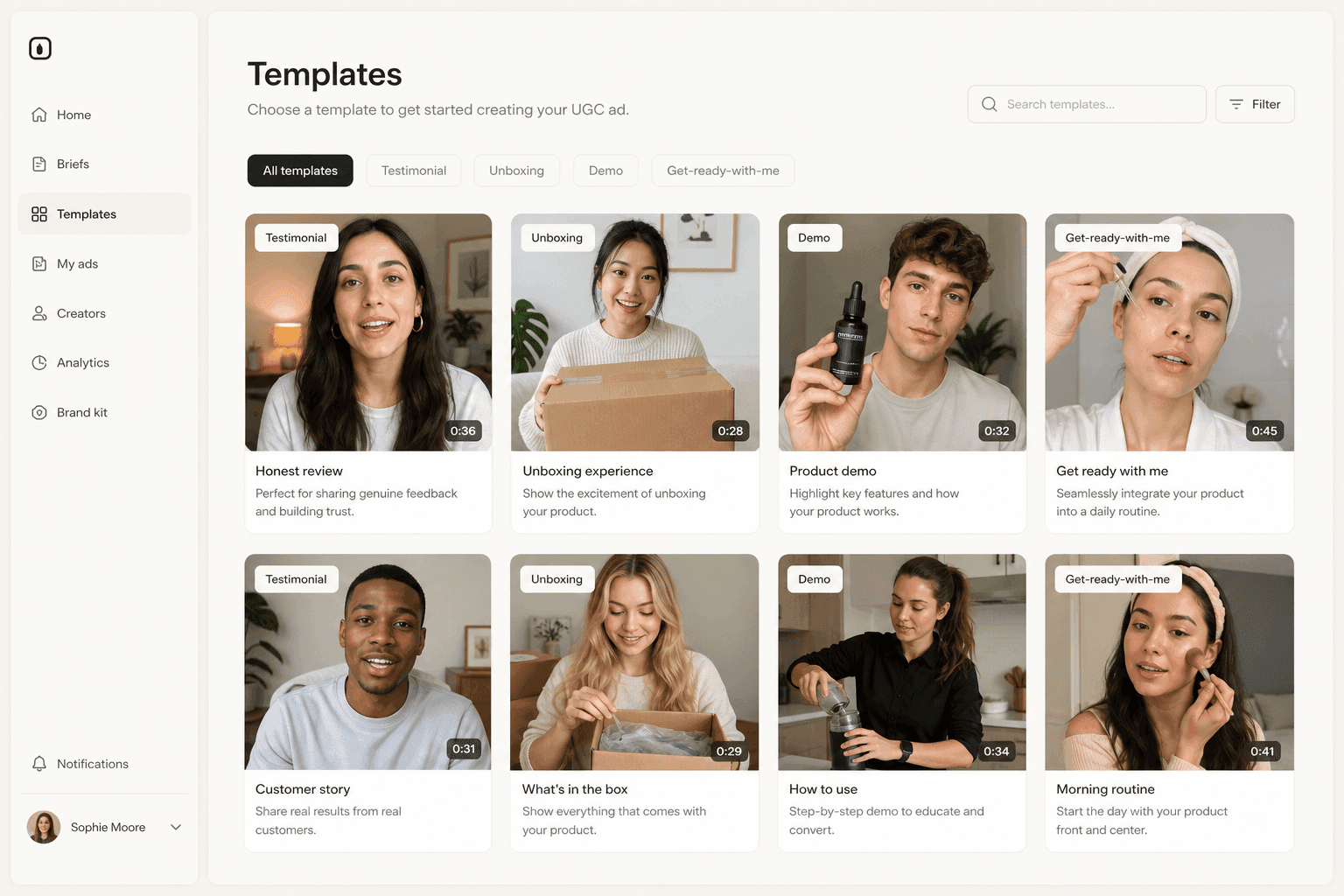
Novoads is an AI UGC video-ad generator, so it competes with human UGC creators for the file side of this comparison, and not with influencers for the audience side. You upload a product image or write a script, pick an AI actor, and get an ad-ready video in 9:16, 1:1 or 16:9 that runs from your own ad account.
To show the product in someone's hand, name the route. Either upload a photo of a person holding it to create a custom actor, or start from a Discover product template, which places your uploaded product in the template creator's hand. A stock actor from the library has empty hands.
A clip costs from about a dollar for a five-second Seedance 2.0 Mini clip to about $8 for an eight-second Seedance 2.5 clip, and about $26 for a full 30-second Seedance 2.5 take. Novoads starts at $49/month (Starter, 50 credits per month). All plans are published on /pricing. You can run your angle tests in Novoads before you spend a creator budget on the winner.
What it does not sell is what an influencer sells: a real person's followers, and a real customer's lived experience. For those, hire people.
Rent the audience, own the file
UGC and influencer marketing are not two prices for the same thing. One buys an asset you control and must pay to distribute. The other buys attention that belongs to someone else, along with her disclosure duty and your duty to watch her keep it.
Decide which one you are short of before you brief anyone. Pay for files while you are still learning what to say. Pay for audiences once you know.
Frequently Asked Questions
What is the difference between UGC and influencer marketing?
With UGC, you pay a creator to make a video and deliver it as a file, then you run it from your own accounts and pay the platform for reach. With influencer marketing, you pay a creator to publish to her own followers, so her audience is most of what you buy. UGC is a production purchase with a license attached; influencer marketing is closer to a media buy.
Can I run an influencer's post as an ad?
Only with permission and the right agreement. Google's Ads Help tells advertisers they are responsible for securing sufficient rights to use a creator's video as an ad, which may require a separate agreement with the creator. On Meta, running the post from the creator's handle is a partnership ad, and Meta's help centre says it needs permission from the partner whose handle the ad includes and that creators can revoke that permission at any time.
Do UGC creators have to disclose that they were paid?
If the creator posts the video on her own account, she is acting as an influencer and the FTC's Disclosures 101 guidance applies: the relationship should be obvious and, in a video, disclosed inside the video. If the video only runs as your ad, under your brand's name, the sponsor is visible, but the FTC still treats what the creator says as an endorsement, so she cannot describe experience with a product she has not tried.
Is UGC cheaper than influencer marketing?
Per piece, usually. Influencer Marketing Hub's 2026 benchmark puts about 80% of reported UGC creator prices under $500, against mid-tier influencers most often in the $2,000 to $5,000 and $5,000 to $10,000 bands. But a UGC video has no audience of its own, so you also pay for ad spend, while an influencer fee includes her reach. Compare the cost of the outcome you need, not the invoice.
Who is responsible if an influencer does not disclose a paid post?
Both of you. The FTC's Disclosures 101 brochure tells influencers it is their responsibility to disclose, and the FTC's Endorsement Guides FAQ says that when law enforcement becomes necessary, its focus usually will be on advertisers or their ad agencies and public relations firms. The same FAQ says the ultimate responsibility for disclosure rests with the influencer and the brand, not the platform.
Can AI replace UGC creators or influencers?
AI can replace the UGC side: a generated presenter can deliver a scripted, vertical, talking-to-camera ad that runs from your account. It cannot replace an influencer, because it has no followers to reach. It also should not pose as a real customer: the FTC's 2024 final rule on reviews and testimonials targets testimonials that misrepresent that they are by someone who does not exist, naming AI-generated fake reviews.
Key Takeaways
- UGC buys a video file you run from your own ad account, so you pay twice: once for the video, once for the reach. Influencer marketing buys a post to someone else's followers, so the reach is built into the fee.
- An influencer post is not an ad license. Google tells advertisers they are responsible for securing the rights to run a creator's video as an ad, and Meta's partnership ads need the creator's permission, which Meta says creators can revoke at any time.
- The FTC's Disclosures 101 brochure (November 2019) says an influencer's endorsement should make any brand relationship obvious, gifted product included, and that in a video the disclosure belongs in the video, not only the description. Its FAQ adds that enforcement usually focuses on advertisers, so the brand carries the risk either way.
- Influencer Marketing Hub's 2026 benchmark (600+ respondents) puts about 80% of reported UGC creator prices under $500, while mid-tier influencers most often sit in the $2,000 to $5,000 and $5,000 to $10,000 bands. The fee tracks audience size because the audience is the product.
- AI actors can replace the UGC file but never the influencer's audience, and they should present a product, not pose as a customer: the FTC's 2024 rule targets testimonials from someone who does not exist.
Sources
- •FTC: Disclosures 101 for Social Media Influencers (November 2019)
- •FTC: FTC's Endorsement Guides, What People Are Asking
- •FTC: Final Rule Banning Fake Reviews and Testimonials (August 14, 2024)
- •Meta Business Help Centre: About partnership ad permissions
- •Meta for Business: Creator marketplace and partnership ads
- •Google Ads Help: Creator partnerships boost
- •TikTok Ads Manager Help: About Spark Ads
- •Influencer Marketing Hub: Influencer Marketing Benchmark Report 2026