How to Create an AI Influencer in 2026: 7 Steps From Persona to Paycheck
An AI influencer is a rendered persona with a real audience business behind it. Here are the seven steps to build one, the disclosure rules that now apply, and when an AI UGC actor sells more product for less money.

Mauricio Valdivia
·11 min
The face takes an afternoon. The audience takes a year.
In 2023, a Barcelona design agency got tired of human models who missed shoots and blew up campaigns, so it rendered its own. Aitana Lopez has pink hair, a fitness habit, and no pulse. Her creators at The Clueless say she can earn up to €10,000 in a good month, and that the average sits closer to €3,000. The face was the fast part. The audience that pays those invoices took a year of daily publishing to earn.
That gap is the honest headline of this guide. Creating an AI influencer in 2026 is a solved technical problem: any competent image model can produce a beautiful synthetic face before lunch. What separates the accounts that earn from the graveyard of abandoned personas is everything around the face: a niche chosen on purpose, a character document that keeps her consistent, a publishing cadence that survives month four, disclosure practices that survive a regulator's glance, and a clear answer to whether you should be building an audience at all, or just making ads.
This guide walks all seven steps in order, then ends with the fork most tutorials skip: when a brand is better served by an AI UGC actor in a paid ad than by a persona account it has to grow from zero.
What an AI influencer actually is (and what it is not)
An AI influencer is a computer-generated character with its own name, personality, and social presence, built to accumulate an audience and promote things to it. The definition sounds simple. The operational reality is three jobs stacked on top of each other.
A persona, a pipeline, and a publishing habit
The persona is the character: face, backstory, voice, opinions. The pipeline is the technical system that reproduces that character on demand, in new outfits and new scenes, without the face drifting. The publishing habit is the unglamorous part: showing up in feeds several times a week, replying to comments in character, and doing it for months before anyone pays.
The accounts people cite as proof the model works all have those three layers. Lil Miquela has appeared in ads for fashion houses like Chanel and Givenchy. Lu do Magalu, the AI persona of Brazilian retailer Magazine Luiza, has more than 8 million Instagram followers and ranks among Brazil's most-followed influencers. Neither is a lucky render. Both are content operations with a synthetic face on the front.
The audience half and the creative half
Every influencer deal, human or synthetic, bundles two different products: the creative (the content itself) and the audience (the distribution it rides on). An AI influencer is an attempt to own both halves. That is what makes it powerful, and also what makes it slow: the creative half can be generated in an afternoon, but the audience half obeys the same cold-start physics as any new account. Hold that split in mind, because it decides the fork at the end of this guide. Human creators already sell one half as a standalone business: the UGC creator path is the creative half priced per asset, no audience required.
Step 1 and 2: pick the niche, then write the character bible
Pick a niche where a synthetic face is an asset
The niches where AI influencers work are the ones where the persona's look and lifestyle are the content: fashion, fitness aesthetics, travel, gaming, product curation. The niches to avoid are the ones where the persona would be impersonating an expert. YouTube's monetization policy is explicit about this: it prohibits channels that use AI-generated personas to present themselves as human experts giving advice on health, legal, financial, or political topics, and its named example is an AI doctor handing out medical advice. If your persona's plan involves advice people might act on, stop now. Pick a niche where being fictional is a feature.
A useful test before committing: search the niche and count the synthetic faces already in it. Two or three means the format is validated. Twenty means you are late and will need a sharper character to cut through. And if the honest finding is that your niche punishes any face, human or rendered, faceless video ads sell with b-roll, screens, and a voiceover instead of a persona.
Write the character bible before you render anything
The character bible is a one-to-two-page document that fixes everything the pipeline must keep constant. It feels bureaucratic. It is the single highest-leverage artifact in the whole build, because every generation session for the next year will be prompted against it, and every drift bug ("why does she look different this week?") gets debugged against it. A working bible covers five blocks:
- Identity: name, age, city, occupation, and the two-sentence backstory that explains why she posts.
- Voice: how she writes captions and replies, three phrases she overuses, and what she would never say.
- World: the recurring locations, the friends who get mentioned but never shown, the running jokes.
- Visual anchors: face geometry, hair color and cut, skin detail, wardrobe palette, and the accessories that repeat.
- Guardrails: the topics she stays out of, and the disclosure line every sponsored caption carries.
A rule that saves weeks: decide the persona's opinions now, not later. An account that only posts pretty pictures is wallpaper. The persona needs takes, preferences, and a consistent voice in captions and replies, and those cannot be improvised post by post without drifting.
Step 3 and 4: generate the persona, then make it move and talk
Build the reference set, stills first
Start with volume, then cull. Generate a few dozen stills of the candidate face across angles, lighting setups, and expressions, and select the ten to twelve images that read as unmistakably the same person. That culled set becomes the canon: every future generation is conditioned on it, whether your image tool calls that a character reference, a subject anchor, or a fine-tune. Working stills-first is also the cheap way to make mistakes: a bad still costs cents and seconds, a bad video costs dollars and minutes, so the face should be fully locked before anything moves.
Animate and give her a voice
Motion comes from image-to-video: feed canon stills into a video model and direct short clips, a walk through a market, a to-camera aside, a getting-ready sequence. Voice comes from TTS, and the rule is the same as the face: pick one voice profile and never change it. For talking pieces, lip-sync ties the two together. The plumbing is the same thing an AI avatar video generator does when it turns a typed script into a person speaking on camera. None of this requires exotic tooling in 2026; it requires discipline about reusing the same references every single time.
How you know it worked
The test is recognition, not beauty. Put three finished posts side by side and show them to someone who has never seen the persona: if they can tell all three are the same person without reading the handle, the pipeline is working. A stricter version: generate a three-by-three grid of new scenes from the canon set, and count how many a stranger would group as one identity. Eight of nine is a pass. Five of nine means the reference set is too loose, and you fix it now, before there are forty published posts in three slightly different faces.
Step 5: publish like a media company, not a campaign
A cadence you can sustain past month four
The accounts that break through post four to five times a week and treat engagement as half the job: replying to comments in character, reacting to niche news in the persona's voice, showing up in stories between feed posts. One polished post a week reads as a brand experiment. Daily presence reads as a person. The bar is not production quality, which you now have on demand. The bar is stamina, and stamina survives on a rhythm you can batch. A sustainable week looks like:
- Two hero posts (an outfit, a location, a small storyline beat) generated in one batching session.
- Two lighter posts recycled from the canon set: a crop, a mood shot, a caption-led take on niche news.
- One in-character reply session a day, fifteen minutes, comments and DMs only.
Batch the renders weekly and the persona survives your busy weeks. Generate the day of posting and the account dies the first time work gets loud.
The cold-start math nobody puts in the tutorials
Run the arithmetic before you commit. Five posts a week for six months is roughly 130 published assets, plus daily conversation, before a new account typically has enough of an audience to interest sponsors. Even at a few dollars of generation cost per post, the cash cost is modest; the real spend is the operator hours behind every caption, reply, and trend response, multiplied by 26 weeks of consistency, at zero revenue. That is not a campaign budget. That is seed funding for a small media company whose anchor talent happens to be rendered. Price it that way and the decision gets honest.

Step 6: the disclosure rules you cannot skip
The FTC lines: no fake customers, no hidden deals
Two US federal rules frame everything a monetized AI persona does. First, the FTC's 2024 rule on reviews and testimonials bans content that misrepresents it comes from someone who does not exist, naming AI-generated fake reviews explicitly, with civil penalties attached. An AI persona posing as a satisfied customer of a product is exactly that. Second, the FTC's Endorsement Guides require that a material connection between an endorser and a brand be disclosed clearly and conspicuously. A paid post from your persona is an endorsement with a material connection, and the disclosure duty does not evaporate because the endorser is synthetic. The safe posture is simple: the persona can be openly fictional and openly sponsored, and neither costs you the audience. What it cannot be is a fake person pretending to be a real customer. There is a compliant version of that move: an AI testimonial video built from a real customer's review, where the words are genuine and only the presenter is synthetic.
Platform labels: TikTok, YouTube, Meta
Each major platform now has its own labeling layer on top of the law. TikTok requires creators to label AI-generated content that contains realistic images, audio, or video, and offers its AI-generated label plus ordinary stickers and captions as valid disclosures. YouTube requires disclosure when a creator uses AI to meaningfully alter or generate photorealistic content, and states plainly that disclosing does not limit a video's audience or its eligibility to earn money, which removes the main excuse for hiding it. Meta labels ads that were created or significantly edited with its own generative AI ad tools. The pattern across all three is the same: label realistic synthetic media, and the platforms leave you alone.
The YouTube monetization trap, and the defense you already built
Labeling is not the monetization risk. The real trap is YouTube's mass-production line: AI-generated content made from generic templates, giving the impression of mass production without the creator's original perspective, is not eligible to monetize. The defense is the thing you built in step 2. YouTube explicitly permits content that expresses your unique creative voice, naming the case of using AI to visualize a unique character and narrative you invented. A documented, distinctive, consistent persona is not just craft; it is the paper trail that keeps the account on the right side of that line.
Step 7: monetization, with honest timelines
Brand deals, and what the real numbers look like
The headline path is sponsored content, and the benchmark numbers are public: The Clueless says Aitana can earn up to €10,000 in a good month, average around €3,000. Read those numbers with their sequencing attached. They describe a famous account operated by a professional agency, well after its cold start. A realistic first-year arc for a solo operator is months of unpaid publishing, then small product-gifting deals, then the first modest paid placements once the niche audience is real. The persona earns like talent: slowly, then suddenly, and only if the audience half got built.
Affiliate, licensing, and the quiet pivot most operators make
Beyond sponsorships sit affiliate revenue on curated products and, for genuinely distinctive characters, licensing the persona itself to a brand for a campaign. The deepest affiliate pool right now is TikTok Shop, where sellers set creator commissions anywhere from 1% to 80%. But the most common quiet pivot is instructive: operators discover that brands do not want to rent their small audience, they want to buy the content itself, UGC-style clips of a convincing synthetic person talking about a product, sold per asset. At which point the operator is no longer running an influencer business at all. They are running an ad-creative business, which raises the question this guide ends on: if that is the destination, why take the detour through the cold start?
AI influencer vs AI UGC actor: which one do you actually need
An AI UGC actor is the other way to put a synthetic person behind your product: instead of a named persona with an account you grow, it is a realistic AI actor who appears in ads you run under your own brand, with distribution bought from the ad auction instead of earned from an algorithm. Same underlying technology, opposite business. The split mirrors the broader AI vs human UGC creators comparison: AI owns volume, speed, and testing, while a specific human face owns lived experience.
Build an AI influencer when:
- The persona itself is the product: you are building an entertainment property, a brand mascot with a feed, or an audience asset you will monetize across sponsors.
- You can fund six-plus months of publishing with no revenue and staff the daily in-character engagement.
- Your niche rewards a fictional face (fashion, aesthetics, gaming) rather than punishing it (expert advice).
Use AI UGC actors when:
- The goal is selling a product now, and every week of audience cold start is a week of lost sales.
- You need volume and variation, many hooks, angles, and actors tested in parallel, not one persona's consistency.
- You want the economics per video, not per follower: ads priced in dollars that convert without any audience of their own.
| AI influencer | AI UGC actor | |
|---|---|---|
| What you own | A persona and its audience | A library of ad creatives |
| Time to first result | Months | Days |
| Cost shape | Operator hours, compounding | Per video, about a dollar (five-second Seedance 2.0 Mini) to $8 (eight-second Seedance 2.5); about $26 for a 30-second Seedance 2.5 take |
| Distribution | Earned, algorithm-dependent | Bought, budget-dependent |
| If it fails | Audience is unsellable | Turn the ad off, test the next |
The house position, argued at length in our nano-influencer analysis, holds here too: AI substitutes for the creative half of an influencer deal, and for none of the audience half. An AI influencer account is a bet that you can build the audience half yourself. An AI UGC actor is the decision not to need it.
How Novoads solves the ad-creative half
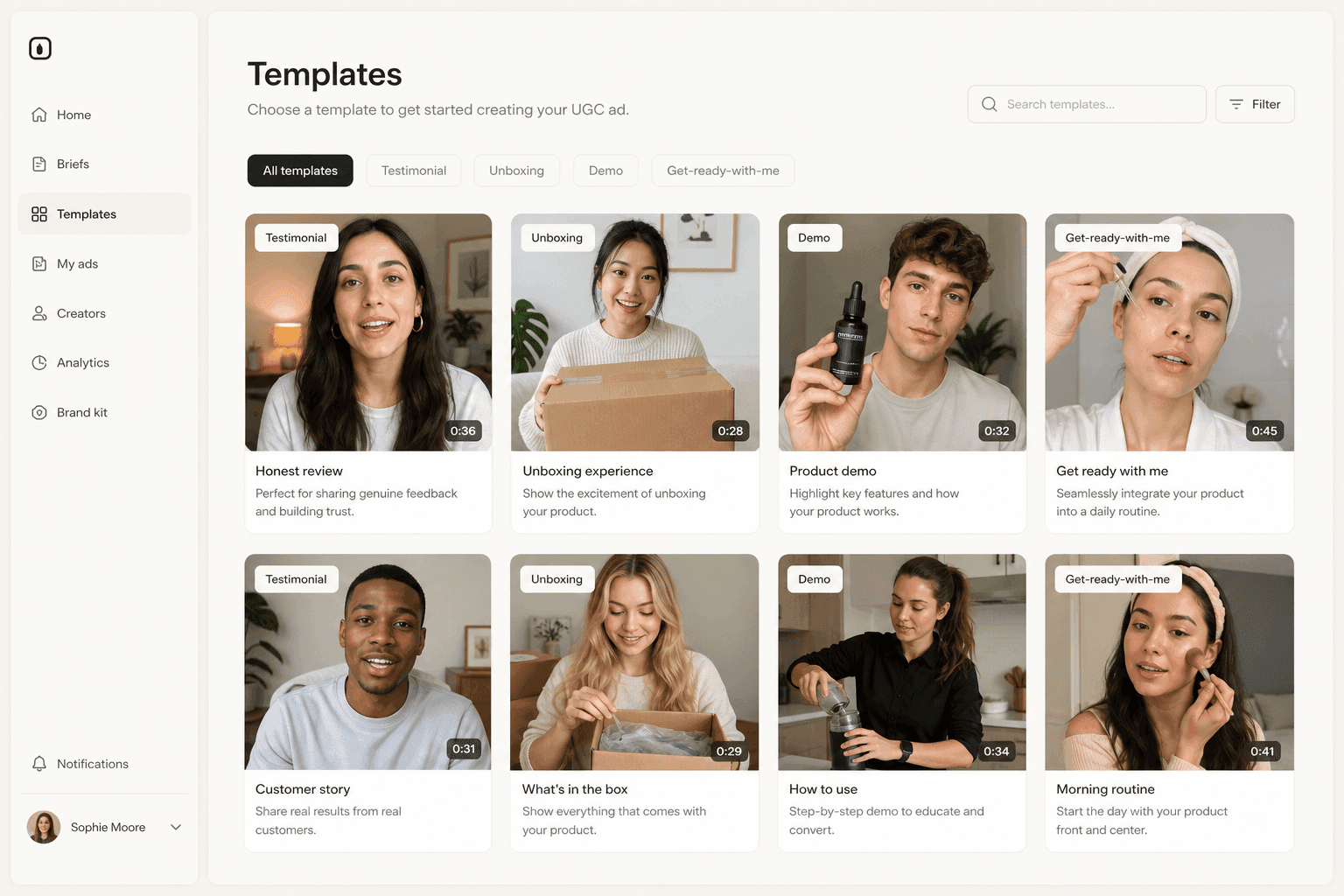
Novoads generates ad-ready UGC-style videos from a product image or a script: pick from over 100 AI actors, with voices in 31 languages, and get vertical, square, or horizontal output built for ad platforms in about four minutes. Videos run on frontier engines (Seedance 2.0, Kling v3 Pro, Google Veo 3.1) at about a dollar to $8 per clip of up to eight seconds, from a five-second Seedance 2.0 Mini clip to an eight-second Seedance 2.5 clip, or about $26 for a full 30-second Seedance 2.5 take, which is what makes testing fifteen variations a normal Tuesday instead of a quarter's production budget. The entry plan is $49 a month, and you can cancel anytime.
Rent the audience or build one, but price both honestly
The seven steps above are all doable this quarter: niche, bible, references, motion and voice, cadence, disclosure, monetization. What the tutorials undersell is that only two of the seven are technical, and neither is the hard one. An AI influencer is a media company with a rendered face; an AI UGC actor is an ad budget with one. Build the media company if the persona is the product. If the product is the product, generate the actor, run the ad, and spend the year you just saved on offers instead of followers. The full workflow is in our step-by-step guide to making UGC ads with AI.
If that second path is yours, you can have the first ad rendered before the character bible would have hit page two.
Frequently Asked Questions
What is an AI influencer?
An AI influencer is a computer-generated persona with its own name, personality, and social media presence, used to build an audience and promote products the way a human influencer would. The best-known examples are Lil Miquela, who has appeared in ads for fashion houses like Chanel and Givenchy, and Lu do Magalu, the AI persona of Brazilian retailer Magazine Luiza with more than 8 million Instagram followers.
Do I have to disclose that my influencer is AI?
In practice, yes. TikTok requires creators to label AI-generated content that contains realistic images, audio, or video. YouTube requires disclosure when AI meaningfully alters or generates photorealistic content, and states that disclosing does not limit a video's audience or its eligibility to earn money. On the commercial side, the FTC requires material connections between a brand and an endorser to be disclosed clearly and conspicuously, and its 2024 rule bans fake reviews and testimonials attributed to someone who does not exist, which is exactly what an undisclosed AI persona posing as a happy customer is.
Can an AI influencer actually make money?
Yes, once it has an audience. The Clueless, the Barcelona agency behind AI model Aitana Lopez, says she can earn up to 10,000 euros in a good month, with the average closer to 3,000 euros. The caveat is sequencing: those numbers arrived after the account had built a following. Sponsorships, affiliate deals, and character licensing all pay against attention you have to accumulate first.
How long does it take to create an AI influencer?
Building the persona takes days. Building the audience takes months. A realistic plan is four to five posts a week sustained for at least six months, which is roughly 130 published assets plus daily comment and DM activity in the persona's voice, before brand deals become plausible. Treat it as launching a small media company, not running a campaign.
What tools do I need to create an AI influencer?
Three layers: an image model that can hold one face consistent across poses and outfits (this is where the character reference set lives), a video model to animate stills into motion, and a TTS voice locked to one voice profile so she always sounds the same. The specific brands matter less than consistency: whatever stack you pick, you need to reproduce the same face, voice, and styling on demand for months.
Is an AI influencer or an AI UGC actor better for selling products?
For most brands, the AI UGC actor. An AI influencer is an audience business: you spend months earning distribution before the first sale. An AI UGC actor appears in ads you run with paid distribution from day one, costs a few dollars per finished video, and does not need followers to convert. Build the influencer if the persona itself is the product; use UGC actors if the product is the product.
Key Takeaways
- An AI influencer is three things at once: a consistent rendered persona, a generation pipeline that can reproduce it on demand, and a publishing habit sustained for months. The face is the easy third.
- The build order matters: niche, character bible, reference stills, animation and voice, cadence, disclosure, monetization. Skipping the bible is why most AI personas drift into a different face by week three.
- Disclosure is not optional. The FTC bans AI-generated fake reviews and requires paid connections to be disclosed, TikTok requires labels on realistic synthetic media, and YouTube requires disclosure for photorealistic AI content but says the label does not limit reach or earnings.
- The money is real but back-loaded: Aitana Lopez's agency reports up to 10,000 euros in a good month, with the average around 3,000 euros, after the account was already famous. Expect months of publishing before the first paid deal.
- If the actual goal is selling a product, an AI UGC actor in a paid ad skips the audience cold start entirely: ad-ready output for about a dollar to $8 per clip of up to eight seconds, from a five-second Seedance 2.0 Mini clip to an eight-second Seedance 2.5 clip, or about $26 for a full 30-second Seedance 2.5 take, distribution bought with ad spend instead of earned over months.
Sources
- •FTC: Final Rule Banning Fake Reviews and Testimonials (Aug 14, 2024)
- •TikTok Newsroom: New labels for disclosing AI-generated content
- •YouTube Help: Disclosing use of altered or synthetic content
- •Euronews: Meet the Spanish AI model earning up to 10,000 euros a month
- •Built In: What Are AI Influencers?