How to Sell on TikTok Shop in 2026: Setup, Listings, Fees, First Orders
Opening a TikTok Shop takes a government ID, a W-9, and one product listing. Here is the full seller setup: Seller Center registration, listings that pass review, what the 6% referral fee really costs on an order, fulfillment options, and how creator collabs land your first sales.

Mauricio Valdivia
·12 min
TikTok keeps six cents of every dollar you sell
Selling on TikTok Shop means opening a Seller Center account, passing document verification, listing products that survive compliance review, and handing TikTok a referral fee on every completed order, 6% for most categories under the fee schedule TikTok updated in May 2026. That is the whole machine. TikTok defines that referral fee as encompassing all TikTok Shop fees except shipping and tax, and its entry requirements are identity documents, not an audience: an ID, a W-9, and one product listing get a US shop live.
The catch is not the signup. It is everything around it. Sellers get rejected for a cropped driver's license photo, price their margins around the wrong "commission," list a supplement that compliance will never approve, and then wonder why a verified shop with twenty products has zero orders. This guide walks the seller side end to end: eligibility, registration, listings, the real fee math, fulfillment, and the creator system that produces first orders. It is US-scoped, because that is where TikTok's seller documentation is most complete, and every number in it is dated to TikTok's own pages.
What you need before you touch the signup form
Registration fails on documents far more often than it fails on anything else. TikTok's verification is picky in specific, predictable ways, so the fastest path is gathering everything before you start.
Who can open a US shop
TikTok's own onboarding guide is blunt about eligibility. Applicants must be at least 18 years old, must reside in the USA, and must register with a phone number and email address not already used to open another shop. One line in the requirements is oddly specific: politicians are prohibited from becoming TikTok Shop sellers. There is no audience requirement anywhere in the list. A shop is a merchant account, not a creator account, and TikTok evaluates it like one.
The documents that pass verification
For identity, US individual sellers can use exactly four document types. Anything else gets rejected:
- A US passport or passport card
- A US driver's license
- A US state ID
- A permanent resident card
The file rules are equally rigid: documents must be valid, uncropped, fully visible, and under 10 MB in JPG, PNG, JPEG, or PDF format. Screenshots of a screen, paper IDs, and expired documents all fail.
Three more things commonly get requested:
- Proof of address: a utility bill, bank or credit card statement, or insurance policy whose address matches what you typed into the form.
- Tax details: US-based sellers complete a W-9; non-US sellers a W-8. You will also provide the last four digits of your SSN, or an ITIN if you do not have one.
- Bank account information for payouts, plus warehouse and return addresses.
The single most common rejection cause is a mismatch: the address on the bill differs from the address in the form, or the name on the ID differs from the registered name. Verification is string-matching, not judgment. Make every field identical before submitting, because business and personal information cannot be changed after submission.
Individual seller or business seller
At signup you pick a business type: individual seller, or a business entity (sole proprietorship, corporation, partnership). Individuals verify with personal ID alone. Businesses add IRS-issued proof, such as a 147C or CP 575 letter showing the legal business name, address, and EIN. An SS-4 application or a screenshot of the IRS website does not count. If you are starting out and selling under your own name, individual is the simpler path, and you can graduate the account later.
Registration, step by step
With documents in hand, the actual flow is five steps, and TikTok's onboarding course lays them out in order: verify your business, submit tax details, set up logistics, add products, link your TikTok account.
Create the account and verify
Start at the US Seller Center signup page. You can register with your existing TikTok account or with a fresh email or phone number, confirm the terms, and enter an invitation code if you have one. Then comes business verification: pick your business type, submit the documents above, and wait. If the registration is rejected, the fix is almost always mechanical: correct the discrepancy, or upload a clearer copy in an accepted format, and resubmit.
Taxes, payouts, and addresses
The W-9 (or W-8) unlocks payouts; without it TikTok cannot settle money to you. You will also configure the warehouse address orders ship from and the return address customers send items back to. None of this is glamorous, and all of it gates the moment your first product can actually sell.
Link one official TikTok account
Your shop connects to a TikTok account that becomes the public face of the store, and your products display on that profile automatically. The constraint worth knowing before you choose: each TikTok Shop may link to only one official TikTok account, and you can change that account up to three times, total. Pick the handle you intend to build on, not a throwaway.
Listings that pass review the first time
A verified shop sells nothing until products clear listing review. This is the second gate, and it has its own failure modes.
Three ways to load your catalog
TikTok Shop supports three upload paths:
- Upload products individually, which forces you to write each listing carefully.
- Bulk upload for faster setup when you have a spreadsheet-sized catalog.
- Synchronize your shop with an existing external ecommerce store.
If you already run a store elsewhere, the sync path saves the most time; if you are testing a single product, the manual path is the honest workout. Every listing needs the basics done well: accurate titles, real images of the actual product, the correct category, and descriptions that match what ships.
Why your products are invisible on day one
A detail that generates a disproportionate amount of new-seller panic: products will not be visible until document verification is completed. You can upload your whole catalog during onboarding, and TikTok holds it hidden until the identity checks clear. A silent catalog in week one is usually a pending verification, not a broken shop.
Prohibited, restricted, and the new-only rule
TikTok Shop runs two lists, and the difference matters:
- Prohibited products cannot be sold under any circumstances: weapons, drugs, recalled goods, counterfeits, and gray-market items sold outside authorized channels.
- Restricted products may be sold, but only after you submit qualification documents and get approval.
And one rule catches more beginners than any other: several categories, including beauty, supplements, and food, only allow new items. A "like new" opened skincare bottle is not a compliance gray area, it is a violation. Reading the prohibited and restricted policies before sourcing inventory is cheaper than reading them after a suspension.
The fee math on a real order
Fees are where most guides on this topic go stale, because TikTok has changed the schedule more than once. The numbers below come from TikTok's own fee pages, with their effective dates, and the current chart lives inside Seller Center if you want to check a specific category.
The referral fee, in plain numbers
TikTok Shop charges sellers a single referral fee per completed order, and it covers everything except shipping and tax. The fee rose to 6% per order on April 1, 2024, and on October 31, 2024 TikTok lowered it to 5% for five fine-jewelry sub-categories. The category chart TikTok updated in May 2026 keeps that shape:
| Category | Referral fee |
|---|---|
| Most categories | 6% |
| Fine-jewelry sub-categories | 5% |
| Pre-owned fashion and collectibles | 5% |
| Collectibles portion above $10K | 3% |
The calculation base is customer payment plus platform discount minus tax, and TikTok defines qualified orders as completed orders. Promotions layer on top of the standing schedule: as of July 2026, TikTok's seller recruitment page advertises a 0% commission fee for the first 90 days for new shops, terms attached, so a new seller's real rate can start below the chart.
One vocabulary trap deserves its own sentence. The referral fee is what TikTok takes. The affiliate commission is what you pay creators, and you set it yourself. They are separate costs that both come out of the same sale, and conflating them is the most common margin mistake on the platform. A third number stays out of this math entirely: what TikTok ad campaigns cost only enters the P&L if you later buy traffic, and it belongs in an ad budget, not in per-order margin.
A worked example: one $25 serum
Take a $25 skincare serum, sold through a creator video, no platform discount on the order:
- Customer pays $25.
- Referral fee at 6%: $1.50 to TikTok.
- Affiliate commission at 15% (a rate you chose): $3.75 to the creator.
- Left before product and shipping costs: $19.75.
Whether that order makes money now depends entirely on your landed cost and fulfillment, which is the next section. The point of the math is what it makes visible: the platform's cut is small and fixed, and the cost you control, the commission, is also the thing generating the sale.
Refunds, settlement, and when money lands
Three timing and refund rules shape your cash flow:
- Settlement happens after the order is delivered and no refund or return request is open on it, not at checkout.
- Payouts land in your bank account automatically once you cross the $1 minimum threshold.
- On a refund, TikTok returns the referral fee minus a refund administration fee of 20% of that fee, capped at $5 per SKU since May 15, 2025.
On the $25 serum, a full refund costs you $0.30 in admin fee. Annoying, not fatal, but worth modeling if your category runs high return rates.
Fulfillment: your garage or TikTok's warehouse
Every order needs to physically move, and TikTok gives US sellers two lanes.
Shipping it yourself
Seller-fulfilled shipping means you store inventory, print labels, and get packages moving on TikTok's timelines. It keeps control and works fine at low volume, but the shipping-speed metrics, late-dispatch flags, and logistics disputes are all yours.
Fulfilled by TikTok
Fulfilled by TikTok (FBT) is TikTok Shop's in-house service that handles storage, packing, and shipping for you. You send inventory to TikTok's network, and eligible products pick up a free 3-day delivery tag that TikTok features in search and a dedicated channel. TikTok's own pitch is aggressive on the economics: its platform data claims sellers can cut per-order costs by about 20% to 35% on average versus mainstream carriers, and each inbound shipment gets 60 days of storage at no charge. Those are the vendor's numbers, so treat them as a claim to test against your own rate card, not a guarantee. The operational upside is harder to argue with: FBT orders' logistics issues are excluded from your seller performance metrics.
A simple way to decide:
- Ship it yourself when volume is low, products are oversized or regulated, or you already run fulfillment for other channels.
- Use FBT when order volume is outgrowing your table of padded mailers, when the 3-day tag matters for conversion, or when logistics metrics are dragging your account health.
First orders: rent creators before you buy ads
A verified shop with clean listings still has zero distribution. On TikTok Shop, distribution mostly means creators, and the Affiliate Center is the machine that recruits them.
Open collaboration: your catalog, every creator
An open collaboration makes your products visible for promotion to all TikTok Shop creators, at a commission rate you set per product, anywhere from 1% to 80%. Creators browse the marketplace, add your product to their showcase, film with it, and earn the commission on what they sell. Free samples are the accelerant: TikTok's own seller playbook pushes samples because products that offer them get ranked higher when recommended to creators. For a shop with no audience, this is the honest answer to "how do I get first orders": you are not buying reach, you are pricing an incentive and letting thousands of creators decide whether your product is worth filming. Commission-per-sale is also the economics behind AI influencer personas, which monetize the audiences they build partly through affiliate deals exactly like these.
Target collaboration: picked creators, better rates
A target collaboration allows sellers to invite specific creators to promote specific products on their behalf, with a commission set per invite. The mechanics reward using both: the target collaboration commission rate will always supersede the open collaboration rate, so the standard play is a modest open rate as the floor, then higher targeted offers to creators whose content actually converts. Creators are paid on results, typically receiving commission 15 days after the order delivery date, which means your commission budget only spends when a sale lands. Once a specific creator converts reliably, the rung above a collab is a partnership ad that runs from the creator's own handle with your brand attached.
Shop Ads, once something moves
Paid traffic comes last for a reason. With a TikTok Shop connected, you can create ads with the Sales objective in TikTok Ads Manager, and Shop Ads use the products from your shop, Showcase, or Catalog, optimized for the actions most valuable to your shop. Ads amplify a signal: a listing that converts from creator traffic, a video that already sells. When the winner is a creator's organic post, Spark Ads boost it from the creator's own handle while every like, comment, and follow stays on the original video. Pointing budget at a catalog with no proven listing mostly buys you expensive data. The sequencing that works is affiliate first, read what converts, then put spend behind the winner.
The content layer: where the videos come from
Everything above assumes video exists: creators film your samples, your own account posts shoppable clips, Shop Ads boost the best of them. Producing that content at the volume TikTok Shop rewards is its own discipline, and we have a full guide on it, how to make TikTok Shop videos with AI, covering hooks, scripts, posting cadence, and the disclosure rules that apply to commercial and AI content. For seeing what already performs in your category before you script anything, TikTok Creative Center remains free to browse, even though its data has narrowed since 2024.
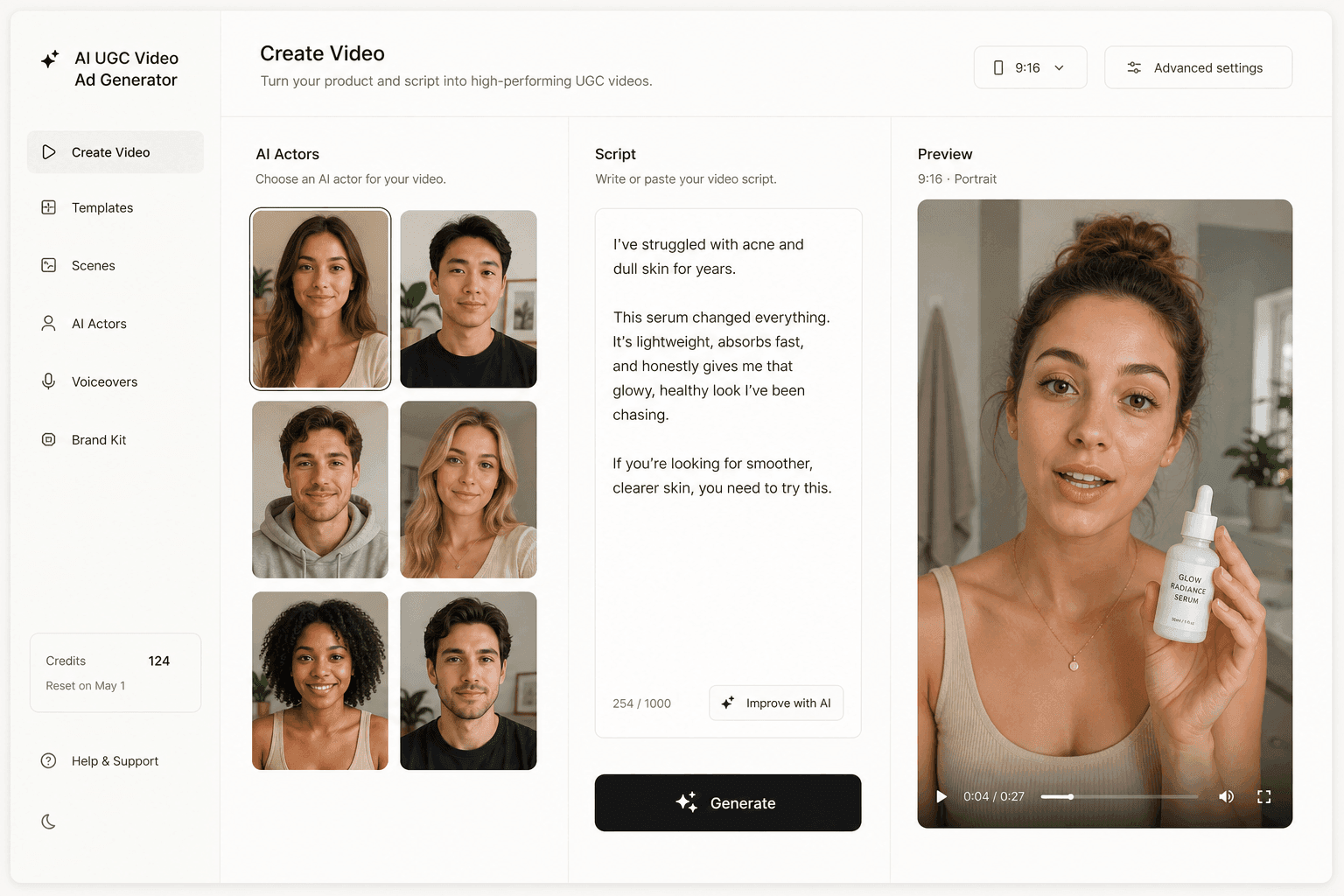
The short version of where Novoads fits: when your affiliate flywheel is still cold, your shop needs product clips it fully controls. In Novoads you upload the product photo, write or auto-generate a script, pick an AI actor, and get an ad-ready vertical video for a few dollars of credits, on a plan that starts at $49 a month. That keeps the shop's own account stocked with content while sample-fueled creator collabs ramp.
The shop is the easy part
Registering a TikTok Shop is a week of paperwork. What separates shops that sell from shops that sit is everything this guide sequenced after verification: listings that clear compliance the first time, margins built on the real 6% fee plus a commission you chose deliberately, fulfillment that does not sink your metrics, and an affiliate funnel that hands creators a reason to sell for you. The platform's cut is the smallest number in your P&L. The distribution you recruit is the biggest. Price the commission like it is your growth budget, because on TikTok Shop, it is.
Set up the shop this week, seed the open collaboration, and let the content layer, yours and your creators', do the selling. And when a listing earns real ad spend, the craft of TikTok ads that actually sell is the next guide in the sequence.
Frequently Asked Questions
Do you need a business license to sell on TikTok Shop?
Not necessarily. TikTok Shop US lets you register as an individual seller using a government ID (US passport, driver's license, state ID, or permanent resident card), the last four digits of your SSN or an ITIN, and a W-9 tax form. Registered businesses go through the corporation or partnership path instead, where TikTok asks for IRS-issued documents such as a 147C or CP 575 that show the legal business name and EIN. Sole proprietorships may also be asked for IRS proof of business.
How much does TikTok Shop take per sale?
TikTok charges sellers a referral fee on each completed order. The fee moved to 6% per order in April 2024, and TikTok's category chart, updated in May 2026, keeps most categories at 6% with select fine-jewelry sub-categories and pre-owned categories at 5%. The fee is calculated on customer payment plus platform discount minus tax. TikTok also runs promotions: as of July 2026 its seller recruitment page advertises a 0% commission fee for the first 90 days for new shops, with terms attached.
What is the difference between the referral fee and the affiliate commission?
The referral fee is what TikTok charges you on every completed order, currently 6% for most categories. The affiliate commission is what you choose to pay creators who promote your products through the Affiliate Center, anywhere from 1% to 80% of the sale. The first is automatic and non-negotiable. The second is a marketing budget you control per product, and many new sellers confuse the two when they calculate margins.
How do sellers get their first orders on TikTok Shop?
Mostly through creators. An open collaboration makes your products visible to every TikTok Shop creator at a commission rate you set, and free samples give creators a reason to film with your product. Once specific creators perform, a target collaboration lets you invite them directly at a higher rate, which always supersedes the open rate. Shop Ads come after that: once a listing or a creator video is converting organically, ads scale a signal that already exists.
When does TikTok Shop pay sellers?
After delivery, not after checkout. TikTok settles the order amount with sellers once the order is delivered and no refund or return request is open on it, and payouts go to your bank account automatically once the settlement rules and the $1 minimum payout threshold are met. If a customer refunds, TikTok returns the referral fee minus a refund administration fee of 20% of that fee, capped at $5 per SKU since May 2025.
Do I need followers to sell on TikTok Shop?
TikTok's published requirements for opening a US shop are about identity, age, and residency: an ID, a tax form, and an address, not an audience. A shop with zero followers can list products and recruit creators through the Affiliate Center from day one. Audience thresholds exist on the other side of the marketplace: creators who want to promote products face their own eligibility rules, which is exactly why sellers without followings lean on affiliate collabs for distribution.
Key Takeaways
- TikTok Shop registration is document-driven, not audience-driven: US individual sellers need to be 18 or older, reside in the US, and pass verification with a government ID, proof of address if asked, and a W-9. Products stay hidden until verification completes.
- The standing referral fee is 6% on most categories and 5% on select fine-jewelry and pre-owned categories, charged on customer payment plus platform discount minus tax. TikTok also runs new-seller promotions, so check the live offer in Seller Center.
- The referral fee and the affiliate commission are two different costs: TikTok takes the first automatically, and you choose the second (1% to 80%) as the rate you pay creators who sell for you.
- You pick fulfillment per SKU: ship orders yourself and own the logistics metrics, or send inventory to Fulfilled by TikTok and let TikTok store, pack, and ship with its 3-day delivery tag.
- First orders usually come from creators, not ads: an open collaboration puts your catalog in front of every TikTok Shop creator at a commission you set, and samples plus targeted invites do the early selling.