Colossyan Review for Ads: What a 30-Second Avatar Ad Costs
A 30-second stock-avatar ad comes to $4.45 on Colossyan's Professional plan billed monthly. But Colossyan is built for training, and its use policy is worth reading first.

Mauricio Valdivia
·13 min

A $4.45 avatar ad from a tool built for training
On Colossyan's Professional plan, a 30-second stock-avatar ad comes to $4.45 billed monthly. Billed yearly, it's $2.95. Either way, that's less than the $9.80 a 30-second talking actor costs on our Plus plan.
But Colossyan built its product for workplace training, and its own comparison page points marketing and social buyers to HeyGen, which it calls "a strong choice for marketing and social media video". So a review for ad buyers can't stop at the price. Colossyan's Acceptable Use Policy has clauses on advertising and on avatars voicing personal experiences, and you'll want to read them before you write a script.
We didn't test Colossyan for this post. Everything about Colossyan here comes from its own pages and from public ratings, read October 31, 2026. The Novoads side comes from our price list and one of our own renders.
What Colossyan is built for
Training teams are the buyer
Colossyan's pricing page calls it "Your single platform to create video-first, multimodal training and enablement content that engages and scales". Its generator page is titled "AI Video Generator for Training Teams". You drop in a PDF, slides or a script, and a Colossyan feature called Cora drafts the video. Then you direct the result, with a presenter picked from its 300+ stock avatars or a custom avatar of your own. Colossyan also sells quizzes, branching scenarios, courses and SCORM export (the format learning management systems read).
Its use-cases page says "We have shipped it for L&D, comms, sales, and customer success teams". The six jobs it lists are employee onboarding, compliance training, customer education, internal communications, product explainers and sales enablement. None of them is marketing or advertising. Its product-explainer page even asks "Why choose Colossyan for product training?", and Colossyan pitches its scenario avatars at "real-world training scenarios" such as offices and factory floors. The generator page also contrasts Colossyan with generic AI video generators, which it describes as "Built for social clips and generic marketing video".
Where ads come up
Ads do come up on Colossyan's blog. A post dated November 26, 2025, says "Brands use Colossyan for TikTok, YouTube Shorts, UGC-style ads, and product explainers", and it walks through a TikTok workflow in which you start from a product page, select 9:16 and generate multiple hook variations. A post dated February 18, 2026, describes dropping product media onto the timeline and exporting vertical, square and widescreen versions.
Those posts are the only places where we found an aspect ratio named. The product and pricing pages we read don't mention one, and we couldn't see Colossyan's help center, so check the export sizes in the editor before you plan around them.
Its numbers vary from page to page
Colossyan's own figures don't always agree, so treat them as approximate.
- Its pricing page says 120+ languages, and its avatars page says 100+.
- Its plan table lists 700+ stock voices, and its voices page says "more than 600 available voices".
- Its custom avatar page says in one place that a Studio Avatar takes five working days, and in another that it takes about 15.
Colossyan's plans and prices
Prices as of October 31, 2026, in US dollars before any tax, as shown to a visitor from Spain. Colossyan counts minutes separately for its two avatar engines, NEO and NEO2.
| Plan detail | Starter | Professional | Enterprise |
|---|---|---|---|
| Price | Free | $59 a month billed yearly, or $89 billed monthly, for one editor | Contact sales, billed annually |
| NEO minutes a month | 20 | 30 | Unlimited |
| NEO2 minutes a month | 0.5 | 10 | Unlimited |
| Editor seats | 1 | Up to 3 | Custom |
| Each extra editor | Not offered | $30 a month billed yearly, or $45 billed monthly | Custom |
| Custom avatars | 15 | 20 | Unlimited |
| Cloned voices | 3 | 5 | Unlimited |
| Video resolution | Up to 1080p | Up to 1080p | Up to 4K |
| Colossyan overlay | Stays on | Removed | Removed |
One review that ranks for Colossyan's name still lists a $19 basic plan and a free plan with 5 minutes of video. Neither appears on the pricing page.
What Colossyan's free Starter plan gives you
The $27 struck through on the Starter card is what Colossyan says the plan is worth, and its FAQ describes it as "$27/month worth of value". You pay nothing for Starter, and you don't need a credit card. Its NEO2 allowance covers one 30-second stock-avatar video a month, and that video keeps the Colossyan overlay, because removing the watermark is a paid feature. That's enough to judge the avatars, though we wouldn't run the result as an ad. Colossyan also mentions a 14-day free trial alongside the plan.
What yearly billing commits you to
On yearly billing, you pay for Professional up front, so a year for one editor costs $708. You get the year's minutes when you buy, which helps if your ads come in bursts. If you cancel early, your plan stays active until the end of the billing period, and Colossyan's FAQ says "Unused months are not refunded." Minutes you haven't used by the end of a billing period don't roll over, and deleting a generated video doesn't give you back the minutes it used.
Colossyan's refund policy gives you a full refund if you ask within 14 days of buying, have generated less than 10 minutes of video and aren't on Enterprise. You can also pause your account for free for up to 2 months.
What one 30-second ad costs on Colossyan and on Novoads
The math on Colossyan
Colossyan says "Every stock avatar in the library now runs on NEO 2", and its FAQ says "Videos with a NEO2 avatar use your NEO2 minutes." So a stock-avatar ad draws on Professional's 10 NEO2 minutes a month, and a 30-second ad uses half of one.
- Billed monthly, $89 for 10 NEO2 minutes is $8.90 a minute, so the ad costs $4.45.
- Billed yearly, $59 a month for the same 10 minutes is $5.90 a minute, so the ad costs $2.95.
- On a yearly Professional plan, you can add 600 NEO2 minutes for $1,500 a year through sales. That's $2.50 a minute, or $1.25 for each extra ad.
Ten minutes covers 20 ads of that length a month. Drafts don't count against them, and Colossyan's generator page promises "Unlimited free drafts and previews before you spend minutes", so you can check a script before it costs you anything.
That math rests on two assumptions of ours.
- We've assumed Colossyan counts a 30-second video as exactly half a minute. Its FAQ says videos count "based on their length", and we found no rounding rule on the pages we could read.
- We've assumed your ad uses a stock avatar. We couldn't find a page that says which avatars still run on NEO. An ad with a NEO avatar would draw on the 30 NEO minutes instead. That works out to $1.48 billed monthly, or 98 cents billed yearly.
The math on Novoads
We bill a talking actor by the started minute, so anything from 1 to 60 seconds costs the same. At 720p that's 200 credits. At 480p it's 100. So a 30-second ad at 720p costs the same number of credits on every plan, and the dollar cost depends on what you pay per credit.
- On Starter, which is $15 a month for 200 credits and monthly only, the ad costs $15.00 and uses up the whole month's credits.
- On Plus, at $49 a month for 1,000 credits, you pay $0.049 a credit. The ad costs $9.80, and a month covers five.
- On Plus billed annually, at $39 a month, you pay $0.039 a credit. The ad costs $7.80.
At 480p, halve each of those dollar figures. You pay for Novoads from the first month, and our pricing page lists every plan and credit cost.
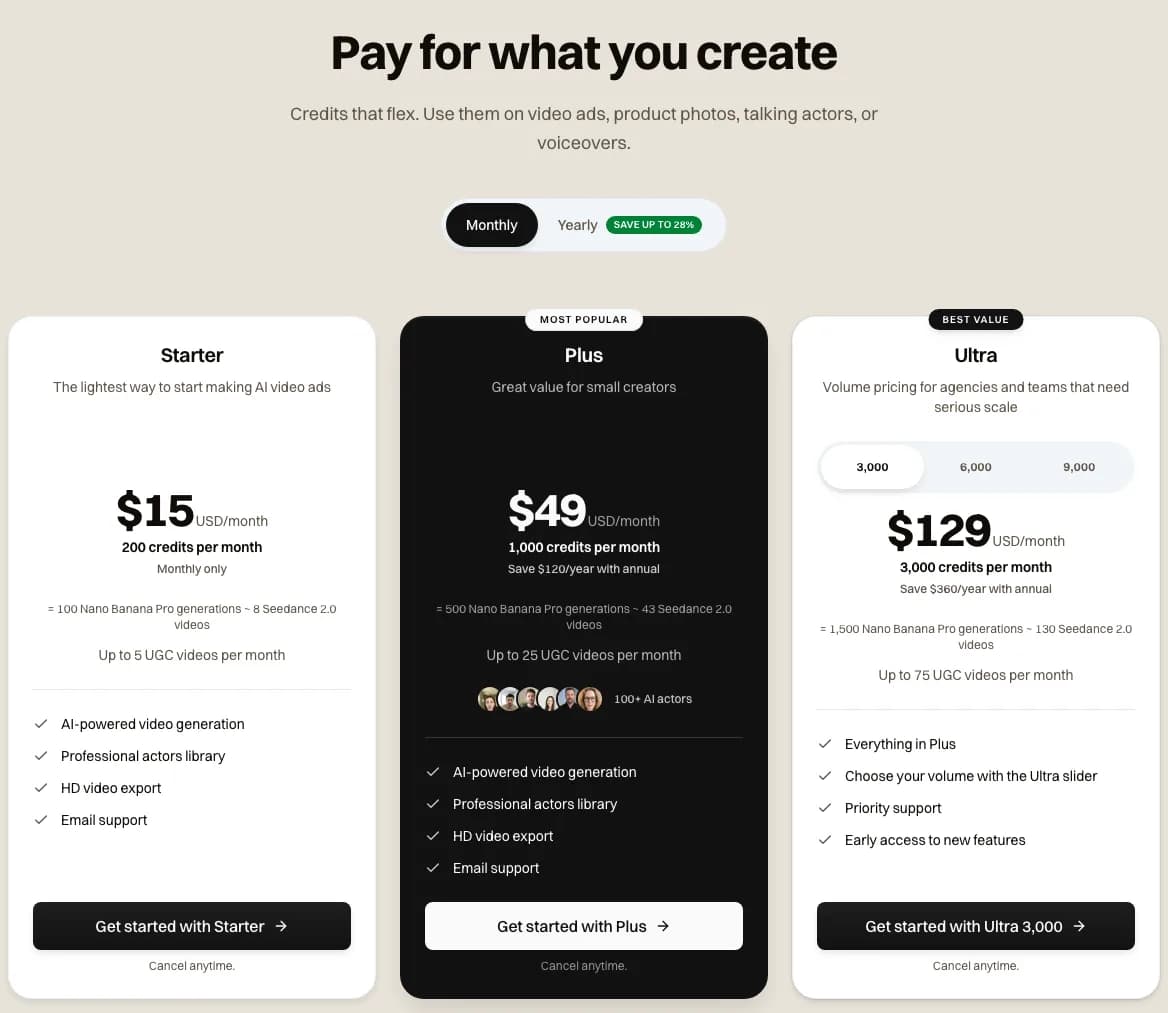 The Novoads pricing page with Monthly selected, 2026-10-31. Starter is $15 a month for 200 credits, monthly only.
On October 9, 2026, we asked for a 10-second talking-actor ad with library actor María and the voice Alexandra. It came back in 1 minute 9 seconds. The ad ran 9.5 seconds, and María read the script word for word. We were billed 200 credits, because one started minute is the smallest amount we bill.
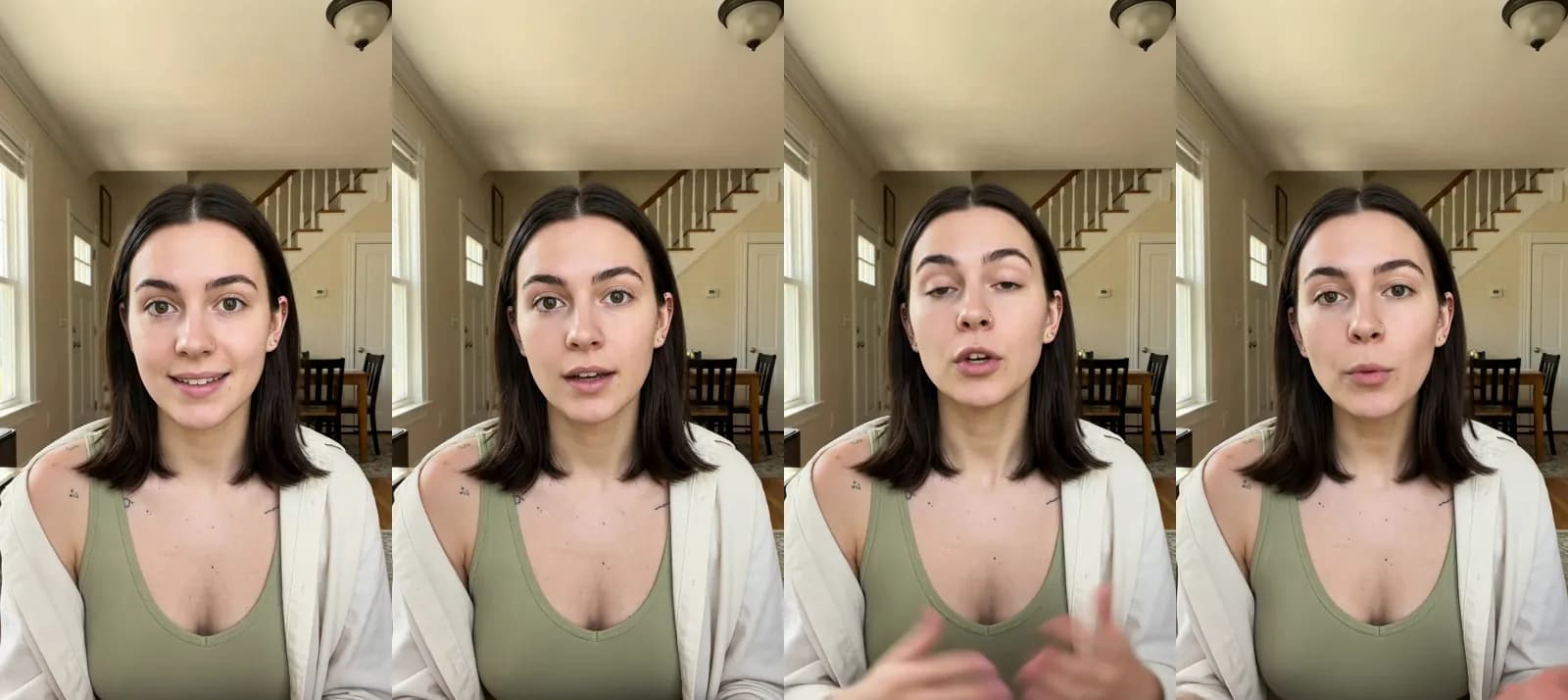 Talking actor, rendered 2026-10-09 · María talks up a reusable pet hair roller from her hallway · one started minute, 200 credits at 720p
Where Colossyan costs less
On a 30-second stock-avatar ad, Colossyan costs less than our Plus plan whether you pay monthly or yearly.
- Billed monthly, it's $4.45 against $9.80, a gap of $5.35.
- Billed yearly, it's $2.95 against $7.80, a gap of $4.85.
- A month of Professional at $89 covers 20 ads, and a month of Plus at $49 covers five.
Even at 480p on Plus, our ad costs $4.90, which is still more than Colossyan's monthly figure. On Professional, Colossyan also exports at up to 1080p, while we render a talking actor at up to 720p. And because Colossyan counts by length and we bill by the started minute, the gap should widen on shorter ads.
Our entry plan does cost less than Colossyan's first paid plan. Professional costs $89 a month or $708 up front. Our Starter is $15 a month, though that covers a single talking-actor ad. If you only want one look at a 30-second avatar, Colossyan's free Starter costs you nothing.
Can a Colossyan avatar run as an ad?
Colossyan's pages don't give one consistent answer, so we'll quote them and keep our own reading separate. We aren't lawyers, and none of this is legal advice.
What the Acceptable Use Policy says
The policy was last updated July 25, 2025. Its first section covers all the content you use with Colossyan, and three of its items touch on ads. You agree not to use content in these ways.
- "in an international television advertising campaign by or on behalf of an entity with annual revenues of more than One Billion Dollars ($1,000,000,000)"
- "in advertisements for medical devices or services or pharmaceutical products or political advertising"
- "that impersonates or attempts to impersonate any person or represent that content from the Services was human generated when it is not"
Its second section, headed "Avatars, Voices and Models", adds more limits, because those are "based-on real people" and their use "is subject to specific licensing conditions". Among other things, it says you can't use them in your videos in these ways.
- "alongside or in connection with regulated or not age-appropriate goods or services, such as gambling, adult entertainment venues, escort services, dating services, or the sale, advertisement or use of liquor, tobacco products or illicit drugs"
- "in which the Avatar, Voice or Model is making any kind of statement of opinion, including expressing any personal preferences or experiences as their own preferences or experiences, or endorsing a political party, candidate, elected official, or opinion"
- "for television broadcasting or advertising"
- "as suffering from, or medicating for, a physical or mental ailment"
As we read it, three of those matter most to an ad buyer. "For television broadcasting or advertising" could mean television only or advertising in general, and the policy doesn't say which. The line on personal experiences reads to us like a bar on the classic testimonial, where a stock avatar says it tried a product and loved it. And the first section's line on "human generated" content matters if your ad is meant to pass as a real customer. A script that only says what the product does looks safer, though the personal-experiences line also covers "any kind of statement of opinion".
None of this makes a first-person line safe somewhere else. In any tool, ours included, when an AI actor says "I" about a product, that's a claim you're making as the advertiser, so keep it true.
What Colossyan says elsewhere
Colossyan's other pages sound more permissive.
- Its November 2025 blog post says brands use it for "UGC-style ads".
- Its avatars page says "NEO 2 avatars also have no industry restrictions" and names healthcare and financial services.
- Its HeyGen comparison page says "Colossyan has no industry restrictions on stock avatar usage".
Colossyan's research page dates NEO 2 to January 2026, after the policy's last update. So the avatars page may describe a change the policy hasn't caught up with, but that's a guess on our part. As of October 31, 2026, the policy still includes these lines, and none of the pages we read says the avatars page overrides it.
We'd treat the policy as the page that counts, because Colossyan's Terms of Service (last updated December 19, 2024, with separate terms for Enterprise customers) tie your rights to it. Colossyan licenses its own material in a generated video "Subject to the full payment of fees and compliance with the requirements of the Acceptable Use Policy". The Terms add that the license "may be revoked" if you break the rules.
Stock avatars and your own avatar
The Terms define the two separately. An Avatar is "a synthetic avatar as presenter in Customer Created Content based on real-life persons". A Custom Created Avatar is "based on the visual representation and/or voice of a real-life person selected by the Customer, including Instant Avatars". The policy's second section names Avatars, so an ad with your own Instant Avatar may fall outside it. That's our reading, and Colossyan may see it differently.
The first section still applies, though, and the Instant Avatar terms say "You must comply with the Terms of Service and the Acceptable Use Policy at all times". For a Custom Created Avatar, the Terms also say "it is your responsibility to collect all necessary consents, authorisations and licenses and waivers from the relevant actor".
An Instant Avatar also comes with a practical limit. Colossyan says you can make one from a photo or short video in under a minute, and Professional allows 20. But if you clone your voice for it, its FAQ warns that "the generated audio quality may start to degrade after about 30 seconds/500 characters". That's roughly the length of the ad we've priced.
Before you pay for media, we'd send Colossyan your script and your channels, ask in writing whether they're covered, and keep the answer.
Who Colossyan points to for marketing video
Colossyan's comparison page, titled "HeyGen vs Colossyan: Training Team Comparison", isn't dated. As of October 31, 2026, it said this under the heading "Which Platform Is Right for Your Team?".
HeyGen is a strong choice for marketing and social media video with excellent translation. Colossyan matches it on video quality and goes further with structured courses, interactivity, and content lifecycle management. Whether you need video only or full training programs, Colossyan covers both.
Its "Choose HeyGen if..." list opens with "You primarily create marketing and social media video".
Read the whole paragraph, though. It's Colossyan's framing on its own sales page, it concedes nothing on quality, and the page never uses the word "ads". We read it as a training company pointing marketing buyers to a rival for that job while keeping its claim on everything else.
If you're weighing HeyGen, start with our HeyGen review and our HeyGen vs Colossyan comparison. For the other big name in presenter video, see our Synthesia review and Colossyan vs Synthesia.
Colossyan's ratings
Trustpilot
Colossyan has a 4.0 rating from 9 reviews on Trustpilot, as of October 31, 2026. Only 4 of them came in the last 12 months, so one new review can move the score. Both reviews from September 2026 are positive, one titled "This is a really great tool!" and the other "Generally it has been good". A 3-star review from April 2026, titled "Lots of pauses", says "noticeable pauses between scenes create an awkward rhythm that increases the overall video length."
G2 and the other review sites
We couldn't view G2, Capterra, GetApp, TrustRadius or Gartner, so we won't quote a score from any of them. We can tell you what Colossyan says about G2, though its pages don't agree.
- Its generator page says "4.7 on G2, from 480+ reviews".
- Its use-cases page says training and enablement teams "rate us 4.6 on G2".
- Its avatars page says "Rated #1 on G2 for AI Video Generation".
We couldn't check any of those against G2 itself.
Who Colossyan suits, and who we'd send elsewhere
Training teams
We think Colossyan makes sense when training is the job. If you run onboarding, compliance or customer education, and you want courses, quizzes and SCORM exports in one place, that's what its pages are built around. Colossyan's free Starter plan also lets you judge the avatars before you pay.
We'd also consider it for a presenter ad that states product facts in a category the policy doesn't touch, if you need up to 20 of those a month. Our guide to AI avatar video generators covers that format across tools. Our Akool pricing breakdown prices the same format on another stock-avatar tool and reads its rules for paid ads.
Ad buyers who need something else
We'd look elsewhere in four cases.
- Your ad needs someone speaking from experience, and you planned to use a stock avatar.
- You sell something on the policy's lists, such as alcohol, gambling, dating services or medical products.
- You're planning a television campaign.
- You want your own cloned voice reading ads longer than about 30 seconds.
If ads are the whole job, that's what we built Novoads for. You write a script or start from a product image, pick an AI actor, and download a file for whichever ad platform you use. You still run the ad yourself. As the math above shows, a talking actor costs more with us than a stock avatar does on Professional. But our plans start at $15 a month, and you can spend the same credits on video models, product photos and voiceovers. Our pricing FAQ says "All videos generated with Novoads are fully licensed for commercial use."
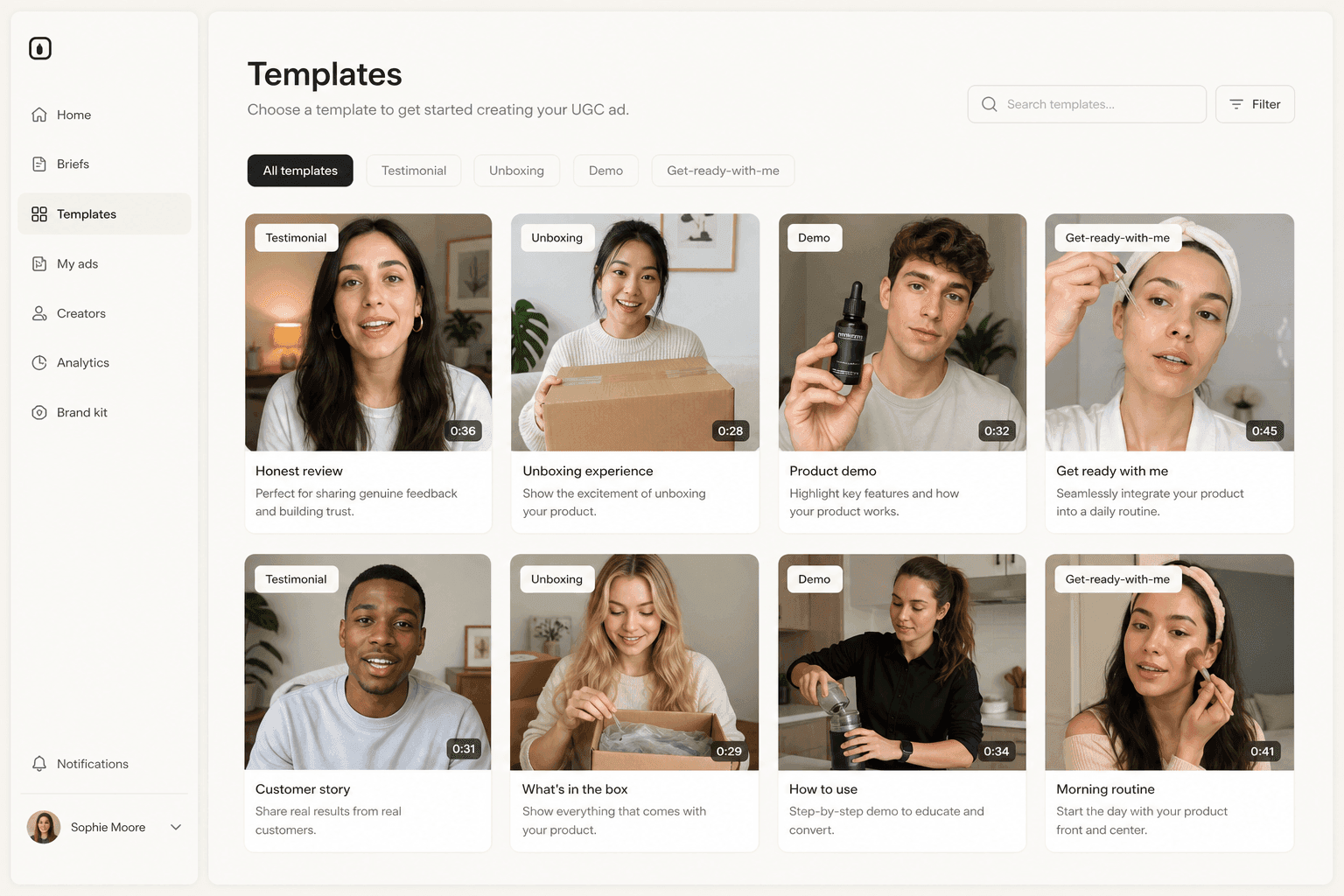
A stock talking actor from our library has empty hands, though. To show your product in hand, you upload a photo of someone holding it and make a custom actor. Our Colossyan alternative page puts the two side by side, and our guide to AI actors explains how brands cast them.
What we'd do before paying for either
Take one real script and check it against the policy's second section before you compare prices. If it clears that list and a presenter look suits your product, Colossyan is the cheaper way to make that ad. If it doesn't, or you want a creator look, compare the UGC tools by job and price the ad you'd actually run.
Frequently Asked Questions
Is Colossyan worth it for video ads?
It depends on your script. A 30-second stock-avatar ad works out to $4.45 on Professional billed monthly. That's less than the $9.80 a talking actor of the same length costs on our Plus plan. But Colossyan built its product for training, and its Acceptable Use Policy, last updated July 25, 2025, bars its stock avatars from voicing personal experiences as their own. If your ad states product facts and your category isn't on its restricted lists, it's worth pricing out. If your ad is a testimonial, read the policy first and ask Colossyan in writing.
Key Takeaways
- A 30-second stock-avatar ad works out to $4.45 on Colossyan's Professional plan billed monthly. Billed yearly, it's $2.95, assuming the ad counts as half a NEO2 minute.
- A talking actor of the same length costs 200 credits on Novoads, or $9.80 on Plus, so Colossyan costs less whether you pay monthly or yearly.
- Colossyan's Acceptable Use Policy lists 'for television broadcasting or advertising' among the barred uses of its Avatars, Voices and Models, and it doesn't let them voice personal experiences as their own.
- As of October 31, 2026, Colossyan's comparison page calls HeyGen 'a strong choice for marketing and social media video' and says Colossyan matches HeyGen on video quality.
- Colossyan has a 4.0 rating from 9 reviews on Trustpilot, as of October 31, 2026. We couldn't view G2 or the other review sites, and Colossyan's own G2 figures vary from page to page.
Sources
- •Colossyan: Pricing
- •Colossyan: HeyGen vs Colossyan, Training Team Comparison
- •Colossyan: Acceptable Use Policy
- •Colossyan: Terms of Service
- •Colossyan: Refund Policy
- •Colossyan: AI Avatars
- •Colossyan: Custom AI Avatars
- •Colossyan: AI Video Generator
- •Colossyan: Use Cases
- •Colossyan: Research
- •Colossyan blog: 5 AI video ad generators to boost your marketing results
- •Colossyan blog: 5 best AI social media video generators for viral content
- •Novoads: Pricing