Gemini TTS Pricing: Every Model and Route, Plus What a 30-Second Ad Voiceover Costs
Google lists Gemini 3.8 Flash TTS at $0.00225 per 10 seconds of audio through December 31, 2026, then twice that. We go through every Gemini TTS model on the Gemini API, the Agent Platform and Cloud Text-to-Speech, price one 30-second ad read on each route, and show what a voice costs inside an ad tool.

Mauricio Valdivia
·12 min
Under a cent for a 30-second read, until January 1
Google lists Gemini 3.8 Flash TTS at $0.00225 per 10 seconds of audio output on the Gemini API's Standard tier. That rate holds through December 31, 2026. By our arithmetic, it puts a 30-second ad voiceover at about $0.0068, counting the script's text input. On January 1, 2027, the listed rate rises to $0.0045 per 10 seconds. The same read then costs about $0.0136.
None of the top five results for this search works out what one voiceover costs on each of Google's routes at today's rates. The only calculator among them lists just two TTS models, both 2.5 previews, and Google's deprecations page says each could be shut down as early as November 17, 2026.
We read Google's pricing and documentation pages from Spain on November 5, 2026, and set them beside a clip we made in Novoads with a voice from our own catalog. We didn't test Gemini TTS for this post, and we didn't generate any Gemini audio. If you searched for the price of the Gemini app, that's a different product. Google's terms say AI Studio and the Gemini API are for developers building for professional or business purposes, not for consumer use, and every price we quote is for those developer routes.
Gemini TTS prices on all three of Google's routes
Prices as of November 5, 2026. Google sells these voices in three places. The Gemini API is the developer route, and you create its keys in AI Studio. The Gemini Enterprise Agent Platform and Cloud Text-to-Speech are the two routes inside Google Cloud. The table shows list prices for audio output in US dollars per million tokens. For the Gemini API, that's the Standard tier, and each cloud page lists a single rate.
| Model | Price pages that list it | Through Dec 31, 2026 | From Jan 1, 2027 | Earliest shutdown, Gemini API list |
|---|---|---|---|---|
| 3.8 Flash TTS | Gemini API, Agent Platform, Cloud TTS | $9.00 | $18.00 | None announced |
| 3.8 Flash-Lite TTS | Gemini API, Agent Platform, Cloud TTS | $6.00 | $12.00 | None announced |
| 3.1 Flash TTS Preview | Gemini API, Cloud TTS | $20.00 | No change listed | November 17, 2026 |
| 2.5 Flash Preview TTS | Gemini API | $10.00 | No change listed | November 17, 2026 |
| 2.5 Pro Preview TTS | Gemini API | $20.00 | No change listed | November 17, 2026 |
| 2.5 Flash TTS | Cloud TTS | $10.00 | No change listed | Not on the list |
| 2.5 Flash-Lite Preview TTS | Cloud TTS | $10.00 | No change listed | Not on the list |
| 2.5 Pro TTS | Cloud TTS | $20.00 | No change listed | Not on the list |
The Gemini API's rates and its older voices
The Gemini API's price page has the most detail. Text input for both 3.8 models costs $0.50 per million tokens this year and $1.00 next year. Google also gives the audio rate per 10 seconds. For Flash-Lite TTS, that's $0.0015 this year and $0.003 next year.
The three older models on this route are on their way out. Google's deprecations page gives 3.1 Flash TTS Preview, 2.5 Flash Preview TTS and 2.5 Pro Preview TTS a shutdown date of November 17, 2026, and names the 3.8 pair as their replacement. The page calls that the earliest possible date and says Google will give advance notice of the exact one. Google's model page already calls 3.1 Flash TTS Preview a legacy preview model.
There's one more open question about the 2.5 voices. On September 18, Google's changelog said it was limiting the 2.5 models to users who'd actively used them in the past, while also saying they aren't deprecated. That note doesn't name the voices. We've kept the older rows in the table so it's complete, but we wouldn't start a new ad pipeline on any of them. Google hasn't announced a shutdown date for the 3.8 pair.
The Agent Platform, where this year's rates come as credits back
The Gemini API's price page warns that its prices may differ from the Agent Platform's. Today they match for the 3.8 pair, in both columns. The Agent Platform's footnote calls this year's rows promotional pricing, provided through 50% credits back on net spend on the same model within a given period. We couldn't find how long that period runs or how the credit shows up on your bill, so we'd budget at the listed rate and count the credit once it arrives.
The Agent Platform's price page covers only the 3.8 pair. Its speech overview also lists 3.1 Flash TTS Preview, 2.5 Pro TTS and 2.5 Flash TTS, and for those earlier models it points you to the Cloud Text-to-Speech docs. The Agent Platform's prices are in US dollars. If you pay in another currency, Google says the prices listed in your currency on its Cloud Platform SKUs apply.
Google's pages don't agree on the launch stage, either.
- The Agent Platform's model pages call the pair GA, with a release date of October 28, 2026.
- Both cloud price pages label it Preview.
- The Gemini API's changelog marked the pair generally available on September 22, 2026.
Cloud Text-to-Speech lists the 3.8 pair, but its API doesn't offer it
Cloud Text-to-Speech's price page lists the 3.8 pair at the same rates, marked Preview. But its documentation, last updated October 30, 2026, says the pair is generally available through the Agent Platform API and Agent Studio, and that the two aren't available through the Cloud Text-to-Speech API. So if you call that API, the Gemini voices you can buy are 3.1 Flash TTS Preview, 2.5 Flash TTS, 2.5 Flash-Lite Preview TTS and 2.5 Pro TTS, and we'd treat the 2.5 ones with the same caution as above.
None of the Gemini rows on that page comes with free usage. The page still opens by saying Text-to-Speech is priced by the characters you send each month. That's how its other voice families are sold, and Google lists the Chirp 3: HD voices at US$30 per 1 million characters past the free usage limit.
A 30-second ad read, worked out route by route
The assumptions behind the math
Google prices audio by the token, so what a voiceover costs depends on how long the audio runs. Our math rests on four assumptions, and you can redo it with your own script.
- A 30-second read at an average pace runs about 75 words.
- Google's price pages for these voices count 25 audio tokens per second. Thirty seconds comes to 750 of them.
- Google's tokens page puts 100 tokens at about 60 to 80 English words. We take the higher token count, 125 text tokens for 75 words.
- We count text input at each model's listed rate and leave out style instructions, which add text tokens at that same rate.
What one read costs on each route
At the rates listed through December 31, 2026, one 30-second read comes to these amounts by our arithmetic.
- About $0.0068 on 3.8 Flash TTS through the Gemini API. Google's own per-10-second figure gives the same audio cost.
- About $0.0046 on 3.8 Flash-Lite TTS through the Gemini API.
- The same two amounts on the Agent Platform, before any credits back.
- About $0.0076 on the Cloud Text-to-Speech API with 2.5 Flash TTS or 2.5 Flash-Lite Preview TTS.
- About $0.0151 on the Cloud Text-to-Speech API with 3.1 Flash TTS Preview or 2.5 Pro TTS.
From January 1, 2027, both 3.8 amounts double. That's about $0.0136 on 3.8 Flash TTS and about $0.0091 on Flash-Lite TTS. At this year's rate, a full minute on 3.8 Flash TTS costs about $0.0136, the same as a 30-second read next year. A hundred of these reads on 3.8 Flash TTS would cost about $0.68 this year.
How the per-second token count could change the price
We took the 25 tokens a second from the Gemini API's and Cloud Text-to-Speech's price pages, where the figure appears under the voice rows. We couldn't find a per-second figure on the Agent Platform's TTS pages, so we used the same 25 for its line. Google's general page on tokens gives 32 tokens per second for audio, but in a passage about input that doesn't name these voices.
We can't tell you which count a real 3.8 read returns, because we didn't run one. At 32 tokens a second, the read above would cost about $0.0087 instead. Pace changes the cost too. Every extra second of audio adds 25 tokens, or $0.000225 at this year's Standard rate, so a slow, breathy read costs more than a brisk one with the same words.
Batch, Flex and Priority on the Gemini API
These three tiers are part of the Gemini API. Neither cloud price page lists a batch, Flex or Priority rate for these voices, and the Agent Platform's model pages say you buy them pay-as-you-go.
Prices as of November 5, 2026, per million audio tokens for 3.8 Flash TTS.
| Gemini API tier | Audio through Dec 31, 2026 | Our 30-second read | Speed, in Google's words |
|---|---|---|---|
| Standard | $9.00 | About $0.0068 | Interactive |
| Batch | $4.50 | About $0.0034 | 24-hour target turnaround |
| Flex | $4.50 | About $0.0034 | 1 to 15 minute latency target |
| Priority | $16.20 | About $0.0123 | Lower latency |
Batch halves the price if you can wait a day
Google's Batch API page says batch usage is priced at 50% of the standard interactive cost, with a target turnaround of 24 hours that's usually much quicker. A job that runs or waits for more than 48 hours expires with no results.
Google's price page lists Batch audio for 3.8 Flash TTS at $4.50 per million tokens this year, half the Standard rate. That brings our 30-second read down to about $0.0034. On Flash-Lite TTS, it drops to about $0.0023. Batch makes sense for a catalog of product voiceovers you can queue overnight. For a script you're still fixing an hour before launch, the Standard rate is the one to budget for.
Flex is on the price list but still in preview
The price page also lists Flex prices for the 3.8 pair, and they match Batch. Google's Flex page says the feature is in preview and offers a 50% cost reduction in exchange for variable latency and best-effort availability. It puts the latency target at 1 to 15 minutes. We couldn't find a TTS model in that page's list of supported models, so we'd treat Flex for voices as listed but unproven.
Priority costs more and is also in preview
Google describes Priority as a tier for business-critical workloads that need lower latency. Its page says the feature is in preview and priced at 75 to 100% more than the standard API. On the voice rows, that's $16.20 per million audio tokens for 3.8 Flash TTS this year. At that rate, our 30-second read comes to about $0.0123.
Google's free tier and the minimum to start paying
Free of charge, within limits you see only after signing in
Google's price page lists both 3.8 models as free of charge on the free tier, for Standard requests. Google's rate-limits page doesn't give the voices' free limits. Instead, it says you can view your limits in Google AI Studio, behind a sign-in we didn't do for this post. The same price page says AI Studio's own playground is free of charge in every available region.
Before you send an unreleased script, keep in mind that Google's price page says free-tier content is used to improve its products. For paid use, it says content isn't used that way, so we'd keep launch scripts on a paid key. Google's docs also say its AI plans for AI Studio are separate from Gemini API usage tiers and that it bills and manages Gemini API usage separately, so a consumer subscription doesn't cover API calls.
Paying starts with a $5 top-up
Google's billing page says moving to the paid tier means linking a billing account and prepaying at least $5 of credits. By our arithmetic, that $5 covers about 730 of the reads above on 3.8 Flash TTS at this year's Standard rate. Google's billing FAQ adds that prepaid credits expire after a year and can't be refunded.
The audio file, the voices and the languages
WAV or raw PCM, so plan on converting
Google's speech guide says a standard request on the Gemini API returns a complete WAV file (24 kHz, mono, 16-bit), and streaming returns headerless raw PCM. The Agent Platform's docs say MP3 and Ogg Opus output aren't supported for these models. If your video editor wants MP3, you'll have to convert the file yourself. MP3 and Ogg Opus show up only for the older Gemini voices on the Cloud Text-to-Speech API.
Voice counts depend on the page you read
Three of Google's pages describe the 3.8 pair's voices, and each gives a different count, so whenever you quote a voice count, name the page it came from.
- Google's speech guide lists five ways to get a voice. You can pick from 30 curated studio voices or from an extended library it describes as hundreds of additional voices, or you can make one with voice design, voice replication or voice remixing.
- The Agent Platform's docs list four of those ways (all but remixing) and put its library at more than 2,000 curated preset voices.
- The September 22 changelog entry says 150+ prebuilt and custom voices.
Remixing is the newest of the five ways, and the changelog marks it released on November 4, 2026. For how replication works, consent recording included, see our post on the 3.8 launch.
Language counts, page by page
The language counts differ by page as well.
- Google's Gemini API model page lists 130 languages for 3.8 Flash TTS and 101 for Flash-Lite TTS.
- The Agent Platform's model pages say 132 and 103.
Either way, Flash-Lite TTS covers fewer, so check for your market's language on the page for the route you'll use. If you're weighing other voice models too, our post on Qwen Audio 3 TTS looks at what an ad voiceover needs from one.
What a voice costs inside an ad tool, ours included
Our AI voice is priced per 400 characters
Novoads doesn't sell or run Gemini TTS. Our AI voice comes from our ElevenLabs catalog, and we price it per started block of 400 script characters, with a 1-credit minimum. We base our math on a pace of 15 characters a second.
- At that pace, a 30-second script runs 450 characters. That rounds up to 2 credits.
- That's about 10 cents on Plus and 15 cents on Starter, dividing each plan's price by its credits.
- On Plus, that's about 14.4 times Google's Standard list rate for the same read on 3.8 Flash TTS.
- A full minute costs 3 credits with us, or about 15 cents on Plus. That's about 10.8 times Google's listed rate for a minute.
Read for read, Google's API is the far cheaper voice. If you're building an app, voicing thousands of product clips or wiring up your own pipeline, buy it from Google. Our voice catalog covers 31 languages, so check for yours there too.
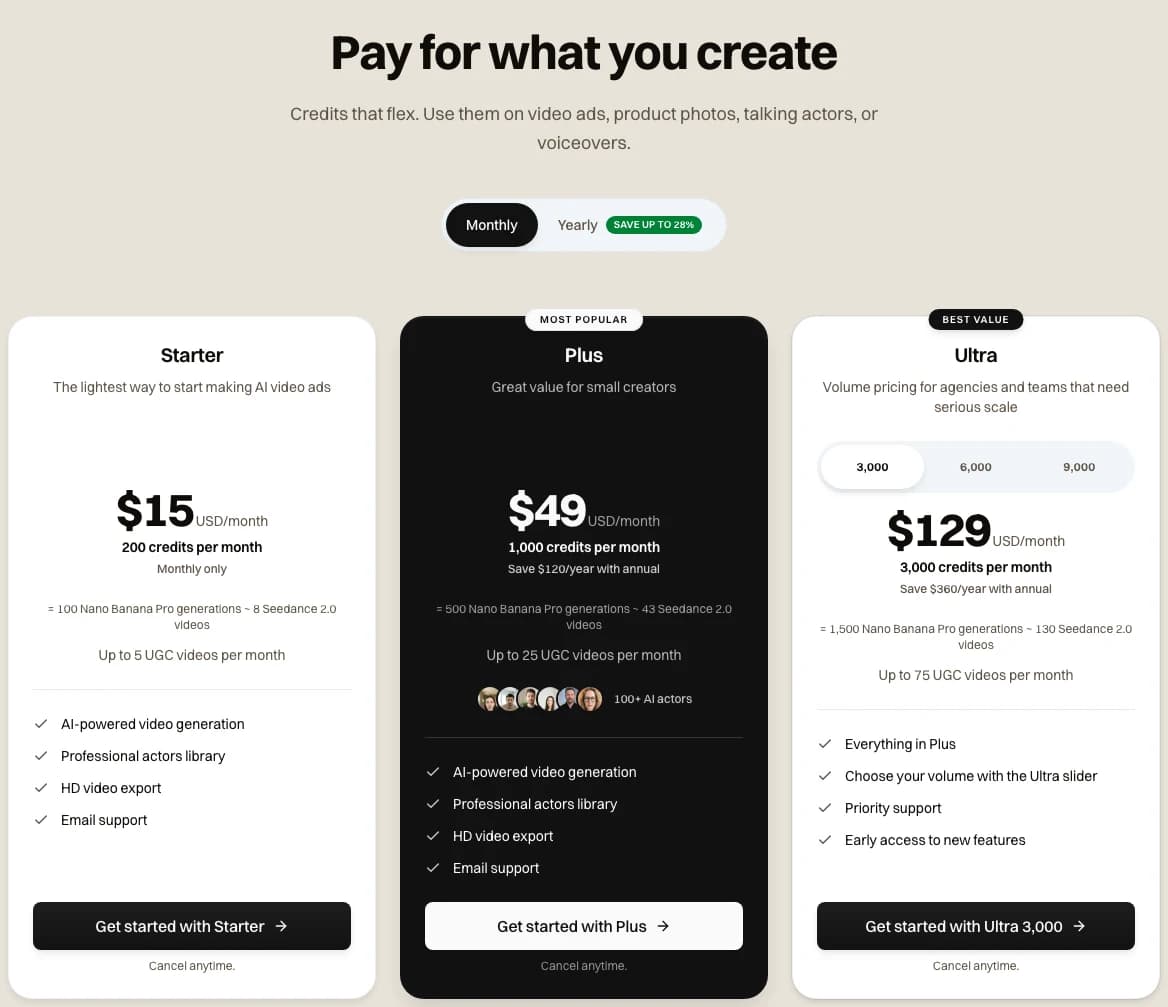 Our pricing page set to Monthly, taken 2026-11-05, with Starter, Plus and Ultra side by side and the monthly credits on each card
Every Novoads plan is paid from the first month. Our pricing page lists what each one includes, starting with Starter at $15 for 200 credits.
The voice inside a talking-actor ad
We can't play audio in a post, so we're showing four frames of a finished ad made with our voice. On October 20, 2026, we made a 15-second ad through the Novoads connector. In it, library actor Emma reads a script about linen sheets for hot sleepers, in the Alexandra voice from our ElevenLabs catalog. The ad came back in 1 minute 40 seconds with the script read word for word. At 720p it cost 200 credits, voice included.
 Made in Novoads with Talking actor · Emma, one of our library actors, reads a linen-sheets script for hot sleepers in the Alexandra voice · 15 seconds at 720p for 200 credits · rendered 2026-10-20
A started minute of talking actor costs 200 credits at 720p, and that's the price of the whole ad. At 480p the same minute is 100 credits. So when you compare, set Google's price for the voice alone against our 2 credits. For 200 credits you get an actor on camera saying your script, which a voice API doesn't give you. If you're casting one, our guide to AI actors covers how brands cast them, and our piece on what makes a UGC-style ad read as organic goes well past the voice.
Choosing between a voice API and an ad tool
Which one to buy comes down to what you're making.
- For raw voiceover at volume, Google's API is the cheaper buy by a wide margin, and ElevenLabs' API is the other common one to price.
- If you'd rather host a voice yourself, we compared open-source voice models for ad work.
- If you're comparing ad tools, we priced a 30-second ad on HeyGen's plans too.
- If what you need every month is the finished ad, with an actor and the voice already in it, that's what we built Novoads for.
Get the ad with the voice already in it
Novoads turns your script into a talking-actor ad, voice included, on monthly plans paid in credits.
Compare Novoads plansIf you build on Google's voices this year, budget for the 3.8 rates to double on January 1, 2027.
Frequently Asked Questions
How much does Gemini TTS cost?
Google's Gemini Developer API pricing page lists Gemini 3.8 Flash TTS audio output at $9.00 per million tokens on the Standard tier through December 31, 2026. Google puts that at $0.00225 per 10 seconds of audio. From January 1, 2027, the listed rate is $18.00 per million tokens. Text input costs $0.50 per million tokens this year and $1.00 next year. For Flash-Lite TTS audio, Google lists $6.00 this year, then $12.00. By our arithmetic, a 30-second ad voiceover comes to about $0.0068 on 3.8 Flash TTS at this year's Standard rate. Those are list prices in US dollars, read on November 5, 2026.
Key Takeaways
- Google lists Gemini 3.8 Flash TTS audio at $0.00225 per 10 seconds on the Gemini API's Standard tier through December 31, 2026. On January 1, 2027, the listed rate doubles to $0.0045.
- By our arithmetic, a 30-second ad voiceover costs about $0.0068 on 3.8 Flash TTS at this year's Standard rate, text input included. On Flash-Lite TTS it's about $0.0046, and Batch pricing halves both if you can wait a day.
- The Agent Platform lists the same 3.8 rates and says this year's are provided through 50% credits back. Cloud Text-to-Speech's price page lists them too, but its docs say the 3.8 pair isn't available through the Cloud Text-to-Speech API.
- Google's deprecations page lists November 17, 2026 as the earliest shutdown date for 3.1 Flash TTS Preview and the two 2.5 preview voices, so we wouldn't start new ad work on any of them.
- With our AI voice, the same 30-second read costs 2 credits. On Plus that's about 10 cents, or about 14.4 times Google's Standard list rate, so for a bare voiceover Google's API is the cheaper buy.