InVideo Review for Ads: The Agentic Editor and Who It Fits
InVideo review for ad teams: what its browser editor and AI assistant do well, where its own pages and dated ratings show limits, what a seat costs, and who it fits.

Mauricio Valdivia
·13 min
Five editor releases since September 1, judged for ads
InVideo's news page lists five product updates about invideo Editor between September 1 and October 6, 2026: the browser editor itself, then agentic sound design, agentic effects, an MCP server for outside AI agents, and scene extension. It is a bet on the edit. Our verdict: InVideo fits ad teams that start from footage they shot or collected and want an AI assistant to log it, cut it and fill the gaps; teams that start from a script and need talking product ads should price the finished ad, agent work included, against a generator before they commit. We have not used InVideo hands-on. This review is built from InVideo's own dated pages, public ratings read on October 21 and 22, 2026, and our own renders of the same ad type in Novoads.
The sections below take InVideo at its word, page by page. Where a page carries a date, the date is the page's own; where it carries none, the date is the day we read it. Capability claims stay in InVideo's voice, because the outside write-ups we found repeat InVideo's own descriptions rather than test the editor.
InVideo today: an editor with an agent inside
The September 1 post that introduced invideo Editor
InVideo's news post dated September 1, 2026 introduces invideo Editor as "a professional video editor that runs in the browser and comes with an AI assistant editor you can hand real editing work to." You describe the edit in plain words, and the post says the assistant watches the footage, does the work and places the result on a multitrack timeline you keep control of. The page's own metadata shows an edit on September 25, so every line quoted here is the page as it read on October 21 and 22, 2026, not necessarily the words that went up on September 1.
What the post lists for the assistant editor:
- A first draft from raw footage, "with or without a script," with the best takes picked and filler removed, plus a flag on script lines that were never shot.
- Multicam: give it a folder per camera and InVideo says "it frame-matches every angle and switches between them based on who is speaking."
- Footage search by person, emotion, action, object, scene or camera angle, with no manual logging.
- B-roll inside the project: "The assistant editor generates it or searches the stock library and drops it on the timeline."
- Cleanup and delivery, where "Dubbing into other languages with lip sync is built in."
InVideo also says "More than 200 video, image, and audio models are available from inside the editor," next to licensed stock clips, images and music from iStock, Shutterstock, Storyblocks and other providers. That count is InVideo's own, and we have not checked it.
Four follow-ups, each with its own date
InVideo kept adding to the editor after September 1, and each addition has its own post on the news page:
- September 25, Agentic Sound Design. The agent "analyses the sequence, finds or generates sounds, and builds a layered sound bed you can direct and refine."
- September 30, Agentic Effects. It builds a described look on your footage, with editable-project export to Adobe Premiere Pro, DaVinci Resolve and Final Cut Pro.
- September 30, invideo MCP. A server that lets outside agents work inside the editor; the post names Claude, ChatGPT, Claude Code, Codex, Cursor, VS Code and Gemini CLI.
- October 6, Agentic Extend. "Extend a scene by up to 30 seconds through conversation." InVideo says it is designed to keep "the scene's characters, products and audio identity" as the action continues.
The help center's own "Introducing invideo Editor" article carries September 11, 2026, which is the date of that help article, not a second launch. What the five news dates show is pace: four editor features between September 25 and October 6.
Where the ad features live
For ads specifically, InVideo points to its AI UGC ads page, an undated product page we read on October 21 and 22, 2026. It describes an agent that starts from a product or app link, writes or takes your script, casts a creator, and stitches a finished ad "sized for where it runs: TikTok and TikTok Shop, Reels, Meta, Shorts, or your product page." The same page offers "Export everything if you would rather finish in your own editor," which ties the ad agent back to the timeline above. The September 1 post adds that Invideo Agent Two "runs inside the same project," so a video can be generated, assembled and finished in one place.
What InVideo does well for ad work
Turning raw footage into a first cut
Plenty of ads still start as footage: a founder talking into a phone, a creator's raw takes, a product demo shot on a kitchen table. For that work, the assistant editor's feature list is the strongest thing InVideo publishes. A base cut from raw footage, search across hours of takes and multicam switching take on the slow, unglamorous hours of an ad edit. The output stays editable, too: "Everything the assistant editor places is a normal clip on a normal timeline."
Our read: for a team that tests several openings against one body, this is the right shape of tool, because swapping a hook is an edit, not a fresh render. If that is your workflow, our guide to testing ten openings on one video ad pairs well with an editor like this.
Briefing a creator agent from a product link
InVideo's UGC ads page makes four promises an ad buyer will care about. All four are InVideo's words, and none were tested by us:
- Paste a link and "the agent pulls your product details, imagery, and app interface into context."
- It casts a creator and "locks the face and voice together," so the same person carries every shot.
- "Framing, expression, and product placement are fixed as images first. You approve the look before anything animates."
- "Ask for ten hooks and the agent builds ten," each on the same creator and product.
The still-first step is the one we would copy. Approving a frame is cheaper than approving a clip, and a product placed wrong in a still costs one image to fix. The page also says "You never pick a model or write a prompt," which suits a busy team and frustrates one that wants to choose the engine per shot. Whether the creators look convincing depends mostly on the video engine underneath, the point our piece on where AI UGC realism comes from makes about every tool in this category.
Review links, seats and export to your editor
Agencies and in-house teams with several hands on one ad get the most from InVideo's team features. The September 1 post says a shareable review link "lets anyone scrub the finished output and leave frame-accurate comments, and the assistant editor can act on those comments directly." The US copy of the pricing page from October 19, 2026 lists multiplayer editing for up to 5 seats on Starter, 10 on Plus and 20 on Max.
When a client's own editor wants the project, InVideo says you can "Export an editable project that opens in Premiere Pro, Final Cut Pro, or DaVinci Resolve with every cut and layer intact." For an agency whose client keeps a house editor, that handover matters more than any single feature above.
Where InVideo falls short
Limits InVideo prints on its own pages
None of these come from a reviewer. Each is InVideo's own wording, with the page's date where it carries one:
- Seedance 2.5 is not on the entry plan. The Starter card on the US pricing copy of October 19, 2026 says "No access to Seedance 2.5"; the model starts on Plus.
- Credits reset. The pricing FAQ says "Unused credits don't roll over to the next month," and adds "We reserve the right to update credit costs at any time, without prior notice."
- An agent reply can spend more than the clip. InVideo's help center says agent work and model generation use credits and that "credit usage is not limited to finished video clips," because a reply can include processing your request as well as producing media.
- Team features sit higher up. The September 1 post says "Team features are available on Team and Enterprise plans."
- The price moves. Internet Archive copies of the US pricing page show Plus at $50 per seat a month billed annually on September 29, $36 on October 5 and $30 on October 19, 2026, each struck through from $60.
Two of these deserve a fair reading. Novoads' monthly plan credits reset too, so the rollover rule matters less than how many credits a finished ad burns. And the help center's line about agent replies is honest disclosure, but it means the cost of an agent-made ad is a conversation, not a price tag you can read before you start.
Ratings by venue, with dates and counts
The public scores split sharply by where you look, and InVideo has two Trustpilot profiles that should never be quoted as one:
| Venue | Profile | Score | Count | Read |
|---|---|---|---|---|
| Trustpilot | ai.invideo.io | 2.9, Average | 909 reviews | Oct 21, 2026 |
| Trustpilot | invideo.io (Invideo Studio) | 1.8, Poor | 1,024 reviews | Oct 21, 2026 |
| G2 | archived copy | 4.3 of 5 | 179 reviews | captured Aug 8, 2026 |
| Product Hunt | invideo | 3.2 | 11 reviews | Oct 21, 2026 |
| App Store, US | iOS app | 4.5 of 5 | 27,936 ratings | Oct 22, 2026 |
On the ai.invideo.io profile, 60% of reviews were five stars and 30% were one star when we read it on October 21: a split crowd, not a middling one. The App Store score belongs to the iOS app, listed as "invideo: AI Video Editor," which is a narrower product than the web platform. Trustpilot and G2 block automated readers, so the Trustpilot figures come from two separate reads that agreed, and the G2 row is the latest archived copy we could open, from August.
What we could not check without an account
We have no InVideo account and made none, so the questions an ad buyer most wants answered stay open here:
- how good the agent's creators look across a batch, and whether the face-and-voice lock holds from the first ad to the twentieth;
- how many regenerations a usable ad takes;
- how many credits a finished ad really burns once agent replies are counted;
- what checkout charges in your region on the day you buy.
Those answers come from a month on your own product, not from any review, this one included. InVideo's help center says its free plan needs no card, so a first look costs nothing; a real test of ad volume will need a paid month.

What InVideo costs in October 2026
As served in the US on October 19, 2026, and unchanged when a US reader checked on October 21, InVideo's pricing page listed Starter at $10, Plus at $30 and Max at $75 per seat a month billed annually, each 50% off a struck-through $20, $60 and $150, with 400, 2,000 and 5,000 credits per seat a month. The page's own line for Plus, "Save $360 per seat compared to monthly," puts its monthly price at $60. A Chilean IP was shown a different lineup on October 21, Basic, Pro and Ultra, so read the page from where you will buy.
The plan-by-plan math is in our InVideo pricing breakdown. One like-for-like line belongs here: InVideo's compare table meters Seedance 2.5 at 1080p at about 96 credits per 5 seconds, so a 30-second take is about 576 credits, about $8.64 on InVideo's annual Plus promotion or $17.28 at its monthly price. The same take is 360 credits in Novoads: $17.64 on the Novoads Plus plan billed monthly or $14.04 billed annually. Billed annually, InVideo's promotion makes that clip close to 40% cheaper; billed monthly, the two land within 40 cents of each other.
Who InVideo fits, and who should look elsewhere
Use InVideo when:
- your ads start as footage, such as founder clips, creator takes or demos, and the slow part is logging, picking takes and cutting;
- several people cut and review the same ad and need frame-accurate comments;
- the final edit happens in Premiere Pro, Final Cut Pro or DaVinci Resolve, and you want an editable project to hand over;
- you want generation, stock and the timeline in one browser tab, and you are happy to let an agent choose the model.
Look elsewhere when:
- the ad is a talking spokesperson made from a script, and you need to know what each finished video costs, agent work included, before you write the next one;
- you want Seedance 2.5 on the cheapest plan;
- public review scores weigh on the decision, because two Trustpilot profiles at 2.9 and 1.8 are hard to explain to a client;
- you need a price that holds for the quarter you budget, since the US page showed three annual Plus prices in three weeks.
If your shortlist has a presenter-avatar tool on it, our HeyGen vs InVideo comparison covers avatars and credits. Against a model suite, read InVideo vs Higgsfield. For the wider field, see the InVideo alternatives for ads.
How Novoads handles the same product ad
Novoads is an ad generator rather than a timeline editor. You upload a product photo or write a script, pick an AI actor or a video model, and get an ad-ready clip, with each model priced in credits per clip. Product in hand has two routes: a custom actor made from a photo of someone holding your product, or a Discover product template, which swaps your product into the template creator's hand before the clip animates.
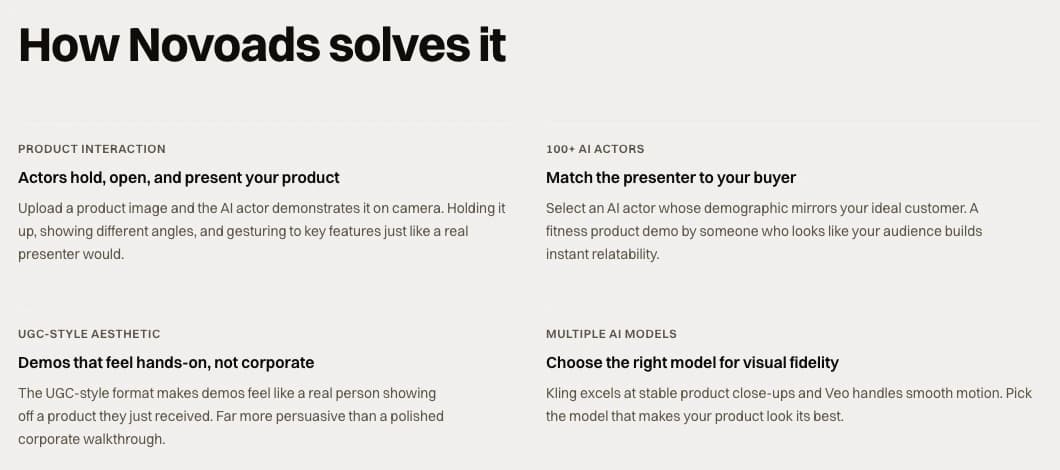 Screenshot: novoads.ai/use-cases/videos-demo-de-producto-con-ia, the "How Novoads solves it" cards for product demo videos, including choosing the right model for each product, taken 2026-10-22
One prompt, four clips, four prices
On September 28, 2026 we gave three of the video models in Novoads one prompt, "A glass skincare bottle on a marble counter, slow push-in, soft morning light," and got four four-second vertical clips with no reference image, Omni Flash at two resolutions. Three ran in the app and the 4K one through our REST API.
 Google Veo 3.1, Omni Flash and Seedance 2.0 Mini · one prompt, a glass skincare bottle on a marble counter with a slow push-in, left to right: Veo 3.1 at 720p 72 credits, Omni Flash 720p 12 credits, Omni Flash 4K 36 credits, Seedance 2.0 Mini 720p 4 credits · rendered 2026-09-28
- Google Veo 3.1 at 720p: 72 credits, back in 77 seconds. The only clip with no invented text, a blank tag behind the glass. The light came out as hard sun, not the soft morning we asked for.
- Omni Flash at 720p: 12 credits, 4 minutes 12 seconds. It printed made-up words on the bottle, "LUZUBÓLIA" among them, and its push-in ends on a close-up of them.
- Omni Flash at 4K: 36 credits, 3 minutes 26 seconds. A whole invented label, starting "LALUR".
- Seedance 2.0 Mini at 720p: 4 credits, 84 seconds. "HYDRATE" spelled right, the small print under it garbled.
At the Plus plan's rate of $49 for 1,000 credits, the four clips cost about $3.53, 59 cents, $1.76 and 20 cents. The lesson for a product ad is the label: three of the four clips carried words that do not exist, which you avoid by asking for no text or by uploading the real product photo. InVideo's UGC page says its agent "locks your product once: same packaging, same label, same proportions." That is the right promise, and the first thing we would check in any tool, ours included.
What a talking ad costs on the same engine
The Novoads talking actor runs on VEED Fabric 1.0, and InVideo's video model rate card, read on October 22, 2026, lists the same engine at 3.80 to 9.60 credits a second across its 480p to 720p range. The meters differ, so the answer flips with length:
- 30 seconds: 114 to 288 InVideo credits, about $1.71 to $4.32 on InVideo's annual Plus promotion or $3.42 to $8.64 at its monthly price. In Novoads, a talking actor bills 200 credits per started minute at 720p, which is $9.80 of the Novoads Plus plan or the whole 200-credit Starter month, and 100 credits at 480p. For a 30-second talking ad, InVideo's per-second meter is cheaper.
- 60 seconds: at the top of InVideo's range, 576 credits, about $8.64 annual or $17.28 monthly, while Novoads still bills the same 200 credits. At a full minute and 720p, the per-minute bill is the cheaper one, on either billing.
InVideo's figures here are a floor: they assume Plus, they are per seat, and an agent-made ad adds whatever the agent replies spend on top.
Where InVideo stays ahead
- The edit. Novoads makes the clip. InVideo's assistant editor cuts footage, switches multicam angles and exports an editable project to Premiere Pro, Final Cut Pro or DaVinci Resolve.
- The catalog. InVideo says more than 200 models sit inside its editor. Novoads offers a shorter list of video engines, including Seedance 2.5, Seedance 2.0, Seedance 2.0 Mini, Kling v3 Pro, Google Veo 3.1 and Omni Flash.
- Teams. Seats, live multiplayer editing and frame-accurate review links come built into InVideo's plans.
Where Novoads fits is the ad that starts as a script or a product photo: you pick the engine for each clip, and a talking ad up to a minute long costs the same 200 credits at 720p. Plans start at $15 a month for 200 credits on Starter, with the full ladder on the pricing page. Monthly plan credits reset, as InVideo's do, and credits from top-up packs last 90 days. For the feature side by side, see how Novoads compares with InVideo.
Buy the edit or buy the render
InVideo's five releases since September 1 all make the edit smarter, and for footage that is the right bet. An ad that starts as a script is a different job: there, the render is the product, and its price per clip is the number to compare. Pick the tool that matches where your ad starts, then test it on your own product before you commit a quarter's budget. Footage wants an editor; a script wants a price per clip.
Frequently Asked Questions
Is InVideo actually good?
For editing footage, InVideo's own pages make a strong case: its news post dated September 1, 2026 introduces invideo Editor, a browser editor with an AI assistant that cuts a first draft from raw footage, plus editable-project export to Premiere Pro, Final Cut Pro or DaVinci Resolve. Public scores split by venue. On October 21, 2026 Trustpilot showed 2.9 from 909 reviews for ai.invideo.io and 1.8 from 1,024 for invideo.io (Invideo Studio), while the US App Store showed its iOS app at 4.5 from 27,936 ratings on October 22. We have not used InVideo hands-on.
Is anything better than InVideo AI?
It depends on where your ad starts. For footage, InVideo's September 1, 2026 post lists multicam, footage search and editable-project export, the jobs its editor is built for. For a talking ad made from a script, compare the price per finished video. InVideo's rate card, read October 22, 2026, bills VEED Fabric 1.0 by the second, so a 30-second talking clip costs fewer dollars on InVideo. Novoads, which publishes this blog, bills its talking actor per started minute, so a full 60-second ad at 720p costs fewer dollars on Novoads. Test both on your own product.
Is InVideo AI safe and free?
InVideo's news post dated September 1, 2026 says the company is SOC 2 Type II certified and GDPR compliant and publishes its controls and subprocessors at trust.invideo.io. On cost, InVideo's help center (article dated July 28, 2026) says you can use InVideo AI for free without entering card details, with limited credits that reset weekly, and the September 1 post says the manual editor is free with no limit on projects or footage. The assistant editor and generative models use credits, which InVideo's paid plans sell per seat.
How much does InVideo cost per month?
It depends on region and billing. The Internet Archive's copy of InVideo's US pricing page from October 19, 2026 shows Starter at $10, Plus at $30 and Max at $75 per seat a month billed annually, each 50% off a struck-through $20, $60 and $150, with 400, 2,000 and 5,000 credits per seat a month. A US reader saw the same prices on October 21, while a Chilean IP was served a Basic, Pro and Ultra lineup instead. The annual Plus price was $50 on September 29 and $36 on October 5, so check the page on the day you buy.
Key Takeaways
- InVideo's news post dated September 1, 2026 introduces invideo Editor, a browser editor with an AI assistant editor; separate posts add agentic sound design (September 25), effects and an MCP server (September 30) and scene extension of up to 30 seconds (October 6).
- For ads, InVideo says its UGC agent reads a product link, locks a cast creator's face and voice, and shows every shot as a still before it animates. We could not test any of it without an account.
- InVideo's own pages set the limits: no Seedance 2.5 on Starter, no credit rollover, team features on Team and Enterprise plans, and agent replies that can spend credits beyond the finished clip.
- Ratings split by venue: Trustpilot showed 2.9 from 909 reviews for ai.invideo.io and 1.8 from 1,024 for invideo.io on October 21, 2026, while the US App Store showed 4.5 from 27,936 ratings on October 22.
- On the same VEED Fabric engine, InVideo's per-second meter makes a 30-second talking clip cheaper than Novoads' 200-credit talking actor, and the per-minute bill wins at a full minute at 720p.