Meta Muse Image for Advertisers: What the New AI Image Model Means for Your Ads
Meta just launched Muse Image, its first in-house AI image model, and it is rolling into Advantage+ creative. Here is what it does, why it matters for ad creative, and how to pair AI images with AI UGC video ads today.

Mauricio Valdivia
·Updated ·10 min
Meta Built Its Own Image Model, and Ad Creative Is the Point
On July 7, 2026, Meta shipped its first homegrown image generator. It is called Muse Image, and it was built inside Meta Superintelligence Labs. The timing is not an accident. More than 8 million advertisers already use at least one of Meta's generative AI ad creative tools, and Meta now wants the model behind those tools to be its own.
For everyday users, Muse Image is a new way to make pictures inside Meta AI, Instagram, and WhatsApp. For advertisers it is something more specific. It is the image engine that is about to sit inside the ad manager you already run campaigns in, generating on-brand variants without an export step.
This post covers what Muse Image actually is, why it matters for ad creative in particular, how to place it next to other image models, and the workflow that turns an AI image into an ad that actually sells.
What Muse Image actually is
Strip away the launch noise and Muse Image is two claims stacked together: a model that reasons, and a model Meta owns end to end. Both matter for advertisers, and they matter for different reasons.
Built inside Meta Superintelligence Labs
Muse Image is the first image generation model from Meta Superintelligence Labs, now available in Meta AI. That ownership is the story. For years Meta layered generative features on top of models it did not fully control. Muse Image is Meta's own, which is why it can ship simultaneously into consumer apps and the ad stack rather than living in one corner of the product. It is the image half of a broader push into AI ad tooling that Meta has been assembling all year, and it slots into the same end-to-end AI advertising suite the company has been rolling out.
An image model that reasons before it renders
The more interesting claim is technical. As Meta puts it, Muse Image does not just build an image, it thinks through your prompt first, using advanced reasoning to understand complex prompts. In Meta's own description the model operates as an agent: it invokes search and coding tools to improve accuracy and self-refines its own generations before handing you the result.
Why does that matter for ads? Because ad creative is not artistic exploration. When you generate a hero shot of a specific serum bottle, the label has to be right, the cap has to be the right color, and the product cannot morph into a generic stand-in. A model that follows instructions faithfully, edits with precision, and reasons about a brief is a better fit for commerce than one that produces a beautiful but wrong picture.
Reasoning pays off in three places advertisers care about:
- Product accuracy. The model can hold a real label, logo, or packaging shape steady across variations instead of inventing a new one each time.
- Complex briefs. A prompt like "same bottle, morning-routine bathroom, soft window light, room for a headline top-left" is a set of constraints, not a keyword, and a reasoning model handles it as one.
- Fewer re-rolls. Editing is native. You can sketch changes or edits directly on your images instead of re-rolling the whole prompt and hoping the product survives.
That last point is the quiet time-saver. Most of the hours lost to AI image tools are not the first generation, they are the ten regenerations chasing a version where the product still looks like itself.
Where you can use it today
At launch, availability is deliberately staged. Muse Image is live in the Meta AI app and on meta.ai, in Instagram Stories in the US, and in WhatsApp direct chats in a limited set of countries. Meta says it is coming soon to Facebook and Messenger, to more countries, and to advertisers through Advantage+ creative. For most marketers, the surface that counts is that last one, and it is a few weeks out rather than live today.
Why Muse Image matters specifically for advertisers
A new consumer image toy is not news for a performance marketer. A new image model wired into the ad manager is. The advertiser story is about placement and workflow, not raw pixels.
Advantage+ creative gets the model
Meta says that, in the coming weeks, advertisers and agencies will be able to tap into Muse Image through Advantage+ creative. Advantage+ is Meta's automation layer for ad creation, the thing that already proposes backgrounds, crops, and text variations while you build a campaign. Putting Muse Image underneath it means the model is not a separate app you export from. It is the generation step inside the workflow you already use, which is the difference between a tool you occasionally open and one you use on every campaign.
From one product shot to many on-brand variants
The practical payoff is variant volume. Meta reports that early testers of the Muse-powered generation saw higher-quality output, with better photorealism and product integrity, meaning the product stays recognizably itself across restyles. That is exactly the constraint that used to make image variants painful. If you can generate ten backgrounds and lighting treatments for the same product without it drifting, you can feed the one thing paid social actually rewards, which is testing volume rather than a single perfect creative.
Built on the platform where the ad runs
There is a quieter advantage. Meta says the model draws on Instagram for social context, so it is tuned on the same visual language your audience already scrolls past. A standalone generator has no idea what performs on Reels. A model built by the platform that serves the ad starts closer to native, and native is what the feed favors.
What advertisers can actually do with it
Meta has described a concrete set of advertiser-facing jobs for Muse Image inside Advantage+ creative. None of them are exotic. All of them are chores that used to eat an afternoon:
- Restyle an existing ad image into fresh variants.
- Generate stills from a video asset, so a strong frame becomes a static creative.
- Reimagine spaces by dropping catalog products into a photo of the buyer's room.
- Spin variants at volume: new backgrounds, lighting, and treatments for the same product.
Taken together, they turn a single proven asset into a family of creatives you can test.
Restyle and remix existing ad images
The headline advertiser capability is restyling. Meta says the updated tools let marketers restyle ad images inspired by existing ads, so a creative that worked can seed a family of fresh variants instead of a one-off. Meta also says the model can generate still images from video assets, which means a strong frame from a video ad can become a static creative without a new shoot. For teams running AI-generated images in paid campaigns, the ability to spin controlled variations off a proven asset is more useful than raw novelty.
Reimagine the product in the customer's world
The other advertiser feature is placement. With Muse Image's photorealistic generation, Meta AI can reimagine a shopper's room, dropping catalog products into a photo of the buyer's actual space. For furniture, decor, and home brands, that turns a flat catalog shot into a personalized visualization. It is the same reasoning engine, pointed at the moment a shopper is trying to picture the product in their life.
One caveat: disclosure still applies
Convenience does not suspend the rules. Generating an ad image with AI does not change what you can claim, and on regulated surfaces it can change what you must label. A few habits keep you clean:
- Keep the claim true. A restyled or reimagined image cannot imply a result the product does not deliver.
- Do not fabricate proof. An AI-generated "before and after" or a synthetic testimonial is a fast way to get an ad rejected.
- Follow the platform's labeling rules. Meta and other platforms are tightening how AI-made creative is disclosed, and the rules for labeling AI-generated ads are worth reading before you scale.
The same discipline applies whether the pixels came from Muse Image, a standalone generator, or a camera.
How Muse Image compares to other AI image models
It is tempting to score Muse Image against every image generator on a benchmark. For advertisers that is the wrong lens. The question is not which model paints the prettiest picture, it is which model fits the job of making ad creative you can ship and test.
Where a native platform model has the edge
Muse Image's advantages are structural, not just aesthetic:
- It reasons about briefs instead of matching keywords.
- It edits precisely, so a proven asset stays on-brand across variants.
- It lives where the ad runs, one click inside Advantage+ with no export.
When there is no reformatting and no context switch, the friction drops on every single campaign. That integration is worth more to a busy performance team than a marginal quality win on a leaderboard.
Where standalone tools and motion still matter
The edge is not absolute. General-purpose image generators still lead on breadth and open-ended creative exploration, and a specialist image model like the latest lightweight generators can be the right pick when you want maximum control outside Meta's walls. And no image model, Muse included, closes the format that actually converts on paid social. That is video. Here is the honest placement:
| Dimension | Meta Muse Image | Standalone image generators | AI UGC video tools |
|---|---|---|---|
| Lives in | Meta apps and ad manager | A separate app or API | An ad-first workflow |
| Strong at | Reasoned edits, on-brand variants | Broad, open-ended generation | Talking-actor video ads |
| Ad integration | Native via Advantage+ | Bolt-on, manual | Built for paid social |
| Output | Still images | Still images | Vertical UGC video |
| Best for | In-platform image variants | Concept exploration | Video you test in volume |
Where images stop and video takes over
Muse Image is a genuine upgrade for the static layer of ad creative. But static is only ever half of the funnel, and on TikTok, Reels, and Meta it is the smaller half.
Static images are the setup, not the sell
Images win the scroll-stopping moment and the display placements. They rarely carry the sale on paid social, where a real-feeling person talking to camera is what moves a cold audience. The formats that convert are UGC-style video ads, and an image, however photoreal, cannot deliver a hook, a demo, and a call to action in eight seconds of motion.
A simple way to split the work:
- Reach for an image when you need a scroll-stopper, a display or catalog placement, a marketplace listing, or a clean thumbnail.
- Reach for video when the job is a cold-audience hook, a product demo, a testimonial, or anything that has to build trust before it asks for the click.
Most performance accounts need both, in that order: the image earns the attention, the video earns the sale.
Muse Video is announced, not shipped
Meta clearly knows this. Alongside Muse Image it previewed Muse Video, which it says is already in development and offers competitive performance in prompt adherence, visual fidelity, and temporal consistency. That is a real signal about where Meta is heading. It is also not a product you can put in a campaign today. Until it ships broadly, the motion layer of your ad creative comes from AI video tools, and the bar there has already moved to native, high-resolution AI video. The gap between a strong static image and a finished video ad is exactly where most advertisers still lose time.
How to pair AI images with AI UGC video today
The smart move is not to wait for Muse Video. It is to treat AI images and AI UGC video as two steps of one pipeline: make the image, then make it move.
The workflow
The sequence is short and it repeats.
- Generate or clean the product image. Use Muse Image inside Advantage+, or an image tool that outputs an ad-ready shot, to get a hero image where the product is accurate.
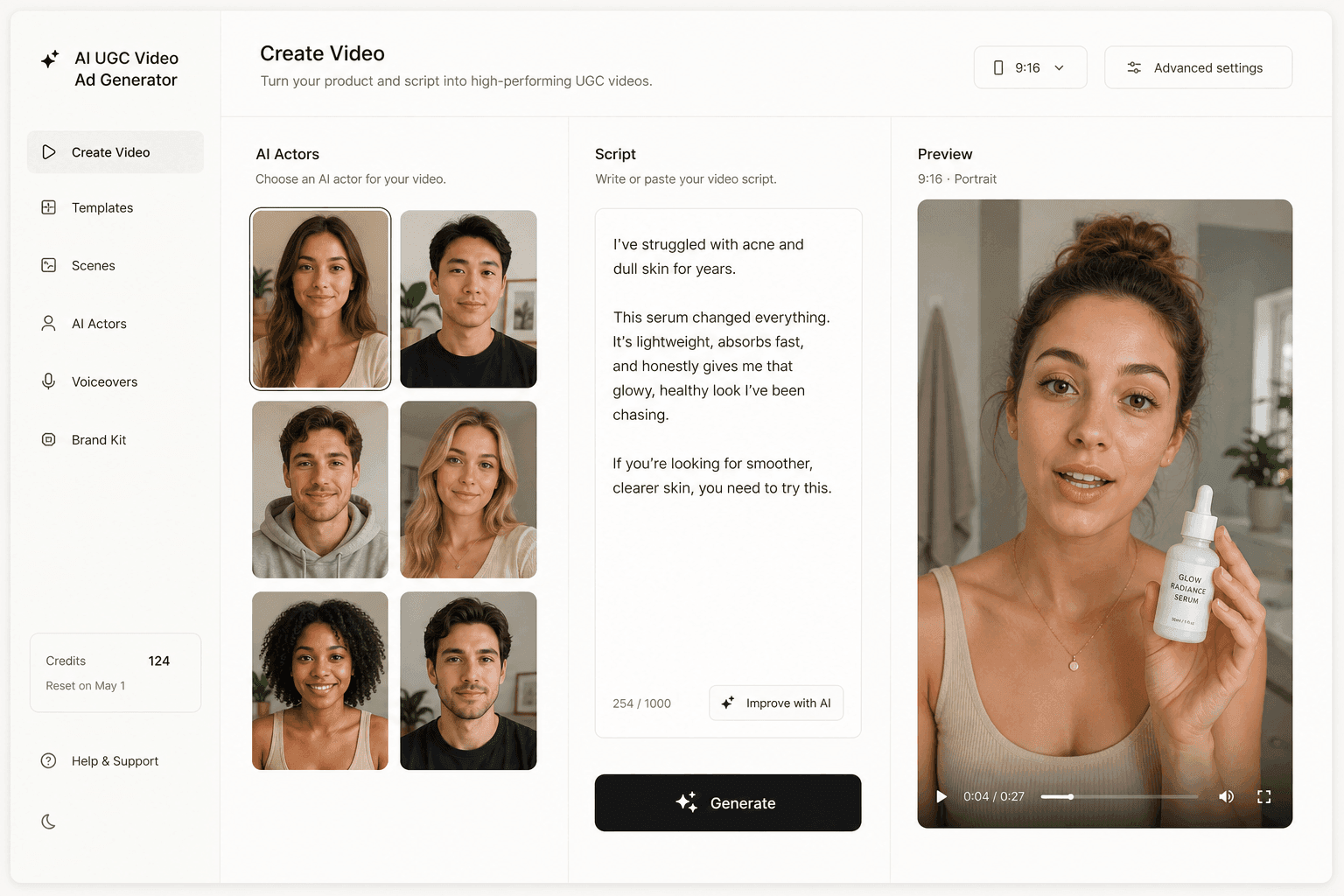
- Write or auto-generate a script. Turn the angle into a 15-to-30 second hook, problem, and payoff.
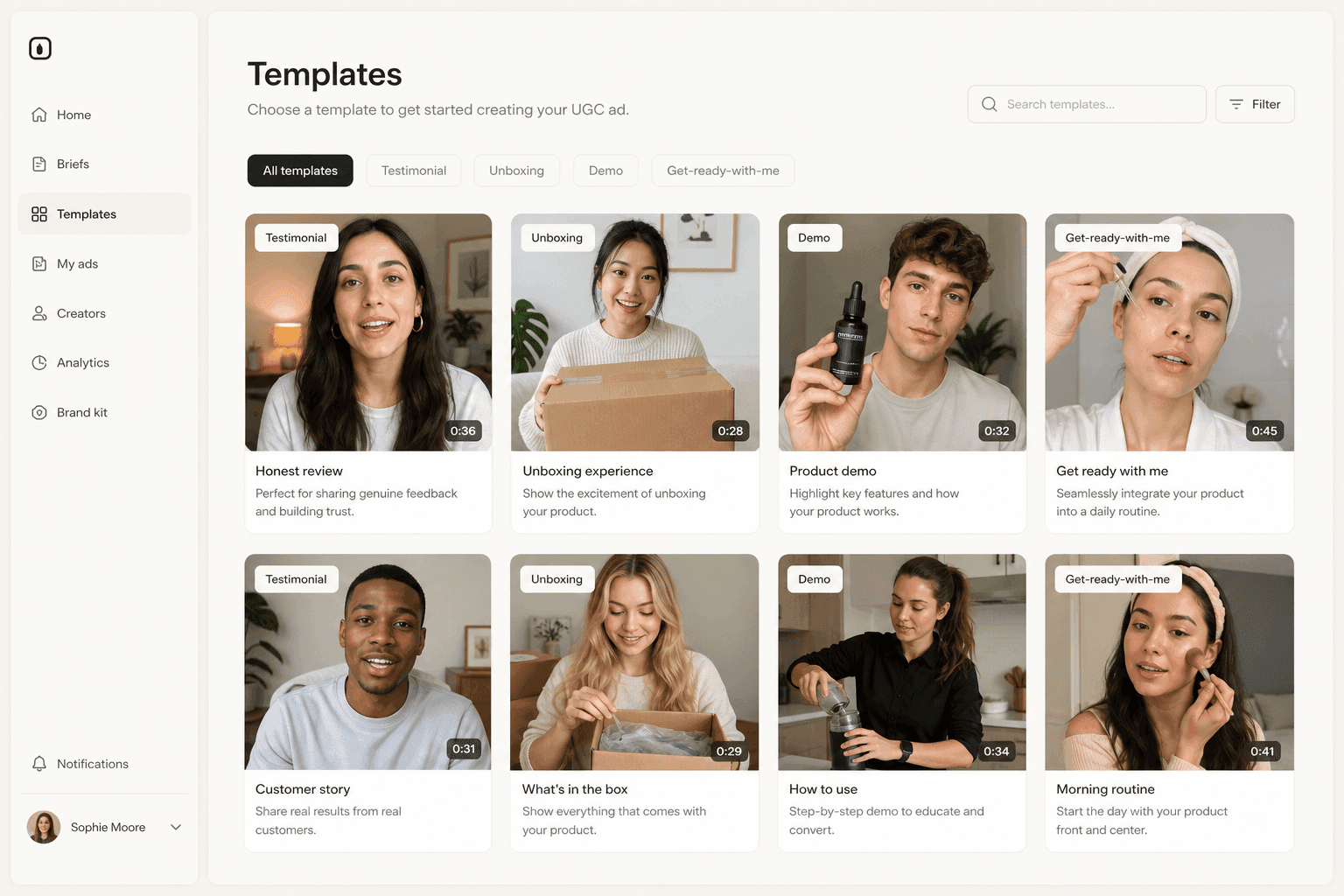
- Pick an AI actor. Match age, gender, and accent to the audience so the ad sounds native, not generic.
- Render a vertical UGC ad. Get a 9:16 clip with voice, lip-sync, and captions, ready to drop into the campaign.
- Test in volume. Ship several variations, kill the losers, and scale the winner.
That last step is the whole point. You can run the product image through three hooks and two actors and generate the video ad itself with AI in Novoads, which is built to make that kind of volume cheap instead of a production project.
A quick way to know the pairing worked:
- The product looks identical in the image and in the video actor's hands.
- The hook lands in the first three seconds, before anyone decides to scroll.
- You have enough variations to kill the losers and still have a winner left.
If any of those is missing, you have a nice asset, not a test.
A worked example
Take a skincare serum. You generate one clean product image, then write three hooks: a before-and-after, a dermatologist-style claim, and a five-second problem opener. Pair each hook with two AI actors for a native-sounding accent, and you have six 9:16 ads in a single sitting. At roughly two to three dollars per clip for the cheaper models, versus 200 to 500 dollars and a week or two for a human creator, the test that would have blown a month's creative budget fits in an afternoon. Launch all six, read the data, and put spend behind the one that beats your benchmark.
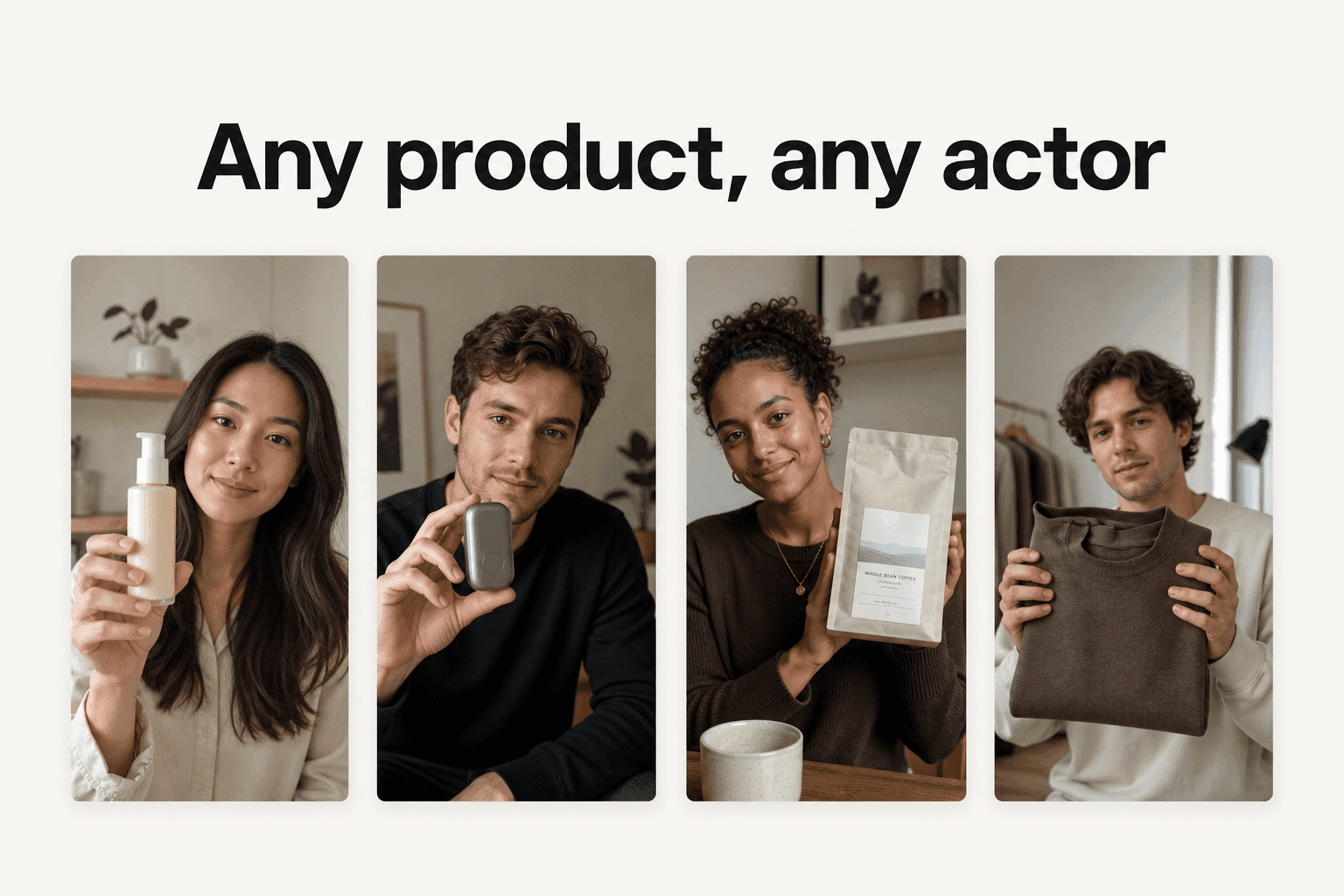
Images are the setup. Video is the sell.
Muse Image is a serious upgrade to the static half of ad creative, and once it lands in Advantage+ it will make on-brand image variants a normal part of every campaign. But the format that closes on paid social is still motion, and that layer is where you win or lose the test.
That is the seam Novoads is built for. You can generate an ad image from a product photo, then turn it into a UGC-style video ad in 30-plus languages with real regional accents, using models like Seedance, Kling, and Veo, and export a 9:16 clip ready for TikTok, Reels, and Meta. A video runs from a few dollars, and the entry plan is $49 a month, cancel anytime. Make the image, then make it sell.
Frequently Asked Questions
What is Meta Muse Image?
Muse Image is the first image generation model built by Meta Superintelligence Labs, Meta's dedicated AI research group. It launched on July 7, 2026, inside Meta AI, and it also powers new creative tools across Meta's apps. Unlike a bolt-on integration, it is Meta's own model, which is why it can move into places most third-party generators cannot reach, including the ad manager.
Can advertisers use Muse Image?
Yes, soon. Meta says advertisers and agencies will be able to tap into Muse Image through Advantage+ creative in the coming weeks. Advantage+ is Meta's AI ad-creation layer, so Muse Image becomes the engine behind image variants and edits generated for campaigns, rather than a separate tool you export from and paste back in.
Where can you use Muse Image right now?
At launch it is available in the Meta AI app and on meta.ai, in Instagram Stories in the US, and in WhatsApp direct chats in a limited set of countries. Meta says it is coming soon to Facebook and Messenger, to more countries, and to advertisers through Advantage+ creative.
How is Muse Image different from other AI image generators?
Two things stand out. First, it reasons: Meta says the model operates as an agent, invoking tools and self-refining its output instead of mapping keywords to pixels in one pass. Second, distribution: because Meta built it, the model lives inside the apps and the ad tools where creative actually runs, and it draws on Instagram for social context. For most standalone generators, the ad integration is something you have to add yourself.
Is there a Meta video model coming?
Meta says Muse Video is already in development and previewed it alongside Muse Image, describing competitive performance in prompt adherence, visual fidelity, and temporal consistency. It is not broadly available yet, so for now the motion side of ad creative still comes from other AI video tools.
Key Takeaways
- Muse Image is Meta Superintelligence Labs' first in-house image model, live now in Meta AI and rolling into advertiser tools through Advantage+ creative in the coming weeks.
- For advertisers the point is not novelty. It is that Meta's own model plugs straight into the ad manager, so generating on-brand image variants becomes part of the campaign workflow.
- Muse Image reasons about a prompt before it renders and can edit existing images, which suits ad creative where product accuracy matters more than raw artistry.
- Static AI images win the top of the creative funnel, but paid social is a video game. Muse Video is announced, not shipped, so the motion gap is still open.
- The fastest play today is to pair AI images with AI UGC video: generate the product shot, then turn it into a talking-actor ad you can test in volume.