OpenArt AI Review for Ads: Billing Rules and 3.5 on Trustpilot
What OpenArt offers ad makers, the refund and credit rules to read before you pay, and its 3.5 Trustpilot score from 1,627 reviews on October 27, 2026.

Mauricio Valdivia
·11 min
The billing complaints line up with OpenArt's own rules
OpenArt's plans give you one credit balance for more than 100 image, video and audio models. They also include Director, a video agent you can start from ad formats such as product ads, UGC ads and ad remakes. On Trustpilot, OpenArt scores 3.5 from 1,627 reviews. Thirty percent of those reviews give it one star, and most complaints in the newest ones are about credits, charges and refunds.
We think OpenArt suits an ad maker who wants many models on one bill and will check every credit quote before approving a render. It's a poor fit if you expect credits back when a finished render misses the brief.
We haven't used OpenArt ourselves. This review draws on OpenArt's own pages and its Trustpilot profile, all read October 27, 2026, and on our own run of the same kind of ad in Novoads.
What OpenArt gives you for making ads
OpenArt's terms describe it as a platform for AI-generated images, videos and audio, and all of it runs on the credits that come with a monthly plan.
More than 100 models, minus Sora 2
OpenArt's model index lists video, image and audio models side by side.
- video models such as Seedance 2.5, Seedance 2.0, Kling 4.0, Kling 3.0 and 3.0 Omni, Wan 3.0, MiniMax H3, Gemini Omni Flash, Veo 3, FLUX 3, PixVerse and LTX-2.3
- image models such as GPT Image 2.5, GPT Image 2, Nano Banana 2, Seedream 5.0 Pro, FLUX 3 Image, Ideogram 4.5, Qwen Image 3.0 and Recraft V4
- audio models such as Eleven v4 from ElevenLabs, Fish Audio Drama 3 and Mirelo SFX 2.0
There's also Seedance 2.5 Draft, which makes 480p previews of a video and then upgrades the one you like to 1080p. The index describes clips of up to 30 seconds for Seedance 2.5, Kling 4.0 and Wan 3.0. But OpenArt's help center still says standard generations run 5 to 15 seconds, depending on the model.
Sora 2 is the exception. Its entry in the index says "Sora 2 is no longer available" and suggests Gemini Omni Flash, MiniMax H3 and Kling 3.0 instead, although the site menu still showed Sora 2 that same day.
Director and its ad formats
Director is OpenArt's video agent, and every paid plan lists access to it. On the home page, its starting formats include Product Ads, Ad Remake, UGC Ads, Brand Film and Promo video, along with formats for film and music. The site menu sums up UGC Ads as "Authentic creator-style ads that convert" and Branding Ads as "On-brand video ads at scale."
In a blog post on September 18, 2026, OpenArt says Director builds multi-scene videos up to five minutes long from a single project. The post adds that small business owners use OpenArt to make their own commercials and brand films.
Characters, dubbing and upscaling
Each plan caps how many consistent characters you can keep, from about 13 on Starter to about 353 on Wonder. The help center says a character you create in OpenArt works in both images and videos, which helps if your ads use the same spokesperson in stills and clips. The home page lists three editing tools, and the menu adds a fourth.
- Dubbing into 24 languages, with optional lip sync
- Lip sync from an audio track and an image
- Edits and retakes of videos you've already made
- Image upscaling, from the main menu
An MCP server and a CLI, but no public API
OpenArt runs an MCP server for Claude, ChatGPT and Cursor. Its Cursor page says OpenArt MCP "has no extra cost," that generations use the same credits as on openart.ai, and that MCP is "included on every plan from Starter up." Its main MCP page even shows a sample prompt for "a TikTok-style UGC ad with one creator casually demonstrating that exact bag."
There's a command-line tool too. On API access, the help center's answer is "No public API is available currently," so a team that wants OpenArt inside its own software would work through the MCP server or the CLI. We compared OpenArt's server with others in our roundup of AI video MCP servers.
How good OpenArt says it is
OpenArt publishes two scorecards of its own. Both are worth a look, though neither is an outside test.
Director's benchmark result, as OpenArt tells it
In a post on September 22, 2026, OpenArt says Director "has ranked #1 in Physion Labs' Arc Ads benchmark" and "shares the top spot with Runway." According to the post, five agents each got the same 100 ad briefs, and the effectiveness category rates "the creative itself through human judgments, rather than live campaign results."
We haven't read Physion Labs' own report, so the result here is OpenArt's version of it. We'd take it as a sign that Director's ads look good to a panel of people, which doesn't yet tell you whether they sell.
OpenArt's own leaderboard for ad video
OpenArt also runs a model leaderboard it calls the Arena. On October 27, its board for ad video models, ranked on "Industry-specific criteria, focused on ads cases," put Seedance 2.5 first with a score of 1,072. Wan 3.0, Seedance 2.0, Google Omni Flash and MiniMax H3 followed, in that order.
The company that runs the board also sells access to those models, so we'd treat it as a shortlist of engines to test for yourself. We put Seedance and Kling, two engine families OpenArt carries, head to head in our Kling vs Seedance comparison for video ads.
What OpenArt's Trustpilot reviewers say
A 3.5 score from 1,627 reviews
On October 27, 2026, Trustpilot showed OpenArt at 3.5 from 1,627 reviews. The split is wide, with 54% five-star and 30% one-star. The three ratings in between add up to 16%. The profile is busy, too, with 1,495 reviews in the last 12 months, so the numbers change from day to day.
OpenArt claimed the profile in September 2025, pays for a Trustpilot subscription and asks customers for reviews, which means the score mixes invited and unprompted ones. The company has replied to 38% of negative reviews. Trustpilot's own summary of 1,438 reviews says "most reviewers were somewhat happy with their experience overall."
G2 and Capterra weren't visible to us that day, so we've left them out. There's no app-store rating to add either, since OpenArt's help center says "there is no mobile app available yet."
The 20 newest reviews, read against OpenArt's rules
We read the 20 most recent reviews, which make up the first page of the profile. They aren't a representative sample of all 1,627, so they show what went wrong for some recent buyers but not how often it happens. By our count, 14 of the 20 complain about credits, charges, refunds or renewals. Five praise the support, a refund or the interface, and we couldn't place the last one either way.
Six of those complaints match a rule OpenArt has put in writing.
- A US store owner who subscribed "to create some advertisements for my store" wrote on October 22, "First project and it used almost all 12000 credits and the final project was the OPPOSITE of what I asked for." OpenArt's help center says "The interface shows the credit cost before you generate," and its terms warn that output "is not guaranteed to match your input prompt."
- A Director user in Austria wrote on October 27, "After roughly 1,500 credits spent on planning, I approved a generation quoted at 10,125 credits." The result had "a duplicated character and incorrect lip-sync," the reviewer added. "I then approved another 2,372 credits for corrections." The help center says credits for a failed generation come back "in most cases," but that OpenArt is "generally unable to issue refunds for completed generations."
- A reviewer in Jamaica, writing on October 25, quoted support's offer of an "exceptional refund arrangement" with "a 10% processing fee" taken off. Section 3.6 of the terms makes purchases non-refundable except where the law requires a refund, and the help center names a minimum 10% fee for one case, when OpenArt moves a yearly plan bought by accident to monthly.
- A reviewer in Switzerland wrote on October 25, "You sign up for a monthly plan, but receive no reminder before the next payment is due." OpenArt's terms promise a reminder only "Where required by applicable law" and make it your job to cancel before the period ends. The help center asks you to cancel "at least 5 days before your renewal date."
- A US reviewer wrote on October 25 that after the first video attempt, OpenArt "took me to the subscription page" and "Didn't let me see a sample of the video and didn't save it." OpenArt's FAQ says new accounts get 40 trial credits for 7 days. The help center's rough guide puts a video at 100 to 800+ credits, so those sign-up credits can run out before a single video is finished.
- A US reviewer wrote on October 23 that "when you cancel your account it wipes out all your unused credits you purchased without a refund." Section 3.2 of the terms says "Unused credits do not carry forward after subscription termination."
All of those rules are on public OpenArt pages today, so you can read them before you pay.
What the positive reviews in the same 20 say
The five positive reviews are mostly about support. A Canadian reviewer wrote on October 26 that "The support is extremely quick with response time and easy to deal with," and two others praised a fast response. A reviewer in Finland wrote on September 1 that the interface "is way more easier than Higgsfield," a tool we cover in our Higgsfield review.
Support sometimes goes past the written rules, too. A Dutch reviewer who forgot to cancel before an annual renewal wrote on October 23, "Their terms say purchases are non refundable, so that was my own mistake to live with." Support then "came back offering a refund for the unused part of the term," and the review's title is "Character consistency that actually holds up."
The rules you agree to before you pay
OpenArt last updated its terms of service on July 30, 2026, and we read its help center on October 27, 2026.
Refunds are in section 3.6, credits in section 3.2
Section 3.6, Cancellation and Refunds, opens with "All purchases are non-refundable, except where a refund is required by applicable law." It adds that "No prorated refunds are provided for the current billing period," and that a cancelled subscription stays active until the end of the period you've paid for.
The credit rules are in a separate section, 3.2. It says credits "are not redeemable for cash or other goods/services," that they can't be transferred to another user, and that the number of credits a model costs "may change during the duration of a subscription." When the subscription ends, "Unused credits do not carry forward."
So section 3.6 covers getting money back and section 3.2 covers credits, and it helps to keep the two apart. The written policy allows a refund where the law requires one, and the reviews above show support sometimes offering more.
What happens in five common cases
| If you | OpenArt's rule | Where it's written |
|---|---|---|
| Want to stop the next renewal | Cancel at least five days before | Help center |
| Hit a failed generation | Credits back in most cases | Help center |
| Dislike a finished generation | Generally no refund | Help center |
| Bought a yearly plan by mistake | Partial refund, minimum 10% fee | Help center |
| Buy an add-on credit pack | Unused add-on credits roll over | Help center |
Monthly plan credits work differently. The help center says they "reset each billing cycle and do not carry over."
Which OpenArt plan you need for ads
Prices as of October 27, 2026, in US dollars per seat, as OpenArt's pricing page showed them.
Commercial use starts at Plus
OpenArt's terms allow non-commercial use of output on every plan and commercial use "For subscription levels at, and above, the “Plus” level." The help center says the same. Plus costs $34 a month billed monthly, or $27 a month billed annually. It comes with 12,000 credits a month. Starter, at $14 a month, falls below that line, so any ad you plan to run needs Plus or above.
OpenArt's September 18 blog post answers "Yes" to using OpenArt for "paid ads" without naming a plan, and the older FAQ says "You can use any image you created for commercial purposes." We'd plan around the terms and the help center, since both draw the line at Plus. Our OpenArt pricing breakdown covers every plan, allowance and add-on.
Watermarks and how long OpenArt keeps your files
Under section 4.5 of the terms, output made on a free plan "may include a visible OpenArt watermark." The help center says free users can't remove the video watermark, while paid subscribers can download without it.
Storage has limits too. If you never subscribe, the help center says your creations "are stored for 7 days, then automatically deleted," and after a subscription ends, you have 14 days to download your assets.
Who should use OpenArt for ads, and who shouldn't
This part is our reading of the facts above.
When OpenArt is a good fit
- You want to try many engines on one bill. More than 100 models share one credit balance, and the Arena board gives you a shortlist, as long as you remember it's OpenArt's own.
- You want an agent to plan a multi-scene ad from a format like product ads or UGC ads, and you'll read each credit quote before you approve it.
- You already work in Claude, ChatGPT or Cursor and want images and video inside that chat. The MCP server comes with every plan from Starter up.
- You need the same character in stills and video, and OpenArt says its characters work in both.
When it isn't
- You want to run ads on the cheapest plan, Starter.
- You expect credits back when a finished render misses the brief.
- You want to price a clip before you sign up. Without an account, we couldn't see what any single model costs. By the help center's rough guide, an image costs 5 to 50 credits. A video costs 100 to 800+.
- You need a public API for your own software.
- You tend to cancel at the last minute.
We've also reviewed two other ad tools, TopView and Pollo AI.
How we made four static ads in Novoads for 8 credits
In Novoads, one credit balance covers video ads, product photos, talking actors and voiceovers. On October 20, 2026, we asked it for static ads of a plain amber candle jar on a limestone bath ledge, with the headline "Light it. Slow down." and the line "Soy wax · Cotton wick · Hand-poured." We sent the request from an AI agent through the Novoads MCP connector, as a single Nano Banana Pro call.
It came back with four variants in the 4:5 feed shape. At 2K, the call cost 8 credits. That's 2 per image, and the price hasn't changed since.
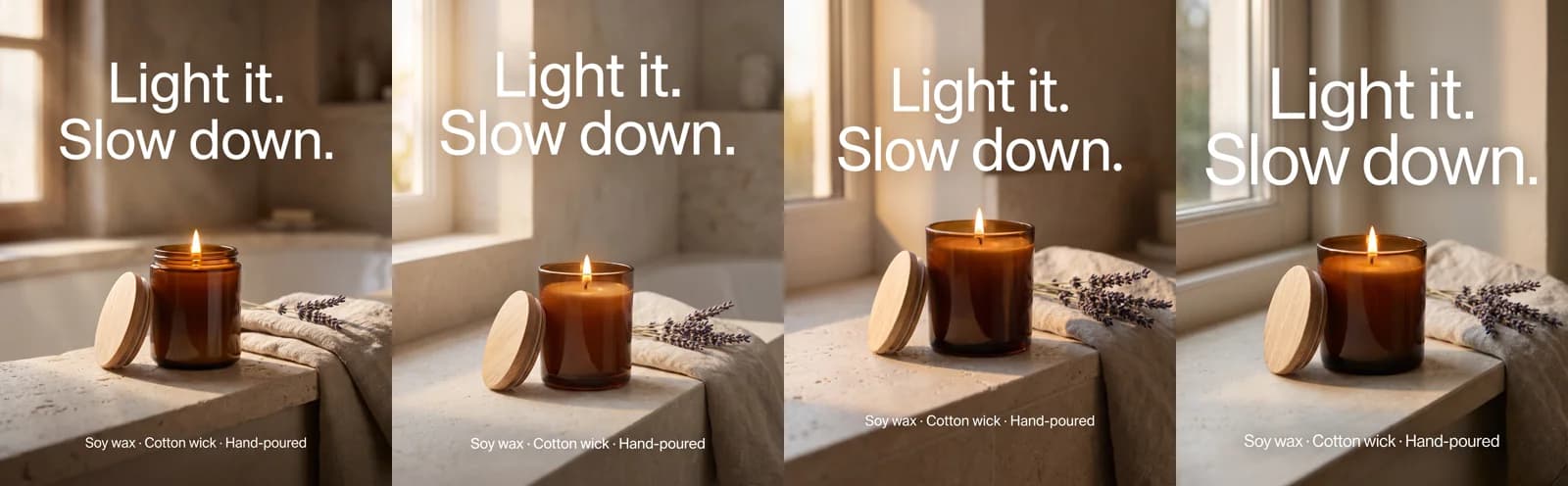 Nano Banana Pro · one call, four 4:5 static ad variants at 2K of an amber candle jar, headline "Light it. Slow down." · 8 credits · rendered 2026-10-20
OpenArt's MCP page pitches the same kind of job, an ad made from inside an AI agent. Our guide to Nano Banana Pro for ad creative has more on the model. Seedance 2.5, the model at the top of OpenArt's ad board, is in Novoads too.
What that run costs on Starter and Plus
You pay for Novoads from the first month. Starter is $15 a month for 200 credits, billed monthly only. Plus is $49 a month for 1,000 credits. Billed annually, Plus comes to $39 a month.
| Plan | Price | Credits a month | This run (8 credits) |
|---|---|---|---|
| Starter | $15 a month | 200 | about 60 cents |
| Plus | $49 a month | 1,000 | about 39 cents |
That works out to about 15 cents an ad on Starter and about 10 cents on Plus. Every plan and its credits are on Novoads' pricing page.
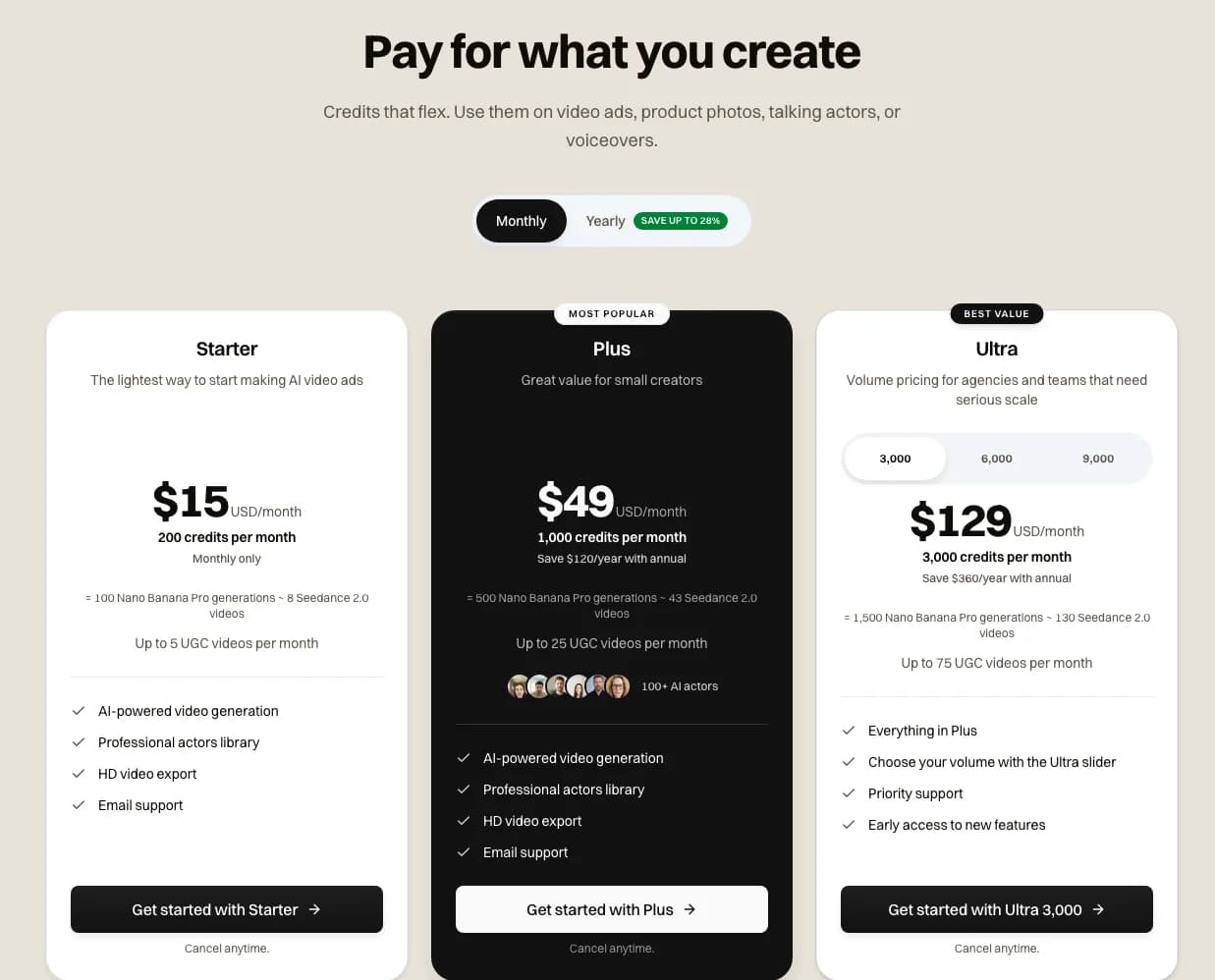 The Novoads pricing page with Monthly selected · screenshot taken 2026-10-27
Read sections 3.2 and 3.6 before you pick a plan
If OpenArt's model list and Director suit your ads, the buying decision comes down to its rules. Start on Plus if you're going to run the ads, since that's where commercial use begins. Check the credit quote before you approve a Director generation. And set a renewal reminder the day you subscribe.
Frequently Asked Questions
How much does OpenArt AI cost?
On October 27, 2026, OpenArt's pricing page showed four individual plans, priced in US dollars per seat. Starter is $14 a month billed monthly, or $13 a month billed annually. Plus is $34 a month, or $27 billed annually, and it's the first plan with commercial use rights. Pro is $56 a month, or $44 billed annually. Wonder is $240 a month, or $175 billed annually. Starter comes with 4,000 credits a month and Plus with 12,000. Pro comes with 24,000 and Wonder with 106,000.
Does OpenArt give refunds?
Section 3.6 of OpenArt's terms (last updated July 30, 2026) makes all purchases non-refundable except where applicable law requires a refund, and it rules out prorated refunds for the current billing period. OpenArt's help center adds that credits for a failed generation are refunded automatically in most cases, while completed generations generally aren't. If you bought a yearly plan by accident, the help center says OpenArt will move you to monthly with a partial refund, minus a minimum processing fee of 10%.
Can I use OpenArt for commercial ads?
Yes, from the Plus plan up. OpenArt's terms (last updated July 30, 2026) allow non-commercial use of output on every plan and commercial use at the Plus level and above, and its help center says the same. On October 27, 2026, Plus cost $34 a month billed monthly, or $27 a month billed annually. Output made on a free plan may carry a visible OpenArt watermark.
Is OpenArt legit?
OpenArt's prices, terms of service and help center are all public. On October 27, 2026, its Trustpilot profile showed a 3.5 TrustScore from 1,627 reviews. Of those reviews, 54% gave five stars and 30% gave one. OpenArt claimed the profile in September 2025 and invites customers to leave reviews, so the score mixes invited and unprompted ones. Most complaints in the 20 most recent reviews were about credits, charges, refunds and renewals.
Key Takeaways
- OpenArt sells one credit balance that covers more than 100 image, video and audio models, and you can start its Director agent from an ad format such as product ads, UGC ads or ad remakes.
- On October 27, 2026, OpenArt scored 3.5 on Trustpilot from 1,627 reviews, and almost a third of them gave it one star.
- Six complaints among the 20 newest reviews match rules OpenArt has put in writing, from credits used up on a single project to unused credits that are lost when a plan ends.
- OpenArt's terms make all purchases non-refundable unless the law requires a refund, and its help center adds that completed generations generally aren't refunded.
- Commercial use starts at Plus, which costs $34 a month billed monthly, and OpenArt asks you to cancel at least five days before your plan renews.