Ad Creative Strategy: The Four Decisions to Make Before You Produce a Single Ad
Ad creative strategy is the plan you make before production: which reasons to buy your ads will argue, which format proves each one, how each ad opens, and what the batch has to teach you.

Mauricio Valdivia
·12 min

Twelve new ads, one creative in the system's eyes
A skincare brand spends a Monday filming twelve videos for its new vitamin C serum. Same creator, same counter, same opening line. What changes from one video to the next is the caption color, the music and the last words of the call to action. By Friday the ad account holds twelve ads and, in practice, one idea.
Meta has described what its delivery system does with a batch like that. In creative diversification guidance dated December 16, 2025, Meta says its ads system "groups together ads that share key visual and thematic attributes," and that when multiple ads look or feel alike, "these are seen as variations of the same creative." TikTok's help article on creative best practices for performance ads, last updated June 2025, points the same way: it suggests 3-5 different creatives per ad group and says it is always better to use creatives with big differences, especially when testing.
The fix is not a sharper edit. It happens a week earlier, on the page where someone decides what the twelve ads are going to argue. That page is an ad creative strategy: the decisions about angles, formats, hooks and a test plan that a team makes before anyone films, generates or edits a frame. This guide walks through those four decisions in order, shows what Meta, TikTok and Google each publish that bears on them, and builds a complete plan for one product.
What an ad creative strategy actually decides
The phrase gets used for everything from a mood board to a media plan. It is more useful as a narrow thing: the plan for which ads deserve to exist.
Strategy sits above the brief
A brief tells a creator, an editor or a generation tool how to make one ad. A strategy decides which ads get a brief at all. The two fail in different ways. A bad brief produces a weak version of a good idea, and a round of revisions fixes it. A bad strategy produces twelve polished versions of the same idea, and no revision fixes that, because the problem sits upstream of every file.
The process that turns briefs into shipped files on a schedule is creative operations, and it is worth building. This guide stays one step earlier, on what goes into the queue in the first place.
Four decisions, in a fixed order
Every creative plan answers the same four questions, and the order matters:
- Angle: the reason to buy that the ad argues.
- Format: the kind of ad that proves that reason best, such as a testimonial, a demo or a static image.
- Hook: the opening that makes the right person stay long enough to hear the reason.
- Test plan: the question the batch must answer, and what you will do with each possible answer.
Each decision narrows the next one. Teams that start from a format ("we need UGC videos this month") or from hooks ("write twenty openers") skip the only decision that creates real difference between ads. They find the sameness later, in the results, after the budget is spent.
Where strategy stops
A strategy ends where production starts, and it picks the work up again when results arrive. Knowing which metric to trust at which stage of an ad's life is creative analytics, and running a clean comparison is covered in our guide to ad creative testing. Neither can rescue a batch that was never planned to differ.
Why the platforms reward planned difference
Meta, TikTok and Google each publish creative guidance for advertisers, and on this point they line up. Read side by side, they say the delivery system can only choose between ideas you actually gave it.
| Platform | Document | Dated | Core point |
|---|---|---|---|
| Meta | Demystifying Creative Diversification | December 16, 2025 | Look-alike ads read as one creative |
| TikTok | Creative best practices for performance ads | Updated June 2025 | 3-5 different creatives per ad group |
| About the ABCDs of effective video ads | Study from April 2021 | Checklist for video execution |
Look-alike ads get pooled into one creative
Meta's guidance, which our explainer on creative diversity in Meta ads unpacks, goes further than "make more ads." It says that when ads look or feel alike, learnings and delivery optimizations are shared at the creative level, not just the individual ad level, which is why Meta adds that "simply iterating on a single concept isn't enough." It also draws a line most teams blur. Creative iteration, in Meta's words, "might produce two ads with identical visuals, but different text CTAs." Creative diversification is "the creation of distinct campaign assets tailored to different personas or use cases."
Meta's first best practice is to "develop ads that are truly different in look, feel, storyline, and message." Storyline and message are not editing choices. They get decided in the plan, or they do not get decided at all.
Near-duplicates waste the exploration stage
TikTok's article frames the same idea around the ad group. It suggests 3-5 different creatives per ad group and 3-5 diversified ad groups per campaign, says creatives with big differences are better especially when testing, and adds: "This is especially helpful during the ad group's exploration stage." TikTok presents all of this as general best practice, and the page says "these tips are a starting point," so treat 3-5 as a sensible default rather than a quota.
The planning consequence is plain arithmetic. If three of an ad group's five creatives share one angle, the group explores three ideas with five slots, and two of those slots add little the group did not already have.
A checklist for execution, not for ideas
Google's contribution is the ABCDs: Attention, Branding, Connection and Direction, its four principles for effective YouTube video ads. Google's help page says the ABCDs "deliver as much as a 30% lift in short-term sales likelihood and a 17% lift in long-term brand contribution," citing a Google/Kantar study from April 2021. That is Google reporting on its own framework from a 2021 study, so read it as a direction, not a guaranteed result.
The more useful line sits in Google's Think with Google article on the framework: "The ABCD principles are not a formula for generating creative ideas." The ABCDs grade how well an idea is carried out. They cannot tell you which ideas to plan, and that is the job of the first decision.
Decision one: choose angles from reasons to buy
An angle is where difference comes from, so it is where a creative plan should spend most of its thinking.
An angle is a reason to buy, in one sentence
Write each angle as a single sentence a customer could say. For the serum: "It evens out my skin tone without stinging." "It replaced three steps of my morning routine." "It is the gift my skincare-obsessed sister actually kept using." If the sentence needs an "and," it is two angles.
Keep angles separate from the words in the ad. "It replaced three steps" can become a dozen scripts and captions, and every one of them argues the same thing. Meta's guidance makes the same kind of split, with one ad built on "emotional appeal" and another on "product features," and tells advertisers to "create ads that speak to different audience motivations or use cases."
Where angles come from without a research budget
Most small teams already sit on better angle sources than any brainstorm:
- Reviews, yours and competitors'. The exact phrase a buyer used, such as "finally something that doesn't pill under makeup," is often a finished angle.
- Pre-sale questions and support tickets. Every repeated objection is an angle waiting to be answered on camera.
- The thing the product replaces. A routine, a service, a habit or a pricier product.
- The moment of use. When and where the product earns its place: the gym bag, the night shift, the first cold week of the year.
- The person who buys for someone else. Gift buyers, parents and partners buy for a different reason than the user does.
The stranger test for distinctness
Before the angle list is final, read the sentences to someone outside the team and ask them to describe each ad back to you in five words. If two descriptions come back the same, those are one angle, whatever the scripts say. It is a human version of the similarity Meta describes, and it costs a minute instead of a test budget.
For a first batch, three or four angles is enough. More than that spreads a fixed budget so thin that no single angle gets a result you can read.
Decision two: give each angle the format that proves it
With the angles fixed, format stops being a matter of taste. Each format is a kind of evidence, and each angle needs a particular kind.
Formats are evidence types
A talking-head testimonial proves that a person believes the claim. A product demo video proves the product does the thing. A before-and-after proves that a change happened. A static image proves an offer at a glance. Matched to angle types, that gives a simple default:
| Angle type | Format that proves it | Why it fits |
|---|---|---|
| Result or change | Before-and-after demo | Shows the change |
| Objection or doubt | Talking-head testimonial | A person vouches |
| Replaces a routine | Side-by-side comparison | Shows what drops out |
| Price or offer | Static image | Reads in one second |
| Origin or mission | Founder to camera | Explains the why |
| How it works | Hands-on product demo | Shows the mechanism |
The testimonial row is the backbone of UGC-style ads, and it only works when the person answers a real doubt. Our breakdown of testimonial video examples shows the beats that separate proof from praise.
Platform texture changes the execution, not the choice
The format choice travels across platforms. The look of the finished cut does not. TikTok's article recommends "featuring people such as creators, employees, or customers to capture attention and increase engagement," and advises that you "go for a DIY or not overly polished style" so the ad sits naturally among user videos. Google's ABCDs also ask advertisers to feature people, but pair that with the Branding principle: "Brand early, often, and richly." Meta names formats as one of the dimensions of distinctness, next to visuals and messaging.
So plan one format per angle and let each platform set the texture. The same testimonial can be a handheld, lightly edited cut for TikTok and a cut that shows and names the product in its opening seconds for YouTube. Spec sheets are a floor, not a strategy: TikTok's own list of basics includes sound or music, vertical 9:16, at least 720p resolution and content inside the UI safe zone, and every network sets its own numbers, which our video ad specs by platform guide collects in one place.
Two formats per angle is the practical ceiling
In a first batch, give each angle one or two formats, never more. Three angles in two formats each is six concepts, and every result still says something about the angle. Three angles in five formats is fifteen concepts, and a win cannot tell you whether the reason or the format did the work.
Decision three: write hooks after the angle is fixed
Hooks are the most over-produced part of most creative plans, because they are the cheapest part to write.
A hook's job is to deliver the angle fast
TikTok's article tells advertisers to "prioritize your hook in the first 6 seconds" and to "introduce your content proposition in the first 3 seconds for better recall and awareness." Google's Attention principle says to "get to the heart of the story faster." Neither describes a clever line detached from the rest of the ad. Both describe the angle arriving early.
That is why the hook comes third. Written before the angle, a hook tends to promise something the rest of the ad never proves. For the craft of the opening line itself, see how to write ad hooks.
Match the hook to the angle type
Each angle type has a natural way in:
- Result angle: open on the outcome, then rewind to how it happened.
- Objection angle: open by saying the objection out loud ("I thought vitamin C always stings").
- Replacement angle: open on the thing being replaced, in the middle of the routine.
- Offer angle: open on the number.
- Use-moment angle: open inside the moment itself.
Two hooks per angle, not twenty for one
Twenty hooks on one angle is iteration in Meta's sense: useful for getting more out of a proven idea, poor at finding one. Meta says creative iteration "can inform new ad concepts for a diversification strategy, but should not replace true creative diversification." In a first batch, write two hooks for each angle and format pair. Hook volume belongs in the batch after an angle has won, which is where our guide to ad hook variations picks up.
Decision four: write the test plan before anything is produced
A test plan written after the ads exist tends to describe whatever happened. Written first, it shapes what gets made.
One question per batch
A useful batch question names the variable and the metric: "Which of these three reasons to buy gets the cheapest first purchase?" A useless one asks which ad is best. The first question tells the team the batch varies angles and holds the rest roughly steady. The second tells the team nothing about what to produce.
Size the matrix to the question
The size of the plan is a multiplication: angles, times formats per angle, times hooks per pair. Three angles, two formats and two hooks is 12 ads. That also sits inside TikTok's suggested ranges if you spread the twelve over three ad groups of four and mix the angles inside each group, so that no group is a set of near-copies. How many cells a given budget can actually resolve depends on conversion volume, which our guide to how many ad creatives you need works through.
Decide what each answer will change
Write the if-then lines into the plan before launch:
- If one angle clearly wins: the next batch spends on that angle, with new hooks and one new format, the rebuild our guide to repurposing winning ads walks through.
- If two angles tie: keep both and give each a format it has not tried.
- If nothing wins: either the angles were too close together, or the problem is the offer or the landing page rather than the ads.
A plan without pre-written decisions tends to end in a meeting where everyone reads the same dashboard and reaches a different conclusion.
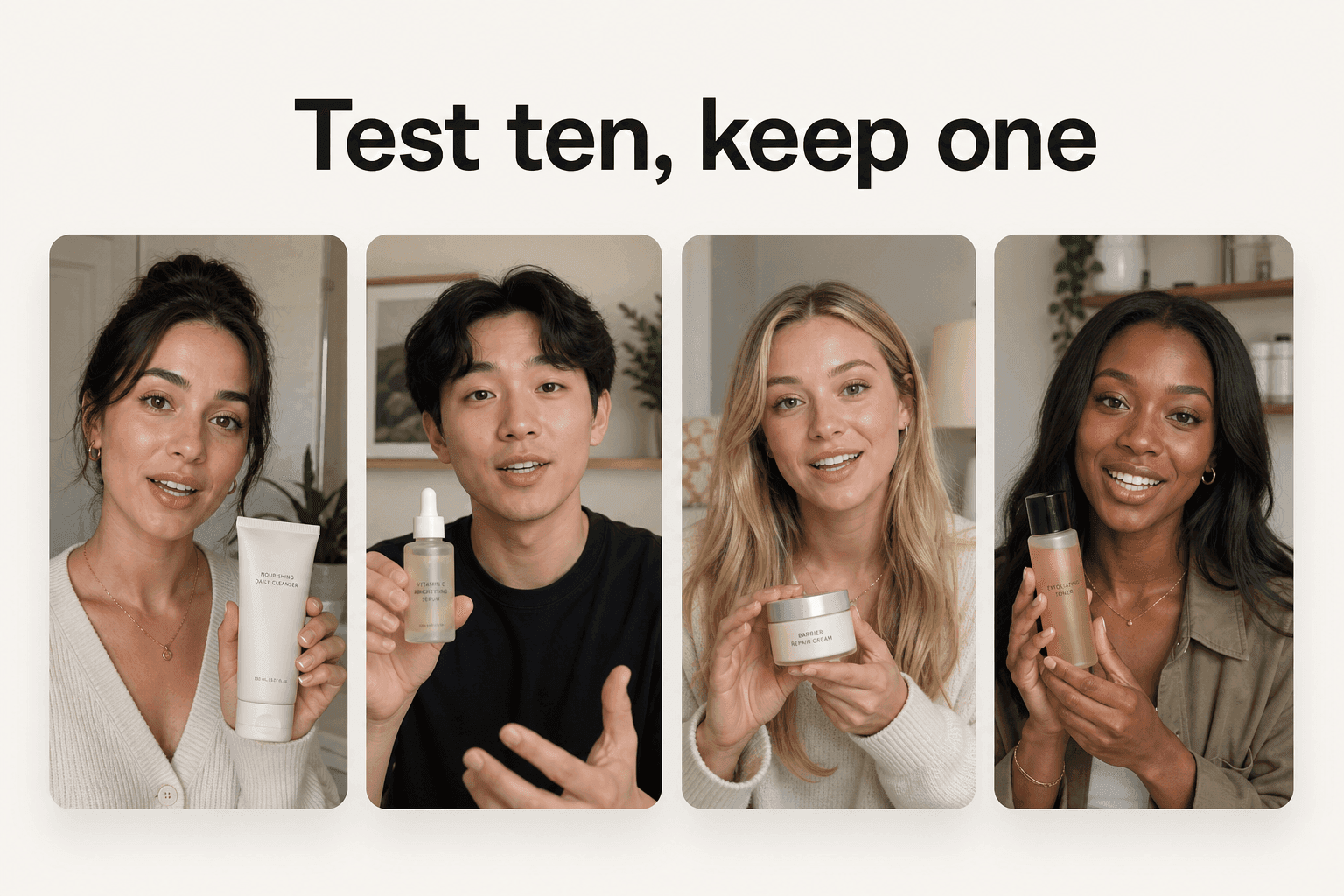
A worked plan: one serum, three angles, twelve ads
Here is the whole method applied to the vitamin C serum from the opening, for a small brand with one product and a modest test budget.
The angle map and the matrix
| Angle | Formats | Hook A | Hook B |
|---|---|---|---|
| No sting | Testimonial, demo | Objection said aloud | Close-up, calm skin |
| Replaces three steps | Comparison, demo | Crowded bathroom shelf | Routine on a timer |
| The gift | Testimonial, founder | Unwrapping moment | Sister asks where |
Three angles, two formats each and two hooks per angle and format pair gives 12 ads, and every one of them traces back to the single reason it argues. When the results come in, the team can read them by angle first and by format second.
The ABCD pass before a single render
Each of the twelve concepts goes through four questions borrowed from Google's framework, on paper, before production starts:
- Attention: does the angle show up in the first three seconds?
- Branding: is the product on screen early and named out loud? Google notes that audio brand mentions strengthen on-screen brand visuals.
- Connection: is there a person, carrying one message only? Google's guidance is to avoid doing too much in one ad.
- Direction: does the ad say exactly what to do next?
A concept that fails two of the four goes back to the plan, not to the edit. On paper, the fix costs a sentence. After production, it costs a reshoot or a new render.
What the week looks like
Monday is angles and the matrix. Tuesday is scripts, hooks and the ABCD pass. Wednesday and Thursday are production. Friday is launch, with the if-then lines already written. Compare that with the opening scene: the same twelve files and the same week, but twelve ads that disagree with each other on purpose.
Failure modes that break a plan before launch
Most broken creative plans fail in one of a handful of ways, and each one has a cause worth naming:
- Variant soup. Twelve files, one angle. It happens because iteration feels like output. Recover by counting angles, not files, before approving a batch.
- Format-first planning. "We need three UGC videos" before anyone knows what they argue. It happens because formats are easy to brief. Recover by writing the angle sentence first and choosing the format from it.
- Hooks without a body. The opening promises a result the ad never shows. It happens when hooks get written in a separate session from scripts. Recover by checking that the last five seconds pay off the first three.
- Late branding. The product appears only on the end card. It happens because visible branding can feel like a native-content mistake. Recover with Google's brand-early principle, carried out in the platform's own style.
- A test with no decision. Results arrive and nobody knows what they change. Recover by writing the if-then lines before launch.
- More cells than budget. Twelve ads on a budget that can read four. Recover by cutting angles before cutting spend per angle.
How Novoads solves the production gap in a creative plan
Novoads generates UGC-style video ads from a script and an AI actor, or from an uploaded product image, and exports them in 9:16, 1:1 or 16:9. That matters to a creative plan because production is the step where most twelve-ad strategies quietly shrink to three.
The formats in the plan map onto routes in the app. A talking AI actor delivers the testimonial and objection scripts. Video generation from your product image is the route for demos and comparisons, and Product-to-Ad turns the same photo into a static ad image. A stock talking actor from the library has empty hands, so when an angle needs the product held on camera, create a custom actor from a photo of someone holding it, or start from a Discover product template, which puts your uploaded product into a template creator's hand.
A generated video runs from about a dollar for a five-second Seedance 2.0 Mini clip to about $8 for an eight-second Seedance 2.5 clip, and about $26 for a full 30-second Seedance 2.5 take. If all twelve serum concepts were eight-second Seedance 2.0 Mini clips, the batch would use 25.2 credits. Novoads starts at $49/month (Starter, 50 credits per month), and all plans are published on /pricing. What it will not do is pick your angles. The plan is still yours to write, and once it exists you can produce the whole batch in Novoads.
Plan the difference, then produce it
Delivery systems have become very good at matching ads to people. They cannot invent a reason to buy that no ad in the account argues. Meta pools look-alike ads, TikTok asks for creatives with big differences, and Google says its own checklist is not a source of ideas. All three leave the same job on the advertiser's desk.
The account only ever chooses between the ideas you gave it, so give it different ones.
Frequently Asked Questions
What is an ad creative strategy?
An ad creative strategy is the set of decisions a team makes before producing ads: which reasons to buy the ads will argue (the angles), which format proves each reason, how each ad opens (the hook), and what the batch is meant to teach (the test plan). It sits above the creative brief. A brief explains how to make one ad; a strategy decides which ads deserve a brief at all.
What is the difference between an ad angle and a hook?
An angle is the reason to buy an ad argues, written as one sentence a customer could say, such as 'it replaced three steps of my morning routine'. A hook is the opening of the ad that delivers that reason fast. One angle can carry many hooks, but a hook without a planned angle tends to promise something the rest of the ad never proves. Plan the angle first, then write two or three hooks for it.
How many ad creatives should you test at once?
There is no universal number. TikTok's help article on creative best practices for performance ads (last updated June 2025) suggests 3-5 different creatives per ad group and 3-5 diversified ad groups per campaign as a starting point. What matters more is how many distinct ideas those creatives carry, because Meta says ads that look or feel alike are seen as variations of the same creative. A practical first batch is three angles, two formats each and two hooks per pair, which is 12 ads with real differences.
Do the same creative rules apply on Meta, TikTok and YouTube?
The planning rules travel; the execution changes. All three platforms point toward distinct concepts, a fast opening and a clear next step. The texture differs: TikTok's help article recommends a DIY or not overly polished style and featuring people such as creators, employees or customers, while Google's ABCDs for YouTube ask advertisers to brand early, often and richly. Plan one format per angle, then adapt the cut to each platform's specs and style.
What is Google's ABCD framework for video ads?
ABCD stands for Attention, Branding, Connection and Direction, Google's four principles for effective YouTube video ads. Google's help page says the ABCDs can deliver as much as a 30% lift in short-term sales likelihood and a 17% lift in long-term brand contribution, citing a Google/Kantar study from April 2021. Google's own Think with Google article also says the ABCD principles are not a formula for generating creative ideas, so they work best as a check on concepts you have already planned.
How do you produce enough distinct ads to test a creative strategy?
Production is where most plans shrink, because each distinct concept needs its own shoot or edit. Generating the ads with AI changes that math. In Novoads, a talking AI actor delivers testimonial and objection scripts, video generation works from an uploaded product image, and a generated video runs from about a dollar for a five-second Seedance 2.0 Mini clip to about $8 for an eight-second Seedance 2.5 clip, and about $26 for a full 30-second Seedance 2.5 take. Novoads starts at $49/month (Starter, 50 credits per month). The tool does not choose your angles; the plan still has to come first.
Key Takeaways
- An ad creative strategy is a planning step, not a production step: it fixes the angles, the formats, the hooks and the test plan before anyone films, generates or edits a frame.
- The platforms reward planned difference. Meta's December 16, 2025 guidance says ads that look or feel alike are seen as variations of the same creative, and TikTok's help article (last updated June 2025) suggests 3-5 different creatives per ad group and says creatives with big differences work better, especially when testing.
- Start from angles, meaning one-sentence reasons to buy, and let each angle choose the format that proves it. A new call to action on the same visuals is iteration, not a new concept, by Meta's own distinction.
- Use Google's ABCDs (Attention, Branding, Connection, Direction) as a paper check on every planned concept. Google credits them with as much as a 30% lift in short-term sales likelihood in a 2021 Google/Kantar study, and also says they are not a formula for generating ideas.
- Write the test plan first: one question per batch, a matrix sized to that question (three angles, two formats and two hooks is 12 ads), and the decision each possible result will trigger.