HeyGen vs Creatify for UGC-Style Ads: Which Fits, and What a 30-Second Ad Costs
HeyGen bills credits per minute of avatar on screen; Creatify bills per 15 seconds of finished ad. Avatars, product shots, batch variations, languages, API access and plan prices compared from each vendor's own pages, as of September 14, 2026.

Mauricio Valdivia
·12 min

HeyGen meters the avatar. Creatify meters the whole ad.
A growth marketer at a sneaker brand has until Friday to hand her media buyer twenty versions of a 30-second UGC-style ad. Same shoe. Twenty hooks. She opens HeyGen, writes the script, picks one of its 1,100+ creator-style presenters, and watches a credit meter that counts minutes of avatar video. Then she opens Creatify, pastes the product page, and watches it pull the assets, write the script and render an ad on a meter that counts every 15 seconds of finished video.
Both tools can make that ad. That part is settled.
What is not settled is where each one expects the work to start and what its meter actually counts. HeyGen is a script-first avatar studio that now sells hard into paid social. Creatify is a link-first ad generator that surrounds its URL-to-video flow with a large avatar library. Those two starting points change the cost of a test batch, the way you localize a winner, and what a developer pays to automate production. Every price and credit rate below was read from each vendor's own public pages on September 14, 2026. Prices in this category move often, so check that date before you put a number in a budget.
The short verdict by use case
If you read one section, make it this one.
- Pick HeyGen if your ads start from a script your team already wrote, if a winning ad needs to run in other markets, or if a developer will generate video from your own stack with uneven volume. Its avatar meter is inexpensive per minute, its paid plans list 175+ languages and dialects, and its API needs no subscription.
- Pick Creatify if your ads start from a catalog of product pages and you want batches of variations with little setup. Paste a link, choose several scripts and avatars at once, and use the tracking, cloning and launch tools it lists around the finished ad.
- Treat realism as a tie you test yourself. HeyGen's homepage calls its avatars the most lifelike in AI video, and Creatify's homepage calls its avatar video the most realistic avatars yet. Two superlatives cancel out. Render the same script in both and judge what comes back.
If you are still deciding whether the format itself belongs in your account, why UGC-style ads work on paid social is the primer. This post assumes you are past that and choosing a tool.
Two tools built around different starting points
Both products have converged on the same outcome: a person on camera, speaking your script, in a vertical file you can upload to an ad account. What differs is the first screen, and the first screen shapes most of what happens after it.
HeyGen: a script-first avatar studio that learned ad work
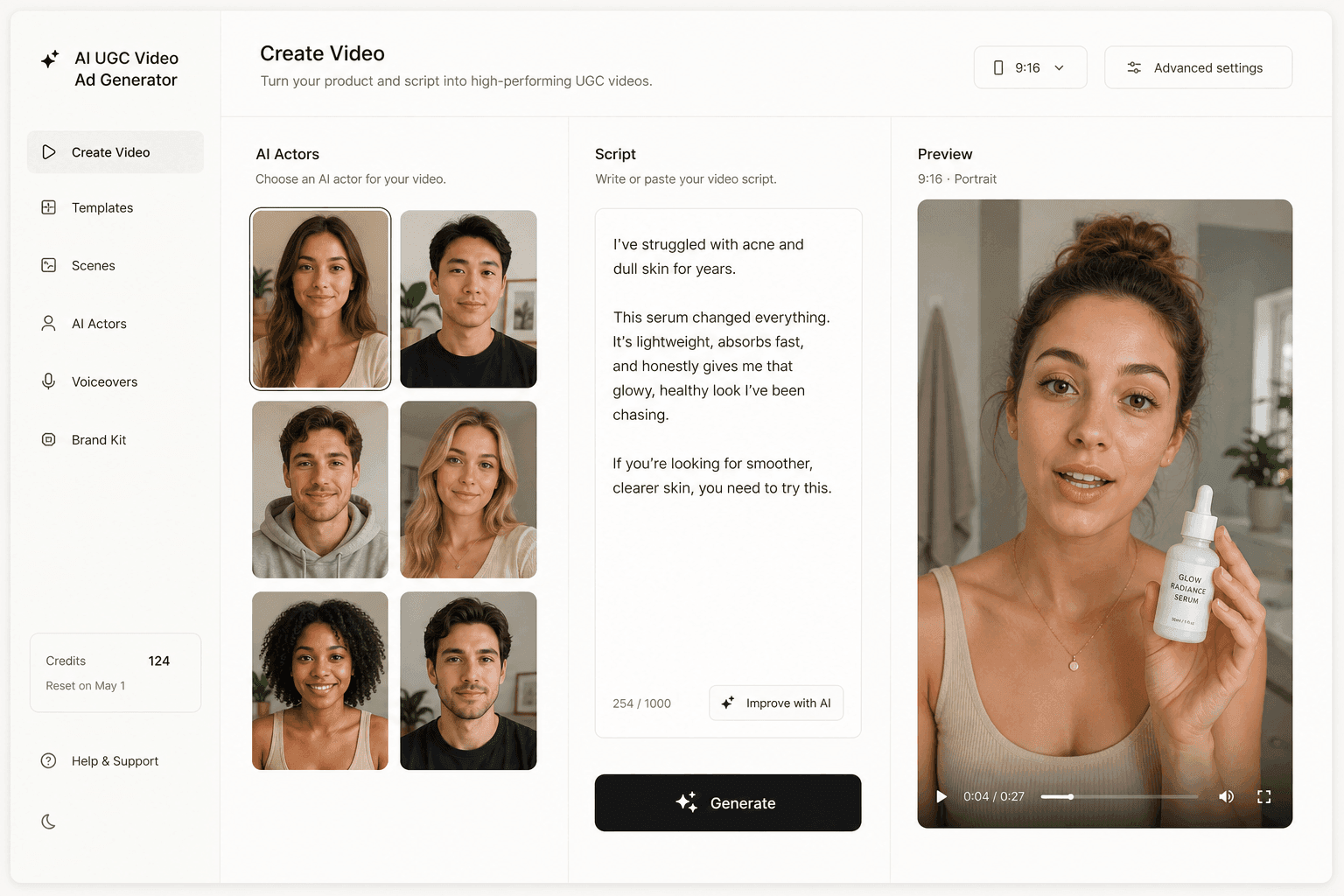
HeyGen's UGC video generator puts the words before the face. Its own summary of the flow is to write your script, pick a creator-style presenter, and generate. The presenter pool is large: HeyGen offers 1,100+ AI UGC video presenters that it says are designed to look like everyday creators, not corporate spokespeople. From one script it lets you swap presenters, backgrounds, hooks and calls to action to build variations for A/B tests, and its UGC ads page names Meta Ads Manager and TikTok Ads Manager as destinations for the finished file.
The rest of HeyGen is wider than advertising. The same account covers translation, training video and a full studio editor, which is why its Business plan lists interactive video and SCORM export in the same card as extra seats. For a performance team most of that breadth is background noise. One part of it matters a great deal, though: localization, which gets its own section below.
Creatify: a link-first ad generator with an avatar library around it
Creatify's front door is the product page. Its URL to Video page says you paste a product link and Creatify pulls your assets, writes the script, and delivers a ready-to-run video ad in under 60 seconds. Its help centre says it supports most product links, naming Amazon, Shopify and App Store pages, with one caveat worth knowing before a launch day: some websites with firewalls may block it from reading the page.
Around that core sits an ad stack rather than a general video studio. Creatify's homepage says it can batch-create a dozen variations at once. Its Pro plan card lists a Competitor Ad Tracker covering 10M+ Meta ads, Ad Clone for remaking an ad from a URL, a Performance Agent with automations, and an MCP connector for Claude and ChatGPT. Its plan comparison also lists an Ad Launcher for Meta, TikTok and AppLovin, and its homepage says you can see spend, ROAS and CTR for every creative. Where HeyGen hands you a finished file, Creatify wants to stay in the loop after the file ships.
Where the two now overlap
The overlap is bigger than those two starting points suggest, so here it is plainly.
- Both turn a link into a video. HeyGen also runs a URL-to-video tool that accepts a product link, blog post or web page, including a UGC style that generates an ad with a presenter, hook and call to action.
- Both put your product in the shot. HeyGen's product placement tool combines a product photo and a face photo into a presenter video. Creatify's avatar page says a spokesperson you describe can hold your product.
- Both let you edit after generation. HeyGen says every scene, script line, voice, caption and visual is editable in its studio. Creatify's help centre says you can change almost anything in a generated ad with its editor.
- Both keep unused monthly credits alive for a second month. The details are under pricing.
Avatars, products and batch variations, head to head
Here is the snapshot on the dimensions a performance marketer actually tests, then a closer read on the three that decide most choices. Every cell comes from the vendor's own pages as of September 14, 2026.
| Factor | HeyGen | Creatify |
|---|---|---|
| Where an ad starts | Script, then presenter | Product link, then avatar |
| Creator-style presenters | 1,100+ UGC presenters | 300 Starter, 1,500 Pro |
| Custom avatars | 1 on Free, 5 on Business | 3 on Pro |
| Product in the shot | Product photo plus face photo | Described avatar holds product |
| Link to video | One tool among many | The front door |
| Batch variations | Swap presenter, hook, CTA | Many scripts per link |
| Languages listed | 175+ on paid plans | 75+ on paid plans |
| Length, entry paid plan | Up to 30 minutes | Up to 2 minutes |
| Entry paid plan | $29/mo, 600 credits | $39/mo, 100 credits |
| Video credit meter | Per minute of avatar | 5 credits per 15 seconds |
| API access | Pay as you go | Subscription from $99/mo |
Presenter library and custom avatars
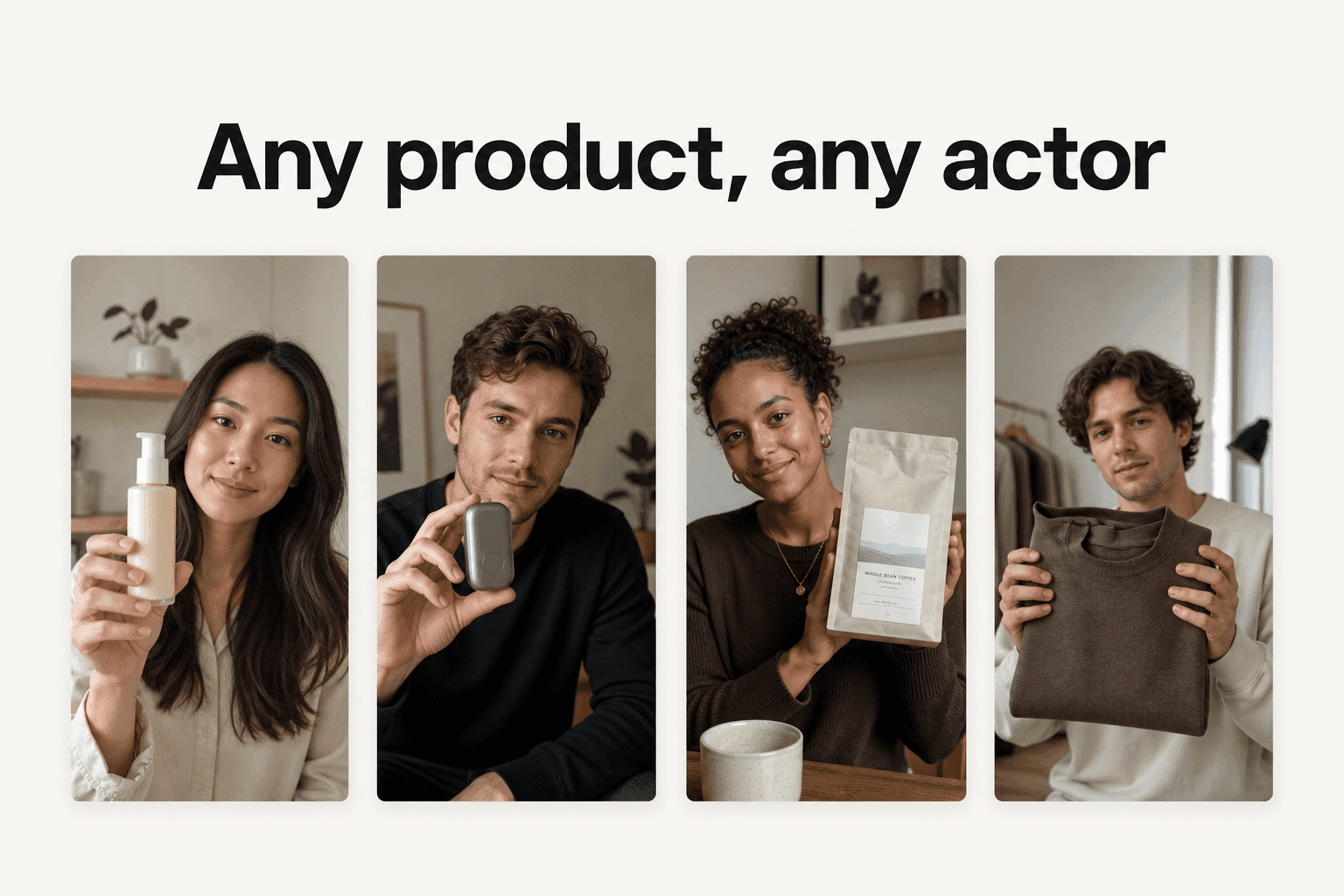
On raw counts, HeyGen's UGC pool of 1,100+ creator-style presenters sits between Creatify's two paid tiers: Creatify Starter lists 300 realistic AI actors, and Pro lists 1,500 plus 3 custom avatars. HeyGen's UGC page says paid plans unlock additional creator-style presenters without printing a per-plan count, so check the pool on the plan you would actually buy. Library size matters less than it looks, because a single test batch rarely uses more than a handful of faces. The number that matters is whether the faces on your plan match the buyers you target, and Starter's 300 is a real ceiling for a brand selling to several demographics at once.
Custom avatars split along a different line. HeyGen's Free plan includes 1 custom video avatar and Business includes 5, and its newest avatar model, Avatar V, builds a digital twin from a 15-second video of a real person. Creatify Pro includes 3 custom avatars, and its avatar page says you can pick a presenter, upload your own photo, or describe one from scratch. If your strategy rests on a recurring brand face, such as a founder or a spokesperson whose likeness you have rights to, HeyGen's twin workflow is the more developed of the two. If you want an invented presenter who fits a niche audience, Creatify's describe-it route is built for exactly that.
Getting the product into the shot
UGC ads live or die on the product being visible in the first two seconds, and neither tool leaves you without a route. The mechanics differ. HeyGen's product placement flow takes two inputs, a product photo and a face photo, and combines them into a presenter video. It also lets you review the combined image before the full render, which is the cheapest possible place to catch a bad composite. Creatify's route runs through its avatar builder, where a spokesperson you describe can hold your product.
The honest test is practical, and it costs a few credits on each side. Run the same three product photos through both and check three things on each result:
- Is the label legible at phone size, or does the packaging melt into a generic bottle?
- Do the hands grip the product naturally, or does it float?
- Does the product hold its scale when the presenter moves?
Batch variations and render queues
Batch is where Creatify's link-first design pays off most clearly. Its Batch Mode lets you select multiple scripts for each product URL and multiple avatars, so one link fans out into a grid of variations in a single step. HeyGen reaches variations from the opposite direction: one script, then swaps of presenter, background, hook and call to action. Both end in a test set. Creatify's route is faster when your input is a catalog. HeyGen's is tighter when your input is one script you keep sharpening.
Watch the render queue as closely as the credits. Creatify Starter runs 1 generation at a time, and Pro runs up to 5 in parallel. HeyGen notes that its system will not process 20 videos at the same time because of concurrency limits, and its Business plan lists 2x more concurrency than Pro. If you plan to render a twenty-ad batch on the morning of a launch, the queue is the limit you will actually hit, not the credit balance.
Languages, editing control and the API
These three rarely decide a first purchase. They very often decide whether a team is still on the tool six months later.
Localizing a winning ad
HeyGen treats translation as a core product rather than a feature. Its Creator and higher plans list 175+ languages and dialects, and its video translator localizes an existing video into 175+ languages with lip sync and preserved voice tone. So the workflow for a proven ad is simple: keep the winner, translate it, ship it in the new market. HeyGen's credit table prices lip-synced translation at 6 credits per minute in speed mode, which makes localizing a 30-second winner a rounding error next to generating it.
Creatify's pricing page lists 75+ languages on both paid plans, and its avatar page says every avatar lip-syncs in 75+ languages, so the natural workflow there is to render the ad again in each target language. One caution before you plan a market around a count: Creatify's help-centre FAQ still names 29 supported languages. On either tool, render a short test in your exact target language, and have a native speaker watch it, before you commit a launch to it.
Editing after the first render
Both tools let you fix a render instead of starting over. HeyGen's studio exposes every scene, script line, voice, caption and visual. Creatify's editor lets you change almost anything in a generated ad, and for more complex builds it offers Ad Flow, which it describes as a node-based editor for ads.
The difference that shows up on an invoice is how revisions are charged. Creatify charges 3 credits per 15 seconds for a revision, and on Pro and higher tiers revisions are free as long as you do not change the script, avatar or voice. HeyGen's meter tracks avatar generation itself. Its Avatar IV guide says it charges only the actual seconds of avatar generation rather than the whole video length, so scenes without the presenter on screen do not burn avatar credits, while a fresh take of the presenter does.
Automating production through the API
The API is where the cost ranking flips, which is why it earns its own look.
HeyGen's API is pay as you go and standalone. Its help centre says you can buy API credits without a Creator, Pro or Business plan, that one US dollar generally buys one minute of standard 720p or 1080p avatar video, and that Avatar IV costs $4 per minute of 1080p output.
Creatify's API sits behind a subscription. Its developer documentation says you subscribe to a plan to unlock API access: API Starter is $99 a month for 500 credits, and API Pro is $299 a month for 2,000. On the API, AI Avatar and URL to Video each cost 5 credits per 30 seconds.
Here is the same 30-second avatar video priced through each API, as of September 14, 2026:
- Creatify API Starter: 5 of 500 monthly credits, about $0.99 of the $99 fee if you use the full allowance.
- HeyGen API, Avatar IV at 1080p: about $2.00 at $4 per minute.
- HeyGen API, standard avatar generation: about $0.50 at one dollar per minute.
So a team pushing steady, high volume through code can reach a low unit cost on Creatify's subscription, as long as it actually spends most of the monthly credits. A team with spiky or experimental volume avoids a monthly commitment entirely on HeyGen, and pays only for the minutes it renders.

What each plan costs, as of September 14, 2026
Both vendors publish their self-serve prices on public pages, and HeyGen's help centre describes its paid plans as newly credit-based. Prices and credit rules in this category move often, so treat every figure here as dated and re-check before you commit.
HeyGen's ladder
- Free, $0 a month. 3 videos per month, each up to 1 minute. HeyGen's help centre adds that the allowance is 1 to 3 videos depending on region, and that Free does not use credits.
- Creator, $29 a month, or $24 a month billed annually. 600 credits, videos up to 30 minutes, 1080p export, watermark removal, voice cloning and 175+ languages and dialects.
- Pro, from $49 a month. 1,000 credits and 4K export, with tiers that run from 1,000 credits at $49 up to 100,000 credits at $4,300 a month.
- Business, $149 a month, with additional seats at $20 each. 1,500 credits, and extra credits at $0.05 each.
- Enterprise, contact sales.
One packaging detail catches solo marketers mid-campaign: Creator does not support one-time credit purchases, so running out in week three means upgrading to Pro rather than topping up.
Creatify's ladder
- Free Plan. 10 monthly credits, enough for up to 2 video ads or 20 image ads, with a watermark on exports.
- Starter, $39 a month. 100 credits, 300 AI actors, 75+ languages, videos up to 2 minutes, 1 generation at a time.
- Pro, $99 a month. 300 credits on the base tier, with tiers up to 5,000 credits a month, 1,500 AI actors plus 3 custom avatars, videos up to 10 minutes and up to 5 generations in parallel.
- Enterprise, "Let's talk!" No public price.
Creatify also advertises savings of up to 50% on annual plans. The pricing page text we could read does not print the annual dollar amounts or the prices of Pro's higher credit tiers, so this post does not convert either into a number.
How the two credit meters count
The two ladders look comparable until you read what a single credit buys.
- HeyGen meters the presenter. Avatar IV costs 16 credits per minute with a Photo Look and 31 with a Video Look, and Avatar V costs 48 per minute. Other features draw from the same balance at their own rates, such as Video Agent at 40 credits per minute in standard mode.
- Creatify meters the finished video. A Video Ad, Avatar Video or AI Shorts render costs 5 credits per 15 seconds, rounded up. Its Agent, Ad Flow and Ad Clone tools use a variable amount that Creatify says cannot be determined upfront.
- Both give credits a second month. HeyGen rolls unused monthly plan credits over for one additional billing cycle, and Creatify says monthly-plan credits are valid for two months.
Both vendors show the credit cost before you render for most tools. That is the habit worth building on either one: read the number on the render button, not the plan card.

A worked example: 20 thirty-second ads for one product
Back to the sneaker brand. The brief is twenty 30-second UGC-style ads with a presenter on screen the whole time, one product, launching next week. Here is what that batch costs on each vendor's published meter.
- Total footage. Twenty ads at 30 seconds each is 10 minutes of presenter video.
- HeyGen credits. At Avatar IV's Video Look rate of 31 credits per minute, 10 minutes is 310 credits. Even at the highest avatar rate HeyGen publishes, Avatar V at 48 credits per minute, it is 480 credits. Both fit inside Creator's 600 credits at $29 a month.
- Creatify credits. A 30-second render is two 15-second blocks at 5 credits each, so 10 credits per ad and 200 credits for the batch. That is double Starter's 100 credits, so the batch needs Pro's 300 credits at $99 a month.
- Plan cost per ad. $29 divided by 20 ads is about $1.45 on HeyGen Creator. $99 divided by 20 ads is about $4.95 on Creatify Pro.
- Revisions. Say five ads need rework. On Creatify Pro that is free if the script, avatar and voice stay the same; at the revision rate of 3 credits per 15 seconds it would otherwise be 6 credits per ad. On HeyGen, regenerating the presenter draws avatar credits again at the published per-minute rate.
What the math does and does not say. On the presenter alone, HeyGen's entry plan buys this batch for a fraction of Creatify's price. But the two meters are not buying the same basket. Creatify's 10 credits per ad pays for a finished ad render assembled from your product page, with the script and assets pulled for you. HeyGen's 31 to 48 credits per minute pays for the talking presenter. If you have HeyGen's Video Agent build the scenes, that feature carries its own rate of 40 credits per minute in standard mode, and generated image and video assets are priced separately again.
So a team that writes its own scripts and assembles scenes itself will find HeyGen's number close to its real bill. A team that wants a product page turned into twenty finished ads with minimal hands-on time will find that Creatify's higher per-ad credit includes work it would otherwise do by hand.
Which one fits your ad program
Neither tool wins outright, and a comparison that crowned one would be selling something. The fit test splits on where your ads start and who drives production.
Choose HeyGen when:
- Your team writes scripts and wants the lowest credit cost per minute of presenter.
- A winning ad needs to run in other markets, and translating it with lip sync beats rendering it again.
- You want a recurring brand face built from a short video of a real person.
- A developer will call the API with irregular volume, and you would rather prepay dollars than hold a subscription.
- The same account also has to cover training, explainer or internal video.
Choose Creatify when:
- Your input is a catalog of product pages, not a folder of scripts.
- You want many scripts and avatars per product generated in one batch step.
- You want competitor ad tracking, ad cloning and a launch-and-report layer next to the generator.
- You push steady volume through the API every month and will use most of a subscription's credits.
- You accept a smaller monthly credit allowance in exchange for the page-to-ad assembly each credit includes.
If a third name is on your shortlist, Arcads versus HeyGen and Arcads versus Creatify run the same pair-by-pair test with a third tool in the mix. If that third name is Higgsfield, our Higgsfield review covers its link-to-ad tool, and for longer shortlists see the HeyGen alternatives and Creatify alternatives roundups.
Where Novoads fits, with a disclosure
This post is published by Novoads, an AI UGC video-ad generator, so we compete with both tools above. That is why there is no Novoads column in the table and nothing in the verdict depends on us. For completeness, it is a narrower third option: you upload a product image or write a script, pick an AI actor who can hold the product on camera, and get an ad-ready video. It has a smaller actor library than either tool here (it markets 100+ AI actors), and it does not turn a product link into a finished ad. Novoads starts at $49/month (Inicial, 50 credits per month), and all plans are published on /pricing. If your ad depends on a creator holding your real product from a photo you already have, it is worth a test beside these two. If your input is a URL or a translation pipeline, HeyGen or Creatify is the better-shaped tool. Our separate head-to-heads, Novoads vs HeyGen and Novoads vs Creatify, make that case in full.
The avatar is a commodity. The meter is the product.
It is tempting to settle this pair on a feature list. It does not work, because both tools put a believable presenter on screen, both accept a link, both place your product and both let you edit the result, so the list mostly agrees with itself. What still separates them is the unit each one bills and the input each one expects. If your testing starts from a script and ends in five languages, HeyGen's per-minute presenter meter and no-commitment API were built for you. If it starts from a product page and ends in an ad account dashboard, Creatify's per-ad meter prices in the assembly work you would otherwise do yourself. Render the same 30-second script on both this week, read the credit cost on the button, and let the cheaper usable ad make the call.
Frequently Asked Questions
What is the main difference between HeyGen and Creatify?
Where the ad starts and what the meter counts. HeyGen's UGC flow has you write the script, pick a creator-style presenter from a pool of 1,100+, and generate, and its credits are charged per minute of avatar video. Creatify's flagship flow starts from a product link: it pulls your assets, writes the script and renders the ad, and it charges 5 credits per 15 seconds of finished video. Each vendor now also offers the other's starting point (HeyGen has a URL-to-video tool, Creatify accepts your own script), but the default path shapes cost and speed.
Which is cheaper for a 30-second UGC-style ad?
On the entry plans and the presenter alone, HeyGen, as of September 14, 2026. A 30-second presenter clip uses about 16 to 24 HeyGen credits at its published avatar rates (31 to 48 credits per minute), and Creator includes 600 credits for $29 a month. The same 30 seconds costs 10 Creatify credits, and Starter includes 100 credits for $39 a month, Pro 300 for $99. The caveat is scope: Creatify's credit covers a finished ad built from your product page, while HeyGen charges separately for features such as Video Agent, which runs 40 credits per minute in standard mode.
Do HeyGen and Creatify offer a way to start without paying?
Both do, with tight limits. HeyGen's Free plan is $0 a month and lists 3 videos per month of up to 1 minute each; its help centre adds that the allowance is 1 to 3 videos depending on region. Creatify's Free Plan includes 10 monthly credits, enough for up to 2 video ads or 20 image ads, and its exports include a watermark. Either is enough to judge whether the presenters fit your brand before you pay.
Can HeyGen or Creatify turn a product URL into a video ad?
Both can. It is Creatify's signature flow: paste a product link and it pulls your assets, writes the script and delivers a video ad, and its help centre says it supports most product links, including Amazon, Shopify and App Store pages, though some firewalled sites can block it. HeyGen also runs a URL-to-video tool that accepts a product link, blog post or web page, with a UGC style that generates an ad with a presenter, hook and call to action. The difference is emphasis: in Creatify the link is the front door, in HeyGen it is one tool among many.
Which one is better for ads in several languages?
HeyGen has the deeper localization workflow. Its paid plans list 175+ languages and dialects, and its video translator localizes an existing video with lip sync, at 6 credits per minute in speed mode. Creatify lists 75+ languages on its paid plans and says every avatar lip-syncs in 75+ languages, though its help-centre FAQ still names 29 supported languages, so test your target language before you plan a launch around it.
Which has the better API for automated ad production?
It depends on volume shape. HeyGen's API is pay as you go and needs no Creator, Pro or Business plan; HeyGen says one dollar generally buys one minute of standard avatar video, and Avatar IV costs $4 per minute at 1080p. Creatify's API sits behind a subscription, $99 a month for 500 credits on API Starter or $299 for 2,000 on API Pro, with AI Avatar and URL to Video at 5 credits per 30 seconds. Steady high volume favors Creatify's per-video unit cost; irregular or experimental volume favors HeyGen's no-commitment model.
Key Takeaways
- HeyGen is script-first: you write the ad, pick one of its 1,100+ creator-style presenters, and pay credits per minute of avatar video. Creatify is link-first: you paste a product page, it pulls the assets and writes the script, and it charges 5 credits per 15 seconds of finished video.
- As of September 14, 2026, HeyGen Creator is $29 a month for 600 credits, while Creatify Starter is $39 a month for 100 credits and Creatify Pro is $99 a month for 300. Both vendors also publish a no-cost plan with tight limits.
- On the published meters, twenty 30-second presenter ads use 310 to 480 HeyGen credits, which fits inside Creator, and 200 Creatify credits, which needs Pro. Creatify's credit also pays for the page-to-ad build, so the two numbers do not buy the same basket.
- HeyGen is stronger for localizing a winner (175+ languages and dialects, lip-synced translation of an existing video) and for spiky API use (pay as you go, no plan needed). Creatify is stronger for catalog batching and the tracking, cloning and launch tools it lists around the ad.
- Realism is a tie you have to test yourself. Both homepages claim the realism superlative, so render the same script on both and judge the output, not the adjectives.