Bakery Ads: What to Make With AI, What Each Costs, and When You Can Say 'Gluten-Free'
Five ads a bakery or cake shop can make with AI from its own photos, what a clip, a still and a presenter video cost in Novoads credits and dollars, and what the FDA means by gluten-free, so you know before the word goes in a caption.

Mauricio Valdivia
·12 min
Your best cake leaves with one photo and no video
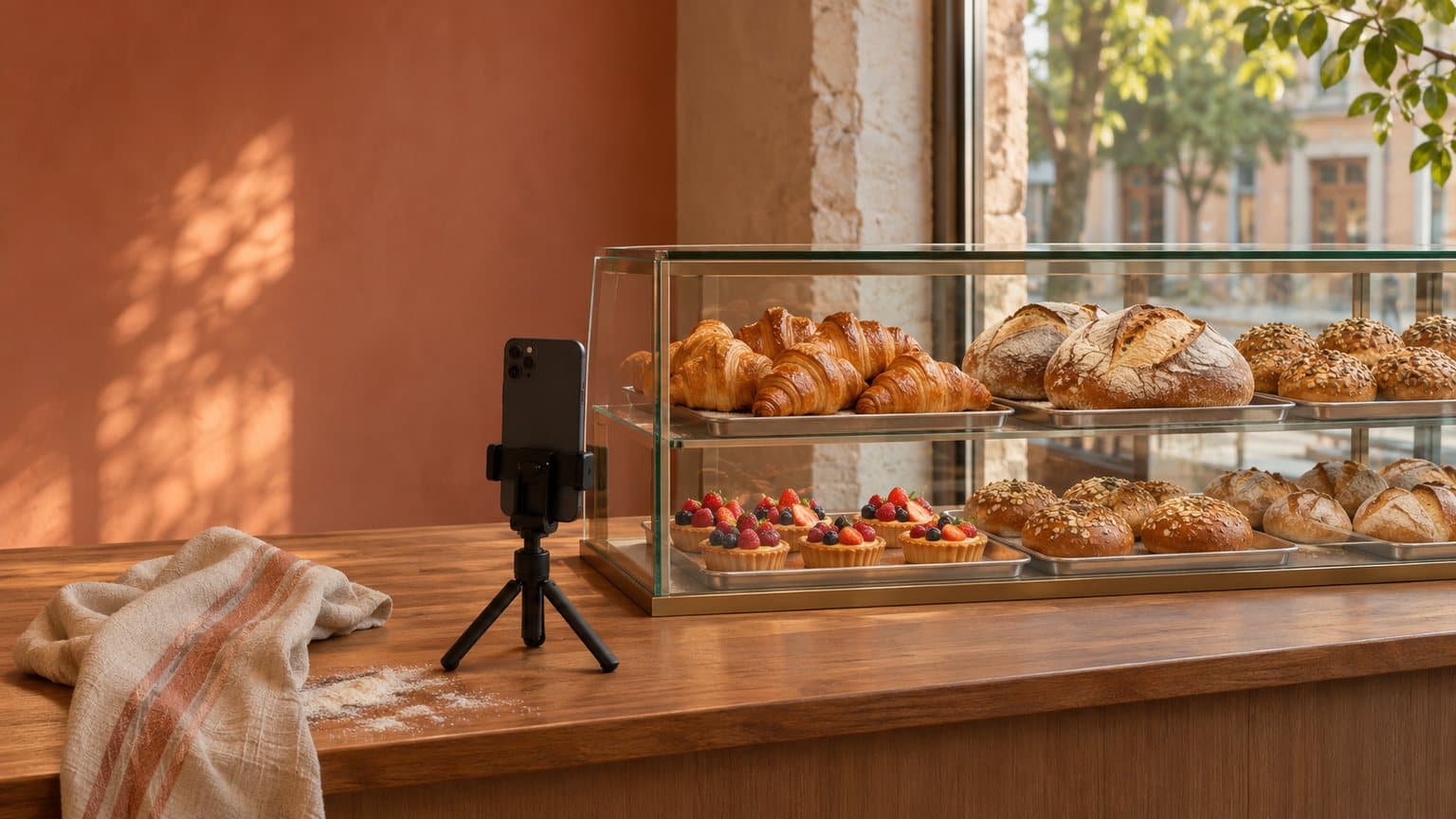
By the time the morning case is full, the best thing you baked this week has usually left in a box. A wedding cake gets one good phone photo on the bench before the van door shuts. Nobody's filming at 5 a.m. when the first trays come out. So the ad ends up as a photo and a line of text, or there isn't one that week.
We wanted to see what that one photo can turn into. We don't own a bakery, so we generated a picture of one to stand in for your photo. It shows a display case with croissants on two shelves, two scored sourdough loaves and six fruit tarts. Then we used it as the first frame of a five-second video clip, in which the camera slides along the glass and the case turns until you see its side. The still cost 1 credit and the clip cost 5.
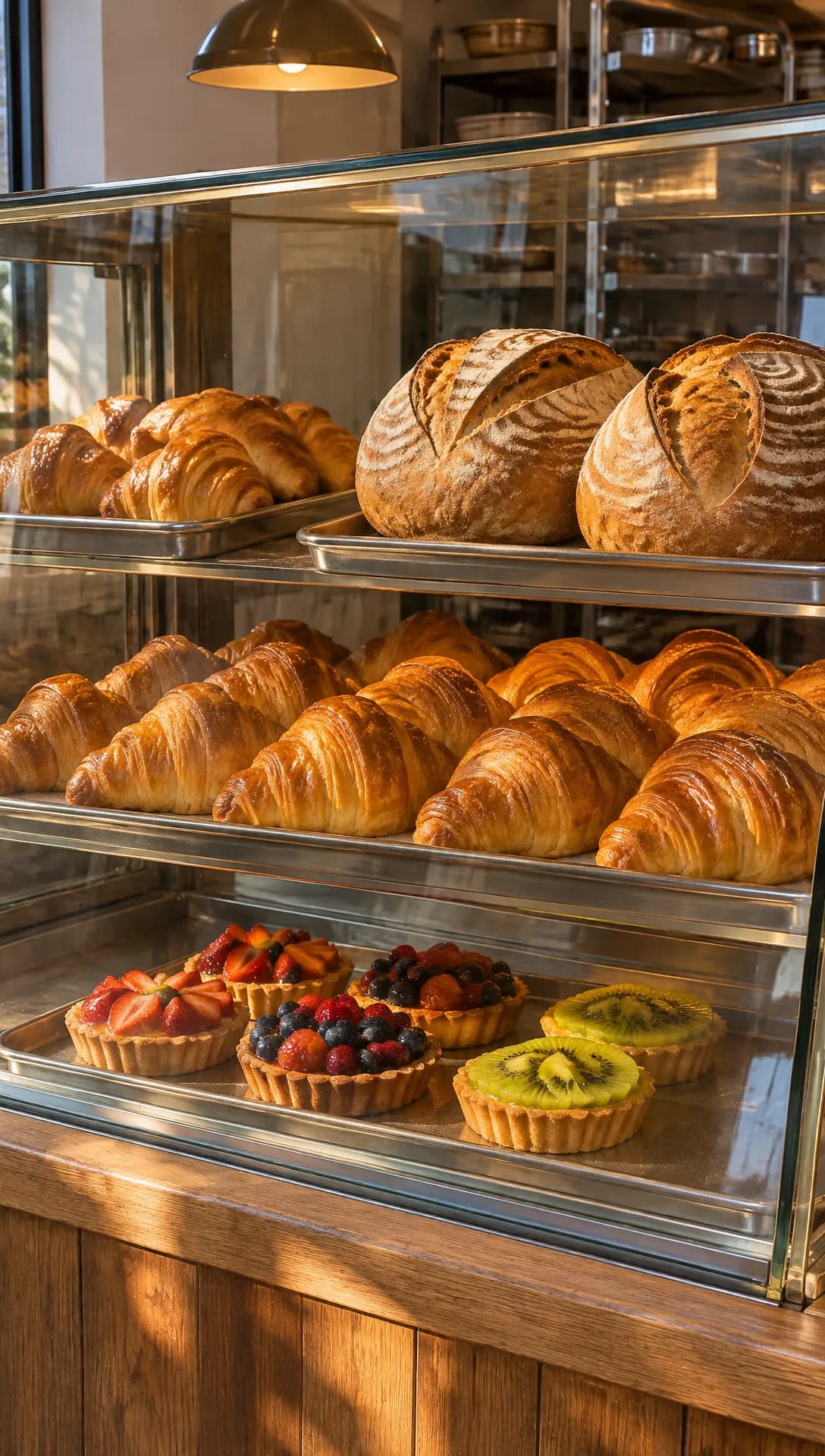 Made in Novoads with GPT Image 2.6 Sunburst · prompt: a small bakery's display case first thing in the morning, as a vertical phone photo · 1 credit · made 2026-11-13. It stands in for your own photo. This isn't a real bakery, and nothing in the case is a product anyone can buy.
One thing came back that we didn't ask for. The photo ends partway through the second loaf. When the camera moved past that edge, the model had to show more shelf, and it put a third loaf there. That's worth knowing before you hand a video model a photo of a cake somebody ordered.
On November 13, 2026, we read the results page for "bakery ads" and opened four of its pages. We also read the FDA's page on gluten-free labeling and the rule behind it, and we priced every ad in this post from our own price list. All we made was one picture and one five-second video. We didn't run anything here as a paid ad, and we haven't measured what any of it sells.
In what we could read of those four pages, none puts a price on making a video ad or walks through making one with AI. One of them tells bakeries to advertise "gluten free" as a benefit and never says what the term has to mean, which is why this post ends on that word.
Five ads a bakery runs, and where AI should stay out
The two idea lists we read from those results, one from Signs and Mirrors and one from YoonPak, point a bakery at the same few things. Between them they cover seasonal specials, custom orders, behind-the-scenes clips and customer reviews. We sorted those into five ads you'd actually make this month. In each one, AI can add motion, a voice or captions to something that's already yours. But it shouldn't show a bake you didn't make.
The holiday pre-order ad
Pie week, the December cookie boxes, the Easter breads. This ad's job is to get orders in before your cutoff, so it has to give the deadline, the pickup days and what the box holds while people can still order.
- An AI presenter can read the cutoff and the pickup window in twenty seconds, and your phone shot of the packed box can become a short clip to go with it.
- AI doesn't get to decide what's in the box. If this year's box holds nine cookies, a clip that shows twelve is an ad for a box nobody will collect.
The new flavor or limited batch
A new flavor is the reason a regular comes in on a Tuesday. The ad only needs to show it and say how long it's around.
- A video model is worth its credits here, because it adds a few seconds of camera movement to your own photo (a slow push toward a cut slice, a slide down the tray).
- It also fills in whatever your photo didn't show, the way ours did. It can add a filling, a color or a size the real item doesn't have, so keep the item whole in the frame and ask for a short, slow move.
The baker at work
People buy from a baker they've watched at work. Signs and Mirrors' list says to "show your team frosting cakes, kneading dough, or setting up the display case in the morning," and we'd take that literally. This is the one ad we'd film for real. Ten seconds of your own hands scoring a loaf beats anything generated, and all it takes is a phone on a shelf.
- AI helps on the days nobody filmed. You can turn a photo of the bench or the oven door into a short moving shot.
- It shouldn't show a baker, a kitchen or a method that isn't yours.
To see how short vertical ads open, our TikTok ad examples post lists the first seconds of fifteen of them.
The custom cake order ad
Birthday and wedding cakes sell on two things, your past work and your lead time. The ad shows cakes you've actually made and tells people how far ahead to order and how to get started.
- An AI presenter can explain the ordering steps, and photos of finished cakes can play as clips beside it.
- Never show an AI-made cake as past work, and never show a design you couldn't make.
We think a cake is the hardest thing in this post to hand a video model. The piping is exactly what a customer will hold you to, and the model has to guess every side of the cake your photo didn't catch.
The customer review ad
YoonPak's list tells bakeries to "Include these testimonials in your commercials and other promotional campaigns." A written review from a real customer is the raw material, and we'd ask that customer before their words go into an ad.
- An AI presenter can read the review aloud as a quote, with a line that says a customer wrote it.
- The presenter is an AI actor. It isn't the customer, and the script shouldn't let it talk as if it ate the cake. And the review has to be a real customer's, whoever reads it.
If you also ship boxes from an online store, our ecommerce video ads post goes through the product ads a store needs. If you also seat guests, our restaurant ads guide covers the dish close-up and the alcohol offers TikTok won't run.
How to make each ad in Novoads
Two routes cover all five ads. On one, a picture from your camera roll becomes a short clip. On the other, an AI presenter reads your script.
From your own photo to a five-second clip
- Shoot the photo vertical, in the light you'd want in the ad. Leave some room around the bake, because the model keeps what's in the frame and makes up what isn't.
- In Novoads, open Video and set Model to Kling 3.0, Aspect ratio to 9:16 and Duration to 5 seconds. Estimated cost shows the credits before you spend them (10 for this clip).
- Upload the photo where the box says "Drop a start frame or click to upload". Kling 3.0 opens the clip on your photo. In the editor, Seedance takes a photo only as a reference that guides the clip.
- Describe the camera move and the light, and say nothing that would change the bake. Our prompt opened with "The camera slides slowly along the bakery display case." and closed with "No people, no text."
- Tap the round arrow button, then hold the clip up against your photo before it goes anywhere.
We made ours the cheaper way, through our connector for AI assistants, where a Seedance 2.0 Mini clip can open on your photo. Five seconds at 720p cost 5 credits.
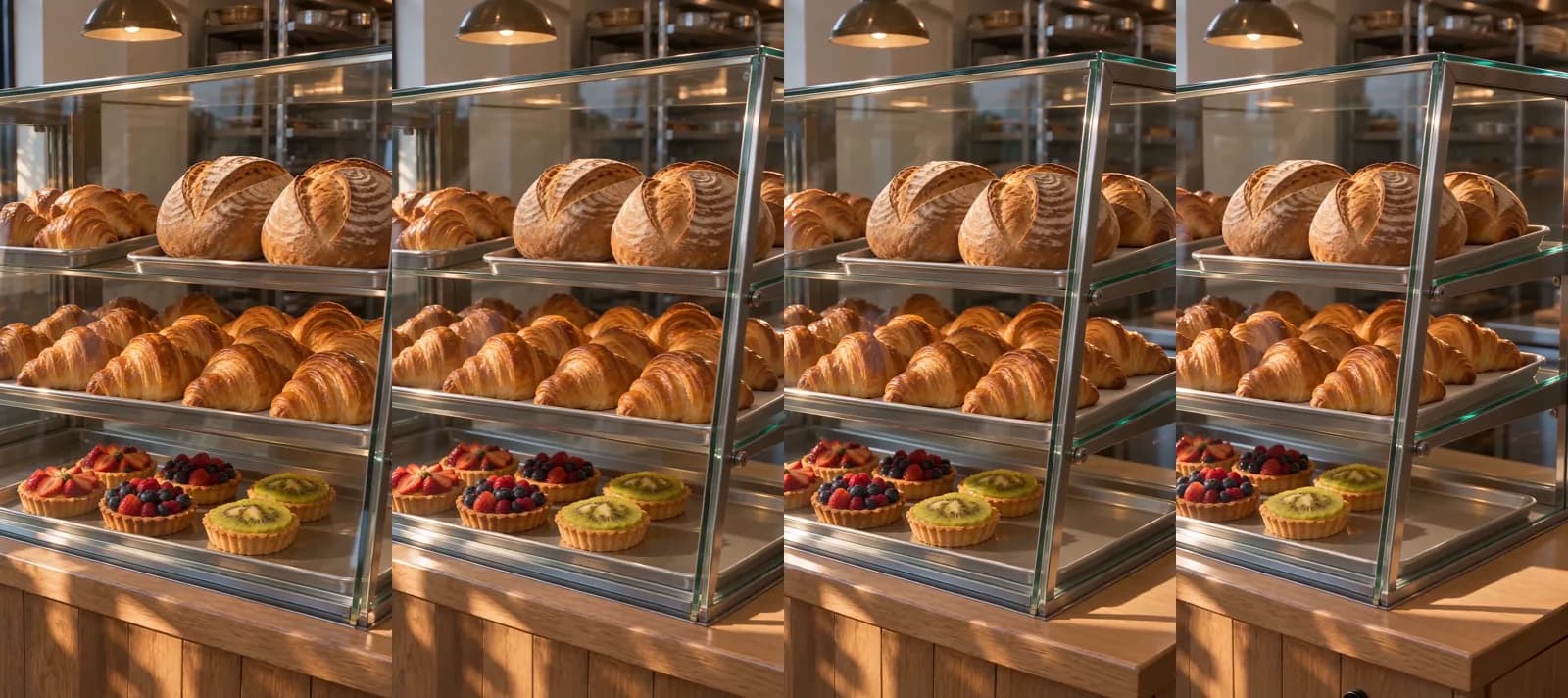 Made in Novoads with Seedance 2.0 Mini · prompt: the camera slides slowly along the bakery display case, from the still above as its start picture, sound off · 5 credits · rendered 2026-11-13. Four frames of the 5-second clip.
The clip came back vertical and silent, because we turned the sound off. The croissants and the tarts hold their shape as the case turns, and the light stays warm. We also asked for faint steam rising from the bread, and the frames show none. And by the third frame the extra loaf is on the shelf. Neither would matter for a tray of plain loaves, but you'd only catch them by looking.
If you want more than one shot, our longer walk-through takes one product photo all the way to a finished 15-second ad.
With an AI presenter who reads the order details
The pre-order, custom cake and review ads all need someone to say something (a cutoff date, a lead time, a customer's sentence). In Novoads, that's a talking actor. Open Talking Actors, write or pick a script, choose an actor and generate.
A few facts shape that script.
- An AI presenter is an AI actor. It isn't you, your decorator or the customer who left the review, so don't write "I baked" or "I ordered" for it.
- A 20-second cutoff reminder and a 55-second ordering explainer cost the same, because talking actors are charged by the started minute.
- A presenter from the library doesn't hold your box or your cake, so the clip has to show the bake.
The presenter's mouth and the audio come back already in sync. If you want the cutoff readable with the sound off, you add captions afterward. Karaoke, the style the app selects by default, costs 0 credits.
What to check before it goes out
- Count the loaves on the shelf, the slices on the plate and the cookies in the box, and match them to the real thing.
- Look hardest at the edges. Anything the clip shows past the border of your photo was invented.
- Don't ask the video model to write your dates on screen. The app's own hint says "Captions may come out misspelled here: add them after with Captions."
- Fix the prompt before you generate a second time, because every new take costs its credits again.
What each bakery ad costs to make
Prices as of November 13, 2026. Every plan here is a paid one, Starter included, and these are the first three.
- Starter is $15 a month for 200 credits, monthly only, which works out to $0.075 a credit.
- Plus is $49 a month for 1,000 credits, which works out to $0.049 a credit.
- Ultra 3,000 is $129 a month for 3,000 credits, which works out to $0.043 a credit.
The dollar columns are our own arithmetic, credits times each plan's rate.
| What you make | Model and setting | Credits | Starter | Plus | Ultra 3,000 |
|---|---|---|---|---|---|
| 5-second clip from your photo | Seedance 2.0 Mini, 720p, through our connector | 5 | about 38 cents | about 25 cents | about 22 cents |
| 5-second clip from your photo | Kling 3.0, in the editor | 10 | 75 cents | 49 cents | 43 cents |
| Still for the pre-order post | GPT Image 2.6, medium quality | 1 | about 8 cents | about 5 cents | about 4 cents |
| AI presenter, up to 60 seconds | Talking actor, 480p | 100 | $7.50 | $4.90 | $4.30 |
| AI presenter, up to 60 seconds | Talking actor, 720p | 200 | $15.00 | $9.80 | $8.60 |
| Captions on a finished video | Karaoke style, in the app | 0 |
A week of posts, added up
Take three clips from your own photos (the new flavor, the counter and the pre-order box) and one still, a seasonal backdrop to put your dates on. That's 16 credits when the clips go through our connector. At Starter's rate it's $1.20, and at the Plus rate it's about 78 cents. On Ultra 3,000 it's about 69 cents. Made in the editor on Kling 3.0, the same set comes to 31 credits.
A Starter month covers 12 of those sets, with 8 credits left over. A Plus month covers 62.
The presenter is where the credits go. Add one 480p presenter video for the pre-order cutoff and the week comes to 116 credits. That's $8.70 on Starter and about $5.68 on Plus. And on Starter, a single 720p presenter video uses the whole month's credits.
That math leaves out a few things.
- A second take costs its credits again.
- Joining clips into one ad and adding music are separate steps.
- Ad spend on a platform is a separate bill.
- The minutes you spend holding each clip up to the actual bake aren't in it either.
The pricing page lists every plan, with annual billing on Plus and Ultra.
What a photographer charges, for scale
Shopify's guide to product photography pricing, dated January 27, 2026, gives a range for a photographer's work. It says "Per-image pricing can land anywhere between $50 and $350, with room on either end for outliers." For food, it adds that "Food stylists, like other specialists, charge anywhere from a few hundred dollars to $2,000 a day."
It's one vendor's guide, and it prices a different job. A photographer makes you new pictures of the cake, while an AI clip only adds motion to a picture you already took. If your photos are dark, or the cake left before anyone took one, a photographer fixes a problem that a video model can't.
When a bakery can say gluten-free
YoonPak's list, published July 5, 2024, tells bakeries that their ads should focus on "benefits such as low sugar, gluten free and high fiber." It doesn't say that the FDA defines one of those terms. The FDA's consumer page on the term says it's current as of May 4, 2023, and the rule text below is from the 2025 annual edition of the Code of Federal Regulations.
What the FDA's definition asks for
The FDA's page says that, as one of the criteria for the claim, "the FDA set a limit of less than 20 ppm (parts per million) for the unavoidable presence of gluten in foods that carry this label." The rule is 21 CFR 101.91, and it says the same thing in its own words: any unavoidable gluten in the food "is below 20 ppm gluten."
Staying under 20 ppm is one condition, but it isn't the whole test. The FDA's page also lists what a food with the claim can't contain.
- "an ingredient that is any type of wheat, rye, barley, or crossbreeds of these grains"
- "an ingredient derived from these grains and that has not been processed to remove gluten"
- "an ingredient derived from these grains that has been processed to remove gluten, if it results in the food containing 20 or more ppm gluten"
The rule's own example for the second item is wheat flour, and for the third it's wheat starch. So a loaf made with ordinary wheat flour doesn't meet the definition, whatever a lab result says.
Three other wordings fall under the same rule. The FDA's page names "free of gluten," "without gluten" and "no gluten," and says a food label that bears one of them and fails the requirements "is considered misbranded and subject to regulatory action by the FDA."
Who the rule binds, and what the FDA says about menus
This is a labeling rule for packaged food the FDA regulates. The page says it "applies to packaged foods, which may be sold in some retail and food-service establishments such as carry-out restaurants."
On menus, the FDA's word is should. Its page says "restaurants making a gluten-free claim on their menus should be consistent with the FDA's definition." It adds that "State and local governments play an important role in oversight of restaurants." The page talks about restaurants and doesn't name bakeries.
Neither the page nor the rule text mentions advertising. So nothing above is a rule about ads, and we won't pretend it is.
What that means for the five ads
From here on, this is our own reading of those pages, and it isn't legal advice. If the label on the box or the line on the menu couldn't carry the word, we wouldn't put it in the ad for that item either. A customer who avoids gluten reads all three the same way.
- In a flavor reveal, the caption is where the word tends to slip in. We'd use it only for an item that meets the whole definition, ingredients included.
- An AI presenter says whatever the script says. If the script says gluten-free, you said it.
- A customer may call your brownie gluten-free in a review. Once that review is in your ad, we'd treat the word as yours.
- A clip shows how a bake looks. It can't show what went into the batter, and the croissants and loaves in our own clip are pictures of wheat bakes.
Read the FDA's page and the rule itself before the word goes anywhere. Both are in the sources at the end of this post.
Start with one photo from this week
Novoads is the paid tool we build for ads like these. You bring a photo of a bake or a few lines to read, pick a video model or an AI actor, and download a vertical video that you post or run yourself. It makes the ad and stops there, without placing it or buying the media. There's a separate Novoads page about video ads for food and beverage brands, written more for packaged products than for a shop with a morning case. For the wider picture of what AI does in advertising, our guide to AI ads is the general one. A polished 30-second spot is a different job, and we cover it under AI commercials.
Price a week of bakery clips before you make one
A five-second clip from your own photo is 5 credits, and an AI presenter is 100 or 200 credits a started minute. The pricing page shows what each plan's credits come to.
See what each plan costsPick one bake from this week that you have a good photo of, make the five-second clip, and put the two side by side before anyone outside the shop sees it.
Frequently Asked Questions
How do you advertise a baking business?
Start with photos of bakes you've already sold. Five ads fit a bakery: a holiday pre-order reminder with the cutoff and the pickup days, a new flavor reveal, a clip of the baker at work, an explainer on ordering a custom cake and a customer's review read out as a quote. Film the baker for real. For the others, AI can turn a photo into a short clip or have an AI presenter read the details, as long as nothing on screen is a bake you didn't make.
How much does it cost to make a bakery video ad with AI?
In Novoads, as of November 13, 2026, a five-second Seedance 2.0 Mini clip that opens on a photo of your bake costs 5 credits through our connector for AI assistants. That's about 38 cents at Starter's rate and about 25 cents at the Plus rate. In the editor, Kling 3.0 opens a clip on your photo for 10 credits. A video with an AI presenter, up to 60 seconds long, is 100 credits at 480p. At 720p it's 200. Starter is $15 a month for 200 credits, and you pay for Novoads from month one.
Can a bakery call something gluten-free in an ad?
The FDA's definition is written for the labels of packaged food, and the FDA pages we read don't mention ads. Under that definition, a food labeled gluten-free has to stay below 20 parts per million of gluten, and it can't be made with wheat, rye, barley or an ingredient from them that wasn't processed to remove gluten. For menus, the FDA says restaurants making the claim should be consistent with its definition. Our reading is that an ad shouldn't use the word for an item whose label or menu line couldn't. That's our view, and it isn't legal advice.
Is 'no gluten' on a label treated the same as 'gluten-free'?
Yes. Alongside gluten-free, the FDA's page lists three other wordings (free of gluten, without gluten and no gluten) and says a food label that bears any of them and fails the requirements is considered misbranded. The rule is about food labels, and its text is in 21 CFR 101.91.
Can I use an AI-made picture of a cake in my bakery's ad?
We wouldn't show a generated cake as one you made, or as one a customer will pick up. In this post, we used a generated still only to stand in for an owner's photo, and its caption says so. Use AI to add motion, a voice or captions to photos of your real bakes. Then check every clip against the photo, because a video model fills in whatever the photo didn't show.
Key Takeaways
- A bakery's ads come down to five: the holiday pre-order, the new flavor, the baker at work, the custom cake order and the customer review. AI can add motion, a voice or captions to what's yours, but it shouldn't show a bake you didn't make.
- For this post, a GPT Image 2.6 still stood in for an owner's phone photo, and Seedance 2.0 Mini turned it into a 5-second clip for 5 credits. Past the edge of the photo, the model added a third loaf the still doesn't have.
- Three clips from your own photos and one still come to 16 credits, which is $1.20 at Starter's rate. A video with an AI presenter, up to 60 seconds long, is 100 credits at 480p. At 720p it's 200.
- The FDA's limit of less than 20 parts per million is only one condition of its gluten-free definition. A food made with wheat, rye or barley ingredients that weren't processed to remove gluten doesn't meet it.
- That rule is written for packaged-food labels. For menus, the FDA says restaurants should be consistent with its definition. The pages we read don't mention ads, so matching your ad to your label is our own reading of them.