Ecommerce Video Ads: 7 Winning Examples and How to Make Them With AI
Ecommerce video ads are short vertical product videos that sell by showing the product in use. Here are seven formats that convert and how to produce them with AI in minutes.

Mauricio Valdivia
·11 min
Your product photo gets scrolled past. A 15-second video gets bought.
Open TikTok's Creative Center right now. Without logging in, you can scroll a free gallery of the highest-performing ads running on the platform, filter them by region, objective, industry, and format, then sort by reach or click-through rate. Almost none of the winners are polished brand films. They are phone-shot product videos: a hand squeezing a serum, a reveal from a cardboard box, a five-second before-and-after.
That is what an ecommerce video ad is now. Not a commercial. A short, vertical clip that sells a physical product by showing it doing its job, in a feed, next to a friend's holiday photos.
This guide is for DTC brands and the agencies that run their ads. It covers what actually makes an ecommerce video ad convert, seven formats that reliably work with a concrete example for each, a worked build of one product into a week of ads, and how to produce the whole set with AI for a few dollars instead of a few thousand.
What makes an ecommerce video ad work
An ecommerce video ad is a short video built to move a physical product, usually a vertical 9-to-30-second clip for a paid social feed or a product page. It is a specific job, not a genre, and three things decide whether it does that job.
It shows, it does not describe
A product page can list specs. A video ad cannot afford to. The format wins because it demonstrates: the texture of the cream, the size of the bag against a hand, the sound the blender makes. Shoppers trust what they can see happening more than what a caption claims, which is why a ten-second demo of the product in use out-converts a beautiful static shot of the product sitting still. If your ad could be replaced by a photo and a paragraph, it is not using the medium.
It borrows a real person's credibility
A brand talking about itself is discounted the moment it starts talking. A person who looks like a peer is not. Most high-performing ecommerce video ads use the UGC style on purpose: handheld, spoken to camera, lightly imperfect, so the message reads as a recommendation rather than a pitch. The product does not change. The wrapper does, and the wrapper is where the trust comes from.
It earns the first three seconds
This is the part brands underspend on. In a feed, the first three seconds decide whether the other twenty-seven are ever seen. A weak opening (a logo sting, a slow pan, "Hi guys") loses the viewer before the product appears. The strongest hooks put the tension on screen immediately: the problem, the result, or the single most surprising thing about the product, in frame one. A skincare ad that opens on the glowing "after" cheek outperforms the same ad that spends three seconds introducing the brand, because the second version spent its most valuable real estate on nobody's favorite subject. Everything after the hook is only as valuable as the hook that bought its attention, which is also why the hook is the variable worth testing hardest.
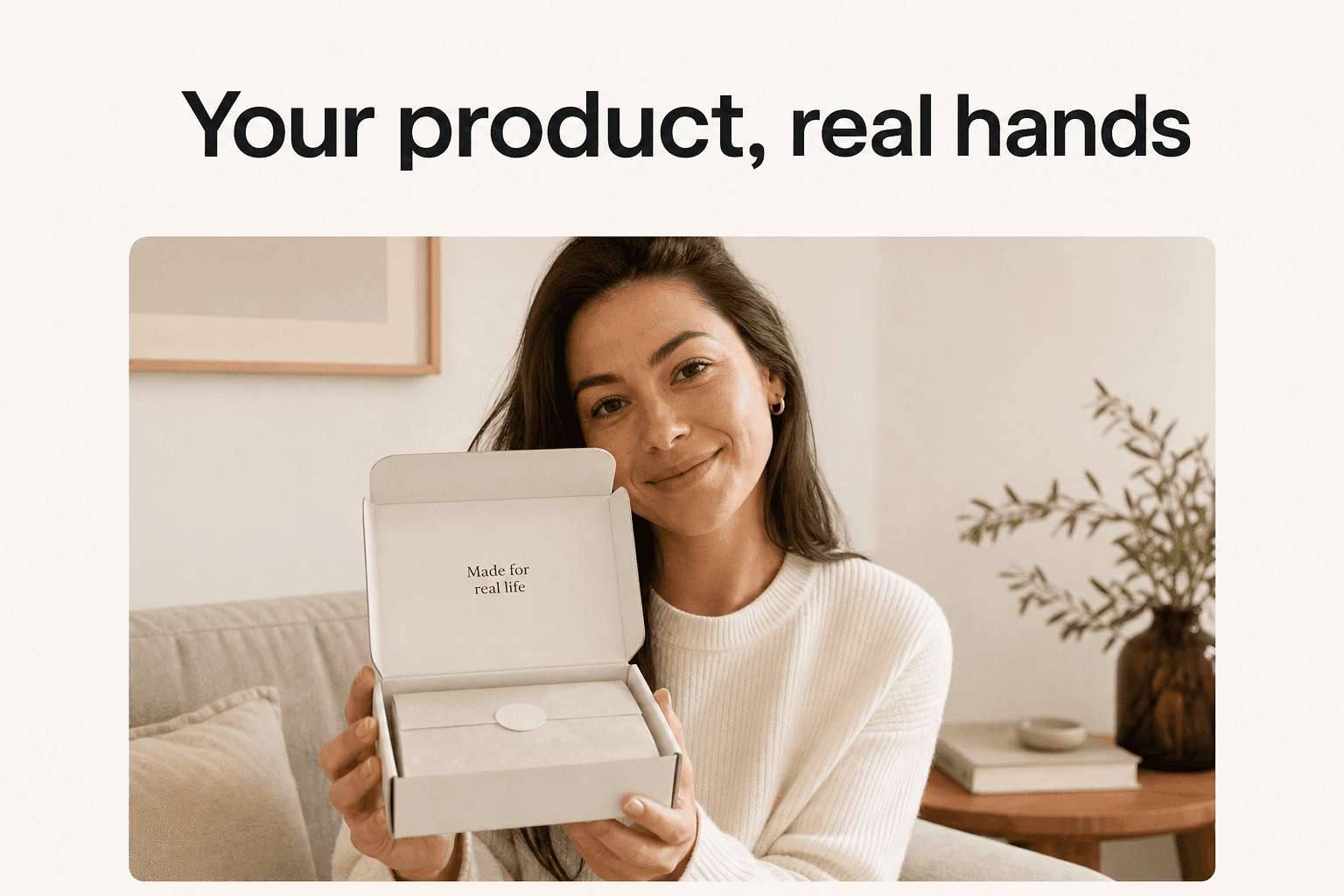
7 ecommerce video ad formats that actually sell
You do not need a hundred ideas. You need seven containers and a rotation. Each format below is a proven structure for moving trust onto a product, with an example of the kind of store it fits. Pick three to start, and build variations inside each.
Formats that show the product in use
-
1. The demo. The product solving the exact problem it is sold against, in one continuous shot. A cordless vacuum lifting cereal off a rug in one pass. A stain remover erasing a coffee ring on camera. Demos work because they collapse the gap between claim and proof: the viewer watches the promise happen instead of reading it.
-
2. The unboxing. The package, the reveal, the first reaction. This format sells the ownership experience, not just the object, which is why it works so well for subscription boxes, jewelry, and anything with premium packaging. The reveal is the hook, so open on the box already in frame, not on a title card.
-
3. The before-and-after. Two states, one cut. Frizzy hair then smooth, cluttered desk then organized, dull sink then gleaming. The format is almost unfairly effective for skincare, cleaning, and home products because the transformation is the argument. Keep the "before" honest and short, and let the "after" land without narration.
Formats that borrow trust
-
4. The testimonial. A real-seeming person to camera explaining what changed for them. This is the closest thing to a friend's recommendation, and it is the backbone of most UGC ad examples that scale. Specificity is what makes it believable: not "I love it," but "I stopped reaching for three other products after a week."
-
5. The founder story. The person who made the product explaining why. Founder-led clips carry a credibility that scripted actors cannot fake, and they work especially well for a launch or a mission-driven brand, where the same clip often doubles as a brand video. The hook is the frustration that started the company, told in the first sentence.
Formats built for the scroll
-
6. The problem-solution skit. A frustration acted out in the first three seconds, the product as the turn. A tangled charging cable, a dramatic sigh, then the magnetic cable that fixes it. This is the most feed-native format there is, and it lives or dies on the cold open. If the frustration is not instantly recognizable, the skit fails.
-
7. The offer clip. The product plus a reason to buy now: a bundle, a discount window, a bestseller restock. This is the format you rotate in when a proven creative needs a conversion push. Keep the product demonstration, then end on the specific offer and a clear call to action, never a vague "shop now." The offer clip is also the safest place to reuse a winner: take the hook and demo from your best-performing ad, and swap only the ending to carry the new promotion.
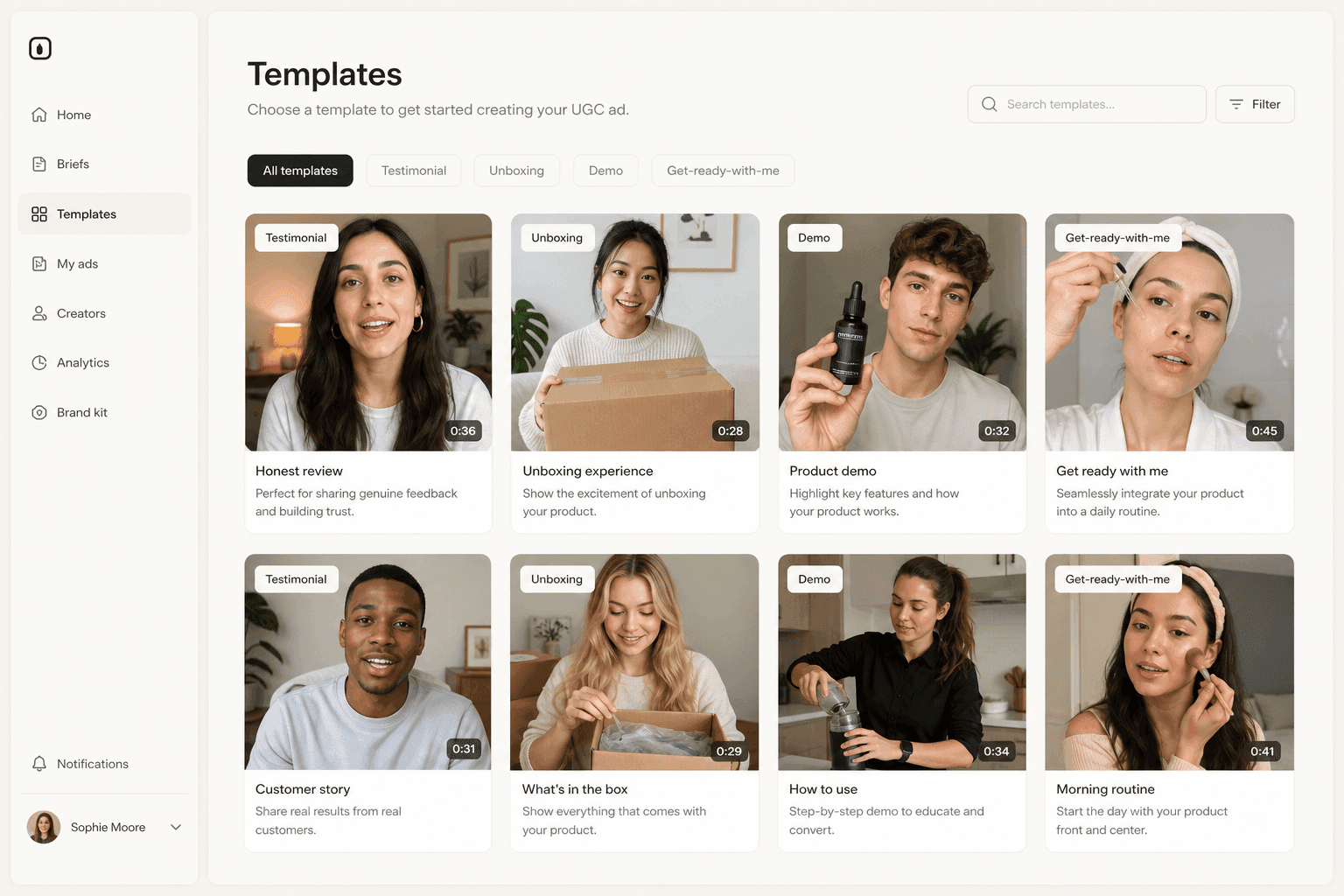
A worked example: one serum, a week of ads
Formats are abstract until you run one product through them. Take a mid-priced vitamin-C brightening serum, a classic DTC product. Here is how you turn a single SKU into a test-ready set.
Pick three angles, not one
Angles come before scripts. For the serum, three that pull on different motivations: a before-and-after on skin brightness (the visible-result buyer), a testimonial about fading dark spots after a month (the skeptical buyer who needs proof), and a problem-solution skit about dull, tired-looking morning skin (the impulse scroller). Same bottle, three completely different reasons to stop scrolling.
Write the hook first, then the rest
Each angle needs its own opening line, because the hook is 80% of the work. Before-and-after: open on the "after" cheek in close-up, then cut to the "before." Testimonial: "I had given up on my dark spots." Skit: a groggy face in the bathroom mirror at 7am. The body of each script is short: show the serum applied, name one concrete benefit, end with the offer. Twelve to twenty seconds is plenty. Our guide to making product videos with AI walks the scripting step in detail.
Do the cost math
Here is why the old way capped your testing. Three angles, filmed by a creator, is three briefs, a week of back-and-forth, and a bill that climbs fast (our breakdown of what UGC creators charge runs the real numbers). Now double it, because you want two actor variations per angle to see which face converts. That is six clips, and at creator prices it is a real budget decision. Generated with AI, the same six clips cost a few dollars each and land in an afternoon. The serum did not get cheaper to sell. Testing it did.
How do you know the set worked? You are not judging the videos, you are judging the numbers. Launch all six into one campaign, give them enough spend to clear a few hundred impressions each, and read hook rate (the share who watch past three seconds) and click-through rate side by side. One or two clips will pull clear of the rest, usually not the one you would have bet on. That clip becomes the control, and the next batch is six variations of it, not six fresh guesses.
The reason this loop was rare until recently is pure economics. Put the two production paths side by side and the difference is not quality, it is how many shots on goal you can afford:
| Hire a creator | Generate with AI | |
|---|---|---|
| Cost per clip | $100 to $500+ | A few dollars |
| Time to first cut | Days to weeks | Minutes |
| Realistic test set | 1 to 2 ads | 10+ variations |
| Best fit | A flagship face | Volume testing |
How to make ecommerce video ads with AI
The production step used to be the bottleneck. It is now the fastest part. The workflow in Novoads collapses a shoot into three moves, and the product is the input, not an afterthought.
Start from the product image
Upload a photo of the product and the tool builds an ad creative around it. This is the product-to-ad path: no shoot, no studio, no product-URL to paste, just the image file you already have in your catalog. Under the hood it runs GPT Image 2 at a fraction of a credit per image, so generating a shelf of product visuals to test costs almost nothing.
Script it and pick an actor
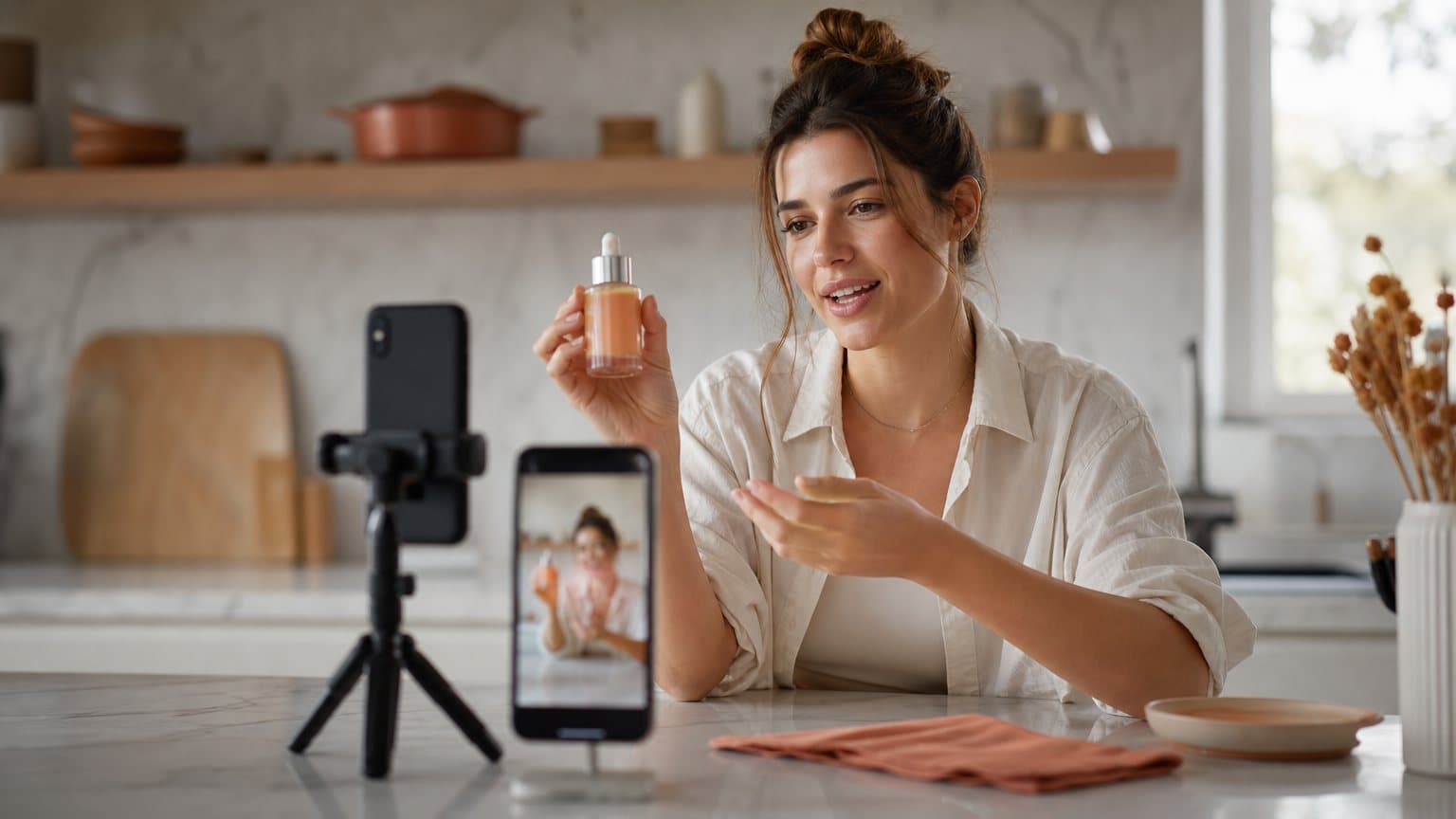
Write the hook and the body, or auto-generate a first draft and edit it, then choose an AI actor whose age, look, and accent match your audience. The actor delivers the script to camera with voice, lip-sync, and captions, in the handheld UGC style that reads as a recommendation. Want a version with no presenter at all? The same flow produces faceless video ads built around the product and a voiceover.
Export vertical, launch, read the data
Every clip exports 9:16 in HD, ready for TikTok, Reels, and Meta, or resized 1:1 and 16:9 for other placements. A single clip runs from about two dollars for the cheapest engine to around eleven for the highest-end one, and it is generated in roughly four minutes. You launch the set as a test, kill the losers fast, and put budget behind the winner. This is the same discipline behind any well-run AI ad program: the tool is not the strategy, the testing loop is.
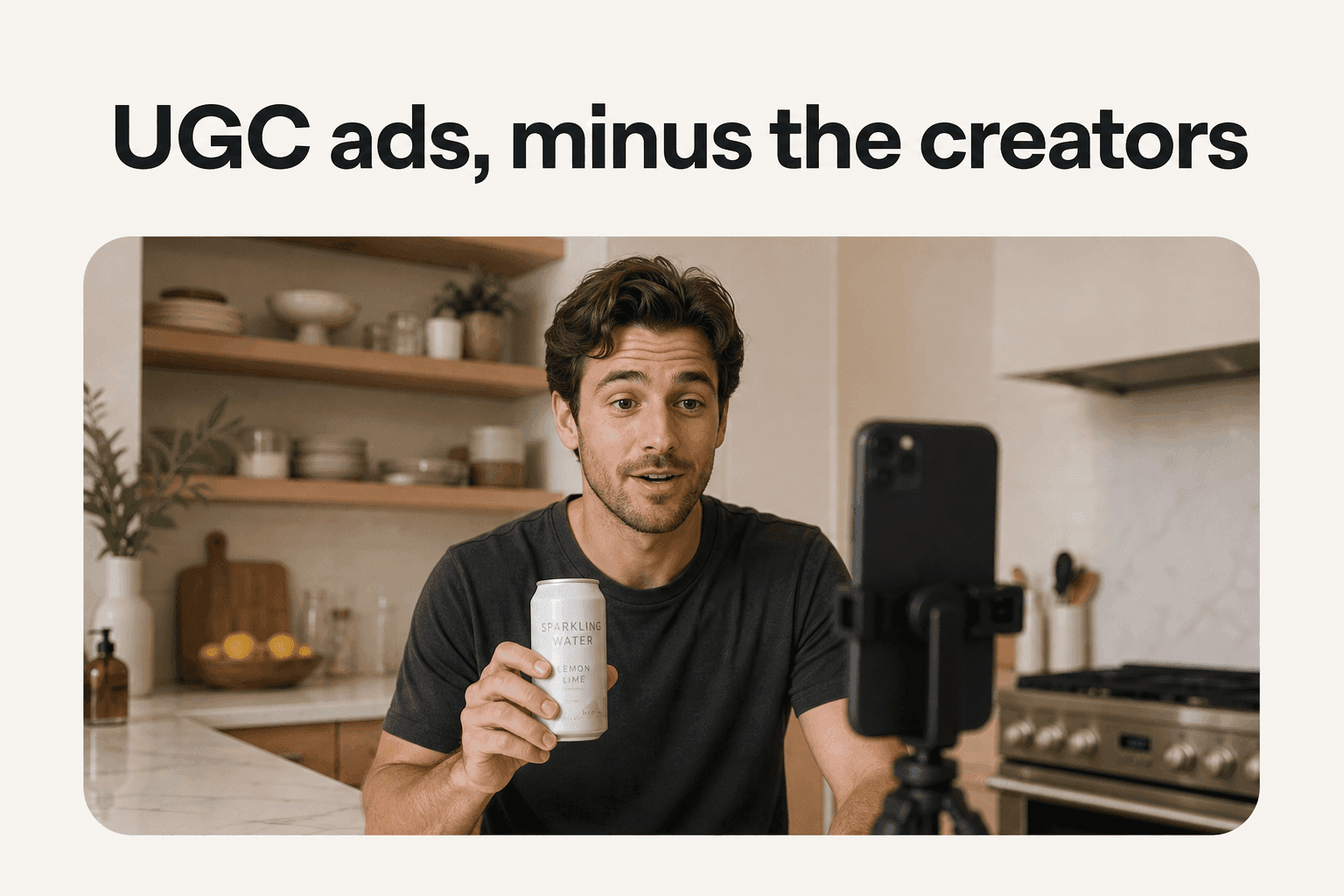
Benchmark against real winners before you spend
The fastest way to write a better ad is to study one that already works, and you do not have to guess which ones do.
Use TikTok's Top Ads gallery
TikTok's Creative Center is free and browsable without an account, and its Top Ads section is the useful part: "See high-performing auction ads on TikTok. Let successful cases inspire your creativity," filtered by region, objective, ad language, ad format, and likes, then sorted by For You, Reach, or CTR. Set the industry to your category and you are looking at the exact structures converting in your market this week. Our deeper walkthrough of the TikTok Creative Center covers the rest of the toolset, and the same benchmarking instinct applies when you are building TikTok Shop videos.
Model the structure, not the product
The mistake is copying a specific ad. The win is copying its skeleton. Watch ten winners in your category and note what they share:
- Time to product. How many seconds pass before the product is on screen (usually under one).
- Hook placement. What fills the first three seconds: a problem, a result, or a reveal.
- Demo framing. How the product is shown doing its job, and from what angle.
- The call to action. The exact words used, which almost always name a specific next step, not a generic "shop now."
That shared structure is the signal. Rebuild it around your own product and your own angle, then test your version against the pattern rather than against your gut.
Why volume beats the perfect ad
Here is the stance that changes how you budget. The winning ecommerce video ad is almost never the one the brand would have picked. The face that converts, the hook that lands, the angle that clicks, they are consistently surprising, which means the reliable path to a winner is running many and reading the results, not agonizing over one.
That reframes the whole problem. The bottleneck was never creativity, and it was never the media budget. It was production throughput. When each variation costs a hundred dollars and a week, testing is a luxury, so brands ship one or two precious ads and call it a campaign, using a testing medium to do the exact opposite of testing. The classic failure mode is the hero-video trap: pouring the entire quarter's creative budget into one polished flagship, launching it, and having nothing to rotate in when it fatigues in ten days.
The other failure mode is the opposite and just as costly: generating fifty near-identical clips that all share one weak hook. Volume only helps when the variations are genuinely different, different angles, different faces, different first three seconds. Ten real variations beat one hero video and beat fifty clones of a loser.
So spend your variation budget on the variables that actually move performance, in roughly this order:
- The hook. The single highest-leverage variable. Test three completely different first three seconds before you touch anything else.
- The angle. Same product, different reason to care: results, price, status, convenience. Each pulls a different buyer.
- The actor. Age, look, and accent change who feels spoken to. A face that matches your audience converts a version that a mismatched one buries.
- The call to action. A specific next step versus a generic one is a small change that reliably swings click-through.
Everything else (music, captions, transitions) is a second-order tweak. Win the hook and the angle first.
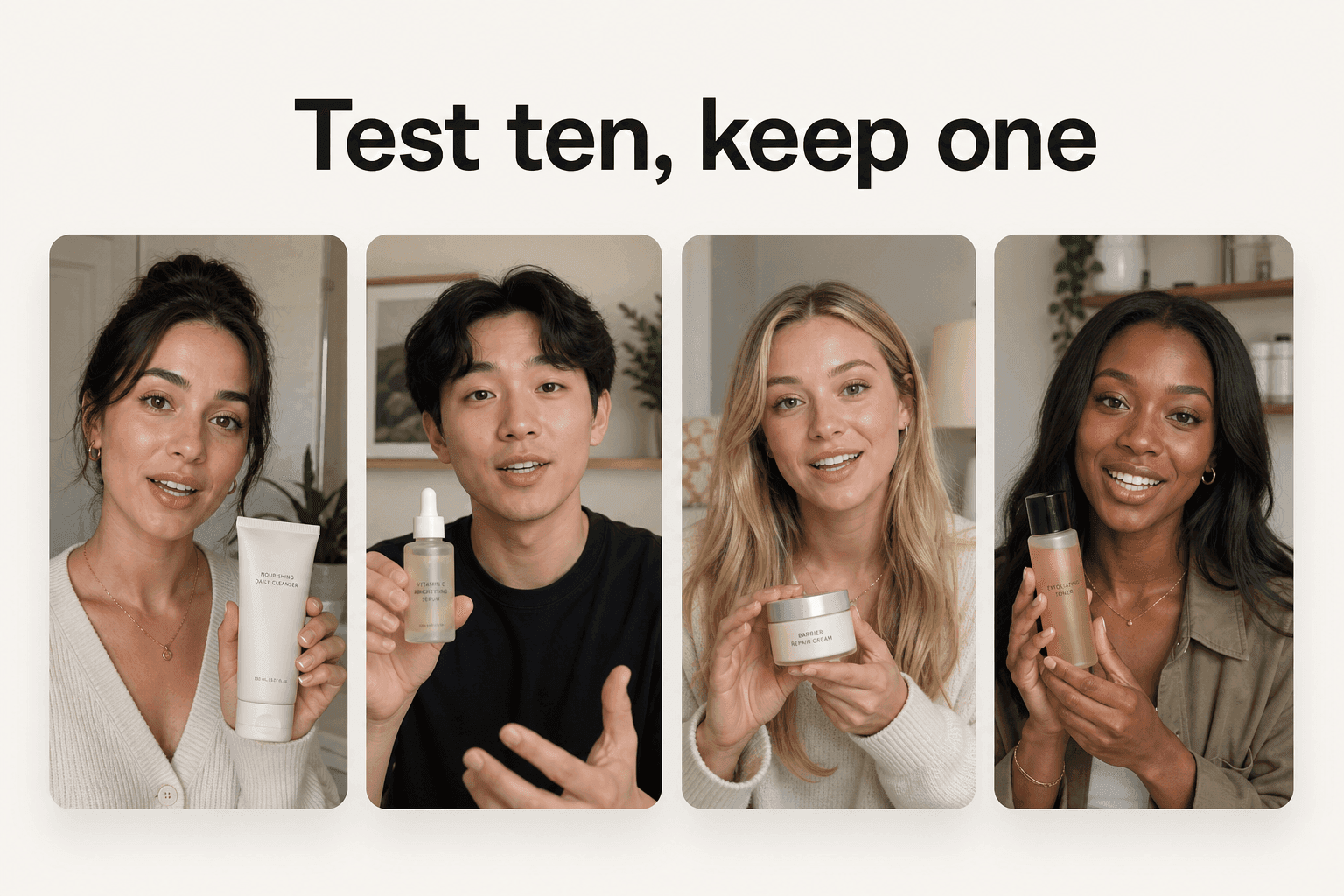
How Novoads solves the ecommerce testing bottleneck
Novoads exists to make the volume the format was always built for actually affordable. You upload a product image or write a script, pick an AI actor, and get an ad-ready UGC-style vertical video in about four minutes, for a few dollars, exported 9:16 for any platform. Because each clip is that cheap and that fast, producing the ten genuinely different variations that a real test needs stops being a budget meeting and becomes an afternoon.
That is the whole shift. An ecommerce video ad was never really about one video. It was about running the format the way it demands to be run: many angles, many hooks, many faces, launched as a test and pruned by the data. The trust signal that sells your product used to be locked behind a creator's calendar and a four-figure invoice. Now it is generated from the product photo already in your catalog.
You can produce your first ecommerce video ad with Novoads from $49/month at novoads.ai. Cancel anytime.
Frequently Asked Questions
What is an ecommerce video ad?
An ecommerce video ad is a short video, usually a vertical 9 to 30 second clip, made to sell a physical product in a social feed or on a product page. Instead of describing the product, it shows the product being used, unboxed, or reacted to by a real-seeming person. The goal is a click or a purchase, so the format leads with a hook, demonstrates the product fast, and ends with a clear reason to buy now.
What kind of video ads work best for ecommerce?
The reliable winners are demos, unboxings, before-and-afters, testimonials, founder stories, problem-solution skits, and offer clips. They all do the same job in different packaging: move a real person's credibility onto your product and show it solving the exact problem it is sold against. The best-performing version for your store is usually not the one you predicted, so you test several and let the data pick.
How long should an ecommerce video ad be?
For feed placements on TikTok, Reels, and Meta, aim for 9 to 30 seconds, with the hook landing inside the first three seconds. Shorter clips (9 to 15 seconds) tend to hold attention better for cold traffic, while a 20 to 30 second version has room for a demo plus a testimonial. Product-page and retail-media videos can run longer, but a paid social ad rarely benefits from going past 30 seconds.
How do you make ecommerce video ads with AI?
You upload a product image or write a short script, pick an AI actor that matches your audience, and generate a UGC-style vertical video with voice, lip-sync, and captions. In Novoads this takes about four minutes and costs a few dollars per clip, and you export it 9:16 for any ad platform. The practical win is not one perfect video, it is producing ten variations of one product cheaply enough to actually test them.
How much do ecommerce video ads cost to produce?
Hiring a creator or studio runs from around $100 to $500 or more per clip, and that price is what makes testing many angles slow and expensive. Generating the same UGC-style ad with AI costs a few dollars per variation and takes minutes, so a full set of test creatives is a single-digit-dollars exercise rather than a four-figure one. The real cost of the old way was never one video, it was the volume you could not afford.
Where can I find ecommerce video ad examples to model?
TikTok's Creative Center Top Ads is a free gallery of high-performing real ads you can browse without an account, filtered by region, objective, industry, and format, then sorted by reach or CTR. It is the fastest way to see which structures are converting in your category right now. Model the structure (the hook, the pacing, the call to action), not the specific product, and rebuild it around your own.
Key Takeaways
- An ecommerce video ad is a short vertical product video, usually 9 to 30 seconds, built to sell in the feed by showing the product in use rather than describing it.
- Seven formats do most of the work: demo, unboxing, before-and-after, testimonial, founder story, problem-solution, and the offer clip. Each is a container for the same job, moving trust onto the product.
- The first three seconds decide everything. A weak hook means the rest of the ad is never seen, so most of the craft lives at the start.
- The winning ad is rarely the one you would have guessed, which is why testing many variations beats polishing one. Volume is the strategy, not a nice-to-have.
- AI produces each variation from a product image or a script in minutes for a few dollars, which is what finally makes testing at ecommerce volume affordable.