Best AI Marketing Tools in 2026: 12 Picks by Job, Priced for Small Teams
Twelve AI marketing tools picked by the job they do, each priced from its own page with its billing period, plus what one finished ad costs in the tools that make ads.

Mauricio Valdivia
·19 min

Not one of the top five lists tells you what a finished ad costs
Search for the best AI marketing tools and the five results at the top hand you dozens of names and very little to budget with. Three of them give no prices at all. None of the five works out what one finished ad costs in the tools that make ads, and that's the number a small team spends against every month. The one list that adds up whole stacks builds them from AdCreative.ai at $20 a month and Jasper at $59 a month. Those are the rates you get when you pay for a year. Month to month, they're $39 and $69.
So we picked 12 tools by the job each one does for a small team, from making ads and writing copy to images, scheduling, email, search research and site analytics. We read every price on each tool's own page, from Spain, along with the billing period that goes with it. We didn't test the other 11 tools for this post. Novoads is ours, and its section includes two runs we made, with what each one cost in credits.
We put the same three questions to every pick.
- Does it help you win customers, or turn the visitors you already have into buyers?
- What does the plan a small team would start on cost, and how is it billed?
- What's the catch you'd want to know about before you pay?
The 12 picks and the plan to start on
Prices as of November 6, 2026.
Each row shows the plan we'd expect a small team to start on, with the billing period the tool's page gives for it. When a row has two prices, it's the same plan billed two ways. Where a page leads with its yearly rate, we list the month-to-month price first, because that's what you pay if you don't want to commit to a year. Prices are in the currency each page showed a visitor from Spain, which is why Mailchimp and Semrush's paid plan show up in euros. Adobe's row comes from its US plan card.
| Job | Tool | Plan to start on | Price and billing period |
|---|---|---|---|
| Video ads (UGC-style clips, product video, talking actors) | Novoads | Starter | $15 a month, monthly only, 200 credits |
| Video ads (avatars, product clips, ad cloning) | Creatify | Standard | $15 billed monthly, or $10 a month on the annual plan, 55 credits a month |
| Static ads and banners | AdCreative.ai | Starter | $39 billed monthly, or $20 a month billed yearly, 20 credits a month |
| Copy, research and ideas | ChatGPT | Plus | $20 a month, on monthly plans only |
| Copy, research and ideas | Claude | Pro | $20 billed monthly, or $17 a month on the annual plan |
| Copy in a set brand voice | Jasper | Pro | $69 billed monthly, or $59 a month billed yearly, 1 seat |
| Images, video and audio | Adobe Firefly | Standard | US$9.99 a month, billed monthly, 2,000 credits |
| Social scheduling | Buffer | Free | Free for up to 3 channels (Essentials is $5 a month per channel, billed yearly) |
| Mailchimp | Free | €0 a month under 250 contacts | |
| Email and text messages | Klaviyo | Free | Free up to 250 active profiles and 500 email sends a month |
| Search research | Semrush | Free | $0 with 10 reports a day (the SEO plan is €134 billed monthly) |
| Site analytics | Microsoft Clarity | Free | Free, with no paid version |
Five of the twelve start on a free plan. The other seven are where a small team's money goes, and three of those make ads, so the next section does the sum the top results skip.
A small team won't buy all twelve, and it shouldn't. Pick one tool for each job you actually have this quarter, then check the two stacks further down, where we add up what that comes to.
Ad creative tools and what one finished ad costs
Three picks make the ads themselves (Creatify, AdCreative.ai and Novoads). For these three, we can divide a plan's price by what its credits make and get the price of one ad. That's the figure that tells you whether a month of ads fits your budget. Novoads gets its own section further down, where we hold it to the same test and show our runs.
For most small teams that advertise, this is also where acquisition happens. The ad is what a stranger sees first, and you'll want several versions of it, because you can't tell in advance which one will work. So the price of each extra ad adds up fast.
Creatify
Creatify makes video ads built around AI avatars and product footage. Its plan table also lists an ad clone tool, a competitor ad tracker and an ad launcher for Meta, TikTok and AppLovin, so it covers more of running a campaign than most picks here.
Standard is where a small team would start. It's $15 billed monthly, or $10 a month on the annual plan, and the page shows the annual price first. Either way, you get 55 credits a month, and the page says they expire after 2 months.
The same page shows what those credits make, in a breakdown you can open from Standard's credit line. It says 55 credits make 7 five-second Seedance 2.0 videos. A footnote to the breakdown puts every row at 720p and 1K, and adds that higher resolution, longer clips and premium models use more credits. The rows are alternatives. You can spend the month on those clips or on another row, such as 11 fifteen-second videos with Creatify's Aurora avatars, but you can't add the counts together.
That 7 is rounded down. Creatify's pricing page rates a five-second Seedance 2.0 clip at 7.75 credits. Seven clips use 54.25 credits, so there's no room for an eighth. Spend a whole Standard month on them and each clip costs about $2.14 at the monthly price, or about $1.43 on the annual plan.
Pro, the next plan up, is $55 billed monthly, or $38 a month on the annual plan. Its 280 credits make 36 of the same clips. That's about $1.53 a clip billed monthly, and about $1.06 on the annual plan.
The catch on Standard is capacity. It runs 1 generation at a time, and Pro runs up to 5 at once. Both come with 1 seat. Creatify also has a free plan with 10 credits a month and a watermark on exports. The page says that covers up to 2 video ads or 20 image ads.
Creatify's pricing FAQ says the creatives stay yours after your plan ends, and you can use them on whatever channel you like. Our Creatify pricing guide goes through every plan, and our Creatify review covers its ad agent and its user ratings.
AdCreative.ai
AdCreative.ai makes static ads and banners for your brand, and it lists ad platform integrations and competitor insights on its Starter plan. Its plans open on yearly billing, so the first Starter price you see is $20 a month. Billed month to month, Starter is $39. Both come with 20 credits a month and 1 brand. AdCreative also has a 7-day free trial with 20 credits for ads, banners, videos and UGC videos.
The credit is the unit to watch. AdCreative's FAQ says you use a credit when you download a generated creative, and that you can make unlimited creatives, since credits only go when you download. So Starter gets you 20 downloads a month. That's $1.95 per downloaded creative billed monthly, or a dollar billed yearly.
That unit is also the catch. One credit buys one downloaded creative, which isn't the same thing as a finished video clip, so compare the $1.95 with another tool's price only when you're buying the same kind of ad. Our AdCreative.ai review goes further into what Starter buys and where its video ads start.
What one finished ad costs in these two tools
Each line uses the tool's own unit and the prices above.
- A five-second Seedance 2.0 clip at 720p on Creatify Standard costs about $2.14 billed monthly and about $1.43 on the annual plan.
- On Creatify Pro, that clip costs about $1.53 billed monthly and about $1.06 on the annual plan.
- A fifteen-second Aurora avatar video on Creatify Standard costs about $1.36 billed monthly and about 91 cents on the annual plan.
- One downloaded creative on AdCreative.ai Starter costs $1.95 billed monthly and a dollar billed yearly.
Two things move these numbers more than a plan's sticker price. Annual billing cuts Creatify's price per clip by about a third. And the model you pick changes how many credits each clip uses, which is why every figure here names its model and resolution. We price the same five-second clip in Novoads in our own section.
How to price one ad in any credit-based tool
Most ad tools sell credits, and a plan's price on its own doesn't tell you much. The same five steps work for any of them, and they're the steps behind every per-ad figure in this post.
- Find the plan's monthly credits and its price for the billing period you'll actually pay.
- Find how many credits one ad uses at the model, length and resolution you'd pick. If the pricing page doesn't say, look for the tool's credit guide in its help center.
- Divide the month's credits by the credits one ad uses, and round down, because part of an ad isn't an ad.
- Divide the plan's price by that count. That's your price per ad, and it's the number to compare across tools.
- Check what happens to credits you don't use, because credits that expire unused raise the real price of the ones you spend.
On that last step, Creatify's credits expire after 2 months, and Firefly's reset each billing cycle without rolling over. Our plan credits reset at each renewal too.
Copy and research with ChatGPT, Claude and Jasper
Ad copy, landing-page drafts, email subject lines and notes on what competitors claim are all writing jobs. Two general AI assistants and one writing tool made for marketing teams cover them. For acquisition, they write the hooks and the scripts your ads need. For conversion, they draft the page and the follow-up email that turn a click into a sale.
ChatGPT
ChatGPT drafts copy, brainstorms angles, reads the files you upload and makes images. OpenAI's pricing docs list Plus at $20 a month, and ChatGPT's own pricing page says Plus is sold on monthly plans and that its annual plans are for Business and Enterprise.
Business, for two or more users, is $25 per user billed monthly. Billed annually, it's $20 per user a month. The cheaper Go plan is $8 a month in OpenAI's docs, and ChatGPT's pricing page says Go may include ads. The free plan lets you try it out, with limited uploads, image creation, voice chats and deep research.
For a small team, ChatGPT is where the words get written. Making the clip, scheduling the posts and sending the email are jobs for other picks on this list. If you'd rather make the ads without leaving the AI chat you already use, our roundup of AI video MCP servers covers the ad tools that plug into an assistant.
Claude
Claude does the same jobs, from drafts to research. On the free plan, it can search the web, create files and run code, though usage is limited every 5 hours and every week.
Pro is $20 billed monthly, or $17 a month on the annual plan. That annual plan is $200, billed up front. Team is for groups of 2 to 150 people. It's $25 per seat billed monthly, or $20 per seat a month billed annually. Claude's pricing page says its prices don't include tax and that usage limits apply.
Usage is the catch. Every plan has limits, so price the plan by how much you write in a busy week rather than a quiet one.
Jasper
Jasper is a writing tool built for marketing teams. Its brand voices, knowledge assets and audiences keep copy on brand when several people write it. Pro is $69 billed monthly, or $59 a month billed yearly. It comes with 1 seat and room for 2 brand voices. You also get 3 audiences and 5 knowledge assets. Jasper offers a 7-day free trial.
The catch is the price. Month to month, Jasper Pro costs more than three times as much as ChatGPT Plus for one person. It earns its place when many people write for one brand and the copy keeps drifting off voice. For a team of one or two, a general assistant with a good brief covers most of what Jasper does for copy.
Which writing tool to pay for
At $20 billed monthly, ChatGPT Plus and Claude Pro cost the same. Claude's annual plan brings Pro down to $17 a month, while ChatGPT's page offers Plus on monthly plans only. We'd pick the one whose drafts you edit less and keep only one of the two, because paying for both rarely gets you better copy.
Test them on a real job before you choose. Give each one the same product page and the same brief, ask for a handful of hooks for a short video ad, and count how many you'd actually run. Then ask each for the follow-up email to someone who clicked and didn't buy. The assistant that wins both is the one to keep, and Jasper only comes in once several people are writing for the brand.
Images and scheduling with Adobe Firefly and Buffer
Making images for ads and posts, and scheduling them, are weekly jobs for any team that posts. Neither one wins you a customer by itself, but a steady flow of posts keeps your brand in front of the people your ads reached.
Adobe Firefly
Firefly makes images, video and audio. Adobe's FAQ calls the output of its own Firefly models safe for commercial work. For partner models, Adobe leaves that check to you, so you decide whether the output suits your project.
Adobe's US plan card lists Firefly Standard at US$9.99 a month, billed monthly, with 2,000 generative credits. Its Spanish plan page shows the same plan at €11.17 a month, VAT included. Every paid plan comes with unlimited standard images and vectors, and the credits pay for premium work, which Adobe lists as video, audio and partner models. The credits reset each billing cycle and don't roll over. Adobe also has a free plan with daily generations.
The catch is in what counts as premium. Standard images don't use credits, so the 2,000 credits only cover that premium work, and how far they go depends on how much of it you make. On Standard, there's no cap on how many stills you can make with Adobe's own models. Our Adobe Firefly pricing guide works out what an ad costs on each plan.
If you design in Canva instead, our Canva pricing guide covers its plans, and our AI ad generator vs Canva comparison shows what each one makes when the job is an ad.
Buffer
Buffer schedules posts to your social channels and charges by the channel. Its pricing page says you're billed per channel, so you only pay for the accounts you actually manage. The free plan connects up to 3 channels, with room for 10 scheduled posts per channel. It's for one user and includes Buffer's AI assistant.
Essentials is $5 a month per channel, billed yearly. For one channel, that's $60 a year. Team is $10 a month per channel, also billed yearly, and adds unlimited team members. Both paid plans start with a 14-day free trial.
The free plan's catch is its ceiling. Ten scheduled posts per channel means you'll be topping up the queue as posts go out, which suits a team that posts a few times a week and plans a few days ahead. Once you're planning a month at a time, Essentials is a cheaper fix than adding a second tool.
Email on free plans with Mailchimp and Klaviyo
Email turns a visitor who didn't buy into a customer who does, and we think it's the cheapest conversion channel a small team has, because you've already paid to bring those people in.
Both picks have a free plan for a small list.
Mailchimp
From Spain, Mailchimp's pricing page comes up in Spanish and in euros, and it says the service is free under 250 contacts. Sending pauses if you go over the plan's contact or email limits.
Mailchimp shows its Standard plan at a 15% discount for the first 12 months. The price that matters for a budget is the one after that, so we left the paid prices out of the table.
The catch comes at the edge of the free plan. Once your list grows past 250 contacts, you're choosing a paid plan, and the discounted first-year price is the one you'll see first.
Klaviyo
Klaviyo's free plan allows up to 250 active profiles and 500 email sends a month. It also includes US$5 a month of mobile messages. Klaviyo says that once you hit the limit, you can't send more email or texts until the next billing cycle, or until you move to a paid plan.
Here, too, the catch is the ceiling. Once your list passes 250 active profiles, the free plan stops covering it.
Mailchimp or Klaviyo
Both start free for a list under 250 people, so the free plans won't decide it for you. Klaviyo puts text and mobile messages in the same free plan, so it's the one to try if you'd send both. If you only send email, start with whichever one your store or site already connects to, because the first job is getting a welcome email out at all.
Search research and site analytics with Semrush and Clarity
These two tell you what people search for before they find you and what they do once they arrive. Search research feeds acquisition. Site analytics feeds conversion, because it shows where visitors leave.
Semrush
Semrush's tools cover everything from keyword research and competitor analysis to AI visibility. Its free plan is $0 and doesn't need a credit card. It gives you 1 demo project and 10 reports a day across its main tools. From Spain, the paid SEO plan is €134 billed monthly, or €112.52 a month billed annually. Semrush also offers a 7-day free trial.
The catch is the jump from free to paid. The SEO plan is the priciest starting plan in the table, so use the free plan's daily reports until you know you'll need more. For a small team, a handful of keyword checks a week often fits inside them.
Microsoft Clarity
Clarity records sessions and builds heatmaps of how people use your site. Microsoft's Clarity FAQ says it's a free service forever, with no traffic limits and no push to upgrade to a paid version. Its Copilot can summarize a page's heatmap for you, though the same FAQ says not to treat Copilot's takeaways as expert recommendations.
For conversion, this is the pick that shows where visitors give up before they buy, whether that's on your pricing page or at checkout. The catch is the time it takes, since recordings only help if someone watches them and fixes what they show.
Used together, the two close a loop. Semrush tells you which searches could bring people to a page, and Clarity shows you what they do once they land on it. A small team can run both on free plans until the traffic is worth paying to study.
How Novoads does on the same test
Novoads is ours, so it gets the same three questions as every other pick, plus two of our own runs that show what the credits make. It's an acquisition tool. You use it to make the video ads a stranger sees first, and as many versions of them as your credits allow.
For acquisition, what counts is how many versions you can afford to try. A month of Plus makes 43 five-second clips, enough to test several hooks for each product before you put money behind the one that works.
What our plans buy
Novoads starts at $15 a month on Starter, which gives you 200 credits each month. Plus is $49 a month for 1,000 credits. For more volume, Ultra starts at $129 a month for 3,000 credits. All plans are listed on novoads.ai/pricing.
Starter is billed monthly only, and a credit on it costs 7.5 cents. On Plus, a credit costs 4.9 cents, and Plus is also $39 a month billed yearly. A five-second Seedance 2.0 clip at 720p is 23 credits, about $1.13 on Plus.
- Starter's 200 credits make 8 of those clips a month.
- Plus's 1,000 credits make 43 of them.
- Ultra's 3,000 credits make 130.
Our plans page shows the same counts on each card.
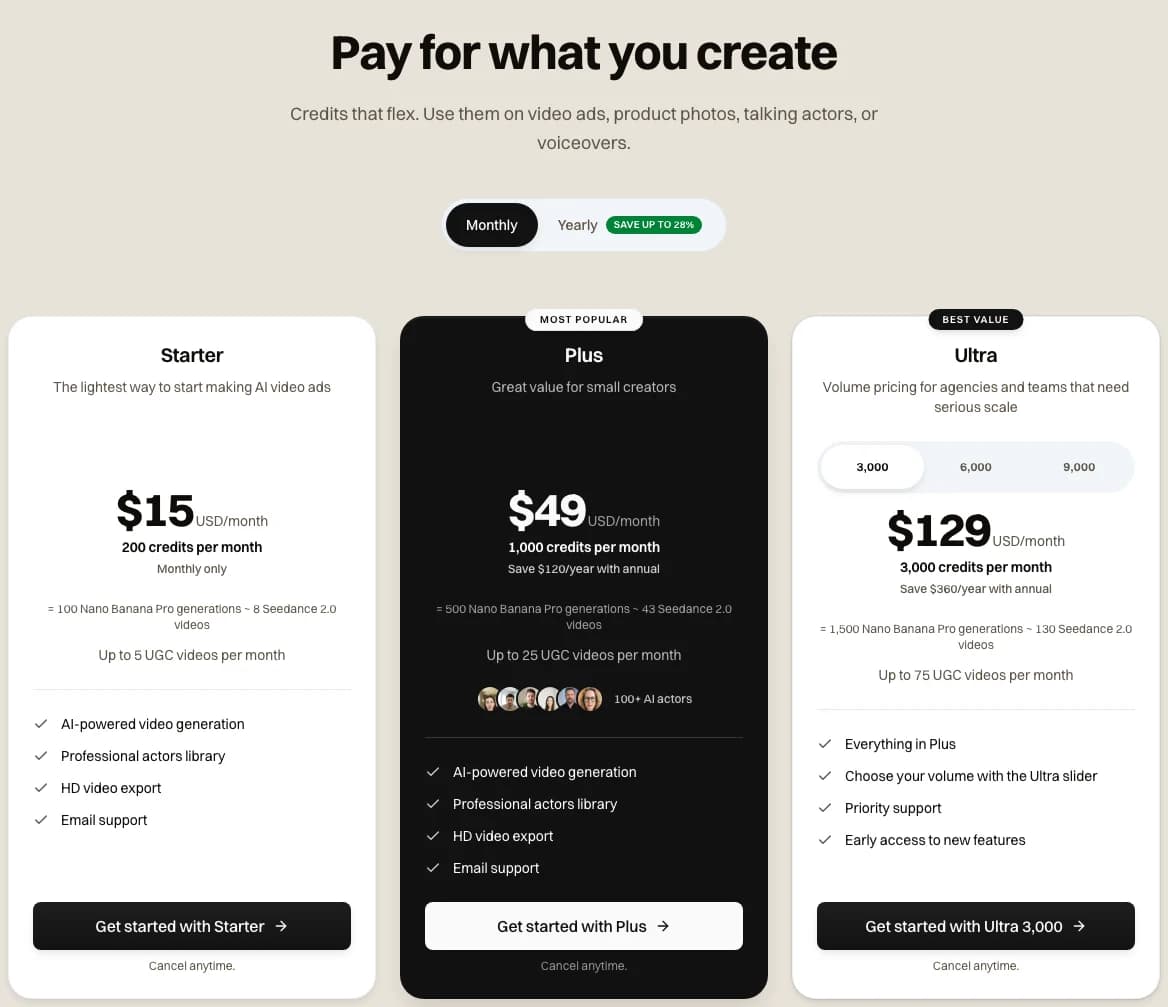 Our pricing page with Monthly selected, taken 2026-11-06. Each card says how many Seedance 2.0 videos its credits make.
Plan credits reset at each renewal and don't carry over. Top-up credits last 90 days. On commercial use, our pricing FAQ says, "All videos generated with Novoads are fully licensed for commercial use."
Two of our own runs
We wrote one prompt with two shots. On July 29, 2026, Seedance 2.0 in Novoads turned it into this 8-second vertical selfie clip. A woman in a gray hoodie sits on the edge of a bed, talks to the camera and points at her cheek, then lifts a small white jar of face cream and nods. The model made her up, and the clip has no brand and no on-screen text. At today's 720p price, that clip is 36 credits, about $1.76 on Plus. In July it cost 42 credits, at that month's prices.
 Seedance 2.0 in Novoads, one prompt split into two shots, 8 seconds, vertical, with a person the model made and no brand or on-screen text. Rendered 2026-07-29, 36 credits at today's 720p price.
On October 9, 2026, we made a 14-second talking-actor ad at 720p through our MCP connector. A stock actor (a creator holding a small microphone in a living room) reads a short script about lighting a soy candle to end the workday, word for word. The ad came back in 1 minute 33 seconds. It cost 200 credits, which is a whole Starter month, or $9.80 on Plus. A talking actor costs 200 credits per started minute at 720p. At 480p, it's 100. Either way, the voice is included.
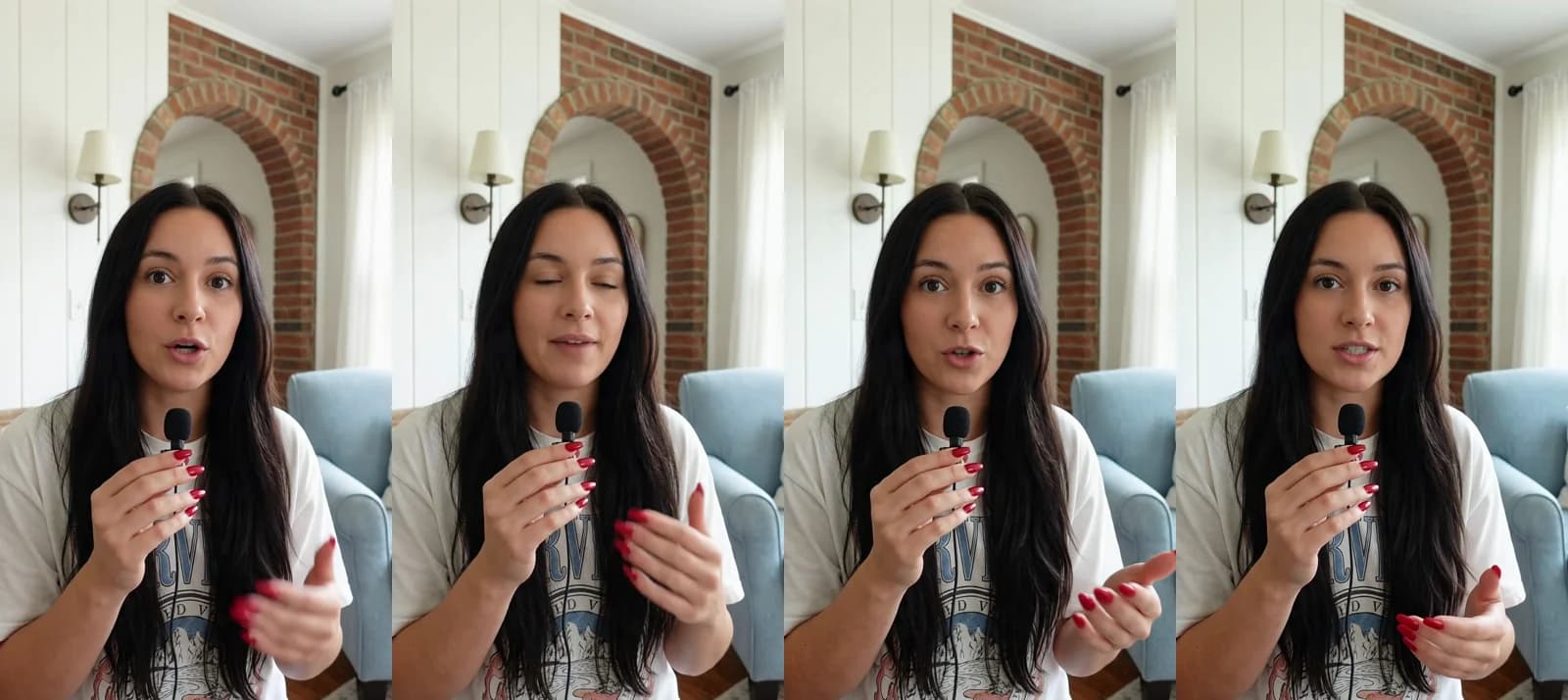 Talking actor in Novoads, a 14-second ad at 720p that reads a soy-candle script word for word. 200 credits. Back in 1 min 33 s. Rendered 2026-10-09.
Where Creatify is cheaper, and where we are
Creatify is the pick closest to Novoads, so we priced the same clip on both. The table assumes you spend the month's credits on five-second Seedance 2.0 clips at 720p.
| Plan and billing | Price per clip |
|---|---|
| Creatify Pro, $38 a month on the annual plan | about $1.06 |
| Novoads Plus, $49 a month | about $1.13 |
| Creatify Standard, $10 a month on the annual plan | about $1.43 |
| Creatify Pro, $55 billed monthly | about $1.53 |
| Creatify Standard, $15 billed monthly | about $2.14 |
On Creatify's own numbers, Pro on the annual plan is about 7 cents a clip cheaper than our Plus. Every other Creatify price in the table is higher. On our Starter plan, $15 makes 8 of these clips. Creatify Standard makes 7 for the same price, billed monthly.
With talking ads, it goes the other way, and by a wide margin. Creatify's breakdown says Standard's credits make 11 fifteen-second Aurora avatar videos. That's about $1.36 each billed monthly, and about 91 cents on the annual plan. Our talking actor costs 200 credits for anything up to a minute, which is $9.80 on Plus. So for short talking-head ads in volume, Creatify is far cheaper on its own numbers, and the choice between the two comes down to how the actor and the clip look.
Jobs we leave to the other picks
Novoads makes the ads. It doesn't write your landing pages or emails, schedule your posts, send your newsletter, read your site's traffic or buy media, and it doesn't upload or run your ads anywhere. The one piece of copy it writes is the ad script, which it can draft from a link to your website.
For everything else, use the picks above. ChatGPT, Claude or Jasper writes the copy, Buffer schedules it, Mailchimp or Klaviyo sends it, and Semrush and Clarity tell you what people search for and what they do on your site. Creatify's plan table lists media buying services and an ad launcher, so if you'd like one tool to make the ads and launch them, Creatify covers more of that chain than we do.
Price your next month of ads
Starter is $15 a month for 200 credits, enough for 8 five-second Seedance 2.0 clips at 720p.
See the plansTwo small stacks, added up
A stack is one tool for each job you actually have. Both stacks are in US dollars, as each page lists them, and free plans cover the jobs that don't need a paid plan yet.
A starter stack for a few ads a month
| Tool | Plan | Per month |
|---|---|---|
| Novoads | Starter, monthly only | $15 |
| ChatGPT | Plus | $20 |
| Adobe Firefly | Standard, billed monthly | US$9.99 |
| Buffer, Mailchimp or Klaviyo, Semrush, Microsoft Clarity | Free plans | $0 |
| Total | $44.99 |
Swap ChatGPT Plus for Claude Pro at the same $20 billed monthly, and the total stays at $44.99. On Claude's annual plan, it comes to $41.99 a month. For ads, Starter's 200 credits make 8 five-second Seedance 2.0 clips at 720p. Spend them on a talking actor instead, and they make one ad up to a minute long.
A stack for ads every week
| Tool | Plan | Per month |
|---|---|---|
| Novoads | Plus, billed monthly | $49 |
| Claude | Pro, billed monthly | $20 |
| Adobe Firefly | Standard, billed monthly | US$9.99 |
| Buffer | Essentials, one channel, billed yearly | $5 |
| Klaviyo, Semrush, Microsoft Clarity | Free plans | $0 |
| Total | $83.99 |
Plus's 1,000 credits make 43 of those clips a month. Spent on talking-actor ads up to a minute long, they make 5. Billed yearly, Plus is $39 a month and Claude Pro is $17. That brings this stack to $70.99 a month, if you're sure you'll still want the same tools in a year.
We'd decide what to pay for first by where you're losing customers.
- Ads first, if strangers never hear of you.
- Clarity first, if they arrive and leave without buying.
- Email first, if they come back and nobody writes to them.
How we'd choose if we were starting today
Start with the job that's losing you the most customers right now. If it's ads you can't make often enough, work out what one finished ad costs in the tool you're considering before you look at the monthly price, the way we did above. If it's visitors who leave without buying, Clarity costs nothing and shows you where they go. And if it's words, ChatGPT Plus or Claude Pro at $20 billed monthly will carry a small team's copy on its own.
Whatever you pick, read the billing period next to the price, because several of these pages show the yearly rate first and the month-to-month one only when you ask for it.
Frequently Asked Questions
What are the top 5 AI marketing tools?
It depends on which jobs you have, so we'd pick one tool per job. For a small team, that's Novoads or Creatify for video ads, ChatGPT or Claude for copy, Adobe Firefly for images, Buffer for scheduling and Mailchimp or Klaviyo for email. Each starting price in this post comes from the tool's own pricing page, read on November 6, 2026.
Which AI tool is best in market now?
No single tool covers ads, copy, email, search and analytics, so there isn't one best tool for marketing as a whole. For copy and research, OpenAI's pricing docs list ChatGPT Plus at $20 a month, and Claude's pricing page lists Pro at $20 billed monthly. Pick the one whose drafts you edit less.
Which AI tool is best for advertising?
To make the ads, compare what one finished ad costs. Creatify's pricing page says Standard's 55 monthly credits make 7 five-second Seedance 2.0 clips at 720p. In Novoads, one of those clips is 23 credits, about $1.13 on Plus. For static banners, AdCreative.ai's FAQ says you use a credit each time you download a creative.
Which AI is best for promoting?
Promoting is as much about scheduling and sending as it is about making. Buffer's pricing page says its free plan connects up to 3 channels. Klaviyo's pricing page says its free plan covers up to 250 active profiles and 500 email sends a month.
Key Takeaways
- None of the top five results for this search works out what one finished ad costs. The one list that adds up whole stacks prices AdCreative.ai and Jasper at their yearly-billing rates without saying so.
- Creatify's pricing page says Standard's 55 monthly credits make 7 five-second Seedance 2.0 clips at 720p. Spend them that way and a clip costs about $2.14 billed monthly, or about $1.43 on the annual plan.
- In Novoads, a five-second Seedance 2.0 clip at 720p is 23 credits, about $1.13 on Plus. Starter's 200 credits make 8 of them a month. Plus's 1,000 credits make 43.
- On Creatify's own numbers, its Pro plan on annual billing works out to about $1.06 a clip, a little under our Plus. Its 15-second Aurora avatar videos cost far less than our talking actor, which is 200 credits per started minute.
- Novoads Starter, ChatGPT Plus and Adobe Firefly Standard come to $44.99 a month in US dollars. Buffer, Mailchimp or Klaviyo, Semrush and Microsoft Clarity cover the other jobs on their free plans.