Best Pika Alternatives for Ad Creative: 6 Tools Built for Campaigns, Not Effects
Pika's four plans buy an effects engine with a published price per effect, from $0 to $76 a month billed yearly. Here are six Pika alternatives mapped to real ad creation, compared on native audio, workflow, and the kind of ad each one actually finishes.

Mauricio Valdivia
·12 min

Pika is priced by the effect, not the ad.
The best Pika alternatives for ad creative are the tools that finish the job Pika deliberately leaves open. Pika sells effects and trends, and it sells them well. What it does not sell is a campaign: a script, an actor, a product held to camera, and the same format repeated twenty times until the data picks a winner.
You can see the difference on Pika's own price list. It charges per feature. A 1080p five-second clip is 40 credits. A five-second Pikaffect is 15 or 18. Pikaformance bills 3 credits for every second of audio. None of that is a flaw. It is a product that knows exactly what it is, and an advertiser arriving from it is not leaving because the output looks bad. They are leaving because an ad is a workflow, and the effect is only one beat of it.
The 6 best Pika alternatives, at a glance
Pika sits at the playful, effects-first end of AI video. The six tools below win, where they win, by being closer to a finished ad: audio generated in the same pass, a spoken creator, a product import step, or a format that comes out ready for paid social. Pick the one that matches the ad you need, then argue about price.
- Higgsfield is best for turning a product link into a social-first ad without leaving an effects-rich workspace.
- Google Veo is best for a premium hero cut with native audio at 1080p and 4K.
- Kling is best for a cinematic spoken scene with native multilingual sound.
- Seedance is best for a multi-shot product story with synchronized audio.
- Creatify is best for batching many ad variations out of a product page.
- Novoads is best for a finished UGC ad where an AI actor holds and presents your product.
The first question is not price. It is which layer of the ad you want to stop building by hand. If the answer is the voice, start with a native-audio model. If it is the actor and the script, start with an ad-first tool. Our companion roundup of Veo alternatives for ad creative works the same problem from the premium end, and the Runway alternatives guide covers the high-craft cinematic end.
| Tool | Best at | Audio in the same pass | Best-fit ad job |
|---|---|---|---|
| Pika | Effects and trend clips | Pikaformance, per second | Playful organic-style posts |
| Higgsfield | Product link to ad | Via its ad workspace | Social-first product ads |
| Google Veo | Premium 1080p and 4K | Native | Polished hero brand cuts |
| Kling | Cinematic multi-shot | Native, multilingual | Talking product scenes |
| Seedance | Multi-shot storytelling | Native, with lip-sync | Story-driven product spots |
| Creatify | Variation volume | Via its ad workflow | Batch tests from a product page |
| Novoads | Finished UGC ads | Voice, lip-sync, captions | Ecommerce UGC with the product in hand |
What Pika is genuinely good at
It is worth being precise about what you would be replacing, because Pika is not a weaker version of an ad tool. It is a different product with a coherent shape.
An effects catalogue with a published price per effect
Pika's feature list reads like a catalogue of named effects. Its paid plans grant "Access to Pika 2.5 (all resolutions), Pikaframes, Pikascenes, Pikadditions, Pikaswaps, Pikatwists, all Pikaffects," and the pricing page then publishes a credit cost for each of them individually. A five-second Pikaffect is 15 credits as image-to-video or 18 as video-to-video. Pikascenes runs 20, 35, or 65 credits depending on resolution. Pikatwists is 60 on the Turbo model and 80 on Pro.
That transparency is unusual and useful. Most video tools hide the per-generation cost behind one undifferentiated credit balance; Pika tells you before you click what a specific transformation will draw down. If your work is picking an effect and applying it, that is a better price list than most of the category publishes.
The trend surface: a selfie and a sound
The second thing Pika does well is social velocity. Its homepage sells the video app on the promise to "Turn any photo into a reality-bending video with just one tap," and its AI Trendmaker invites you to "Hop on any video trend, or create your own, with just a selfie and a sound." Pika describes its own experiments as part of a "quest to make creation accessible to all."
Read those as a positioning statement, because that is what they are. This is a product for the person who wants to be in the video, on the trend, today. That instinct is real, and it is not one an ad platform can fake. A brand whose social team lives inside trend cycles will get more out of Pika than out of a formal ad tool.
What the four plans actually buy
Pika's pricing page opens with "Pika has four plans, so you can pick what fits your needs," and the toggle defaults to yearly billing. Every price below is followed on the page by the words "billed yearly," so the month-to-month rate is higher.
| Plan | Price | Monthly video credits |
|---|---|---|
| Basic | $0 | 80 |
| Standard | $8/mo (yearly) | 700 |
| Pro | $28/mo (yearly) | 2,300 |
| Fancy | $76/mo (yearly) | 6,000 |
Two details on that grid matter more than the numbers. The first is that "Commercial use" is listed on all four cards, including the $0 Basic tier, and Basic also lists "Download videos with no watermark." The second is what Basic gives up instead: it is limited to "Access to Pika 2.5 (480p only), Pikascenes, Pikadditions, Pikaswaps, Pikatwists, Pikaffects Image-to-Video only." The entry tier is capped on resolution and input mode rather than on rights, which is a more advertiser-friendly trade than most entry tiers make.

Where an ad brief runs out of road
None of what follows is a knock on output quality. The reasons advertisers move on are about the shape of the job, and they show up in three specific places.
An ad is a script, an actor, and a product
A performing UGC ad is a stack: a hook that lands in three seconds, a person your audience believes, a product visible and used on camera, a claim delivered in a voice that matches the market, captions burned in for sound-off feeds, and a 9:16 cut sized for TikTok, Reels, and Meta. Pika hands you one layer of that stack, beautifully. You supply the rest.
Pika does publish an audio-driven feature, so this is not a sound-versus-no-sound story. Pikaformance appears on the pricing page at 720p with an audio duration of up to 10 or up to 30 seconds, billed at 3 credits per second. What the plan pages describe is an effect you apply to a clip. What an ad brief needs is a place to put the script, choose who says it, and get the same person back tomorrow for variation eleven. Our guide to creating ads with AI walks through those layers in order.
The credit math at testing volume
Now do the arithmetic on the published numbers, because this is where the difference becomes concrete rather than philosophical.
Pika's own table prices a 1080p five-second text-to-video or image-to-video generation on Model 2.5 at 40 credits. Divide each plan's allowance by that published rate and the ceiling appears:
- Basic, 80 credits, capped at 480p where a five-second clip is 12 credits: six clips a month.
- Standard, 700 credits: seventeen 1080p five-second clips.
- Pro, 2,300 credits: fifty-seven.
- Fancy, 6,000 credits: one hundred and fifty.
Then remember that a single ad is rarely a single clip. If your ad is a hook beat, a demo beat, and a payoff beat, that is three generations before you have opened an editor. Add a Pikaformance read at 30 seconds and you have spent another 90 credits. The number that matters in ad work is not credits per generation. It is credits per finished, testable ad, and every extra beat multiplies it. For the broader picture of what a produced AI ad costs across tools, the best free AI video generators roundup maps where the cheapest tiers stop being useful, and the UGC creator explainer covers the format this is all trying to imitate.
Sound, length, and resolution
The third constraint is shape. Pika's text-to-video and image-to-video tables are built around 5s and 10s durations, with Pikaframes stretching to a 20-25s band, and Pikaformance capped at 720p. Those are excellent parameters for a trend clip. They are tight parameters for an ad that has to establish a problem, show a product working, and land a claim.
The alternatives below relax those constraints in different directions: longer takes, native audio, higher resolution, or a workflow that assembles the beats for you. Which one you need depends on the ad, which is why the list is not ranked.
The 6 alternatives, mapped to ad creation
Here is where each tool fits, what it does differently from Pika for ad work, and the ad job it is best at. Three of these models, Seedance, Kling, and Veo, are also available inside Novoads, so reaching them does not mean managing three subscriptions.
1. Higgsfield, best for turning a product link into a social-first ad
Higgsfield is the closest thing here to Pika's spirit with an advertising mode bolted on properly. It describes itself as an "AI-native creative suite," and its Marketing Studio "is Higgsfield's AI ad generator for marketing teams. Paste a product URL, pick a format, and generate publish-ready video ads in seconds," marketing a path of "From product link to video ad in 2 minutes." The product import will "automatically extract the product name, description, and images," or you can upload up to five images by hand.
For ads specifically it offers "40+ ready-to-use avatars or generate your own from a text prompt via Soul 2.0," covers UGC formats including "talking heads, product reviews, tutorials, unboxings, and virtual try-ons," and exports 9:16, 16:9, and 1:1. Notably, its ad videos are "powered by Seedance 2.0," the same engine several tools in this list rent. Our Higgsfield alternatives roundup goes deeper on where that workspace fits.
- Different from Pika for ads: a product-URL import and an avatar layer.
- Trade-off: its plan figures are not rendered in the page source, so check current pricing in the app.
- Best-fit ad job: a social-first product ad built from a live product page.
2. Google Veo, best for a premium hero cut with native audio
Google's Veo 3.1 is "a model for generating video with native audio" and supports "1080p and 4K" output. Its native clip durations are 4, 6, or 8 seconds, and the docs note that duration "Must be '8' when using extension, reference images or with 1080p and 4k resolutions."
Against Pika, the edge is not playfulness. It is finish. A Veo clip can arrive with its audio already attached at a resolution a brand campaign will accept, which removes an entire production stage from a sound-on placement. The trade is length and looseness: eight seconds is a hero shot, not a story. Novoads runs it as Google Veo 3.1.
- Different from Pika for ads: native audio at 1080p and 4K.
- Trade-off: short fixed durations, less effect-driven play.
- Best-fit ad job: a premium, sound-on hero shot at the top of a funnel.
3. Kling, best for a cinematic spoken scene
Kling's own VIDEO 3.0 guide leads with a "Native Audio Upgrade, Enhanced Element Consistency, and Support for Multi-Shot Narratives." It supports "longer video generation (up to 15 seconds)" with "native audio-visual output, with highly flexible storyboard control," and its feature grid lists "Multilingual Support (Chinese, English, Japanese, Korean, Spanish)" alongside "Dialects and Accents." The same guide explains that "VIDEO 3.0 will automatically plan scene transitions, shot framing, and camera angle changes based on the prompts."
That fifteen-second ceiling plus native sound is the practical difference for a talking product scene. Where Pika would have you generate a clip and then find the voice somewhere else, Kling can arrive with the scene and the sound together. Kling's own prompt guidance is worth reading before you spend on it, since it warns that asking for too many camera movements at once "can create unstable results." Novoads runs it as Kling v3 Pro, and our Seedance versus Kling comparison digs into which of the two wins on specific jobs.
- Different from Pika for ads: native multilingual audio and 15-second takes.
- Trade-off: prompt discipline matters, and camera requests can fight each other.
- Best-fit ad job: a cinematic, spoken product scene.
4. Seedance, best for a multi-shot product story
Seedance 2.0 is the most interesting of the three engines for product work, because of how it takes input. Its reference-to-video mode accepts "up to 9 images, 3 video clips, 3 audio clips, plus natural language instructions," and you address them directly in the prompt: ByteDance's own launch post shows the pattern as "The character is from @Image 2, the scene is from @Image 3, and the props are from @Image 4." It "supports 15-second high-quality multi-shot audio-video output," can "reference composition, motion, camera movement, visual effects, audio and other elements from input assets," and its audio option covers "sound effects, ambient sounds, and lip-synced speech."
For an ad, that means your actual product can be one of the referenced images rather than something the model invents. ByteDance is also candid about the limits, noting "there is still room for optimization regarding multi-subject consistency," which is the honest caveat to keep in mind when a scene has two people and a product in it. Novoads runs it as Seedance 2.0, alongside the half-price Seedance 2.0 Mini for high-volume testing.
- Different from Pika for ads: reference images pin your real product into the scene.
- Trade-off: multi-subject consistency is still improving, per its maker.
- Best-fit ad job: a short product story with a turn.
5. Creatify, best for batching variations from a product page
Creatify approaches the problem from the marketing side rather than the model side. Its signature workflow is "URL to Video," and its homepage pitch is the volume play: "Batch create a dozen variations at once." Its published plans are $39 a month for Starter with "100 Credits / mo" and $99 a month for Pro with "300 credits / mo," and it maintains an entry plan with 10 monthly credits, enough to "Create up to 2 video ads or 20 image ads," with "access 300 AI actors."
The comparison with Pika is almost a category difference rather than a feature difference. Pika sells you a transformation; Creatify sells you a pipeline from a product page to a set of testable ads. Our Creatify alternatives roundup covers that field in more detail.
- Different from Pika for ads: a URL-in, many-ads-out batch workflow.
- Trade-off: less creative range on the pure effects axis.
- Best-fit ad job: many variations of the same product claim.
6. Novoads, best for a finished UGC ad with the product in hand
Novoads is the one tool here built around the whole ad rather than the render: a product image plus a script becomes a vertical UGC ad where an AI actor holds and presents your actual product, voice and captions included. It also runs Seedance 2.0, Seedance 2.0 Mini, Kling v3 Pro, and Google Veo 3.1 under one roof, so three of the alternatives above are reachable from the same account and the same script.
- Different from Pika for ads: the script, actor, voice, and format are the product.
- Trade-off: it is not the place to go for a trend effect or a meme transformation.
- Best-fit ad job: ecommerce UGC where the demo is the ad.
A worked example: one cold brew concentrate ad
Say you sell a cold brew coffee concentrate and want a 15-second vertical ad: a groggy 7am hook, a pour over ice, and a short line to camera holding the bottle. Here is that brief on Pika and on an ad-first tool.
The brief
- Hook: someone half-awake, staring at an empty kettle.
- Turn: the concentrate goes over ice and the glass fills.
- Payoff: a believable line to camera, bottle in frame.
- Delivery: 9:16, captions, a warm natural voice, sized for Meta.
The winner among five hooks like this is unpredictable, which is the whole reason to make several cheaply rather than perfect one.
Running it on Pika
On Pika you would prompt each beat and lean on what it is good at, the transformation in the middle. The pour is the fun one, and an effect could make it distinctive. Then the assembly starts.
- Generate three beats. At 1080p and five seconds, Pika's table prices each at 40 credits, so one assembled ad is 120 credits before revisions.
- Write the script and produce the spoken line. Pikaformance can carry audio at 720p and 3 credits per second, so a 30-second read is 90 more credits, and it is a separate step from the visuals.
- Cut the beats together, add captions, and export at 9:16 yourself.
- Repeat all of it four more times to have five variants worth testing, against Standard's 700 monthly credits.
You end with distinctive footage and a real production task on top of it. For a trend post, that trade is fine. For variant eleven of a product claim, it compounds badly.
Running it on an ad-first tool
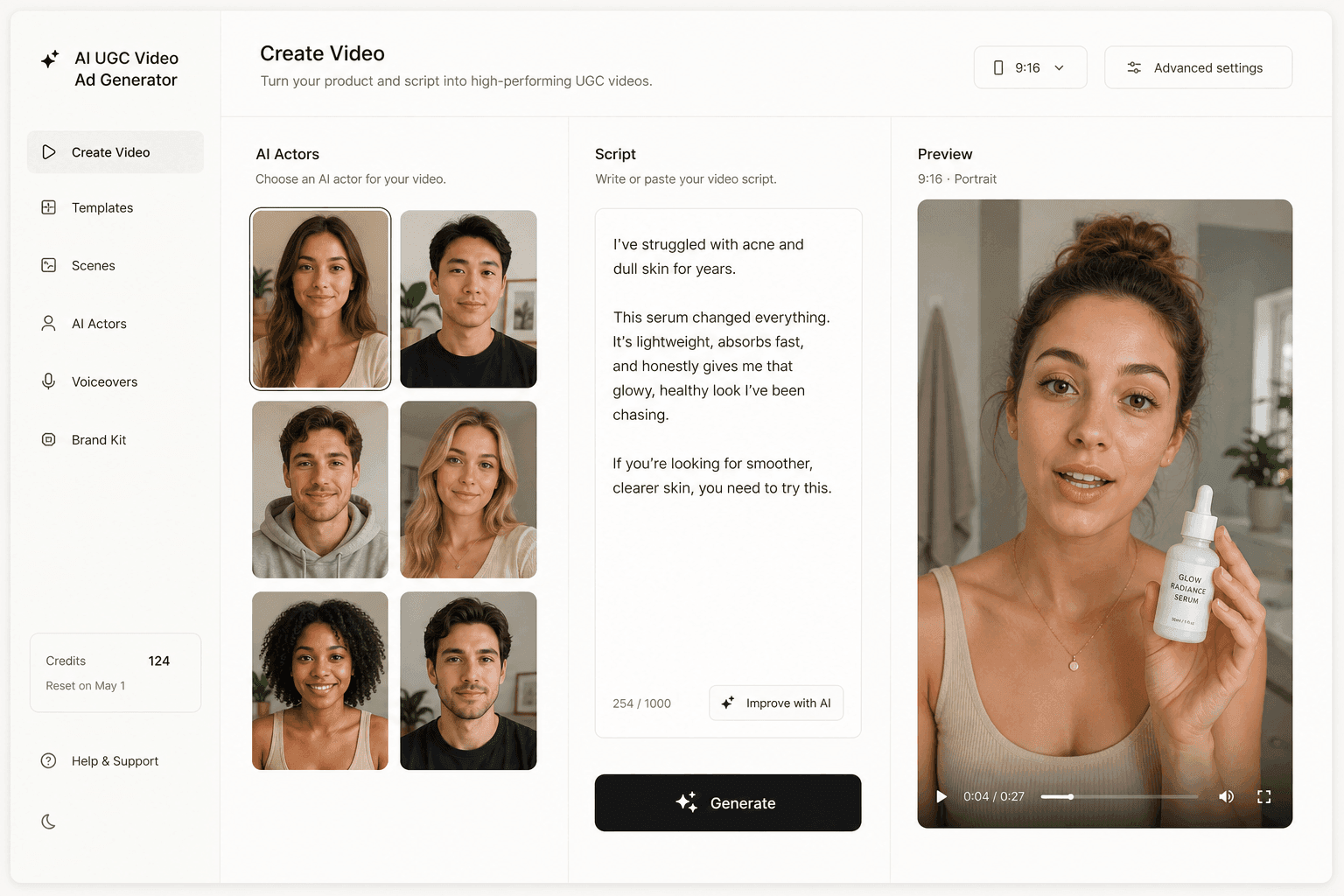
On Novoads the same brief collapses. Upload the bottle photo, paste or auto-generate the script, pick an actor whose age, accent, and energy match your buyer, and generate. You get a finished 9:16 ad with the actor holding the bottle, synced voice, lip-sync, and captions, in about four minutes. Testing five hooks means editing five lines of script, not building five timelines. And because Seedance 2.0, Kling v3 Pro, and Google Veo 3.1 are all available, you can render the same script across engines and keep whichever lands.
How Novoads turns a product photo into a finished ad
Novoads is built for the job that makes advertisers leave a pure video tool: shipping many finished UGC ads, in the language the audience actually speaks, without a production stage behind every clip.
From product photo to a finished UGC ad
You upload a product image and write or auto-generate a script, pick an AI actor, and get a vertical ad where the creator presents your real product on camera. Each clip arrives finished:
- Voice, lip-sync, and burned-in captions, ready for sound-off feeds.
- 9:16, 1:1, and 16:9 output in HD, downloadable for any ad platform.
- 31 languages with real regional accents, rather than translated captions over an English read.
The realism itself is not the argument. Every serious tool in this category rents the same frontier engines, so on raw output quality this is a tie, honestly stated. The argument is what it costs to reach an ad you can actually run.
Every frontier engine in one place
The models this article compares are not subscriptions you have to choose between one at a time:
- Seedance 2.0 and the half-price Seedance 2.0 Mini for high-volume testing.
- Kling v3 Pro for cinematic clips, plus Kling Motion Control to drive a specific performance.
- Google Veo 3.1 for premium, sound-on cuts.
- GPT Image 2 for product-to-ad stills at 0.3 credits per image.
That is the practical answer to model churn. You keep the script and swap the engine. Access starts at $49/month, and you can cancel anytime.
The last mile is the product
The best Pika alternative is not the tool with the wilder effects. It is the tool that closes whichever part of the ad you are currently closing by hand. Pika is honest about being an effects and trends engine, it prices that engine more transparently than most of the category, and for organic social velocity it is a good buy at $8 a month billed yearly. For a repeatable, on-brand product ad, the expensive part was never the render. It was the script, the actor, the voice, the captions, and the eleven variants nobody wants to cut by hand, and that is the part worth paying a tool to finish.
Frequently Asked Questions
What is the best Pika alternative for ad creative?
It depends on which part of the ad you want handed to you. If you need a talking creator holding your product with synced voice and captions, Novoads is the closest fit, and it also runs Seedance 2.0, Kling v3 Pro, and Google Veo 3.1. If you want to stay close to Pika's effects-led feel but with an ad mode, Higgsfield's Marketing Studio takes a product URL. For a premium hero cut with native audio, Google Veo. For a cinematic spoken scene, Kling. For a multi-shot product story, Seedance. For batching many variations from a product page, Creatify.
How much does Pika cost?
Pika lists four plans on its pricing page, with the toggle defaulting to yearly billing. Basic is $0 with 80 monthly video credits, Standard is $8 a month billed yearly with 700 credits, Pro is $28 a month billed yearly with 2,300 credits and carries the 'Best value' badge, and Fancy is $76 a month billed yearly with 6,000 credits. The monthly and weekly cadences exist as toggle options, so treat every one of those figures as the annual rate rather than the month-to-month price.
Can you use Pika videos in commercial ads?
Pika lists 'Commercial use' on all four plan cards, including the $0 Basic tier, as of 2026-07-31. Basic also lists watermark-free downloads. What Basic does restrict is output: it is limited to Pika 2.5 at 480p and to image-to-video, which is below the resolution most paid social placements want. Always read the current plan card before building a campaign on it, because plan contents change more often than prices do.
Does Pika generate voice and lip-sync for a talking ad?
Pika does publish an audio-driven feature. Pikaformance appears on its pricing page at 720p with an audio duration of up to 10 or up to 30 seconds, billed at 3 credits per second. What its plan pages do not describe is the surrounding ad workflow: an actor library, a script step, and a vertical ad format. So the voice layer exists as an effect you apply rather than as part of an ad assembly line, which is the gap most advertisers actually feel.
Is Pika good for product ads?
Pika is strong at the thing it sells: short, effect-driven, trend-native clips made in a tap. Its own homepage pitches turning a photo into a reality-bending video and hopping on video trends with a selfie and a sound. Those are excellent organic-feed instincts. A product ad asks for something different, which is the same brand, the same claim, and the same format repeated across many variations, and that is a workflow question rather than a fidelity question.
Which Pika alternatives generate audio with the video?
Three of the models in this comparison do. Seedance 2.0 exposes a synchronized-audio option covering sound effects, ambient sound, and lip-synced speech. Kling ships native audio with multilingual output in Chinese, English, Japanese, Korean, and Spanish. Google Veo 3.1 generates all audio natively and supports 1080p and 4K. Novoads runs all three, so you can render the same script on each and keep the one that performs.
Key Takeaways
- Pika publishes four plans on a default yearly toggle: Basic at $0 with 80 monthly video credits, Standard at $8 with 700, Pro at $28 with 2,300, and Fancy at $76 with 6,000. Every figure is billed yearly, so the month-to-month rate is higher.
- Pika prices the effect, not the ad. Its own tables charge per feature: a 1080p five-second clip is 40 credits, a 5s Pikaffect is 15 or 18, and Pikaformance bills 3 credits per second of audio. A three-beat ad is three charges plus your editing time.
- The advertiser's gap is workflow, not price. Pika's plan copy speaks to 'the creatively curious' and its homepage sells one-tap effects and video trends, so a repeatable on-brand product ad is something you assemble around Pika, not something Pika hands you.
- For spoken product ads, start from a model that makes the sound. Seedance generates synchronized audio including lip-synced speech, Kling VIDEO 3.0 ships a native audio upgrade with multilingual support up to 15 seconds, and Google Veo generates video with native audio at 1080p and 4K.
- Novoads is the ad-first pick: a product photo plus a script becomes a UGC ad with an AI actor, voice, lip-sync, and captions, and it runs Seedance 2.0, Kling v3 Pro, and Google Veo 3.1 in one place. It starts at $49/month.