Cleaning Ads: Ideas That Book Jobs, and Why 'Eco-Friendly' Alone Falls Short
Five kinds of ads that house and office cleaners run, how to make each one with AI from your own job photos, what each costs in credits, and what the FTC's Green Guides say about a bare 'eco-friendly'.

Mauricio Valdivia
·12 min
We Turned a Picture of a Just-Cleaned Kitchen Into a Five-Second Clip
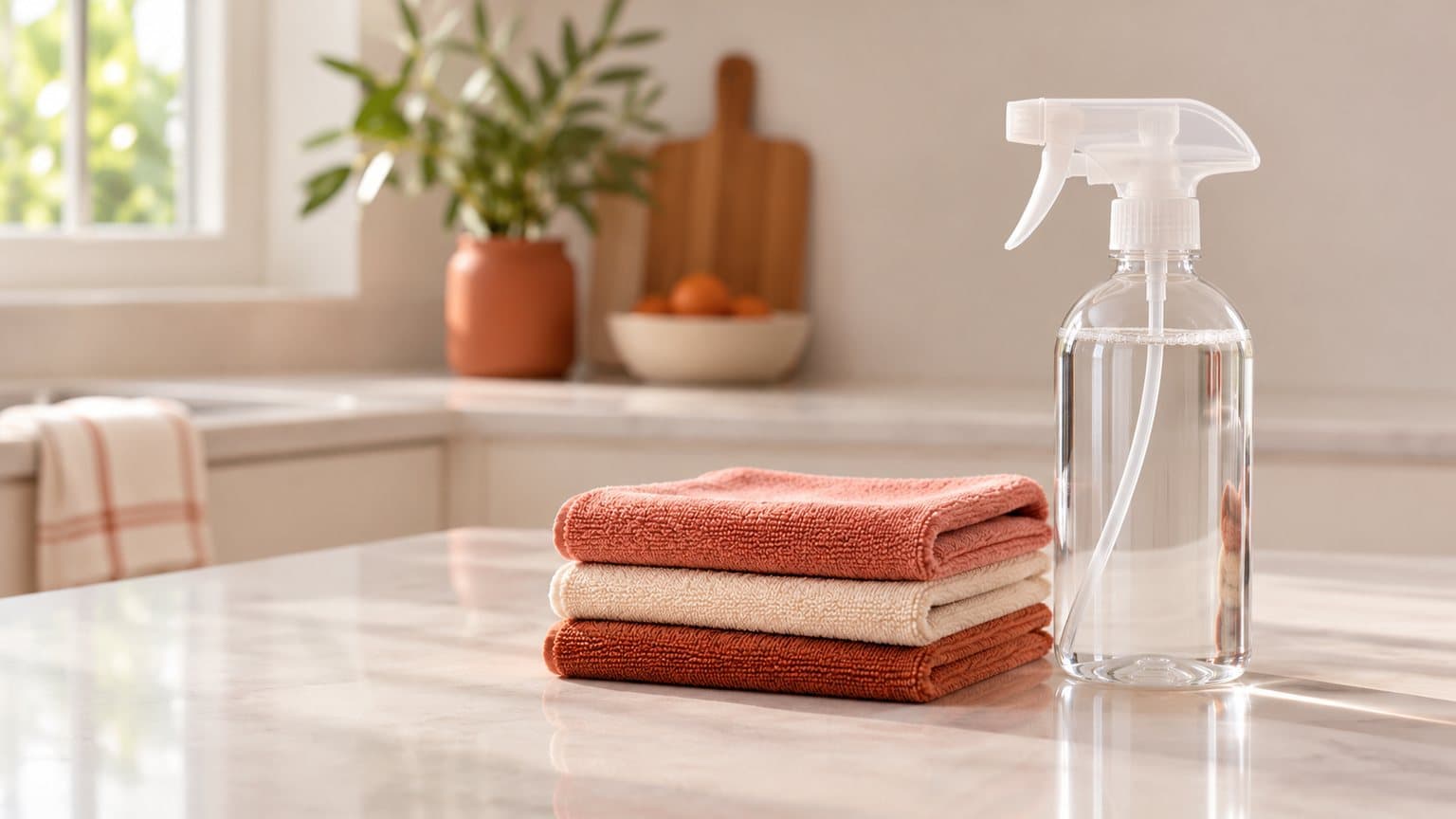
The counter is speckled granite, wiped down, with a stack of blue, yellow and green microfiber cloths beside a clear, unlabeled spray bottle. A blue bucket sits on the tile floor, and the sun comes in through the window over the sink. We had GPT Image 2.6 Sunburst draw the picture for 1 credit. Your client's kitchen isn't ours to show, so this made-up one stands in for the photo you'd take on your phone before you lock up. Then Seedance 2.0 Mini turned it into a five-second vertical clip for 5 credits.
Making the clip is the easy half of a cleaning ad. The hard half is something you already know from the van. Your work disappears. A move-out clean gets handed to a landlord who never saw the oven before you started. Your biweekly Thursday client stopped noticing the baseboards months ago, and the office you clean at night is empty while you're in it. So most of the ads in the trade's own guides come down to proof that the work happened, plus an offer with a date on it.
We searched "cleaning ads" on November 13, 2026, and read the six guides for cleaning companies we could open. Two were on the first page of results and four just past it. Two more near the top wouldn't open for us, so we can't speak for them. The guidance on "eco-friendly" comes from the FTC's Green Guides, as printed in the government's official yearly edition of the federal regulations, and our credit prices are from the same day. We made the kitchen picture and its clip with our own connector, the one AI assistants use to run Novoads. We haven't run any of these ads for a cleaning company, so nothing here ranks them by the calls they bring in.
The Five Ads Cleaning Businesses Keep Running
InvoiceOwl lists seven examples, Nextdoor's business blog gives seven ideas of its own, and Contractor+ sorts its ideas by type. Side by side, they come down to five kinds of ad. Under each one, we've added what AI can do for it and what we wouldn't let AI show. Both calls are ours. If AI ads are new to you, start with our general guide to AI ads. For a gym, TikTok's limits on weight-loss claims are in our gym ads guide.
Before and after of a job you did
It's the first example on InvoiceOwl's list, and it's the one ad nobody else can make for you. A greasy range hood next to the same hood after you've finished tells a stranger what a deep clean buys, and it doesn't need an adjective.
- AI can put a slow camera move on your after photo, or travel from the before to the after in a few seconds, so two stills play in a feed.
- We wouldn't let it supply the after. A generated kitchen shown as your work is a result you didn't deliver, and the person who books will hold their own kitchen up against it.
Use photos from a job you did, with the client's okay, and shoot both from the same spot so the only thing that changes is the cleaning.
An offer with a deadline
InvoiceOwl's seasonal example is a company advertising its services to "prepare for holiday gatherings or spring cleaning." Your calendar has more dates than that, from the end-of-month move-outs and the week before Thanksgiving to the office manager who wants the carpets done before everyone's back in January.
- AI can give you a presenter who reads a short script with your offer and your deadline. Next month, you change the date and the offer and make it again without booking anyone.
- We wouldn't pass that presenter off as you or one of your cleaners. Call them an AI presenter, and don't write a script where they say they've scrubbed ovens for years.
A review from a client
InvoiceOwl describes a testimonial ad where "a satisfied customer shares their experience with the company." For a business that sends people into someone's home, a client's own sentence carries more weight than anything you can say about yourself.
- AI can read out a review a client really wrote, as a quote, with the words captioned on screen. Ask the client first.
- We wouldn't have an AI actor play the happy client, or caption a review nobody wrote, because both are made-up testimonials.
Meet the crew
InvoiceOwl calls this the ad that highlights staff, and Nextdoor calls it an employee spotlight. It answers the question every new client has but rarely asks out loud. Who's going to be in my house? A real photo of your team with their first names does that job, along with a line about background checks or insurance if those are true for you.
- AI can add a little movement to the photo.
- We wouldn't generate the people. An AI-made crew is a picture of strangers who'll never knock on the door.
The green clean
Contractor+ leans on this one hardest. We counted 15 uses of "eco-friendly" or "green cleaning" in its guide, among them a carousel slide titled "Eco-friendly Clean" and a promise of "eco-friendly cleaning services that are safe for children and pets." Neither that guide nor the other five we opened mentions that the FTC has guidance on the word eco-friendly.
The ad itself is a good one when it's specific. A parent with a toddler on the kitchen floor wants to know which products you bring and what's in them, and a slogan doesn't tell them.
- AI can say the specific thing clearly, in a caption or a presenter's line.
- We wouldn't put a bare "eco-friendly" badge on screen, or a certification logo your supplies haven't earned.
How to Make Each One in Novoads
Each of these starts from a photo you took or a script you wrote. The first retraces the run at the top of the post, as it happened.
One job photo, turned into a moving clip
We asked GPT Image 2.6 Sunburst for a vertical phone photo of a bright kitchen just after a cleaning, with no people, labels, logos or text, and it came back clean on the first take.
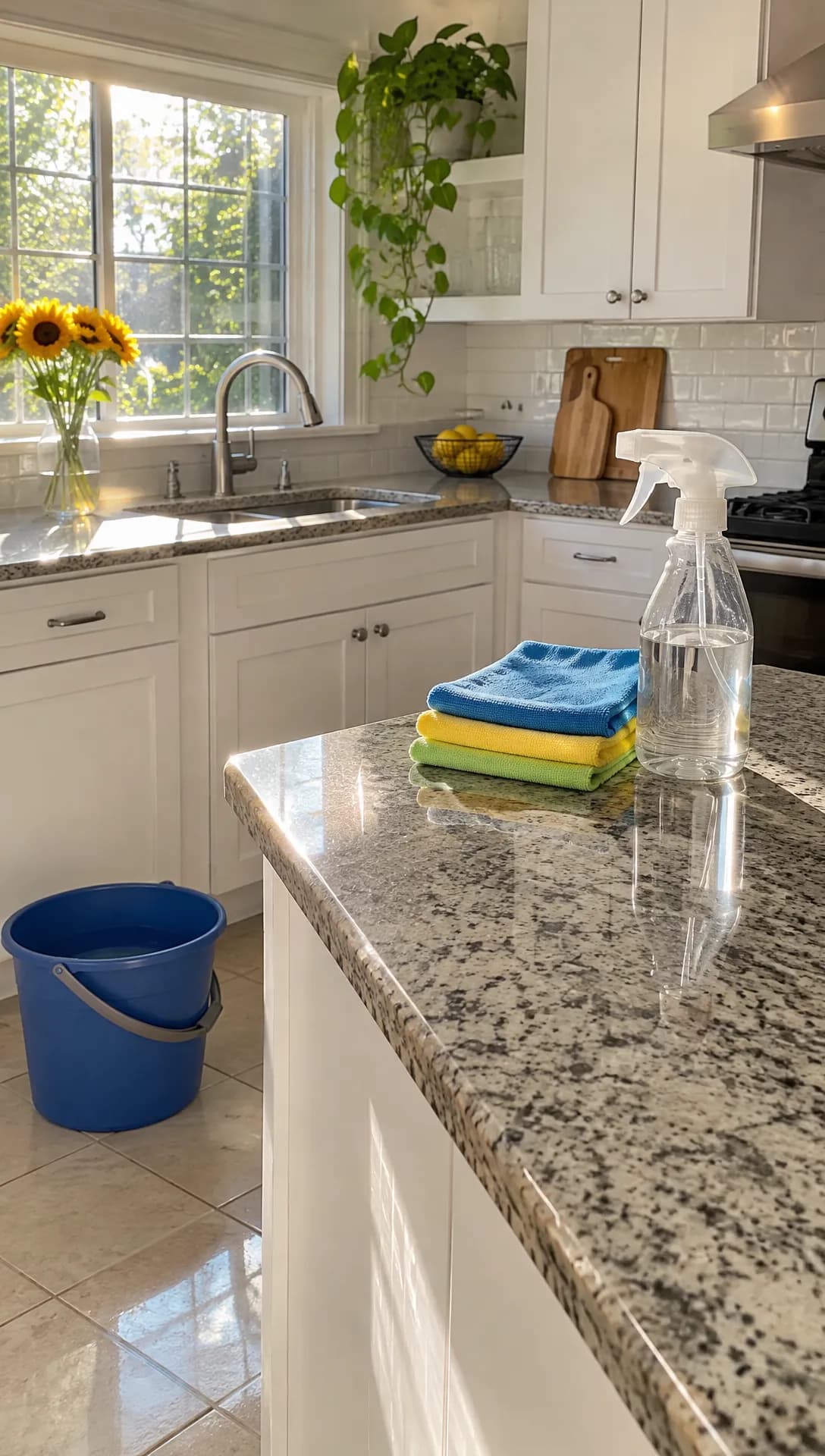 Made in Novoads with GPT Image 2.6 Sunburst · prompt: a spotless kitchen just after a cleaning, as a vertical phone photo · 1 credit · rendered 2026-11-13 · stands in for your own job photo
We handed that picture to Seedance 2.0 Mini as the clip's start picture and asked for a slow, silent move along the counter with no cuts. Five seconds at 720p came back on the first take, too.
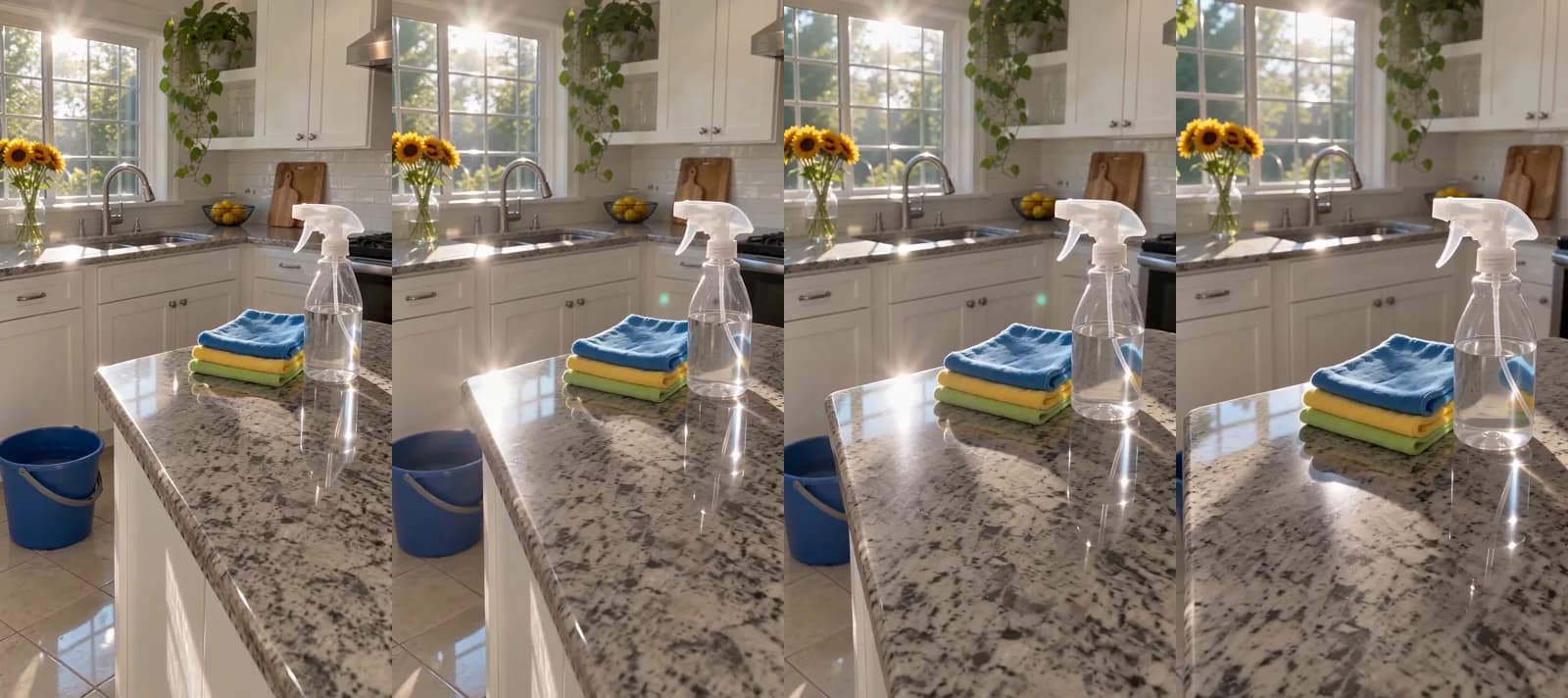 Made in Novoads with Seedance 2.0 Mini · prompt: a slow move along the counter as sunlight crosses it, silent · 5 credits · rendered 2026-11-13 · four frames from the five-second clip
From left to right, the camera drifts along the counter, sunlight flares in the window and glints on the granite, and by the last frame the bucket is out of the shot. Across the four frames, the bottle, the cloths and the cabinets keep their shape. That's the first thing we'd check on a clip of your own, because a client's kitchen that changes shape isn't their kitchen anymore.
We made this through our own connector, which takes a start picture on Seedance 2.0 Mini. In the app's Video tool, the route is a little different.
- To start the clip on your photo, pick Kling 3.0 under Model and drop the photo into the box that reads "Drop a start frame or click to upload." Once it's in, and if its shape matches the clip's, the app shows "The video starts on this picture."
- To stay on Seedance 2.0 Mini, add the photo as a reference image and name it in your prompt as @Image1.
- Describe the camera move, set the Duration and press the arrow.
- Keep written words out of the prompt. If your prompt asks for captions, a line under it warns they may come out misspelled and points you to Captions afterward.
Our walkthrough for product photos follows one photo all the way to a finished clip.
Before to after, with a start and an end frame
Wan 3.0 is the model we'd pick here, because it takes a start frame and an end frame. Choose it under Model, switch the picture area from Reference to Start / End Frames, and drop the before photo in as the start and the after photo as the end. Ask for a slow, steady change between them. Your photos set where the clip begins and ends, and everything in between is the model's guess, so watch it once at full size. If a cabinet door changes or a window moves, run it again or post the two stills side by side. We didn't run this one for the post, so its credits come from our price list and the result is yours to judge.
An AI presenter for the offer
Open Talking Actors, pick a face under Choose an actor, and paste your script. Four things belong in it:
- the job
- what's included
- the day the offer ends
- how to book
Write it so the presenter names your business and never speaks as one of your crew. The voice list covers 32 languages, which helps if your clients' first language isn't English. The video comes back with the voice and the lip-sync done, at 720p unless you pick 480p. Captions go on afterward as their own step, which matters for the office manager scrolling with the sound off.
A client's review, read as a quote
It's the same tool with a different script. The presenter says a client wrote this, reads the client's words as written and says how to book.
The crew photo
Treat your team photo the way you'd treat the kitchen picture, as the opening frame with a slow push-in. We haven't tried a team photo for this post. In our reading, faces are where a video model's redrawing shows first, so compare each face in the clip with the photo and post the photo itself if one has drifted.
What Each Ad Costs in Credits
Prices as of November 13, 2026.
| What you make | Model and setting | Credits |
|---|---|---|
| One still picture | GPT Image 2.6 Sunburst, medium quality | 1 |
| One job photo, moving for 5 seconds | Seedance 2.0 Mini, 720p | 5 |
| The same, opening on your photo in the app | Kling 3.0, 5 seconds | 10 |
| Before to after, 5 seconds | Wan 3.0, 720p | 9 |
| AI presenter, up to 60 seconds | Talking actor, 480p | 100 |
| AI presenter, up to 60 seconds | Talking actor, 720p | 200 |
The talking actor is billed by the started minute, so a quick move-out offer costs as much as a 60-second one.
A month of ads for a small crew
A month's set could be three before-and-after clips from three jobs, plus a presenter video with the month's offer. At 9 credits each, those Wan 3.0 clips come to 27. The presenter adds 100 at 480p. So the set is 127 credits. For each plan, we divided its price by its credits and multiplied by 127.
| Plan | Price a month | Credits a month | The 127-credit set | Whole sets in a month |
|---|---|---|---|---|
| Starter | $15 | 200 | about $9.53 | 1 |
| Plus | $49 | 1,000 | about $6.22 | 7 |
| Ultra 3,000 | $129 | 3,000 | about $5.46 | 23 |
That sum leaves four things out:
- retakes, each charged again at the same price as the first take
- joining the clips into one ad, plus captions and music
- what you pay a platform to show the ad
- your own time checking each clip against the real photo
What one agency charges to run them
Cleaning Business Growth, a marketing agency that works with cleaning companies, lists its Meta Ads Management plan at $500 a month on its own pricing page, updated October 23, 2026. The same plan card also shows these terms:
- a one-time setup fee of $500
- a minimum ad spend of $900 a month
- static and video ad creative, included in the plan
That's one agency's list price, and we wouldn't call it the going rate. The agency also builds and runs the campaign, while Novoads only makes the clip. You still place it, pay for the reach and answer the leads. A longer scripted spot is a different job, and we priced one in our post on what an AI commercial costs.
What the FTC's Green Guides Say About "Eco-Friendly"
The Green Guides are the Federal Trade Commission's guidance on environmental marketing claims, set out in 16 CFR Part 260. We read the government's edition revised as of January 1, 2026, and the wording itself dates from 2012.
The sentence on general claims
Section 260.4 covers general environmental benefit claims, the broad kind a single word like eco-friendly can make. It says that in many cases such claims "likely convey that the product, package, or service has specific and far-reaching environmental benefits," and that "marketers should not make unqualified general environmental benefit claims."
The section's first example is the word itself. Of a brand name "Eco-friendly" with nothing beside it, the Guides say "the use of such a brand name is deceptive," because the marketer is highly unlikely to back up everything the name suggests.
What the Guides accept in its place
Paragraph (c) of the same section offers the way out. It says, "To avoid deception, marketers should use clear and prominent qualifying language that limits the claim to a specific benefit or benefits." The first example then accepts "Eco-friendly: made with recycled materials," but only if four things hold.
- The qualifier is clear and prominent.
- The marketer can back it up for the whole product.
- Using recycled materials makes the product better for the environment overall.
- The ad's context doesn't imply other deceptive claims.
Another section says marketers "should place disclosures in close proximity to the qualified claim," which is why we say the benefit goes right beside the word. Paragraph (c) adds that "Marketers should not imply that any specific benefit is significant if it is, in fact, negligible."
How strong the Guides are, and who they cover
They're guidance. The Guides say of themselves that they "do not confer any rights on any person and do not operate to bind the FTC or the public." The next sentence reads, "The Commission, however, can take action under the FTC Act if a marketer makes an environmental claim inconsistent with the guides."
They apply to claims about "a product, package, or service." A cleaning service's ads fall within that, even though every example in section 260.4 is a product or a package. They also cover claims made "through words, symbols, logos, depictions, product brand names, or any other means," and in our reading, that includes a leaf icon as much as a caption. And they "do not preempt federal, state, or local laws." We didn't check any state's rules for this post.
"Non-toxic" and "safe for pets"
Cleaning ads have a second word with the same problem. Section 260.10 says, "A non-toxic claim likely conveys that a product, package, or service is non-toxic both for humans and for the environment generally." Its only example is a cleaning product advertised as "essentially non-toxic," and the Guides say that ad "likely conveys that the product does not pose any risk to humans or the environment, including household pets." The section says marketers making a claim like that should have "competent and reliable scientific evidence" behind it, or should qualify it clearly.
What we'd change in the five ads
This part is our reading of the Guides. It isn't legal advice, and we've linked the sections themselves in the sources.
- In the green clean ad, trade the badge for the fact. Name the products you use and a specific benefit that's true of them, put it right beside the word, and keep the label or data sheet that backs it up.
- If you can't name a benefit like that, drop the word and sell the clean.
- A presenter's line counts the same as a caption, and so does a picture. Section 260.4's third example is a printer ad that never claims an environmental benefit outright, and the Guides say its forest pictures, together with its text, likely convey far-reaching environmental benefits anyway. So we'd keep leaves and badges out of an image prompt too.
- Don't let "non-toxic" or "safe for pets" ride along in an offer, or in a review you repeat, unless you have the evidence section 260.10 describes.
Where Novoads Fits, and What to Make First
Novoads is the tool we build, and for a cleaning company it does two of the jobs in this post.
- It animates your job photos for a few seconds.
- It has an AI presenter read your offer script.
You pay from the first month. Starter is $15 a month for 200 credits, and the other plans are on the pricing page. Our pricing FAQ says, "All videos generated with Novoads are fully licensed for commercial use." What you get is the ad file. Posting it on Facebook or Nextdoor and paying to have it shown still fall to you. The AI UGC ads page shows the presenter format on its own, and our look at real TikTok ads shows how they open.
Turn this week's job photos into ad clips
Bring the before and after from a real job, or hand an AI presenter this month's move-out offer. Plans are paid from the first month, and every clip shows its credits before you make it.
See how the AI ads are madeIf you make one thing this week, make it the before and after from your next move-out clean. Take two photos from the same spot, spend 9 credits on the clip, and if the caption says "eco-friendly," finish the sentence with the benefit you can prove.
Frequently Asked Questions
What are some effective advertising ideas for house cleaning services?
The guides we read for this post overlap on five ideas. Show the before and after of a job you really did, run an offer with an end date around move-outs and holidays, put a client's own review on screen with their permission, introduce the people who'll have the key, and if you sell a green clean, say the specific thing that's true about your supplies. AI can move your photos and read your offer, but it shouldn't invent the after photo, the crew or the client.
Can a cleaning ad say eco-friendly?
The FTC's Green Guides (16 CFR 260.4) say marketers shouldn't make unqualified general environmental benefit claims, and their first example calls a bare brand name Eco-friendly deceptive. With clear, prominent language beside it that limits the claim to a specific benefit, the same example wouldn't be deceptive, as long as the marketer can back that benefit up, the benefit makes the product better for the environment overall, and the rest of the ad doesn't imply more. The Guides say they don't bind the public, though the FTC can act under the FTC Act. This is our reading, and it isn't legal advice.
What does a before-and-after cleaning ad cost to make with AI?
In Novoads, a five-second Wan 3.0 clip that runs from your before photo to your after photo costs 9 credits at 720p. An AI presenter reading your offer for up to a minute costs 100 credits at 480p. Three of those clips plus one presenter video come to 127 credits, about $6.22 on the Plus plan. Those are our prices as of November 13, 2026, and they leave out retakes, captions, music and what a platform charges to show the ad.
Should I use an AI-generated before and after photo in a cleaning ad?
We wouldn't. A before and after is a claim about a result, so a generated room shown as your work promises something you didn't deliver. Use two photos from a real job, taken from the same spot, with the client's okay. AI is fine for adding a slow camera move to those photos or for traveling from the first to the second, as long as you check that the room itself doesn't change.
Key Takeaways
- The cleaning guides we read keep coming back to five ads: a before and after of a job you did, an offer with a deadline, a client's review, a look at the crew, and the green clean.
- AI is useful for moving your own job photos and reading your offer out loud. We wouldn't use it to supply the after photo, the crew or the happy client.
- As of November 13, 2026, a before-to-after clip made from two job photos costs 9 credits on Wan 3.0. An AI presenter reading your offer for up to a minute costs 100 credits at 480p.
- The FTC's Green Guides say marketers shouldn't make unqualified general environmental benefit claims, and their first example is the brand name Eco-friendly with nothing beside it. They're guidance, and the wording dates from 2012.
- If you keep the word, the Guides ask for clear qualifying language that limits it to a specific benefit, and that benefit should be true, backed up and more than negligible. Or you can drop the word and sell the clean.
Sources
- •16 CFR 260.4, General environmental benefit claims (GPO, Code of Federal Regulations, revised as of January 1, 2026)
- •16 CFR 260.1, Purpose, scope, and structure of the guides (GPO)
- •16 CFR 260.3, General principles (GPO)
- •16 CFR 260.10, Non-toxic claims (GPO)
- •InvoiceOwl: Must-See House Cleaning Ads for Inspiration
- •Contractor+: House Cleaning Ad Ideas, Copy, Design and Placement
- •Nextdoor for Business: How to advertise your cleaning business
- •Cleaning Business Growth: Meta Ads Management for Cleaning Companies