Hedra Review for Ads: Any Face Can Talk, but Which Ads Fit?
Hedra turns one portrait and a voice track into a talking character, which suits mascot, explainer and multi-language ads. Built from Hedra's own pages, dated public ratings and one talking-character ad we rendered ourselves, this review shows where it falls short and who should pick it.

Mauricio Valdivia
·11 min
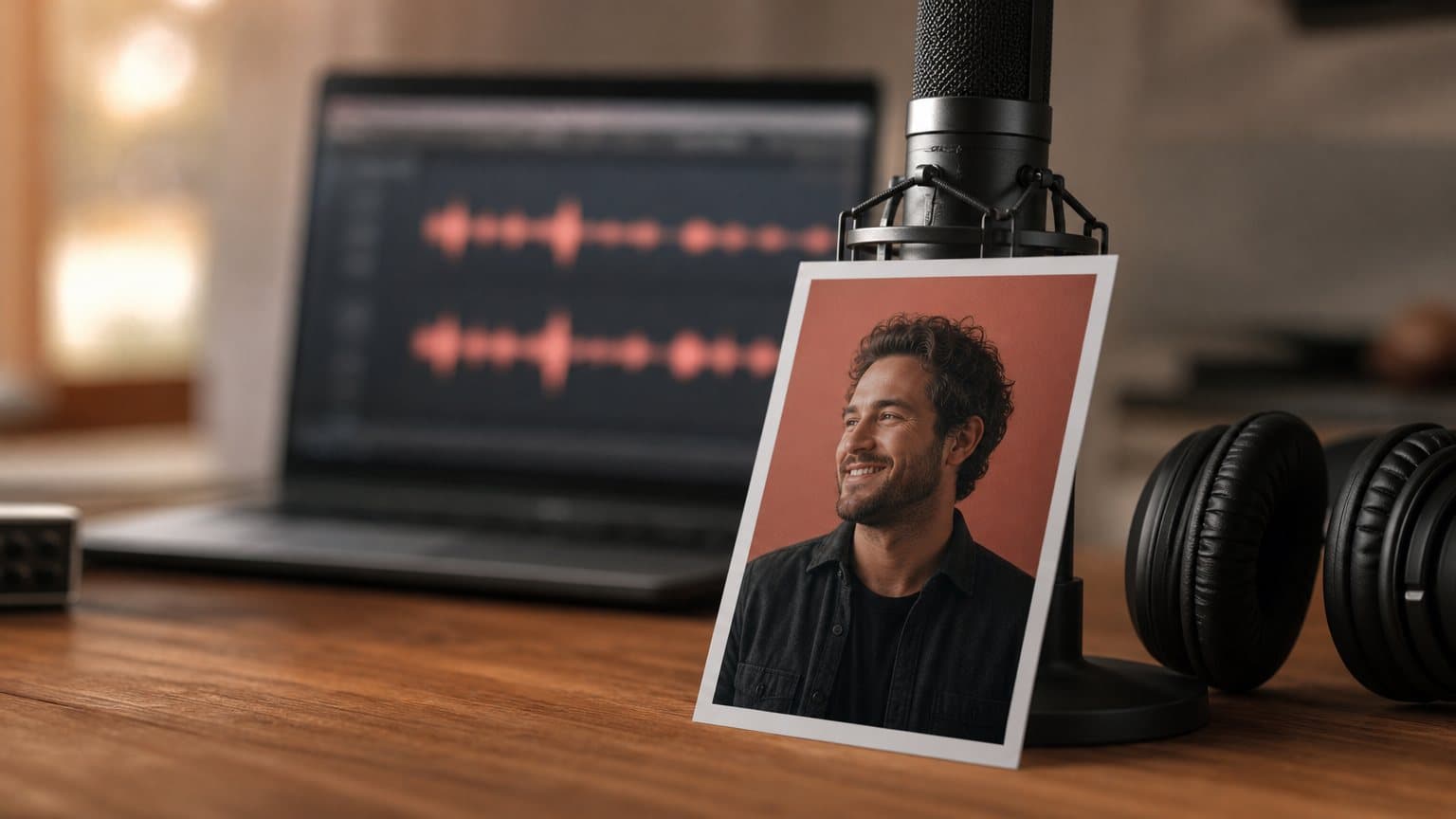
Hedra's showcase opens with a talking bear roofer
The first clip in the "Best of" gallery on Hedra's page for its talking-character model is a bear who runs a roofing company. A fox scientist, a teacher explaining fractions and a Frankenstein news anchor follow it, and further down a claymation musician sings and a cat hosts a podcast. That gallery is the review in miniature. Give Hedra one still image and a voice track, and almost any face can talk.
Our verdict for advertisers: Hedra is a strong pick when the face in your ad is a character (a mascot, an animal, an illustration or a stylized founder), when you already have the voice, and when one take has to ship in several languages. It is a weaker pick when the voice is the hard part, when the shot depends on hands around a product, and when public reviews weigh on your choice of vendor. On October 21, 2026, Trustpilot showed Hedra at 1.8 out of 5 from 68 reviews.
We have not used Hedra hands-on. This review is built from Hedra's own pages, read on October 21 and 22, 2026, from public ratings with their dates and counts, and from a talking-character ad we rendered in Novoads, the same kind of ad that fills Hedra's gallery.
What Hedra sells in October 2026
Hedra sells its models two ways: Hedra Studio, a web app on monthly plans, and the Hedra Developer API, which charges code per use. For ad work the core is talking video, and there Hedra has two models of its own, Character 3 and Hedra Avatar, with avatar models from other labs on the same key.
One portrait and one voice track become a talking character
Character 3 is the model behind the gallery. Hedra's page calls it "an omnimodal model designed specifically for image-to-video lip-syncing" and says it "turns a single static portrait and an audio file into a talking avatar." The specification block reads like an ad buyer's checklist:
- Inputs: text, an image and an audio track, with the audio marked as required.
- Output: 540p, 720p or 1080p, in seven aspect ratios that include 9:16, 1:1 and 16:9.
- Length: up to 10 minutes in one generation.
The overview names "talking avatars, marketing clips, and storytelling" as the job, so advertising is a stated use, not a stretch.
Released in March 2025, so a known quantity
Hedra's model page says: "Character 3 was released in March 2025, following Hedra Character 2, with joint processing of image, text, and audio." The same answer adds that Hedra introduced Omnia in February 2026. Read together, Character 3 is about nineteen months old and not Hedra's newest model. For a buyer that helps: a review of it describes a known quantity, not a launch-week demo.
The newest dated post we found on Hedra's blog is aimed at developers. On October 6, 2026, Hedra published a post saying its Developer API "gives your code more than 110 generation models through one API key and one prepaid wallet," with Veo, Kling and Seedance among them.
Two avatar models of its own, more from other labs
Hedra's talking-avatar page draws the line itself: "Hedra Avatar and Hedra Character 3 are ours; Omnihuman, Kling AI Avatar and VEED Fabric run on the same engine and the same key." The split matters when you budget, because inside Hedra the outside models cost more per second, as the cost section shows.
Where Hedra is strong for ads
Hedra's own pages make three cases that map straight onto ad work.
Any face can talk, even one no casting call would find
The gallery is the argument. Hedra's reel for Character 3 takes in the roofing bear, a grandmother telling a bedtime story and a startup founder in a podcast interview, and the page says the model is "useful for character-driven storytelling, virtual presenters, and social media content." For a brand with a mascot, a cartoon founder or a product with a face, that is a short road from a drawing to a spokesperson, the same idea as an AI avatar from a photo. You do not have to start from a blank page either: Hedra's prompt tips suggest you "use Hedra's pre-built characters and environments to establish a baseline before customizing."
Hedra also writes that "the community notes its ability to generate natural micro-expressions," such as blinks, eye shifts and subtle head tilts in time with the speech. That is Hedra's description of its own model, not a test we ran.
Every placement, and takes up to ten minutes
The seven aspect ratios cover the placements an ad buyer uses: 9:16 for Reels, TikTok and Shorts, 1:1 for feeds, 16:9 for YouTube, and four more: 4:3, 3:4, an ultra-tall 9:21 and an ultra-wide 21:9. Length is not the limit either. Hedra's lip-sync page says "Hedra Character 3 runs to ten minutes in a single generation, which is what makes it usable for training and walkthroughs rather than only for clips." Our reading for ads: a long founder explainer or a video sales letter can come out as one continuous take instead of stitched pieces.
Another language or another hook costs a render, not a shoot
Because the model maps sound to mouth shapes rather than reading words, the audio is the lever, and Hedra's pages point it at three ad jobs:
- Languages: Hedra says "the language is a property of the audio you send, not a setting you pick," and its lip-sync page shows one presenter delivering the same line in three finished takes, "English, Japanese, German," with "Same presenter, same office, same source frame."
- Hooks: the talking-avatar page makes the ad case in so many words: "ten hooks for TikTok, Reels and YouTube cost ten renders rather than ten shoots."
- Two voices: the same page puts two people in one shot ("Pass one audio track per speaker and mark where each of them sits in the frame"), which opens skits and podcast-style ads.
If a hook test is the plan, our guide to testing ten openings on one video ad covers how to read the results.

Where Hedra falls short for ads
The weak spots come from the same pages, and from the public record.
The voice track comes first, and it sets the ceiling
Character 3 is driven by audio, and the audio is a required input. Hedra's own advice is blunt: "your audio quality heavily dictates the output," so it asks for "clean speech with clear pronunciation and zero background noise or heavy reverb." Hedra does give you ways to make that track. Its lip-sync page lists voice models from ElevenLabs and MiniMax, a voice clone among them, under the line "Every sync model, and every voice to drive it." The order still matters: the voice comes before the picture, and a flat or noisy read becomes a flat or noisy ad. For a team that writes scripts quickly, a voice read worth keeping is the bottleneck, not the render.
Hedra flags overacting hands itself
The Character 3 page names the quirk in its own words. If you see "overly dramatic or unnatural hand gestures," which it calls "a common quirk noted by users," the advice is to "use your text prompt to explicitly restrain their movement." In product ads, hands hold the bottle and point at the label, so we would budget extra takes for any shot with hands in frame. Hedra also recommends "generating a library of approved character angles" to keep a character consistent across videos. That is prep work before the first ad ships, and the same problem we cover in keeping one AI actor consistent across ad variations.
Check which model made the sample you are watching
Hedra's talking-avatar page, the one that lists ads first among its uses, shows sample takes labelled "VEO 3.1 · 0:08 · 1080P." That is Google's Veo 3.1 running inside Hedra, not Character 3. The labelling is honest, and it is also easy to miss. Judge Character 3 by its own gallery and each outside model by its own samples, because Hedra prices and builds them differently.
A thin public record, and a poor one
| Where | What it showed | Read on |
|---|---|---|
| Trustpilot | 1.8 of 5, "Poor", 68 reviews | Oct 21, 2026 |
| Trustpilot star mix | 78% one-star, 9% five-star | Oct 21, 2026 |
| Product Hunt | No reviews yet | Oct 21, 2026 |
| G2 | Page refused our fetchers | Oct 21, 2026 |
Trustpilot shows the profile as claimed by Hedra since May 2025, with replies to 43% of negative reviews, and it adds a caveat of its own: "This company hasn't invited customers recently, so reviews may not be representative." A second read on October 22 showed the same 1.8, now from 69 reviews. We read the score as a sentiment signal from a small, self-selected group, not as a test of video quality. The two gaps say little either way: Product Hunt had no reviews to show, and a page that refused our fetchers is not evidence that no G2 rating exists.
What Hedra costs, in brief
Hedra bills two ways, and the two wallets do not mix:
- Studio plans are billed monthly in credits. On the pricing page we read on October 21, 2026, they started at $20 (US dollars) a month for Basic's 2,000 credits, and Basic lists "Slower generations." Hedra says commercial rights and unwatermarked output come with every paid plan.
- The API bills per second "from a prepaid dollar balance," with "No subscription, no seats, no minimum." Character 3 lists at 5 cents a second at 720p.
Hedra's developer docs add: "Studio subscription credits are separate; they do not fund v3 jobs." Inside Studio, the price book its app loaded on October 21, 2026 gave Character 3 a base rate of 7 credits a second, while the outside avatar models in the same list ran from 11 (Kling AI Avatar v2 Standard) to 32 (Omnihuman 1.5). Every plan, and what one talking ad costs on each, is in our Hedra pricing breakdown.
Who should use Hedra, and who should pass
Hedra's strengths and weak spots sort ad teams cleanly.
Use Hedra when:
- your spokesperson is a character: a mascot, an animal, an illustration or a stylized founder;
- you already have the voice, or you will record or clone it, because the audio drives everything;
- one take has to ship in several languages, since swapping the audio swaps the language;
- you want long single takes, such as explainers or video sales letters up to ten minutes;
- your developers want one key and one wallet for many models.
Look elsewhere when:
- you cannot produce a clean voice track, because the model works from whatever audio you give it;
- the shot depends on steady hands around a product, the quirk Hedra flags itself;
- public reviews weigh in your vendor approval, given the 1.8 Trustpilot showed on October 21, 2026;
- you would rather cast from a library of human actors than design a character.
If you are weighing Hedra against a presenter-first tool, our Hedra vs HeyGen comparison puts the two side by side, and our roundup of D-ID alternatives covers more talking-avatar tools matched to the job.
How Novoads makes the same talking-character ad
Novoads comes at the same ad from the other side: a script and a cast of stock actors, or a video model that speaks the line itself.
Our run: a planter that talks, for 8 credits
On October 20, 2026 we made a talking-character ad in Novoads, the job Hedra's gallery is built on. We started from a still of a white self-watering ceramic planter with a sculpted face on a sunny kitchen windowsill, made with GPT Image 2.5 Sunburst for 1 credit, and gave Seedance 2.0 Mini two lines of dialogue in the prompt. Two minutes and 21 seconds later, the planter said "Two weeks without water, and look at me." and then "Self-watering. You're welcome." with its mouth moving, the slow push-in we asked for and no text on screen. A transcript of the clip matched both lines word for word, apart from one comma. There was no audio file to prepare: the model voiced the dialogue from the prompt.
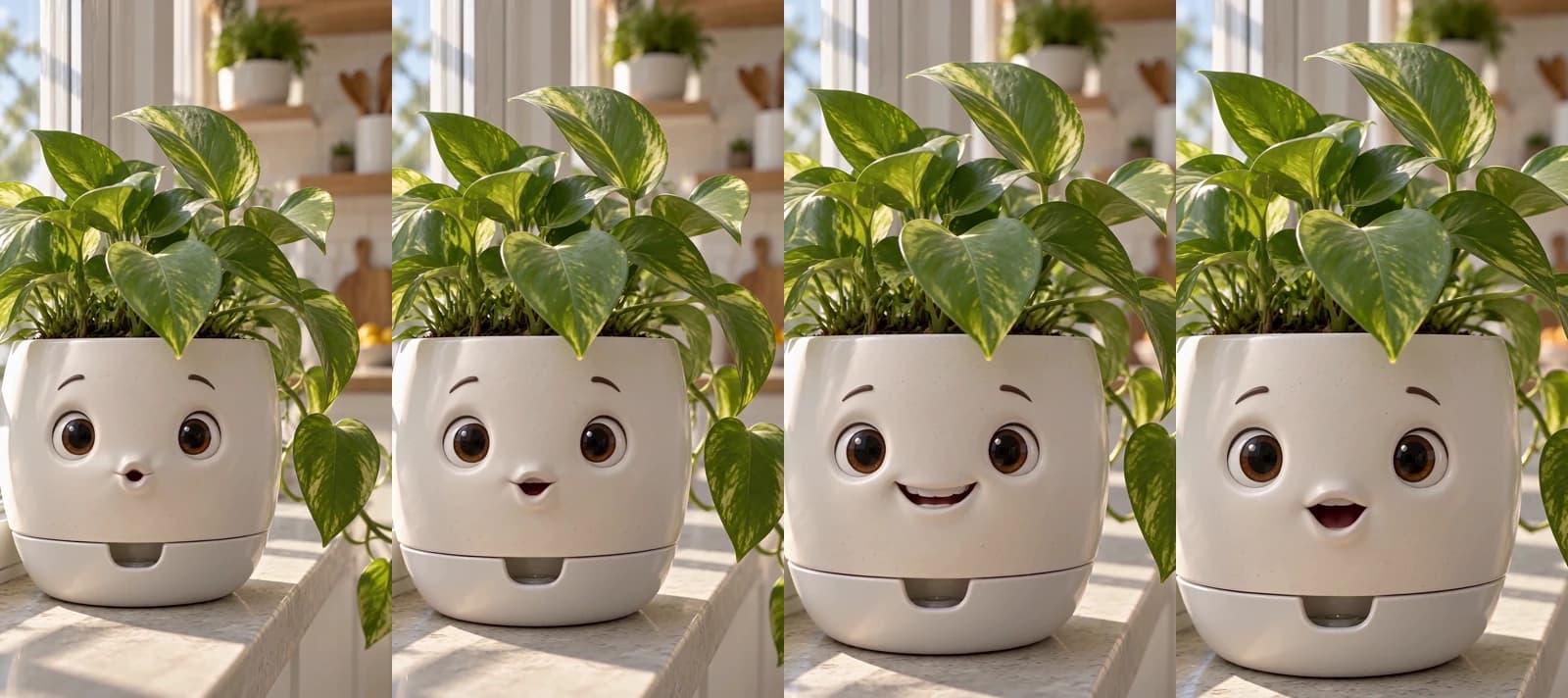 Seedance 2.0 Mini · prompt: a self-watering ceramic planter with a face on a kitchen windowsill says "Two weeks without water, and look at me." · 8 credits · rendered 2026-10-20
What the same jobs cost on each side
Two jobs, each priced from both sides' own numbers:
- An eight-second talking character: our clip cost 8 credits, which is about 39 cents at the Plus plan's rate of $49 for 1,000 credits, or 60 cents at Starter's $15 for 200. Character 3 at 720p through Hedra's API lists 5 cents a second, so 8 seconds comes to 40 cents, before the voice track it needs. For short talking-character clips, the two land close together.
- A 30-second talking presenter: Novoads bills its talking actor per started minute, 200 credits at 720p, so a 30-second ad costs $9.80 of a Plus plan ($49 for 1,000 credits), or the whole of a Starter month ($15 for 200). The same 30 seconds of Character 3 at 720p through the API comes to $1.50. Hedra is cheaper here, by a wide margin. Two things narrow it: a 60-second talking-actor ad costs the same 200 credits as a 30-second one, and the 480p option halves the minute to 100 credits.
For clips that are not a talking presenter, Seedance 2.0 Mini at 1 credit a second at 720p and Kling v3 Pro at 10 credits for five seconds keep a test round cheap.
Casting from a library instead of a portrait
The other difference is where the face comes from. Hedra starts from a portrait: yours, one you design, or one of its pre-built characters. Novoads starts from a cast of stock AI actors, 103 of them on the public actors page on October 22, 2026, with voices in 31 languages. When the face has to be yours, or someone holding your product, you upload a photo and Novoads turns it into a custom talking actor.
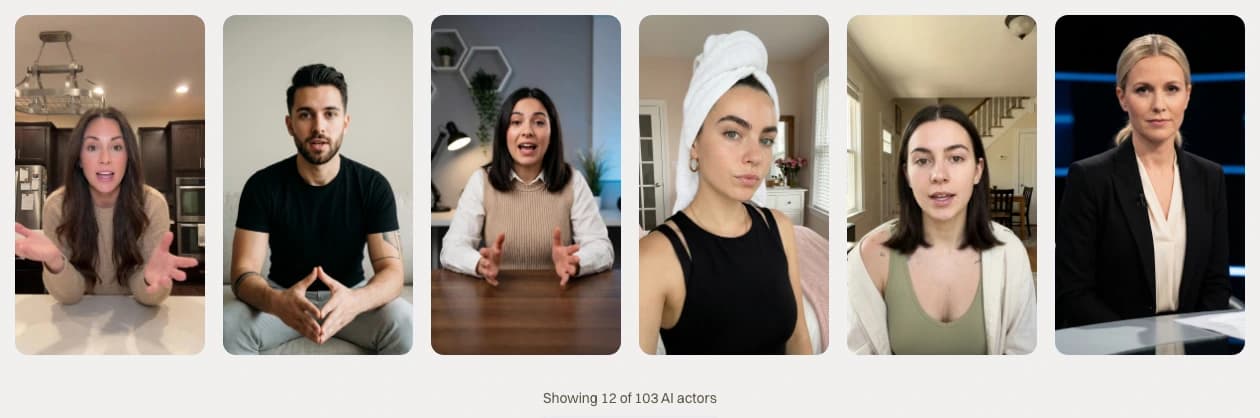 Screenshot: novoads.ai/actores, a row of the actor library and its count, "Showing 12 of 103 AI actors", taken 2026-10-22
Hedra's gallery leans into characters, from bears to clay figures, while our actor library is people; a talking product like the planter goes through a video model instead. If your ad is a testimonial, see how AI testimonial videos come together in Novoads, from script to finished ad, and our guide to AI actors covers how brands cast them.
The face is the cheap part now
Hedra's real achievement is that a face, almost any face, no longer needs a casting call: one portrait and a voice track turn a bear, a cat or a founder into a presenter for a few cents a second. What it does not settle for you is the rest of the ad: a voice worth listening to, hands that behave around a product, and a vendor record your finance team will sign off on. Pick the tool by which of those you already have. If you have a character and a voice, Hedra is a good place to make them talk. If you have a product and a script, start where the cast is already waiting.
Frequently Asked Questions
What is Hedra AI good for?
Hedra's own pages pitch it hardest at talking video. Its Character 3 model turns a single portrait and an audio file into a talking avatar, and Hedra says it is useful for character-driven storytelling, virtual presenters and social media content. For ads, that fits mascot and character spots, founder explainers up to ten minutes long, one take in several languages (the language follows the audio), and hook tests, which Hedra pitches as ten renders instead of ten shoots.
Is Hedra legit and reliable?
Hedra runs public model pages, published prices and developer docs, and it has claimed its Trustpilot profile since May 2025. Its public record is the weak point: on October 21, 2026, Trustpilot showed 1.8 out of 5 ('Poor') from 68 reviews, 78% of them one-star, with a note that the company had not invited customers recently, so the reviews may not be representative. Product Hunt showed no reviews. We have not used Hedra hands-on, so run one real script through it before you commit a budget.
When was Hedra Character 3 released, and is it the newest model?
Hedra's Character 3 page says the model was released in March 2025, following Character 2. The same page says Hedra introduced Omnia in February 2026, so Character 3 is not Hedra's newest model. It remains one of the two avatar models Hedra calls its own, beside Hedra Avatar.
How much does Hedra cost?
On the pricing page we read on October 21, 2026, Hedra Studio plans started at $20 (US dollars) a month, billed monthly, for 2,000 credits on Basic, with Pro at $50 for 7,200 credits and Ultra at $100 for 18,000. The API is separate: it bills per second from a prepaid dollar balance with no subscription, and it lists Character 3 at 5 cents a second at 720p. Studio credits do not fund API jobs. Our Hedra pricing breakdown works through every plan.
Key Takeaways
- Hedra's core for ads is talking video from one image: its Character 3 model turns a single portrait and an audio track into a talking character, in seven aspect ratios including 9:16, for up to ten minutes per generation.
- Character 3 is a mature model, not a fresh launch: Hedra's own model page dates it to March 2025 and says Hedra introduced Omnia in February 2026.
- The weak spots are on Hedra's own pages: the audio is a required input that 'heavily dictates the output', and overly dramatic hand gestures are 'a common quirk noted by users'.
- Hedra's public record is thin and poor: Trustpilot showed 1.8 out of 5 from 68 reviews on October 21, 2026, and Product Hunt showed no reviews.
- We have not used Hedra hands-on. Our talking-character clip in Novoads cost 8 credits in Seedance 2.0 Mini (about 39 cents at the Plus rate), close to the 40 cents Character 3 costs for 8 seconds through Hedra's API, while for a 30-second talking presenter Hedra's API is far cheaper than our 200-credit minute.