Leonardo AI vs Midjourney for Ads: Image Costs, Privacy and 150 Free Daily Tokens
By our math, Leonardo's original Nano Banana costs 4 to 5.6 cents an image, and a four-image Midjourney Basic prompt about 4 cents. We quote both on privacy and ad rights.

Mauricio Valdivia
·12 min
Leonardo bills in tokens and Midjourney in GPU minutes
Leonardo AI charges tokens for each image and shows the count on its Generate button, so you don't see what an ad image costs until you're inside the app. Midjourney charges for GPU time instead, and its help center puts a standard prompt (which returns four images) at about 0.8 minutes. We could read seven of the top search results for this comparison, and none of them gives the dollar cost of one image on either tool.
We did that arithmetic wherever the makers publish enough numbers, and we say so where they don't. We couldn't open Leonardo's own site or Midjourney's help center on November 5, 2026, so those figures come from Internet Archive copies (each dated where we use it) and from Leonardo's help center, which did open. The review scores come from public review sites and app stores. We didn't test Leonardo AI or Midjourney for this post, and the one set of images in it is ours, made in Novoads with Nano Banana Pro.
For ad work, two other questions matter as much as price. Who can see your images before a campaign goes out, and does your plan let you use them commercially? We answer both in each maker's own words. We found no shutdown notice for either tool. TechCrunch reported in 2024 that Canva had bought Leonardo, and Leonardo's help center now explains how to edit its images in a Canva account.
What one ad image costs on each, by our arithmetic
Leonardo's plan figures here come from the Internet Archive's November 1, 2026 snapshot of leonardo.ai/pricing, in US dollars before tax. Midjourney's figures come from copies of its plans page, saved October 20, and of its GPU speed page, saved October 15, 2026.
Leonardo lists a per-image token count for one current model
Leonardo's Tokens FAQ says "each feature, image and video model has its own unique token cost, based on the complexity and computing power required." The next sentence adds that the cost "may vary based on the number of reference images used, settings, image size, number of images being generated, etc." So even one model's cost changes with how you set it up.
Only one of the help articles and API pages we read gives a current model a per-image token count, and that's the original Nano Banana (Gemini 2.5 Flash Image). That article, last updated August 25, 2026, says "Currently, all Nano Banana generations cost 40 tokens per image," and that added reference images don't use any tokens. It also says Leonardo now offers Nano Banana Pro, so we take the 40 as the original model's price and don't use it for anything else.
| Leonardo plan | Price a month | Fast tokens a month | One original Nano Banana image, our sum |
|---|---|---|---|
| Essential | $12 | 8,500 | $12 ÷ 8,500 × 40 = about 5.6 cents |
| Premium | $30 | 25,000 | $30 ÷ 25,000 × 40 = 4.8 cents |
| Ultimate | $60 | 60,000 | $60 ÷ 60,000 × 40 = 4 cents |
Those prices assume you spend every token you pay for. Leonardo's rollover article says unused paid tokens can build up to three months' worth, so you don't lose them outright in a slow month. The pricing page says paying yearly takes "Up to 20% off," but the table sticks to the monthly prices.
What a four-image Midjourney prompt costs
Every Midjourney prompt returns four images at once. The Basic plan is $10 a month for 200 minutes of Fast GPU time. If you use all of it, that works out to 5 cents a minute. The GPU speed page lists approximate times per prompt.
| Midjourney Basic job | Approximate GPU time | The set of four | Each image, all four used | One image kept |
|---|---|---|---|---|
| SD prompt | 0.8 minutes | 4 cents | 1 cent | 4 cents |
| HD prompt | 1.3 minutes | 6.5 cents | about 1.6 cents | 6.5 cents |
Unused Fast time doesn't carry over to the next month, the page says. It also warns that nonstandard aspect ratios might need more time, so a 4:5 or 9:16 ad could take longer, and cost more, than the table shows. Standard, Pro and Mega include 30 minutes of Fast time per dollar, compared with Basic's 20, and our breakdown of Midjourney's plans goes through each one.
How the two compare
Leonardo's 40 tokens buy a single image, while a Midjourney prompt buys a set of four. If you'd run all four as ad variations, an SD prompt on Midjourney's Basic plan gives you the cheapest images in this post, at a cent each. If you keep only one, it carries the full 4 cents, the same as an original Nano Banana image on Leonardo's Ultimate plan.
On the cheapest paid plan at each maker, one original Nano Banana image on Leonardo's Essential costs more than a whole SD set on Midjourney's Basic but less than an HD set. These images come from different models, so the comparison is about cost and says nothing about quality. For the models themselves, see what Midjourney 8 means for ads and our Midjourney and Nano Banana comparison.
What we couldn't price, and what changes the math
Leonardo's other image models
Leonardo offers Nano Banana Pro, Nano Banana 2.1, GPT Image 2, Lucid Origin and Phoenix, and we didn't find a published per-image count for any of them in its help center or API docs. Its how-to article says "Based on the model and settings, the token cost will be displayed on the Generate button," and that Ultra mode costs more tokens than Fast. Lucid Origin's own article says its cost varies with fast or ultra quality, image size and image dimensions. That button is inside the app, and we didn't open the app for this post, so we left those prices out rather than guess at them.
Two features do list their own token counts, but neither prices a finished ad image. Flow State, which Leonardo pitches for brainstorming, costs 1 token for every image that appears on your screen. PhotoReal, which the help center files under legacy features, starts at 20 tokens an image, and its cost changes with the dimensions.
Buying in the app, and running out of tokens or minutes
Subscribing through Apple's US App Store costs more than paying on the web. We read the App Store's in-app purchase list on November 5, 2026.
- Essential, $15.99
- Premium, $39.99
- Ultimate, $79.99
Those rows don't name a billing period, but the yearly plans have rows of their own, so we read these as monthly prices. On that reading, Essential costs about a third more in the app than on Leonardo's website.
Leonardo's Premium and Ultimate subscribers who run out of tokens can keep making images with a named list of models, at lower priority and with no extra token cost. Leonardo calls this Relaxed Generation. Third-party models such as Nano Banana and GPT Image aren't eligible, and the Tokens FAQ says relaxed generations "only activate once you have completely run out of tokens and cannot be manually enabled." Top-up tokens don't expire, but Leonardo only sells them to people with an active subscription.
On Midjourney, Relax mode for images comes only with Standard, Pro and Mega, and a Relax job can wait anywhere from 0 to 30 minutes. Extra Fast time costs $4 an hour on every plan, which by our arithmetic is about 5.3 cents for an SD prompt.
The API is billed separately
Leonardo's API docs say "The API is priced on a Pay-As-You-Go basis, with no upfront commitment or monthly fees," so none of the plan arithmetic above applies to it, and we didn't read any API prices. Midjourney's community guidelines say that "With a few rare exceptions that are explicitly granted, Midjourney does not provide an API," and its terms forbid automated tools.
What Leonardo's 150 daily tokens cover
The daily allowance
Leonardo's Tokens FAQ, as we read it on November 5, 2026, says "Free users get 150 daily tokens." They don't build up, it adds, so whatever you don't use expires instead of carrying over to the next day. On the November 1 copy of the pricing page, the free plan's card lists Auto-only model access and public creations next to those tokens.
Paid accounts fall back to the same allowance once everything else runs out. The FAQ says a paid user with no rollover balance and no top-up tokens gets a daily reset to 150 tokens.
Which models a free account can use
Leonardo's pages disagree on this. Its how-to article, updated November 2, 2026, says "Free users can only use Auto Image or Auto Video," and the pricing card marks third-party models with a dash on the free plan and a check on every paid one. But the Nano Banana article, updated August 25, 2026, says anyone can generate with that model, "including free plan users, who are allocated 150 daily tokens." We can't tell which page is current, so we haven't worked out how many images 150 tokens would make. Leonardo's FAQ also says "Free users are subject to stricter filtering."
Midjourney's only trial is in a separate app
Midjourney has no free plan on its own site. Its Free Trials article (copy of October 16, 2026) says "No free trial is currently available in Discord or the midjourney.com website," and its getting-started guide (copy of October 26, 2026) tells you to subscribe to one of its plans before you make anything. The same Free Trials article points to "a limited trial" in niji · journey, a separate app for iOS and Android, and further down we keep its rating apart from Midjourney's.
Who can see the images you make
Leonardo's Private Mode on paid plans
Leonardo's Private and Public images article, updated August 25, 2026, says "Private image generation is a feature only available to paid members." Paid users can turn Private Mode on or off. With it off, images go to the public feed, where they "will be visible and useable by other members." With it on, the article says, images "won't be visible to other users or Leonardo.Ai" and won't be used for Leonardo's advertising or to improve its service.
We found nothing saying whether a new paid account starts with Private Mode on or off. If your ads aren't public yet, check the setting before you generate the first one. The cheapest Leonardo plan with private creations is Essential, at $12 a month. On the free plan, creations are public.
Midjourney images are public by default below Pro
Midjourney's terms, in a copy from November 1, 2026, say "By default, Your Content is publicly viewable and remixable." Its plans page says Stealth Mode, which keeps images and videos private, "is only available on the Pro and Mega Plans," so the cheapest private option there is Pro at $60 a month, or $48 billed yearly.
Two details matter if your ads haven't launched. Even with Stealth on, anything you make in public Discord channels stays visible to others, according to the June 12, 2026 copy of the Stealth Mode article. And Midjourney's changelog of October 8, 2026 says "Non-stealth images can still appear on Explore and on profiles, even if you made them inside a private folder." So for private work, the cheapest plan is $12 a month on Leonardo and $60 on Midjourney.
Running the images as ads, in each maker's words
We quote each maker's pages here, but we can't tell you how they apply to your business.
Leonardo's free and paid plans
Leonardo describes rights to generated images differently for free and paid users. Its terms, in a copy from October 4, 2026, say they were last updated January 19, 2026. Three of its pages address paid subscribers.
- The FAQ on the November 1 copy of the pricing page says "you retain full ownership, copyright, and other intellectual property rights of images that you generate."
- Clause 8.3 of the terms gives that ownership to a paid subscriber "subject to your compliance with these Terms and to the extent permitted by law."
- The help center's commercial-use article ties full ownership to "generating privately using a paid subscription."
The same pages put it differently for free users.
- The pricing FAQ says "Leonardo.Ai owns rights to the images you create" and grants "a non-exclusive, royalty-free licence to use your generated content for commercial purposes."
- Clause 8.7 of the terms gives Leonardo ownership of a free subscriber's output.
- The help center's general FAQ, updated February 16, 2026, says commercial use "applies for free users too."
So in Leonardo's words, a free user holds a license for commercial use while Leonardo owns the image, and the image is public.
The October 25, 2026 copy of Leonardo's API page adds that images made on the platform and through the API "can be used for commercial purposes, subject to our Terms of Service."
Midjourney and the $1,000,000 line
Midjourney's plans page says anyone who has held a subscription may use their images "in just about any way you want," with one exception. "You must purchase the Pro or Mega plan if you are a company making more than $1,000,000 USD in gross revenue per year." Its terms (November 1 copy) cover "a company or any employee of a company with more than $1,000,000 USD a year in revenue," who must be on Pro or Mega "to own Your Assets."
For a business over that line, Midjourney's entry plan is Pro, at $60 a month or $48 billed yearly. We found no revenue limit like this on the Leonardo pages we could read, though that doesn't prove there isn't one. Our Midjourney and Stable Diffusion comparison puts this rule next to Stability's.
What each maker says it does well, and how users rate them
These are the makers' own claims, and we didn't test them.
Leonardo's claims for text and product shots
Leonardo's help center makes its case for ad work across a few articles.
- The Lucid Origin article says "Clean text, sharp layouts, and polished graphic design elements come naturally," and calls the model "Ideal for branded content, promos, and visually driven storytelling."
- The Phoenix article says Phoenix can render "coherent text in a wide variety of contexts," up to whole sentences.
- For product ads, a Product Photography Blueprint makes "a branded image and video of our product" in the help center's example.
- Its Canvas Editor handles inpainting and outpainting, and the pricing card lists 80+ models on every paid plan.
Leonardo also has its own Midjourney comparison, published October 17, 2025 and still using old plan names. It's the maker's view of its rival, but one line in it matches the pages above. "Leonardo has a free plan while Midjourney doesn't."
Midjourney's claims for V8.2
What we cite from Midjourney's help center in this section comes from copies saved between October 1 and October 10, 2026. Its Version article says Midjourney made V8.2 its default image model on July 24, 2026.
- Its V8 alpha post from March 17, 2026 says "Text rendering works better than ever (when specified in "quotes")."
- The Edit Model takes up to 4 reference images, and the aspect ratio article calls 9:16 "common for mobile content on social media."
- On V8.2, an SD image starts as a 1024-pixel square, and an HD image is a 2048-pixel square that can't be upscaled any further.
- The Version article says inpainting or outpainting an HD image brings it down to SD.
We compare Midjourney with Adobe's image model in a separate post.
How users rate them
We read these scores on November 5, 2026.
- Leonardo scores 4.7 on Trustpilot, rated "Excellent," from more than 1,500 reviews. Of those, 87% give five stars and 9% give one. Leonardo has claimed the profile and has replied to 73% of negative reviews.
- Leonardo's app scores 4.8 on Apple's US App Store from more than 11,000 ratings. On Google Play it scores 4.7 from about 120,000 reviews.
- Midjourney scores 1.7 on Trustpilot, rated "Bad," from 373 reviews. Of those, 76% give one star. Midjourney has also claimed its profile, and it has replied to 8% of negative reviews.
- niji · journey, the app Midjourney's trial article names, scores 4.4 on Apple's US App Store from 584 ratings. It's a separate app, so this isn't Midjourney's own rating.
These numbers aren't like for like. The sample sizes differ, Leonardo replies to far more of its negative reviews, and we didn't look into how either profile collects reviews. We wouldn't pick a tool on these scores alone, and our roundup of Midjourney alternatives covers more of the field.
Where Novoads fits, and where it costs more
Nano Banana Pro at 2 credits an image
You pay for Novoads from your first month, and one credit balance covers stills, video ads, talking actors and voiceovers. We price Nano Banana Pro per image by resolution, and our plans page shows how many credits each plan includes.
- Nano Banana Pro costs 2 credits an image at 1K or 2K, and 4 credits at 4K.
- Starter is $15 a month for 200 credits, billed monthly only. A credit there is $0.075, so a 2K image is 15 cents.
- Plus is $49 a month for 1,000 credits, or $39 a month billed yearly. A credit there is $0.049, so a 2K image is about 10 cents.
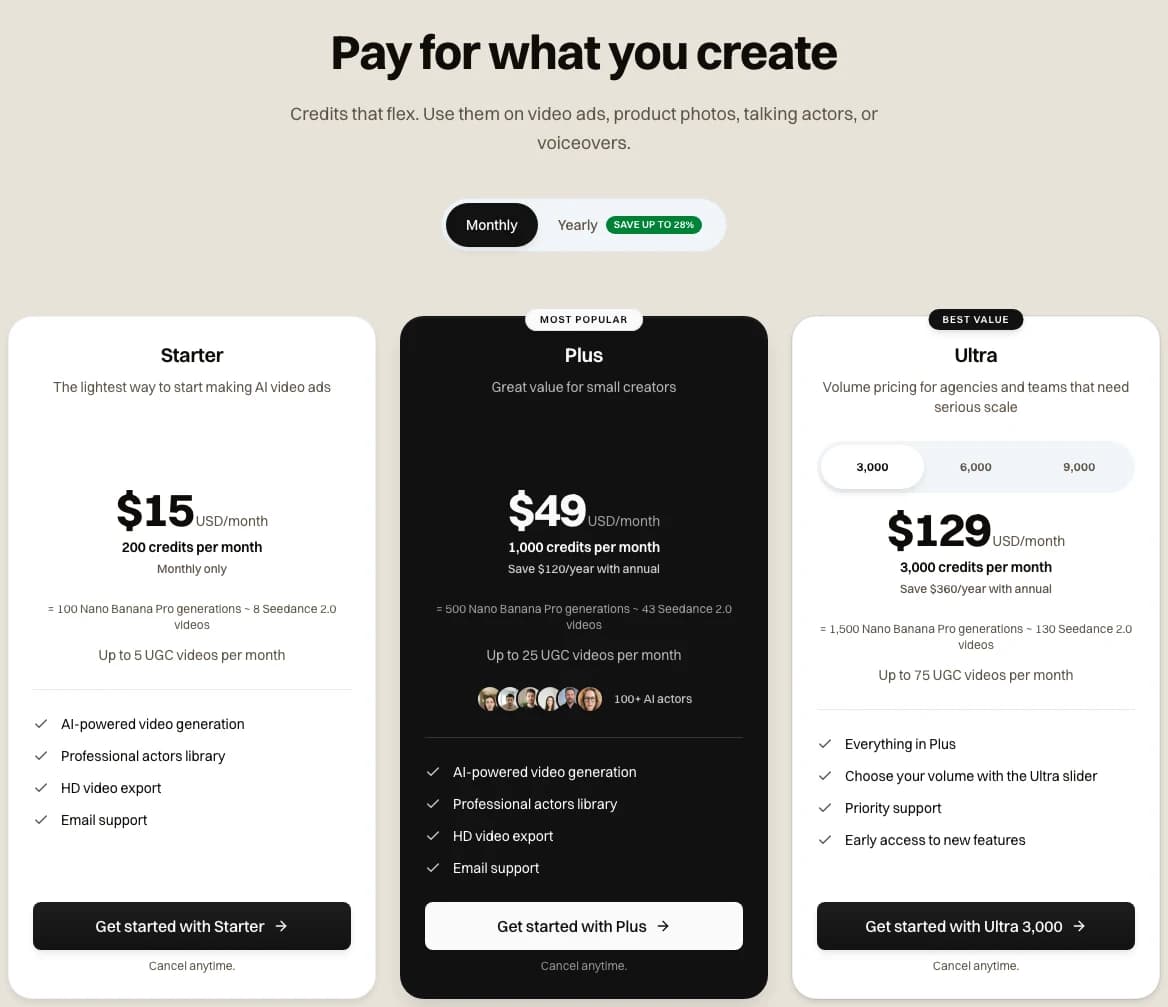 The Novoads pricing page with Monthly selected, showing Starter, Plus and Ultra with the credits each includes, taken 2026-11-05
Per image, that's more than either rival, going by their own numbers. A Midjourney Basic SD prompt costs 4 cents for all four images. Leonardo's original Nano Banana runs 4 to 5.6 cents an image, and it's a different model from ours. The fair match would be Nano Banana Pro on Leonardo, and we couldn't find a published price for it, so no figure in this post shows Novoads coming out cheaper.
Four static ads from one request
We made the set below in Novoads with Nano Banana Pro on October 20, 2026. One request returned four static ads in a 4:5 frame, each showing an amber glass jar candle under a wooden lid, set on a limestone bath ledge, with the headline "Light it. Slow down." The four together cost 8 credits. By our arithmetic, that's 60 cents on Starter and about 39 cents on Plus.
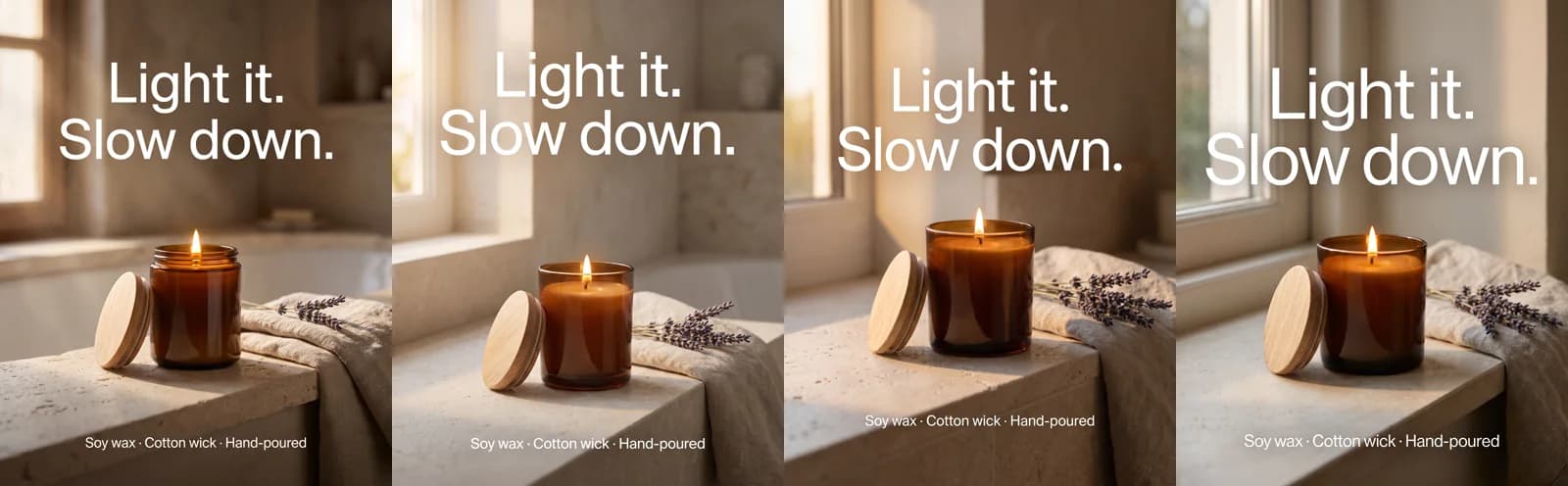 Made in Novoads with Nano Banana Pro · one request, four 4:5 candle-jar statics at 2K · 8 credits · rendered 2026-10-20
Neither Leonardo nor Midjourney made this set, though Leonardo also offers Nano Banana Pro. Our static ads explainer covers the format, and our guide to Nano Banana Pro covers the model.
See what a month of ad images costs
Compare Starter, Plus and Ultra credits for Nano Banana Pro images, video ads and voiceovers.
See the plansWhich one to pick for an ad
Leonardo AI fits when
- you want to try a tool before you pay, since its free plan gives you 150 tokens a day, with public images and the model limits above
- you need private images on a small budget, starting with Essential at $12 a month
- you'd rather see each image's token cost on the Generate button before you spend it
Midjourney fits when
- you'll use most of each set of four, which brings an SD image on Basic down to about a cent
- your company is under the $1,000,000 revenue line, so Midjourney's terms don't push you to Pro
- you don't need an API, which Midjourney says it doesn't provide except in rare cases
Whichever you choose, check the token count on Leonardo's Generate button or the minutes on Midjourney's GPU page on the day you buy, because both prices change with settings these figures can't show.
Frequently Asked Questions
Is Leonardo AI completely free?
No. Leonardo has a free plan, and its Tokens FAQ says free users get 150 tokens a day, which expire if they go unused. The November 1, 2026 copy of its pricing card limits that plan to Auto models and public creations, and paid plans start at $12 a month before tax. Midjourney's help center says it has no free trial on Discord or its website.
Is Leonardo AI legal to use?
We can't give legal advice, but Leonardo's own pages say who owns what. Its terms give a paid subscriber ownership of their content, subject to compliance with the terms and to what the law permits, and they give Leonardo ownership of a free subscriber's output. Its pricing FAQ says free users get a royalty-free license for commercial use, and its help center says commercial use applies to free users too.
Is Leonardo AI trustworthy?
We read its public scores on November 5, 2026. Leonardo scored 4.7 on Trustpilot from more than 1,500 reviews. On Apple's US App Store it scored 4.8 from more than 11,000 ratings. Leonardo has claimed its Trustpilot profile and has replied to 73% of negative reviews. TechCrunch reported in 2024 that Canva had bought the company.
Is Leonardo AI restricted?
The free plan is. Leonardo's how-to article says free users can only use Auto Image or Auto Video, its FAQ says they get stricter filtering, and the pricing card lists free creations as public. Its help center says private generation is for paid members only.
Key Takeaways
- Leonardo's help center puts the original Nano Banana (Gemini 2.5 Flash Image) at 40 tokens an image. By our arithmetic that's 4 to 5.6 cents, depending on the plan, and we found no per-image count for its other current models on the pages we read.
- A Midjourney SD prompt on the Basic plan makes four images for about 4 cents if you use the month's whole Fast allowance. Spread over all four, each image costs a cent, but if you only keep a single image, it carries the full 4 cents.
- Leonardo's free plan gives you 150 tokens a day, and its pricing card limits that plan to Auto models and public images. Midjourney's help center says it has no free trial on Discord or its own website.
- Private images start at $12 a month on Leonardo's Essential plan and at $60 on Midjourney's Pro. Midjourney requires Pro or Mega for any company with more than $1,000,000 a year in revenue.
- In Novoads, Nano Banana Pro costs 2 credits an image. That's about 10 cents on Plus and 15 cents on Starter, which is more per image than the cheapest option on either rival.