Nano Banana 2 Lite Makes a Product Ad Image in 4 Seconds for $0.034
Google launched Nano Banana 2 Lite, a fast text-to-image model that returns a picture in about four seconds for $0.034. Here is what a cheap, fast AI image model changes for ecommerce ad-makers who live on product photos and static variations.

Mauricio Valdivia
·11 min

A Product Shot Now Costs Less Than Four Cents
A skincare brand wants to test ten angles for a new serum. Not ten videos. Ten stills: different backgrounds, a hand holding the bottle, the bottle alone on marble, a flat-lay with the ingredients around it. Last year that was a photographer, a half-day studio booking, and a week of turnaround. On June 30, it became a prompt and about four seconds.
Google shipped Nano Banana 2 Lite, a fast text-to-image model that, in Google's own words, "delivers text-to-image outputs in 4 seconds" at "$0.034 per 1K image." At roughly three and a half cents an image, the cost of trying a composition rounds to nothing. You can generate fifty product mockups for the price of a coffee and throw forty-nine of them away.
It launched next to a video model, Gemini Omni Flash, and the two tend to get talked about in the same breath. But they do different jobs, and we already covered the video side of the launch separately. This piece is about the image side, because static product images and ad variations are where most ecommerce testing actually starts, and a fast, cheap image model changes that math first. The question for anyone buying media is not whether the pictures are impressive. It is what a sub-nickel image does to the way you find a winning ad.
What Nano Banana 2 Lite Actually Is
Strip away the launch-day noise and the model is easy to place: a speed-and-cost tier of an image generator, built for the part of the workflow where you make a lot of options and keep a few.
Four seconds, three and a half cents an image
The two numbers are the whole pitch. Nano Banana 2 Lite returns an image in about 4 seconds, and it costs $0.034 per 1K image. Put those together and a still stops being something you plan around and becomes something you spam. The old instinct, born from paying per shot, was to brief carefully and generate sparingly. At this price the correct instinct flips: generate wide, judge fast, delete most of it.
That is a genuine change in behavior, not just a lower invoice. When an image is expensive, you protect the one you commissioned and force it to work. When an image costs almost nothing, the smart move is to make thirty and let the market tell you which composition, palette, and product framing actually lands. The static ad is where an angle is born, and cheap stills mean you can afford to be wrong forty-nine times on the way to the fiftieth that works.
Why Lite is a throughput tier, not a hero-image tier
The word to notice is Lite. It is a speed-and-cost tier, not the flagship. The trade is fidelity and headroom for throughput: it is tuned for ideation and volume, not for the single hero frame you enlarge on a billboard or a homepage banner. That is the right tool for the front of a testing pipeline and the wrong tool for the one asset that has to be perfect. Knowing which job you are doing is most of the skill.
Practically, that means you use it to explore, then finish the survivor somewhere else. The image that wins your static test earns a higher-fidelity render, a retouch pass, or a real photograph. Lite gets you to the decision cheaply; it is not the thing you ship at full resolution to a cold audience without a second look.
It shipped as the image half of a two-model launch
Nano Banana 2 Lite did not arrive alone. Google released it beside Gemini Omni Flash, a text-to-video model, and the pairing is deliberate. Google's framing is that the image model is the front end and the video model is the back end of the same idea. That is why the launch reads as one announcement even though it is two tools with two very different price tags and two very different jobs. For ad-makers, keeping them separate in your head is useful: one makes stills for a cent, the other makes motion for more, and most of your testing volume lives on the cheap side.

Where Static Images Sit in an Ad Test
Cheap video gets the headlines, but on most performance accounts the still image is doing quiet, constant work. Understanding where it sits explains why a fast image model matters before a fast video model does.
The still is where the angle is decided
Before you commit a video budget to an idea, a static image tells you whether the idea even holds. You are really asking three composition questions:
- Does the product read at a glance?
- Does the palette stop the scroll?
- Is the benefit obvious without a word of copy?
You answer all three fastest with images, not clips. A still is cheaper to make, faster to judge, and easier to compare side by side, which is exactly what you want when you are hunting for an angle rather than polishing one.
This is why seasoned buyers treat static as reconnaissance. You run a spread of images, watch which framing earns the cheapest click, and only then spend the expensive seconds of video on the concept that already proved it can stop a thumb.
Static variations are the cheapest way to find a hook
A hook is not a sentence you write once; it is a hypothesis you test many times. In static form, a hook is a background, a crop, a facial expression, a way of showing the product in use. Each is a variation, and variations are the currency of paid social. The account that tests twenty static angles this week learns twenty things; the account that perfected one learns one.
At three and a half cents an image, the ceiling on how many angles you can afford to test effectively disappears. The bottleneck moves from generation cost to judgment: your ability to look at thirty options and pick the three worth spending on. That is a better problem to have, and it is the problem cheap image models hand you.
A worked example: thirty stills before one video
Say you are launching a supplement and you want to find the visual angle before you brief a single video. You generate thirty static concepts with a fast image model: the tub on a kitchen counter, in a gym bag, beside a blender, held mid-scoop, shot top-down with the label facing camera. Thirty images at $0.034 each is about $1 of raw generation. You run them as a cheap static test, kill the twenty-five that flop, and keep the five that pull.
Now you know your angle before spending a cent on motion. The five survivors become the storyboards for video, or the basis for a comparison across the platforms you actually run. The dollar you spent on stills saved you from burning a video budget on a composition that was never going to work. That is the loop good creative teams already use, now priced so low that skipping it makes no sense.
What a Sub-Nickel Image Changes for Ecommerce Ad-Makers
For a direct-to-consumer brand, the front of the creative pipeline is a recurring tax: product photography, background swaps, seasonal refreshes, a new SKU every month that needs its own shots. A fast, cheap image model rewrites the cost of all of it.
Product photography, minus the studio day
The most immediate change is that the studio day becomes optional for a large class of images. Lifestyle context, background variations, a product placed in a dozen settings: these no longer require a booking and a week of turnaround. You describe the scene and get a usable frame in seconds, then iterate until the composition is right. The photographer still matters for the hero shot and the brand-defining image, but the long tail of context shots, the ones you needed twenty of and could never justify shooting, is now within reach of an afternoon.
One SKU, twenty backgrounds, one afternoon
The catalog problem is where the price really bites. A store with dozens of SKUs needs each product shown in multiple contexts:
- on white for the product page,
- in a lifestyle scene for the ad,
- against a seasonal backdrop for the promo.
Multiply SKUs by contexts and the shot list explodes. At a few cents an image, you can fill that grid in an afternoon instead of a quarter, which means your ads can show the actual product in the actual context a buyer imagines using it.
Here is how the jobs sort out, because a cheap image model is excellent at some and useless at others:
| Ad-image job | Fast, cheap model | The catch |
|---|---|---|
| Concept exploration | Ideal | None worth naming |
| Static ad variations | Ideal | Watch for brand drift |
| Catalog and backgrounds | Strong | Check product accuracy |
| The one hero frame | Weak | Finish on a flagship tier |
| A spokesperson selling | Wrong tool | Needs an actor and a voice |
The bottom two rows are the honest limits. The model is a gift for the top three and a mismatch for the bottom two, and pretending otherwise is how people ship AI ads that quietly underperform. Our breakdown of what real UGC creators charge shows how steep the bottom-right job gets when a human does it, and why a still can never stand in for it.
The image-to-video chain Google is pitching
Google is not selling these models as two separate toys. It recommends a chain: "Use Nano Banana 2 Lite as a high-speed image generation model, then pass that image as a reference to Gemini Omni Flash to animate it into a high-quality video." Storyboard cheap, animate the survivor. For a marketer that reads as a familiar discipline, now priced so low that skipping the storyboard step makes no sense. Sketch the frame for a cent, lock the one you like, and spend the more expensive video seconds only on the concept that already earned them. The same instinct shows up in how we think about choosing a video model for the motion pass: the cheap step de-risks the expensive one.

What a Cheap Image Model Does Not Solve
This is the trap the price sets. Cheap, pretty images make it feel like the hard part is done, so people generate a gorgeous still, run it, and wonder why it does not convert. The image was never the whole problem.
A product image is not a product ad
A converting static ad is an argument, not a picture. It needs several things a render does not supply on its own:
- a headline that names a benefit,
- an offer that gives a reason to act now,
- a layout that survives a muted, thumb-sized feed,
- first-glance clarity that tells a stranger what it is.
A beautiful render supplies the visual; it does not supply the angle, the hook, or the trust signal that carries the sale. Those are the expensive parts, and they are exactly the parts a fast image model leaves untouched.
The person, the accent, the trust signal
The moment your ad needs a human, an image model stops being enough. Most performance UGC is built on a real-seeming person talking to camera about the product, in the buyer's own accent, holding the thing in their hand. A still cannot do that job, and neither can a scene generator. That is a different axis entirely, and it is the one that decides whether a testimonial reads as trustworthy or as a stock photo with a caption.
This is the line that separates a fast image model from a finished ad. The model makes the visual layer cheaper, which is real and useful. It does not make the person, and the person is what most of your best-performing ads are actually built around.
Disclosure and SynthID follow the file
There is also a compliance layer the raw price hides. Google says its new models tag output with a watermark: "Built on Google's secure infrastructure, Gemini Omni and Nano Banana 2 Lite use SynthID watermarking." That is not a footnote for advertisers. TikTok, Meta, and other platforms increasingly ask you to disclose AI-generated content, and the label follows the file into your ad account. A workflow that already thinks about format, captions, and labeling AI-generated ads is doing work the model call does not. As generation gets cheaper and more realistic, the value shifts up the stack, toward the layer that assembles, localizes, and ships the ad responsibly.
How Novoads Turns a Product Image Into an Ad
The front of the pipeline keeps getting cheaper. What it does not do is assemble itself into something a buyer clicks. That assembly is the product.
Upload a photo, get an ad creative
In Novoads, you upload a product image and its product-to-ad flow turns it into an ad creative. That flow runs on GPT Image 2 at medium quality and costs 0.3 credits per image, and the image stack also includes Nano Banana Pro. The point is not which image model sits underneath, because that is a swappable component; the point is that the output is aimed at an ad, with the product read correctly and framed for a feed, rather than a bare generation you still have to turn into a campaign. A raw API call to a fast image model hands you a picture. It does not hand you an ad.
The script, the actor, the accent
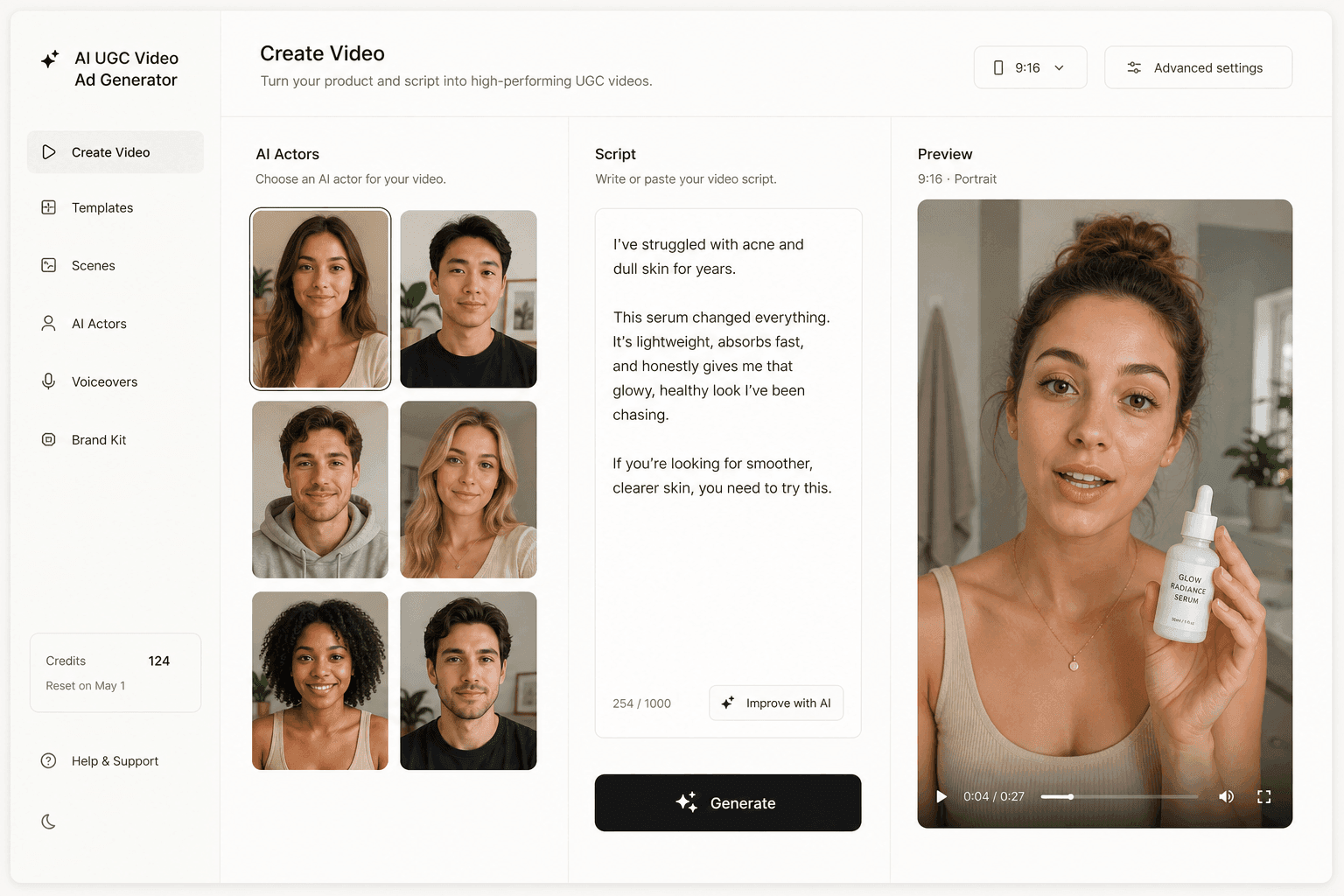
The bigger gap a still cannot cross is the human one, and it is where the workflow earns its keep. In Novoads, you write or auto-generate a script and pick an AI actor whose age, gender, and accent match your audience, and it produces a UGC-style vertical video with voice, lip-sync, and captions, formatted 9:16 for TikTok, Reels, and Meta. Headline time to a finished clip is about four minutes. Novoads makes native-local video ads in 30-plus languages with real regional accents, so a clip sounds like a creator from the buyer's own city rather than a translated script read by a generic voice. A fast image model does not touch that axis, and it is the one that decides whether a testimonial is believed.
Volume is the real unlock
The reason to care about cheap models at all is testing, and testing means volume. A finished Novoads clip runs from about a dollar for a five-second Seedance 2.0 Mini clip to about $8 for an eight-second Seedance 2.5 clip, and about $26 for a full 30-second Seedance 2.5 take, a fraction of a hired shoot and cheap enough to run the many variations paid social rewards. You can produce your first AI UGC ad with Novoads on the $49-a-month Starter plan, which grants 50 credits, enough for about a dozen videos. Cancel anytime. The point is not one perfect asset. It is never running out of angles to test, whether those angles start as AI-generated ad images or as a spokesperson reading a script.
Cheap Pixels, Expensive Angles
Nano Banana 2 Lite is a real step: a usable image in four seconds for three and a half cents. If your ads run on product photos and static variations, and most ecommerce ads do, it belongs in your toolkit, and it will keep getting cheaper and sharper. That is worth being excited about.
But the price also clarifies where the value went. When an image costs a nickel, the scarce thing is no longer the picture. It is the angle worth testing, the offer worth making, the person the buyer believes, and the discipline to run enough variations until one beats the benchmark. The pixels are the cheap part now. The ad is everything you build around them, and that is exactly the part a workflow, not a prompt, is for.
Frequently Asked Questions
What is Nano Banana 2 Lite?
Nano Banana 2 Lite is a fast text-to-image model Google launched on June 30, 2026, alongside its Gemini Omni Flash video model. Google says it delivers a text-to-image output in about four seconds and prices it at $0.034 per 1K image. It is built for speed and volume rather than the single highest-fidelity frame, and Google recommends using it as a high-speed image generator that you can then pass to a video model to animate.
How much does Nano Banana 2 Lite cost per image?
Google lists Nano Banana 2 Lite at $0.034 per 1K image. That is roughly three and a half cents for a still at 1K resolution, which is cheap enough that generating fifty product mockups and discarding forty-nine of them is a rounding error rather than a budget decision. That price is the raw model call only. It does not include the copy, the layout, the offer, or the testing volume a real static ad campaign needs.
Is Nano Banana 2 Lite good for product photos and ad images?
For the front of the pipeline, yes. It is well suited to concept exploration, static ad variations, background swaps, and catalog fill, where speed and volume matter more than perfection. It is the wrong tool for the one hero image that has to be flawless, because Lite trades fidelity and headroom for throughput. And a good product image is still not a product ad: the still is one ingredient of an argument the ad has to make.
Can I use Nano Banana 2 Lite inside Novoads?
Not as of this writing. Novoads' product-to-ad flow runs on GPT Image 2 at medium quality and costs 0.3 credits per image, and its image stack also includes Nano Banana Pro. Nano Banana 2 Lite is a separate, newly launched Google model available through Google's own surfaces and hosts like fal, and it is not one of the models Novoads offers today. The workflow is model-agnostic by design, so frontier models get added as they earn their place.
Does a cheap image model replace product photography or a UGC ad?
No. It replaces the studio day for concepts and variations, not the finished asset. A static product image still needs a headline, a benefit, an offer, and a layout the platform rewards. A UGC video ad needs all of that plus a person the viewer believes, in the buyer's own accent, and enough variations to find the winner. A cheaper image lowers one line item; it does not remove the work that turns a picture into something that converts.
Do AI-generated images need to be labeled as AI?
Google says both new models tag their output with SynthID watermarking, and platforms like TikTok and Meta increasingly ask advertisers to disclose AI-generated content. The label follows the file, so a workflow that already handles format, captions, and disclosure is doing work the raw model call does not. Treat the watermark and the disclosure as part of shipping the ad, not a footnote.
Key Takeaways
- Google launched Nano Banana 2 Lite on June 30, 2026: a fast text-to-image model that returns a picture in about four seconds for $0.034 per 1K image.
- It is the image half of a two-model launch. The video half, Gemini Omni Flash, is a separate model, and Google pitches chaining them: generate the image first, then animate it.
- For ecommerce ad-makers, a sub-nickel image collapses the cost of the front of the pipeline, where an angle is actually born: concept exploration and static ad variations.
- Lite is a throughput tier, not a hero-image tier. It is right for volume and ideation, wrong for the single frame you blow up on a billboard, and it is still not an ad on its own.
- Novoads turns an uploaded product photo into an ad creative on GPT Image 2 at 0.3 credits per image, then wraps it in a script, an AI actor, a native accent, and 9:16 format for the platform.