Travel Facebook Ads: 5 Video Ideas, and the Catalog Ad Meta Built for Travel
Five video ads a travel agency, a tour seller or a small hotel can build from photos it already has, what each costs in credits and dollars, and how Meta's travel catalog ad picks what to show.

Mauricio Valdivia
·11 min
The seats are unsold. The photos are on your phone.
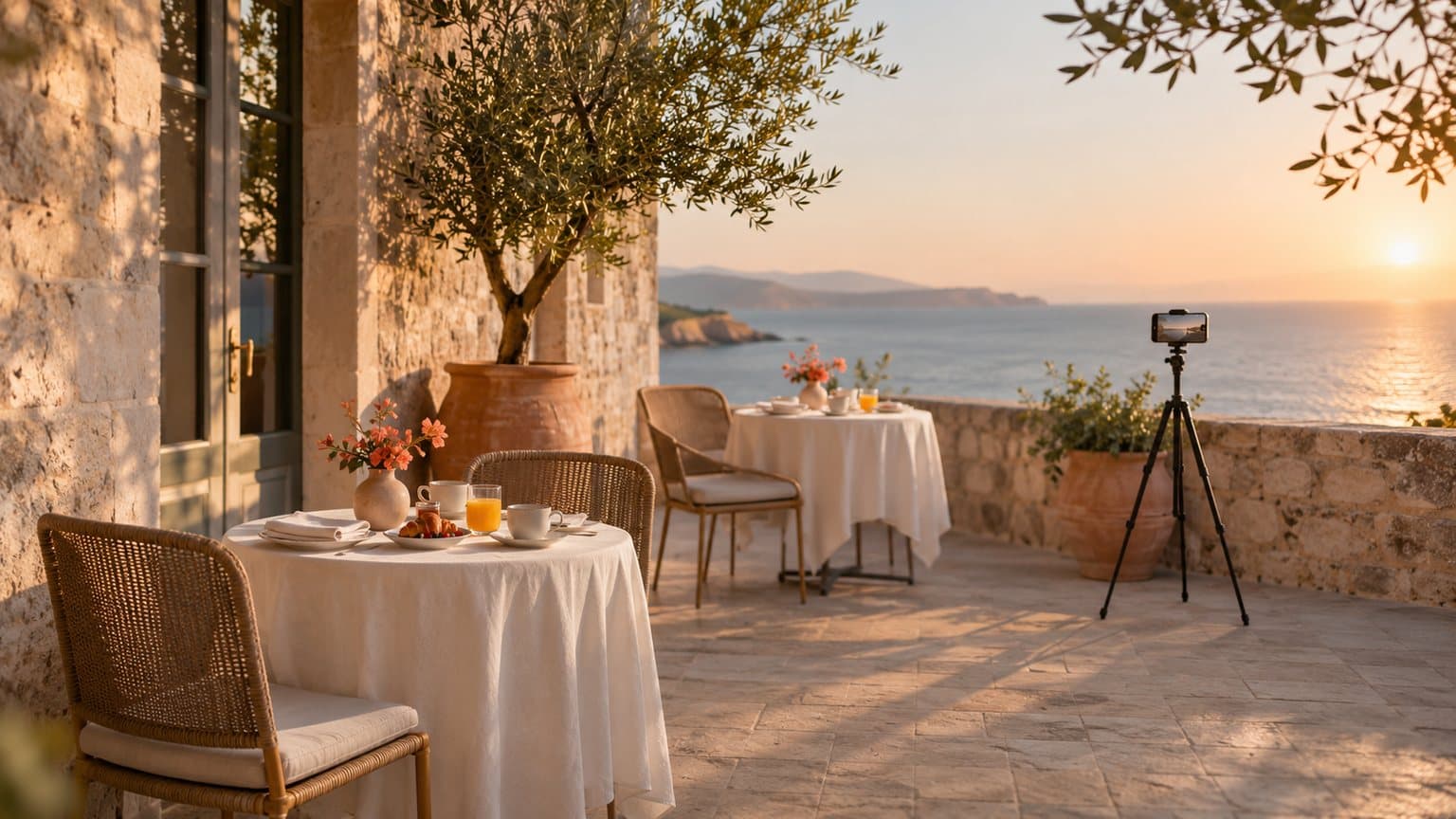
We made one picture and one five-second clip for this post, and the pair cost 6 credits. The picture is a made-up hotel terrace at sunset, standing in for a photo you'd take yourself. The clip starts on that picture and moves slowly toward the sea. The loungers and the olive pots stayed as they were, but the model also put a low sun on the right of the last frame, and the picture never had a sun in it.
Most weeks, a travel business has some version of that job. A departure three weeks out still has seats. The room block for a holiday weekend isn't filling. People opened the page for your coast walk and left without asking for a quote. You already have photos that could sell each of those, but you don't have a film crew or a spare week.
We don't run a hotel or sell tours, and we didn't run any of these ads on Facebook ourselves. The Meta facts here come from Meta's developer pages and from the results for this search, read on November 13, 2026. The prices are Novoads' own, and we made the still and the clip in Novoads for this post.
Five kinds of video cover most of those weeks, and most start from photos you've already taken. Meta also has an ad type built for travel that runs from a catalog instead of a video. Only one of the pages we opened for this search explains it, and none gives its photo limits or says what one ad costs to make.
Five video ads a travel business can run on Facebook
We went through the idea lists in the results for this search and sorted them by what a travel agency, a tour seller and a small hotel each sell. The five below are our reading, and nobody measured them against each other. The general method for any business is in AI ads in five steps. With travel, the question for each video is what it's allowed to show, because the thing in the picture is the thing the guest pays for.
1. The place, moving
People who've never heard of you see this one first. It's a short vertical video of the cove at the end of the walk, the terrace at breakfast or the boat leaving the harbor. AI does one part of it well. It turns a photo you already shot into a few seconds of footage, so three photos become three clips you can cut together.
Leave out any beach, view or weather that isn't the real one. Ask a video model for a scene in words alone and it'll draw a bay, but it won't be your bay. So start every clip from your own photo.
2. The trip, day by day
A tour is a sequence, and this ad shows it in order, with one short clip per stop, each starting on the photo you took there. A presenter can introduce the days before the clips run. Say plainly it's an AI presenter, and never pass it off as your guide.
The itinerary sets the limit. Every stop, boat, hotel and activity in the video has to be on the trip you're selling this season, so a clip of last year's boat comes out.
3. The room, walked through
For a small hotel, this is the product demo. Someone choosing a room wants to see the bed, the bathroom, the window and what's outside it, so make one clip from each room photo with a slow push-in. We'd keep the camera move small, because the further it travels from the photo, the more of the room the model has to make up.
That's also where this one goes wrong. A video model can add a balcony, stretch the room or change the view through the window, and each of those is a promise the room can't keep.
4. The offer with a date on it
This one carries the last seats on a departure, the early-booking price or the holiday weekend block. You'll remake it more often than any other, which is why it suits a presenter reading a script. You type the offer, the dates and the price, pick an AI actor, and next month you change three lines and make it again.
Two things can't be wrong in it. The price has to be the full price the guest will pay, and the deadline has to be a real one.
5. A past guest's own words
We think the strongest travel ad is one you didn't write. It's a guest's phone clip from the summit, or a review they left, shown word for word over a photo you took of the place. AI should do the least here of all five. Ask the guest's permission, add captions so it reads with the sound off, and leave the rest alone. An AI actor presented as someone who took the trip is a fake guest, and a review nobody wrote is a fake review.
| Video | Start from | Keep out |
|---|---|---|
| The place, moving | Your photos of the place | Scenery that isn't there |
| The trip, day by day | One photo per stop | Stops not on this trip |
| The room, walked through | Your room photos | Features the room lacks |
| The offer with a date | A script and an AI presenter | A price or deadline that isn't real |
| A past guest's own words | The guest's clip or review | An AI actor posing as a guest |
How to make each one in Novoads
Three of those five start from a photo, one starts from a script, and the fifth needs nothing generated at all.
From your photo to a short clip
We made one for the post, with a stand-in for the photo. It's a still made with GPT Image 2.6 Sunburst for 1 credit, and the terrace in it is invented. In your case, the picture is one you took of a real place. We animated ours with Seedance 2.0 Mini through our connector for AI assistants, which opens the clip on the still. In the editor, Seedance takes a reference picture but no start frame, so these steps use Kling 3.0.
- Open Video, tap the sliders button and set the Model to Kling 3.0.
- Drop your photo into the box that reads "Drop a start frame or click to upload". If the photo has the clip's shape, the app shows "The video starts on this picture."
- Set Aspect ratio and Duration. You'll see the Estimated cost in credits on the same panel, before you're charged anything.
- Type one sentence about how the camera or the water should move. Skip describing the place, because the photo already shows it.
- Press the arrow to generate.
 Made in Novoads with GPT Image 2.6 Sunburst · a made-up boutique hotel terrace at golden hour, as a vertical phone photo · stands in for your own photo · 1 credit · rendered 2026-11-13
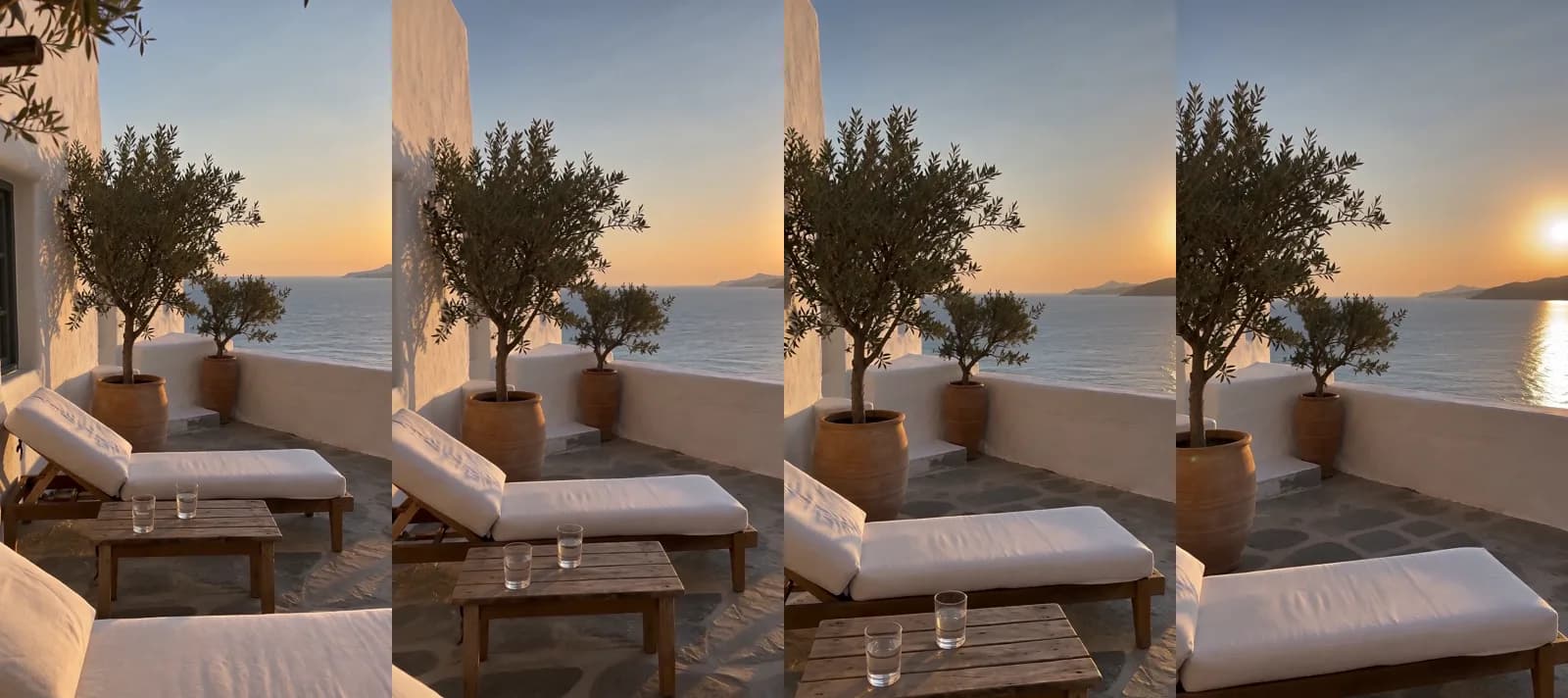 Made in Novoads with Seedance 2.0 Mini · the terrace still as the start frame, a slow move toward the sea, 5 seconds at 720p, sound off · 5 credits · rendered 2026-11-13
The clip cost 5 credits. The camera moves forward across the terrace, and nothing on the terrace changes shape. Now look at the last frame. A sun sits low on the right with its light on the water, and there's more coastline than the picture showed. On a made-up terrace, that's harmless. On yours, it could be a sunset over a sea your terrace doesn't face at that hour.
So the check is the same every time. Put the clip next to the photo and look for anything that wasn't there. If you find something, make the clip again or leave it out. Our photo-to-video how-to walks through the same steps more slowly, and our restaurant ads guide runs them on a dish.
From a script to an AI presenter
The dated offer goes the other way. Open Talking Actors, and the empty screen lists three steps.
- Write or pick a script. Say what the trip or the room is, the dates, the full price and how to book, in the words you'd use with a guest at the front desk.
- Choose an actor.
- Press the arrow. The app stops first to let you hear the voice, and there you can swap it or change its speed before you spend any credits.
What you get back has the voice and the lip-sync already in it. Captions come after, as a separate step you start from the Captions button on that video. The app's default caption style, Karaoke, costs 0 credits. We charge for a talking actor by the started minute, so a 20-second offer costs the same as a 60-second one. The voice list holds 32 languages, for guests who book in another one.
The presenter is an AI actor. Don't introduce them as your guide, your front desk or a guest who took the trip. Our post on talking head video for ads goes deeper on the format.
Joining the pieces
A day-by-day ad is several clips in a row. Check the placement's sizes in our video ad specs by platform first. Then join the clips in the editor, use Add music if you want a track under them, and press Export. Novoads makes the file, and you upload it and run the ad yourself in Meta's tools.

What each ad costs
Prices as of November 13, 2026. Novoads sells credits by the month, and each piece of an ad costs a set number of them. We worked out the dollar columns ourselves by dividing each plan's price by its credits.
- On Starter, $15 buys 200 credits a month, so one credit costs $0.075.
- On Plus, $49 buys 1,000 credits a month, so one credit costs $0.049.
- On Ultra 3,000, $129 buys 3,000 credits a month, so one credit costs $0.043.
The credits behind each piece
| What you make | Credits | Starter | Plus | Ultra 3,000 |
|---|---|---|---|---|
| A 5-second Seedance 2.0 Mini clip at 720p | 5 | about 38 cents | about 25 cents | about 22 cents |
| A 5-second Kling 3.0 clip | 10 | 75 cents | 49 cents | 43 cents |
| A talking presenter, up to 60 seconds, 480p | 100 | $7.50 | $4.90 | $4.30 |
| The same presenter at 720p | 200 | $15.00 | $9.80 | $8.60 |
| Three Kling 3.0 clips and the 480p presenter | 130 | $9.75 | $6.37 | $5.59 |
One ad, added up
Take video 2 with three stops and a presenter up front. Three Kling 3.0 clips at 10 credits each come to 30. The presenter at 480p adds 100. That brings the ad to 130 credits, the last row of the table. A Starter month covers one ad like that, with 70 credits left over. A Plus month covers seven, and an Ultra 3,000 month covers 23.
That sum leaves a few things out.
- Every re-roll, which costs the same credits again. Travel clips get re-rolled because you're checking them against a real place.
- Music and your ad spend.
- Your own time, most of it spent comparing clips with photos.
What a creator charges for a travel video
Launchpoint says it connects travel and hospitality brands with UGC creators. Its own rate guide, updated March 2026, opens with "Travel UGC creators typically charge between $150 and $500 per video". That's a vendor's guide giving its own figure, so read it as one company's range.
It also isn't the same product. A UGC creator goes to the place, films it and hands you a person who was there. The clips above animate photos you already took, and the presenter is an AI actor reading your script.
The catalog ad Meta built for travel
Every ad above is one you make. Meta also has one it puts together for you from a list of what you sell. Its developer guide calls them travel ads, and they come in three kinds, for hotels, flights and destinations. We read the guide and its catalog pages on November 13, 2026, and the pages carry no date of their own.
What it shows, and who sees it
The guide lists three targeting strategies.
- Retargeting, to "Show relevant hotels, destinations or flights to people who have been to your website or app looking for hotels, destinations or flights."
- Cross-sell and upsell, to "Target people who have purchased a flight with relevant hotels, or upsell priority boarding or seat selection."
- Prospecting, to "Expand the reach of your ad and find new customers", meaning people who haven't visited you yet.
Meta's word in the first one is "relevant". A person who searched or viewed something on your site sees the hotels, flights or destinations from your catalog that best match what they searched or viewed. That isn't a promise to show the exact listing they opened. The match is by type, so the guide says to "promote a hotel set to a hotel audience, a flight set to a flight audience and a destination set to a destination audience". We covered the wider picture in how to target audiences in Meta ads.
What goes in the catalog
You fill the catalog from a file. For destinations, Meta's catalog page says "Every line or item in the file represents a single destination." The hotel page says the same about hotels. The guide has three catalog types, and none is called tours or packages, so our reading is that a tour seller lists destinations. A destination's photo rules are short.
- At least one image, and up to 20
- Each image up to 4 MB
- A minimum size of 500 x 500 px
- JPG, GIF or PNG format
You can put prices on the photo. The guide says "Overlays allow advertisers to add pricing information (as a direct price or percentage off) for each item within Advantage+ catalog ads." A hotel can show a price, a struck-through price and a percent off. Destinations and flights get the price alone, and the guide notes that the other two "are available for hotels only." The price in the ad is whatever your file says that day, because "The pricing information is dynamically pulled from the price and sale price columns of the feed."
What it needs before it runs
This is where the catalog ad stops being a quick job. The guide opens with what it assumes you already have, including a catalog and a product set, and it adds "You have set up the required travel events on your website or in your mobile app." Your site or app has to tell Meta what each visitor searched and viewed, or there's nothing to match against.
The guide is for developers who use Meta's Marketing API. You don't have to build the catalog itself in code, since the destination page says you can create and manage it in Commerce Manager. We didn't read Meta's Business Help pages for this post, so we can't tell you what the rest of the setup looks like without a developer.
Meta's tip about 100 hotels
Under prospecting, the guide's advice includes "Use a broad product set with over 100 hotels." That's a tip for reaching new people, and the guide doesn't state it as a minimum. A hotel group, or an agency with a long list of destinations, has the kind of catalog that tip describes. A twelve-room inn has one item to show. We think its money goes further on videos 1, 3 and 4.
If you already run a hotel catalog
Meta is moving hotel catalogs to what it calls its enhanced catalog infrastructure. Its migration guide, which has no date of its own, gives February 10, 2027, as the deadline and says "After this date, legacy catalog management is blocked." The guide doesn't present that as an end to hotel ads, and its list of what stays the same includes "retargeting, broad audience, and lookalike targeting remain unchanged". A small hotel will care most about one sentence, which says "If you manage your catalogs solely through Commerce Manager and do not use API endpoints to manage them, no action is required".
What this changes for your five videos
We read three things into those pages that Meta doesn't say itself.
- The catalog ad's retargeting strategy is for people who already looked. Somebody has to bring them to your site first, and that's the job of videos 1 to 4.
- The catalog's photos are the listing. We'd put only real photos of the real hotel, room or destination in it, and never a picture a model made.
- A carousel of the hotels someone viewed, with prices, is Meta's part. Don't spend clips remaking it.
Which one to make first
Start with the calendar.
- If a departure or a weekend is close and unsold, make video 4 today. It's a script and an AI presenter, with no photos to gather.
- If nothing is urgent, make video 1 from your three best photos and run it to people who don't know you.
- If you run a small hotel, make video 3 before anything else.
- If you sell many hotels or destinations and your site already sends Meta its travel events, the catalog ad is worth the setup.
Novoads is the tool we build for the making part. You bring photos or a script, pick a model or an AI actor, and pay in credits for each piece. You pay from month one, and the plans are on the pricing page. Our page on AI video ads for Facebook shows the formats, and there's one for tourism businesses as well.
Make the video for your next unsold departure
Start from the photos you already have, or from a script for an AI presenter. Starter is $15 a month for 200 credits.
See Facebook video adsPick the departure with the most unsold seats, write its offer in four sentences, and make that video before you make any other.
Frequently Asked Questions
Does Facebook have an ad type made for travel businesses?
Yes. Meta's developer guide describes travel ads that run from a catalog of hotels, flights or destinations. For retargeting, the guide says they "Show relevant hotels, destinations or flights to people who have been to your website or app looking for hotels, destinations or flights." The same ad type also has strategies for cross-selling to past buyers and for finding new customers. We read Meta's developer pages on November 13, 2026, and they carry no date of their own.
How many photos can a destination have in Meta's travel catalog?
Up to 20, and at least one. Meta's destination catalog page says each image can be up to 4 MB and at least 500 x 500 px. The formats it lists are JPG, GIF and PNG.
What does a travel video ad cost to make with AI?
In Novoads, a 5-second Kling 3.0 clip that starts on a photo of yours costs 10 credits. A talking AI presenter at 480p costs 100 credits for anything up to a minute. Three clips plus the presenter come to 130 credits. That's about $6.37 at the Plus rate as of November 13, 2026. Re-rolls, music, what you pay Meta to run the ad and the hours you spend comparing clips with your photos all fall outside that sum. Novoads bills from month one.
Can I use AI-generated scenery in a hotel or tour ad?
We wouldn't. A guest books what the ad shows, so a beach, a room or a view that a model drew is a promise the trip can't keep. Start each clip from your own photo and compare the result with it. That's our advice about keeping the ad honest, and it isn't a summary of Meta's ad policies, which we didn't read for this post.
Key Takeaways
- Five video ads cover most weeks for a travel agency, a tour seller or a small hotel: the place in motion, the trip day by day, the room walked through, the dated offer and a past guest's own words.
- Start every clip from your own photo. A video model can draw a prettier bay or a balcony the room doesn't have, so compare each clip with its photo before you post it.
- In Novoads, three short Kling 3.0 clips and a talking AI presenter at 480p come to 130 credits. That's about $6.37 at the Plus rate as of November 13, 2026.
- Meta's travel ads run from a catalog of your hotels, flights or destinations, and they show the relevant items from it to people who searched or viewed something on your site or app. The same ad type can also reach people who never visited.
- A destination in Meta's catalog takes up to 20 photos, and the ad needs travel events set up on your site or app, so it isn't a list you upload once and forget.