Talking Head Video for Ads: What a Minute Costs, and Why TikTok Says Add Scenes
What a minute of talking head video costs on HeyGen, Synthesia, Creatify and Novoads, and what TikTok's 2021 ecommerce data says about cutting away from one person to other scenes.

Mauricio Valdivia
·19 min
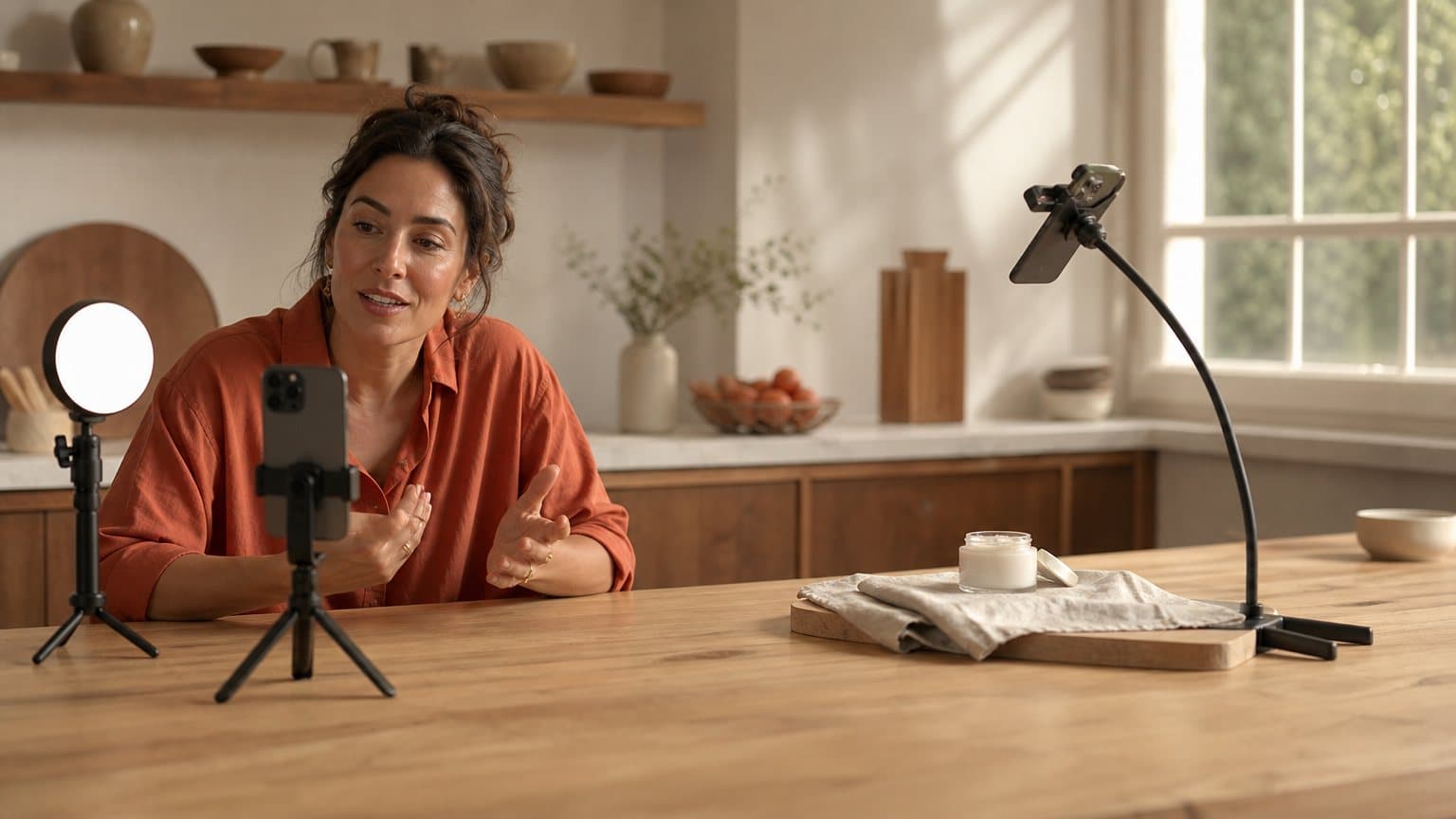
One person on camera, and the minute nobody prices
Search for talking head video and the first results teach you to frame a face, clip on a microphone and light a room. None of the five top-ranking pages we read puts a dollar figure on a minute of it, or on one finished ad, so we worked those out ourselves. We read each tool's own pricing and help pages, and TikTok's, from Spain on November 6, 2026. We also priced two talking-actor ads we made in October.
By our arithmetic, an Avatar IV minute on HeyGen's Creator plan comes to about $1.50. A minute of our talking actor costs $9.80 on Plus and $15.00 on Starter. Those are our 720p prices, and on Plus, HeyGen's minute costs less than a sixth of ours.
Then there's TikTok's own data. In a post first published in December 2021, TikTok reported that ecommerce videos showing a variety of scenes saw a 38% lift in conversion over videos of one person selling a product in a continuous shot. The number comes from a machine-learning ranking in TikTok's own auction, it's nearly five years old, and it covers ecommerce only. TikTok's post never uses the words talking head. We think a talking head ad filmed in one take fits its description anyway, so we priced a second scene too.
What a talking head video is, and where ads use it
The definition the dictionary and the guides share
Merriam-Webster's entry, as archived on October 19, 2026, defines a talking head as "the televised head and shoulders shot of a person talking". It gives 1964 as the term's first known use. Backstage's how-to guide, in a copy archived on September 25, 2025, describes it in production terms, as one person "usually framed from the chest up, speaking directly to the camera." Tella's explainer keeps it simpler. A talking head video, in its words, is "when someone talks straight to the camera, usually showing just their head and shoulders."
All three agree that it's one person, facing the lens, framed tight. For an ad, we'd add a product and a reason to act now, two things the definitions leave out.
Where the format shows up in ads
TikTok's Help Center page on creative best practices, last updated in June 2025, recommends "featuring people such as creators, employees, or customers to capture attention and increase engagement." It also asks for a "DIY or not overly polished style" so an ad fits in with what people post on TikTok. TikTok's "7 Top Tips" PDF, dated February 2022, tells advertisers to "Address users directly on camera". Its checklist names speaking directly to the camera as a messaging tactic, alongside voice-over and text overlays.
Google gives similar advice for video ads in general. Its guide to the ABCDs of effective video ads, dated May 2023, says to "Feature people’s experience with your product and represent your consumer."
In paid social, the format usually takes one of four shapes:
- A creator who reviews the product the way a customer would
- A founder who explains why the company made it
- A spokesperson who walks through an offer and its terms
- A customer who tells the story of the problem it solved
Each needs a different person on screen, and our guide to AI actors in ads covers how brands cast for each one.
Three ways to get one made
You can film a person, use an avatar tool, or use a talking actor. Mostly, the trade-off comes down to what it takes to make a second version.
| Route | Who's on screen | What a new version takes | How it's priced |
|---|---|---|---|
| Film a person | A creator, an employee or you | Another shoot or another take | The creator's fee and your time |
| An avatar tool such as HeyGen, Synthesia or Creatify | A presenter the tool makes from your script | A new script in the same tool | Credits or minutes on a monthly plan |
| A Novoads talking actor | One of our library actors, or you from a photo | A new script and a new render | 200 credits per started minute at 720p |
Filming gives you a real person with a real reaction to the product, and every change after the shoot means another take. The avatar tools trade that for speed, and our roundup of AI avatar video generators compares the main ones for ads. A Novoads talking actor is one of our library actors reading your script, or your own face if you make an avatar from a photo first.
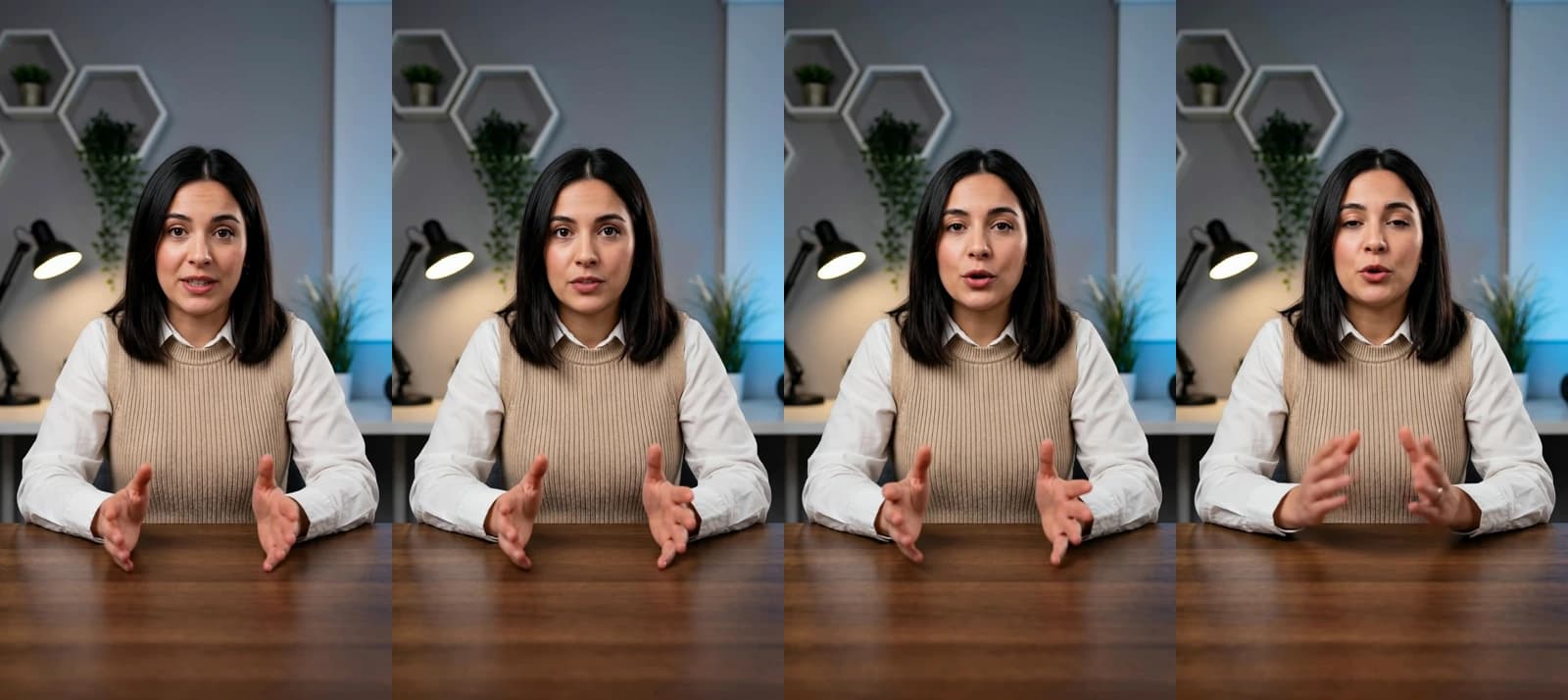 Talking actor at 720p · library actor Bárbara at a desk reads a 22.6-second script · 200 credits, one started minute · rendered 2026-10-05
We made that one on October 5, 2026, from a 22.6-second script about a tool that builds you a weekly report. Bárbara reads it at a desk, straight into the lens, in the voice called Aaryn Wood. It cost 200 credits, and the render came back in 2 minutes 31 seconds. When we transcribed it on our own machine, the transcript matched the script word for word.
What TikTok found about one person in one continuous shot
The 38% finding, in TikTok's words
TikTok's post is titled "Triple-digit conversion lift: Simple creative tips to make your ads work harder". One of its sections, written for ecommerce brands, is headed "Mix it up with multiple scenes". It opens with "Forget the long tracking shot" and says that "Keeping things lively holds interest and drives engagement." The finding itself takes one sentence.
We found that TikTok videos that showcased a variety of scenes led to a 38% lift in conversion over videos featuring one person selling a product in a continuous shot.
The next sentence turns it into advice. "Consider adding b-roll footage or transitions in your TikToks as a way to continuously hook your audience."
We read that as a finding about the unbroken shot. Nothing in the sentence says a person on camera hurts an ad, and an ad can keep its presenter and still show a variety of scenes. TikTok was comparing variety with one continuous take.
How far that 38% goes
TikTok says its team "used a machine learning model to analyze the performance of thousands of ads on our auction platform". Each creative attribute then got a ranking based on its "likelihood to achieve a high conversion rate in the auction." So it's a ranking of what tended to go with conversions in TikTok's own auction. We don't read it as a test in which one ad ran both with and without extra scenes.
A copy of the post archived on December 3, 2021, carries that date and the same sentence. The live page now shows December 21, 2021. Either way, the finding is nearly five years old, it covers ecommerce only, and we wouldn't treat it as TikTok's current guidance. The phrase TikTok uses for what it measured against is "one person selling a product in a continuous shot". The post's other lifts come from the same ranking, so they share its date and its method.
A 2023 study that measured attention instead
Vidmob used its own AI analytics to study 1,678 ads that brands ran on TikTok in 2023. Its report on hooks, as archived on May 28, 2024, has two findings that bear on a talking head ad.
- Talking head style footage had a +14% lift in two-second view-through and a +5% lift in six-second view-through, against the average
- Ads with both a human and a product in the first 6 seconds had a +5% lift in six-second view-through
The campaigns in that study had an awareness objective, and both measures count people who keep watching. Neither one says anything about sales. Vidmob also recommends direct-to-camera footage when you use talent, because it makes the ad feel like a conversation with the viewer.
What the two studies mean for a talking head ad
We don't see a contradiction between them. Vidmob's data says a face talking to the camera holds attention in the first seconds, and TikTok's 2021 ranking says varied scenes went with more conversions. So we'd open on the face and cut away once the hook has landed. That's our reading of two different studies, and neither one tested it.
TikTok's two suggestions for breaking up the shot are b-roll footage and transitions. In a talking head ad, b-roll means cutting from the presenter to footage of what they're talking about. A transition means moving from one shot to the next instead of holding a single framing for the whole ad. Either one breaks up the continuous shot the 38% was measured against, and you can use both without losing the person who opened the ad.
What a minute of talking head video costs on each tool
Prices as of November 6, 2026. HeyGen's prices came up in dollars for us, and its UK page lists Creator at £21 a month. Synthesia's $19 is its US price. Other countries see other prices, and our Synthesia pricing post lays them out by region.
Each of these tools sells credits or minutes at its own price and charges them at its own rate. So the number you can compare across them is dollars per minute of finished video, which is the last column below.
| Tool and plan | Monthly price | How talking head video is billed | One minute, by our arithmetic |
|---|---|---|---|
| Novoads Starter | $15 for 200 credits | Talking actor, 200 credits per started minute at 720p or 100 at 480p, voice included | $15.00 at 720p, $7.50 at 480p |
| Novoads Plus | $49 for 1,000 credits ($39 a month billed annually) | The same per-minute cells | $9.80 at 720p, $4.90 at 480p |
| HeyGen Creator | $29 for 600 credits ($24 a month billed annually) | Avatar IV Video Look 31 credits a minute, Avatar V Video Look 48 | About $1.50 (Avatar IV), about $2.32 (Avatar V) |
| Synthesia Starter, US price | $19 (first month $9, a promotion) | About 100 credits a minute of finished video, after 10 included minutes | About $1.58 for each of the roughly 12 paid minutes |
| Creatify Standard | $15 for 55 credits, or $10 a month on the annual plan | 5 credits per 15 seconds, rounded up | About $5.45 billed monthly, $3.64 on the annual plan |
The minute prices in the last column are our arithmetic. We divided each plan's price by its credits, then multiplied by the tool's rate. Synthesia's $9 first month and Creatify's 30% annual saving were both offers on their pages that day, and either can change.
What the billing rule does to a 25- or 40-second ad
We bill a talking actor by the started minute, so a 25-second ad and a 40-second ad cost the same. Each takes 200 credits at 720p. On Plus, that's $9.80 either way. Our two sample ads ran 22.6 and 40.3 seconds. Each one cost 200 credits. A 61-second ad starts a second minute, so it costs 400 credits. That's why we keep a talking head script under a minute here.
Creatify's help center puts avatar video at 5 credits per 15 seconds, rounded up. The article is dated August 19, 2026. By our arithmetic, that rule gives these costs on Standard billed monthly:
- A 25-second ad uses 10 credits, about $2.73
- A 40-second ad uses 15 credits, about $4.09
- A 60-second ad uses 20 credits, about $5.45
Synthesia's help center says a typical finished video uses about 100 credits a minute. A video with more on-screen avatar time uses a little more, it says, and one with less uses a little less. The first 10 minutes each month come out of the included allowance before you spend any credits.
HeyGen's help center also gives its rates per minute. It says the cost HeyGen shows before you generate "is always the cost that will be charged for that generation". The same article says some accounts see different credit costs "depending on account creation date and region", so check the number in the app before you count on ours.
What a month of each plan buys
Spread over a month, the same rules give these totals. Each line is our arithmetic on the tool's own numbers, rounded down to whole ads or minutes.
| Plan | Price a month | What one month buys |
|---|---|---|
| Novoads Starter | $15 | 1 talking head ad up to a minute at 720p, or 2 at 480p |
| Novoads Plus | $49 | 5 ads up to a minute at 720p, or 10 at 480p |
| HeyGen Creator | $29 | About 19 minutes of Avatar IV, or 12 of Avatar V |
| Synthesia Starter, US price | $19 | About 22 minutes, counting the 10 included ones |
| Creatify Standard | $15 | 5 ads of 25 seconds, or 3 of 40 seconds |
Where HeyGen costs less, and what our minute includes
On these numbers, our 720p minute on Plus costs about 6.5 times HeyGen's Avatar IV minute. Our 480p minute is $4.90 on Plus. That's still about 3.3 times HeyGen's Avatar IV minute. HeyGen's Creator card also lists 1080p export. Our talking actor renders at 720p or 480p. At the default size, a render comes out at 736 by 1312 pixels.
HeyGen's help center, updated October 29, 2026, lists cheaper looks as well.
- Avatar IV Photo Look is 16 credits a minute, about 77 cents on Creator.
- Avatar III Video Look is 4 credits a minute there, about 19 cents.
- HeyGen's own post of August 14, 2026, put Avatar III at 3 credits a minute, so the rate has moved at least once.
Creatify's Standard minute, about $5.45 billed monthly, also costs less than our 720p minute on Plus. So does Synthesia's, at about $1.58 for each paid minute on its US price. Count the 10 included minutes too, and Synthesia's Starter works out to about 86 cents a minute.
Our minute does include a few things the per-minute rates in the table don't show.
- The voice. The 200 credits cover the voice and the video together, and each of our two sample ads was billed 200 credits in all.
- Any length up to a minute, at one price. A 59-second ad costs no more than a 15-second one.
- The other scenes. A cutaway clip from Seedance, Kling or Veo comes out of the same credit balance as the actor.
If your ad is one person reading a script and nothing else, we think HeyGen's Creator minute is the better buy on price. Our HeyGen pricing guide goes through its other plans, and our Creatify pricing breakdown does the same for Creatify. If you'd rather run a lip-sync model yourself on fal, our post on H3 Max lip sync prices a talking head ad made that way.
Free plans, watermarks and the right to run the ad
All three rivals let you start without paying, and for an ad, the terms that come with those plans matter more than the watermark does.
- HeyGen's pricing page offers 3 watermarked videos a month on its Free plan, each up to a minute long. Its help center says free users get 1 to 3 videos depending on their region.
- HeyGen's terms, last updated October 16, 2026, say output made under a Free Plan may not be "used in connection with commercial activities, advertising, client work". So you can't run a video from HeyGen's free plan as your ad. On Creator, Pro and Business, the terms don't restrict your commercial use of what you make, "except in the case of termination".
- Synthesia's Basic plan costs nothing and shows 10 minutes of video a month, and its videos carry a Synthesia watermark.
- Creatify's Free plan includes 10 credits a month, enough for up to 2 video ads, and its exports carry a watermark. Its pricing FAQ says you own your creatives even after your plan ends, and that you can use them in any channel.
Our own plans start with Starter at $15 a month for 200 credits.
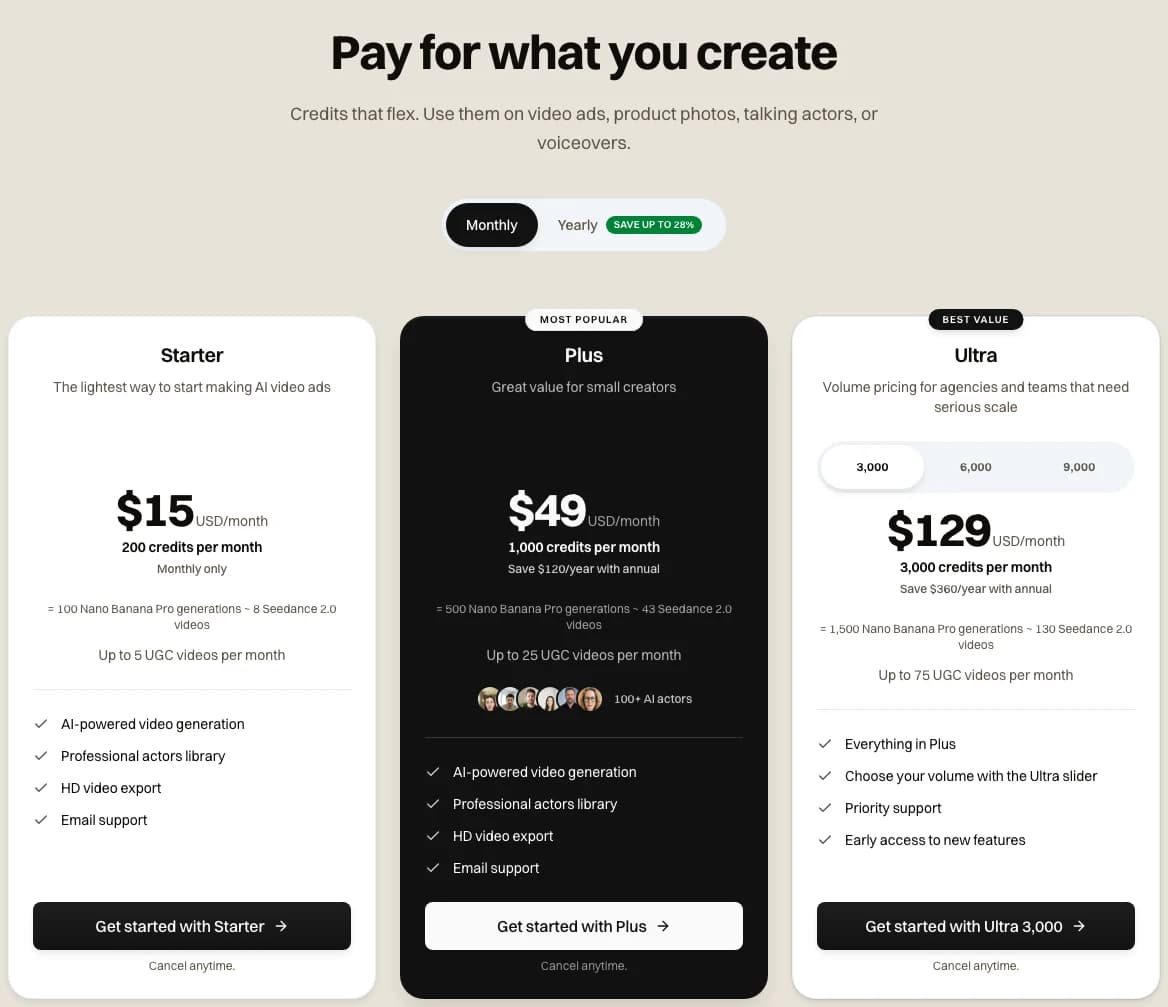 Our pricing page in its Monthly view, 2026-11-06. Starter is $15 a month for 200 credits. Plus is $49 for 1,000. Ultra is $129 for 3,000.
How to make a talking head ad that keeps people watching
TikTok's Help Center page on creative best practices was last updated in June 2025, and we read it on November 6, 2026.
Land the hook in the first few seconds
TikTok's Help Center tells advertisers to "Prioritize your hook in the first 6 seconds to boost engagement and increase watch time." Vidmob's 2023 numbers above point the same way. For a talking head ad, we'd put the problem in the actor's first line and get the product on screen before the six-second mark. Our guide to ad hook variations shows how to test several openings on one video.
As a guide to pace, our 40.3-second ad got through all 112 words of its script. That's about 2.78 words a second. At that pace, 30 seconds holds roughly 83 words, though that's from one render, and another voice may read faster or slower.
How long the ad should run, and where TikTok's advice disagrees with itself
TikTok has put more than one length on paper, and Backstage adds a rule of thumb for talking heads in general.
- TikTok's 2021 post found a 280% lift in conversion for ads that ran 21 to 34 seconds, compared with shorter or longer ones.
- TikTok's "7 Top Tips" PDF says In-Feed ads can run 5 to 60 seconds. It calls 21 to 34 seconds the recommended length for In-Feed advertising, citing research from May to July 2021.
- The same PDF's checklist says "Be mindful of recommended video length (9-15 seconds)".
- Backstage says "most talking head videos should be short and punchy".
So the same PDF recommends two different lengths, and the longer one rests on TikTok's 2021 research. For a talking head ad, we'd write to the longer window and cut a 15-second version from the same script to test against it. On our pricing, each version is a separate render and its own started minute.
Cut away to b-roll and other scenes
Backstage's guide recommends "Cutting to b-roll (footage that illustrates what you’re saying)". In an ad, the shots worth cutting to are usually the product up close, the problem the script names, the result, and the offer on screen.
Each cut adds a new scene, and that's the variety TikTok's 2021 ranking linked to more conversions in ecommerce. We'd keep the face on screen for the hook and the call to action, and put the cutaways in between. That way you keep the person who holds the first seconds and still add the scenes the ranking favored.
A scene plan for a 30-second talking head ad
From the pages above, we'd lay out 30 seconds in five beats. The plan is ours, built from those sources, and we haven't tested it as a whole.
| Seconds | On screen | Why it's there |
|---|---|---|
| 0 to 6 | The presenter, face to camera, naming the problem | The hook, inside TikTok's six-second window |
| 6 to 12 | B-roll of the problem | The first cut away from the face |
| 12 to 20 | The product up close, in use | The proof, and the product in the frame |
| 20 to 26 | The result, with the offer as on-screen text | Text that shows the offer, as TikTok's ecommerce finding suggests |
| 26 to 30 | The presenter again, with the call to action | The close, back on the person who opened |
That's three cutaways around one presenter, and it lands inside TikTok's 21-to-34-second window.
Captions, sound and TikTok's basics
TikTok's Help Center lists the basics as sound or music, a vertical 9:16 frame, "at least 720P resolution", and keeping your content inside the UI safe zone. For on-screen text, it recommends "displaying 5-10 words per second". TikTok's 2021 post also found that ecommerce videos with closed captions or on-screen text showing an offer or call to action saw an 80% lift in conversion.
Backstage puts sound ahead of picture, saying "audio is more important than video quality", so pick the voice as carefully as the actor. TikTok's 2021 post saved its biggest number for resolution. Videos at 720p or higher saw a 312% lift in conversion there. That's why we'd use our 480p setting for drafts and script tests and render the version you'll run at 720p.
How to make a talking head ad in Novoads, and what a second scene costs
Prices as of November 6, 2026.
From a script to a talking actor
- Write the script, up to 1,500 characters.
- Pick one of our library actors, or upload a photo of yourself to make a custom actor.
- Pick a voice for the actor.
- Choose 720p or 480p, then generate.
The price is set before you render. It's 200 credits per started minute at 720p, voice included. At 480p, it's 100 credits.
A stock actor from our library has empty hands, so a script about your product won't show anyone holding it. To put the product in the actor's hands, make a custom actor from a photo of yourself holding it. To keep the same actor across a set of variations, see our guide to keeping one AI actor consistent.
Our two ads, and the scene change they don't have
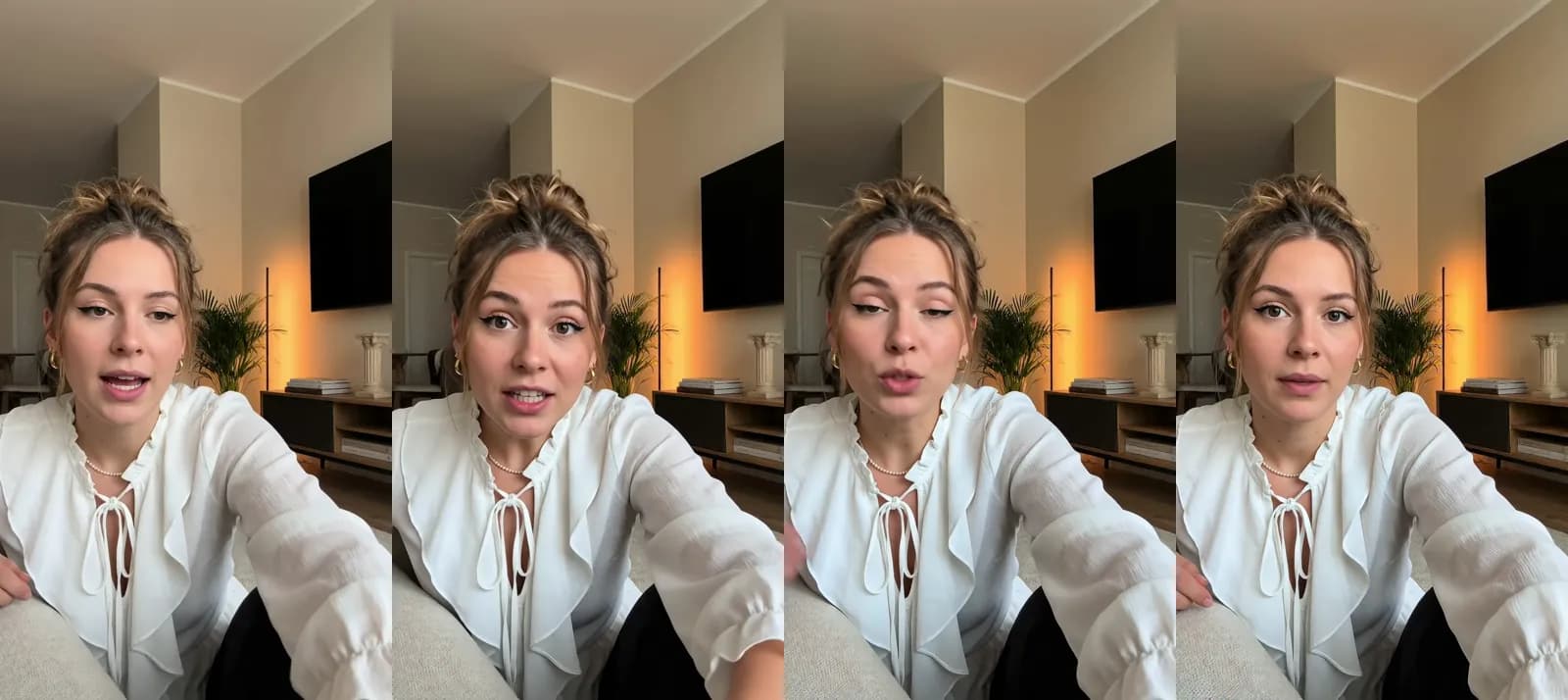 Talking actor at 720p · library actor Olivia reads a 40.3-second script about linen sheets · still 200 credits, one started minute · rendered 2026-10-20
We made this second one on October 20, 2026, with Olivia, another library actor, reading a script for people who sleep hot. It opens on "If you wake up sweaty at three in the morning, you need to hear this". It runs 40.3 seconds, and the render took 4 minutes 38 seconds to come back. It cost 200 credits, the same as the shorter ad, and all 112 words of its script came through as written.
Both of our ads are one actor in one continuous shot, so neither shows the scene changes TikTok's page recommends. In TikTok's terms, they're the kind of video the 38% was measured against. Neither one cuts away to b-roll, so we can't show you the finding in a render of ours.
What a second scene costs here
A five-second Seedance 2.0 Mini clip at 720p costs 5 credits. That's about 25 cents on Plus, or about 38 cents at the Starter rate. Seedance 2.0 Mini can start from an image, so the clip can be your own product photo set in motion.
- One 720p talking actor and three such clips come to 215 credits, about $10.54 on Plus.
- That's more than the 200 credits Starter includes each month, so on Starter a 720p actor leaves no room for clips.
- At 480p, the same set comes to 115 credits, about $5.64 on Plus or $8.63 at the Starter rate, which suits a draft.
If we re-cut the linen ad to the scene plan above, we'd keep Olivia for the hook and the close and add three Mini clips in between. One would show the problem at night, one the linen up close from a product photo, and one the made bed in the morning. At 720p that's the same 215 credits, and a Plus month covers four ads like it.
Kling v3 Pro costs 10 credits for five seconds. Google Veo 3.1 is a flat 72 credits a clip, about $3.53 on Plus.
Price your talking head ad before you make it
A talking actor is 200 credits per started minute at 720p, voice included. A five-second Seedance 2.0 Mini cutaway is 5 credits.
See plans and creditsYou make the talking actor and the clips in Novoads, then put them together in the video editor you already use. Our pricing page lists what a month of each plan buys.
Frequently Asked Questions
What is a talking head video?
It's a video of one person, usually framed from the chest up, speaking directly to the camera. That's how Backstage defines it. Merriam-Webster traces the term to television's head-and-shoulders shot of a person talking and gives 1964 as its first known use. In ads, it's a creator, founder or spokesperson pitching a product straight to the viewer.
Key Takeaways
- A talking head video shows one person, usually framed from the chest up, speaking straight to the camera. Merriam-Webster traces the term to television's head-and-shoulders shot and gives 1964 as its first known use.
- In December 2021, TikTok reported that ecommerce videos with a variety of scenes saw a 38% lift in conversion over videos of one person selling a product in a continuous shot. The number comes from a machine-learning ranking in TikTok's own auction, it's nearly five years old, and the post never uses the words talking head.
- On HeyGen's Creator plan, an Avatar IV minute comes to about $1.50 by our arithmetic. Our talking actor costs 200 credits per started minute at 720p. That's $9.80 on Plus, about 6.5 times HeyGen's Avatar IV minute.
- On a short ad, the way a tool rounds the length can move the price as much as its rate does. We bill by the started minute, so a 25-second ad costs the same as a 60-second one. Creatify's help center puts avatar video at 5 credits per 15 seconds, rounded up.
- Both of our sample ads are one actor in one shot, so neither shows the scene changes TikTok's data points to. On Novoads, a Seedance 2.0 Mini cutaway is 5 credits for five seconds at 720p. Three of them with a 720p talking actor come to 215 credits, more than a month of Starter includes.
Sources
- •TikTok for Business: Triple-digit conversion lift (first published December 3, 2021)
- •TikTok Ads Help Center: Creative best practices (last updated June 2025)
- •HeyGen pricing
- •HeyGen help center: How to use credits on HeyGen
- •Synthesia pricing
- •Creatify help center: Credit usage, billing and validity
- •Tella: What is a talking head video?
- •Google: The ABCDs of effective video ads (May 2023)