Gemini Omni 1.2 Flash for Ads: 15-Second Clips and What One Ad Costs
Gemini Omni 1.2 Flash makes clips up to 15 seconds long, and Google lists it at $0.07 a second for 720p. We worked out what a whole ad clip costs at Google's prices and compared it with fal, Flow and Omni Flash in Novoads.

Mauricio Valdivia
·13 min
A 15-second Gemini Omni clip for about $1.04
Google released Gemini Omni 1.2 Flash on November 5, and two things changed for anyone who makes video ads with it. One generation can now run up to 15 seconds, where 1.1 stopped at 10, so a whole short spot can come out of a single prompt. Google also cut the price to $0.07 a second for 720p video. It says that's 30% cheaper than 1.1.
By Google's own figures, a 15-second clip comes to about $1.04 on its paid Gemini API, and what you send in (the prompt and any reference images) is billed on top. The guides that come up when you search for Omni still describe 1.1 and its 10-second ceiling, and none of them compares the new price with fal, Google's Flow app or the credits an ad tool charges. So we did the math for one 10-second clip and one 15-second clip.
We read Google's launch post, its developer docs and price list, its help pages for Flow and Vids, and fal's model page on November 6, 2026, all from Spain. Everything on the Novoads side comes from our own price list and a clip we made in September on Omni Flash, the 1.1 model. We didn't run 1.2 for this post.
What Google says is new in 1.2
Google's launch post, dated November 5, 2026, and its Omni developer docs lay out what's new. We didn't measure quality or speed, so we've left those claims in Google's words. For the earlier background, see our post on the 1.1 release.
Clips from 3 to 15 seconds, in one-second steps
Length is the change ad makers will notice first. "You can now generate and edit videos natively up to 15 seconds long, up from 10 seconds with Omni 1.1," the launch post says. You set the length "in one-second increments from 3 to 15 seconds." So a short bumper and a full-length spot can both come from the same model, in one generation each. Google's docs also note, "When you don't set the duration, the model defaults to 10 seconds."
Google aims the longer clips straight at advertisers. The launch post says you can now "produce full social ad spots in a single generation." On 1.1, a 15-second spot meant joining two clips or extending one.
Two features still work in chunks of 10 seconds or less. Google's docs say, "First and last frame interpolation supports video durations from 3 to 10 seconds." So a clip that opens on your product shot and closes on your end card can't use the full 15. Extending a clip also goes a turn at a time, "up to a total length of 30 seconds." Each turn adds 3 to 10 seconds.
Labels, faces and brand colors across shots
For product ads, Google's most interesting claim is about the label on the pack. The launch post says, "Faces, garments, packaging typography, and brand colors stay consistent across camera angles." We haven't tested that on 1.2. Our own 1.1 clip further down shows why it matters, since the label on our bottle came back with invented words on it.
According to Google's docs, "By default Omni Flash will try to create a video with a few different shots." As we read it, that default suits a spot with a product close-up and a wider scene. If you want one continuous shot, you'll have to ask for it in the prompt.
For talking ads, the launch post says, "You can generate scenes with more fluid, natural-sounding dialogue, clearer lip-sync, and distinct multi-speaker conditioning." If you sell outside English-speaking markets, there's one limit that's easy to miss. Google's docs say, "English (EN) is fully supported, but other languages have not been evaluated, so they may work but results can vary." So test a Spanish or Portuguese script before you build a campaign around it.
Google also names what it's still working on. Its launch post says "development is ongoing to further improve things like fast sports action, rapid script changes and complex physics."
Editing, references and what the API doesn't accept yet
Google pitches 1.2 for reworking a clip you already have. "Multi-turn conversational editing works across full 15-second clips, making it easy to produce ad variants for different audiences and placements without re-briefing or re-generating," the launch post says. Its examples include "swapping a product or background, changing the lighting or weather, or switching the aspect ratio." Google's suggested workflow is to "draft fast at 360p or 720p" and then "fix a detail with a follow-up edit instead of re-generating the entire clip."
For references, Google's Omni docs set these limits on the Gemini API.
- Up to 6 reference images a request, with up to 3 images for each of up to 2 characters.
- One reference video of up to 3 seconds for a clip of 11 to 15 seconds.
- Up to 3 reference videos for a clip of 3 to 10 seconds.
A few inputs aren't supported at the moment. The launch post lists "audio cues" among the ways you can guide a clip, but the docs say, "Uploading audio inputs or audio references is unsupported in the current version of the API." They also say, "Voice editing is not supported." So if your ad depends on your own voice track or jingle, the API can't take it today.
Three more rules in Google's Omni docs will matter to a lot of advertisers.
- "Editing or extending uploaded videos is not currently available for users in the European Economic Area (EEA), Switzerland, and the United Kingdom (editing or extending videos generated by the model is supported)."
- "Uploading and editing images containing certain recognizable people is not supported."
- "All generated videos include SynthID watermarking, which is invisible to viewers but can be detected programmatically for provenance verification."
The price cut, in Google's words and in tokens
The launch post says, "We have dropped the price 30% from Gemini Omni 1.1." That makes 1.2 "available at $0.07 per second for 720p video." Google's developer price list shows where that figure comes from. On that list, 1.2 costs $12.00 per million video output tokens. Google counts video "at a rate of 5,792 tokens per second of 720p video." The same page lists 1.1 at $17.50 per million.
By our arithmetic, the new token price works out to $0.0695 a second, which Google rounds to $0.07. The token price fell 31.4%, also by our arithmetic, a little more than the 30% Google quotes.
Omni 1.2 is only on the paid tier. The price list calls it "now generally available to developers on the paid tier of the Gemini API," and gives its prices "per 1M tokens in USD" on the Standard tier. Google's API changelog adds that the release "doubled paid-tier rate limits."
What one 1.2 clip costs on Google's API
Prices as of November 6, 2026, on the paid Gemini API's Standard tier, in US dollars.
Google gives its own rounded figure for each clip length, and we've set our sums from the token rate beside them. Both rows are at 720p, the default resolution in Google's docs.
| 720p clip | Google's own figure | Our arithmetic from the token rate |
|---|---|---|
| 10 seconds (57,920 video tokens) | about $0.70 | $0.695 |
| 15 seconds (86,880 video tokens) | about $1.04 | $1.043 |
Both rows cover the video only. Google bills input at $1.50 per million tokens for text, images and video, and text output at $9.00 per million. We left those out of the table because they depend on what you send.
We worked from the token rate because rounding to $0.07 first adds a cent to a 15-second clip. And a clip you throw away costs as much as one you keep, so a finished ad costs the clip price times however many tries it took to get there.
Drafts and upscales at Google's per-second prices
Google's price list also gives per-second figures for the other resolutions, each one rounded from the token rate. The 10-second totals are our own sums.
- 360p, for drafts, at $0.023 a second (1,931 tokens a second), or about 23 cents for 10 seconds
- 1080p with upsampling at $0.104 a second (8,688 tokens a second), or about $1.04 for 10 seconds
- 4K with upsampling at $0.209 a second (17,376 tokens a second), or about $2.09 for 10 seconds
That's why Google's advice to "draft fast at 360p or 720p" matters for your budget. By our arithmetic, a draft at the lowest resolution costs about a third of the same clip at the default, so the drafts you throw away cost less than the clip you keep.
Where else you can buy a 1.2 clip
Google's API isn't the only way in. On November 6, fal was selling 1.2 by the second, Google's Flow app was charging Flow credits for it, and it was also available in Google Vids, the video app in Google Workspace.
fal, priced by the second
fal lists 1.2 at $0.0819 a second for 720p video. Its own example puts a 10-second clip at about $0.82. By our arithmetic, a 15-second clip at that rate comes to $1.23. That's about 18% above Google's token rate.
fal's page says "Native audio is included" and marks the model for commercial use. On fal, the model makes clips "with durations from 3 to 15 seconds," the same range as Google's API. If 1.2 is the only model you call, Google's own API costs less per clip than fal does. We think fal makes more sense for a team that already calls other models through it.
Flow, priced in credits
Google's Flow app charges in Flow credits rather than dollars. Flow's help page on credits prices 1.2 at 3 credits a second at 720p. That rate covers clips of up to 10 seconds, and it applies to all users. Every Google account gets 50 Flow credits a day, "With or without a subscription."
Clips longer than 10 seconds need a paid Google AI plan. The page marks them "Google AI Plus, Pro, & Ultra subscribers only," and each second past the tenth costs 6 credits at 720p. Google AI Plus adds 200 Flow credits a month, and Google AI Pro adds 1,000. The page also says, "Unused monthly Google Flow credits do not roll over to the next month."
| Flow clip at 720p | Flow credits | Who can make it |
|---|---|---|
| Omni 1.2, 10 seconds | 30 (our sum at 3 a second) | All users |
| Omni 1.2, 15 seconds | 60 (our sum, 3 a second to 10 seconds, then 6 a second) | Google AI Plus, Pro and Ultra subscribers |
| Omni 1.1, 10 seconds | 15 (the help page's figure) | All users |
So in Flow, a 10-second 1.2 clip costs twice as many credits as a 1.1 clip of the same length. As we read it, the 30% cut Google announced applies to its developer API, and Flow's credits went the other way.
The daily credits come with a few conditions, all on the same help page.
- Without a subscription, "you may not be able to generate videos" during peak hours, "roughly 2 PM to 5 PM UTC."
- One request in Flow "may generate 2 videos."
- "Limits are subject to change at any time."
If you want to see 1.2 before you pay anything, one day's credits cover a 10-second clip at 720p outside those hours.
Vids, inside Google Workspace
The launch post says you can "generate 15-second clips at no additional cost in Google Vids with a Google account or Google Workspace subscription." In Vids you set the length with a slider, and Google's help page says, "You can select a duration from 3 to 15 seconds." You can pick 720p or 1080p.
Two conditions matter for ads.
- Google's Vids limits page gives a personal Google account 60 seconds of AI video clips a month, and Business Starter gets 200 seconds.
- The help page on making clips says, "Generated images and videos are for use only within Vids."
So we'd use Vids for a video that stays inside Google's apps. It won't get you a clip you can take out and run as an ad.
Omni Flash in Novoads, the 1.1 model at 3 credits a second
Prices as of November 6, 2026.
Omni Flash is available in Novoads, and our editor opens with it selected. It's Google's 1.1 model (our catalog lists it as Omni 1.1 Flash), and we sell it in four clip lengths. At 720p it costs 3 credits a second. The longest clip is 10 seconds, so a 15-second ad takes two clips here.
What 10 and 15 seconds cost on Starter and Plus
The dollar figures are our arithmetic, each clip's credits times the plan's price per credit.
| Omni Flash at 720p | Credits | On Plus, at $0.049 a credit | On Starter, at $0.075 a credit |
|---|---|---|---|
| 4-second clip | 12 | 12 x $0.049 = about 59 cents | 12 x $0.075 = 90 cents |
| 6-second clip | 18 | 18 x $0.049 = about 88 cents | 18 x $0.075 = $1.35 |
| 8-second clip | 24 | 24 x $0.049 = about $1.18 | 24 x $0.075 = $1.80 |
| 10-second clip | 30 | 30 x $0.049 = $1.47 | 30 x $0.075 = $2.25 |
| 15-second ad (a 10- and a 6-second clip) | 48 | 48 x $0.049 = about $2.35 | 48 x $0.075 = $3.60 |
Those per-credit rates come from each plan's monthly price.
- Starter is $15 a month for 200 credits, billed monthly only.
- Plus is $49 a month for 1,000 credits, or $39 a month billed annually.
- Ultra starts at $129 a month for 3,000 credits.
Billed annually, Plus works out to $0.039 a credit. Every plan is paid from the first month, and you can cancel anytime from the customer portal. Our pricing page has the full list, including the Ultra sizes.
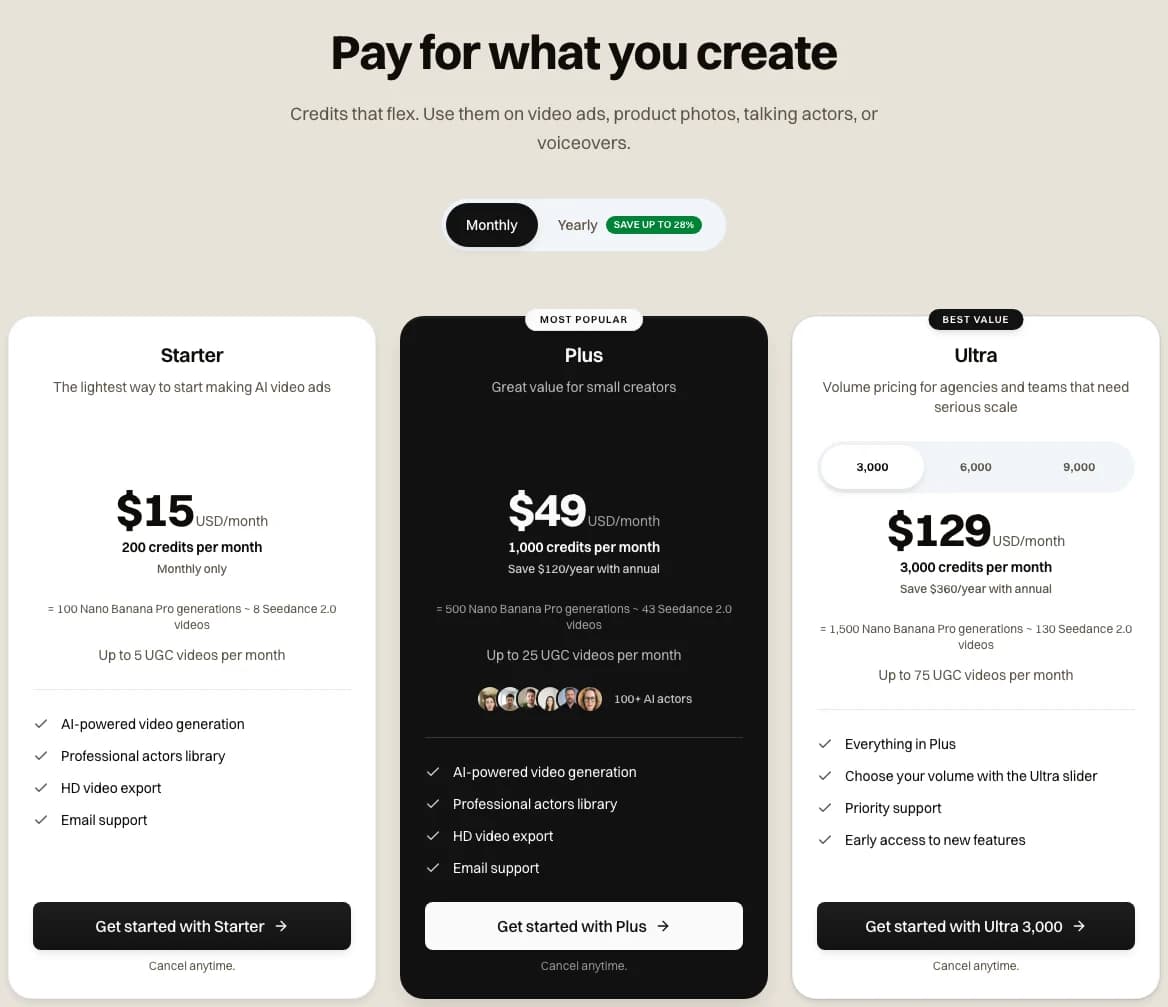
The Novoads pricing page with Monthly selected, captured 2026-11-06.
By our arithmetic, a month of credits spent only on Omni Flash at 720p buys this many clips.
- Starter covers six 10-second clips or four 15-second ads.
- Plus covers 33 ten-second clips or 20 fifteen-second ads.
Where Google's API is cheaper than our Plus rate
Google's own API is cheaper per clip than our Plus rate, and you'll want to know that before you choose.
- A 10-second 1.2 clip costs about $0.70 on Google's API, by Google's own figure, while Omni Flash costs $1.47 on Plus for a clip of that length.
- At 15 seconds, Google's figure is about $1.04. Ours takes two clips at that length and comes to about $2.35 on Plus.
- fal's per-second price is also under our Plus rate, and on Starter the gap is wider.
So what do you get for the difference? In Novoads you can work in an editor instead of calling an API. And one credit balance covers the other models we sell, among them Veo 3.1, Seedance 2.0, Kling 3.0 and Wan 3.0, plus a talking actor and image models like Nano Banana Pro. Google's terms describe the Gemini API as "for developers building with Google AI models for professional or business purposes, not for consumer use." Our FAQ says "All videos generated with Novoads are fully licensed for commercial use."
If you write code and only need Omni, Google's own API is the cheaper buy. If you make ads every month across formats and you'd rather work in an editor than write code, that's what you're paying for with our credits.
What 1.1 put on a label we never asked for
Google's claim that "packaging typography" stays consistent in 1.2 is the one to watch on product ads, because the label is where our own 1.1 clip went wrong. We made this 4-second clip in Novoads on Omni Flash in September, from the prompt "A glass skincare bottle on a marble counter, slow push-in, soft morning light," with no reference image. The prompt didn't mention a label at all. The clip came back in 4 min 12 s with a printed label anyway, and its words were invented ("LUZUBÓLIA" over a garbled second line).

Made in Novoads with Omni Flash · one 4-second 9:16 clip at 720p, no reference image, 12 credits, rendered 2026-09-28 in 4 min 12 s. The words on the label are invented.
It's one clip from the 1.1 model we sell, taken from the four-model test in our InVideo review. It can't tell you what 1.2 does with the same prompt, because we didn't run 1.2. What it does show is why a label deserves a close look whichever version made the clip. If your ad shows a pack, read the label frame by frame before you publish it.
See what a month of Omni Flash clips costs
Starter is $15 a month for 200 credits, and the same credits run Veo 3.1, Seedance 2.0, Kling 3.0 and Wan 3.0. Every plan is paid from the first month.
See the plansWhich route fits which kind of advertiser
Each route we've covered suits a different kind of buyer.
- Google's own API, if you write code and only need Omni. It has the lowest dollar price per clip of any route here, and a 15-second clip there costs about $1.04 before inputs.
- fal, if your team already buys other models there. It costs a little more per second than Google's API.
- Flow, if you want to try 1.2 before you pay. Each day's credits cover one 10-second clip outside peak hours, and 15-second clips need a Google AI plan.
- Vids, for a video that stays inside Google's apps, since Google says its generated clips are for use only within Vids.
- Novoads, if you need a month of ads across formats without writing code. Starter is $15 a month for 200 credits. A 10-second Omni Flash clip uses 30 of them.
Frequently Asked Questions
How much does one Gemini Omni 1.2 Flash clip cost?
Google's Gemini API price list puts a 10-second 720p clip at about $0.70. A 15-second one comes to about $1.04. Both figures are for the paid Standard tier, in US dollars, as of November 6, 2026, and they cover the video only. The text, images and video you send in are billed on top, at $1.50 per million input tokens.
Key Takeaways
- Google released Gemini Omni 1.2 Flash on November 5, 2026. One generation can now run up to 15 seconds, where 1.1 stopped at 10.
- Google lists 1.2 at $0.07 a second for 720p video on its paid Gemini API. That's a rounded figure, worked out from its price of $12.00 per million video output tokens.
- By Google's own figure, a 15-second clip at 720p costs about $1.04 on the API. What you send in is billed on top.
- fal sells 1.2 for $0.0819 a second at 720p. Google's Flow app charges 3 credits a second at 720p. That rate covers clips up to 10 seconds, and longer ones need a Google AI plan.
- Novoads sells Omni Flash, the 1.1 model, for 3 credits a second at 720p. A 10-second clip comes to $1.47 on Plus, so Google's own API is cheaper per clip.