What Is Reve AI? Its 4K Model, Its Sunset, and What to Use Now
Reve AI built a native 4K image model, then said it was sunsetting, with September 27 to create and October 31, 2026 to download. What it was, what it charged, and what to use for image ads.

Mauricio Valdivia
·12 min

Reve set two deadlines, and the second was October 31
Reve AI, the Palo Alto startup behind the Reve image models, told its users it was sunsetting. A banner on its help center gave them until September 27 to create and until October 31 to download their work. The banner didn't print a year, and the press that covered it put both dates in 2026. October 31 was the last date Reve named, so depending on when you read this, that window may already be behind you.
If you made ads in Reve, the notice left you with two jobs, saving what you'd made while Reve still allowed it and finding another model for statics with words in the frame. That also raises a fair question about what Reve was, since the company built its last model around exactly that kind of image.
Everything we say about Reve comes from the Internet Archive's copy of its help center, Reve's own blog posts and pages, and the press and trackers we name as we go, all read on October 31, 2026. We didn't test Reve for this post.
A Palo Alto studio that bet on type inside images
Reve AI, Inc. and its first model
Reve AI, Inc. describes itself on its about page as "a creative tooling startup based in Palo Alto, California," run by a small team of researchers, builders, designers and storytellers. Reve relaunched on September 15, 2025, with a post signed by five co-founders (Christian Cantrell, Michaël Gharbi, Taesung Park, Jon Watte and Mike Speiser). With that post, Reve also opened an API in beta, so other apps could call its models.
The first model came out as a Preview in March 2025. Reve's model page still traces its look to that release, saying Reve "has been known for its distinctly cinematic, filmic, and photojournalistic aesthetic" ever since. Decrypt's report on March 24, 2025 called the model Reve Image 1.0. The post from Reve's account that Decrypt embedded introduced it by its codename, Halfmoon.
Reve's next big step was v1.5. It arrived on February 23, 2026, and Reve called it "our most capable text-to-image model yet." The launch post added that Reve was "already a top three model on Arena," the public leaderboard Reve kept citing in its launches.
Reve 2.0 and Reve 2.1, a month apart
Reve 2.0 launched on June 3, 2026, and Reve's post said it "debuts at #2 on Arena's text-to-image leaderboard." The same post put its gain over v1.5 at 125 Elo points. It said Reve got there "training on 10x fewer GPUs" than its competitors, and it called the new model a replacement for "every model that came before it."
Reve 2.1 followed on July 9, 2026. "Just a month after Reve 2.0," the launch post said, the new model "takes back our spot as second overall," trained at less than a tenth of the compute of the labs ranked above and below it. Both ranks are Reve's own claims from each launch day, and leaderboard places shift as new models arrive.
What Reve said 2.1 could do
Reve pitched 2.1 on two things an ad maker cares about. The first was resolution, and the API launch post of July 14, 2026 made the case for it. It said the model "generates images at native 4K x 4K resolution, true 16 megapixels, no upscaling step." The second was type. The 2.1 launch post promised "multilingual text rendering," which it described as "dense, legible type set inside the image, now extended to foreign scripts."
The API post also aimed the model at brand work, saying "a subject, palette, or brand system holds across scale, so a whole campaign stays on-brand." Reve shipped a run of editing tools around the model, most of them in July 2026.
- References (January 8, 2026) kept characters consistent, holding "facial features, proportions, and presence across scenes."
- Live Layers (July 1) let you "drop in a headline, subtitles, a logo, or an image" and place it yourself.
- Color (July 13) accepted "exact hex codes from product SKUs or a client spec sheet."
- Reframe (July 15) switched an image between vertical, horizontal, square and widescreen aspect ratios.
- Templates (July 20) let you "swap in your own product shot and watch the template update."
One date on Reve's own site is easy to misread. The model page describes Reve 2.1 and says the model and the product "were designed together from the very beginning," but it still ends with "June 3, 2026," the day Reve 2.0 launched. So treat June 3 as the page's first date, and July 9, the date on the launch post, as the day 2.1 arrived. The same page's "3x the number of parameters" is measured against Reve 1.0, the first model.
What Reve announced, in the order it happened
July 27, an investment and a team move
On July 27, 2026, Reve announced "a new investment from OpenAI that gives us the resources to accelerate that broader product ambition." The same post said "members of our AI Research team will join OpenAI to help lead its multimodal research efforts, while Reve will continue to operate independently."
That line about operating independently came before any word of a sunset, so it describes Reve's plans as of July 27 and nothing later. Reve kept posting to its blog for a few more weeks. When we read the blog's index on October 31, 2026, its newest entry was dated August 21, 2026.
August 14, the API's end, as a third party quoted it
AIReiter, a site that sells access to AI models, updated its review of Reve's API on September 19, 2026. It quoted Reve's help center as saying "Reve's API sunset on August 14th and is no longer available." Recraft's guide to Reve lists a Reve support notice about the API's discontinuation, with the same date.
Reve's July 14 post launching the Reve 2.1 API is still on its blog, with an API link in the header. When we loaded the API console address on October 31, 2026, it sent us to Reve's main app.
September 17 to October 31, the notice and its dates
DigitalToday, in a report by Hyunwoo Chu published on September 18, 2026, wrote that Reve made "an official announcement on Sept. 18." Krea's guide to the change, updated on October 23, 2026, says Reve "announced the sunset on September 18, 2026." Both reported that new sign-ups and paid subscriptions had already stopped on September 17, and that paid plans would get their September payment back by mid-October.
Reve's own notice sat on its help center. The Internet Archive saved a copy of the help center on September 22, 2026, which was still September 21 in California. That copy shows a banner that reads "Reve is sunsetting. You have until Sept 27th to create, and October 31st to download your work." Recraft quoted the deadline sentence word for word in a guide it marked verified on September 19, 2026.
The banner gave a date for creating and a date for downloading, and nothing else about accounts or files. We found no change to either date after the September 22 copy, which isn't the same as there being none. Krea's guide, as updated in late October, still gave September 27 for creating and October 31 for exporting a library.
Where Reve's models still appeared on October 31
On November 18, 2025, Reve said its models were "available now on Higgsfield, Flora, OpenArt, Fal, and Replicate." We opened Reve's pages on four of those platforms and on three others, without signing up or running an image. When we looked on October 31, 2026, the pages pointed different ways.
- fal's page for Reve's newest model still read "Generate, edit, and remix in native 4K." But on October 6, 2026, fal's API had answered our own request for that model with a not-found error.
- Replicate's page for the same model returned a not-found error.
- On each::labs, the Reve page showed "0 VARIANTS" and "No models match those filters."
- Higgsfield's address for Reve opened its general AI image page instead.
- OpenArt's address for Reve opened a generator page for a different model, Seedream 4.5 on one visit and Google's Nano Banana Pro on another, and neither page named Reve.
- Picsart's Reve page still said "Reve is integrated into Picsart's AI Image Generator and AI Playground."
- Pixazo's Reve page still listed "Reve Image 2.1 API, Reve Image 1.0 API" with pricing and documentation.
A page that still names Reve tells you what the page says. It doesn't tell you whether a job would run there, and we didn't run one on any of them.
What Reve charged while it sold plans
Prices here are in US dollars, as Reve's pricing page and the code behind it still showed them on October 31, 2026. They're a record of what Reve charged. DigitalToday and Krea both reported that paid subscriptions stopped on September 17, so by their accounts none of these plans could be bought after that day.
Four plans, from Free to Teams
| Plan | Price Reve listed | What the plan card listed |
|---|---|---|
| Free | $0 a month | Image generation, editing by asking, brainstorming in chat, basic storage |
| Lite | $7.99 a month | Everything in Free, with 5x the images and 5x the storage |
| Pro | $19.99 a month | Video generation, 100x the images and storage of Free, PDFs and audio as context |
| Teams | $59 per user a month | Everything in Pro, 10M energy shared across the team, about 1,500 images per user a month |
Reve metered use in "energy," and its code told users their "daily energy will replenish" on a timer. The Lite and Pro cards gave their allowance as a multiple of Free's. Only the Teams card put a number of images on it.
Reve added Teams late in its run, on July 17, 2026, for "design agencies, marketing teams, e-commerce and fashion brands, architecture and design studios."
What an image cost through Reve's API
Reve also sold its models to developers, with its own price list. On October 1, 2025, Reve said it sold "750 API credits per dollar." By Reve's math, plain text-to-image came to $24 per thousand images. Remix and edit came to $40 per thousand. On November 18, 2025, Reve added a Fast Edit API "at just $0.007 per image."
Those prices were lower per image than anything we sell. The cheapest image in Novoads is 1 credit, about 5 cents on Plus. Reve's plain text-to-image call worked out to 2.4 cents. Those prices belong to an API that, by AIReiter's quote of Reve's help center, ended on August 14.
Video, and who could make it
Reve added video on October 30, 2025, "powered by Veo 3.1," Google's video model, which we also run in Novoads for video ads. The launch post said video creation was "available to all Free and Pro users based in the U.S. or Canada" at the time. The Pro card still listed video on October 31, 2026. Reve's pricing code also described a boost that would "generate 100 seconds of video (silent, high quality) for $20."
Reve's terms, last updated October 28, 2025, said output made on a Free account "may be made available" to other users or be searchable by them, which mattered for any ad you hadn't launched yet.
If your images are still in Reve
The banner's word for the last window was download. "October 31st to download your work" is the whole of what it said about your files, and it didn't treat images and video differently.
If you're reading this by October 31, 2026, downloading is the step Reve's notice names. If you're reading it later, the last download day Reve named has passed, and only Reve can say whether anything is still reachable.
What to use for image ads after Reve
Novoads prices in this section are as of October 31, 2026.
What a text-heavy static needs
Reve's pitch (type set inside the picture, and a brand system that holds across a campaign) is most of what a static ad asks of a model. If your ads carry a headline, a price or an offer in the frame, the model you switch to has four jobs.
- Set short lines of type cleanly at the size they'll appear in your placement. Our static ads guide lists the sizes and text limits by platform.
- Keep the product identical across variants, so the only thing changing between them is the line you're testing.
- Hold your brand colors. We compared what image makers document for exact colors in our hex codes guide.
- Cost little enough per image that making variants stays routine.
Nano Banana Pro and GPT Image 2.5 in Novoads
In Novoads, the two image models we'd point a Reve user to are Nano Banana Pro and GPT Image 2.5. Nano Banana Pro costs 2 credits an image at 2K, and 4 at 4K. GPT Image 2.5 costs 1 credit at medium quality, and 2 at high.
On October 20, 2026, we ran one Nano Banana Pro generation to see what a single call returns. We asked for four 4:5 variants of an unlabeled candle jar, each with its headline set in the frame. All four came back usable, and the set cost 8 credits.
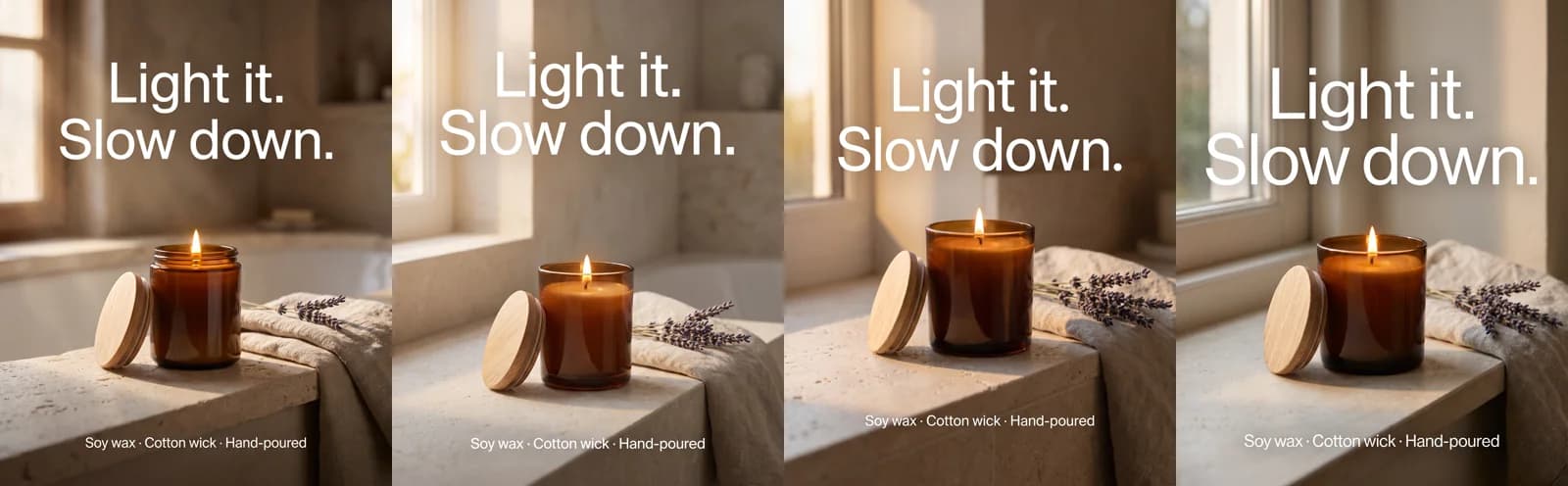 Made in Novoads with Nano Banana Pro · one call returned four 4:5 variants at 2K of an unlabeled candle jar, its headline typeset in every frame · 8 credits for the set · rendered 2026-10-20
Our Nano Banana Pro guide goes deeper on legible headlines and price badges, and the GPT Image 2.5 guide explains its Flare and Sunburst variants.
We sold Reve AI's model, Reve 2.1, in Novoads until October 6, 2026, when fal stopped serving it. We don't run any Reve model now.
What those credits cost on Starter and Plus
Novoads starts at $15/month for Starter, which comes with 200 credits per month. Plus is $49/month with 1,000 credits. If you need more volume, Ultra starts at $129/month with 3,000 credits. Every plan is listed on novoads.ai/pricing, and you pay for each one from the first month.
A credit works out to 7.5 cents on Starter and about 4.9 cents on Plus. So a Nano Banana Pro image at 2K costs about 15 cents on Starter. On Plus, it's about 10 cents. A GPT Image 2.5 image at medium quality costs 7.5 cents on Starter and about 5 cents on Plus. The candle test's 8 credits come to 60 cents on Starter. On Plus, that's about 39 cents.
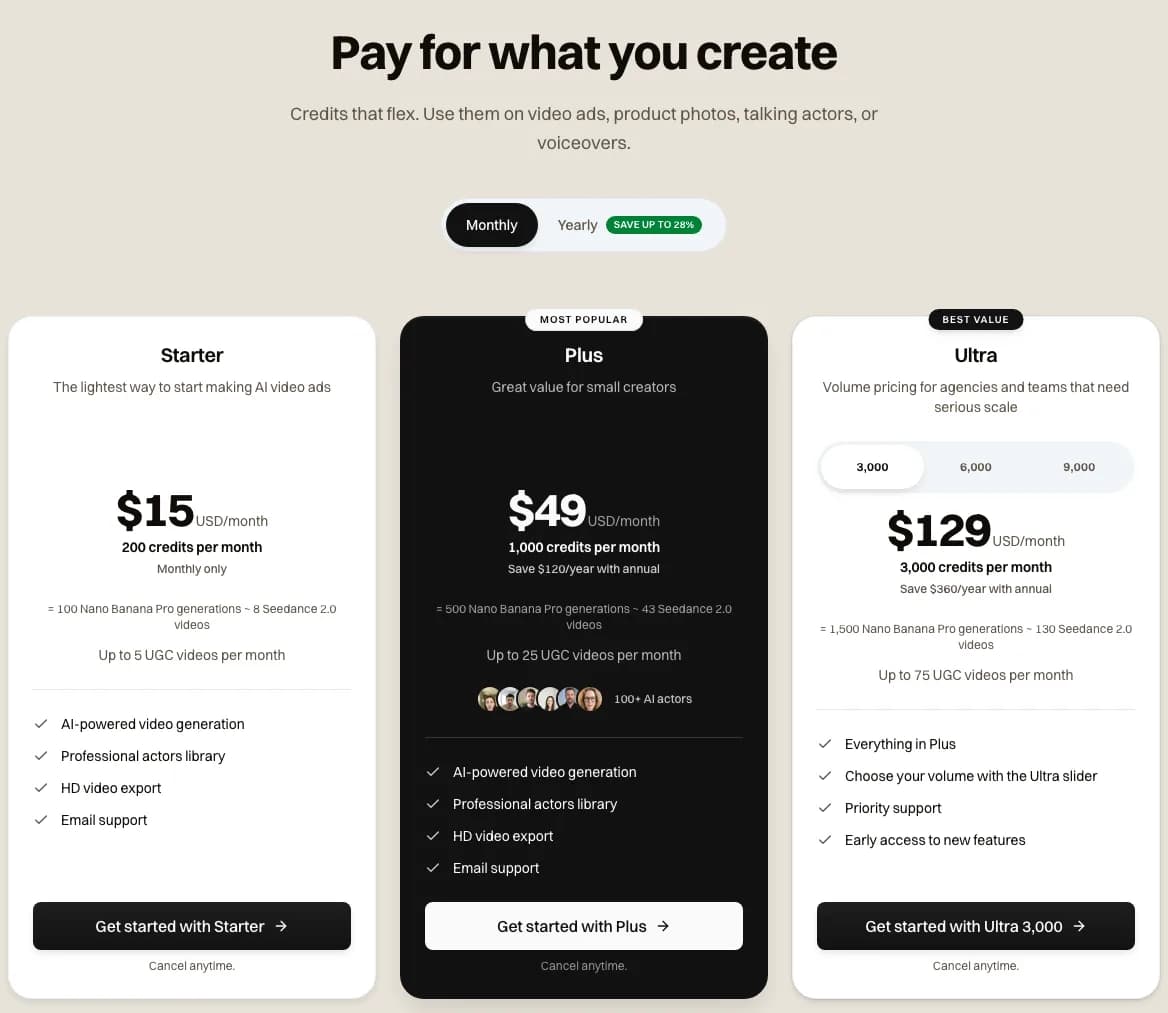 The Novoads pricing page with monthly billing selected, each plan with its monthly credits · captured 2026-10-31
The same credits pay for video ads with AI actors, so statics and videos come out of one balance. If those prices fit the number of statics you make in a month, compare the plans on our pricing page.

Other tools, and who they suit better
Some Reve users will be better off somewhere else.
- If you make only a handful of images a month, a monthly plan built for ad volume is more than you'll need.
- If you want layered, editable design files, look at tools built around them. Linearity and Recraft both published Reve-alternative guides in September 2026 that recommend their own tools, so read those as vendor pitches.
- If your statics are mostly words, our posts on Ideogram V4.0q and Seedream 5.0 Pro look at two models whose makers pitch readable text in the frame. We also run Seedream 5 Pro in Novoads, at 2 credits an image.
- For a wider field, our Midjourney alternatives guide matches image generators to ad jobs.
Reve's dates in one list
- In March 2025, Reve released its Preview model, which Decrypt reported on March 24 as Reve Image 1.0.
- On September 15, 2025, Reve relaunched with a post signed by its five co-founders and an API in beta.
- On October 30, 2025, Reve added video for Free and Pro users in the U.S. or Canada.
- On February 23, 2026, Reve released v1.5.
- On June 3, 2026, Reve 2.0 launched.
- On July 9, 2026, Reve 2.1 launched, and its API followed on July 14.
- On July 17, 2026, Reve launched Teams.
- On July 27, 2026, Reve announced OpenAI's investment.
- On August 14, 2026, the API ended, according to AIReiter's quote of Reve's help center.
- On August 21, 2026, Reve published the newest post on its blog's index.
- On September 17, 2026, sign-ups and paid subscriptions stopped, according to DigitalToday and Krea.
- On September 18, 2026, Reve announced the sunset, as DigitalToday and Krea dated it.
- On September 22, 2026, the Internet Archive saved the help center with the banner.
- September 27 was the banner's last day to create.
- October 31 was the banner's last day to download.
Frequently Asked Questions
Is Reve AI shutting down, and can I still download my work?
Reve said it was sunsetting, in a banner on its help center that the Internet Archive saved on September 22, 2026. The banner gave users until September 27 to create and until October 31 to download their work. We found no later change to those dates, which isn't proof that none was made. October 31, 2026 was the last download day Reve named, so if you're reading after it, only Reve can say whether your files are still reachable.
Key Takeaways
- Reve AI's help center said Reve was sunsetting, in a banner the Internet Archive saved on September 22, 2026. It gave users until September 27 to create and until October 31 to download their work.
- DigitalToday and Krea dated Reve's announcement to September 18, 2026, and both reported that new sign-ups and paid subscriptions had stopped on September 17.
- Reve AI, Inc. is a Palo Alto startup whose image models ran from a Preview in March 2025 to Reve 2.1 on July 9, 2026. Reve said 2.1 rendered native 4K images with legible type set inside them.
- Reve's pricing page still listed Free, Lite, Pro and Teams on October 31, 2026, with Teams at $59 per user a month. Those prices are a record of what Reve charged, since the press reported that paid subscriptions stopped on September 17.
- For image ads with text in the frame, Novoads runs Nano Banana Pro at 2 credits an image and GPT Image 2.5 at 1 credit. On Starter, that's about 15 cents and 7.5 cents an image. Novoads sold Reve's model until October 6, 2026, when fal stopped serving it.
Sources
- •Internet Archive: Reve Help Center, captured September 22, 2026
- •Reve blog: A New Chapter for Reve (July 27, 2026)
- •Reve blog: Launching Reve 2.1 (July 9, 2026)
- •Reve blog: The Reve API (July 14, 2026)
- •Reve: pricing page
- •DigitalToday: Hyunwoo Chu's report on Reve's September 18, 2026 announcement
- •Krea: Reve to Sunset in 2026 (updated October 23, 2026)
- •AIReiter: Reve 2.1 API Review (last updated September 19, 2026)