Ideogram V4.0q Renders Accurate Text in Ad Images, and It's Now on fal
Ideogram released V4.0q, an open-weight image model built around accurate in-image text for logos, posters, and ad creatives. It is now on fal from $0.00375 per megapixel. Here is what reliable text-in-image changes for ad-makers.

Mauricio Valdivia
·10 min

For Years, AI Image Models Couldn't Spell
Picture the poster an image model handed you last year. The lighting was gorgeous, the product looked expensive, the composition stopped the scroll. Then you read the headline, and it said something like "SUMMMER SAAL." Every other pixel was ready to ship. The one part a buyer actually reads was gibberish.
That failure was not a rounding error. It was the reason a whole category of ad work stayed off-limits to generative images: anything where the words carry the sale. Sale posters, price tags, app-store thumbnails, packaging, logos, and coupons all live or die on legible type, and legible type was the one thing image models could not reliably produce.
Ideogram just shipped the model built to close that gap. Ideogram 4, the company's V4 line, is a foundation model designed around in-image text, and on June 3, 2026 the inference code and weights went public. It is now hosted on fal as the V4.0q instant text-to-image endpoint, which turns a prompt into images, posters, and logos with, in fal's own words, accurate text rendering. This piece is about what that unlocks for anyone who makes ads, and where the model still stops short of a finished creative.
What Ideogram V4 Actually Is
Strip away the launch noise and the model is easy to place: a design-first image generator whose headline capability is the thing most models are worst at.
An open-weight model built around text
Ideogram 4 is Ideogram's first open-weight text-to-image model, and the company describes it as a state-of-the-art foundation model trained from scratch rather than a fine-tune of an existing checkpoint. The feature list reads like a design brief, giving you direct control over the things a designer actually decides:
- what the type says, spelled correctly, in one or many languages
- where each element sits, via explicit bounding boxes
- the exact color palette the image uses
- native 2K resolution straight from inference, with no separate upscaling step
In plain terms, you can tell it where the headline goes, what colors the palette uses, and what the type should say, then get a 2K image back ready to place.
That JSON layout control matters more than it sounds. A traditional prompt is a wish. A bounding box is an instruction. When you can pin the logo to a corner and the price to a badge and the headline across the top, you are composing a layout, not rolling dice, which is the difference between a design tool and a slot machine.
The architecture, in one paragraph
Under the hood, Ideogram 4 is a foundation model trained entirely from scratch, not a fine-tune or distillation of any existing checkpoint. The detail that explains its text strength: instead of a text-only encoder, it reads your prompt with a full vision-language model that provides far richer understanding of visual concepts. A model that "sees" as well as reads has a better shot at placing letters correctly inside a scene, which is why type comes out cleaner. At roughly 9.3B parameters, it is compact enough to run on accessible hardware while still holding the frontier on the one axis it optimizes for.
V4.0q: the label you meet on fal
One naming note, because it trips people up:
- Ideogram's own release is "Ideogram 4," the V4 line
- On fal, the instant text-to-image endpoint is labeled V4.0q
- The API path is
fal.run/ideogram/v4/instant - Same model family, host-specific tag
fal pitches it as a way to generate high-quality images, posters, and logos, producing crisp visuals with accurate text rendering, fine detail, and full creative control for polished, ready-to-use designs. It prices the model per megapixel, so the cost scales with the resolution you ask for rather than a flat per-image fee:
| fal mode | Per megapixel | About a 2K (2048 by 2048) image |
|---|---|---|
| TURBO | $0.00375 | about $0.015 |
| BALANCED | $0.0075 | about $0.03 |
| QUALITY | $0.0125 | about $0.05 |
If you have followed the recent wave of fast, cheap image launches, like the one we covered in our look at Nano Banana 2 Lite, this is the same story from a different angle: not "cheaper pixels," but "pixels that finally include readable words."
Why Text-in-Image Is the Hard Part
Cheap, photoreal images have been solved for a while. Text has not, and text is where advertising actually happens. Understanding why the letters were so hard explains why a model that gets them right is a bigger deal than another bump in photorealism.
An ad is mostly text
Look at any static ad that performs and count the words. Almost every element that moves a buyer is literally text:
- a headline that names the core benefit
- a price, a discount, or a bundle
- an offer with a reason to act now
- a call to action
- the brand logo or wordmark
- a trust badge, a star rating, or a review count
Strip the copy out and you are left with a pretty picture that sells nothing. The visual stops the scroll; the text closes the deal. That is why a model that renders type reliably is not a nice-to-have for ad-makers. It is the whole job.
Garbled letters read as fake, and get rejected
Broken text does more than look sloppy. It actively signals "fake," and both the buyer and the platform notice. What garbled letters actually cost you:
- a shopper reads the warped headline as a scam and scrolls past
- a review system can flag mangled or nonsensical text and disapprove the ad
- the creative burns spend and attention before it ever tests the offer
The bar for a shippable static ad is not "looks nice." It is "a stranger reads every word correctly in half a second," and that bar is exactly where older image models fell down.
The hidden cost of the re-render loop
There is also a workflow tax that never showed up on an invoice. When an image model spells badly, you do not get one broken image. You get a loop:
- Generate the image and admire everything except the words.
- Squint at the headline and spot the typo.
- Regenerate and hope the fix does not break the layout.
- Fix the price, regenerate again.
- Give up and drop the type in by hand in a separate editor.
Each pass burns minutes and attention. A model that gets the words right on the first or second try does not just make a prettier image. It deletes that loop, and the loop was the expensive part. Time, not the few cents of generation, was always the real cost of a broken renderer.
Where Reliable Text Rendering Pays Off in Ad Creative
The payoff is concrete and it clusters in a few high-value places, all of them jobs where a word being wrong ruins the asset.
Thumbnails and scroll-stopping hooks
A short, punchy phrase burned into the first frame is one of the most reliable ways to raise a thumbnail's stopping power. It only works if the phrase is spelled right and reads instantly. A clean renderer lets you test, as cheap stills:
- three or four different promise phrases
- the same phrase in several weights and colors
- a question hook against a flat statement hook
You do all of that before a single second of video is rendered. The static frame is where an ad angle is born, and text-on-image is how most hooks get tested first.
Posters, promos, and price tags
This is the sweet spot. Seasonal sale posters, launch announcements, bundle promos, and price-drop creatives are almost pure typography over a product shot. With bounding-box control you can pin each element in place:
- the discount to a badge in the corner
- the headline across the top
- the product centered in the frame
- the fine print along the bottom
Then spin out ten color and copy variants of that same layout in one sitting. What used to be a designer's afternoon becomes a batch of prompts.
Logos, badges, and packaging mockups
The hardest text of all is a wordmark, where a single wrong letter is instantly obvious to anyone who knows the brand. Sharper glyph rendering makes lightweight brand work viable for quick concepting:
- wordmark and logotype explorations
- badge, seal, and guarantee-stamp designs
- packaging and label mockups
This is the kind of work you would never have paid a studio to rough out but now can sketch in minutes. Treat the results as concepts to refine, not final brand assets, and the model earns its keep.
Here is how the jobs sort out, because a text-strong image model is excellent at some and still beside the point for others:
| Ad-creative job | Text-first image model | The catch |
|---|---|---|
| Sale posters and promos | Ideal | Proof every word before you ship |
| Thumbnail hook phrases | Strong | Keep it to a few words |
| Logos and badges | Useful for concepts | Not a final brand asset |
| Photoreal hero product shot | Fine, not the point | Judge on realism, not type |
| A spokesperson selling | Wrong tool | Needs an actor and a voice |
The bottom two rows are the honest limits. A crisp renderer is a gift for anything with words on it and a mismatch for the one job that decides most performance UGC: a believable person talking to camera.
How It Stacks Up Against Other Image Models
The useful comparison is not "which model is prettiest." Photorealism is close to a commodity now. The real axis is what each model is optimized for, and Ideogram planted its flag on the one most others treat as an afterthought.
Text-first versus photoreal-first
Most general image models are tuned to win on photorealism and aesthetic polish, and they treat legible text as a bonus that sometimes shows up. Ideogram inverted that priority: it is designed so that text, layout, and design control are the core capability, and the photography is the supporting act. Neither approach is wrong. They answer different questions.
Reach for a text-first model when:
- the creative is a sale poster, a promo, or a price drop
- a logo, a wordmark, or a badge has to be exact
- the headline or the offer copy lives inside the image
- you need many copy variants of one fixed layout
Reach for a photoreal-first model when:
- the creative is a lifestyle or hero product shot with no copy on it
- the win is realism, texture, and lighting
- any text gets added later in a separate editor
Pick the tool for the job in front of you rather than looking for a single winner.
Open weights change the calculus
There is a second difference that has nothing to do with pixels. Ideogram 4 shipped as an open-weight model, which means the weights are downloadable and the model can be self-hosted or run through hosts like fal, rather than living only behind one company's API. For a team that cares about cost control, reproducibility, or keeping a creative pipeline off a single vendor, that optionality is worth as much as any benchmark. It is the same reason open video weights matter, a thread we pulled on in our breakdown of an open-weights video model. Openness turns a model from a service you rent into a component you can build around.
Pairing AI Images With AI UGC Video Ads
A great image model is one instrument, not the orchestra. The place it fits in a modern ad workflow is specific, and getting the sequence right is most of the value.
The still finds the angle; the video makes the sale
Static images are reconnaissance. They are cheap to make, fast to judge, and easy to compare side by side, which makes them the right tool for a specific set of jobs:
- finding the angle fast and cheaply
- comparing framings and headlines side by side
- killing weak ideas before they cost a video budget
Video is the payload. It is where a real-seeming person builds the trust that converts, and it carries what a still cannot: motion, a voice, and a believable human in the buyer's accent. It also costs more per second, so you want to spend it only on concepts a still already proved. The discipline is old. What changed is that both halves are now cheap enough to run at volume.
A two-step creative pipeline
In practice the loop looks like this:
- Generate a spread of static concepts with a text-first model: posters, hook frames, price-tag variants.
- Run them as a cheap static test and keep the two or three that pull.
- Hand those winning angles to a UGC video step, where an AI actor delivers the script to camera in the buyer's own accent.
- Put budget behind the clip that beats your benchmark, and kill the rest.
The image round de-risks the expensive video round. You are not guessing which angle deserves a video. You already watched the market pick it.
How Novoads Turns Product Photos Into Finished Ads
The front of the pipeline keeps getting cheaper and cleaner. What it still does not do is assemble itself into something a buyer clicks. That assembly is the product.
Upload a photo, get an ad creative
In Novoads, you upload a product image and its product-to-ad flow turns it into an ad creative. The static step is aimed at an ad, not a bare render:
- you upload a product image (JPEG, PNG, or WebP)
- product-to-ad returns an ad creative on GPT Image 2 at medium quality
- it costs 0.3 credits per image
- the image stack also includes Nano Banana Pro
Ideogram V4 is not one of the models Novoads runs today. The point is not which image model sits underneath, because that is a swappable component. The point is that the output is aimed at an ad, with the product read correctly and framed for a feed, rather than a bare generation you still have to turn into a campaign.
The script, the actor, the accent
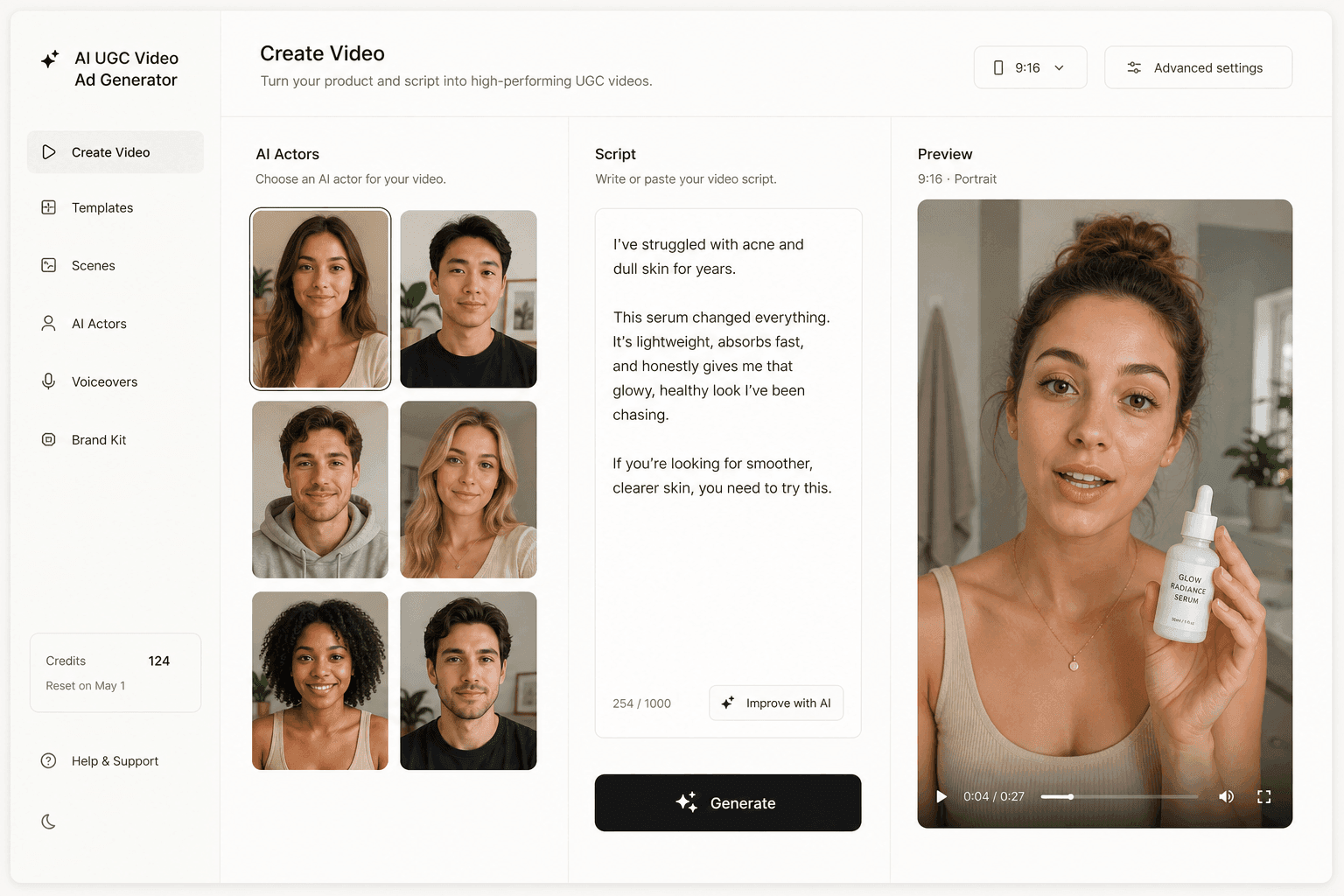
The gap a still cannot cross is the human one, and it is where the workflow earns its keep. In Novoads you write or auto-generate a script and pick an AI actor whose age, gender, and accent match your audience, and about four minutes later a finished clip arrives assembled for the feed:
- an AI actor delivering your script to camera
- synthetic voice with lip-sync
- burned-in captions
- a 9:16 vertical crop for TikTok, Reels, and Meta
Novoads makes native-local video ads in 30-plus languages with real regional accents, so a clip sounds like a creator from the buyer's own city rather than a translated script read by a generic voice. A finished clip runs from about a dollar for a five-second Seedance 2.0 Mini clip to about $8 for an eight-second Seedance 2.5 clip, and about $26 for a full 30-second Seedance 2.5 take, a fraction of a hired shoot and cheap enough to run the many variations paid social rewards.
You can produce your first AI UGC ad with Novoads on the $49-a-month Starter plan, which grants 50 credits, enough for about a dozen videos. Cancel anytime. And whatever the model spits out, remember the compliance layer that follows the file: platforms increasingly ask you to disclose AI-generated media, so a workflow that handles format, captions, and labeling AI-generated ads is doing work a raw model call never touches.

When the Words Finally Land
Ideogram V4 is a real milestone, and a narrow one. It fixes the last stubborn weakness of AI images, the letters, and it does it as an open-weight model you can run through hosts like fal for a few cents an image. If your ads run on posters, promos, and anything with copy on it, that belongs in your toolkit today.
But the fix also clarifies where the value went. When a model can finally spell, the scarce thing is no longer the picture or even the type. It is the angle worth testing, the offer worth making, the person the buyer believes, and the discipline to run enough variations until one beats the benchmark. Clean text is a cheaper ingredient now. The ad is still everything you build around it, and that is the part a workflow, not a prompt, is for. The cost of a hired UGC creator, which our breakdown of what creators charge puts in hard numbers, is the gap a still can never close on its own.
Frequently Asked Questions
What is Ideogram V4.0q?
Ideogram V4.0q is the label fal uses for the instant text-to-image endpoint of Ideogram 4, Ideogram's V4 image model. Ideogram 4 launched on June 3, 2026 as the company's first open-weight text-to-image model: a foundation model trained from scratch, with a structured JSON prompting interface, multilingual in-image text rendering, bounding-box layout and color-palette control, and native 2K resolution. On fal it is exposed as an API that generates images, posters, and logos with accurate text rendering.
Why is text rendering such a big deal for AI image models?
Because most of an ad is text. The headline, the price, the offer, the call to action, the logo, and the trust badges are all letters, and image models historically garbled them: misspelled words, warped glyphs, and gibberish that reads as fake at a glance. A model that renders clean, correctly spelled type is the difference between a usable poster and one you have to re-generate until the words come out right. Text has been the last stubborn weakness of AI images, which is exactly the axis Ideogram is built around.
How much does Ideogram V4.0q cost on fal?
fal prices it per megapixel: $0.00375 in TURBO mode, $0.0075 in BALANCED mode, and $0.0125 in QUALITY mode. For a 2K (2048 by 2048) image that works out to roughly a few cents per generation depending on the mode. That is the raw model call only. It does not include the copy, the layout decisions, the offer, or the testing volume a real static-ad campaign needs.
Can I use Ideogram V4.0q inside Novoads?
Not as of this writing. Novoads' product-to-ad flow runs on GPT Image 2 at medium quality and costs 0.3 credits per image, and its image stack also includes Nano Banana Pro. Ideogram V4 is a separate model available through Ideogram's own surfaces and hosts like fal, and it is not one of the models Novoads offers today. The workflow is model-agnostic by design, so strong new models get evaluated as they earn their place.
Does a better image model replace a UGC video ad?
No. It makes the static layer of a campaign cheaper and cleaner, especially anything with text on it. A converting ad still needs an angle, an offer, and, for most performance UGC, a real-seeming person talking to camera in the buyer's own accent. A crisp poster is one ingredient of that argument, not the whole ad.
Key Takeaways
- Ideogram 4 (the V4 line) is Ideogram's first open-weight text-to-image model, a foundation model trained from scratch and built around accurate in-image text, structured JSON layout control, and native 2K resolution.
- It is now hosted on fal as the V4.0q instant Text-to-Image API, priced per megapixel: $0.00375 in TURBO mode, $0.0075 in BALANCED, and $0.0125 in QUALITY.
- Text is the hard part of AI images and the part that matters most for ads, because headlines, prices, offers, logos, and badges are all text, and garbled letters read as fake and get flagged in review.
- A reliable text renderer removes the re-render loop for the static layer of a campaign, but a clean image is still not a finished ad.
- Novoads pairs AI images with AI UGC video: it turns an uploaded product photo into an ad creative on GPT Image 2, then wraps it in a script, an AI actor, a native accent, and 9:16 format for the platform.