AI Super Bowl Commercials: Which Spots Were AI-Made, From Svedka to Artlist's Five-Day Ad
Which Super Bowl LX ads were made with AI? Svedka's owner, Artlist and Byrna said so, and Genspark used an AI-generated script. We sorted every spot by who said it.

Mauricio Valdivia
·14 min
The 23% counts ads about AI and ads made with it
On game day, Adweek reported, citing iSpot, that 23% of Super Bowl LX commercials featured AI. That's 15 of the 66 ads. The same count takes in OpenAI and Anthropic, which used their spots to sell AI, and Svedka, a vodka brand that used AI to make its spot.
Most of the pages that rank for this question blur the two. Rolling Stone wrote about "the substantial number of ads there were trying to sell America on AI," and New York Magazine's John Herrman opened his piece with "It was a big-tech Super Bowl, where even the ads that weren't about AI were about AI." None of the top results we could read sorts the spots by who said AI made them.
Go by what brands and makers said about their own spots, and the list gets short. Sazerac, which owns Svedka, called Svedka's national spot AI-created. Artlist said its in-house team made the company's spot with its own AI tools, and that spot aired in New York and Los Angeles. Byrna called its banana spot AI-created and said it planned to run it in a local test market, though we found no Byrna page saying it aired. For Genspark, Adweek and iSpot report that the script was AI-generated, but nothing we read says AI made what you see on screen.
We sorted every spot by its brand's or maker's own words, as we read them on November 9, 2026, and we didn't judge any spot by eye. We didn't test Artlist's tools or ComfyUI for this post. The Novoads side comes from our own price list and one of our renders.
Every Super Bowl LX spot tied to AI, sorted by who said it
We split the table into four groups. First come the spots whose brand or maker said AI made them, then the one where a maker said AI wrote the script, then the spots other people tied to AI, and last the spots that sold AI. The Ad Meter column is USA Today's ranking, which Ad Age describes as one "which tracks consumer sentiment for Super Bowl spots each year." It ranked 54 campaigns, while iSpot counted 66 ads, so if a spot isn't ranked, that tells you nothing about how it was made or how people took it.
| Spot | What was said, and by whom | Ad Meter | Source |
|---|---|---|---|
| Its brand or maker said AI made it | |||
| Svedka, "Shake Your Bots Off" (national) | Sazerac, its owner: "a historic, AI-created commercial" | 53rd of 54 (2.18) | Sazerac, Nov. 2, 2026 |
| Artlist's own spot (New York and Los Angeles) | Artlist: made with "its own AI tools," "all in under five days" | Not ranked | Artlist, Feb. 4, 2026 |
| Byrna, "We Don't Sell Bananas" (a local test, planned) | Byrna called it an "AI-Created Commercial" and planned to run it "in a local test market." No Byrna page we found says it aired (our Byrna post) | Not ranked | Byrna, Feb. 5, 2026 |
| A maker said AI did one part | |||
| Genspark (30 seconds, two slots) | iSpot: "the ad's script was actually generated by the Genspark platform itself." Adweek: production was completed "in a single day" | Not ranked | iSpot, Adweek |
| Others tied it to AI | |||
| Xfinity, "Jurassic Park ... Works" | Xfinity, as Newsweek relayed it: "There was no AI used here!" | 6th (3.43) | Newsweek, Feb. 4, 2026 |
| Dunkin', "Good Will Dunkin'" | Variety: actors "de-aged via production techniques," and "the spot was shot on film on a real set" | 4th (3.48) | Variety, Feb. 9, 2026 |
| Bosch, "Justaguy" | Deadline: Guy Fieri's new look was "arranged by AI." No Bosch statement found | 18th (3.12) | Deadline, Feb. 9, 2026 |
| Ro, "Healthier on Ro" | Adventure Media, an agency's blog: AI "throughout pre-production." No Ro statement found | 52nd (2.23) | Adventure Media, Feb. 9, 2026 |
| Only about AI | |||
| OpenAI, "You Can Just Build Things" | OpenAI's CMO: "We shot the ads with real people, on film, who use our tools" | 45th (2.48) | Variety, Feb. 8, 2026 |
| Anthropic, "Can I Get a Six Pack Quickly?" | Creative Salon: "filmed in Los Angeles with real actors and production crews" | Tied 46th (2.45) | Creative Salon, Feb. 4, 2026 |
| Google, "New Home" | TechCrunch: the ad "showcased the Nano Banana Pro" | Tied 23rd (2.94) | TechCrunch, Feb. 8, 2026 |
| Amazon Alexa, "Alexaaaa+" | The Measure: the spot "faced AI concerns head-on" | Tied 10th (3.33) | The Measure, Feb. 18, 2026 |
| Ring, "Be A Hero In Your Neighborhood" | The Measure: about how Ring's cameras "use AI to help locate lost pets" | Tied 10th (3.33) | The Measure, Feb. 18, 2026 |
| Oakley Meta, "Athletic Intelligence is Here" (two parts) | TechCrunch: Meta "spotlighted its Oakley-branded AI glasses" | 44th (2.49) and tied 46th (2.45) | TechCrunch, Feb. 8, 2026 |
| Wix, "Wix Harmony: The New Way to Create" | On AdImpact's list of AI-related commercials | 50th (2.38) | AdImpact, Feb. 26, 2026 |
| Salesforce, "@MrBeast's Vault" | AdExchanger: "an ad for Slackbot, the AI product built into its workplace productivity tool Slack" | 51st (2.32) | AdExchanger, Feb. 10, 2026 |
| Ramp and Rippling | TechCrunch: Ramp's "AI-powered spend management platform," and Rippling "poking fun at HR headaches and the promise of AI automation" | Not ranked | TechCrunch, Feb. 8, 2026 |
| Base44, AI.com and Microsoft | On AdImpact's list of AI-related commercials | Not ranked | AdImpact, Feb. 26, 2026 |
Ro's row is the thinnest. All that ties it to AI is one line on an agency's blog, which says "Ro incorporated AI throughout pre-production for its Serena Williams campaign," and we found nothing from Ro that says so. The spots in the last group are there because of what they sold. OpenAI's marketing chief, Kate Rouch, says the company shot its ads with real people, and Creative Salon reports that Anthropic's spot was filmed with real people too. For the rest, we found no word on whether AI helped make them.
What Sazerac's release says about Svedka's spot, and how far it goes
"Historic" and "AI-created" are Sazerac's words
Sazerac bought Svedka from Constellation Brands, and The Spirits Business reported the sale complete in January 2025. Marketing Dive now calls Svedka "The Sazerac-owned vodka brand." On November 2, 2026, Sazerac put out a release about a fan contest for Svedka's next Super Bowl spot, and one sentence in it looks back at the first. "Following its 2026 Big Game debut, which featured a historic, AI-created commercial reintroducing the brand's Svedbot robot character..."
"Historic" and "AI-created" are the owner's words about its own spot, and nothing we read tests either claim. In the same release, Sazerac's marketing chief, Sara Saunders, calls it "last year's AI-generated ad." The release is a week old, and the spot aired about nine months before it, on February 8, 2026. So the line about AI looks back, and what the release announces is the contest.
Before the game, Sazerac put it differently. Its December 3, 2025, release said the spot was "Created by humans in partnership with robots (aka artificial intelligence)," and "Concepted and managed by Sazerac's in-house team with production by San Francisco-based AI innovation lab, SILVERSIDE." That release doesn't use "historic" or "AI-created," and it calls the robot Fembot, while the November release calls it Svedbot.
What the studio and the tool maker say about the work
Silverside's project page says "Real human dance performances formed the foundation, with AI used in controlled, iterative passes to translate that motion into the Fembot." TechCrunch reported that, by the brand's account, "certain aspects were still handled by humans, such as developing the storyline."
Comfy, the company behind ComfyUI, published a case study on the spot. It describes "Component-based ComfyUI workflows: characters, world, and choreography as separately controllable elements," and three groups at work. "One group trained AI models on the new characters, another trained models to build their world, and a third developed candidate stories." It adds that "A dedicated final pass cleaned remaining hallucinations before delivery."
So why use AI at all? The case study quotes Amy Remley, Svedka's global VP of integrated marketing and innovation, saying "we didn't have the files for the whole robot." She also says "We had just as many brains and hands touching this ad as any traditional production ad." And Saunders, also quoted there, says "The reality is, AI is not creative."
Neither page says which video model was used, and both come from companies that sell this kind of work (Silverside its studio, Comfy its software). Silverside's site also has a separate Svedka project, "a nationwide campaign themed 'She's Got a Tab.'" That's a different campaign from the Super Bowl spot.
Who calls it a first, and in which words
Several pages call Svedka's spot a first, and each picks its own word for how much of it AI did.
- The Hollywood Reporter wrote before the game that "Svedka owner Sazerac is touting the spot as the first known Super Bowl ad created 'primarily' through AI."
- Silverside calls it "the first Super Bowl spot produced primarily with generative AI."
- AdImpact wrote that Svedka "made history by airing the first-ever fully AI-generated Super Bowl commercial."
- Semafor reported that "it was developed almost entirely by prompting AI models."
- iSpot's list of advertisers calls it "The AI-assisted commercial."
- The Verge pointed out that "we've seen plenty of AI-generated commercials before (at previous Super Bowls, no less)."
Primarily, fully, almost entirely and AI-assisted are four different claims. The two sources on the spot's own side, Sazerac and Silverside, both say primarily. That's the word we'd quote, and we don't call the spot a first ourselves.
Three answers to how long it took
Three sources give three timelines, and we don't pick one. Comfy's case study says "under one month of production here," against "about half a year" for campaigns of this scale. TechCrunch reported on February 8, 2026, citing The Wall Street Journal, that "it took roughly four months to reconstruct the Fembot and train the AI to mimic facial expressions and body movements." And The Hollywood Reporter wrote before the game that "Saunders says the ad didn't save much money and certainly not a ton of time compared to a conventional shoot."
They may be measuring different stretches of the work, from the production itself to rebuilding the character. Comfy's case study isn't dated, so its figure stands as we read it on November 9, 2026.
How the spot landed
USA Today's Ad Meter ranked Svedka's spot 53rd of 54. Its score was 2.18. Ad Age wrote in November that companies such as Svedka that used AI to make their work "got kudos from critics, even if the praise was subdued," and that "the spots did not chart highly" on Ad Meter.
The reviews we read were rougher than that. Herrman wrote in New York Magazine that "Svedka's AI-generated vodka ad went down like a shot of warm slop." Adweek ran creatives' reactions under the headline "Svedka's Forgettable Super Bowl Ad Proves AI Isn't an Idea." The Verge, looking at the spot's new robot, Brobot, wrote that "Though Sazerac says Brobot's malfunction is intentional, it looks very much like the sort of gross accidental video output that AI models have been known to generate." And Andy Cohen, who'll help judge the fan contest, says in a YouTube interview with the Svedbot that the old ad was called "bold, bizarre and a dystopian nightmare," according to Marketing Dive.
If you're making AI footage yourself, our posts on AI ads that drew backlash, on the tells critics found in Skechers' AI ads and on reviewing AI ad creative before it runs walk through what to check.
Artlist's five-day spot, which aired in two markets
What Artlist says about how it was made
Artlist's spot advertised Artlist itself, which New York Magazine describes as "a stock media company in the process of pivoting to AI." The company's release of February 4, 2026, ran under the headline "Artlist Debuts Its Big Game Ad Made In-House in Five Days Using AI." It says "Artlist's in-house team conceived, produced, and executed its Big Game spot using its own AI tools," and that the work was done "all in under five days." It also calls the campaign "a live proof-of-concept of the company's cutting-edge AI technology."
Shahar Aizenberg, Artlist's CMO, said in the release, "We didn't just want to make an ad; we wanted to prove the speed of execution and show that high-end video production is possible with Artlist."
The spot is a parody, and the release names "Fanatics, Bud Light, Budweiser, Instacart, and Pepsi" among the big-game ads it sends up. Being parodied says nothing about how those brands made their own ads. The release doesn't name a model. Artlist also has two blog posts about the spot that we couldn't read, so nothing in this post comes from them.
Five days, under five days, less than a week
Artlist's YouTube upload says the spot was "Produced in just five days." The release says "under five days." The Hollywood Reporter, ranking the AI ads after the game, wrote that the spot "took less than a week to create," and credited the claim to "a polar bear reading a voiceover script" in the ad. So all three wordings come from Artlist, by way of its upload, its release and its ad.
Where it ran, and what critics said
The Verge says the ad "only aired in New York and Los Angeles," and The Hollywood Reporter says Artlist "pitched its tools to NY and LA markets." The release doesn't name the markets.
The Verge found "an undeniable cheap and sloppy quality to many of the advertisements" and wrote that "One of the worst examples of this was the Artlist ad." Herrman wrote that the spot "achieved almost perfect levels of aesthetic anonymity." And in its entry on the spot, The Hollywood Reporter writes of "these proto-assaults of slop."
What it cost, as reported
Herrman also wrote that the ad "bragged that it was made in just five days for a few thousand dollars." That's the ad's own claim, as he heard it.
The Drum's write-up of Artlist's award entry puts a number on it. It says the campaign "created a broadcast-ready commercial in five days for around $5,000," and it sets that against "a typical $1.2m budget and months-long timeline." The page doesn't say whether the $5,000 covers things like staff time or airtime, or whose typical budget it has in mind. The entry won Gold in AI and Silver at The Drum Awards for Marketing.
Its YouTube view count
On November 9, 2026, YouTube showed more than 43 million views on Artlist's upload. That's one reading, on one day. The page doesn't say how those views were earned, so we don't read anything into the number.
The spots others tied to AI, and what the 23% counts
Xfinity said no AI was used
Before the game, The Hollywood Reporter wrote that other Super Bowl spots would use AI "as more of a tool, like to change the appearance of characters from Jurassic Park or the visage of Guy Fieri." Newsweek then relayed Xfinity's reply on Instagram. "There was no AI used here! This spot was made with a combo of practical sets, green screen VFX, and CGI: the same tools used to make the original Jurassic Park film!" We didn't open the Instagram post, so that's the reply as Newsweek quoted it.
Was the Super Bowl Dunkin' commercial AI?
We found nothing from Dunkin' saying it used AI. Variety reported that "The various actors got a special effects tune-up and were de-aged via production techniques. But the spot was shot on film on a real set." The Verge wrote that Dunkin's spot "fell foul of the same speculation regarding AI usage," and said it had asked Dunkin', ILM and Lola VFX which tools went into the Xfinity and Dunkin' ads. We found no published answer.
In New York Magazine, which refers to Xfinity's spot as Comcast's, Herrman wrote that "hypervigilant viewers complained that ads from Dunkin' Donuts and Comcast looked like they might have been AI generated, when they probably weren't." "Probably" is his judgment. So Dunkin's spot was shot on film on a set, nothing we read names the de-aging software, and nobody speaking for Dunkin' has said the spot used AI.
Bosch, left unsorted
Deadline wrote that "Guy Fieri debuted a very different new look, arranged by AI, for his Bosch Appliances commercial." Fieri told TODAY, "Wait a second, it's not AI. That's my acting ability. Don't pigeonhole me," and TODAY adds that "he says with a laugh." That's a joke about his acting, and it doesn't settle how the spot was made. We found no statement from Bosch, so the spot stays unsorted.
Which commercials are AI generated, outside this game
None of the pages we read keeps a full list, so you have to go maker by maker. Silverside's site shows a launch film for Slack's Slackbot made "using AI-generated animation and carefully directed performances," but that page doesn't mention the Super Bowl, so it isn't Salesforce's game-day spot. TechCrunch calls Silverside "the same team behind recent AI-generated Coca-Cola commercials." Our post on four AI commercials brands have already run covers Coca-Cola, Kalshi and Toys R Us, and we wrote up how Kalshi's Veo 3 spots were made separately.
What the 23% counts
Adweek's 23% is iSpot's count of ads that "featured AI," and it covers both ads that sold AI and ads made with it. iSpot's own public report page doesn't give that count, but it does say "AI-focused ads averaged 11% lower Likeability than non-AI spots." AdImpact counted differently. It "tracked 12 AI-related commercials that aired nationally during the game, spanning 11 advertisers," and named Svedka separately, as the spot made with AI. None of these pages splits its count into ads about AI and ads made with AI.
Earlier Super Bowls, and what's known about the next one
2025, when the makers called AI a tool
A year earlier, OpenAI said AI only helped plan its spot. TechRadar reported in February 2025 that "Rouch said Sora and other OpenAI tools were used to prototype ideas, but none were used for the actual creation of the animation." Stash, quoting the agency, wrote that "Human creative professionals were behind the ad and its execution, with OpenAI's video product Sora used as a brainstorming and exploration tool."
Google's spot that year showed Gemini writing for "a Wisconsin cheese market owner," and CNN reported that "The AI-generated copy in the commercial" made a claim about Gouda that Google then changed. AdImpact's look back names AI-related spots in 2025 from GoDaddy, Google, Meta and Salesforce, among others. We didn't look at games before 2025.
Super Bowl LXI's date and reported ad prices
The NFL says Super Bowl LXI is "on Sunday, Feb. 14, 2027, airing on ESPN, ABC and Disney+," and its calendar puts the game at SoFi Stadium in Inglewood, California. Variety reported in August 2026 that Disney "started to sell 30-second berths for $8 million to $9 million, according to people familiar with the talks." The same report says the bulk of NBC's inventory for this year's game sold for "$7 million to $8 million," again citing people familiar with the matter. Neither range comes from Disney or NBC.
Svedka's contest for 2027
Svedka is challenging fans to create its next spot. Sazerac's November release invites "fans 21+" to make a 15-second commercial for Svedka Vodka Water. Entries run from November 2 to December 1, 2026. "The winner will take home $500,000 and could see their idea become the brand's official Big Game commercial on Sunday, February 14, 2027."
"Could see" is the release's wording, so airing isn't promised. The release welcomes entries "Whether AI-led, hilariously low-budget, unexpectedly cinematic or creatively ambitious," and Variety reported that "Executives at Sazerac understand they may get ads made via AI, or with low-budget techniques." Variety also reports that the company "moved early to secure 30 seconds of Super Bowl ad time from Disney."
In what we read, no brand has said it will run an AI-made spot in that game. Byrna said in February that "If this proves to be cost effective, we plan to significantly expand our Super Bowl advertising in 2027," but that line doesn't mention AI.
What 30 seconds of raw AI footage costs in Novoads
Nothing in this section describes how any of the spots above was made. It shows what the same kind of raw footage costs on three video models we sell. We price it in credits, and the dollar amounts are our own arithmetic, at $0.049 a credit on Plus and $0.075 on Starter. Prices as of November 9, 2026.
On each model, a 30-second set is three 10-second clips. Seedance 2.5 can also make the whole 30 seconds as a single take at 720p. That costs the same 210 credits.
| Model and resolution | Credits per 10-second clip | Credits for 30 seconds | At the Plus rate | At the Starter rate |
|---|---|---|---|---|
| Seedance 2.5, 720p | 70 | 210 | $10.29 | $15.75 |
| Seedance 2.5, 1080p | 120 | 360 | $17.64 | $27.00 |
| Omni Flash, 720p | 30 | 90 | $4.41 | $6.75 |
| Omni Flash, 1080p | 45 | 135 | about $6.62 | about $10.13 |
| Kling 3.0 (Kling v3 Pro on our pricing page) | 20 | 60 | $2.94 | $4.50 |
Starter's 200 credits a month don't stretch to 30 seconds of Seedance 2.5 at either resolution.
| One month's credits | Seedance 2.5, 720p | Omni Flash, 720p | Kling 3.0 |
|---|---|---|---|
| Plus, 1,000 credits | 4 sets (840 credits) | 11 sets (990 credits) | 16 sets (960 credits) |
| Starter, 200 credits | none | 2 sets (180 credits) | 3 sets (180 credits) |
The closest real example we have is a 20-second brand film we made on September 8, 2026. It came from one timestamped Seedance 2.5 prompt, for a running label that doesn't exist, built on our N mark. The render took 7 minutes 12 seconds. All seven of its cuts land less than half a second off the times the prompt set, and the kit, the shoes and the logo match in every shot. At today's price, those 20 seconds cost 140 credits.
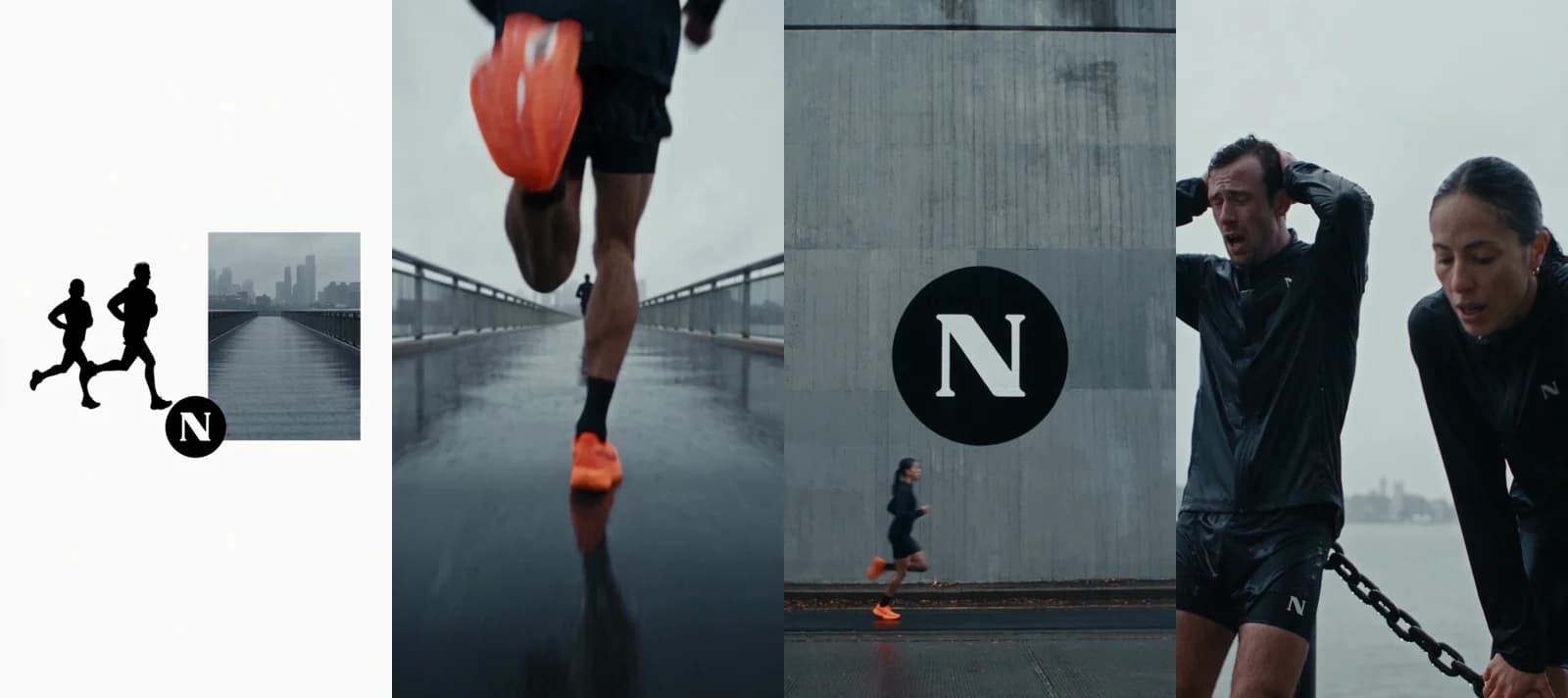
Made in Novoads with Seedance 2.5 · one timestamped prompt for a 20-second 9:16 film at 720p, eight planned shots and no dialogue, for a mock label built on our N mark. 140 credits at today's price, rendered 2026-09-08.
That's all raw footage. A finished spot still needs a voice-over, music, sound, an edit and the takes that miss. Our guide to making AI video look real covers the fixes that cut down on those misses. For what our users' ads were actually charged, see the median Seedance 2.0 ad in October.
Then there's airtime. The low end of Variety's reported range for a 30-second slot next year is $8 million. At $10.29 a set, that's about 777,000 sets of 720p Seedance 2.5 footage. The Drum's figure of around $5,000 for Artlist's spot works out to about 486 sets. That's only arithmetic, since The Drum doesn't say what that amount covers.
You make the ad in Novoads and run it wherever you buy the time. Every Novoads plan is paid from the first month, and the plans page shows each plan's monthly credits.
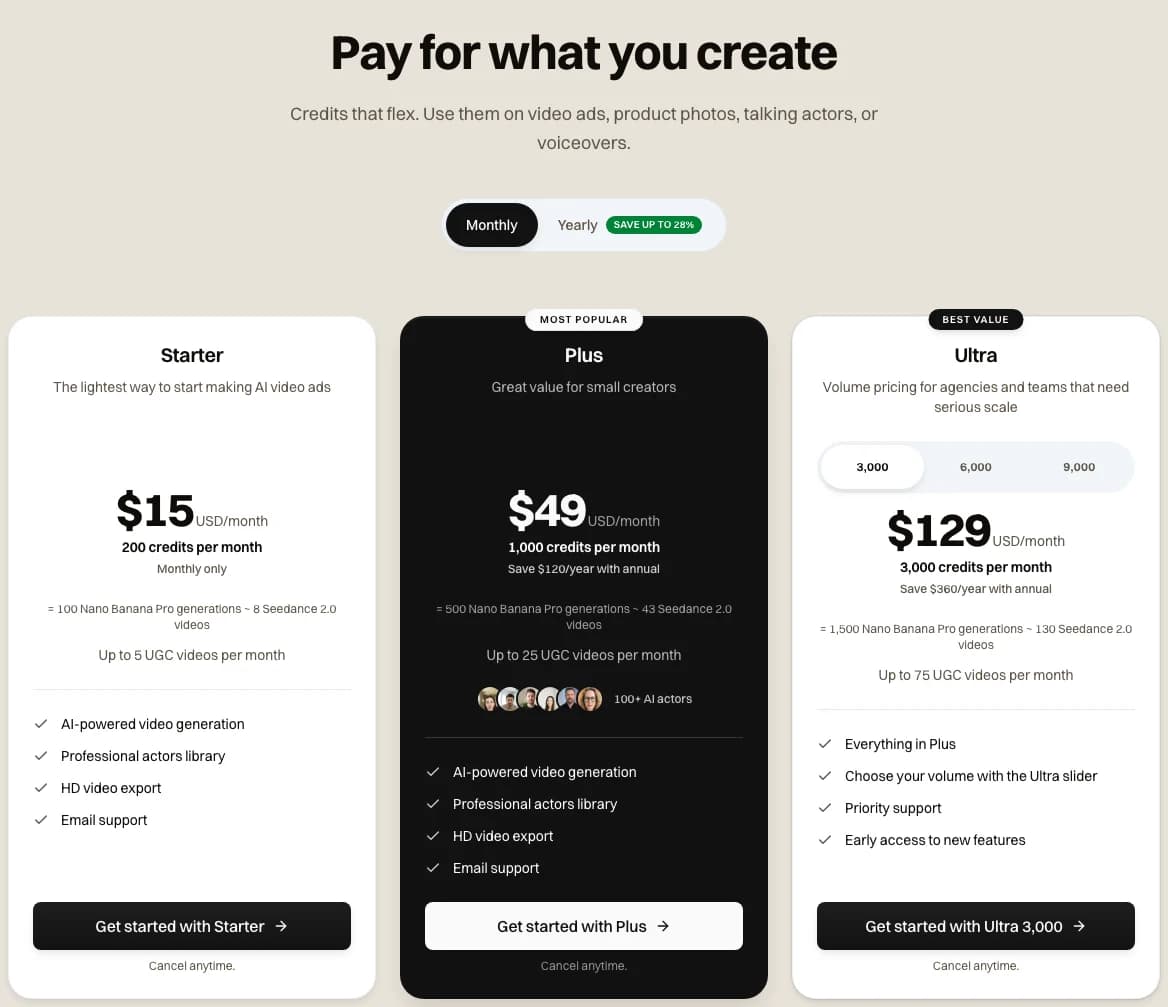
Novoads' pricing page with Monthly selected, captured 2026-11-09, showing Starter, Plus and Ultra with each plan's monthly credits.
Price 30 seconds of footage yourself
Seedance 2.5, Omni Flash and Kling 3.0 clips are priced in credits, and each plan's monthly credits are on one page.
Compare credits by planFrequently Asked Questions
Which Super Bowl commercials are AI generated?
For Super Bowl LX in February 2026, three companies said their own spots were made with AI. Sazerac called Svedka's national spot "a historic, AI-created commercial." Artlist said its in-house team made the company's spot with its own AI tools in under five days, and that spot aired in New York and Los Angeles. Byrna called its We Don't Sell Bananas spot AI-created and planned to run it in a local test market, but we found no page saying it aired. Adweek and iSpot report that Genspark's script was AI-generated. iSpot's count of 15 ads that featured AI lumps these in with ads that sold AI, and we found no breakdown of that count.
Key Takeaways
- Sazerac's November 2, 2026, release says Svedka's Super Bowl debut "featured a historic, AI-created commercial." That's the owner talking about its own spot. Before the game, Sazerac said the spot was "Created by humans in partnership with robots (aka artificial intelligence)."
- Three sources give three different timelines for Svedka's spot. Comfy's case study says under one month of production. TechCrunch, citing The Wall Street Journal, says rebuilding the Fembot took roughly four months. And Sazerac's marketing chief told The Hollywood Reporter the ad didn't save a ton of time.
- Artlist said its in-house team made the company's spot with its own AI tools in under five days, and The Verge reports it aired only in New York and Los Angeles. The Drum's write-up of Artlist's award entry puts the cost at around $5,000 but doesn't say what that covers.
- Adweek's 23% comes from iSpot and counts every ad that featured AI, so it lumps ads that sold AI in with ads made with it. None of the pages we read splits that count.
- In Novoads, 30 seconds of raw Seedance 2.5 footage at 720p costs 210 credits. At the Plus rate of $0.049 a credit, that's $10.29, and voice-over, music, editing, retakes and airtime are all extra.
Sources
- •Sazerac: SVEDKA Vodka Is Challenging Fans to Create Its Next Super Bowl Commercial (PR Newswire, November 2, 2026)
- •Sazerac: Sazerac Company's First-Ever Super Bowl Commercial to Star SVEDKA Vodka (PR Newswire, December 3, 2025)
- •Silverside AI: SVEDKA Super Bowl project page
- •Comfy: Svedka and Silverside customer story
- •TechCrunch: The Super Bowl 60 ads that leaned on AI (February 8, 2026)
- •The Hollywood Reporter: Svedka's Super Bowl ad and AI (February 3, 2026)
- •Artlist: Artlist Debuts Its Big Game Ad Made In-House in Five Days Using AI (PR Newswire, February 4, 2026)
- •The Drum: How Artlist proved AI can replace Big Game production with a $5,000 ad (June 5, 2026)
- •The Verge: Super Bowl 2026's AI-generated ads (February 9, 2026)
- •New York Magazine: All Those Super Bowl Ads About AI Were a Strange and Unsettling Mess (February 9, 2026)
- •Adweek: AI Took Over the Super Bowl, Accounting for 23% of Ads (February 8, 2026)
- •Byrna: Fiscal fourth quarter and full year 2025 results (February 5, 2026)
- •AdImpact: Most-streamed Super Bowl ever, AI ads rise (February 26, 2026)
- •Variety: Disney sells out Super Bowl LXI ad inventory (August 5, 2026)
- •NFL: 2026-27 National Football League important dates